
South Korea Physical AI Market Size, Share, Report 2026 To 2035
South Korea Physical AI Market (By Deployment: Cloud-based AI, On-device AI; By Component: Hardware, Software, Services; By Technology: Computer Vision, NLP, Gesture, Reinforcement Learning & Control Systems, Others; By Robot Type: Industrial Robots, Service Robots, Humanoids/Social Robots, Cobots, Exoskeletons/Prosthetics, Mobile Robots/Drones; By Application: Healthcare, Manufacturing & Automotive, Logistics & Warehousing, Retail & Hospitality, Defense & Security, Agriculture, Education & Research, Others) - Industry Analysis, Size, Share, Growth, Trends And Forecast 2026 To 2035
- Last Updated: 07 Jul 2026
- Report Code: ARC3947
- Category: ICT
South Korea Physical AI Market Size, Forecast 2026 To 2035
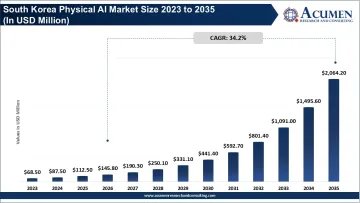
The South Korea physical AI market size accounted for USD 112.5 million in 2025 and is estimated to surpass USD 2,064 million by 2035 growing at a CAGR of 34.2% from 2026 to 2035. The rapid integration of service robots and adoption of cobots across multiple sectors has promoted the expansion of physical AI market in South Korea, making it Asia’s fastest country to boom.
Report Highlights
- By deployment, on-device AI segment is anticipated to grow at a rapid pace and registered 54.4% market share in 2025, due to increasing requirements for secured real-time processing in devices.
- The cloud-based AI market segment was projected to be the second-largest segment in 2025, contributing 45.6% of the market, due to increasing adoption of cloud for remote management of robots, digital twins, industrial IoT devices.
- By component, hardware segment dominated the market with a 50.4% share in 2025 due to increasing investments in AI hardware-based components such as robotics, sensors, semiconductors.
- The software segment is expected to capture 37.4% market share in 2025, due to rising adoption of AI software platforms for predictive maintenance, and robotics.
- By technology, computer vision technology held leading market share of 44.2% in 2025, as this technology serves as the basis for robots to perceive their environment for autonomous navigation and inspection.
- The speech/natural language processing (NLP) segment was projected to contribute 20.6% market share in 2025, with rise in adoption of voice-activated service robots for various applications.
- By robot type / form factor, industrial robots segment is expected to lead the market and capture 41.8% market share in 2025 owing to rapid increase in automation in various South Korean manufacturing industries.
- The service robots segment witnessed significant growth and captured 12.9% market share in 2025, due to the rise in service robot adoption for healthcare, retail, hospitality sectors.
- By application, manufacturing & automotive segment contributed to the largest share of 23.8% in 2025, on the back of manufacturers accelerated their investment in AI-based smart factories.
- The healthcare segment gained a substantial market share of 17.5% in 2025. The sector is actively investing in AI powered robotics systems for a range of healthcare applications, including surgical procedures, rehabilitative treatments, and hospital automation.
South Korea Physical AI Market Overview
The South Korea physical AI market is emerging as one of Asia's most dynamic innovation ecosystems, supported by rising investments in autonomous robotics, edge AI computing, intelligent mobility, and digital manufacturing. Increased labor shortage and workforce ageing, coupled with demand in industrial automation has led to companies investing in physical AI systems for enhancing production efficiency, process productivity and safety at workplaces.
Continued innovation in AI chips, vision, synthetic data, high performance computing and digital twin applications, is driving innovation across physical AI. With the advent of strong collaboration between the government and the private sector, supported by various supportive government initiatives and increased deployment of physical AI for industrial sector, defence, intelligent vehicles, healthcare and smart cities, the market is anticipated to thrive.
Why South Korea is Becoming a Global Hotspot for Physical AI Investments?
According to the expert panel at Acumen Research and Consulting, South Korea is one of only a handful of economies building out an entire Physical AI value chain, while many countries are merely building out AI software, the nation of South Korea is tying together semiconductor, industrial robots, AI infrastructure, auto manufacturing and sovereign AI into a singular national initiative.
"A significant investment vote of strategy comes via NVIDIA's planned expansion into South Korea in 2026."
- NVIDIA Founder and CEO Jensen Huang revealed on a visit to Seoul a number of long-term alliances across the SK Group, Hyundai Motor Group, LG Group, NAVER and Doosan Group, calling South Korea one of the world’s most significant ecosystems for future-generation Physical AI.
- Instead of announcing just one alliance, NVIDIA’s expansion cut across multiple verticals like memory, AI factories, humanoids, industrial automation, auto production, AI cloud infrastructure and digital twins, suggesting the tech giant is looking to the country as a commercialization hub and not merely a component provider.
- NVIDIA is looking to take this vision for Physical AI and transform South Korea into a world leading hub to realize these aspirations.
- South Korea’s own semiconductor market is also boosting the investment ecosystem. South Korea initiated a $576 billion (KRW 800 trillion) long-term semiconductor strategy to scale AI chip fabrication and semiconductor infrastructure.
- SK hynix revealed plans to list $28 billion on Nasdaq to fund new AI memory manufacturing sites within South Korea, and Samsung is increasing production capacity at home to keep up with exploding AI infrastructure needs.
| Year | Strategic Development | Significance |
|---|---|---|
| 2026 | NVIDIA expanded strategic partnerships with SK Group, Hyundai Motor Group, LG Group, NAVER, and Doosan Group to accelerate AI factories, industrial robotics, sovereign AI, autonomous mobility, and digital twin technologies. | Demonstrates NVIDIA's long-term commitment to positioning South Korea as one of its primary global Physical AI ecosystems. |
| 2026 | SK hynix announced plans for a $28 billion U.S. listing to finance expansion of AI memory manufacturing capacity. | Strengthens global production of high-bandwidth memory (HBM), a critical technology supporting AI servers, intelligent robots, autonomous vehicles, and edge AI devices. |
| 2026 | Samsung Electronics projected nearly an 18-fold increase in quarterly operating profit, primarily driven by surging demand for AI memory chips and high-performance semiconductors. | Highlights the accelerating global investment cycle in AI infrastructure and reinforces South Korea's position as a leading supplier of advanced AI hardware. |
| 2026 | NVIDIA and Hyundai Motor Group expanded collaboration to develop AI-powered mobility solutions, digital twin technologies, and intelligent manufacturing systems. | Strengthens South Korea's leadership in autonomous manufacturing and AI-driven mobility. |
Market Dynamics
Driver
Accelerated Deployment of Smart Manufacturing & Industrial Automation
South Korean manufacturers' swift adoption of AI-powered robotics, cobots and autonomous production systems across all segments of industry will boost the market for physical AI solutions as businesses seek to deploy intelligence automation to improve operational efficiency, productivity, and precision and decrease reliance on human resources.
Restraint
High Development Costs & Technical Complexity
Developing and deploying a physical AI system requires considerable investment in hardware, such as sensors, AI chips, robotic systems, computers and software integration, as well as software that integrates numerous elements into a functioning product. These systems can also be too complex to deploy easily for some.
Opportunity
Humanoid Robot Deployment in Both Commercial and Industrial Sectors
Many firms across many segments are pouring investment into the research of humanoid robots to perform functions across a spectrum of applications including logistics and shipping as well as in healthcare and the industrial segment to facilitate complex tasks by taking advantage of advances in the fields of artificial intelligence, as well as vision and autonomous navigation.
Segmental Insights
Deployment Insights
On-device AI constituted the largest deployment type within the South Korea physical AI market in 2025, accounting for 54.4% share, which naturally pushes technology players to infuse AI capabilities directly within physical devices instead of leveraging cloud infrastructure. Real-time processing, minimized latency, and heightened data privacy are driving high interest in on-device deployment of industrial robots, automated manufacturing equipment and cooperative robots in the country. Moreover, automated mobile robots, smart consumer devices, and healthcare gadgets are in robust demand that creates a strong demand for on-device deployment.
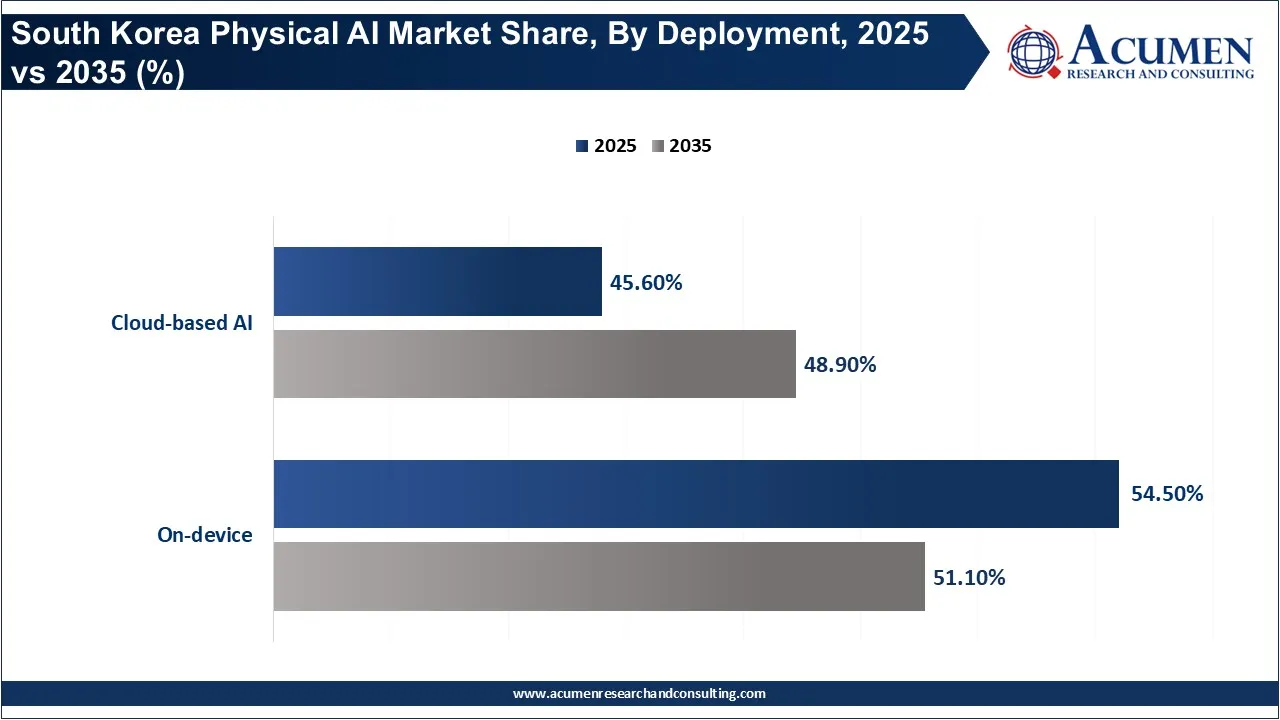
The cloud-based AI segment represented the second-largest deployment category with 45.6% share in 2025; the sector’s adoption is expected to expand as enterprises consider integrating it into their overall IT infrastructure for remote fleet management, fleet maintenance, simulation for industrial IoT models and twin simulations, deployment of industrial robots. Government efforts to drive digital transformation coupled with an increase in cloud adoption, and enhanced 5G coverage continue to drive increased demand for connected robotic systems.
Component Insights
The hardware segment was the leading sector, accounting for a significant 50.4% share in the South Korea physical AI market in 2025. The hardware comprises essential elements such as high-performance processors, AI accelerators, sensors, LiDAR, cameras, robotic arms, actuators, embedded controllers, communication modules, and dedicated semiconductor chips. South Korea, being a leader in semiconductor technology, robotics manufacturing, and electronics production, maintains strong investments in hardware for industrial automation, autonomous robots, healthcare devices, and smart mobility.
Unlike conventional software-dominated AI, physical AI heavily relies on advanced hardware for real-time processing of massive sensory data in a precise and safe manner. The capital expenditure in AI-powered robotic hardware continues to rise as enterprises upgrade their manufacturing facilities with an Industry 4.0 industry.
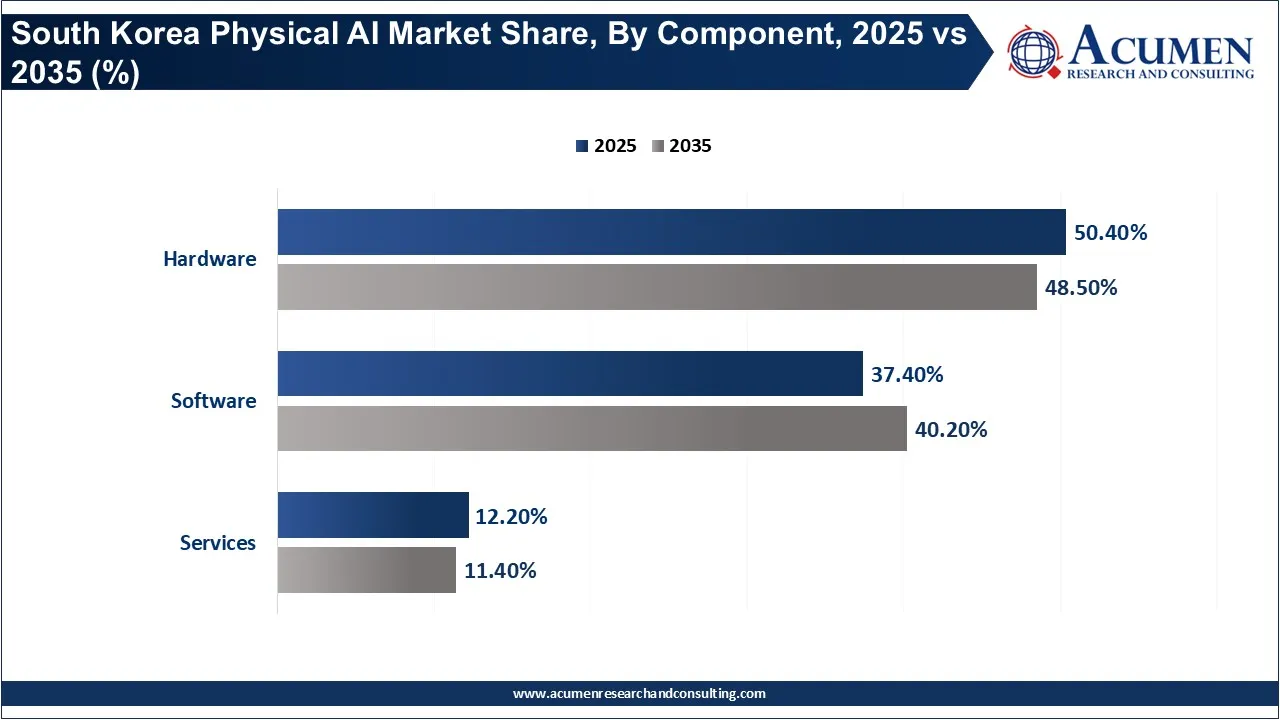
The software segment represented the second-largest segment with a 37.4% share in 2025 and is predicted to witness the fastest growth during the forecast period, with its market share expected to reach 40.2% by 2035. The proliferation of AI operating systems, robot perception software, navigation software, computer vision tools, predictive maintenance solutions and fleet management tools is boosting software spending. Companies are understanding the importance of software in creating an intelligent, flexible, and scalable physical AI system.
Enhancements in generative AI, foundation models for robots, reinforcement learning, and cloud-based management tools are enabling robots to perform more intricate tasks and lowering costs of deployment. Software is crucial for delivering updates remotely, fostering continuous learning, and enhancing system performance, thus becoming a key driver of growth for the segment.
Technology Insights
The computer vision segment held the largest share of 44.2% in 2025. Computer vision offers core abilities for most of the physical AI application, such as, industrial inspection, robotic guidance autonomous navigation and warehouse automation. Beyond this, latest applications such as defect detection, facial recognition and quality control are being prominent in the industry.
South Korea’s highly automated manufacturing sector, particularly automotive, electronics and precision engineering continues to rely on vision-enabled robotic systems to improve operational accuracy. Advances in AI-powered cameras, high-resolution sensors and deep learning-based image recognition reinforce the technology’s leadership in the market.
South Korea Physical AI Market Share, By Technology, 2025 (%)
| Technology | Revenue Share, 2025 (%) |
|---|---|
| Computer Vision | 44.2% |
| Speech / NLP | 20.6% |
| Gesture / Movement Recognition | 17.7% |
| Reinforcement Learning & Control Systems | 13.9% |
| Others | 3.5% |
The speech/ Natural Language Processing (NLP) segment held the second position with a share of 20.6% in 2025. The rapid evolution in Large language models (LLM), conversational AI, multi-lingual speech recognition, voice assisted robotics and human machine interfaces has changed the applications of service robots. South Korea’s increased interest in Intelligent service robots for its elderly population, health centers, hotels, and retail stores is pushing further developments in voice assisted interaction technologies.
Robot Type / Form Factor Insights
Industrial robots dominated the South Korea physical AI market with 41.8% in 2025 and were projected to be the leading segment during the predicted timeframe. South Korea is a world leader in terms of industrial robot density among manufacturing economies due to high use in automotive, electronics, semiconductor fabrication, battery production and heavy industry sectors. The country's robust investment in smart factories, precision manufacturing, quality control, and completely automated production lines continued to spur demand for AI-driven industrial robots.
South Korea Physical AI Market Share, By Robot Type, 2025 (%)
| Robot Type | Revenue Share, 2025 (%) |
|---|---|
| Industrial Robots | 41.8% |
| Service Robots | 12.9% |
| Humanoids/Social Robots | 13% |
| Cobots | 11.6% |
| Exoskeletons/Prosthetics | 8.9% |
| Mobile Robots/Drones | 11.8% |
Service robots accounted for 12.9% of the South Korea physical AI market in 2025. Growth in sectors such as healthcare, hospitality, retail, logistics, public services, and elder care are driving rapid adoption of service robots in the country. South Korea's aging population, labor shortages in service industries, and increasing adoption of contactless automation are creating strong demand for intelligent service robots capable of customer interaction, delivery, cleaning, patient assistance, and administrative support.
Application Insights
The manufacturing & automotive application sector was the most prominent application of South Korea physical AI market and it is accounted for 23.8% share in 2025. The globally leading manufacturing industries such as automobile, semiconductor, electronics, ship building, battery, and etc. Invest in the intelligence and automation to drive manufacturing improvements in productivity, quality, operation and enhance global competency.
This segment is being fueled by the growing need for physical AI for predictive maintenance, automated and autonomous production, robot-based inspection, intelligence-based assembling, defect detection, automated warehousing system and adaptive manufacturing systems. Furthermore, the smart factory initiatives and government support towards digital transformation initiatives drive the sustained demand for the physical AI application.
South Korea Physical AI Market Share, By Application, 2025 (%)
| Application | Revenue Share, 2025 (%) |
|---|---|
| Healthcare | 17.5% |
| Manufacturing & Automotive | 23.8% |
| Logistics & Warehousing | 13.9% |
| Retail & Hospitality | 12.5% |
| Defense & Security | 9.1% |
| Agriculture | 8.2% |
| Education & Research | 9% |
| Others | 6% |
The healthcare application sector occupied the second position in South Korea physical AI market by holding 17.5% share in 2025. Adoption of the physically AI solutions such as AI surgical robots, AI rehabilitation systems, hospital logistics robots, smart imaging, aged care robots and intelligent health wearable, and etc. Are driven by the rise in the demand for improved patient care along with rising labor cost associated with South Korea's aging demographics and continued demand for the modernization of hospital facilities and medical research centers.
Top Government Initiatives & Schemes in South Korea for Physical AI
- AI Initiatives National AI Strategy (2019-2030): South Korea’s long-term AI plan endeavors to develop into one of the top five global AI economies by facilitating the dissemination of AI technologies across the robotic and autonomous systems, smart factories, healthcare, and intelligent manufacturing sectors.
- AI Semiconductor Strategy (K-Semiconductor Belt): The government aims to enhance national hardware power in terms of the development of AI semiconductors and high-tech semiconductor manufacturing. This initiative specifically promotes development in related industries such as robot systems, autonomous machines, and edge computing.
- Digital New Deal: This initiative involves massive investments in AI infrastructure, 5G networks, and cloud computing to expedite the dissemination of AI into intelligent industrial robots, autonomous vehicles and other systems to build the digital New Deal.
- K-Humanoid Alliance (2025): Launched by the Ministry of Trade, Industry and Energy (MOTIE), the K-Humanoid Alliance connects robot manufacturers, AI companies, and research centers and universities for the commercialization of future human-robot systems and to reduce South Korea’s dependence on foreign robotics technology.
- K-Robot Economy Strategy: This national strategy is intended to enhance manufacturing productivity by promoting commercialization in areas of advanced service robots, cobots, autonomous mobile robots (AMRs), and AI in intelligent industrial processes.
Recent News
- In July 2026, South Korea’s National Growth Fund’s chairman Lee Eog-weon announced that the it will scale up the investment for physical AI sector by $96.3 billion in next 5 years. Lee also mentioned that physical AI can boost productivity and create new growth engines for the country.
- In July 2026, South Korea announced plans to double its DRAM production capacity by the mid-2030s while significantly expanding domestic production of High Bandwidth Memory (HBM), strengthening the country's leadership in AI hardware required for intelligent robots and Physical AI systems.
- In April 2026, South Korea expanded international investment cooperation with Qatar to jointly promote investments in manufacturing AI, robotics, AI semiconductors, and industrial automation, creating new opportunities for cross-border commercialization of Physical AI technologies.
South Korea Physical AI Market Top Companies
| Company | Headquarters | Role in Physical AI |
|---|---|---|
| LG Electronics | Seoul, South Korea | Developing AI factories, robotics foundation models, and synthetic data generation platforms in collaboration with NVIDIA to accelerate industrial and service robotics. |
| Samsung Electronics | Suwon, Gyeonggi Province, South Korea | Designs advanced AI processors, memory chips, edge AI hardware, and robotics technologies while expanding AI infrastructure for intelligent manufacturing. |
| SK Group (SK Telecom & SK hynix) | Seoul, South Korea | Investing in AI cloud infrastructure, autonomous systems, AI data centers, and high-bandwidth memory (HBM) essential for Physical AI computing. |
| NAVER Corporation | Seongnam, Gyeonggi Province, South Korea | Developing sovereign AI infrastructure, AI factories, hyperscale data centers, and large-scale AI platforms supporting robotics and digital twins. |
| Superb AI | Seoul, South Korea | Provides computer vision, synthetic data generation, and MLOps platforms for autonomous robots, industrial automation, and AI model deployment. |
| Clobot Inc. | Seongnam, Gyeonggi Province, South Korea | Develops autonomous robot navigation software, fleet management systems, and robot operating platforms for logistics, hospitals, and smart buildings. |
| Doosan Robotics | Suwon, Gyeonggi Province, South Korea | Manufactures collaborative robots (cobots) integrated with AI for manufacturing, logistics, food service, healthcare, and industrial automation. |
| Rainbow Robotics | Daejeon, South Korea | Develops humanoid robots, collaborative robots, and autonomous robotic systems for industrial automation and advanced AI research. |
Segments Covered
By Deployment
- Cloud-based AI
- On-device AI
By Component
- Hardware
- Software
- Services
By Technology
- Computer Vision
- Speech / Natural Language Processing (NLP)
- Gesture / Movement Recognition
- Reinforcement Learning & Control Systems
- Others
By Robot Type / Form Factor
- Industrial Robots
- Service Robots
- Humanoids/Social Robots
- Cobots
- Exoskeletons/Prosthetics
- Mobile Robots/Drones
By Application
- Healthcare
- Manufacturing & Automotive
- Logistics & Warehousing
- Retail & Hospitality
- Defense & Security
- Agriculture
- Education & Research
- Others
Looking for discounts, bulk pricing, or custom solutions? Contact us today at sales@acumenresearchandconsulting.com
Frequently Asked Questions

Other ICT Reports
April 2025
October 2023
July 2024
May 2020