
Humanoid Robot Market Size, Share, Growth, Forecast 2026 To 2035
Humanoid Robot Market (By Component: Hardware, Software; By Application: Research & Space Exploration, Education & Entertainment, Healthcare & Personal Assistance, Hospitality, Industrial & Logistics, Others; By Motion: Biped, Wheel Drive) - Global Industry Analysis, Size, Share, Analysis, Trends and Forecast 2026 - 2035
- Last Updated: 30 Dec 2025
- Report Code: ARC3880
- Category: Semiconductor and Electronics
Humanoid Robot Market Size and Forecast 2026 - 2035
The global humanoid robot market is projected to grow from USD 2,060.4 million in 2025 to USD 21,647.3 million by 2035, registering a CAGR of 26.4% during the forecast period from 2026 to 2035. The growing advancements in AI and sensor technologies are boosting the demand for humanoid robots. In addition, rising demand for automation in service, healthcare, and industrial applications is creating new growth opportunities for the market.
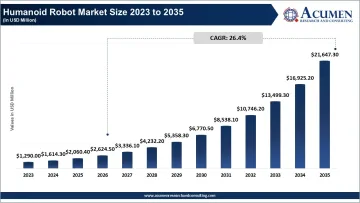
A humanoid robot is referred to as a robot whose size and shape resemble that of a human. Currently, the humanoid robot is still in its infancy, but some of the robots have already moved from research and development to physically addressing different sectors including personal assistance & caregiving, research, education, space exploration, and entertainment, among others.
The construction of a humanoid robot necessitates a pool of different engineering disciplines, such as software engineering, electrical engineering, and mechanical engineering. The growth of the humanoid robot market has been largely fueled by advances in technology, the reduction of hardware cost, a shortage of labor in developed nations, and favorable government support.
Report Highlights
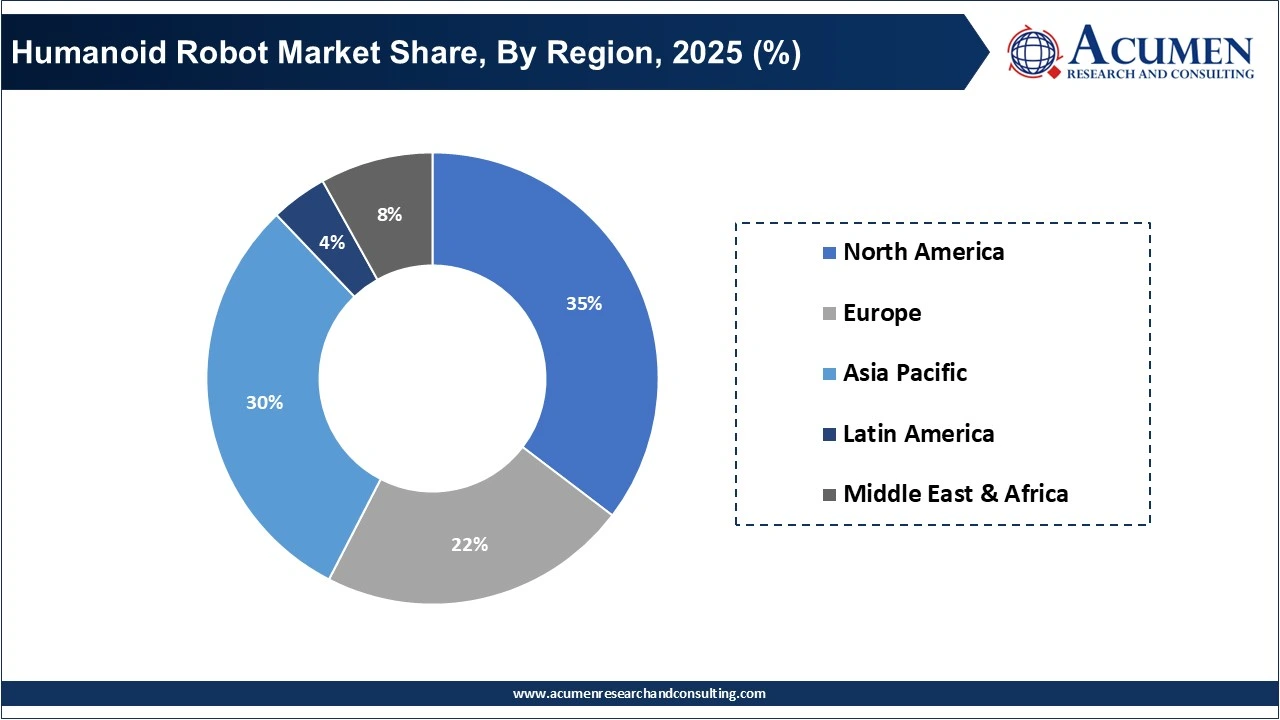
- By Region, the North America humanoid robot market accounted for the largest revenue of USD 725.3 Million in 2025.
- By Region, the Asia-Pacific humanoid robot market is projected to grow at a profitable CAGR of over 28.7% from 2026 to 2035.
- By Component, the hardware segment represented over 69% of the total market share in 2025.
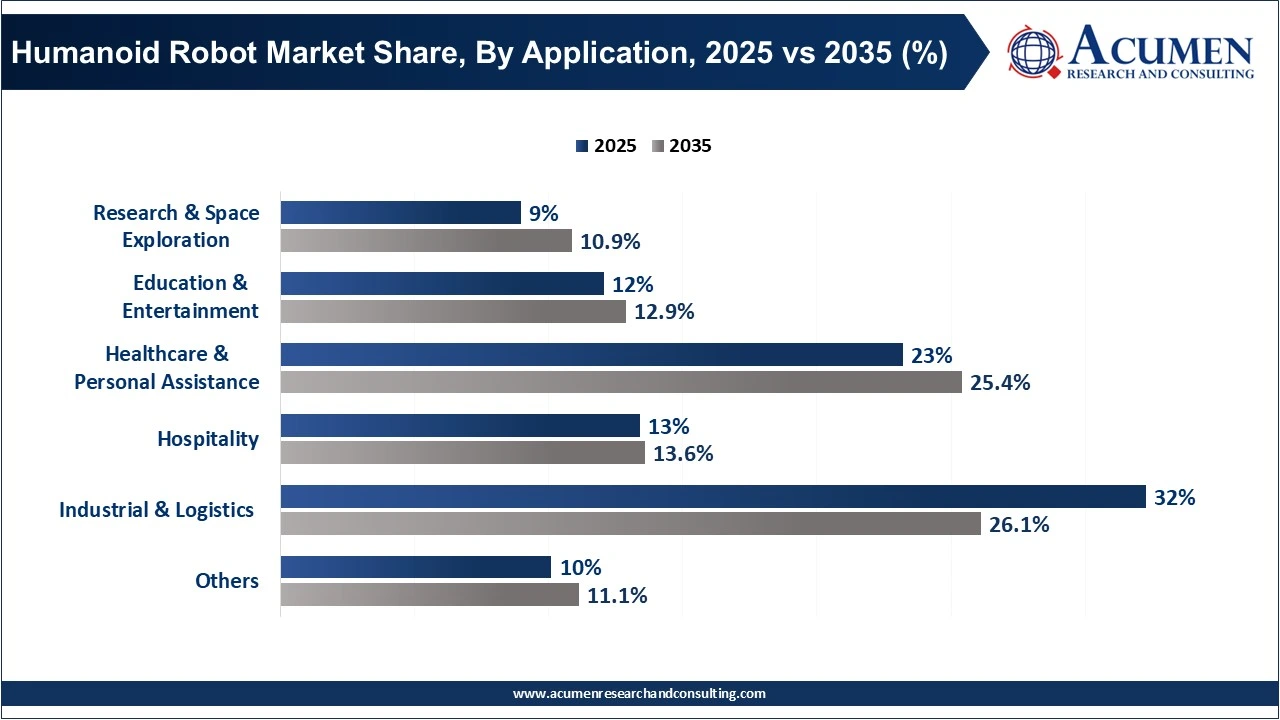
- By Application, the industrial & logistics segment accounted for 32% of the market share in 2025.
- By Motion, the wheel drive segment accounted for over 65% of the humanoid robot market share in 2025.
Global Humanoid Robot Market Dynamics
What is Driving the Growth of Humanoid Robots Market?
Labor Shortages
- One of the key forces of market growth for humanoid robots is labor shortages. Labor shortages affect different industries. The benefits of using humanoid robots provide an opportunity to overcome labor shortages in industries with manpower. Currently, manufacturers are looking forward to the idea of robots to help overcome labor shortages. For example, in the year 2024, the car manufacturers Mercedes-Benz and BMW looked forward to incorporating the use of humanoid robots for assistance due to the shortage of employees.
According to the data by ManpowerGroup, over 75% of employers found it challenging to fill job vacancies in 2024.
| Year | Labor Shortage (%) |
|---|---|
| 2021 | 69% |
| 2022 | 75% |
| 2023 | 77% |
| 2024 | 75% |
Technological Advancements
- The evolving advanced technologies of AI, HPC, Next-Generation Sensors, and battery technology are also growing at a fast pace to integrate quick development of a humanoid robot. For example, with the help of technologies like AI and HPC, robots can work efficiently in a complex real-world scenario with an unstructured environment. The usage of AI technology among robots enhances risk management, precision, and productivity. The usage of AI among humanoid robots helps them to pick and pack items, move items around with their vision independently in the factory, and carry out maintenance work faster than humans. In addition, advanced sensors such as 3D/depth camera sensors and voice sensors with next-generation sensors help robots understand their environments better.
Market Restraints
Market Acceptance Paired with Ethical & Regulatory Concerns
- Acceptance in the market is hampered by factors such as a lack of infrastructure and a high initial investment cost, which would result in a restricted growth rate of humanoid robots over a short period of time. In addition, a poor image in society is another challenge for humanoid robots. Humanoid robots are gaining strength in terms of carrying out complex tasks, hence potentially replacing human labor in many workplaces, particularly in manufacturing companies. This would lead to a severe loss of employment for many people.
Risk Associated with Job Automation
- The threat of job automation has been identified as a major factor restraining the market for humanoid robots, with rising concerns over displacement of employment. With humanoid robots finding application in various sectors such as service, manufacturing, and healthcare, there exist threats to employment due to a possible loss of jobs. This can result in opposition from trade unions, employee resistance, and obstacles in implementing regulations due to a possible loss of employment. Reputational risks can be a problem if humanoid robots are used with less focus on workforce transition.
Market Opportunities
Integration with AI
- Globally in the market for humanoid robots, there is an increasing trend in robotics and AI research. In the early years of its existence, robotics was all about making humanoid robots that could act like humans and have a humanlike appearance. However, in modern times, there is a continuous trend of researchers to combine AI and humanoid robots. This can be seen in Fully Automated Living Systems (FALLS), which are robotic systems that function and learn autonomously without any kind of human control or supervision.
Expansion of Humanoid Robots in Healthcare and Assistive Services
- Humanoid robots offer a great market opportunity for growth in terms of providing assistance in the healthcare sector due to the rising need for continuous care in a world where there are few human resources available. Humanoid robots can be used to assist healthcare staff in monitoring patients, facilitating mobility assistance services, reminding patients of medicines, and carrying out general care services. Humanoid robots provide a benefit due to their human form, making it easier for patients to communicate with them. This increases acceptance in terms of assistance in a healthcare setting with low efficiency.
Humanoid Robot Market Report Scope
| Attribute | Details |
|---|---|
| Humanoid Robot Market Size 2025 | USD 2,060.4 Million |
| Humanoid Robot Market Forecast 2035 | USD 21,647.3 Million |
| Humanoid Robot Market CAGR During 2026 – 2035 | 26.4% |
| Analysis Period | 2023 – 2035 |
| Base Year | 2025 |
| Forecast Data | 2026 – 2035 |
| Segments Covered | By Component, By Application, By Motion, and By Geography |
| Regional Scope | North America, Europe, Asia-Pacific, Latin America, and Middle East & Africa |
| Key Companies Profiled | Engineered Arts Limited, HANSON ROBOTICS LTD, Honda, HYULIM Robot Co., Ltd, KAWADA Robotics Corporation, ROBOTIS, Sanbot Co, SoftBank Robotics, Willow Garage, and Toshiba Corporation |
Humanoid Robot Market Regional Analysis
North America dominated the humanoid robot market by garnering a major market share in 2025. This is attributed to the well-established presence of prominent technology players, widespread acceptance of new technologies, well-developed IT infrastructure, and effective efforts in digital transformation. The presence of a well-developed IT infrastructure impacts positively in promoting a large adoption of this technology. Also, a large number of technology firms facilitate a highly competitive market.
| Region | Market Share, 2025 (%) | Key Highlights |
|---|---|---|
| North America | 35% | Dominant because of the robust presence of key tech players, high adoption of novel technologies, advanced IT infrastructure, and efficient initiatives in digital transformation. |
| Europe | 22% | Increasing demand for humanoid robots in the healthcare industry and the growing development of robots with innovative features boost the market growth |
| Asia-Pacific | 30% | Countries such as India, Japan, China, and South Korea are contributing significantly to the growth of the Asia-Pacific market. |
| MEA | 8% | The ongoing research efforts emphasized on the development of new technologies are projected to improve the utilization of humanoid robots, thereby leading to their growing adoption in the healthcare industry. |
| Latin America | 4% | Growing preference and rising availability of humanoid robots in diverse sectors including hospitality, healthcare, and research initiatives in robotics propel market growth. |
The Asia-Pacific market is expected to observe a significant growth throughout the forecast period. Countries such as India, Japan, China, and South Korea are contributing significantly to the growth of the Asia-Pacific market. According to International Federation of Robotics statistics, there were 290,300 units of annual instalment of industrial robots registered in 2022 in China, with a market share of 52%, followed by Japan with 50,400 units. The countries mentioned have many start-ups conducting their research work on robotics. In 2023, the Chinese Government expressed its vision to achieve the creation of humanoid robots by 2025, thus cultivating the growth of corporations engaged with the development of humanoid robots, enhancing international cooperation on robotics issues, and developing sound supply chain for the industry. All such aspects are anticipated to accelerate the growth of the market for humanoid robots.
Humanoid Robot Market Segmental Insights
The worldwide market for humanoid robot is split based on component, application, motion, and geography.
Component Insights
The hardware segment dominated the humanoid robot market in 2025. The hardware components include body components and electronic, electrical, and mechanical components that work collaboratively in performing an assigned function and other components such as sensors, actuators, generators, control systems, and others. The hardware components of humanoid robots make these robots resemble humanoids and consequently have immense value. The functions of humanoid robots include healthcare services, research functions, and education functions of integrating new technologies smoothly due to its hardware components. For example, in March 2023, it was announced that Sanctuary Cognitive Systems Corporation (Sanctuary AI), an industrial humanoid robot manufacturer, together with Canadian Tire Corporation (CTC), an organizational entity providing retail products and services to Canada, unveiled the first installation of an innovative solution that would integrate general robots with human-like intelligence at a customer facility.
| Component | Market Share, 2025 (%) | Key Highlights |
|---|---|---|
| Hardware | 69% | The hardware components include body components and electronic, electrical, and mechanical components that work collaboratively in performing an assigned function and other components such as sensors, actuators, generators, control systems, and others. |
| Software | 31% | The software category is experiencing robust growth because of the improvements in Artificial Intelligence-based human robot interaction, learning algorithms, and autonomous decision-making techniques. These make robots more adaptable to their environment. |
Application Insights
According to the humanoid robot industry analysis, in 2025, the industrial & logistics application dominated the market with around 32% share. The segment is driven by labor shortages, increasing wages, and growth in demand for continuous operations. Currently, the humanoid robots are being piloted for tasks designed around human environments (factories, warehouses, plants). Companies want the robots that can use existing tools, stairs, doors, and workstations. Humanoid robots can undertake repetitive, physically demanding, or hazardous tasks while integrating with the existing warehouse and manufacturing systems, making adoption faster and commercially more feasible compared to other use cases.
| Application | Market Share, 2025 (%) | Key Highlights |
|---|---|---|
| Research & Space Exploration | 9% | Humanoid robots are being employed in increasing numbers in space missions as well as in research labs for performing critical, repetitive, or precision work. |
| Education & Entertainment | 12% | The increasing use of humanoid robots for interactive educational experiences is poised to raise the level of experiential learning and entertainment experiences. |
| Healthcare & Personal Assistance | 23% | These robots support people in their house chores and being their companions, improve people’s life quality. Humanoids support individuals in their day-to-day tasks in hospitals and care homes, which includes helping them administer medications at their prescribed time. |
| Hospitality | 13% | Hotel industry, airport, and service sector providers adopting humanoid robots in guest handling, concierge, and general customer service. |
| Industrial & Logistics | 32% | The segment is driven by labor shortages, increasing wages, and growth in demand for continuous operations. |
| Others | 10% | Other use cases, such as security, public services are being developed for humanoid robots with wider autonomy, mobility, and human interaction capabilities. The development of humanoid robots is underway to assist in disaster scenarios to perform navigation in human-made environments in areas that are difficult to access by humans. |
Healthcare & Personal Assistance humanoid robots segment display a high long-term growth potential as these robots can be used in patient assistance, hospital logistics, and rehabilitation support. Currently, the adoption in this sector is slow due to safety regulations, and cost; however, with technological developments and mass production of robots for specific applications, humanoid robots could witness strong adoption in healthcare sector by 2035.
Motion Insights
The wheel drive segment led the humanoid robot sector. Wheel drive technology has contributed immensely to robotics as it serves as an effective means of giving robots both flexibility and mobility. An example of a humanoid robot with a wheeled base, equipped with state-of-the-art AI functionality for human interaction, is Pepper from SoftBank Robotics (Japan). There is a compact humanoid robot called Alpha Mini from UBTECH (China), which uses wheels for more flexibility. MIP, a small wheel drive robot designed for entertainment and education, sends from WowWee U.S. These multi-wheel drive robots have immensely showcased their potential in robotics, enabling uses in customer services, research in education, and entertainment. These robots are soon likely to be in high demand in military use, owing to an advantage offered by wheeled robots.
| Motion | Market Share, 2025 (%) | Key Highlights |
|---|---|---|
| Biped | 35% | Biped technology offers benefits including handling complex logistics, reduced workplace injuries, and enabling effective assistance in healthcare. |
| Wheel Drive | 65% | Wheel drive technology has contributed immensely to robotics as it serves as an effective means of giving robots both flexibility and mobility. |
Humanoid Robot Market Players
- Engineered Arts Limited
- HANSON ROBOTICS LTD
- Honda
- HYULIM Robot Co., Ltd
- KAWADA Robotics Corporation
- ROBOTIS
- Sanbot Co
- SoftBank Robotics
- Willow Garage
- Toshiba Corporation
Humanoid Robot Market Segmentation
By Component
- Hardware
- Software
By Application
- Research & Space Exploration
- Education & Entertainment
- Healthcare & Personal Assistance
- Hospitality
- Industrial & Logistics
- Others
By Motion
- Biped
- Wheel Drive
By Region
- North America
- U.S.
- Canada
- Europe
- U.K.
- Germany
- France
- Spain
- Rest of Europe
- Asia-Pacific
- India
- Japan
- China
- Australia
- South Korea
- Rest of Asia-Pacific
- Latin America
- Brazil
- Mexico
- Rest of LATAM
- The Middle East & Africa
- South Africa
- GCC Countries
- Rest of the Middle East & Africa (ME&A)
Looking for discounts, bulk pricing, or custom solutions? Contact us today at sales@acumenresearchandconsulting.com
Frequently Asked Questions

Other Semiconductor and Electronics Reports
June 2023
October 2021
July 2019
January 2024