
Humanoid Robot Battery Market Size, Share, Trends, Report 2026 To 2035
Humanoid Robot Battery Market (By Battery Chemistry: High-Nickel NMC/NCA, LFP, Lithium Polymer, Solid-State/Semi-Solid-State, Otherrs; By Cell Form Factor: Cylindrical, Pouch, Prismatic; By Battery Capacity: <1 kWh, 1–2.5 kWh, 2.5–5 kWh, 5 kWh; By Battery Component: Battery Cells, Battery Management System, Thermal Management System, Battery Pack Housing & Structural Components, Others; By Application: Industrial/Manufacturing, Logistics & Warehousing, Healthcare & Caregiving, Retail & Hospitality, Domestic/Personal, Research & Education, Others) - Global Industry Analysis, Size, Share, Regional Analysis, Trends and Forecast 2026 - 2035
- Last Updated: 21 Sep 2026
- Report Code: ARC3983
- Category: Energy and Power
Humanoid Robot Battery Market Size, Forecast Report 2026 To 2035
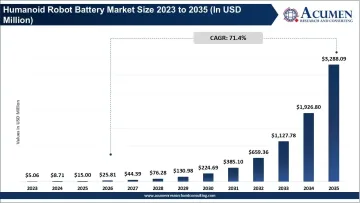
The global humanoid robot battery market size was valued at USD 15 million in 2025 and is expected to reach at USD 3,288.09 million by 2035; growing at a strongest CAGR of 71.4% during the forecast period of 2026-2035. Increasing commercialization of humanoid robots across manufacturing, logistics, and other labor-intensive environments is driving demand for lightweight, high-energy-density batteries that can support longer operating cycles and high-power movement. Advances in battery chemistry, cell design, fast-charging technology, and battery management systems are further improving energy efficiency, safety, and runtime, accelerating adoption of advanced battery solutions in humanoid platforms.
Report Highlights
- By region: Asia-Pacific dominated the humanoid robot battery market in 2025 with a 50.0% share, supported by its large robotics manufacturing base, advanced battery ecosystem, and strong industrial automation activity.
- By North America: North America held the second-largest regional share at 37.0% in 2025, supported by investment in artificial intelligence, robotics, advanced manufacturing, and autonomous systems.
- By battery chemistry: High-Nickel NMC/NCA led the market in 2025 with a 72.0% share, driven by its high energy density and suitability for weight-sensitive humanoid platforms.
- By battery chemistry: solid-state/semi-solid-state is projected to be the fastest-growing chemistry segment, with its share rising from 5.0% in 2025 to 30.0% by 2035, supported by demand for higher energy density and improved battery safety.
- By cell form factor: cylindrical cells dominated in 2025 with a 42.0% share, benefiting from mature manufacturing infrastructure, established supply chains, and proven performance across automotive and consumer electronics applications.
- By cell form factor: pouch cells are expected to be the fastest-growing form factor, increasing from 38.0% in 2025 to 44.0% by 2035, as their lightweight and flexible packaging is well suited to the space-constrained architecture of humanoid robots.
- By battery capacity: 1–2.5 kWh segment dominated in 2025 with a 58.0% share, reflecting its balance between energy availability, battery weight, physical footprint, and the requirements of emerging humanoid platforms.
- By battery capacity: >5 kWh segment is projected to register the fastest growth, with an 89.7% CAGR from 2026 to 2035, as larger-capacity batteries support longer duty cycles and reduce charging interruptions in industrial and logistics applications.
- By battery capacity: 2.5–5 kWh segment represented the second-largest capacity category in 2025 at 24.0%, while its share is projected to reach 38.0% by 2035, reflecting increasing demand for greater operating endurance.
- By battery component: battery cells dominated the component segment in 2025 with a 68.0% share, as cells represent the primary energy-storage element and strongly determine battery cost, weight, capacity, and operating performance.
- By battery component: battery management systems were the second-largest component category in 2025 at 12.0%, supported by the need to continuously monitor voltage, temperature, current, state of charge, and battery health under highly variable robotic loads.
- By application: industrial/manufacturing applications dominated in 2025 with a 42.0% share, driven by the suitability of humanoid robots for repetitive assembly, material handling, machine tending, inspection, and intralogistics activities.
- By application: logistics and warehousing represented the second-largest application segment in 2025 at 28.0%, supported by growing use-case potential in picking, sorting, loading, unloading, and material transportation.
What Is the Humanoid Robot Battery Market and Why Is It Becoming a Critical Component of Humanoid Robotics?
The humanoid robot battery market includes battery cells, battery modules, battery management systems, thermal-management system, pack enclosure and other power-management technology that can sustain humanoid robots. Where most of the industrial robots do not need power to move, humanoids robots must power motors, actuators, processors, sensor systems, communication and balance-systems while walking around moving through an environment.
“One example is BMW's pilot of the Figure 02 at its Spartanburg factory, which ran for over 1,250 hours, traveled over 90,000 km and supported production of over 30,000 BMW X3 vehicles over a span of 10 months. Similarly, in September 2026, Agility Robotics launched Digit 5 with a claimed operating time of more than 20 hours per day with rapid recharging, highlighting how runtime and recharge characteristics are becoming directly linked to commercial robot utilization.”
Investment, Funding & Production Hotspots Across the Globe
- China accounted for more than 97% of global humanoid robot shipments in the first half of 2026, with global shipments reaching about 19,100 units during the period.
- In August 2026, China's industrial robot output increased 34.6% year over year, while lithium-ion battery output increased 57.2%, creating a rapidly expanding domestic manufacturing base for both robotics and battery components.
- The South Korean government plans to spend KRW 2.3 trillion through 2030 on full-stack humanoid development, beginning with a proposed KRW 600 billion allocation in 2027.
- The government plans to increase localization of key humanoid-robot components from 45% currently to 80% by 2030 and purchase 250 domestically developed humanoids in 2027 and 1,080 through 2030.
- Galbot completed a CNY 2.5 billion, approximately $368 million, financing round in March 2026.
- Xpeng's robotics unit raised more than $900 million in its first funding round in August 2026, with plans to expand hardware, AI, production facilities, and global operations.
- Hyundai plans to build production capacity for up to 30,000 Boston Dynamics humanoid robots annually by 2028, alongside planned deployment of Atlas robots at its Georgia manufacturing operations.
- Figure 02 operated for approximately 1,250 hours at BMW's Spartanburg plant, completing more than 1.2 million steps and handling over 90,000 components during its pilot.
Humanoid Robot Battery Market Growth Drivers & Opportunities
Market Drivers
- Higher hours are commercial reality: Humanoids are now being asked to perform multi-hour factory and warehouse trips, rather than short demos. BMW's Figure 02 accumulated approximately 1,250 operating hours during its production pilot, and Agility's Digit 5 is intended to operate for more than 20 hours a day with high-speed charging. Higher usable energy, smarter power management, temperature control and fast-charging battery architecture is becoming more relevant.
- Expansion of physical AI increases energy demand: Humanoids combine 24/7 sensing, onboard AI compute, communications, balance control, and numerous electric actuators, all demanding simultaneous high loads that stationary industrial robots don't see.
Market Opportunities
- Battery systems engineered for humanoid designs: Humanoid form-factor platforms need batteries that are capable of occupying small body cavities and sustaining multiple episodes of acceleration, deceleration, balancing, and actuator loading. This will enable lightweight pouch cells, modular battery packs, AI-enabled BMS, swappable modules, and thermally optimized pack architectures instead of replicating a typical EV battery pack.
What Limits the Expansion of Humanoid Robot Battery Market?
The growth of the humanoid robot battery market is hindered due to the trade-off between capacity, weight, safety, runtime, and physical packaging. Increasing the capacity of the battery pack that would increase runtime would also increase the weight, thereby increasing the energy consumption of the robot's walking, balancing, lifting, and acceleration. This feedback loop lowers the feasible size of a pack, not to mention how robots also have to endure to frequent high-power load variations while keeping a stable temperature in compact bodies.
Segmentation Insights
Battery Chemistry Insights
High-Nickel NMC/NCA: The Current Energy-Density Benchmark for Demanding Humanoid Platform
High-Nickel NMC/NCA was the dominant segment in 2025, with 72% share. The platform leadership came from high energy density, relatively acceptable weight/energy ratios and existing manufacturing footprints. These factors matter a lot for humanoid robot batteries because batteries need to supply a lot of energy while not adding too much weight to the robot torso or lower body. Therefore, high-nickel chemistries align well with platforms that use their energy for extended runtime, dynamic motion and large power draws from motors, actuators, sensors, processers and communications systems.
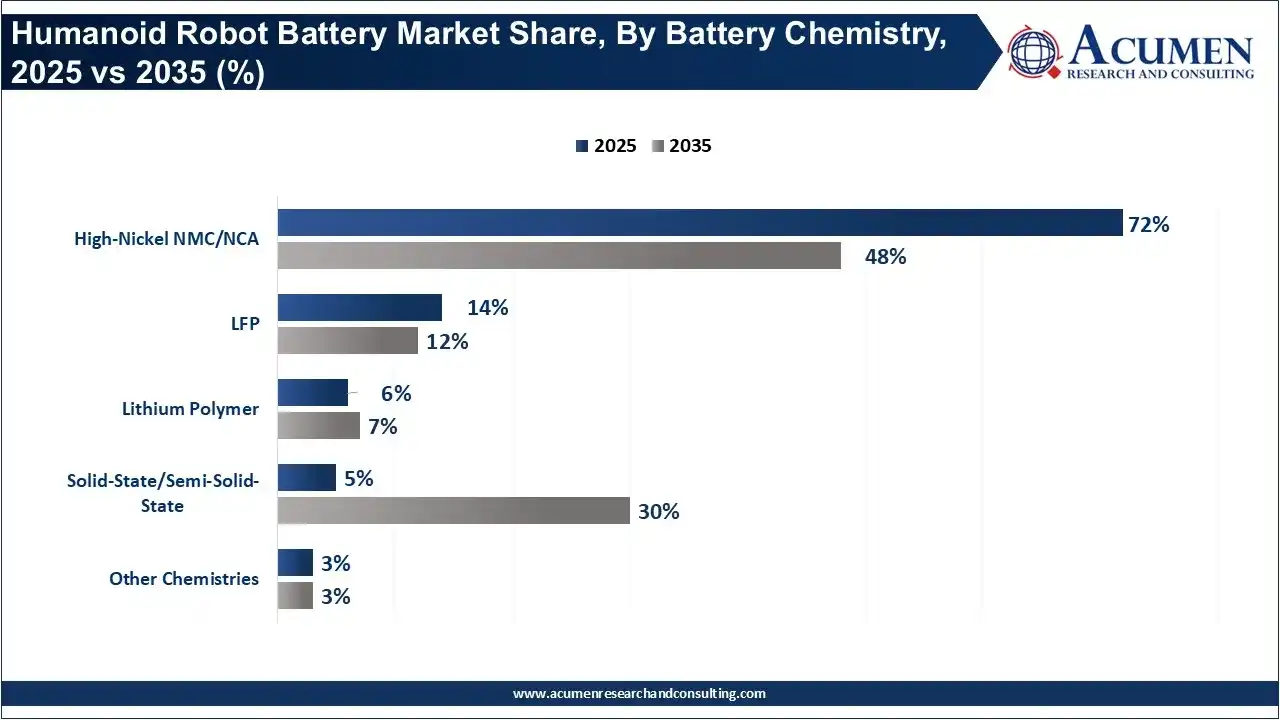
Solid-state and semi-solid-state batteries are expected to be the fastest-growing chemistry segment, with their market share projected to increase from 5.0% in 2025 to 30.0% by 2035. Their growth is being driven by the need to increase energy density while improving safety and reducing the risks associated with conventional liquid-electrolyte systems. Humanoid robots require batteries that can operate safely in close proximity to people while tolerating frequent movement, variable loads, and demanding thermal conditions.
Cell Form Factor Insights
Cylindrical Cells: Established Manufacturing Scale Supports Current Humanoid Battery Designs
Cylinder cells led the market in 2025 with 42% market share. They are underpinned by established manufacturing processes and dedicated supply chains that have been developed by the electric vehicle and consumer electronics industries. For robots, cylindrical cells can be assembled into modular battery packs that disperse energy storage into tight spaces and still maintain relatively stable thermal and electrical pro-files.
In addition, their established production ecosystem gives robot makers direct access to cell technologies that have already proven themselves in other applications without the need to design and implement a new manufacturing infrastructure.
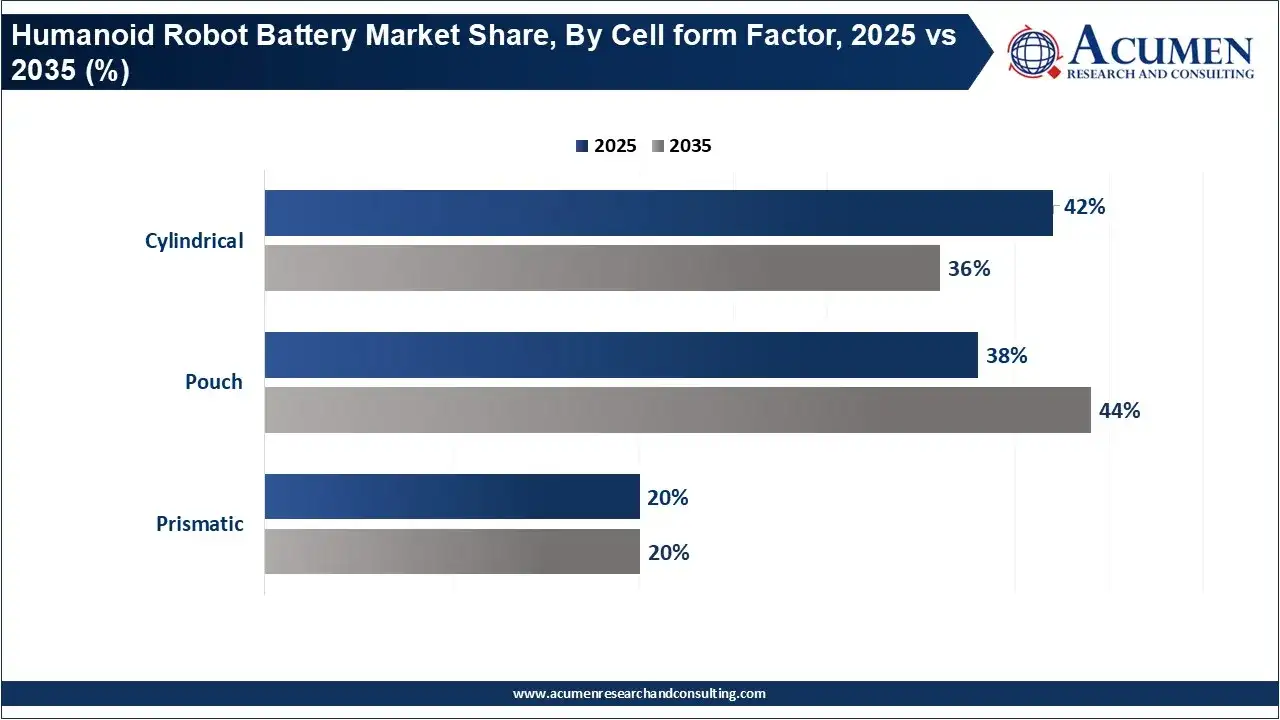
Pouch cells are forecast to be the fastest-growing of the major cell form factors, progressing from 38% market share in 2025 to 44% in 2035. Their light-weight construction, flexible cell packaging designs, and ability to shape battery packs around the tight, complex geometries of humanoid robots are all contributing factors.
Unlike traditional industrial robots, the internal architecture of humanoids contains motors, actuators, control electronics, sensors, cooling systems, and their structural components, leaving little room for batteries. A pouch cell and flexible pack design can offer robot manufacturers more creative freedom in this respect.
Battery Capacity Insights
1–2.5 kWh: The Core Capacity Window for Today's Commercial Humanoid Platforms
The 1–2.5 kWh capacity segment dominated the market in 2025, accounting for 58% of total demand. The segment is valued at $14.97 billion in 2026 and is projected to reach $1,315.24 billion by 2035, representing a 64.4% CAGR during 2026–2035.
This capacity range currently provides a practical balance between operating duration, battery weight, physical size, and the power requirements of many emerging humanoid robots. Developers are increasingly designing platforms around modular battery architectures that can provide enough energy for industrial demonstrations, warehouse tasks, research activities, and controlled commercial deployments without significantly increasing robot mass.
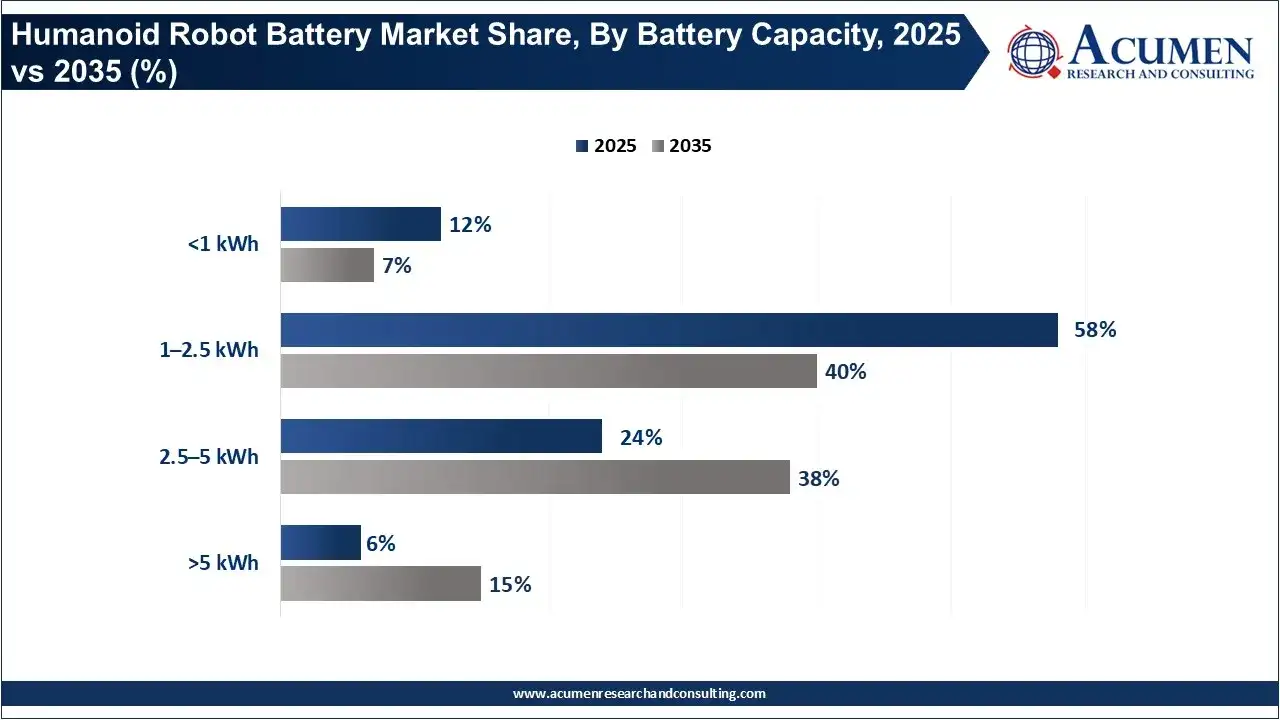
The >5 kWh segment will witness the fastest CAGR and increase in market share from 6.0% in 2025 to 15.0% in 2035. This segment would grow from $1.55 billion in 2026 to $493.21 billion in 2035 at a CAGR of 89.7% during 2026-2035. The increase in this capacity range is driven by advent of larger and more capable humanoids for carrying out longer industrial, logistics, and commercial jobs. Larger batteries allow for increased duty cycles and less time spent in recharging or changing out the battery, which is critical for facilities looking to operate the most robots possible.
Battery Component Insights
Battery Cells: The Value Concentration Point of Humanoid Battery Systems
Battery cells dominated the battery component segment in 2025, accounting for 68.0% of the market. Cells are the main energy-storage element so are the largest % of the battery system value. Vehicles are demanding higher energy density, longer cycle life, fast charge, lighter weight, and safer technology. For humanoid robots, cell selection directly influences battery-pack dimensions, robot weight, operating duration, thermal requirements, and overall system performance.
Humanoid Robot Battery Market Share, By Battery Component, 2025 (%)
| By Battery Component | Revenue Share, 2025 (%) |
|---|---|
| Battery Cells | 68% |
| Battery Management System | 12% |
| Thermal Management System | 8% |
| Battery Pack Housing & Structural Components | 9% |
| Other Components | 3% |
The second-highest component category in 2025 was battery management systems, which accounted for 12% of the market. In humanoid robots, BMS technology is especially relevant due to constantly changing load variations on the battery as the robot drives motors, actuators, sensors, processors, and communication systems. Sophisticated BMS systems constantly record the battery's voltage, temperature, current, charge level, and condition, as well as ensuring safe behavior, which is critical in humanoid robots.
Application Insights
Industrial & Manufacturing: The Primary Commercialization Path for Humanoid Battery Demand
The application segment was led by industrial and manufacturing in 2025, accounting for 42% of the market. Some of the most immediate use cases of humanoid robots exist in manufacturing environments, where facilities have a concentration of repetitive material-handling, assembly, inspection, machine-tending, and intralogistics activities that are well suited for humanoids. Power and energy environments have extensive battery needs, due to the potential for robots operating continuously across multiple shifts while carrying loads.
Humanoid Robot Battery Market Share, By Application, 2025 (%)
| By Application | Revenue Share, 2025 (%) |
|---|---|
| Industrial/Manufacturing | 42% |
| Logistics & Warehousing | 28% |
| Healthcare & Caregiving | 8% |
| Retail & Hospitality | 7% |
| Domestic/Personal | 5% |
| Research & Education | 6% |
| Other Applications | 4% |
Logistics and warehousing represented the second-largest application segment in 2025, accounting for 28.0% of the market. Humanoid robots are being evaluated for picking, sorting, material transportation, loading, unloading, and other warehouse activities. These applications require frequent walking, lifting, gripping, and repetitive motion, resulting in fluctuating power requirements. Battery systems therefore need to combine energy density with high discharge capability and effective thermal management.
Regional Insights
Asia-Pacific Leads as Humanoid Robotics Moves from Prototyping to Commercial Deployment
Asia-Pacific accounted for 50% of the humanoid robot battery market in 2025 versus 37% of North America, making it the largest regional market. This is largely due to the region's particularly deep combination of humanoid robotics, industrial automation, battery manufacturing, electronics manufacturing, and mature automotive supply chains. China especially plays a key role in this ecosystem.
The International Federation of Robotics (IFR) noted that 295,000 industrial robots were installed in China in 2024, 54% of the world total of 550,000 industrial robots, and the country's stock of operational industrial robots was roughly 2.03 million robots, or about 36% of the global total of around 5.56 million units (and the largest national stock).
- China's market share of domestic industrial robot installations increased to 57% in 2024, up from 47% in 2023, suggesting growing domestic manufacturing capacity across the robotics supply chain.
- The overall Asian manufacturing climate offers additional momentum for this battery prospect. In 2024 Japan used around 44,500 industrial robots in the plant, and South Korea 30,600, showing a well-developed automation footprint beyond China.
- Japan has 450,500 industrial robots already in operation and South Korea, the top robot adopter in 2024, leads the world with the highest robot density at around 1,220 robots per 10,000 manufacturing employees.
China Anchors Regional Scale While Japan and South Korea Strengthen the Battery Ecosystem
China is the largest manufacturing and deployment base in the wider Asia-Pacific region, with 295,000 industrial robots installed in 2024, and 2.027 million robots operating as part of the supply of global manufacturing robots.
Chinese domestic robot vendors held 57% of Chinese industrial robot installations in 2024, indicating an increasing depth of a local robotics supply chain.
Japan provides a complementary technology base, with 44,500 industrial robot installations and 450,500 robots on average operating in 2024, and the Japanese government planning 150 GWh/year of local battery manufacturing capacity from 2030, with all-solid-state batteries expected to hit commercial viability from around 2030.
South Korea installed 30,600 industrial robots in 2024, while 1,219 industrial robots were installed for every 10,000 manufacturing employees in South Korea in 2024, making it one of the most highly automated manufacturing hubs in the world.
North America Maintains a Strong Second Position Through AI and Robotics Commercialization
North America was the second-largest regional market in 2025, accounting for 37% of the total market share, at a CAGR of 68% during 2026-2035; driven by continuous investment in robotics, artificial intelligence, advanced manufacturing, and autonomous vehicles.
The United States will continue as the dominant country in the region, with robotics firms, automotive players, artificial intelligence companies, and warehouse automation firms all playing a vital role in the development of humanoid robots.
Significant enhancement in number of humanoids used in manufacturing, logistics, and controlled industrial environments is likely to drive demand for batteries with high power output, quick charging capacity, thermal stability, and advanced battery management system.
United States Drives Commercialization and High-Performance Battery Demand
- Within North America, the United States represents the dominant country-level market, benefiting from substantial investment in humanoid robotics, AI, advanced manufacturing, warehouse automation, and defense-adjacent robotics research.
- The country's large technology ecosystem is encouraging development of humanoid platforms designed for industrial and commercial environments, where battery performance directly affects operating time and robot productivity.
Government Funding for Embodied AI and Humanoid Robotics:
| Country | Government program / funding | Relevance to humanoid robotics |
|---|---|---|
| China | Shanghai Embodied Intelligence Fund | The Shanghai government established a dedicated embodied-intelligence fund covering robotics, core components, sensors and related AI technologies. |
| South Korea | National full-stack humanoid development program | South Korea plans to invest KRW 2.3 trillion in the domestic humanoid ecosystem, including mass-production systems, component localization and government procurement of 1,080 humanoid robots through 2030. |
| United States | Federal AI and robotics R&D programs | U.S. federal support for AI and robotics is distributed across agencies and research programs rather than one dedicated humanoid fund; NSF's broader R&D budget provides a major public research base for AI and robotics development. |
| Japan | Physical AI and robotics R&D initiatives | Japan's national research strategy is explicitly expanding Physical AI research, including humanoid systems, adaptive robots and AI-enabled robotics for manufacturing, healthcare, inspection and services. |
| Germany | Federal/EU-backed humanoid and cognitive robotics projects | European public financing is supporting German humanoid robotics development, with the EIB signing €40 million of InvestEU-backed financing for NEURA Robotics, whose portfolio includes cognitive and humanoid robots. |
| France | EU Horizon Europe / EIC Physical AI programs | France participates in EU-level programs supporting Physical AI, AI agents and agile robotics platforms for industrial and service applications; the 2026 Horizon Europe call funded seven projects with €81.3 million in total EU contribution. |
Top Companies
- CATL: CATL has moved beyond more traditional EV-focused batteries into humanoid robotics, with its batteries currently powering Galbot's S1 humanoid and a collaboration agreement for large-scale deployment within industrial manufacturing settings.
- LG Energy Solution: LG Energy Solution is already expanding the scope of its battery business into robotics and has two supply relationships with leading humanoid robotics developers to provide its high-performance lithium-ion cells for emerging robot platforms.
- Samsung SDI: Samsung SDI is working on next-generation battery development, including solid-state cells, and has indicated that robotics is a potential application for its high-energy-density batteries.
- SK On: SK On is one of the leading Korean battery producers being positioned toward the emerging humanoid robotics market, looking to use its high-nickel lithium-ion cell technology, which would be deployed through its existing automotive battery manufacturing facilities.
- BYD: BYD, which boasts large-scale battery manufacturing of its iron phosphate and lithium-ion cells, also develops robotics technology, offering an integrated battery and robot development toolkit.
- Panasonic Energy: Panasonic Energy has broad experience in manufacturing cylindrical lithium-ion cells and in high-energy-density battery manufacturing, both technologies relevant to small humanoid battery packs.
- EVE Energy: EVE Energy, which is expanding its lithium-ion cell portfolio in multiple sizes and formats, is among the battery vendors identified as participating in the emerging humanoid robotics ecosystem.
- Sunwoda Electronic: Sunwoda supplies lithium-ion battery cells and systems for a broad range of applications and is among the companies developing relevant battery technology for humanoid robotics.
- Gotion High-Tech: Gotion High-Tech, which boasts large-scale lithium-ion manufacturing capacity and has been working on high-energy-density and LFP batteries, is a potential battery supply base for various types of humanoid robot battery architectures.
- Pro Logium Technology: Pro Logium, which is working on solid-state batteries, has the potential to supply the humanoid robotics market in the longer-term, when higher energy density, lighter weight and greater safety are required.
M&A, Launches and Strategic Partnerships
- June 2026: CATL and humanoid robotics company Galbot signed a global strategic cooperation agreement covering smart manufacturing upgrades, global expansion and scaled deployment of embodied-intelligence robots. Galbot's S1 had already entered CATL's production line, creating a direct connection between battery manufacturing and humanoid robot deployment.
- July 2026: Hyundai Motor Group announced an agreement to acquire SoftBank's remaining approximately 10% stake in Boston Dynamics, making the robotics company wholly owned by Hyundai; the companies are also planning deployment of Atlas humanoids at Hyundai's Georgia manufacturing facility, with broader manufacturing applications planned later.
Segments Covered
By Battery Chemistry
- High-Nickel NMC/NCA
- LFP
- Lithium Polymer
- Solid-State/Semi-Solid-State
- Other Chemistries
By Cell Form Factor
- Cylindrical
- Pouch
- Prismatic
By Battery Capacity
- <1 kWh
- 1–2.5 kWh
- 2.5–5 kWh
- 5 kWh
By Battery Component
- Battery Cells
- Battery Management System
- Thermal Management System
- Battery Pack Housing & Structural Components
- Other Components
By Application
- Industrial/Manufacturing
- Logistics & Warehousing
- Healthcare & Caregiving
- Retail & Hospitality
- Domestic/Personal
- Research & Education
- Other Applications
By Region
- North America
- Europe
- Asia-Pacific
- Latin America
- Middle East & Africa
Looking for discounts, bulk pricing, or custom solutions? Contact us today at sales@acumenresearchandconsulting.com
Frequently Asked Questions

Other Energy and Power Reports
July 2024
February 2024
May 2025
July 2023