
Silicon Anode Battery Market Size, Share, Trends, Report 2026 To 2035
Silicon Anode Battery Market (By Technology: Silicon-Carbon, Silicon Oxide / SiOx, Nanostructured Silicon, Silicon-Dominant, Other; By Battery Capacity: <1,500 mAh, 1,500–2,500 mAh, 2,500–5,000 mAh, 5,000–10,000 mAh, 10,000 mAh; By Cell Format: Cylindrical, Pouch, Prismatic, Other; By Application: Automotive, Consumer Electronics, Energy Storage Systems (ESS), Industrial, Aerospace & Defense, Medical, Other) - Global Industry Analysis, Size, Share, Growth, Regional Analysis, Trends and Forecast 2026 - 2035
- Last Updated: 20 Aug 2026
- Report Code: ARC3966
- Category: Energy and Power
Silicon Anode Battery Market Size, Forecast Report 2026 To 2035
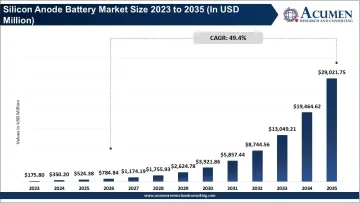
The global silicon anode battery market size was valued at USD 524.38 million in 2025 and is projected to reach USD 29,021.75 million by 2035, expanding at a compound annual growth rate (CAGR) of 49.4% during the forecast period from 2026 to 2035. Rapid investment in EV production and localized battery supply chains across Asia Pacific, North America and Europe is accelerating commercialization of silicon-anode technologies, particularly silicon-carbon and silicon-dominant architectures.
Report Highlights
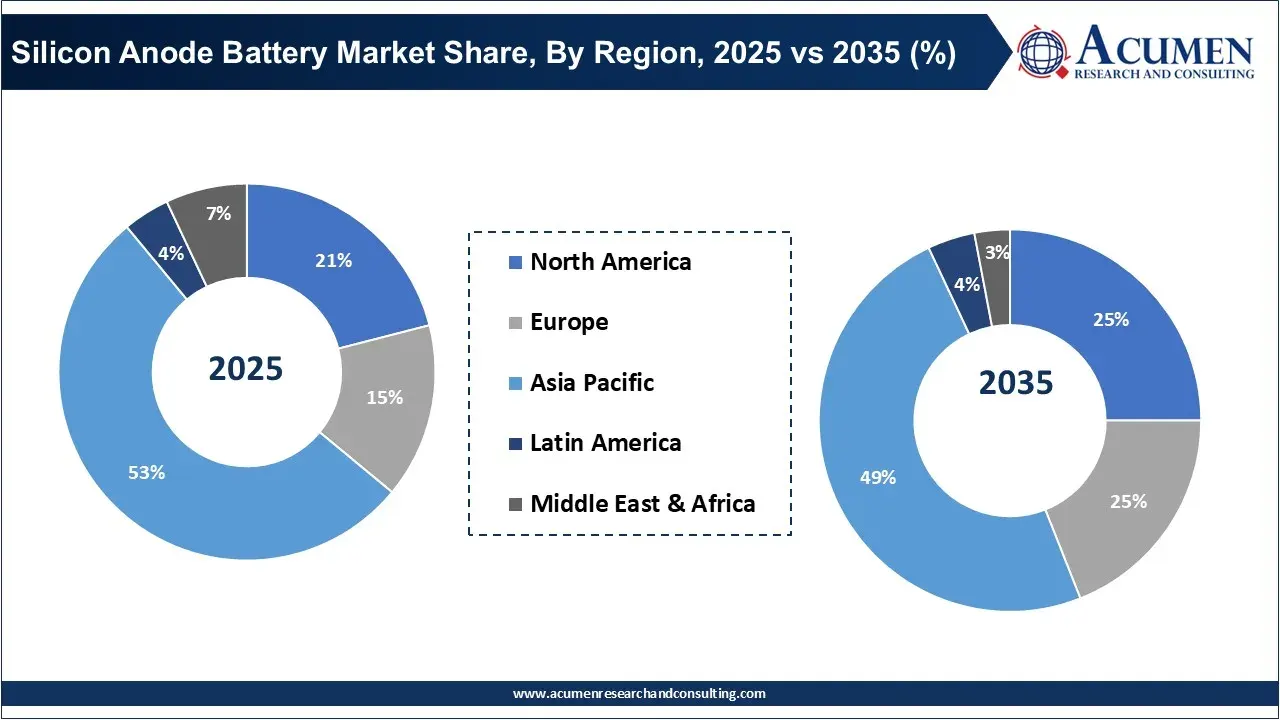
- By region, Asia Pacific dominated with a 53% share in 2025, supported by strong battery, EV, electronics and semiconductor manufacturing ecosystems.
- By region, Europe accounted for 15% in 2025 and is projected to record the fastest regional growth at a 53.3% CAGR, supported by EV battery localization and gigafactory investments.
- By technology, silicon-carbon dominated the market with a 57% share in 2025, supported by its ability to improve silicon's mechanical stability and reduce volume expansion.
- By technology, silicon oxide (SiOx) held the second-largest share at 23% in 2025, supported by its balance of high capacity and improved cycling stability.
- By battery capacity, 2,500–5,000 mAh dominated with a 37% share in 2025, driven by demand from smartphones, laptops, tablets and other portable electronics.
- By battery capacity, 1,500–2,500 mAh held the second-largest share at 25% in 2025, supported by demand for compact and lightweight battery systems.
- By cell format, pouch dominated with a 46% share in 2025, benefiting from its lightweight construction, high space utilization and flexible design.
- By cell format, cylindrical held the second-largest share at 42% in 2025, supported by standardized manufacturing and increasing use in EVs and other high-performance applications.
- By application, automotive dominated with a 38% share in 2025, driven by demand for higher energy density, longer driving range and improved EV battery efficiency.
- By application, consumer electronics held the second-largest share at 36% in 2025, supported by the growing use of silicon-carbon batteries in smartphones, laptops, tablets and wearables.
Silicone Anode Battery Market Overview
The silicon anode battery market is experiencing growth due to the increasing demand for high energy density in the electronics and automotive industries. According to Grepow Blog, silicon can store much more energy than traditional graphite anodes, with a theoretical capacity of around 4200 mAh/g, compared to 372 mAh/g for graphite. This significant gap means silicon can hold far more lithium within the same space, which results in improved performance and increases the energy density of lithium-ion batteries. In addition, growing investments by the automotive industry, battery producers, and technology startups aimed at enhancing battery performance and reducing charging time are significantly accelerating the adoption of silicon anode batteries.
Another major growth factor is the global shift toward electrification and clean energy, supported by government regulation incentives, and carbon reduction targets. Rapid expansion of the electric vehicle market, combined with increasing demand for portable electronics and renewable energy storage solution is driving adoption of advanced battery technologies. At the same time, continuous improvements in silicon anode design are helping material expansion and improve cycle stability, making the batteries more reliable and suitable for large-scale commercial use.
Global Silicon-Anode Manufacturing Statistics
- At nearly 410,000 tonnes per year in 2025, China accounts for nearly 10.8% Y/Y of estimated silicon-carbon anode production. Production will rise further in 2026 as Shanshan Tech, Yuling and other suppliers increase their footprint.
- Several of China’s biggest anode makers-including Shanshan Tech, Yuling, BTR and Putailai-operate in both traditional graphite anode production and new silicon anodes (or silicon/graphite hybrid).
- Both of these players are now operational and operate 10,000 tonnes per year production lines, with Putailai adding a 10,000-tpy silicon-carbon and 2,100 tonnes per year silicon-oxide line on a larger 250,000-tpy of general anode production target in 2025 that expands from 200,000 tonnes per year of the general anode supply today and a goal of 350,000 tonnes per year by 2026.
- Other leading silicon and silicon-hybrid suppliers include Xinyang and Sinode Mego. Group 14 is developing production at a large Sanju, South Korea facility with initial capacity up to 2,000-tpy and expected by March 2026 to support EV-grade 10 GWh silicon-carbon–component, battery cell-volume of output.
- In South Korea Daejoo E.M has a large silicon oxide presence in its home nation starting with over 3,000 tonnes per year operational at that plant today, but will reach more than 100,000 tonnes per year by 2030.
Silicon Anode Battery Market Dynamics
Market Drivers
1. Rising Demand for High-Energy-Density-Batteries
The major driver of the silicon anode battery market is the growing need for batteries that can store more energy in the same or smaller space. Compared to traditional graphite anodes, silicon offers a much higher lithium storage capacity, which directly translates into longer shelf life of batteries and improves the performance. This is especially important for electric vehicles, smartphones, laptops, and wearable devices, where consumers expect longer usage time and fewer charging cycles. As industry continuously push for compact design with higher-performance silicon anode batteries, further essential role in driving market growth.
2. Rapid Expansion of the Electric Vehicle and Consumer Electronics Markets
The global shift towards electric vehicles is accelerating due to environmental concerns, fuel cost volatility, and strict emission regulations. EV manufactures are under pressure to improve driving range, charging speed, and battery efficiency while significantly increasing vehicle cost. Silicon anode batteries help address these challenges by enabling higher energy density and faster charging capabilities. At the same time, growing demand for premium smartphones, tablets, and portable electronics that require high-performance batteries further fuels adoption. This combination of demand from the automotive and electronics sectors acts as a strong and sustained driver for the market.
Market Restraints
1. Silicon Material Expansion and Battery Degradation Issues
Despite the advantages, silicon faces a major challenge related to volume expansion. During charging, silicon absorbs lithium and expands significantly, and then shrinks again during discharge. This repeated expansion and contraction can crack the anode, damage the internal battery structure, and reduce cycle life. As a result, batteries may lose their capacity, fail in durability expectations, and experience particle pulverization within the anode. This technical limitation slows large-scale commercialization and remains a major restraint for the market.
2. Limited cycle life compared to Graphite.
Although silicon anode batteries provide much higher energy density than graphite-based batteries, they generally suffer a shorter cycle life. During repeated charging and discharging silicon anode often experiences rapid capacity fading and reduced columbic efficiency, which means less charge is retained in each cycle. These reliability issues affect long-term battery performance, and restriction has and impact on long-term sustainability in demanding applications like electric cars.
Market Opportunities
1. Continuous Technological Advancements and Material Innovations
The leading improvements in silicon anode are becoming more scalable and economical due to advanced manufacturing technology like non-engineered structures and composite materials. These innovations help manage silicon technologies, improve cycle stability, and extend battery lifespan. By using this technology reduce performance risks and manufacturing challenges. This creates strong opportunities for silicon anode batteries to move beyond niche applications and enter mass-market segments such as mainstream EVs and consumer electronics.
2. Rising Need for Advanced Energy Storage and Clean Energy
The global shift toward renewable energy sources like solar and wind is increasing the demand for efficient and high-capacity storage systems. Energy storage plays a critical role in balancing supply and demand, especially for intermittent renewable sources. Silicon anode batteries offer higher storage capacity and better efficiency, which makes them attractive for stationary energy storage applications. As governments and utilities invest heavily in clean energy infrastructure, this creates long-term growth opportunities for the silicon anode battery market.
Silicon Anode Battery Market Regional Insights
- The North America silicon anode battery market size was valued at USD 110.12 million in 2025 and is projected to reach USD 7,255.44 million by 2035, expanding at a compound annual growth rate (CAGR) of 52.3% from 2026 to 2035.
- The Europe silicon anode battery market size was estimated at USD 78.66 million in 2025 and is expected to hit USD 5,514.13 million by 2035, growing at a CAGR of 53.3% from 2026 to 2035.
- The Asia-Pacific silicon anode battery market size reached at USD 277.92 million in 2025 and is forecasted to surpass USD 14220.66 million by 2035, at a CAGR of 48.1% from 2026 to 2035.
How Did Asia Pacific Dominate the Silicon Anode Battery Market in 2025?
Asia Pacific was the dominant force with 53% in 2025 in the silicon anode battery market. This leadership is driven by strong manufacturing ecosystems in Countries such as China, Japan, and South Korea, where major battery markets and electronics producers are heavily investing in silicon anode technologies. China in particular has develop a comprehensive supply chain and battery production infrastructure that supports large-scale deployment of silicon anode batteries, especially for electronic and consumer integration. Government policies promoting electric mobility, renewable energy integration, and technological innovation further strengthen the region's lead by encouraging both adoption and production.
Government Initiatives to Support the Silicon Anode Battery Market in Asian Countries
- China - Policies toward national new energy storage and advanced battery. China remains a key policy and regulatory player and favors advanced battery materials, high-energy-density cells and supply chains within the country. This favorable landscape aids in the commercialization of silicon-carbon anodes and high-energy-density cell manufacturing.
- South Korea - Support for its strategic battery industry. The rechargeable battery industry is one of South Korea's five national strategic technology initiatives and has been allocated $34 billion from a policy fund released in 2025. This policy funding aims to boost and support next generation cell commercialization efforts within its strategic industries including batteries.
- Japan - Support toward NEDO battery R&D initiatives. Japanese battery policies focus on the research of next generation LI-Ion technologies as well as advanced materials, increased energy density and battery performance thereby supporting the research and commercialization of silicon-based anodes.
- India - Support for its national program on Advanced Chemistry Cell (ACC) battery storage. Government funds of 18,100 crore were set aside under the ACC PLI scheme to fund domestic ACC manufacturing with 50GWh in total. As of December 2025, 40GWh was awarded to 4 different manufacturers and cumulative investment stood at 3,237crore-driving demand for anode active materials along with other battery components.
How is Europe Seen to Grow Rapidly During the Forecast Period?
Europe is recognized as the fastest-growing regional market with a promising CAGR of 53.3% during the forecast period, due to strong investment in domestic battery development, research and development initiatives, and supportive regulatory policies aimed at reducing carbon emissions and enhancing energy independence. Leading countries including Germany and United Kingdom are expanding their battery infrastructure, attracting in both domestic and international technology firms to scale up silicon anode production. Federal incentives and grants for clean energy and advanced battery technologies are encouraging rapid adoption across automotive energy storage applications.
Which Countries Are Leading Silicon-Anode Battery Development?
| Country | Silicon-Anode Battery Development Landscape |
|---|---|
| China | China leads the global commercialization of silicon-anode batteries, with 8 commercial-scale silicon-anode facilities in 2026. Its advantage comes from a large battery manufacturing ecosystem, established anode-material supply chains, and companies pursuing both silicon-carbon blends and higher-silicon architectures. |
| South Korea | South Korea is emerging as one of the strongest silicon-anode hubs, with 6 commercial-scale facilities in 2026, supported by major battery manufacturers, advanced materials companies, and a highly integrated electronics and battery supply chain. |
| United States | The U.S. has 3 commercial-scale silicon-anode facilities in 2026, supported by companies such as Sila Nanotechnologies and Amprius Technologies and growing government-backed investment in domestic advanced-battery production. |
| Japan | Japan remains an important silicon-anode development market because of its established automotive, electronics, and battery-materials industries. Companies including Panasonic are pursuing next-generation anode technologies, while Japan's broader battery R&D ecosystem provides a strong commercialization base. |
| United Kingdom | The UK has a smaller manufacturing footprint but maintains a strong silicon-anode R&D and technology-development position, particularly through Nexeon. The UK's 2025 battery technology roadmap identified silicon-blended anodes as one of the three innovations considered most ready for strong commercial opportunities in the country. |
Silicon Anode Battery Market Segmental Insights
Technology Insights
Silicon-carbon segment held the largest share of 57% in 2025, due to its ability to reduce the key limitations of pure silicon anodes. Combining silicon with carbon, this material improves mechanical stability and limits expansion during charging and discharging. This leads to better cycle life and long-term reliability, which are critical for accelerating the market applications. As manufacturers place greater emphasis on durability and readiness for large-scale production, adoption of this segment is increasing rapidly.
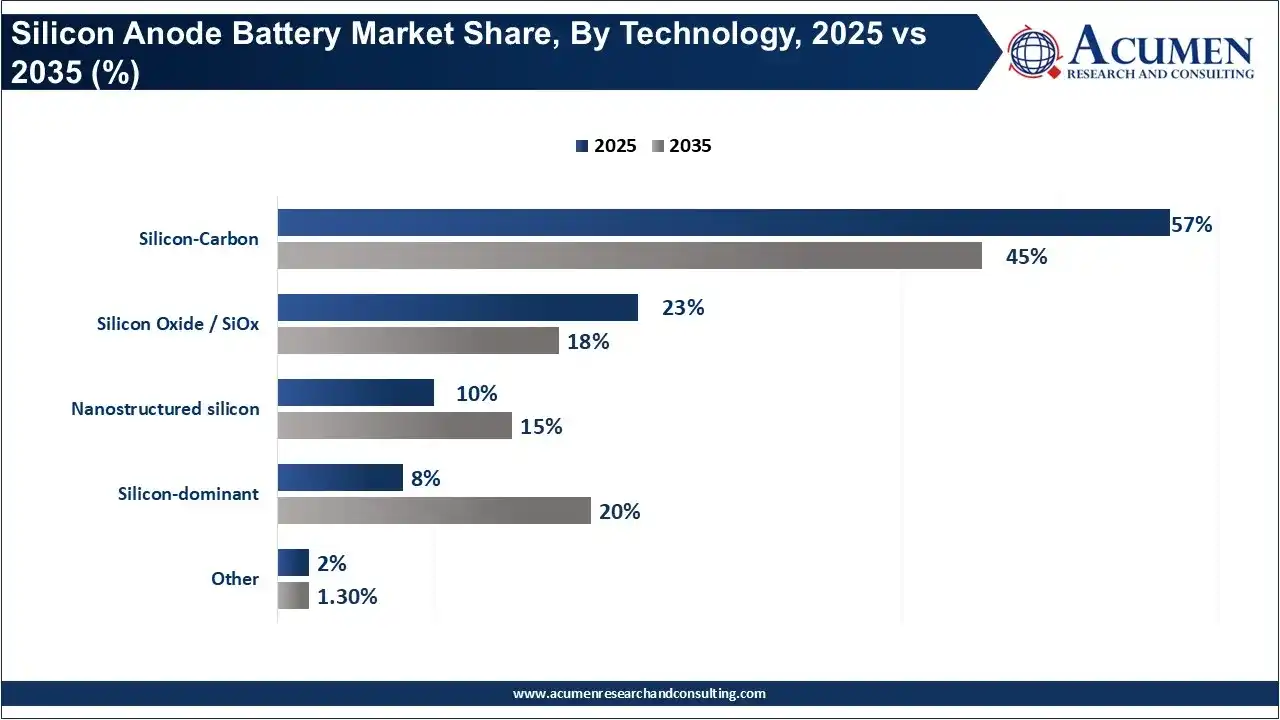
On the other hand, the silicon oxide segment held the second largest share of the market with 23% in 2025. Its adoption is supported by a practical balance between the high capacity potential of silicon and the improved cycling stability of oxide-based structures. SiOx can deliver substantially higher specific capacity than conventional graphite while limiting the extreme volume expansion associated with pure silicon; recent research places SiOx volume expansion at approximately 150%–200%, compared with roughly 300%–310% for pure silicon.
Battery Capacity Insights
The 2,500-5,000 mAH capacity segment dominated the market with the largest revenue at 37% share in 2025, reflecting its strong presence across smartphones, tablets, wearables, laptops, and other portable consumer-electronics applications. The segment benefits from silicon-anode technology's ability to increase energy storage without proportionally increasing battery size, making it particularly attractive for manufacturers seeking longer battery life while maintaining slim device designs. This trend is increasingly visible in smartphones: the global average smartphone battery capacity surpassed 5,000 mAh for the first time in 2025, rising 11% year over year, while approximately 6% of smartphones shipped globally in 2025 used silicon-carbon batteries.
| Battery Capacity | Revenue Share, 2025 (%) | Revenue Share, 2035 (%) |
|---|---|---|
| <1,500 mAh | 18% | 10% |
| 1,500–2,500 mAh | 25% | 14% |
| 2,500–5,000 mAh | 37% | 29% |
| 5,000–10,000 mAh | 8% | 14% |
| >10,000 mAh | 12% | 30% |
1,500 to 2,500 mAh segment held the second largest share of 25% in 2025, due to the increasing adoption in advanced consumer electronic devices, electric bikes, and portable power tools, which require higher energy storage without compromising on battery life or weight. The growth of the segment is also contributing to advancements in silicon anode technology that enable these batteries to maintain longer cycle life despite higher capacities. In addition, growing demand for lightweight and compact power solutions across personal mobility and industrial applications is driving market growth.
Cell Format Insights
Pouch segment formed the largest segment in the silicon anode battery market, with 46.0% of share in 2025. This leading segment is bolstered by lightweight design, high space utilization, and flexible cell design, attributes that makes cells more suitable for early-stage adoption applications where silicon-anode technologies are commercializing-in particular, smartphones, laptops, wearable devices, and high energy density battery systems.
Recent industry developments have further indicated continued development within the full format range: Sionic Energy was already shipping prototype cells in the pouch form factor by 2025 while simultaneously moving its silicon platform toward cylindrical pilot production.
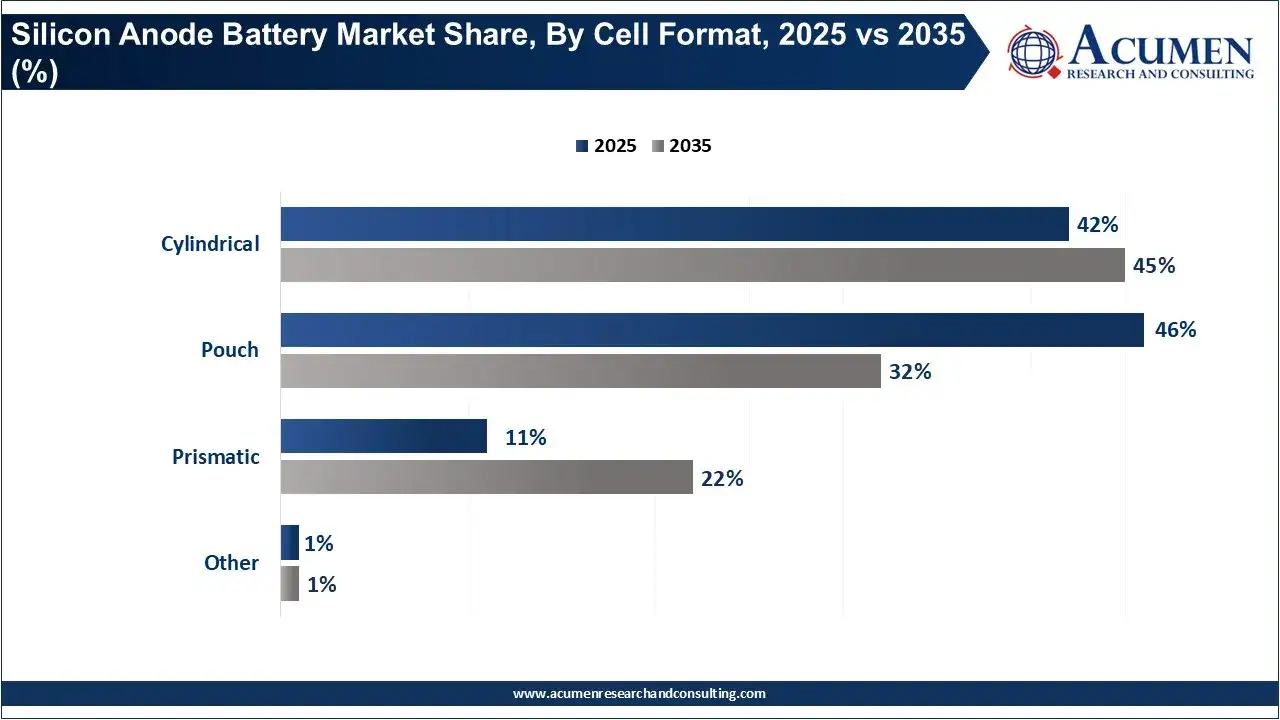
Cylindrical cells occupy the second-largest market share in 2025, capturing 42%. This format growth is facilitated by standardizations in cell manufacturing, enhanced mechanical endurance, a substantial existing industrial capacity, and suitability for demanding, high-performance applications such as EVs, drone systems, aviation, and much more.
In December 2025, for instance, Amprius stated that it had access to over 2 GWh in year-over-year production of its SiCore material across all format types including pouches, cylindrical format batteries and prismatic models.
Application Insights
Automotive segment dominated the silicon anode battery market with 38% market share in 2025, because of the increasing demand for silicon anode batteries apart from conventional batteries to meet the need for high energy density. Electric vehicles require qualities in their battery like high energy density, fast charging, and longer battery life. The growing adoption of electric vehicles, combined with government regulations aimed at reducing carbon emissions, is driving increasing demand for silicon anode batteries in this industry. In addition, automakers are investing heavily in battery innovation to enhance driving range and overall efficiency.
| Application | Revenue Share, 2025 (%) | Revenue Share, 2035 (%) |
|---|---|---|
| Automotive | 38% | 45% |
| Consumer Electronics | 36% | 25% |
| Energy Storage Systems (ESS) | 10% | 15% |
| Industrial | 5% | 7% |
| Aerospace & Defense | 4% | 5% |
| Medical | 2% | 2% |
| Others | 5% | 1% |
On the other hand, the consumer electronics segment held the second largest share of 36% in 2025 in silicon anode battery market; supported by the rapid adoption of silicon-carbon battery technology in smartphones, laptops, tablets, wearables and other compact electronic devices. Consumer electronics are an early commercial application because manufacturers can use silicon-based anodes to increase battery capacity without significantly increasing device size or weight. For example, silicon-carbon batteries can theoretically provide substantially higher anode capacity than graphite, with graphite at around 372 mAh/g compared with up to 4,200 mAh/g for pure silicon, although practical cell-level performance is considerably lower.
Energy & power is the fastest-growing segment in the market, which also held second largest share of 10% in 2025; due to increasing demand for high-capacity and efficient energy storage systems. Renewable energy sources such as solar and wind generate electricity intermittently, so they require reliable storage for balancing supply. Silicon anode batteries, with their higher energy density and longer cycle life, are well-suited for these energy storage systems. These energy storage systems are further fueled by rapid growth in microgrid setups and off-grid renewable energy projects.
Silicon Anode Battery Market Key Players
- Sila Nanotechnologies — Develops Titan Silicon, a silicon-based anode material designed to increase energy density and fast-charging performance while remaining compatible with conventional lithium-ion battery manufacturing.
- Amprius Technologies — Specializes in silicon-nanowire anode batteries targeting high energy and power density, with applications spanning aviation, drones, defense, and electric mobility.
- Group14 Technologies — Develops SCC55® silicon-carbon battery material and is scaling production for EVs, consumer electronics, data centers, and other high-performance applications; the company says it currently has 10 GWh of capacity online.
- Enovix Corporation — Develops batteries using a 100% silicon anode combined with its 3D cell architecture and BrakeFlow™ safety technology, initially targeting smartphones, wearables, IoT, and other high-energy-density applications.
- NanoGraf Corporation — Develops silicon-anode battery materials and high-energy lithium-ion cells, with a focus on improving energy density and performance for portable and specialized power applications.
- Enevate Corporation — Develops silicon-dominant anode technology designed to enable higher energy density and rapid charging, with applications across electric vehicles and consumer electronics.
- Nexeon Limited — Develops advanced silicon anode materials for lithium-ion batteries, focusing on improving energy density while addressing silicon's expansion and cycle-life challenges.
- Ningbo Shanshan Co., Ltd. — A major Chinese battery-materials manufacturer with established expertise in anode materials and silicon-based anode development, benefiting from China's large lithium-ion battery manufacturing ecosystem. Its competitive positioning reflects the growing integration of silicon materials into conventional anode supply chains.
- Hitachi Chemical Co., Ltd. — Develops advanced battery materials and anode technologies as part of its broader portfolio serving lithium-ion battery manufacturers and automotive applications.
- Panasonic Corporation — A major lithium-ion battery manufacturer pursuing higher-energy-density cell technologies, including the incorporation of silicon-based materials into next-generation battery designs for automotive applications.
- Samsung SDI Co., Ltd. — Invests in next-generation battery technologies and advanced anode materials to improve energy density, charging performance, and battery efficiency for EV and consumer-electronics applications.
- LG Energy Solution — Develops next-generation lithium-ion battery technologies and advanced electrode materials, including silicon-based anode approaches aimed at increasing energy density and supporting longer-range EV batteries.
Recent Developments
- In January 2025, NanoGraf launched its Onyx EV-ready silicon anode material, designed to enhance lithium-ion battery performance while maintaining cost parity with synthetic graphite, making it well-suited for electric vehicle applications.
- In July 2025, Enovix Corporation unveiled its AI-1 silicon-anode battery platform, offering a capacity of over 7,350 mAh and high energy density, and began supplying initial samples to leading smartphone manufacturers for evaluation and qualification.
Segments Covered
By Technology
- Silicon-Carbon
- Silicon Oxide / SiOx
- Nanostructured Silicon
- Silicon-Dominant
- Other
By Battery Capacity
- <1,500 mAh
- 1,500–2,500 mAh
- 2,500–5,000 mAh
- 5,000–10,000 mAh
- 10,000 mAh
By Cell Format
- Cylindrical
- Pouch
- Prismatic
- Other
By Application
- Automotive
- Consumer Electronics
- Energy Storage Systems (ESS)
- Industrial
- Aerospace & Defense
- Medical
- Other
By Region
- North America
- Europe
- Asia Pacific
- Latin America
- Middle East & Africa (MEA)
Looking for discounts, bulk pricing, or custom solutions? Contact us today at sales@acumenresearchandconsulting.com
Frequently Asked Questions

Other Energy and Power Reports
November 2024
February 2024
December 2024
April 2023