
Vanadium Redox Flow Battery Market Size, Report 2026 - 2035
Vanadium Redox Flow Battery Market (By Components: Electrolyte Tanks, Electrodes, Cell Stack, Pumps and Flow system, Power Conditioning; By Capacity: 501 kW to 5 MW, 100 to 500kW, Below 100kW; By Application: Energy Storage, Commercial & Industrial, Renewable Energy, Utility Services, Uninterrupted Power Supply (UPS), Others; By End User: Energy & Utilities, Power Generation, Automotive, Chemical, Others) - Global Industry Analysis, Size, Share, Analysis, Trends and Forecast 2026 - 2035
- Last Updated: 27 Jan 2026
- Report Code: ARC3900
- Category: Energy and Power
Vanadium Redox Flow Battery Market Size and Forecast 2026 - 2035
The global vanadium redox flow battery market size was valued at USD 495.43 million in 2025 and is projected to surpass around USD 3,058.12 million by 2035, expanding at a compound annual growth rate (CAGR) of 19.9% during the forecast period from 2026 to 2035.
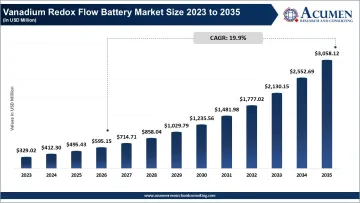
Vanadium Redox Flow Battery Market Highlights
- In 2025, Asia Pacific accounted for the largest market share of around 48% of global revenue in vanadium redox flow battery market.
- North America is projected to register the fastest CAGR of 21.1% from 2026 to 2035 in the vanadium redox flow battery market.
- By Components, the electrolyte tanks held the largest market share, representing around 40% of the total market.
- Based on Capacity, the 501 kW to 5 MW segment dominated the market with approximately 50% share, followed by 100 to 500kW with 30% market share.
- By application, the energy storage segment remained the largest market segment, holding around 42% of the market share in 2025.
Vanadium Redox Flow Battery Market Overview
The global vanadium redox flow battery market is beginning to accelerate commercially driven by the need for long-duration energy storage solutions to support renewable energy integration and grid stability. Currently, the market is shifting towards large scale energy storage system, for the achieve to net-zero carbon emissions, which forces fossil fuel based peaker plants to be replaced with sustainable solutions. Unique aspects of VRFBs, such as deep discharge without capacity loss, no appreciable self-discharge over long idle periods enable flexibility which is attractive to grid operators when reliability and life-cycle focus are prioritized.
Another major growth driver to the market is the strong investments momentum from public and private stakeholders, especially in regions focused on modernizing power grid infrastructure and scaling renewable energy capacity. The expansion of electric vehicle charging infrastructure and growing adoption of environment-friendly "green" data centers are expected to create secondary markets for vanadium redox flow battery (VRFB) systems whose attributes over lithium-ion cells will continue to be longevity and safety over energy density. In addition, government incentives and energy storage mandates are further accelerating VRFB market by reducing deployment risk and improving project economics.
Vanadium Redox Flow Battery Market Dynamics
Market Drivers
Growing Demand for Long-Duration Grid Energy Storage
- Globally, the transition to renewable energy has created a structural flexibility gap in power grids, which given that short-duration batteries cannot mitigate all aspects. As solar and wind generation penetration increases, grid operators need storage systems that can discharge energy for 6 to 12 hours to maintain grid stability during periods when power supply is low. The vanadium redox flow batteries indicates that they are suited for this application as their capacity is exclusively determined by the amount of electrolyte stored in external tanks. Because of their scalability, utilities can build safe, huge energy reserves without the risk of thermal runaway of lithium-ion batteries. For this rationale, the maturity of long-duration energy storage (LDES) is the predominant driver for market, especially for state and electric grid jurisdiction goals for renewables.
Global Shift to Renewable Energy Integration
- The shift toward variable renewable energy (VRE) into the macro-grid energy will require sophisticated "firming" capabilities to convert "as-available" power to "dispatchable" power. The utility of VRFBs in dealing with the frequent cycling required for renewable smoothing and peak shaving provides response time and durability, which is not available with lithium-ion batteries. Data shows multiple advantages for VRFBs provided they can operate at a wide range of temperatures and do not degrade over thousands of cycles compared to lithium-ion batteries that experience capacity loss multiple charge and discharge cycles. This movement is taking place globally but not merely on trend, rather it is defined as a regulatory mandate in many regions where the grid-code regulations require strict compliance for developers to invest in high-cycle-life storage technologies to guarantee system performance in excess of two decades.
Market Restraints
High Initial Capital Expenditure and Material Costs
- While the long-term value proposition of the vanadium redox flow battery (VRFB) is strong, but their high upfront cost is a big hurdle for wider adoption primarily due to high cost of vanadium pentoxide. The vanadium is the key material for steel industry and the change in its price is directly relevant to the global construction trends rather than battery demand, which adds a little price uncertainty and makes it harder for manufacturers to offer long-term price guarantees to the investors. Additionally, more specialized materials are needed for ion-exchange membranes, and to develop and maintain complex plumbing systems to circulate the electrolyte. As a result, the initial investment is much higher compared to lithium-ion batteries, making them less attractive from a cost perspective.
Electrical System Design and Electrolyte Management
- Vanadium redox flow batteries (VRFBs) are more complex than typical solid-state batteries as they rely on pumps, sensors, and thermal management systems to keep electrolyte in optimal condition. Hence, the complexity is also a restraint in itself and one which will require more specialized maintenance, and increasing the potential points of failure with such a complex system. The application of managing the electrolyte, specifically keeping balance between oxidation states, and mitigating cross-contamination across the membrane also requires complicated control algorithms. For these smaller scale users or users in the less-developed area, the periodic maintenance and footprint required by the large electrolyte tanks can be prohibitive for selected applications, which in turn, limits the technology's applications in low-maintenance and more confined footprint applications.
Market Opportunities
Next-Gen Membrane and Stack Efficiency
- A significant opportunity for market growth exists due to the next generation optimizing the efficiency of cell stack and ion-exchange membrane. There have been recent breakthroughs in membrane technologies that have resulted in increased proton conductivity and reduced vanadium all around, which is leading to increase in round-trip efficiency (RTE) and lower cost of operation. Additionally, improvements in electrode materials have helped to make alternative materials for carbon felt, which has been enhanced with nanomaterials for the upper range of power density for the stack. Many of these performance improvements will allow the manufacturers to optimize the amount of stationary material in the stack, and produce lighter and more powerful stacks.
Expansion of Microgrid Infrastructure in Emerging Economies
- The recent expansion of microgrid infrastructure, particularly in emerging economies, is driving significant growth in the vanadium redox flow battery market by increasing demand for reliable, scalable, and long-duration energy storage solutions. In areas with unreliable and inconsistent central grids, such as certain parts of Africa, South East Asia, and mining sites in parts of Australia and Canada, VRFBs have become an additional alternative to diesel generators for these promising areas. These systems can provide stable and long duration power, and do not pose the same fire threat profile. These factors could open opportunities for VRFBs to protect critical infrastructure such as hospitals, battery systems, and other emergency response types of assets. The increasing use of international "green" microgrid funding is driving the ability for renewables and storing energy.
Vanadium Redox Flow Battery Market Report Scope
| Attribute | Details |
|---|---|
| Vanadium Redox Flow Battery Market Size 2025 | USD 495.43 Million |
| Vanadium Redox Flow Battery Market Forecast 2035 | USD 3,058.12 Million |
| Vanadium Redox Flow Battery Market CAGR During 2026 - 2035 | 19.9% |
| Analysis Period | 2023 - 2035 |
| Base Year | 2025 |
| Forecast Data | 2026 - 2035 |
| Segments Covered | By Components, By Capacity, By Application, By End User, and By Geography |
| Regional Scope | North America, Europe, Asia Pacific, Latin America, and Middle East & Africa |
| Key Companies Profiled | Sumitomo Electric Industries, Dalian Rongke Power, UniEnergy Technologies, Invinity Energy Systems, VRB Energy, RedT Energy, Vionx Energy, Big Pawer Electrical Technology, H2 Inc., Australian Vanadium Limited, CellCube Energy Storage Systems (Enerox), and Primus Power Corporation |
| Report Coverage | Market Trends, Drivers, Restraints, Competitive Analysis, Player Profiling, Covid-19 Analysis, Regulation Analysis |
Vanadium Redox Flow Battery Market Regional Analysis
The Asia Pacific region dominated the global vanadium redox flow battery market, accounting for the largest share in 2025, driven by coordinated strategic efforts that control the raw material supply chain and aggressive state-level support for large-scale energy storage projects. Countries such as China, Japan, and South Korea are leading the adoption of VRFB systems for strong-scale energy storage, renewable energy integration, and long-duration storage applications. China has some of the largest vanadium resources in the world and fully integrated vanadium mining industry with battery manufacturing. Additionally, favorable energy transition policies and growing electricity demand across the region continue to reinforce Asia Pacific’s leadership position in the VRFB market.
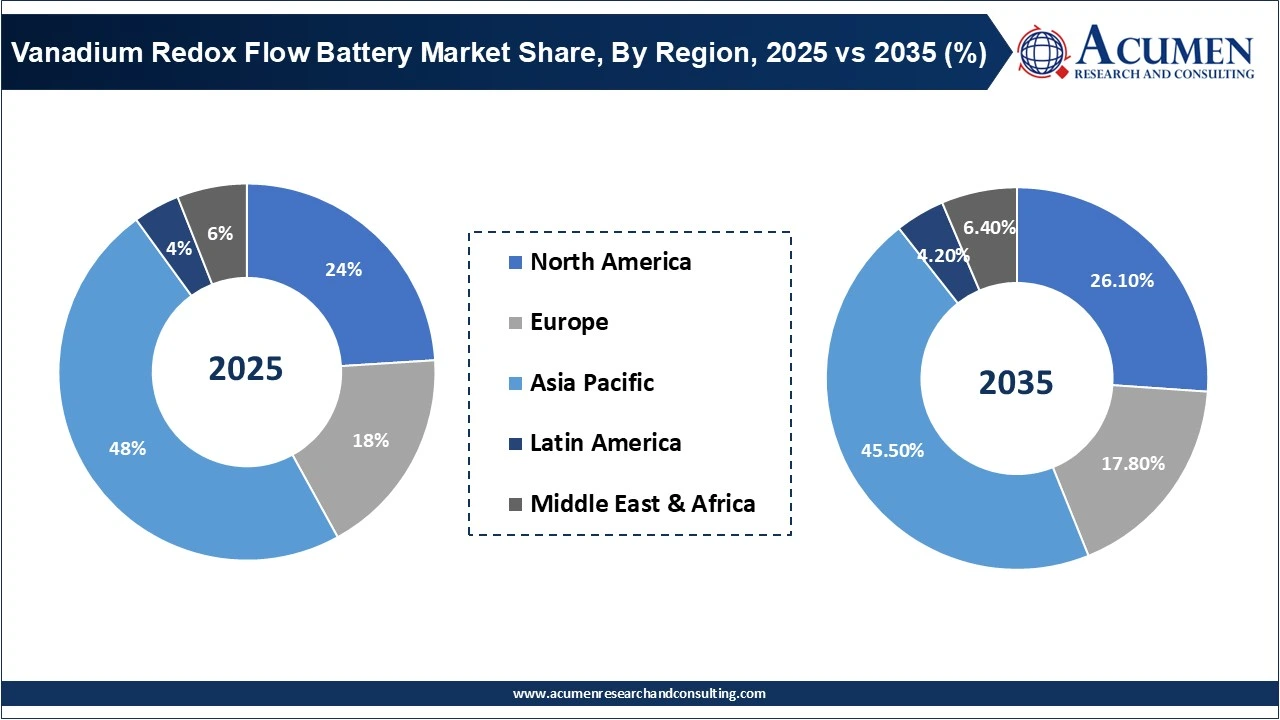
North America is expected to emerge as the fastest-growing regional market, driven by the need to modernize aging grid and achieve aggressive decarbonization targets in states like California and New York. These areas require long-duration storage to handle high solar penetration levels and replace retiring gas-fired plants. The focus on "Made-in-America" supply chains is allowing for local vanadium extraction and electrolyte processing, decreasing the overall dependence on foreign imports. As a result, North America is emerging as an innovation center for flow battery software and system integration, enabling it to be the primary competitor to Asia Pacific.
Vanadium Redox Flow Battery Market Segmental Insights
The worldwide market for vanadium redox flow battery is split based on components, Capacity, application, end-user and geography.
Components Insights
Electrolyte tanks segment held the largest share of around 40% in 2025 and lead the vanadium redox flow battery market. The energy capacity of a VRFB grows linearly with the volume of the electrolyte, hence large-scale utility projects require storage tanks that are capable of holding vanadium-bearing liquid. As the market progresses toward longer discharge times moving away from system, the footprint of the tanks used to contain the electrolyte grows considerably. Additionally, the specialized linings that resist the acidic electrolyte will make up a significant portion of the hardware budget for installing any VRFB. It is likely that vanadium electrolyte tanks will remain the largest component expenditures as long as there is a market focus on bulk energy shifting compared to high energy density.
| Components | Market Share, 2025 (%) | Key Highlights |
|---|---|---|
| Electrolyte Tanks | 40% | High share driven by electrolyte volume determining energy capacity and representing a major portion of system cost in long-duration storage projects |
| Electrodes | 25% | Growth supported by material innovations (graphene, advanced carbon) improving efficiency, lifespan, and overall battery performance |
| Cell Stack | 20% | Demand driven by its critical role in power output, efficiency, and system scalability |
| Pumps and Flow System | 10% | Required for continuous electrolyte circulation and stable battery operation |
| Power Conditioning | 5% | Adoption supported by increasing need for grid integration, monitoring, and energy management |
The electrodes is the most rapidly advancing segment in the market as electrode is the physical site of the electrochemical reaction, and the performance of the electrode drives the efficiency and power output of the battery. The market is advancing rapidly toward carbon based electrodes and surface-treated graphite felts that have increased surface area, improved reaction kinetics, and improved overall electrode performance and efficiency. This increase in the electrodes capability is due to the desire to increase the current density of cell stacks, which reduces overall cell stack size for the same Capacity. As the competition among manufacturers increases, the round-trip efficiency and investment in high-performance electrode materials is out-pacing other component categories.
Capacity Insights
The 501 kW and 5 MW Capacity segment dominated the global vanadium redox flow battery market, supported by strong demand for large-scale energy storage solutions across utility and renewable energy projects. The data indicates that most current pilot programs and early utility deployments are aligned with this Capacity range as it provides a level of grid impact while managing capital risks. These systems are often modular so if a project has larger UI-based power needs, then developers can simply connect multiple systems in parallel. The superiority of 501 kWh to 5 MW systems is reflection of the fact that current market demand on VRFBs is on the "front of the meter" application by improving and maintaining local substation reliability.
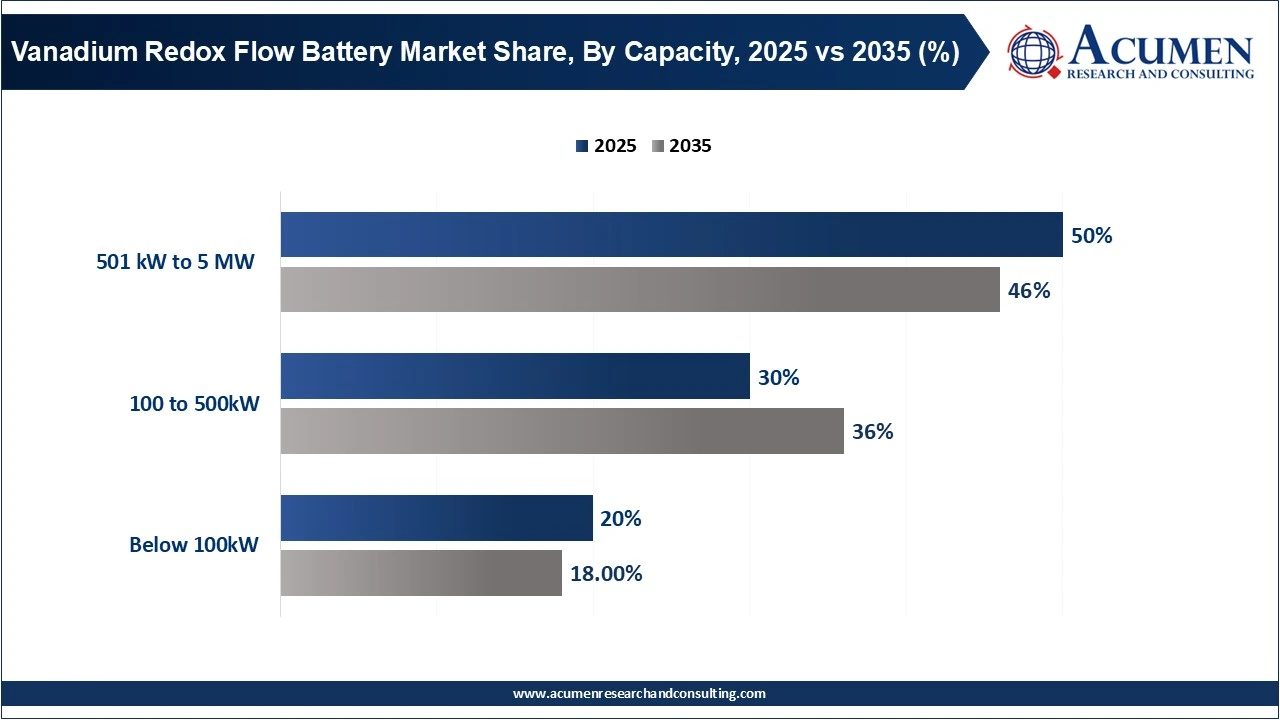
100 to 500 kW segment is witnessing comparatively faster growth, especially in decentralized energy systems and high-end industrial backup space. While not as large as the multi-megawatt utility systems, these units play a critical role in behind-the-meter applications, providing a business or small energy community the required energy independence. This segment largely consists of standardized containerized solutions that can easily be delivered and installed at industrial sites. This space continues to be strong with growing "peak shaving" demand, especially in manufacturing sectors where companies can put a number to demand charges and earn ROI quickly. These systems are viewed as a bridge between residential scale storage and utility scale networks.
| Capacity | Market Share, 2025 (%) | Key Highlights |
|---|---|---|
| 501 kW to 5 MW 50% | 50% | Dominance driven by large-scale grid storage, renewable integration, and utility-level deployments |
| 100 to 500 kW | 30% | Adoption supported by growing commercial, industrial, and microgrid installations |
| Below 100 kW | 20% | Growth driven by pilot projects, distributed energy systems, and small-scale backup applications |
Application Insights
The energy storage application segment led the market with 42% market share in 2025 of the total vanadium redox flow battery market. This is primarily due to the utility operator value of VRFBs with safe, long-lasting, and ability to perform multiple cycles per day without degradation. Governments across the globe enacted or planned mandates for long duration storage of renewable generation, and the volume of VRFB deployments in the utility sector continues to outpace all other applications. Additionally, the long lifecycle and high safety profile of vanadium redox flow batteries make them a preferred choice for stationary energy storage projects, which reinforces sustained dominance of this application segment.
| Application | Market Share, 2025 (%) | Key Highlights |
|---|---|---|
| Energy Storage | 42% | High demand due to VRFB suitability for long-duration, high-cycle stationary energy storage |
| Commercial & Industrial | 25% | Adoption driven by peak shaving, energy cost optimization, and backup power needs |
| Renewable Energy | 15% | Growth supported by increasing integration of VRFBs with solar and wind power plants |
| Utility Services | 10% | Demand driven by grid stabilization, frequency regulation, and load balancing |
| Uninterrupted Power Supply | 5% | Use supported by need for safe, long-life backup power solutions |
| Others | 3% | Includes niche and emerging applications such as telecom and remote installations |
The Commercial and Industrial (C&I) segment is another significant market segment, as the corporates push for 24*7 carbon-free energy solutions. Large energy consumers, data centers, chemical plants, and mining are all turning to VRFBs to ensure power quality or to maximize the value of on-site generation from solar or wind. The lack of fire risk allows for easier permitting for inside or urban industrial environments. The commercial and industrial space also is seen as a wave in green branding by corporate entities. Corporate investment in long-lived, recyclable storage technologies will aid their environmental, social and governance (ESG) goals.
End User Insights
The energy and utilities sector dominated the market with 40% market share in vanadium redox flow battery market. This segment’s leadership is tied to the sector's long term investment horizon. Additionally, utility companies are responsible for macro-level stability of grid, and will only invest in proven safe, reliable storage for large scale renewable integration. The stronghold of this sector is already proving real large scale procurement contracts and massive flow battery "farms" that act as virtual power plants.
| End User | Market Share, 2025 (%) | Key Highlights |
|---|---|---|
| Energy & Utilities | 40% | Dominance driven by large-scale grid modernization and long-duration storage investments |
| Power Generation | 28% | Growth fueled by renewable and hybrid power plants integrating storage for dispatchability |
| Automotive | 14% | Adoption supported by energy storage needs in EV infrastructure and manufacturing facilities |
| Chemical | 6% | Use driven by demand for reliable, continuous power in energy-intensive operations |
| Others | 12% | Includes telecom, data centers, and infrastructure projects requiring stable backup power |
The power generation segent was the second largest market holding 28% market share in 2025 and is also estimated to grow at fastest pace during the forecast period. The growth in this segment is attributed to the power generation companies transitioning to "integrated" power plants where renewable energy developers include storage as part of the generation facility. By collocating VRFBs with wind or solar farms, they can avoid curtailment and sell the energy produced at the peak price, which may increase the project profitability. The independent power producers (IPPs) have begun choosing flow batteries over lithium-ion for long-duration energy storage (LDES), and a substantial increase in adoption is recorded in the generation segment.
Vanadium Redox Flow Battery Market Players
- Sumitomo Electric Industries
- Dalian Rongke Power
- UniEnergy Technologies
- Invinity Energy Systems
- VRB Energy
- RedT Energy
- Vionx Energy
- Big Pawer Electrical Technology
- H2 Inc.
- Australian Vanadium Limited
- CellCube Energy Storage Systems (Enerox)
- Primus Power Corporation
Vanadium Redox Flow Battery Market Recent Developments
- In February 2025, Sumitomo Electric Industries, Ltd. unveiled its advanced vanadium redox flow battery system at Energy Storage North America (ESNA) in San Diego, introducing a next-generation VRFB with up to a 30-year operational lifespan, 15% higher energy density, and an approximate 30% reduction in overall costs, aimed at enhancing long-duration and large-scale energy storage solutions.
- In May 2025, Invinity Energy Systems received approval for a 20.7 MWh vanadium redox flow battery project in the UK, backed by government funding, strengthening its presence in Europe’s long-duration energy storage market and supporting grid reliability and renewable energy integration.
Vanadium Redox Flow Battery Market Segmentation
By Components
- Electrolyte Tanks
- Electrodes
- Cell Stack
- Pumps and Flow system
- Power Conditioning
By Capacity
- 501 kW to 5 MW
- 100 to 500kW
- Below 100kW
By Application
- Energy Storage
- Commercial & Industrial
- Renewable Energy
- Utility Services
- Uninterrupted Power Supply (UPS)
- Others
By End User
- Energy & Utilities
- Power Generation
- Automotive
- Chemical
- Others
By Region
- North America
- U.S.
- Canada
- Europe
- U.K.
- Germany
- France
- Spain
- Rest of Europe
- Asia-Pacific
- India
- Japan
- China
- Australia
- South Korea
- Rest of Asia-Pacific
- Latin America
- Brazil
- Mexico
- Rest of LATAM
- The Middle East & Africa
- South Africa
- GCC Countries
- Rest of the Middle East & Africa (ME&A)
Looking for discounts, bulk pricing, or custom solutions? Contact us today at sales@acumenresearchandconsulting.com
Frequently Asked Questions

Other Energy and Power Reports
May 2025
December 2024
July 2026
August 2023