
Perovskite Solar Cell Market Size, Share, Forecast 2026 To 2035
Perovskite Solar Cell Market (By Type: Hybrid PSCs, Multi-Junction PSCs; By Structure: Mesoporous Perovskite Solar Cells, Planar Perovskite Solar Cells: By Product: Flexible Perovskite Solar Cells, Rigid Perovskite Solar Cells; By Method: Solution Method, Vapor-Deposition Method, Vapor-Assisted Solution Method; By Application: Solar Panel, BIPV, Smart Glass, Others; By End-Use: Energy & Utilities, Consumer Electronics, Automotive & Transportation, Aerospace & Defense, Agriculture, Construction, Others) - Global Industry Analysis, Size, Share, Regional Analysis, Trends and Forecast 2026 - 2035
- Last Updated: 10 Mar 2026
- Report Code: ARC3908
- Category: Energy and Power
Perovskite Solar Cell Market Size and Forecast 2026 - 2035
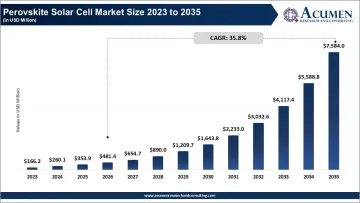
The global perovskite solar cell market size was reached at USD 353.90 million in 2025 and is expected to exceed around USD 7,584.04 million by 2035, expanding at a compound annual growth rate (CAGR) of 35.8% during the forecast period from 2026 to 2035.
Perovskite Solar Cell Market Report Highlights
- In 2025, Asia Pacific is projected to remain the largest regional market, accounting for over 40% of global revenue in the perovskite solar cell market.
- Dominating the market throughout the forecast period for Perovskite Solar Cells, Asia-Pacific region is also expected to be the fastest growing market, registering a CAGR of approximately 36.8% from 2026 to 2035.
- By Type, the hybrid PSCs held the dominant market position, representing 70% of the total market share.
- By Structure, the mesoporous perovskite solar cells lead the market, contributing 65% of the overall structure share.
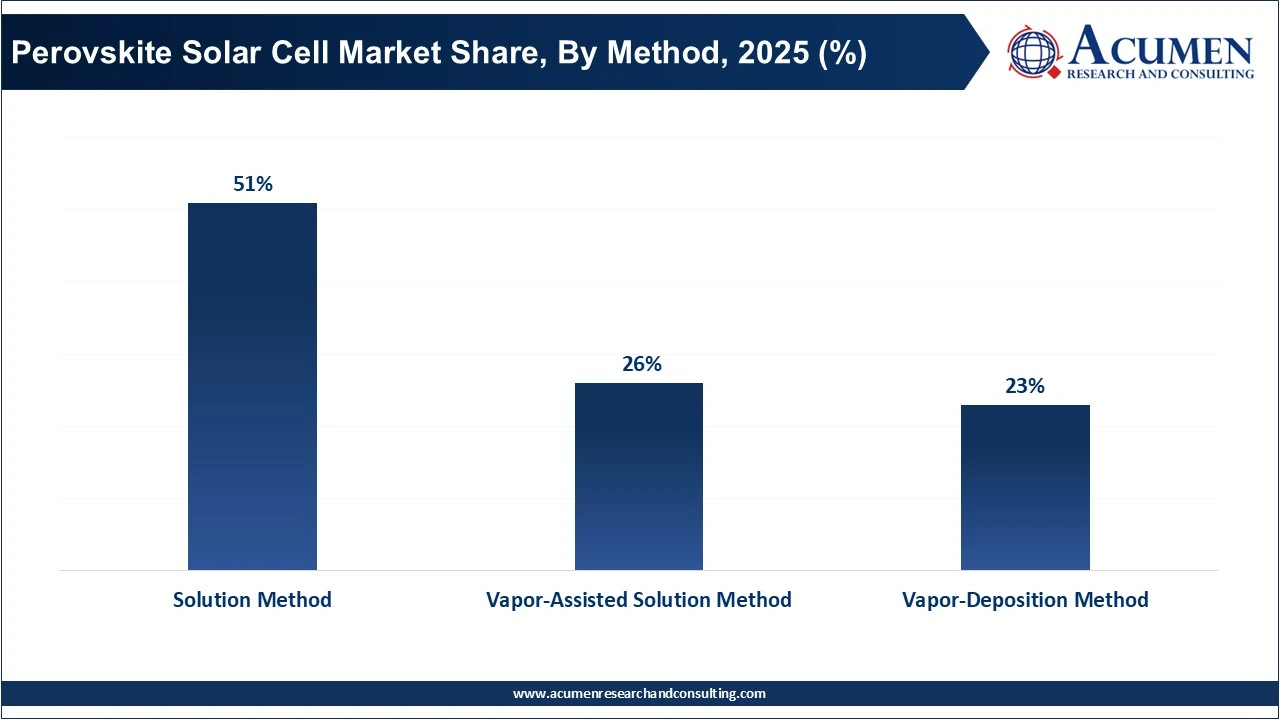
- By Method, the solution method account for the largest portion of market adoption, holding around 51% of the total share.
- By End-use, the energy & utilities sector is the largest end user of perovskite solar cells, representing approximately 40% market share in 2025.
Perovskite Solar Cell Market Overview
The perovskite solar cell market growth is primarily driven by the global shift towards renewable energy and urgent need to reduce carbon emissions. Governments across developed and developing economies are promoting clean energy adoption through supportive policies, funding programs, and long-term decarbonization targets, which is accelerating interest in next-generation solar technologies. Perovskite solar cells offer high power conversion efficiency at lower manufacturing cost compared to traditional silicon cells, making them attractive for both utility-scale and distributed energy applications. In addition, the relatively simple production processes, such as solution-based coating and printing, enable faster scaling and reduced capital investment, make it easier for new manufacturers and technology developers to enter and compete in the market.
Another major factor that impact perovskite solar cell market growth is the rapid advancement in perovskite material stability and durability, which has significantly improved the commercial readiness of this technology. Continuous research and development efforts are extending cell lifetimes, enhancing moisture and heat resistance, and addressing environmental concerns related to lead content. The rising adoption of perovskite-silicon tandem solar cells is also fueling market expansion, as these hybrid designs can deliver higher efficiency than standalone silicon panels while leveraging existing manufacturing infrastructure. Additionally, the growing demand for flexible, lightweight, and aesthetically adaptable solar solutions is opening new opportunities in building-integrated photovoltaics, consumer electronics, aerospace, and portable power applications.
Perovskite Solar Cell Market Dynamics
Market Drivers
Potential for High Power Conversion Efficiency
- A major driver of the perovskite solar cell (PSC) market is the rapid and significant advancement in power conversion efficiency (PCE), which enables the technology to generate substantially more electricity from the same surface area. Since 2009, the efficiency of perovskite solar cells has increased dramatically—from below 4% to over 25% for single-junction cells. Moreover, perovskite-based tandem cells have achieved efficiencies approaching 34%, positioning them among the most promising next-generation photovoltaic technologies.
- This remarkable progress is largely attributed to perovskites’ superior and tunable bandgaps, which allow precise optimization for better absorption of the solar spectrum. As a result, PSCs can deliver higher energy output per square meter compared to many conventional technologies. This enhanced performance not only improves overall system efficiency but also strengthens the return on investment for utility-scale solar projects by maximizing energy yield while potentially reducing balance-of-system costs.
Low-Cost Manufacturing and Raw Material Availability
- Another significant factor of the perovskite solar cell market growth is the low-cost manufacturing potential of perovskite cells and wide availability of its raw material, which together reduce production costs and support large-scale adoption. Unlike silicon cells, perovskite photovoltaics can be produced using low-temperature, high-throughput processes such as solution coating and vapor deposition, reducing energy and capital requirements. The materials used in perovskite synthesis are abundant and inexpensive, helping lower overall electricity generation costs. Additionally, compatibility with roll-to-roll production enables large-scale manufacturing, making perovskite technology a cost-effective and scalable solution for global energy demand.
Market Restraints
Limited Long-term Stability and Durability
- The most significant restraints facing the perovskite solar cell market is the limited long-term stability of the technology under real-world operating conditions. Perovskite materials are highly sensitive to environmental factors such as moisture, heat, oxygen, and ultraviolet radiation, which can cause rapid performance degradation over time. This stability raises concerns about the operational lifespan and reliability of PSCs compared to well-established silicon, which are proven to last 25 years or more. For utility-scale developers and investors, uncertainty around long-term performance increases financial risk, slows down large-scale deployment, and delays regulatory certification and widespread commercial adoption.
Environment and Regulatory Concerns Related to Lead Content
- Another major restraint is the environmental and regulatory challenges associated with the use of lead in most high-performance perovskite formulations. Although the amount of lead used is relatively small, the potential risk of leakage during manufacturing, operation, or disposal raises concerns regarding environmental safety and human health.
- These concerns can lead to strict regulatory scrutiny, increased compliance costs, and delayed market entry, particularly in regions with stringent environmental regulations. As a result, manufacturers must invest significantly in advanced encapsulation technologies and lead-reduction or lead-free alternatives. This adds complexity and increases production costs, thereby restraining the pace of commercialization.
Market Opportunities
Expansion of Perovskite-Silicon Tandem Solar Cells
- One of the most promising opportunities in the perovskite solar cell market lies in the development and commercialization of perovskite–silicon tandem solar cells. By layering a perovskite cell on top of a conventional silicon cell, manufacturers can significantly enhance overall power conversion efficiency without requiring a complete overhaul of existing silicon manufacturing infrastructure.
- This approach enables solar developers to generate more electricity from the same surface area, which is particularly valuable in regions where land availability is limited or installation space is constrained. As conventional silicon technology approaches its theoretical efficiency ceiling, tandem architectures provide a clear and practical pathway to achieving higher performance levels.
- Consequently, perovskite–silicon tandem technology is attracting strong interest from utilities, photovoltaic manufacturers, and investors seeking scalable, next-generation solar solutions with improved efficiency and long-term commercial potential.
Growing Demand for Flexible and Lightweight Solar Applications
- Another major opportunity comes from the rising demand for lightweight, flexible, and design-friendly solar solutions that traditional silicon panels cannot provide, enabling their integration into building facades, windows, curved surfaces, wearable electronics, and portable power devices. This flexibility opens entirely new application areas such as building-integrated photovoltaics (BIPV), smart infrastructure, aerospace systems, and Internet of Things (IoT) devices. As urbanization and smart city development accelerate, the ability of perovskite technology to blend energy generation with everyday structures positions it as a key enabler of future decentralized and integrated solar energy systems.
Perovskite Solar Cell Market Report Scope
| Attribute | Details |
|---|---|
| Perovskite Solar Cell Market Size 2025 | USD 353.90 Million |
| Perovskite Solar Cell Market Forecast 2035 | USD 7,584.04 Million |
| Perovskite Solar Cell Market CAGR During 2026 - 2035 | 35.8% |
| Analysis Period | 2023 - 2035 |
| Base Year | 2025 |
| Forecast Data | 2026 - 2035 |
| Segments Covered | By Type, By Structure, By Product, By Method, By Application, By End Use, and By Geography |
| Regional Scope | North America, Europe, Asia Pacific, Latin America, and Middle East & Africa |
| Key Companies Profiled | Oxford PV, Saule Technologies, Microquanta Semiconductor, GCL Suzhou Nanotechnology Co., Ltd., Greatcell Energy, Hunt Perovskite Technologies, Energy Materials Corp, BASF SE, FUJIFILM Wako Pure Chemical Corporation, Panasonic Corporation, Dyenamo AB, and Frontier Energy Solution |
| Report Coverage | Market Trends, Drivers, Restraints, Competitive Analysis, Player Profiling, Covid-19 Analysis, Regulation Analysis |
Perovskite Solar Cell Market Regional Analysis
The Asia-Pacific region dominated the perovskite solar cell market with 40% market share in 2025 due to its strong manufacturing ecosystem, large-scale solar deployment, and aggressive investments in next-generation energy technologies. Countries such as China, Japan, and South Korea lead in perovskite research, pilot production, and early commercialization, supported by established solar supply chains and cost-efficient manufacturing capabilities. The regions also benefit from abundant access to raw materials, low production costs, and government-supported renewable energy targets that encourage rapid adoption of advanced solar technologies. Additionally, the Asia-Pacific's high electricity demand and large-utility-scale solar projects create favorable conditions for integrating high-efficiency perovskite and tandem solar solutions, reinforcing its dominant market expansion.
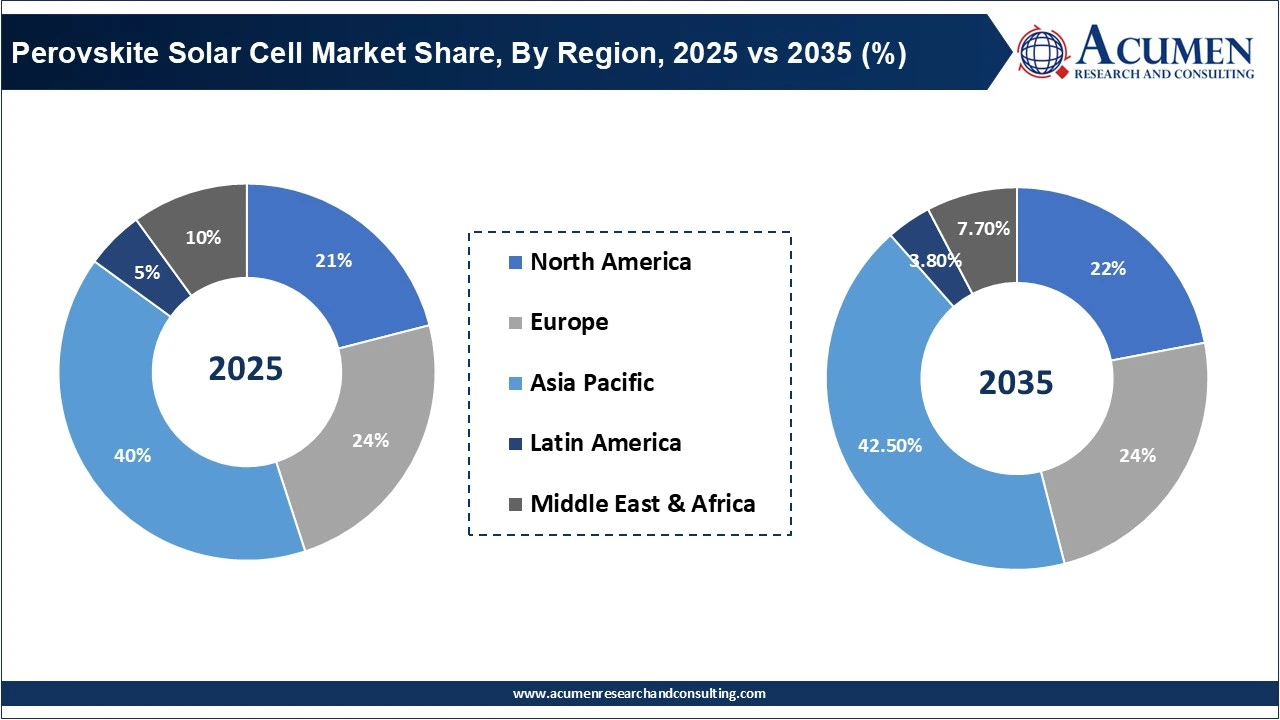
Asia Pacific is also the fastest-growing regional market for perovskite solar cell adoption, driven by strong policy support, advanced research infrastructure, and a clear focus on sustainable and high-efficiency energy solutions. Governments across the region are actively promoting renewable energy deployment through subsidies, favorable regulatory frameworks, and ambitious carbon neutrality targets, which are accelerating the adoption of next-generation solar technologies.
In addition, the presence of major photovoltaic manufacturing hubs, particularly in countries such as China, Japan, and South Korea, provides a strong industrial base for scaling perovskite production and integrating tandem technologies into existing supply chains. Increasing investments in research and development, coupled with rising electricity demand and rapid urbanization, further strengthen the region’s growth prospects.
As a result, Asia Pacific is expected to play a pivotal role in both technological innovation and large-scale commercialization of perovskite solar cells over the coming decade.
- The North America perovskite solar cell market size was valued at USD 74.32 million in 2025 and is expected to surpass around USD 1,668.49 million by 2035, expanding at a CAGR of 36.5% from 2026 to 2035.
- The Europe perovskite solar cell market size was accounted for USD 84.94 million in 2025 and is expected to reach around USD 1,820.17 million by 2035, growing at a CAGR of 35.8% from 2026 to 2035.
- The Asia-Pacific perovskite solar cell market size was estimated at USD 141.56 million in 2025 and is anticipated to hit around USD 3,223.22 million by 2035, expanding at a CAGR of 36.8% from 2026 to 2035.
Perovskite Solar Cell Market Segmental Insights
The global perovskite solar cell market is segmented based on type, structure, product, method, application, end-use and geography.
Type Insights
Hybrid perovskite solar cells currently dominate the perovskite cell market, accounting for 70% share because they offer the best balance between high efficiency, stability, and commercial readiness. By combining perovskite layers with established materials such as silicon, hybrid PSCs significantly improve power output while leveraging existing silicon manufacturing infrastructure. This compatibility reduces adoption risk for manufacturers and utility developers, enabling faster scaling and smoother integration into current solar supply chains. Additionally, hybrid design addresses some of the durability limitations of standalone perovskite cells, making them more stable for large-scale and long-term applications. As a result, hybrids PSCs are widely recognized as the most practical near-term solutions for commercial deployment.
| Type | Market Share, 2025 (%) | Key Highlights |
|---|---|---|
| Hybrid PSCs | 70% | Strong efficiency, stability, and compatibility with existing silicon infrastructure driving adoption. |
| Multi-Junction PSCs | 30% | Rapid growth due to higher efficiency potential and next-generation tandem applications. |
Multi-junction perovskite solar cells is the fastest-growing segment of perovskite solar cell market due to its exceptional efficiency potential and strong alignment with next-generation energy demands. These cells stack multiple light-absorbing layers, allowing them to capture a wider range of solar spectrum and achieve significant improvements in materials engineering and layer optimization, which are accelerating performance improvements, attracting strong interest from research institutions, aerospace applications, and high-value solar projects. As the industry increasingly prioritizes maximizing energy output per unit area, multiple junctions of PSCs are expected to play a key role in future high-efficiency solar systems.
Structure Insights
Mesoporous perovskite solar cells dominated the structural segment with 65% market share in 2025, due to their proven efficiency, strong charge transport properties, and extensive research validation. The mesoporous layer provides large surface area that enhances electron extraction and reduces recombination losses, resulting in table and high-performing devices. This structure has been widely adopted in early-stage commercialization and pilot projects, making it a familiar and trusted configuration that has positioned mesoporous architecture as the preferred choice for applications where reliability and efficiency are critical, supporting its dominant share in the current market.
| Structure | Market Share, 2025 | Key Highlights |
|---|---|---|
| Mesoporous Perovskite Solar Cells | 65% | Proven performance, stable charge transport, and reliability in early commercial deployments. |
| Planar Perovskite Solar Cells | 35% | Faster adoption due to simple fabrication, lower cost, and scalability for large-area modules. |
Planer perovskite solar cells are the fastest-growing structural segment because of their simpler design, lower manufacturing complexity, and superior scalability. Unlike mesoporous structures, planar cells eliminated the need for complex porous layers, enabling easier fabrication and better compatibility with low-cost, large-area production techniques. This simplicity supports faster production speeds and lower capital investments, which is particularly attractive for mass manufacturing. As the market shifts towards commercial-scale deployment and cost optimization, planar structures are increasingly favored, driving rapid adoption and making them a key growth engine in the evolving perovskite solar cell market.
Product Insights
Flexible perovskite solar cells dominated the product segment with 60% market share in 2025 due to their lightweight nature, mechanical flexibility, and brand applications potential. Unlike rigid glass-base modules, flexible PSCs can be integrated onto curves, uneven, or moving surfaces, making them slightly suitable for building-integrated photovoltaics, portable electronics, wearables, and aerospace applications. Their compatibility with low-temperature and roll-to-roll manufacturing processes further supports cost-efficient, high-volume production. As demand grows for adaptable and space-efficient solar solutions, flexible perovskite products continue to see wider adoption, reinforcing their leading position in the market.
| Product | Market Share, 2025 (%) | Key Highlights |
|---|---|---|
| Flexible Perovskite Solar Cells | 60% | Lightweight, adaptable, and suitable for building-integrated and portable applications. |
| Rigid Perovskite Solar Cells | 40% | Growing demand for durable modules in utility-scale and tandem solar projects. |
Rigid perovskite solar cells are the fastest-growing segment as commercialization efforts increasingly focus on high-efficiency, and long-lifetime solar modules. Built on stable substrates such as glass, rigid PSCs offer improved structural durability and easier encapsulation, which are critical for meeting reliability for tandem configurations with silicon, further accelerating adoption in utility and commercial projects. As manufacturers move from pilot production to large-scale modules, rigid perovskite solar cells are gaining momentum and driving rapid market growth.
Method Insights
Solutions segment dominated the market with around 51% share in 2025. It offers a cost-effective, scalable, and energy-efficient production pathway for perovskite solar cells. This approach uses liquid-based coating or printing technique that operate at low temperature, reducing energy consumption and equipment costs compared to conventional silicon processing. Due to its simplicity and economic advantages, the solution method remains the most widely adopted fabrication technique in the current perovskite solar cell market.
| Method | Market Share, 2025 (%) | Key Highlights |
|---|---|---|
| Solution Method | 51% | Low-cost, scalable, and energy-efficient processing method widely adopted in manufacturing. |
| Vapor-Assisted Solution Method | 26% | Balanced method offering improved film quality and moderate cost for commercial deployment. |
| Vapor-Deposition Method | 23% | Increasing use for high-efficiency, uniform films in tandem and multi-junction cells. |
Vapor-deposition method is the fastest-growing manufacturing approach due to its ability to deliver highly uniform, defect-controlled, and high-efficiency perovskite layers. This technique enables precise thickness control and superior film quality, which are essential for advanced applications such as tandem and multi-junction solar cells. Although capital-intensive, vapor deposition supports consistent large-area fabrication and improved solar performance and long-term reliability, adoption of vapor-desposition method is accelerating rapidly.
Application Insights
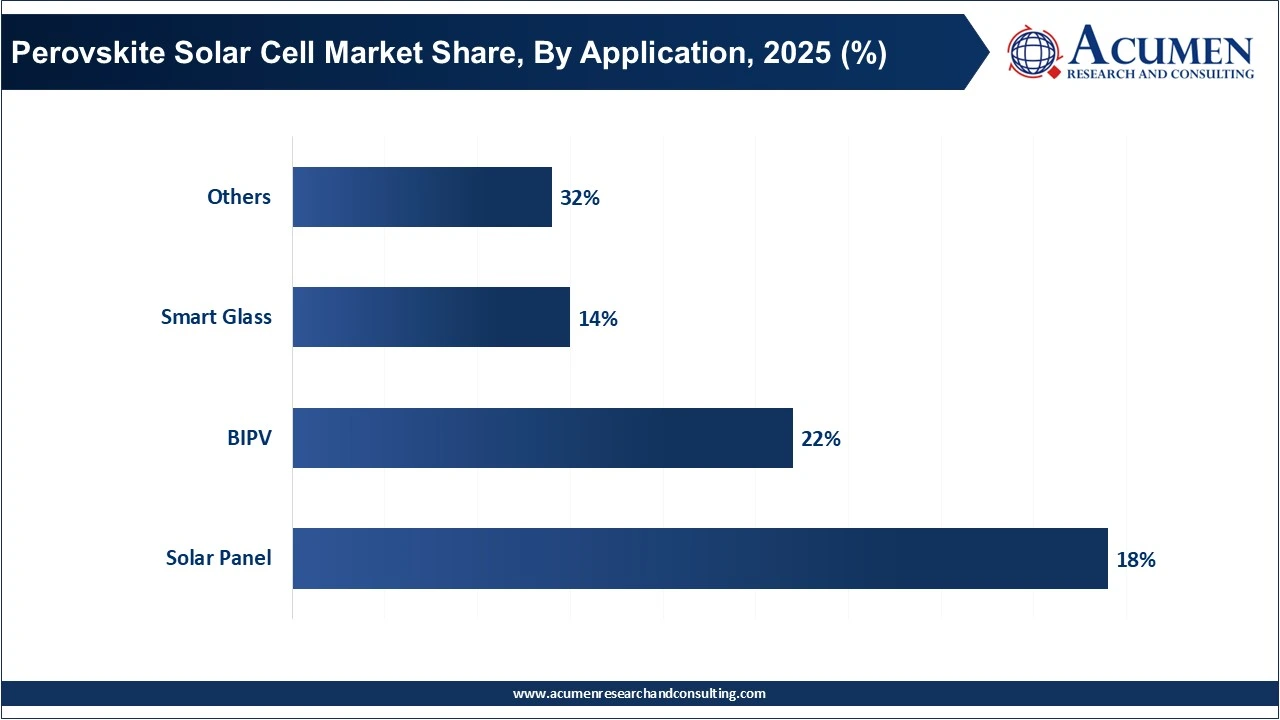
Solar panels represents the dominant segment in the perovskite solar cell market, accounting for around 44% market share due to their direct alignment with large-scale renewable energy generation. Perovskite technology is increasingly being adopted in traditional panel formats, particularly in tandem configuration with silicon, where it enhances overall efficiency without requiring major changes to existing infrastructure. Utility-scale projects prioritize high energy output, proven installation formats, and grid compatibility, all of which favor solar panel applications. As a result, solar panels remain the primary commercial pathway for perovskite solar cells, securing their leading position in the market.
| Application | Market Share, 2025 (%) | Key Highlights |
|---|---|---|
| Solar Panel | 44% | Dominant application due to utility-scale adoption and standardization in energy projects. |
| BIPV | 27% | Fastest-growing segment as flexible perovskite modules enable integration into facades and windows. |
| Smart Glass | 15% | Adoption driven by large-scale energy generation and grid-connected solar projects. |
| Others | 14% | Integration of semi-transparent modules in architectural designs and energy-efficient buildings. |
Building-integrated photovoltaics is the fastest-growing segment because perovskite solar cells enable seamless integration of energy generation into building materials. Their lightweight, flexible, and semi-transparent properties where transitional silicon panels are impractical makes them the preferred alternative. Rapid urbanization, green building standards, and smart city initiatives are accelerating the demand for multifunctional building materials. As developers seek energy-efficient and aesthetically adaptable solutions, BIPV applications are driving rapid growth for perovskite solar technologies.
End User Insights
Energy & utilities dominated the segment for perovskite solar cells with 40% market share in 2025 as it remains the core driver of global solar power deployment. Utilities and independent power producers are actively exploring perovskite-based solutions to increase efficiency and reduce the cost of electricity generation. The technological compatibility with large-area modules and tandem systems supports its generation into utility-scale solar farms and grid-connected projects. With the ongoing transition towards renewable energy and decarbonization goals, the energy sector continues to account for the largest share of perovskite solar cell consumption.
| End Use | Market Share, 2025 (%) | Key Highlights |
|---|---|---|
| Energy & Utilities | 40% | Dominant end-use due to large-scale solar deployment and renewable energy initiatives. |
| Consumer Electronics | 15% | Fastest-growing segment driven by demand for lightweight, flexible power solutions. |
| Automotive & Transportation | 11% | Solar roofs for EVs, buses, trains, and drones. |
| Aerospace & Defense | 9% | Lightweight, high-efficiency modules used in satellites and aircraft applications. |
| Agriculture | 7% | Agrivoltaics, greenhouses, solar-powered sensors. |
| Construction | 10% | Building-Integrated Photovoltaics (BIPV), smart windows, energy-generating facades. |
| Others | 8% | Niche applications like research, portable medical devices, and emerging technologies. |
Consumer electronics is the fastest-growing segment of perovskite solar cells market due to the rising demand for lightweight, compact, and energy-efficient power sources. Perovskite solar cells are well-suited, whereas traditional solar panels are too bulky or rigid. Their strong performance under low-light and indoor conditions further enhance suitable for electronic applications. As smart devices become more pervasive and energy autonomy becomes a key design requirement, customer electronics is emerging as a major growth area for perovskite solar cell market.
Perovskite Solar Cell Market Key Players
- Oxford PV
- Saule Technologies
- Microquanta Semiconductor
- GCL Suzhou Nanotechnology Co., Ltd.
- Greatcell Energy
- Hunt Perovskite Technologies
- Energy Materials Corp
- BASF SE
- FUJIFILM Wako Pure Chemical Corporation
- Panasonic Corporation
- Dyenamo AB
- Frontier Energy Solution
Perovskite Solar Cell Market Recent Developments
- In August 2025, Oxford PV achieved a new record by unveiling its next-generation perovskite-silicon tandem solar panel with nearly approximately 25% conversion efficiency, marking a significant performance milestone for commercial perovskite-silicon modules.
- In February 2025, Microquanta deployed perovskite modules in a large BIPV rooftop project in Shanxi, China, and achieved certified efficiencies around 21.86%, while building a gigawatt-scale production line.
Market Segmentation
By Type
- Hybrid PSCs
- Multi-Junction PSCs
By Structure
- Mesoporous Perovskite Solar Cells
- Planar Perovskite Solar Cells
By Product
- Flexible Perovskite Solar Cells
- Rigid Perovskite Solar Cells
By Method
- Solution Method
- Vapor-Deposition Method
- Vapor-Assisted Solution Method
By Application
- Solar Panel
- BIPV (Building-Integrated Photovoltaics)
- Smart Glass
- Others
By End-Use
- Energy & Utilities
- Consumer Electronics
- Automotive & Transportation
- Aerospace & Defense
- Agriculture
- Construction
- Others
By Region
- North America
- U.S.
- Canada
- Europe
- U.K.
- Germany
- France
- Spain
- Rest of Europe
- Asia-Pacific
- India
- Japan
- China
- Australia
- South Korea
- Rest of Asia-Pacific
- Latin America
- Brazil
- Mexico
- Rest of LATAM
- Middle East & Africa
- South Africa
- GCC Countries
- Rest of the Middle East & Africa (MEA)
Looking for discounts, bulk pricing, or custom solutions? Contact us today at sales@acumenresearchandconsulting.com
Frequently Asked Questions

Other Energy and Power Reports
March 2025
June 2026
April 2024
May 2020