
Quantum Dot Solar Cells Market Size, Share, Forecast 2026 - 2035
Quantum Dot Solar Cells Market (By Product Type: Quantum Dot Photovoltaic Cells, Quantum Dot Hybrid Solar Cells, Quantum Dot with Nanowire in Solar Cells; By Material: Cadmium-Based Quantum Dots, Cadmium-Free Quantum Dots; By Application: BIPV, Multi-Junction Solar Cell, Portable & Wearable Electronics, Single Junction Solar Cell, Transparent Smart Glass & Displays, Others; By End Use: Residential, Commercial, Industrial) - Global Industry Analysis, Size, Share, Analysis, Trends and Forecast 2026 - 2035
- Last Updated: 05 Jan 2026
- Report Code: ARC3886
- Category: Energy and Power
Quantum Dot Solar Cells Market Size and Forecast 2026 - 2035
The global quantum dot solar cells market size will reach from USD 1,489.9 million in 2025 to over USD 7,008.0 million by 2035 with at a CAGR of 16.9% from 2026 to 2035. The increasing demand for flexible, low-cost, and lightweight solar solutions is driving the growth or the quantum dot solar cells market. In addition, the increasing government support for advanced PV technologies is projected to create new growth opportunities for the market.
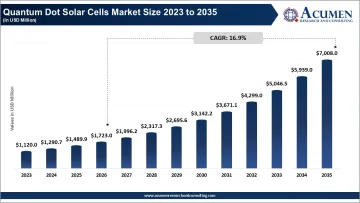
The quantum dot solar cells market is being rapidly driven by the increasing adoption of renewable energy and surge in the demand for consumer electronics and electricity. Stringent government regulations on the emission of carbon and restricted accessibility of fossil fuels generate the strong demand for efficient and cost-effective sources of energy including solar energy. Quantum dot solar cells are highly effective in comparison to other alternative technologies. Additionally, the introduction of innovative technology and growth in research and development activities are projected to propel the demand for quantum dot solar cells, which is expected to drive the growth of the market during the forecast period.
Report Highlights
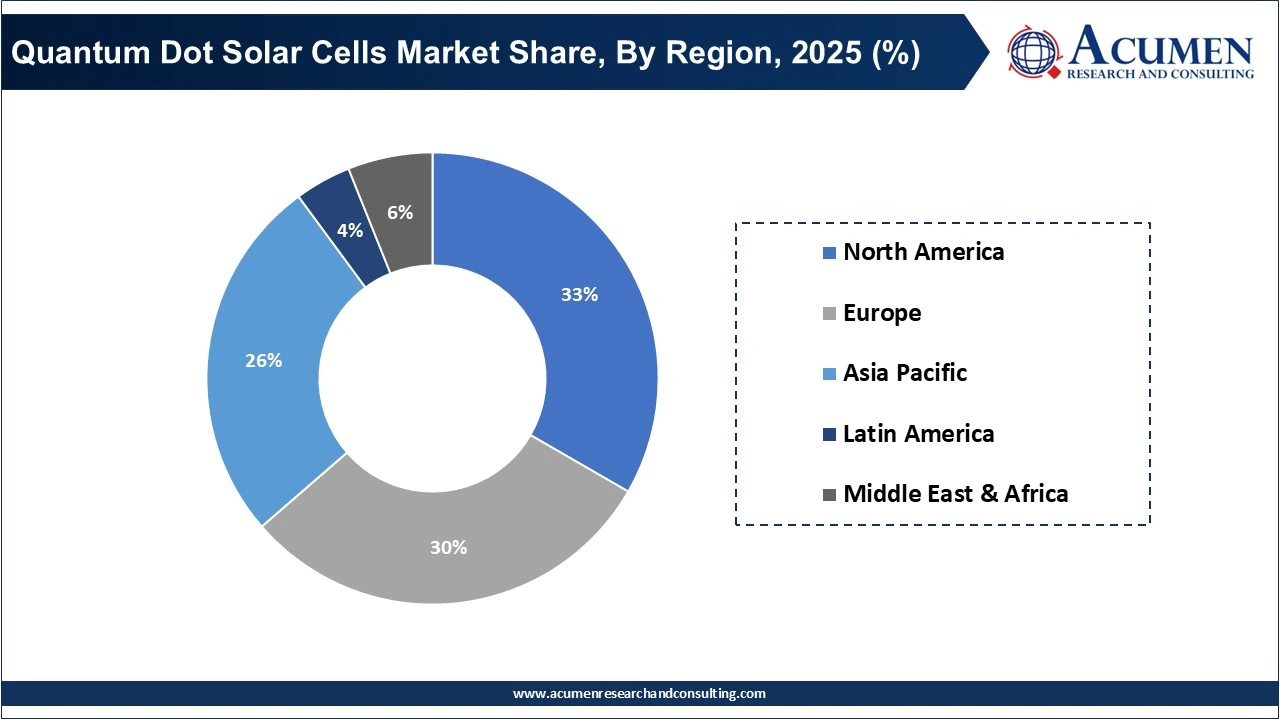
- By Region, the North American quantum dot solar cells market accrued a revenue of USD 495 million in 2025.
- By Region, the Asia-Pacific quantum dot solar cells market is projected to witness a lucrative growth rate of over 18.0% from 2026 to 2035.
- By Product Type, the quantum dot photovoltaic cells segment represents 56% of the total market share in 2025.
- By Material Type, the cadmium-based solar dots segment accounts for 65% of the total market share in 2025.
- By Application, Building Integrated Photovoltaics (BIPV) segment registers 34% of the total market share in 2025.
- By End Use, the residential sector represents 39% of the quantum dot solar cells market share in 2025.
Quantum Dot Solar Cells Market Dynamics
Market Drivers
Increasing Government Support for Advanced PV Technologies
- Increased public and private funding of nanotechnology, clean energy innovation, and next-generation solar materials is driving advances in quantum dot synthesis, stability, and scalability, strengthening the pathway to commercial deployment. According to the International Energy Agency, the solar PV technology is projected to account for a 15.7% share among other technologies in 2030.
Rising Environmental Awareness
- The rising awareness among market players and end-users regarding the adverse impact of alternative solar cells on environment is boosting the demand for quantum dot solar cells as it is renewable and environmentally friendly source of power. Similarly, the growth in the reliance on unconventional sources of energy has a positive market impact, which is projected to augment the demand of the quantum dot solar cells market.
Market Restraints
Stability and Degradation Concerns
- Quantum dot solar cells still face major challenges in terms of long-term stability, environmental sensitivity, and performance degradation under heat, moisture, and UV exposure. These limitations to durability are standing in the way of their ability to meet industrial reliability standards that delay large-scale commercialization and reduce investor confidence in their near-term deployment.
Environmental Concerns Linked to Cadmium
- Owing to the adverse environmental impact of cadmium or other elements, the governments are imposing stringent regulations which are projected to hinder the market demand of the quantum dot solar cells and restrict the growth of the market.
Market Opportunities
Technological Innovations
- Recent technological advancements have lessened the production costs of quantum dot solar cells, which is offering profitable opportunities to key market players in the market over the forecast period. Moreover, enhancement in infrastructural development initiatives and the increasing demand of consumer electronics is projected to further fuel the growth of the quantum dot solar cells market.
Rising Demand for High-resolution and Large Displays
- Over the recent years, there has been a significant increase in the demand for large-size and high-resolution displays owing to the reducing prices of LCDs and increasing demand for improved visual experience. Large-screen displays are becoming more reasonable owing to their reduced LCD prices. The emphasis of display manufacturers is proliferating on the development of 4K and 8k displays. In addition, there has been an increasing demand for quantum dots owing to their ability to enhance the quality of the display. The adoption of quantum dots in these display technologies offers numerous advantages including higher image frame rates, larger bit depth, and a wider color gamut which is projected to create new growth opportunities for the market.
Quantum Dot Solar Cells Market Report Scope
| Attribute | Details |
|---|---|
| Quantum Dot Solar Cells Market Size 2025 | USD 1,489.9 Million |
| Quantum Dot Solar Cells Market Forecast 2035 | USD 7,008.0 Million |
| Quantum Dot Solar Cells Market CAGR During 2026 – 2035 | 16.9% |
| Analysis Period | 2023 – 2035 |
| Base Year | 2025 |
| Forecast Data | 2026 – 2035 |
| Segments Covered | By Product Type, By Material, By Application, By End Use, and By Geography |
| Regional Scope | North America, Europe, Asia-Pacific, Latin America, and Middle East & Africa |
| Key Companies Profiled | Hanwha Group, Nanoco Group plc, HELIENE Inc., NNCrystal US Corporation, QD Solar Inc., Oxford Photovoltaics Ltd., Quantum Material Corporation, QUANTUM SOLUTIONS, UbiQD, and TFQD |
| Report Coverage | Market Trends, Drivers, Restraints, Competitive Analysis, Player Profiling, Covid-19 Analysis, Regulation Analysis |
Quantum Dot Solar Cells Market Regional Insights
Geographically, North America accounts for the largest share of the quantum dot solar cells market. This is attributed to the growing adoption of novel technology in the United States and Canada, coupled with increasing research and development activities in the region. North America plays an important role in the quantum dot solar cell market, driven by its strong commitment in the field of renewable energy. The residential and commercial sectors are increasingly deploying the quantum dot technology, especially with the favorable policy framework and incentive schemes by the governments of these countries. The region of North America benefits from proactive research and development activities, thereby ensuring continued improvement in the efficiency of the solar cells.
| Region | Market Share, 2025 (%) | Key Highlights |
|---|---|---|
| North America | 33% | The market growth is attributed to the growing adoption of novel technology in the United States and Canada, coupled with increasing research and development activities in the region. |
| Europe | 30% | Countries including France and Germany are driving the adoption of advanced solar technologies owing to their robust commitment to reduce carbon emissions. |
| Asia-Pacific | 26% | Growth in the region is largely driven by emerging economies such as China and India. These developing nations are investing heavily in renewable energy to tackle environmental concerns and achieve energy security. |
| MEA | 6% | Rising investments in advanced solar technologies to meet large-scale renewable energy goals are pushing early interest in quantum dot solar cells for high-efficiency, high-temperature applications. |
| Latin America | 4% | Increasing solar adoption in countries such as Brazil, Chile, and Mexico opens up opportunities for quantum dot solar cells, offering flexible and low-cost alternatives suitable for distributed generation and emerging BIPV markets. |
There is expected to be a considerable growth of the quantum dot solar cells market in the Asia-Pacific region. In Asia Pacific, the market is experiencing rapid urbanization and an increase in state-funded renewable energy drives. Growth in the region is largely driven by emerging economies such as China and India. These developing nations are investing heavily in renewable energy to tackle environmental concerns and achieve energy security. The huge manufacturing capacity and rising demand for energy-efficient solutions of the region make it a crucial market for quantum dot solar cells technology. Moreover, various government incentives and subsidies for the adoption of solar energy also favor the growth of the market.
Quantum Dot Solar Cells Market Segmental Insights
The worldwide market for quantum dot solar cells is split based on product type, material, application, end use, and geography.
Product Type Insights
Based on product type, the market is segmented into Quantum Dot Photovoltaic Cells, Quantum Dot Hybrid Solar Cells and Quantum Dot with Nanowire in Solar Cells.
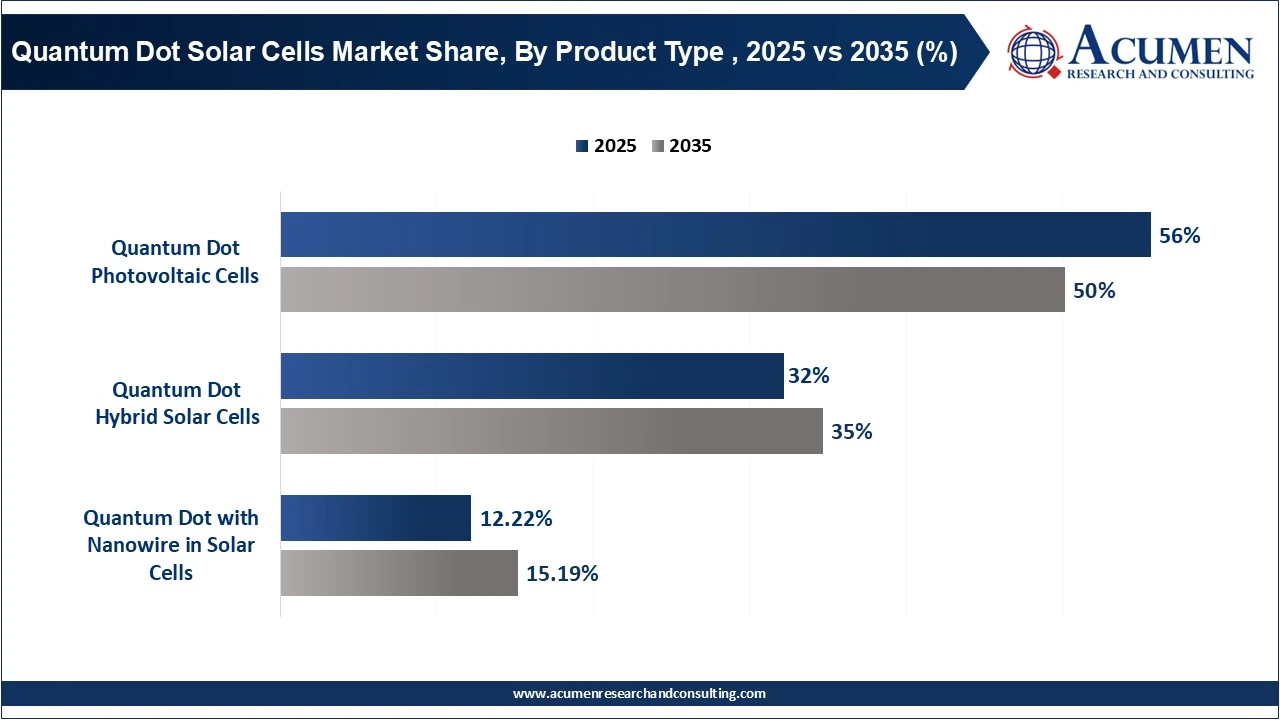
The quantum dot photovoltaic cells segment dominated the market. The dominance is attributed to the tunable bandgaps, superior light absorption ability, and compatibility of quantum dot photovoltaic cells with flexible substrates. These exceptional properties make the technology apt for a wide range of applications, such as building-integrated photovoltaics, portable power systems, and wearable electronics. Continuous improvements in stability and synthesis methods further improve its feasibility. As the demand for efficient and lightweight solar solutions grows, this segment is anticipated to maintain its dominant position in the market.
| Product Type | Market Share, 2025 (%) | Key Highlights |
|---|---|---|
| Quantum Dot Photovoltaic Cells | 56% | As the demand for efficient and lightweight solar solutions grows, this segment is anticipated to maintain its dominant position in the market. |
| Quantum Dot Hybrid Solar Cells | 32% | The rapid growth is driven by their exceptional ability to integrate quantum dots with other materials, including organic compounds, for enhancing the overall efficiency. |
| Quantum Dot with Nanowire in Solar Cells | 12% | This product type enables efficient transfer of photogenerated electrons with the help of nanowire. |
Material Insights
The cadmium-based quantum dots segment dominated the market. This dominance is due to their superior electronic and optical properties. This material offers improved efficiency in converting solar energy to electricity, making them desired for high-end solar applications. These quantum dots are comparatively mature in terms of integration into devices and synthesis. Nonetheless, their use is increasingly restricted by health and environmental concerns related to cadmium toxicity. Their performance is projected to sustain a robust market presence in certain applications despite regulatory challenges.
| Material | Market Share, 2025 (%) | Key Highlights |
|---|---|---|
| Cadmium-Based Quantum Dots | 65% | Dominant because of their superior electronic and optical properties. |
| Cadmium-Free Quantum Dots | 35% | This material addresses health and environmental concerns linked to heavy metals, thereby supporting securer and more sustainable solar technologies. |
Application Insights
The BIPV segment dominates the quantum dot solar cells sector. The ability of BIPV systems to integrate generation of energy with architectural elements makes it increasingly attractive for modern construction projects. BIPV contributes to energy efficiency while conserving a building’s structural function and aesthetics. Quantum dot technology improves BIPV by offering lightweight, flexible, and semi-transparent modules. This allows for wider use in windows, facades, and rooftops. The increasing demand for sustainable buildings and strict energy regulations is continuing to support its dominant position in the market.
| Application | Market Share, 2025 (%) | Key Highlights |
|---|---|---|
| Building Integrated Photovoltaics (BIPV) | 34% | The increasing demand for sustainable buildings and strict energy regulations is continuing to support its dominant position in the market. |
| Multi-Junction Solar Cell | 29% | These cells are specifically demanded by applications which requires maximum output of power in limited space, including specialty electronics and aerospace. |
| Portable & Wearable Electronics | 16% | The need for lightweight, flexible, and low-power solar harvesting systems is driving adoption of quantum dot cells in wearables and portable devices. |
| Single Junction Solar Cell | 9% | Advancements in quantum dot materials are enhancing performance and lowering production costs for single-junction designs. |
| Transparent Smart Glass & Displays | 7% | The emphasis of display manufacturers is proliferating on the development of 4K and 8k displays. |
| Others | 5% | Emerging applications including as sensors, IoT devices, and specialty electronics, are expanding commercial opportunities for quantum dot solar cell technologies. |
End Use Insights
Based on end use, the market is segmented into residential, commercial and industrial.
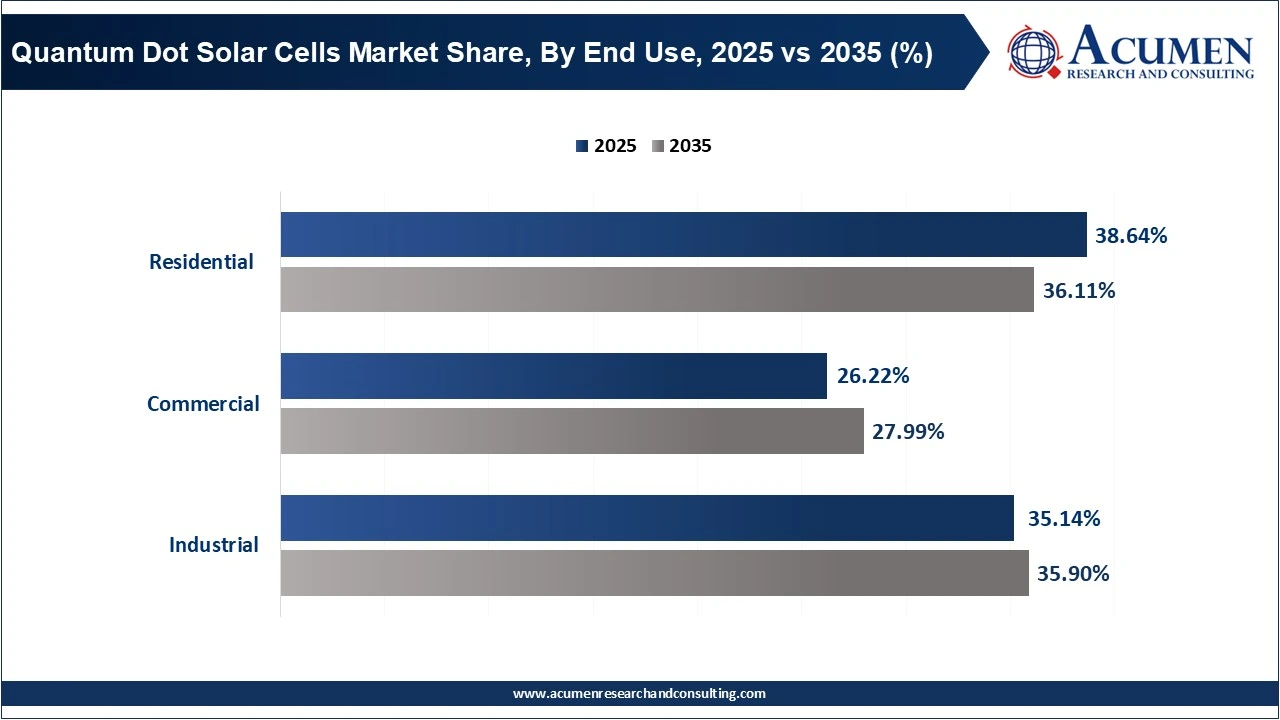
The residential segment is projected to dominate the industry. This is attributed to the increasing adoption by proprietors that are looking for sustainable and efficient energy solutions. The growing focus on renewable energy in residential areas is a key factor that is contributing to the market dominance. Furthermore, innovations in quantum dot technology have led to more affordable and efficient solar panels for home use. Resultantly, the residential sector is projected to continue leading the market in the upcoming years. This growth is further attributed to the shift towards energy independence among end users.
| End Use | Market Share, 2025 (%) | Key Highlights |
|---|---|---|
| Residential | 39% | The growing focus on renewable energy in residential areas is a key factor that is contributing to the market dominance. |
| Commercial | 26% | Corporate sustainability initiatives and government support is contributing to the market growth. |
| Industrial | 35% | Growing focus on energy-efficient manufacturing facilities is opportunistic for the market growth. |
Quantum Dot Solar Cells Market Players
- Hanwha Group
- Nanoco Group plc
- HELIENE Inc.
- NNCrystal US Corporation
- QD Solar Inc.
- Oxford Photovoltaics Ltd.
- Quantum Material Corporation
- QUANTUM SOLUTIONS
- UbiQD
- TFQD
Quantum Dot Solar Cells Market Segmentation
By Product Type
- Quantum Dot Photovoltaic Cells
- Quantum Dot Hybrid Solar Cells
- Quantum Dot with Nanowire in Solar Cells
By Material
- Cadmium-Based Quantum Dots
- Cadmium-Free Quantum Dots
By Application
- Building Integrated Photovoltaics (BIPV)
- Multi-Junction Solar Cell
- Portable & Wearable Electronics
- Single Junction Solar Cell
- Transparent Smart Glass & Displays
- Others
By End Use
- Residential
- Commercial
- Industrial
By Region
- North America
- U.S.
- Canada
- Europe
- U.K.
- Germany
- France
- Spain
- Rest of Europe
- Asia-Pacific
- India
- Japan
- China
- Australia
- South Korea
- Rest of Asia-Pacific
- Latin America
- Brazil
- Mexico
- Rest of LATAM
- The Middle East & Africa
- South Africa
- GCC Countries
- Rest of the Middle East & Africa (ME&A)
Looking for discounts, bulk pricing, or custom solutions? Contact us today at sales@acumenresearchandconsulting.com
Frequently Asked Questions

Other Energy and Power Reports
May 2025
December 2024
October 2020
February 2024