
Solid Oxide Fuel Cell Market Size, Share, Forecast Report 2025 To 2033
Solid Oxide Fuel Cell Market (By Type: Tubular, Planar; By Application: Transportation, Portable, Stationary; By End-User: Commercial, Data Centers, Military & Defence, Others) - Global Industry Analysis, Size, Share, Regional Analysis, Trends and Forecast 2025 To 2033
- Last Updated: 22 Apr 2026
- Report Code: ARC3915
- Category: Energy and Power
Solid Oxide Fuel Cell Market Size and Forecast 2025 - 2033
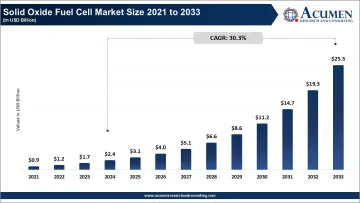
The global solid oxide fuel cell market size accounted for USD 3.05 billion in 2025 and is estimated to hit around USD 25.32 billion by 2033 growing at a CAGR of 30.3% from 2025 to 2033.
A solid oxide fuel cell (SOFC) is an electrochemical device that directly converts chemical energy from a fuel, usually hydrogen or hydrocarbons, into electricity via an oxidation process. It operates at high temperatures (typically between 600°C and 1,000°C), with a solid ceramic electrolyte transporting oxygen ions from the cathode to the anode.
This high-temperature operation enables SOFCs to achieve high efficiency and fuel flexibility, allowing them to run on a range of fuels including natural gas, biogas, and hydrogen. SOFCs are used in stationary power generation, combined heat and power (CHP) systems, and are increasingly being adopted for auxiliary and portable power applications.
Solid Oxide Fuel Cell Market Highlights
- The global solid oxide fuel cell (SOFC) market is projected to reach USD 25.32 billion by 2033, growing at a CAGR of 30.3% from 2025 to 2033.
- The Asia-Pacific SOFC market was valued at approximately USD 1.11 billion in 2024.
- The North America SOFC market is expected to grow at a CAGR of over 32% during the forecast period from 2025 to 2033.
- The stationary application segment dominated the market in 2024, holding 81% of the total market share.
- The commercial end-user segment accounted for 51% of the market share in 2024.
- A key trend in the SOFC market is the ongoing research and development aimed at enhancing efficiency, durability, and cost-effectiveness of the technology
Solid Oxide Fuel Cell Market Dynamics
Market Drivers
- High efficiency and fuel flexibility of solid oxide fuel cells (SOFCs)
- Growing demand for clean and sustainable energy solutions
- Government support and funding for hydrogen and fuel cell technologies
Market Restraints
- High initial cost and complex manufacturing processes
- Long start-up times and operational challenges at lower temperatures
- Limited commercial infrastructure for SOFC deployment
Market Opportunities
- Expanding applications in data centers and distributed power generation
- Integration with renewable energy sources and hydrogen economy
- Advancements in materials to enhance durability and reduce costs
Solid Oxide Fuel Cell Market Report Scope
| Attribute | Details |
|---|---|
| Solid Oxide Fuel Cell Market Size 2025 | USD 3.05 Billion |
| Solid Oxide Fuel Cell Market Forecast 2033 | USD 25.32 Billion |
| Solid Oxide Fuel Cell Market CAGR During 2025 - 2033 | 30.3% |
| Analysis Period | 2022 - 2033 |
| Base Year | 2025 |
| Forecast Data | 2025 - 2033 |
| Segments Covered | By Type, By Application, By End-User, and By Geography |
| Regional Scope | North America, Europe, Asia Pacific, Latin America, and Middle East & Africa |
| Key Companies Profiled | Cummins Inc., KYOCERA Corp., NGK Spark Plug Co., Ltd., Ningbo SOFCMAN Energy, General Electric, Ceres Power, Bloom Energy, Mitsubishi Power Ltd., AVL, Watt Fuel Cell Corp., and FuelCell Energy Inc. |
| Report Coverage | Market Trends, Drivers, Restraints, Competitive Analysis, Player Profiling, Covid-19 Analysis, Regulation Analysis |
Solid Oxide Fuel Cell Market Insights
Solid oxide fuel cells (SOFCs) offer excellent electrical efficiency and fuel versatility. According to the United Nations Economic and Social Commission for Western Asia (UNESCWA), SOFCs are favorable due to their high efficiency, long-term stability, fuel flexibility, low emissions, and potential for cost-effectiveness over time. This adaptability makes them an attractive solution for a wide range of energy needs, propelling SOFC market growth and supporting emissions reduction initiatives.
As global attention shifts to low-carbon technologies, SOFCs are gaining popularity for their minimal environmental impact and role in enabling greener power generation. For instance, the Energy Transitions Commission emphasizes the importance of strategic planning and rapid deployment in accelerating the adoption of low-carbon technologies, thereby supporting decarbonization of both energy and industrial sectors. Since producing high-temperature heat accounts for around 45% of industrial emissions, SOFCs offer a viable, cleaner alternative for industrial heat and power applications.
However, the widespread adoption of SOFCs is hindered by high initial costs, which stem from expensive materials and complex manufacturing processes. These challenges currently limit scalability and mass-market adoption despite the long-term advantages.
Nevertheless, SOFCs are increasingly being evaluated for use in data centers and remote sites, where their high efficiency and reliability are critical for on-site power generation. For example, in December 2021, Vertiv received funding from the Clean Hydrogen Partnership to develop low-carbon fuel cells for data centers. The EcoEdge PrimePower project demonstrates the use of environmentally friendly fuel cells in such applications. Implementing natural gas-powered SOFCs in backup systems can enhance performance and efficiency, showcasing their real-world potential and driving SOFC market growth through sustainable energy solutions.
Solid Oxide Fuel Cell Market Segmentation Insight
The worldwide market for solid oxide fuel cell is split based on type, application, end-user, and geography.
Type Insight
The planar solid oxide fuel cell is gaining popularity due to its small design, high power density, and ease of stacking for large-scale applications. Its flat, layered form enables effective heat management and streamlined manufacturing procedures. Planar SOFCs are ideal for both stationary and mobile power generation. Continued research and cost-cutting efforts are accelerating their use across a variety of industries.
Application Insight
The stationary sub-segment retains a dominant 81% share of the solid oxide fuel cell market, driven by its dependability and long operational life for steady power delivery. These systems are commonly utilized in residential, commercial, and industrial applications to generate combined heat and power (CHP). Their potential to reduce grid dependence and pollution makes them desirable in energy transition schemes. Government incentives and increased demand for clean backup power solutions reinforce this segment's dominance.
End-User Insight
The commercial end-user category dominates due to rising demand for clean, dependable, and cost-effective energy solutions in offices, retail spaces, and data centers. Businesses are using SOFC systems in combined heat and power (CHP) applications to save energy expenditures and carbon footprints. Their excellent efficiency and ability to run on a variety of fuels make them ideal for ongoing commercial use.
Solid Oxide Fuel Cell Market Regional Insight
Why does Asia-Pacific region dominates the solid oxide fuel cell (SOFC) market?
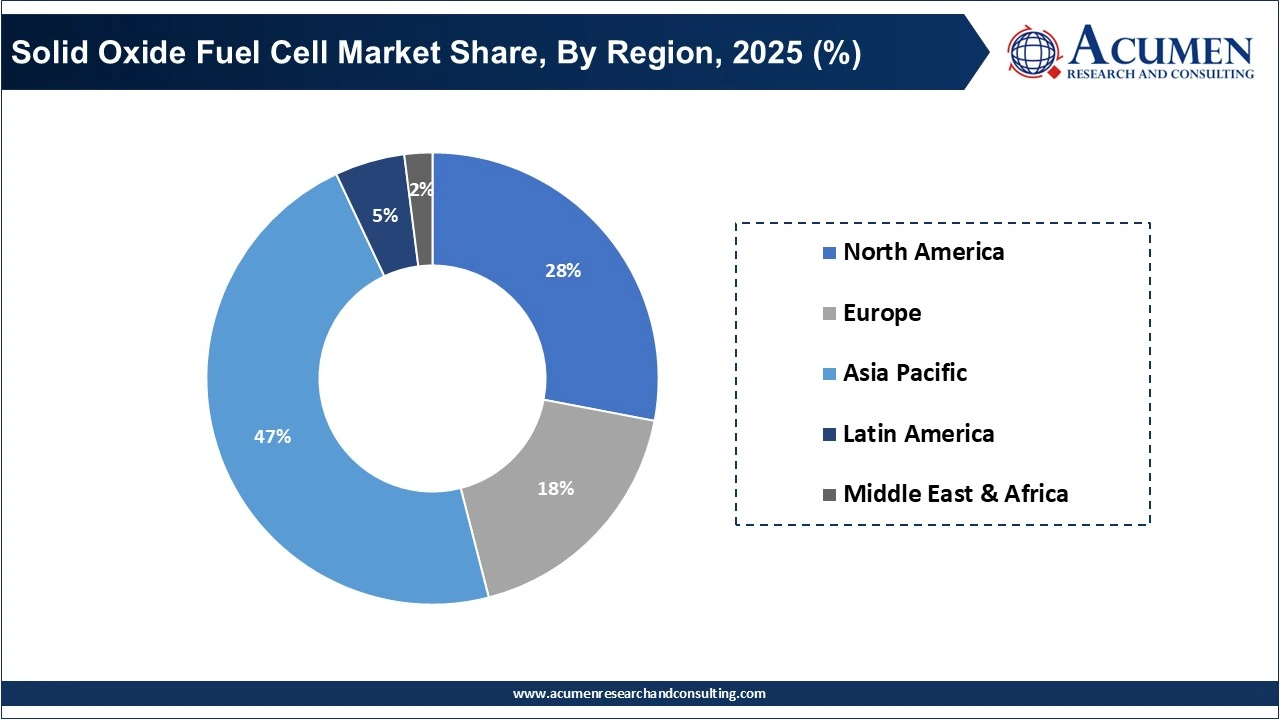
In terms of regional segments, the Asia-Pacific region dominates the solid oxide fuel cell (SOFC) market due to strong government support, significant investments in clean energy, and the presence of key industry players in countries such as Japan and South Korea. For example, in April 2024, Mitsubishi Heavy Industries (MHI) began operating a 400 kW test module of its Solid Oxide Electrolysis Cell (SOEC) technology at Japan's Takasago Hydrogen Park. The SOEC, based on SOFC technology, is highly efficient and operates under high pressure, making use of MHI's patented tubular cell stack. The module, developed at the Nagasaki Carbon Neutral Park, is intended to increase output and capacity for future hydrogen production systems. Furthermore, increasing demand for energy-efficient and low-emission technologies is driving SOFC market expansion across the region.
Why is North America emerging as the fastest-growing in the solid oxide fuel cell (SOFC) market?
North America is emerging as the fastest-growing SOFC market, driven by stricter environmental regulations, technological advancements, and rising deployment in data centers and military applications. For example, the United States Department of Energy (DOE) recently announced $40 million in funding for 15 projects aimed at developing high-performance, energy-efficient cooling solutions for data centers. These data centers, which house key computing infrastructure, consume approximately 2% of total electricity in the United States, with cooling alone accounting for up to 40% of overall energy use. This investment could have a significant impact on the SOFC market by supporting efficient, low-emission energy solutions in data centers. Furthermore, the U.S. government’s emphasis on clean hydrogen and decarbonization is accelerating market growth.
Solid Oxide Fuel Cell Market Players
- Cummins Inc.
- KYOCERA Corp.
- NGK Spark Plug Co., Ltd.
- Ningbo SOFCMAN Energy
- General Electric
- Ceres Power
- Bloom Energy
- Mitsubishi Power Ltd.
- AVL, Watt Fuel Cell Corp.
- FuelCell Energy Inc.
Market Segmentation
By Type
- Tubular
- Planar
By Application
- Transportation
- Portable
- Stationary
By End-User
- Commercial
- Data Centers
- Military & Defence
- Others
By Region
- North America
- U.S.
- Canada
- Europe
- U.K.
- Germany
- France
- Spain
- Rest of Europe
- Asia-Pacific
- India
- Japan
- China
- Australia
- South Korea
- Rest of Asia-Pacific
- Latin America
- Brazil
- Mexico
- Rest of LATAM
- The Middle East & Africa
- South Africa
- GCC Countries
- Rest of the Middle East & Africa (ME&A)
Looking for discounts, bulk pricing, or custom solutions? Contact us today at sales@acumenresearchandconsulting.com
Frequently Asked Questions

Other Energy and Power Reports
August 2023
January 2025
June 2024
August 2022