
Humanoid Robot Battery Management Systems Market Size, Share, Growth, Report 2026 To 2035
Humanoid Robot Battery Management Systems Market (By Component: Hardware, Software; By BMS Architecture: Centralized BMS, Modular BMS, Distributed BMS; By Battery Chemistry: High-Nickel NMC/NCA, Lithium Iron Phosphate (LFP), Lithium Polymer (Li-Po), Solid-State & Semi-Solid-State, Others; By Battery Configuration: Fixed / Integrated Battery BMS, Swappable / Removable Battery BMS; By System Voltage: Below 48 V, 48 V to Below 72 V, 72 V to Below 100 V, 100 V and Above; By Battery Capacity: Below 1 kWh, 1–2.5 kWh, Above 2.5–5 kWh, Above 5 kWh; By Intelligence Level: Conventional BMS, Intelligent / AI-Enabled BMS; By Application: Industrial & Manufacturing, Logistics & Warehousing, Healthcare & Caregiving, Others) - Global Industry Analysis, Size, Share, Regional Analysis, Trends and Forecast 2026 - 2035
- Last Updated: 16 Oct 2026
- Report Code: ARC3998
- Category: ICT
Humanoid Robot Battery Management Systems Market Size and Forecast 2026 to 2035
The global humanoid robot battery management systems market size was valued at USD 2.11 million in 2025. The market is observed to reach at USD 513.48 million in 2035 from USD 3.67 in 2026; while expanding at a CAGR of 73.2% during the forecast period.
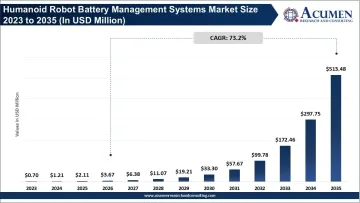
The humanoid robot battery management systems market is growing as manufacturers develop robots capable of performing complex movements, handling physical tasks, and operating for longer periods across industrial and commercial environments. Battery management systems (BMS) play a critical role in these robots by monitoring battery voltage, current, temperature, and state of charge while protecting cells from overcharging, overheating, and excessive discharge.
Demand is supported by advancements in lithium-ion battery technology, increasing investment in humanoid robotics, and the need for reliable power delivery during energy-intensive activities such as walking, lifting, and material handling. Hardware currently accounts for the largest market share, while intelligent and AI-enabled BMS solutions are gaining attention for predictive diagnostics, battery health estimation, and energy optimization.
Key Takeaways
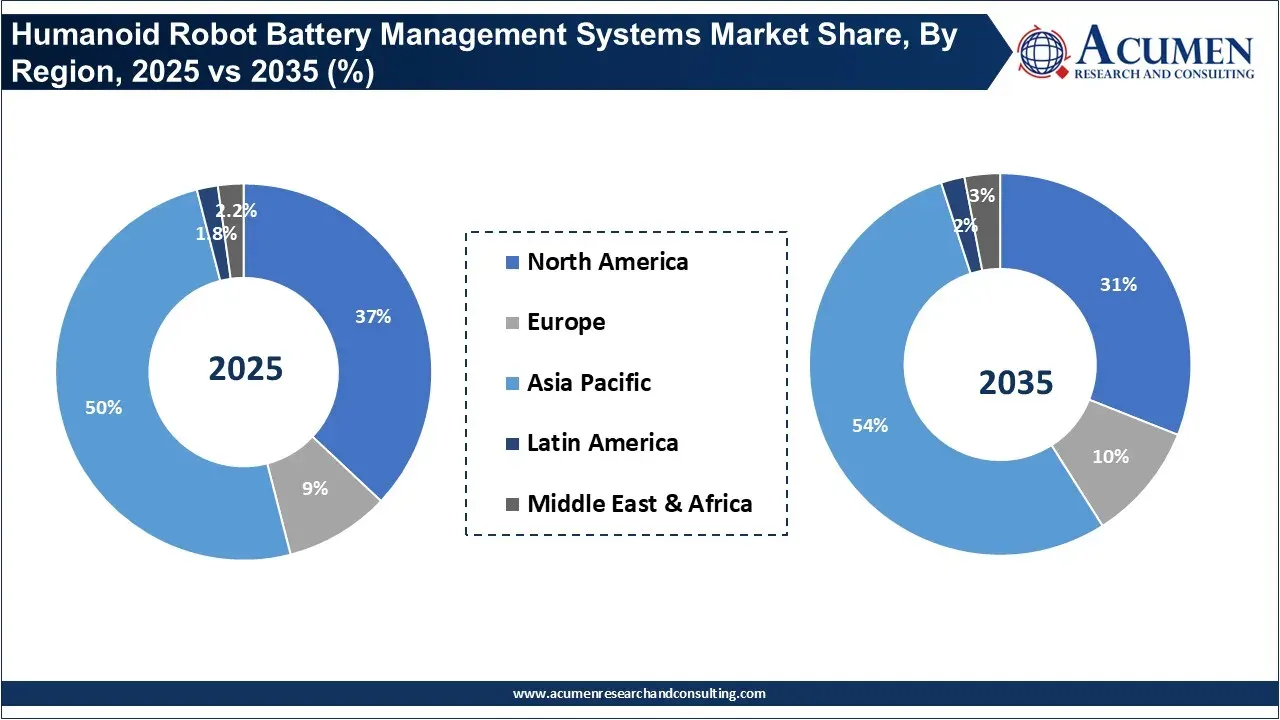
- By region: Asia-Pacific dominated the humanoid robot battery management systems market with a 50.0% share in 2025, supported by its established battery manufacturing ecosystem, electronics supply chains, robotics research capabilities, and growing investment in humanoid robot development.
- By component: Hardware dominated the market with a 78.0% share in 2025, driven by demand for battery monitoring circuits, sensors, controllers, and protection components that manage voltage, temperature, current, and safe battery operation.
- By BMS architecture: Centralized BMS dominated the market with a 57.0% share in 2025, supported by its consolidated control structure, straightforward monitoring, and ability to coordinate battery measurements and protection functions within integrated battery pack designs.
- By battery chemistry: High-nickel NMC/NCA dominated the market with a 72.0% share in 2025, reflecting the importance of high energy density in humanoid robots, where battery weight, available operating time, and power delivery influence overall performance.
- By battery configuration: Fixed or integrated battery BMS solutions dominated the market with a 63.0% share in 2025, supported by their compatibility with purpose-built robot designs and their ability to integrate battery monitoring and protection into the robot's power system.
- By system voltage: The 48 V to below 72 V segment led the market with a 56.0% share in 2025, reflecting the use of mid-voltage battery configurations that balance power delivery, electrical design requirements, and component integration in humanoid robot platforms.
- By battery capacity: The 1–2.5 kWh segment dominated the market with a 58.0% share in 2025, supported by demand for compact energy storage that balances battery weight with the operating energy required for humanoid robot mobility and manipulation tasks.
- By intelligence level: Conventional BMS solutions dominated the market with an 84.0% share in 2025, reflecting continued reliance on established battery monitoring, protection, and control functions. Intelligent and AI-enabled BMS is projected to expand as predictive diagnostics and adaptive energy management gain importance.
- By application: Industrial and manufacturing applications dominated the market with a 42.0% share in 2025, supported by interest in humanoid robots for repetitive factory operations, material handling, and production assistance, where dependable battery performance is essential for operational continuity.
Recent Trends
- Task-Aware Battery Management: Battery management systems are evolving to account for robot activity, movement intensity, and task priorities rather than relying solely on conventional battery indicators. This enables more informed energy allocation across different operating modes.
- Integrated Power Electronics: Developers are integrating battery monitoring, power conversion, protection circuits, and embedded controllers into coordinated architectures. This approach can simplify subsystem integration and improve power delivery to robotic actuators and computing components.
- Modular Battery Architectures: Robot designers are exploring modular and distributed energy-storage configurations to improve serviceability, fault tolerance, and packaging flexibility. These architectures can support different humanoid designs while reducing dependence on a single centralized battery pack.
Humanoid Robot Battery Management Systems Market Dynamics
Market Drivers
- Humanoid Production Expansion: Increasing development and commercialization of humanoid robots are expanding demand for dedicated battery monitoring and control electronics. Every additional robot requires dependable battery supervision to coordinate power delivery, monitor cell conditions, and protect connected subsystems.
- Dynamic Power Loads: Walking, lifting, balancing, and manipulating objects produce rapidly changing electrical loads. Battery management systems that monitor current demand and regulate power delivery help maintain stable operation during movement-intensive tasks and sudden actuator demand changes.
- Battery Health Visibility: Commercial operators need reliable information about battery degradation, remaining useful life, and charging requirements to plan robot availability. Improved battery health estimation can support maintenance scheduling, replacement planning, and more predictable fleet operations.
Market Restraints
- Specialized Engineering Costs: Humanoid-specific battery management requires customized electronics, embedded software, validation, and integration with motion-control systems. These engineering requirements can increase development costs for robotics manufacturers, particularly when designs are still changing rapidly between prototype and production stages.
- Space and Weight Constraints: Battery management hardware, wiring, sensors, and cooling components compete for limited space inside articulated robot bodies. Designers must minimize subsystem weight and volume without sacrificing monitoring accuracy, electrical protection, or serviceability.
- Limited Operating Data: Early-stage humanoid deployments provide fewer long-term battery datasets than mature electric-vehicle applications. This limits the ability to validate battery-aging models across diverse movement patterns, environmental conditions, and charging cycles, increasing uncertainty in performance predictions.
Market Opportunities
- Predictive Maintenance Software: Combining battery telemetry with machine-learning models creates opportunities to identify abnormal degradation, detect emerging faults, and estimate maintenance needs before battery performance deteriorates significantly. These capabilities can help robotics operators reduce unexpected service interruptions.
- Wireless Battery Monitoring: Wireless monitoring architectures could reduce wiring complexity in articulated robots with multiple battery modules or distributed power subsystems. They may simplify packaging and improve diagnostic flexibility, provided communication reliability, cybersecurity, and real-time response requirements are satisfied.
- Battery-System Reference Designs: Semiconductor suppliers can develop prevalidated battery management reference designs tailored to humanoid platforms, including sensing circuits, protection components, embedded controllers, and communication interfaces. Such solutions can shorten engineering cycles and help robot manufacturers accelerate product development.
Market Challenges
- Accurate State Estimation: Estimating remaining charge and battery health becomes difficult when robots experience rapid load fluctuations, frequent acceleration, and irregular operating cycles. Inaccurate estimates can trigger premature shutdowns or leave insufficient reserve energy for safe movement and recovery.
- Functional Safety Integration: Battery management must coordinate electrical fault detection with robot-level safety controls so that power interruptions do not create hazardous movements or uncontrolled shutdowns. Achieving dependable responses requires careful integration, verification, and fault-handling strategies.
- Interoperability Across Platforms: Different humanoid manufacturers use varying battery voltages, cell configurations, communication protocols, and control architectures. Suppliers must accommodate these differences while maintaining consistent diagnostic performance and protection behavior, complicating the development of broadly compatible battery management solutions.
Humanoid Robot Battery Management Systems Market Regional Insights
Which Region Dominated the Humanoid Robot Battery Management Systems Market in 2025?
The Asia-Pacific accounted for the largest share in the humanoid robot battery management systems market in 2025 with 50.0% of the global revenue equivalent to USD 1.06 million. The region's leadership is attributed to the wide presence of the battery manufacturing industry, strong electronics supply chain, technological advancements in the robotics industry, and lucrative funding for humanoid robot use in the industrial, logistics, and service sectors.
The region's market share is projected to increase from 50.0% in 2025 to 54.0% by 2035. Revenue is forecast to reach USD 277.28 million by 2035, expanding at a compound annual growth rate (CAGR) of 74.6% from 2026 to 2035. The anticipated growth is due to the growth of humanoid robot production; more commercial trials; and the increased need for advanced, optimal battery monitoring and control systems.
China, Japan, and South Korea are strategic markets to study due to their manufacturing bases and robotics ecosystems, while India is an emerging market to monitor as the industrial automation and robotics industry matures. Adoption will be driven by the timing of humanoid robot commercialization, battery performance needs, battery costs, and the maturity of reliable BMS technology.
Which Region Is Expected to Grow Fastest Through 2035?
The Middle East & Africa is projected to be the fastest-growing regional market for humanoid robot battery management systems, with a CAGR of 79.2% from 2026 to 2035. The region accounted for 2.2% of global market revenue in 2025, equivalent to approximately $0.05 million. Its share is forecast to increase to 3.0% by 2035, with revenue reaching $15.40 million. Although the region currently represents a relatively small market, its high projected growth rate reflects the potential for humanoid robot adoption as investment in automation, artificial intelligence, and advanced manufacturing expands.
Growth opportunities are linked to technology investment and economic diversification initiatives, particularly in the United Arab Emirates and Saudi Arabia. These countries are exploring robotics and AI applications across industrial operations, logistics, infrastructure, and service environments. As humanoid robots move toward practical deployment, demand may develop for battery management systems that support real-time cell monitoring, thermal control, battery health diagnostics, and efficient power delivery.
South Africa also warrants attention because of its industrial and research capabilities, which could support selected robotics applications. However, regional growth will depend on the commercial readiness of humanoid robots, deployment costs, technical expertise, and the availability of supporting infrastructure.
Top 5 Countries Patent and Innovation Analysis
| Country | Patent and innovation position | Relevance to humanoid robot BMS |
|---|---|---|
| China | Strong patent activity in humanoid robot design, morphology, and control technologies. | A broad robotics and battery manufacturing ecosystem supports opportunities for integrated battery monitoring, protection, and power management. |
| United States | Notable strength in advanced robotics research, AI, control systems, and high-value patent portfolios. | Demand may grow for intelligent BMS, predictive diagnostics, and precise power management in advanced humanoid platforms. |
| South Korea | Active innovation in humanoid robotics, electronics, semiconductors, and battery technologies. | Battery expertise creates opportunities for compact BMS hardware, thermal monitoring, and advanced battery chemistries. |
| Japan | Established robotics and precision-engineering capabilities, supported by industrial automation expertise. | Opportunities include reliable battery control, compact electronics, and power management for industrial and service robots. |
| Germany | Strong industrial robotics, engineering, and automation ecosystem, with companies developing next-generation robotic systems. | Potential demand for robust BMS solutions suited to factory deployment, operational reliability, and integration with industrial systems. |
Humanoid Robot Battery Management Systems Market Segmentation Insights
Component Insights
Hardware: Hardware dominated the humanoid robot battery management systems market with a 78.0% share in 2025, supported by demand for battery monitoring circuits, sensors, controllers, and protection components. These essential electronics enable voltage measurement, temperature monitoring, current regulation, cell balancing, and safe battery operation.
Humanoid Robot Battery Management Systems Market Share, By Component, 2025 & 2035 (%)
| Component | Revenue Share, 2025 (%) | Revenue Share, 2035 (%) |
|---|---|---|
| Hardware | 78% | 64% |
| Software | 22% | 36% |
Software: Software accounted for 22.0% of the market in 2025, reflecting the role of battery monitoring algorithms, state-of-charge estimation, diagnostics, and energy management. Its share is projected to reach 36.0% by 2035 as more advanced battery intelligence becomes important for humanoid robot performance.
BMS Architecture Insights
Centralized BMS: Centralized BMS architecture dominated the market with a 57.0% share in 2025, supported by its relatively straightforward control structure and consolidated battery monitoring. A central controller can coordinate battery measurements, protection functions, and communication, making this architecture suitable for integrated battery pack designs.
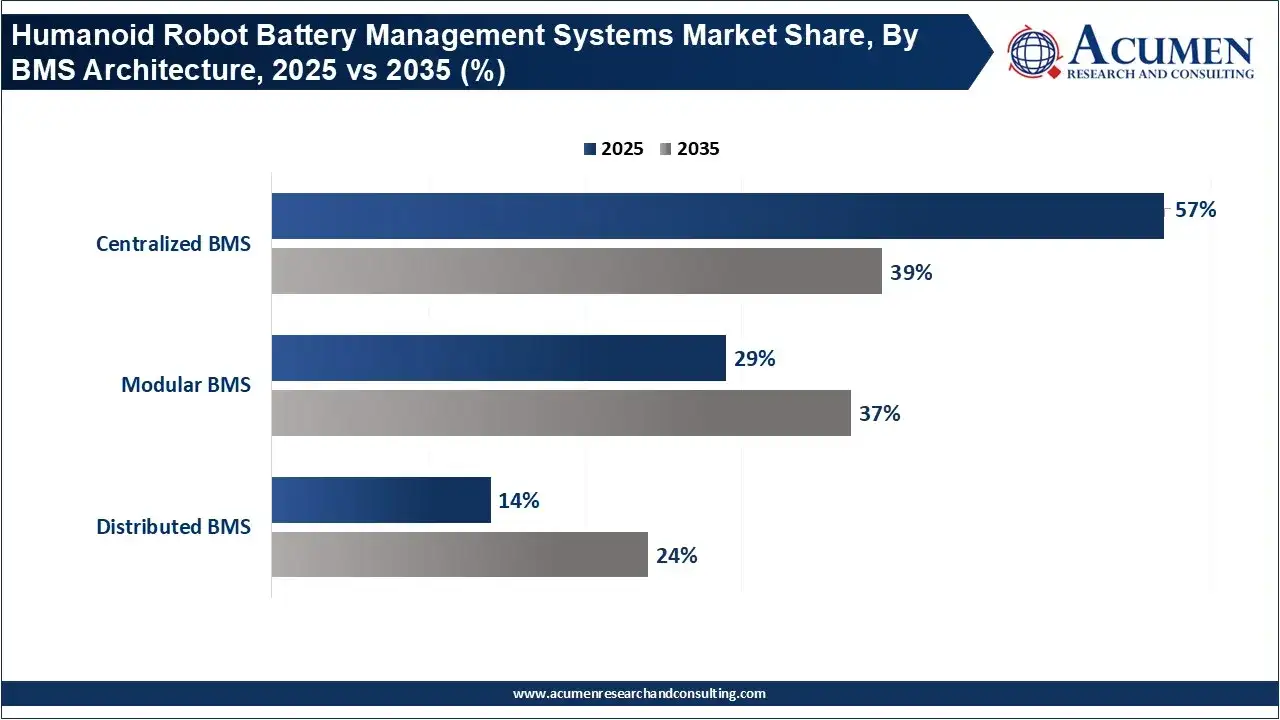
Modular BMS: Modular BMS held the second-largest share at 29.0% in 2025, supported by its flexibility in accommodating different battery pack configurations. Its share is projected to rise to 37.0% by 2035 as humanoid robot manufacturers seek scalable battery monitoring and control solutions for evolving platform requirements.
Battery Chemistry Insights
High-Nickel NMC/NCA: High-nickel NMC/NCA battery systems dominated the market with a 72.0% share in 2025, reflecting the importance of high energy density in mobile robotic platforms. These chemistries can support compact battery designs, helping manufacturers balance operating time, battery weight, and the power requirements of humanoid robots.
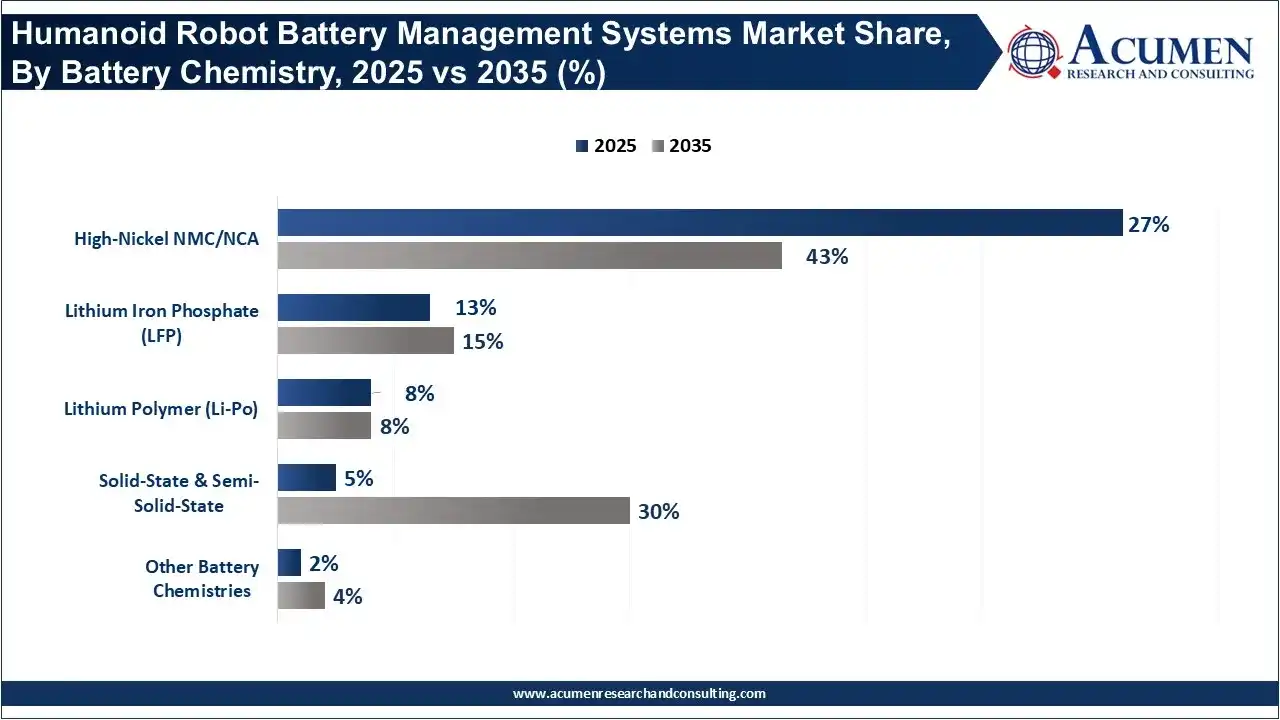
Lithium Iron Phosphate (LFP): LFP held the second-largest share at 13.0% in 2025, supported by its thermal stability, durability, and potential cost advantages. Its share is projected to reach 15.0% by 2035 as developers assess battery safety, lifecycle performance, and operating costs for different humanoid robot applications.
Battery Configuration Insights
Fixed / Integrated Battery BMS: Fixed or integrated battery BMS configurations dominated the market with a 63.0% share in 2025, supported by their suitability for purpose-built humanoid robot designs. Integrated configurations allow manufacturers to coordinate battery packaging, electrical connections, monitoring, and protection around a specific robot platform.
Humanoid Robot Battery Management Systems Market Share, By Battery Configuration, 2025 & 2035 (%)
| Battery Configuration | Revenue Share, 2025 (%) | Revenue Share, 2035 (%) |
|---|---|---|
| Fixed / Integrated Battery BMS | 63% | 43% |
| Swappable / Removable Battery BMS | 37% | 57% |
Swappable / Removable Battery BMS: Swappable or removable battery BMS configurations accounted for 37.0% of the market in 2025. Their share is projected to reach 57.0% by 2035 as developers pursue faster battery replacement, reduced charging interruptions, and improved operating continuity across industrial, logistics, and commercial robot fleets.
System Voltage Insights
48 V to Below 72 V: The 48 V to below 72 V segment dominated the market with a 56.0% share in 2025, reflecting the adoption of mid-voltage battery configurations in humanoid robot platforms. These systems support battery power delivery while balancing electrical design, current requirements, component selection, and integration constraints.
Humanoid Robot Battery Management Systems Market Share, By System Voltage, 2025 & 2035 (%)
| System Voltage | Revenue Share, 2025 (%) | Revenue Share, 2035 (%) |
|---|---|---|
| Below 48 V | 29% | 18% |
| 48 V to <72 V | 56% | 51% |
| 72 V to <100 V | 11% | 20% |
| 100 V and Above | 4% | 11% |
Below 48 V: Systems operating below 48 V held the second-largest share at 29.0% in 2025, reflecting their use in lower-power robotic platforms and selected development-stage systems. Their share is projected to decline to 18.0% by 2035 as higher-power requirements influence battery system design
Battery Capacity Insights
1–2.5 kWh: The 1–2.5 kWh battery capacity segment dominated the market with a 58.0% share in 2025, supported by demand for compact energy storage in humanoid robots. This capacity range can help balance battery weight, available operating energy, and the power needs of mobility and manipulation tasks.
Humanoid Robot Battery Management Systems Market Share, By Battery Capacity, 2025 & 2035 (%)
| Battery Capacity | Revenue Share, 2025 (%) | Revenue Share, 2035 (%) |
|---|---|---|
| Below 1 kWh | 12% | 5% |
| 1–2.5 kWh | 58% | 42% |
| >2.5–5 kWh | 24% | 38% |
| Above 5 kWh | 6% | 15% |
Above 5 kWh: The above 5 kWh segment is projected to grow fastest, registering a CAGR of 91.7% from 2026 to 2035. Growth reflects increasing interest in longer operating cycles and energy-intensive robotic tasks, although higher capacity can introduce additional weight, packaging, thermal, and charging considerations.
Intelligence Level Insights
Conventional BMS: Conventional BMS solutions dominated the market with an 84.0% share in 2025, supported by established battery monitoring, protection, and control functions. These systems provide essential capabilities such as voltage and temperature monitoring, state estimation, and fault response without requiring advanced AI-based analytics.
Humanoid Robot Battery Management Systems Market Share, By Intelligence Level, 2025 & 2035 (%)
| Intelligence Level | Revenue Share, 2025 (%) | Revenue Share, 2035 (%) |
|---|---|---|
| Conventional BMS | 84% | 39% |
| Intelligent / AI-Enabled BMS | 16% | 61% |
Intelligent / AI-Enabled BMS: Intelligent and AI-enabled BMS solutions accounted for 16.0% of the market in 2025, reflecting emerging demand for predictive diagnostics and adaptive energy management. Their share is projected to rise to 61.0% by 2035 as developers pursue improved battery health estimation and more responsive power management.
Application Insights
Industrial & Manufacturing: Industrial and manufacturing applications dominated the market with a 42.0% share in 2025, supported by interest in humanoid robots for repetitive operations, material handling, and factory assistance. These environments require dependable battery monitoring, predictable operating time, and protection against power fluctuations during demanding tasks.
Logistics & Warehousing: Logistics and warehousing held the second-largest share at 28.0% in 2025, driven by potential humanoid robot applications in material movement, picking assistance, and warehouse operations. Battery management is important in these settings because operating continuity, charging schedules, and energy availability can affect fleet productivity.
Humanoid Robot Battery Management Systems Market Share, By Application, 2025 (%)
| By Application | Revenue Share, 2025 (%) |
|---|---|
| Industrial & Manufacturing | 42% |
| Logistics & Warehousing | 28% |
| Healthcare & Caregiving | 8% |
| Retail & Hospitality | 7% |
| Domestic & Personal | 5% |
| Research & Education | 6% |
| Other Applications | 4% |
Competitive Landscape
- Renesas Electronics: Offers a dedicated humanoid robot BMS reference solution covering cell monitoring and balancing, voltage and current sensing, charge and discharge protection, battery control, and active cooling.
- Texas Instruments: Supplies battery monitoring and management integrated circuits that can support voltage measurement, cell balancing, protection, and power management in robotic battery packs.
- Analog Devices: Provides precision measurement and battery monitoring technologies relevant to accurate cell monitoring, diagnostics, and battery pack safety.
- Infineon Technologies: Offers power-management semiconductors, microcontrollers, and sensing technologies that can contribute to battery control and energy-efficient robotic electronics.
- NXP Semiconductors: Provides microcontrollers, power-management components, and system-control technologies suitable for safety-conscious battery and embedded control designs.
- STMicroelectronics: Supplies microcontrollers, analog components, and power electronics that can be integrated into battery monitoring and control systems for mobile robots.
- onsemi: Focuses on intelligent power and sensing technologies that may support efficient power conversion, monitoring, and thermal management in robotic systems.
Value Chain Analysis
- Raw material supply: Lithium, nickel, cobalt, manganese, graphite, copper, and other battery-related materials form the upstream foundation for rechargeable battery production. Material availability and quality influence battery cost, energy density, and reliability.
- Battery cell manufacturing: Battery producers manufacture cells using selected chemistries, including NMC/NCA and LFP. Cell characteristics determine the voltage range, capacity, thermal behaviour, and monitoring requirements that the BMS must accommodate.
- BMS hardware development: Semiconductor and electronics suppliers provide monitoring ICs, sensors, microcontrollers, communication interfaces, and protection circuits. These components measure voltage, current, and temperature while helping prevent unsafe battery operating conditions.
- BMS software and control algorithms: Software supports state-of-charge and state-of-health estimation, cell balancing, fault detection, charging control, and energy optimization. More advanced systems can incorporate predictive diagnostics and adaptive control algorithms.
- Testing and validation: Integrated systems undergo electrical, thermal, vibration, safety, and performance testing. Validation helps ensure that the battery and BMS operate reliably under changing loads and expected environmental conditions.
- Deployment and aftermarket services: Robot manufacturers, fleet operators, and service providers manage charging, battery diagnostics, replacement, maintenance, and recycling. Battery data can help reduce downtime and identify potential failures before they interrupt operations.
Strategic Developments
- March 2026, Samsung SDI unveiled solid-state battery technology designed for humanoid robots at InterBattery 2026, with mass production targeted for the second half of 2027. The development highlights growing interest in batteries that could improve energy density and address the demanding power and packaging requirements of humanoid platforms. Commercial adoption will depend on production readiness, cost, and performance validation.
- June 2026, CATL and Galbot announced a global strategic cooperation agreement on June 24, 2026, focused on smart manufacturing, broader deployment of AI humanoid robots, and after-sales service standards. Galbot's S1 humanoid robot was reported to be operating on CATL manufacturing lines.
Segments Covered
By Component
- Hardware
- Software
By BMS Architecture
- Centralized BMS
- Modular BMS
- Distributed BMS
By Battery Chemistry
- High-Nickel NMC/NCA
- Lithium Iron Phosphate (LFP)
- Lithium Polymer (Li-Po)
- Solid-State & Semi-Solid-State
- Other Battery Chemistries
By Battery Configuration
- Fixed / Integrated Battery BMS
- Swappable / Removable Battery BMS
By System Voltage
- Below 48 V
- 48 V to Below 72 V
- 72 V to Below 100 V
- 100 V and Above
By Battery Capacity
- Below 1 kWh
- 1–2.5 kWh
- Above 2.5–5 kWh
- Above 5 kWh
By Intelligence Level
- Conventional BMS
- Intelligent / AI-Enabled BMS
By Application
- Industrial & Manufacturing
- Logistics & Warehousing
- Healthcare & Caregiving
- Retail & Hospitality
- Domestic & Personal
- Research & Education
- Other Applications
By Region
- North America
- Europe
- Asia-Pacific
- Latin America
- Middle East & Africa
Looking for discounts, bulk pricing, or custom solutions? Contact us today at sales@acumenresearchandconsulting.com
Frequently Asked Questions

Other ICT Reports
June 2026
April 2021
April 2025
January 2026