
Japan Physical AI Market Size, Share, Report 2026 To 2035
Japan Physical AI Market (By Component: Hardware, Software, Services; By Deployment: Cloud-based AI, On-device; By Technology: Computer Vision, Speech / NLP, Gesture / Movement Recognition, Reinforcement Learning & Control Systems, Others; By Robot Type: Industrial Robots, Service Robots, Humanoids/Social Robots, Cobots, Exoskeletons/Prosthetics, Mobile Robots/Drones; By Application: Healthcare, Manufacturing & Automotive, Logistics & Warehousing, Retail & Hospitality, Defense & Security, Agriculture, Education & Research, Others) - Industry Analysis, Size, Share, Trends and Forecast 2026 To 2035
- Last Updated: 13 Jul 2026
- Report Code: ARC3910
- Category: ICT
Japan Physical AI Market Size, Forecast 2026 To 2035
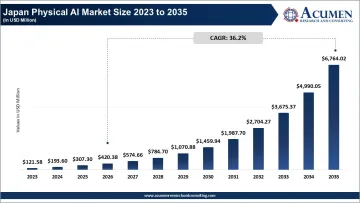
The Japan physical AI market size was valued at USD 307.30 million in 2025 and is expected to reach around USD 6764.02 million by 2035, expanding at a compound annual growth rate (CAGR) of 36.2% during the forecast period from 2026 to 2035.
Report Highlights
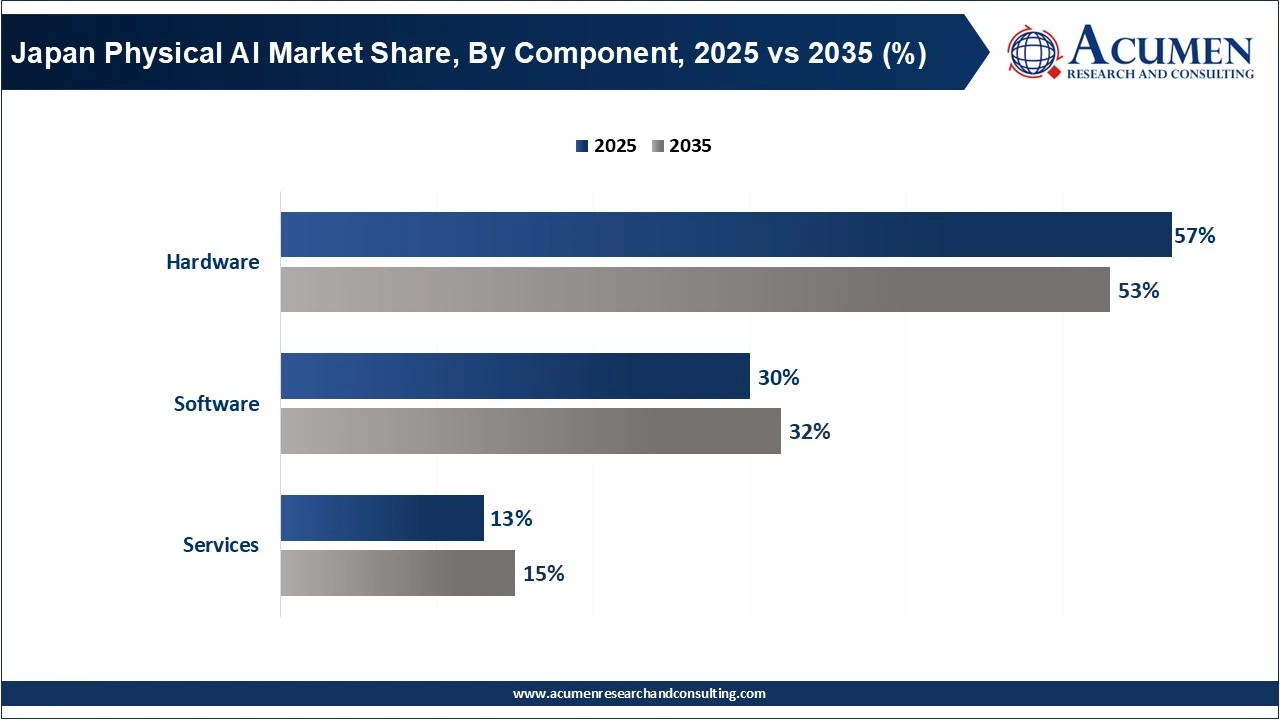
- By component, the hardware segment held the dominant market share, accounting for 57% in 2025. This is due to the robust ecosystem in robotics and semiconductor domain in Japan. Japanese manufactures requires sophisticated sensor, edge processors, LiDAR, cameras and embedded AI chips.
- By deployment, on-device AI systems led the market, accounting for 53% of the overall share. On-device AI is preferred due to the need for real-time processing, ultra-low latency, and high reliability in industrial environments. Japan’s manufacturing sector prioritizes edge intelligence to ensure uninterrupted operations even without cloud connectivity.
- By technology, the computer vision accounted for the largest share, around 40%. The computer vision technologies such as, defect detection, inspection, and robotics are widely used by the factories of Japan for their processes such as quality control, inspection, robots and warehouses automation.
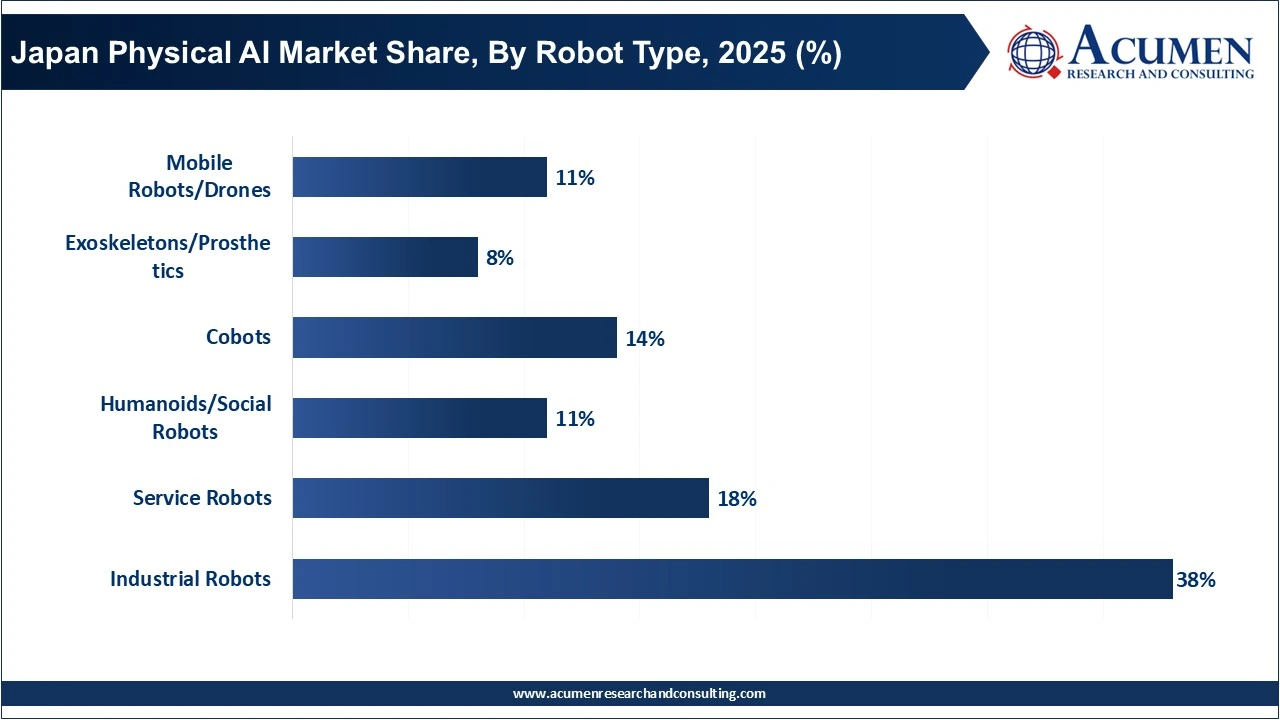
- By robot type, industrial robots segment dominated the market, accounting for 38% in 2025. It is to be noted that Japan has been a leading manufacturer and a user of the industrial robots. Japan contributes extensively to the automotive industry and to electronics.
- By application, the manufacturing & automotive represented 24% of the market. Japan’s global leadership in automotive and advanced manufacturing makes these industries the earliest adopters of Physical AI. AI-enabled robots, predictive maintenance systems, and automated assembly lines improve productivity and reduce downtime.
Japan Physical AI Market Overview
The physical AI market in Japan is growing rapidly, mainly due to demographic challenges like an aging population and ongoing labor shortages. To address these issues, many industries are turning to automation and AI-powered robotics to keep up productivity and efficiency. Sectors such as manufacturing, logistics, healthcare, and retail are leading in the adoption of AI-driven robots, which help fill workforce gaps and improve process reliability. Japanese robotics companies are strengthening their position in the global market by integrating artificial intelligence with advanced sensors, computer vision, and automation systems. This combination enables machines to achieve greater accuracy and awareness in their tasks. National programs such as Society 5.0 and government support for smart manufacturing are also playing a key role in promoting the use and development of physical AI solutions across various industries.
Strong investment in research, innovation, and digital transformation is a significant driver of market growth. Japanese technology firms and startups are allocating substantial resources to AI-driven robotics, autonomous systems, and smart factory solutions to maintain competitiveness in the global market. The advancement of Industry 4.0, along with increased adoption of warehouse automation and service robots, is expanding the scope of physical AI applications in areas such as autonomous mobility, precision manufacturing, and healthcare assistance. Furthermore, collaboration among universities, technology companies, and government institutions is accelerating innovation, which is expected to reinforce Japan's position as a leading center for physical AI development and deployment.
Why Japan Is Becoming a Global Physical AI Hub?
Japan ranks among the largest industrial robot manufacturers and users globally, representing around 45% of world’s industrial robots supply and strengthening its position of the leader in the complex manufacturing and automated solutions since a long time. It supports its strong domestic industrial base through which the nation has the capability to accelerate physical AI product commercialization across various domains including manufacturing, logistics, health care, mobility and services sectors.
As per International Federation of Robotics (IFR), Japan is one of the top leading robot manufacturers in the world along with Fanuc, Yaskawa Electric, Kawasaki Heavy Industries, Denso and Nachi-Fujikoshi that delivers their industrial robots to automotive, electronic, health-care and logistics Sectors across the globe.
Moreover, to secure the needed computational resources the country is continuously bolstering the country's semiconductor ecosystems with colossal investment plans in chip manufacturing along with partnerships to secure supply of these chips that powers the physical AI and robotic machines, and autonomous applications. Overall, aging population and chronic labour shortage in the nation lay a ground to ensure its long-run commitment and application in Physical AI.
Labor Shortages and Demographic Shifts Accelerating Physical AI Deployment in Japan
As one of Japan's most acute structural challenges is an aging population with a contracting workforce, thus the need for a higher utilization of physical AI is very high. More than 29% of Japan's population is aged 65 years or older, giving Japan the highest proportion of elderly citizens among major economies and increasing demand for AI-powered automation and care robots.
- By 2040, government projections suggest Japan could experience a shortage of over 10 million workers, increasing demand for smart automation and robotic solutions powered by AI.
- Japan could be at a shortage of around 570,000 caregivers by 2040, speeding the introduction of rehabilitation and patient-support robots and AI health technology.
- Some of Japan's largest labor shortage rates were observed in the accommodation, food, service, and health care sectors, based on surveys from Japan's Ministry of Health, Labor and Welfare, which fuels service robot deployment and development ofAI-powered assistance solutions for clients.
With workforces continuing to diminish across multiple industries, including manufacturing, logistics, healthcare, retail and construction, organizations are accelerating investments in both AI robotic hardware and autonomy software to sustain workforce levels, productivity and overall continuity of business.
Government Initiatives and METI Policies Supporting Physical AI in Japan
Japan’s coordinated industrial strategy to speed the deployment of artificial intelligence, robotics and intelligent automation into key economic sectors includes national digital transformation strategies, national AI policy/governance structures and industrial modernization initiatives aimed at building national strengths in the physical AI landscape, a sector Japan currently leads globally.
Key Government Initiatives in Japan
- Society 5.0: Japan’s national vision driving a human-centered society by converging advanced technologies like AI, IoT, robotics, big data and cyber-physical systems, and to facilitate the large-scale adoption of AI into manufacturing, healthcare, mobility, agriculture and public sector services.
- Digital Transformation (DX) Promotion: The Government is spurring companies to revitalize their industrial processes with AI-powered automation, digital twins, robots and connectivity to enhance productivity and international competitiveness.
- Green Transformation (GX) Strategy: Japan’s road map for carbon neutrality will drive the uptake of AI-powered smart automation and robots to increase efficiency, optimize industrial processes, and cut emissions.
- Moonshot Research and Development Program: Japan’s national, long-term moonshot project will boost breakthrough technological advances in autonomous robotics, man-machine interaction, and next generation of AI and intelligent robots that can operate in varied conditions.
- Cross-ministerial Strategic Innovation Promotion Program (SIP): This program facilitates cooperation across different government agencies, universities and companies to accelerate the commercialization of advanced robotics, autonomous transportation, AI infrastructure and smarter city solutions.
- Semiconductor Industry Revitalization: Japan continues to inject funding into the nation’s semiconductor manufacturing capabilities and advanced chip designs that support AI-enhanced robots, automated machines and edge AI solutions.
Japan’s Government Funding & National AI Strategy
- By 2030 Japan committed JPY 1tr ($ 7 billion) in government spending for AI and semiconductor technologies aimed at building domestic AI capabilities and driving industrial AI adoption across robotics and manufacturing industries through increased public investment in infrastructure such as computing capacity, AI chips and industrial automation
- In its 2024 budget Japan had its largest National R&D budget at JPY 4.2tr ($ 29 billion) where AI, robotics and digital transformation emerged as top priorities for investment. Public spending on R&D has now shifted towards the area of automation, smart factories and next-generation mobility.
- The goal for the country is to output $250+ billion in domestic semiconductor and advanced technology output by 2030 in order to ensure resilient supply chains of AI hardware and robotics technologies.
- The Society 5.0 initiative still considers smart factories, autonomous mobility and smart cities to be high priorities which incorporates the implementation of AI, IoT and robotics technologies in order to resolve labor shortages and aging populations.
Major METI Policies Supporting Physical AI
| METI Policy / Program | Contribution to the Physical AI Market |
|---|---|
| AI Governance Guidelines | Establishes principles for safe, transparent, and trustworthy AI deployment, supporting the commercialization of autonomous robots and intelligent physical AI systems. |
| Digital Transformation (DX) Initiative | Encourages manufacturers to integrate AI, industrial robotics, predictive analytics, and smart factory technologies to improve operational efficiency. |
| Robotics and Automation Promotion Programs | Supports wider adoption of advanced robotics across manufacturing, logistics, healthcare, construction, and service industries through public-private collaboration. |
| Semiconductor and Digital Industry Strategy | Strengthens Japan's domestic semiconductor ecosystem to ensure a stable supply of advanced processors used in AI computing and robotics applications. |
| Support for Smart Manufacturing | Promotes the adoption of AI-enabled production systems, connected factories, industrial IoT, and autonomous manufacturing technologies. |
| Industrial Competitiveness Enhancement Programs | Provides financial incentives and policy support to accelerate commercialization of AI-powered industrial technologies and next-generation robotics solutions. |
Key Developments Shaping Japan's Robotics Ecosystem
- Toyota Motor Corporation is increasing its adoption of service robots, assist robots, warehouse automation, and AI-powered mobility platforms with ongoing investment in robotic innovation.
- Preferred Networks is among the largest AI companies in Japan, creating deep learning technology solutions to augment robot perception and manipulation, autonomous decision making and the smartification of industrial manufacturing.
- NVIDIA is fostering a stronger physical AI ecosystem in Japan by collaborating with automakers, robotic companies and universities to offer advanced computing infrastructure, AI chips, the Omniverse digital twin technology and robotics development frameworks.
- Fanuc continues to be at the forefront of industrial automation, developing AI-enabled industrial robots that deliver predictive maintenance, adaptive manufacturing, and intelligent production optimization capabilities.
- Yaskawa Electric continues to extend the implementation of its AI-enabled robot solutions across various applications including factory automation, semiconductor manufacturing, welding, packaging, and logistics.
- Kawasaki Heavy Industries is actively working to build intelligent, collaborative robots and autonomous robot platforms that leverage the strengths of physical AI coupled with enhanced sensing and machine learning technology.
- Denso is making great progress on infusing AI-enabled robotics into smart manufacturing while building its autonomous mobility and intelligent factory solutions.
Japan Physical AI Market Dynamics
Market Drivers
1. Japan’s Aging Population Driving Demand for Physical AI
Japan is experiencing a significant demographic challenge, with almost 30% of its population over the age of 65. The working-age population is projected to decrease by about 9 million by 2040. This situation has led to a strong need for automation in many sectors. Factories are facing shortages of assembly workers, hospitals are unable to recruit enough nurses, farms are struggling to find seasonal labor, and logistics centers have difficulty hiring staff. In contrast to other countries where automation may be met with resistance, Japan has accepted Physical AI as a necessary solution to these issues. The government’s Society 5.0 initiative identifies robotics and AI as key tools to address demographic problems and maintain quality of life. As this demographic trend is expected to continue through the 2030s, the demand for Physical AI in Japan is likely to remain high and stable.
2. Government Policies and Investments Accelerating Physical AI Growth in Japan
Japan's government has increased its support for Physical AI by moving from policy frameworks to significant financial commitments. In November 2024, Prime Minister Ishiba announced a JPY 10 trillion (about USD 65 billion) investment fund for AI and semiconductor industries. This fund is expected to stimulate over JPY 50 trillion (USD 327 billion) in public-private investment by 2030, providing long-term financial support for Physical AI development and deployment. The Cabinet approved the Basic National AI Plan in December 2025, which was the first plan to formally identify Physical AI and humanoid robotics as national priorities and to commit to accelerating AI adoption in government and industry. The AI Promotion Act, enacted in May 2025 and fully effective from September 2025, established an AI Strategic Headquarters led by the Prime Minister to coordinate AI policy across ministries. This change removed the fragmented governance that had previously slowed commercialization. These policy measures, along with government procurement that favors domestic AI, are expected to create stable demand and encourage long-term private investment in Physical AI infrastructure and product development.
Market Restraints
1. High Development Costs and Technical Complexity Limiting Physical AI Adoption
The development and commercialization of advanced Physical AI systems, including AI-enabled surgical robots, industrial humanoids, and next-generation cobots, requires significant upfront investment in research and development, precision manufacturing, safety validation, and regulatory approval. These requirements create high barriers to entry and slow the pace of market expansion. Achieving commercial viability for AI-capable humanoid robots requires mastering several disciplines simultaneously, including mechanical design, power electronics, actuator technology, computer vision, reinforcement learning, and human-robot interaction. This multidisciplinary challenge typically involves large teams of specialized engineers working over several years.
High unit costs result in long payback periods for enterprise customers. For example, a surgical robot system costs between USD 1 and 2 million, with annual maintenance contracts in the six-figure range. This restricts adoption to well-funded hospital systems. In the case of service robots and consumer-facing humanoids, the per-unit price must decrease significantly, from tens of thousands to the low thousands of dollars, before mass market deployment is possible. Achieving this requires manufacturing scale that the industry has not yet reached. As a result, adoption in budget-sensitive sectors such as agriculture, small-business retail, and developing-region export markets is expected to lag behind capital-rich industries like automotive manufacturing and major hospitals.
Market Opportunities
1. Humanoid Robots Emerging as a Major Growth Opportunity for Japan’s Physical AI Market
The development of commercially viable humanoid robots is poised to become a major milestone for Japan's Physical AI sector and could significantly influence the nation's economy. These bipedal, dexterous robots, guided by AI, are designed to operate in environments built for humans. They are well placed to tackle Japan's labor shortages in areas such as manufacturing, logistics, retail, hospitality, eldercare, and eventually domestic tasks. Japanese precision engineering firms are positioned to lead in humanoid hardware. Harmonic Drive Systems supplies the precision reducers that enable accurate movement in humanoid joints. Fanuc and Yaskawa provide AI-adaptive control systems, while AI software platforms from NVIDIA and local startups offer perception and planning capabilities. SoftBank's acquisition of ABB's robotics assets has created an integrated capability that covers hardware, software, and global distribution. However, the window of opportunity is limited. Chinese manufacturers have already showcased low-cost humanoid robots at iREX 2025. Japan must accelerate commercialization to maintain its edge in precision engineering before competitors focusing on cost lower the market's growth. Investment banks estimate the global humanoid market could reach USD 5 trillion in the coming decades, potentially twice the size of the automotive industry. This underscores the significant opportunity for Japan.
Physical AI Market Report Scope
| Attribute | Details |
|---|---|
| Physical AI Market Size 2025 | USD 307.30 Million |
| Physical AI Market Forecast 2035 | USD 6764.02 Million |
| Physical AI Market CAGR During 2026 - 2035 | 36.2% |
| Analysis Period | 2023 - 2035 |
| Base Year | 2025 |
| Forecast Data | 2026 - 2035 |
| Segments Covered | By Component, By Deployment, By Technology, By Robot Type, By Application |
| Key Companies Profiled | Fanuc Corporation, Yaskawa Electric Corporation, Mitsubishi Electric Corporation, Omron Corporation, Keyence Corporation, Preferred Networks, SoftBank Robotics, Rapyuta Robotics, Mujin, Inc., Telexistence Inc., SENSYN Robotics, and RT Corporation |
| Report Coverage | Market Trends, Drivers, Restraints, Competitive Analysis, Player Profiling, Covid-19 Analysis, Regulation Analysis |
Physical AI Market Segmental Insights
The Japan market for physical AI is segmented by component, deployment, technology, robot type, and application.
Component Insights
In 2025, hardware accounted for the largest share of market revenue. This growth is driven by replacement cycles in industrial automation, increased deployment of collaborative robots in small and medium-sized enterprises, and rising sensor content across all robot categories. Japan's robust manufacturing sector, supported by companies such as Fanuc, Yaskawa, Kawasaki Robotics, Mitsubishi Electric, and THK, gives the country a clear competitive advantage. Harmonic Drive Systems, which specializes in precision strain wave gears for robotic joints, expects its orders related to humanoid robots to increase two to threefold between 2025 and 2027. This indicates the growing demand for hardware in the emerging humanoid segment.
| Component | Market Share, 2025 (%) | Key Highlights |
|---|---|---|
| Hardware | 57% | Dominates due to high costs of robotics hardware such as sensors, actuators, processors, and robotic bodies used in physical AI systems. |
| Software | 30% | Includes AI models, perception algorithms, and control platforms enabling robots to understand environments and make decisions. |
| Services | 13% | Covers system integration, maintenance, training, and AI model optimization required for long-term operation of physical AI systems. |
The software segment accounts for about 30% of market revenue and is currently the fastest-growing component. Although Japan has traditionally been stronger in hardware than in software, this gap is narrowing quickly. Partnerships between NVIDIA and companies like Fanuc and Yaskawa, along with SoftBank's substantial investment in OpenAI, are bringing advanced AI software capabilities to Japan's robotics industry. The use of foundation models, which are pre-trained on large datasets and then fine-tuned for physical manipulation, signifies a major shift. These models enable robots to perform tasks that are not preprogrammed. Companies such as MUFG, Fujitsu, and NEC are also investing in AI software platforms designed to meet Japanese industrial and public-sector needs.
Deployment Insights
On-device AI is a vital deployment method for physical AI. This approach is particularly crucial in environments that need low latency, have limited connectivity, or require high safety standards. Applications such as surgical robots, autonomous mobile robots in factories, outdoor agricultural drones, and defense systems all depend on response times that cloud-based solutions cannot provide. The launch of NVIDIA's Jetson Thor in 2024, featuring the Blackwell GPU and delivering 800 teraflops of AI performance, has greatly enhanced edge AI capabilities for robotics. Japan's robust industrial IoT and 5G infrastructure, combined with its leadership in IT spending across Asia, support hybrid systems where on-device AI handles real-time control and the cloud is used for model updates and fleet analytics.
| Deployment | Market Share, 2025 (%) | Key Highlights |
|---|---|---|
| Cloud-based AI | 47% | Used for large-scale data processing, training AI models, and centralized fleet management of robots. |
| On-device | 53% | Preferred for real-time decision making, low latency operations, and improved data privacy in robotics and autonomous systems. |
Cloud-based AI deployment plays a significant role in Japan's AI market, accounting for about 47% of total deployment in 2025. This growth is supported by major investments in cloud infrastructure, with Microsoft, AWS, and Oracle committing a combined USD 26 billion through 2025 and 2026. For physical AI systems, cloud connectivity enables continuous model improvement, remote diagnostics, over-the-air software updates, and the management of complex tasks where low latency is not essential. Many industrial applications, including controlled network environments, warehouse management systems, and training pipelines, rely heavily on cloud AI. Recent expansions, such as Microsoft's liquid-cooled AI regions and AWS Japan's USD 15.5 billion investment in 2024, suggest that cloud capacity will be able to meet the increasing demand for Physical AI in Japan during the forecast period.
Technology Insights
Computer vision remains the primary technology for robotic perception tasks, including defect detection in factories and navigation in surgical procedures. Companies such as Japan's Keyence, which leads in factory automation sensors and machine vision, show the commercial maturity of vision-based automation. Reinforcement learning and adaptive control systems are currently the fastest-growing technology segment, as industries move from pre-programmed robots to self-learning systems. For example, Yaskawa's MOTOMAN NEXT-NHC 10DE, introduced at iREX 2024, uses imitation learning from human motion capture data together with NVIDIA GPU-based real-time adaptive control. This demonstrates how reinforcement learning and control systems are making industrial robots more dexterous. The development of multi-modal AI, which brings together vision, language, and proprioception in unified robotic models, is an emerging trend. NVIDIA's GR00T platform is becoming a key focus for Japan's humanoid robotics sector.
| Technology | Market Share, 2025 (%) | Key Highlights |
|---|---|---|
| Computer Vision | 40% | Widely used for object detection, navigation, inspection, and environment mapping in robotics and automation. |
| Speech / NLP | 22% | Enables voice interaction and communication between humans and AI-powered machines in service and consumer robots. |
| Gesture / Movement Recognition | 17% | Used in collaborative robotics, smart interfaces, and human-machine interaction systems. |
| Reinforcement Learning & Control Systems | 5% | Supports autonomous decision-making and adaptive control in robots operating in dynamic environments. |
| Others (multi-modal AI, biomimetic robotics) | 6% | Includes emerging technologies combining multiple AI inputs and bio-inspired robotic designs. |
Robot Type Insights
Industrial robots are the core of Japan's Physical AI market and make up the largest revenue segment. In 2024, Japan installed 44,500 industrial robot units, which keeps the country as the world's second-largest market. These robots are widely used in industries such as automotive, electronics, semiconductor equipment, food processing, and metalworking. Fanuc, which leads the global CNC market with a 65% share and annual revenues of about JPY 795 billion, along with Yaskawa Electric, a major company in motion control and welding automation, are key players in this segment. The main innovation in industrial robots is the integration of AI, which allows machines to handle small variations in parts, work in less structured environments, and optimize production parameters. Fanuc's recent investment in AI robotic arms with predictive maintenance and autonomous learning, planned for its 2025 roadmap, shows how AI is becoming central to industrial robotics.
| Robot Type | Market Share, 2025 (%) | Key Highlights |
|---|---|---|
| Industrial Robots | 38% | Largest segment driven by strong adoption in manufacturing, automotive production, and industrial automation. |
| Service Robots | 18% | Increasing use in healthcare, hospitality, retail, and customer service environments. |
| Humanoids / Social Robots | 11% | Emerging category focused on human-like interaction, caregiving, and social assistance roles. |
| Cobots (Collaborative Robots) | 14% | Designed to safely work alongside humans in factories and warehouses. |
| Exoskeletons / Prosthetics | 8% | Used for medical rehabilitation, mobility assistance, and industrial worker support. |
| Mobile Robots / Drones | 11% | Applied in logistics, surveillance, delivery services, and inspection operations. |
Service robots, such as hospitality, cleaning, delivery, eldercare, and companion robots, are a rapidly expanding segment in Japan. This growth is mainly due to the country's aging population, with almost 30% of people over 65 and a decreasing number of working-age individuals. As a result, service robots are becoming essential in many areas. SoftBank Robotics' Pepper humanoid robot, which is used in retail and hospitality, helped establish this market. Now, new AI-powered service robots are expanding the range of applications. Toyota's TRI-AD division is developing home assistance robots for elderly care, and several startups are focusing on hospital logistics, pharmacy automation, and hotel operations. According to the Ministry of Health, Labour and Welfare, the AI healthcare applications market is expected to reach USD 7.5 billion by 2025, which will increase the demand for service robots in clinical environments.
Application Insights
Manufacturing and automotive applications are currently the main drivers of revenue in Japan's Physical AI market. This includes the use of AI for quality inspection, adaptive assembly, predictive maintenance, and autonomous logistics in factories. The automotive sector in Japan, which includes major companies such as Toyota, Honda, and Nissan, is experiencing significant change. The shift to electric vehicle manufacturing is increasing the need for precision and flexibility in robotic assembly lines. Toyota has announced plans for Level 4 autonomous taxi services, and TRI-AD is conducting research into manufacturing robotics. These developments show that the automotive sector is both a major market for Physical AI and a producer of these technologies. The move from traditional, pre-programmed industrial robots to AI-powered collaborative robots that can manage component variation and perform complex assembly tasks is a key technological trend.
| Application | Market Share, 2025 (%) | Key Highlights |
|---|---|---|
| Healthcare | 17% | Growing use of surgical robots, rehabilitation systems, and AI-powered patient care devices. |
| Manufacturing & Automotive | 24% | Largest application driven by automation, smart factories, and precision robotics. |
| Logistics & Warehousing | 14% | Increasing deployment of autonomous mobile robots and warehouse automation systems. |
| Retail & Hospitality | 11% | Service robots and AI-powered assistants improving customer experience and operational efficiency. |
| Defense & Security | 10% | Includes surveillance drones, autonomous vehicles, and AI-enabled defense robotics. |
| Agriculture | 8% | Adoption of autonomous farming equipment, crop monitoring robots, and AI-powered harvesting systems. |
| Education & Research | 9% | Used for robotics research, AI development, and training in academic institutions. |
Healthcare is the most strategically important sector for Japan's Physical AI market, mainly due to the country's rapidly aging population. With more than 38 million elderly citizens expected in the next decade and a shortage of nursing staff, AI-powered medical devices, surgical robots, rehabilitation exoskeletons, and eldercare robots are becoming essential in healthcare settings. Companies such as Fujitsu and Hitachi have introduced AI-based diagnostic tools that improve treatment accuracy, while Cyberdyne's HAL exoskeleton system is used for physical rehabilitation under clinical supervision. Changes in data-anonymization rules have allowed for federated learning in medical AI, and Japan's universal healthcare system supports the commercialization of approved robotic medical devices through its reimbursement framework.
Physical AI Market Key Players
- Fanuc Corporation
- Yaskawa Electric Corporation
- Mitsubishi Electric Corporation
- Omron Corporation
- Keyence Corporation
- Preferred Networks
- SoftBank Robotics
- Rapyuta Robotics
- Mujin, Inc.
- Telexistence Inc.
- SENSYN Robotics
- RT Corporation
Physical AI Market Segmentation
By Component
- Hardware
- Software
- Services
By Deployment
- Cloud-based AI
- On-device
By Technology
- Computer Vision
- Speech / NLP
- Gesture / Movement Recognition
- Reinforcement Learning & Control Systems
- Others (multi-modal AI, biomimetic robotics)
By Robot Type
- Industrial Robots
- Service Robots
- Humanoids/Social Robots
- Cobots
- Exoskeletons/Prosthetics
- Mobile Robots/Drones
By Application
- Healthcare
- Manufacturing & Automotive
- Logistics & Warehousing
- Retail & Hospitality
- Defense & Security
- Agriculture
- Education & Research
- Others
Looking for discounts, bulk pricing, or custom solutions? Contact us today at sales@acumenresearchandconsulting.com
Frequently Asked Questions

Other ICT Reports
December 2024
September 2022
September 2024
June 2022