
China Physical AI Market Size, Share, Trends, Report 2026 To 2035
China Physical AI Market (By Deployment: Cloud-based AI, On-device AI; By Component: Hardware, Software, Services; By Technology: Computer Vision, Speech/NLP, Gesture/Movement Recognition, Others; By Robot Type: Industrial Robots, Service Robots, Humanoids/Social Robots, Cobots, Exoskeletons/Prosthetics, Mobile Robots/Drones; By Application: Manufacturing & Automotive, Healthcare, Logistics & Warehousing, Retail & Hospitality, Defense & Security, Agriculture, Education & Research, Others) - Industry Analysis, Size, Share, Growth, Trend Analysis And Forecast 2026 To 2035
- Last Updated: 07 Aug 2026
- Report Code: ARC3958
- Category: ICT
China Physical AI Market Size, Forecast 2026 To 2035
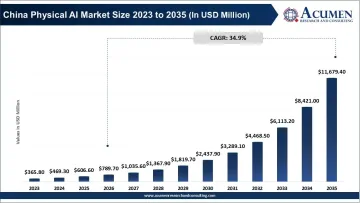
The China physical AI market size was valued at USD 606.6 million in 2025; the market is expected to reach at USD 11,679.4 million by 2035. The market is also seen to grow at a CAGR of 34.9% during the forecast period of 2026-2035. China continues to lead global robotics adoption, with over 290,000 industrial robots installed in 2024, while government investments in embodied AI, humanoid robotics, and intelligent manufacturing are accelerating commercialization of physical AI technologies.
Report Highlights
- By deployment, the on-device AI segment dominated the China physical AI market with a 52.8% share in 2025, driven by growing adoption of edge AI computing, industrial robots, autonomous machines, and real-time intelligent manufacturing systems across China.
- By deployment, the cloud-based AI segment accounted for the second-largest share of 47.2% in 2025, supported by expanding AI data centers, foundation model training, cloud robotics platforms, and centralized robot fleet management.
- By component, the hardware segment dominated the China physical AI market with a 61.2% share in 2025, owing to strong domestic manufacturing of AI chips, sensors, robotic components, machine vision systems, and intelligent hardware platforms.
- By component, the software segment held the second-largest share of 30.9% in 2025, fueled by increasing development of robotics operating systems, computer vision software, AI foundation models, and autonomous control platforms.
- By technology, the computer vision segment dominated the China physical AI market with a 43.8% share in 2025, as AI-powered visual perception remains essential for robotic navigation, inspection, object recognition, and autonomous decision-making.
- By technology, the speech / NLP segment represented the second-largest share of 21.5% in 2025, driven by rising demand for natural human-robot interaction, multilingual AI assistants, and intelligent service robots.
- By robot type / form factor, the industrial robots segment dominated the China physical AI market with a 38.0% share in 2025, supported by China's leadership in industrial automation, electronics manufacturing, automotive production, and smart factory deployment.
- By robot type / form factor, the service robots segment accounted for the second-largest share of 15.1% in 2025, driven by increasing adoption of AI-enabled robots across healthcare, hospitality, retail, logistics, and public services.
- By application, the manufacturing & automotive segment dominated the China physical AI market with a 22.6% share in 2025, owing to rising investments in AI-powered production lines, digital twins, predictive maintenance, and intelligent factory automation.
- By application, the healthcare segment captured the second-largest share of 18.4% in 2025, supported by growing deployment of surgical robots, rehabilitation systems, intelligent diagnostics, and AI-assisted patient care solutions.
What Is Driving China's Leadership in Physical AI Market?
With a world leading position in industrial robotics, artificial intelligence, advanced manufacturing and intelligent automation, China’s physical AI market can capitalize on global growth. By integrating governments leading AI policies, broad-ranging electronics supply chain and extensive hardware development capacity, along with an expanding AI hardware capacity and domestic robotics startups, China is at one of world’s leading centers that have one of the most complete physical AI supply chains.
In addition, with the advancements in embodied AI foundational models, edge AI processors, reinforcement learning and computer vision technologies, more capable robots are going to complete very precise and complicated real-world jobs, empowered with computer vision and learning abilities, able to conduct autonomy navigation.
How Is the Chinese Government Accelerating Physical AI Development?
| Government Initiative / Policy | Key Provisions |
|---|---|
| New Generation Artificial Intelligence Development Plan | Established AI as a national strategic priority with the objective of making China a global AI leader by 2030 through investments in AI research, robotics and talent development. |
| 14th Five-Year Plan (2021–2025) | Identified artificial intelligence, robotics, high-end manufacturing, semiconductors, and digital technologies as strategic emerging industries requiring accelerated innovation. |
| Intelligent Robot Innovation and Development Action Plan | Focuses on advancing intelligent robots through improvements in perception, control systems, AI algorithms and human-robot collaboration. National Computing Power Infrastructure Strategy Expands national AI computing capacity through intelligent computing centers, supercomputers, and domestic AI accelerator deployment. |
| National Humanoid Robot Innovation Program | The Ministry of Industry and Information Technology (MIIT) identified humanoid robots as a strategic frontier industry and released development goals targeting world-leading innovation by 2025 and a globally competitive industrial ecosystem by 2027. |
| National AI Innovation Centers | Supports collaboration among universities, research institutes, and technology companies in AI, robotics, machine vision, autonomous systems, and intelligent manufacturing. |
How Is Physical AI Transforming China's Manufacturing Sector?
- In 2024, China's installed industrial robot base surpassed 2.02 million units, more than half of global total, providing a scalable base to deploy physical AI at factory sites.
- China's manufacturing industry achieved RMB 40.5 trillion ($5.65 trillion) in industrial value added output in 2024, holding to its position as the world’s largest manufacturing power for the 15th straight year.
- China produced 370,000 industrial robots in the first half of 2025, a 27.8% year-on-year growth, illustrating the rapid expansion of indigenous automation capacity for AI-powered machines.
- China had about 470 industrial robots per 10,000 manufacturing workers as of 2024, demonstrating rapid adoption for AI-enabled automation technologies particularly for the automotive, consumer electronics, batteries, and machinery manufacturing sectors.
- China captured 57% domestic suppliers market in industrial robot sector in 2024.
Market Dynamics
Driver
Rising Government Investments and Industrial Automation
China's physical AI market is being driven by strong government support for artificial intelligence, robotics, and intelligent manufacturing under initiatives such as the 14th Five-Year Plan, Made in China 2025, and the National AI Development Plan. The country remains the world's largest industrial robot market, with more than 290,000 industrial robots installed in 2024, creating significant demand for AI-powered perception, autonomous decision-making, and robotic intelligence. Growing investment in domestic AI chips, embodied AI foundation models, and smart factories is further strengthening commercialization across manufacturing, logistics, healthcare, and service robotics.
- UBTECH Robotics are utilizing humanoid robot in a China automobile manufacturing sector facility.
- Huawei is growing industrial and domestic AI intelligence through its AscendAI chip and Atlas AI platforms.
Restraint
High-End Semiconductor Dependence and Complex Humanoid Robot Development
Despite rapid progress, China's physical AI market faces challenges related to advanced semiconductor availability, high development costs, and technical complexity. Physical AI systems require powerful AI processors, precision sensors, force-feedback systems, and high-quality actuators, increasing development and commercialization costs. Export restrictions on advanced AI chips and manufacturing equipment have also encouraged domestic companies to accelerate localization efforts, while achieving reliable autonomous reasoning and safe human-robot interaction remains technically challenging.
Opportunity
Humanoid Robotics, Embodied AI, and Intelligent Manufacturing
China presents physical AI as a growing area where, through quick implementation of robotics for humanoid assistance, embodiment for AI foundation models, manufacturing, and AI infrastructure, significant opportunities can be harnessed. Policies of encouragement from the government on strategic emerging industries, alongside a growing shortage of workers in manufacturing along with automation need of plants are pushing various enterprises to equip their companies with smart robots for numerous applications.
Commercializing general-purpose robots as well as multimodal AI models should pave new ways of implementation into industrial settings, medical and health fields, logistics, education, shopping and retail, public sector. For instance, Alibaba cloud and Baidu AI cloud on accelerating expansion of its AI platforms to foster robotics models development and simulation.
Segmental Insights
Deployment Insights
The on-device AI portion dominated China physical AI market at 52.8% in 2025 as the rapid adoption of intelligent manufacturing, industrial robots, AMRs, humanoids and autonomous driving devices led by Chinese domestic capabilities. The focus to build-up China domestic chip and edge computing helps robots to be able to be localize processing and real time control with very low latency by minimizing reliance on the cloud. Deployment for smart manufacturing where real time control and real time decision making for precise assembly, machine vision inspection, welding and handling will lead this trend especially in factories.
Manufacturers have been using AI enabled robots driven by 'Made in China 2025' and '14th Five Year plan' to make real-time autonomous perception and decision capabilities, with China's companies UBTECH Robotics, Unitree Robotics, Huawei, DJI, Hikrobot and Siasun Robot & Automation to boost adoption by installing edge AI chips, sensors and embedded intelligences onto the robotics platforms.
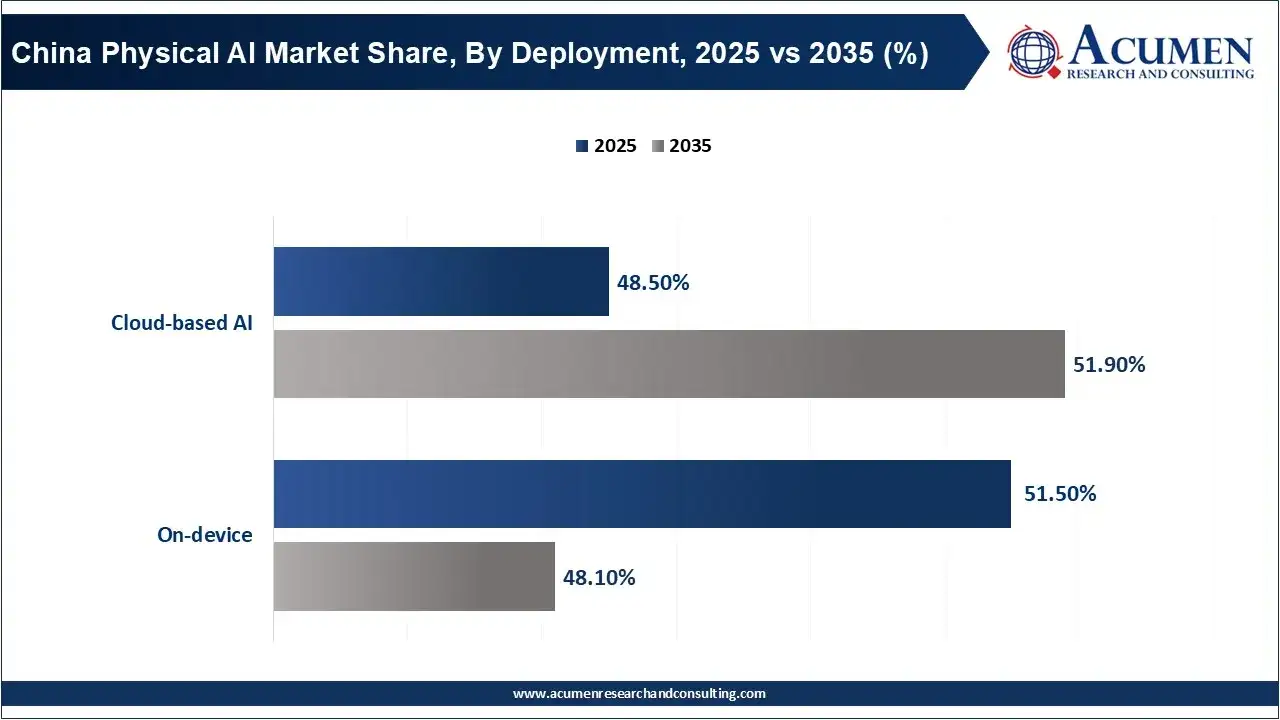
The cloud-based AI portion contributed 47.2% of China physical AI market in 2025 based on fast-growing AI computation facilities, hyperscale data centers and developing foundation models. Chinese technology providers increasingly utilize the cloud to conduct large-scale AI model trainings, managing entire fleets of industrial and service robots, digital twin simulations and continuous optimization by centralized data analysis of performance.
Component Insights
The hardware segment represented the largest portion of the China physical AI market in 2025 with a market share of 61.2% driven by China's strong manufacturing capabilities, and a growing ecosystem of robot production. Physical AI systems are equipped with advanced hardware. With one of the largest production bases of robots in the world, it is able to depend on local component suppliers and policy driven localization of advanced components.
The acceleration of industrial robot, cooperative robot, human-like robot and autonomous mobile robot production fueled sustained demand for high-performance hardware. Hardware sector companies including Huawei, Horizon Robotics, DJI, Hikvision, Hikrobot, Estun Automation, Siasun and Unitree Robotics still invests heavily on advanced robotic hardware.
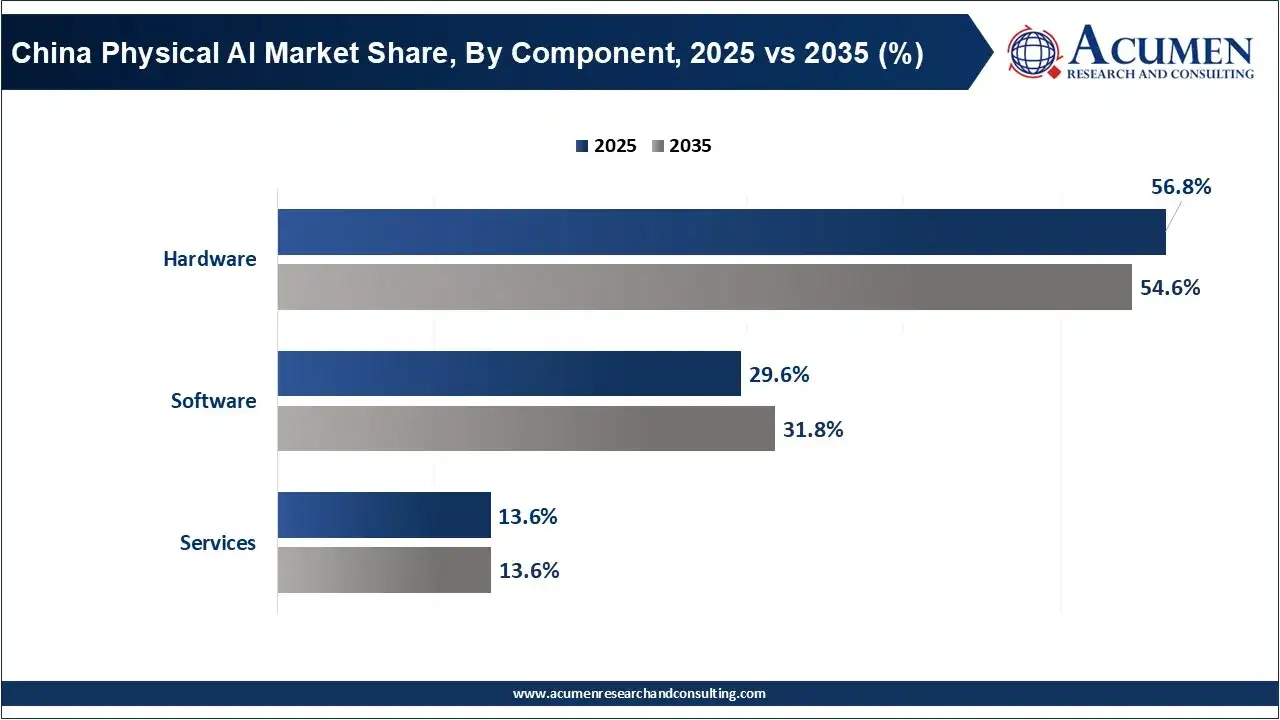
The software segment made up 30.9% market share within China physical AI market in 2025 and is fueled by rapid development of foundation model, computer vision, reinforcement learning, robot operating system and autonomous control software. A capable intelligence software is becoming a core component of physical AI. Its abilities include perception, reasoning, navigation, manipulation and decision making in complex physical environments.
Technology Insights
The computer vision segment held the largest share, accounting for 43.8% of the China physical AI market in 2025. As visual perception is considered the fundamental technology of intelligent robots for autonomous decision-making, the use of AI-powered cameras, depth sensors, LIDAR systems and computer vision algorithms allowed robots to perform a variety of tasks such as object recognition, product inspection, warehouse management, personnel identification and safe operation in dynamic environments.
China currently possesses the leading number of applied computer vision technologies and is continuously advancing in application domain, with the contribution of some key domestic AI companies, such as SenseTime, Megvii, Hikvision, Dahua Technology, Huawei, and Baidu.
The speech and natural language processing (NLP) segment comprised 21.5% share of the China physical AI market in 2025. As a growing demand for intelligent human machine interaction exists for the application of service robots, healthcare assistants, educational robots and business automation, Chinese developers integrate large language models into physical AI systems by applying NLP which makes robots understand human speech command, realize the intent and carry out more complex verbal functions.
The leading Chinese companies in the fields of speech recognition and AI assistants include iFlytek, Baidu, Alibaba, Tencent, Huawei and Xiaomi, etc. These firms continue invest in NLP in an effort to establish a seamless connection between humans and intelligent robotic systems.
Robot Type / Form Factor Insights
The industrial robots segment was the largest component, representing 38% of China’s physical AI market in 2025. Many manufacturers are using AI robots for welding, assembly, inspection, and pick and place, as they look for innovative solutions to increase automation in their factories, address labor shortages, and boost productivity, with technologies such as computer vision, predictive maintenance and autonomous navigation integrated to create smarter systems from intelligent machines.
Many Chinese robot manufacturers including Estun Automation, Siasun Robot & Automation, Efort Intelligent Equipment, Inovance Technology and STEP Electric are also increasing production of AI-powered robots to meet rising domestic demand for smarter factory operations.
The service robots segment held a 15.1% share of China’s physical AI market in 2025. As demand from the healthcare sector, retail and e-commerce, hospitality industry, the elderly care industry and more general purpose tasks continues, an increasing number of robots will be implemented in these sector as well.
The aging population in China, as well as ongoing development and extension of the health and pharmaceutical sector, has created demand for AI-powered robots that are able to perform tasks of medical assistant, security service and some administrative works.
Application Insights
The industrial and automotive segment dominated the China physical AI market, capturing a 22.6% share in 2025, as China holds leadership in industrial production, automotive manufacturing, electronics products, and the rollout of smart factories. An uptick in adoption of intelligent manufacturing via industry 4.0 frameworks and supported by policy incentives from the government have propelled the ongoing growth of in-factory robot deployments.
Key manufacturers such as BYD, SAIC Motor, Geely, CATL, Foxconn China and Midea Group have increased investment in AI and related robots systems that drive product assembly.
The healthcare segment held a share of 18.4% in 2025 on the strength of adoption of advanced robotic surgery and rehabilitation systems, intelligent hospital diagnostics equipment, logistics robots for hospitals and other AI based patient care technologies, China’s growing demand for healthcare, ageing populations, and continued government investment into digital health continue to spur healthcare systems to embrace robotics solutions for operational efficiency.
Physical AI R&D Spending Analysis in China
| Category | Key Insights |
|---|---|
| National AI Investment | China has announced AI-related investments exceeding CNY 1 trillion ($138+ billion) through various national and provincial initiatives over the coming years. |
| Government R&D Intensity | China invested approximately 2.68% of GDP in R&D in 2024, with total R&D expenditure exceeding CNY 3.6 trillion ($500+ billion). |
| AI Computing Infrastructure | Huawei introduced the Atlas 950 SuperPoD AI computing platform in 2026 to strengthen domestic AI computing capabilities using indigenous technologies. |
| Robotics R&D Priority | Robotics has been identified as a strategic industry under China's 15th Five-Year Plan, emphasizing embodied intelligence, industrial robotics, and intelligent manufacturing. |
| AI Patent Leadership | China accounts for over 60% of global AI patent filings, with robotics, computer vision, autonomous systems, and embodied intelligence among the fastest-growing categories. |
| Humanoid Robot Development | More than 100 Chinese companies are actively developing humanoid robots and embodied AI platforms. |
Competitive Landscape
- Huawei Technologies Co., Ltd. – Develops AI processors, edge computing platforms, cloud infrastructure, and intelligent computing systems that support large-scale physical AI deployment.
- UBTECH Robotics – One of China's leading humanoid robotics companies, developing AI-powered humanoid robots for manufacturing, education, logistics, and commercial applications.
- Unitree Robotics – Specializes in quadruped and humanoid robots, advancing embodied AI through intelligent motion control, reinforcement learning, and autonomous mobility.
- Siasun Robot & Automation Co., Ltd. – A leading industrial robotics manufacturer providing AI-enabled automation systems for manufacturing, healthcare, logistics, and smart factories.
- DJI – Integrates computer vision, autonomous navigation, AI perception, and edge intelligence into drones and intelligent robotic platforms.
- Hikrobot – Develops machine vision systems, mobile robots, warehouse automation solutions, and AI-powered industrial inspection technologies.
- Estun Automation – Manufactures intelligent industrial robots, motion control systems, and AI-driven automation equipment supporting China's smart manufacturing transformation.
- Baidu – Develops foundation AI models, autonomous driving technologies, cloud AI platforms, and embodied intelligence software supporting physical AI applications.
- SenseTime – Provides advanced computer vision, perception AI, and multimodal foundation models that enhance autonomous robotic intelligence and physical AI systems.
- Keenon Robotics – Develops autonomous service robots for hospitality, healthcare, retail, and commercial facilities using AI-powered navigation and interaction technologies.
Recent News
- In August 2026 DeepSeek invested $20.8 million in Unitree Robotics to boost embodied AI development before the company goes for the IPO in Shanghai. The collaboration marries DeepSeek's large AI models and Unitree's human robot know-how. The firms intend to promote the use of physical AI through on-device robot training and multi-modality intelligence.
- In July 2026 At WAIC 2026 Matrix Robotics debuted the MATRIX-3, a new generation of the WAVE Physical World Foundation Model as well as kicking off a global partner program. The program targets to enable earlier commercialization of embodied AI through partnerships with robotic developers and manufacturers and key AI ecosystem companies.
Segments Covered
By Deployment
- Cloud-based AI
- On-device AI
By Component
- Hardware
- Software
- Services
By Technology
- Computer Vision
- Speech / NLP
- Gesture / Movement Recognition
- Reinforcement Learning & Control Systems
- Others
By Robot Type / Form Factor
- Industrial Robots
- Service Robots
- Humanoids / Social Robots
- Cobots
- Exoskeletons / Prosthetics
- Mobile Robots / Drones
By Application
- Manufacturing & Automotive
- Healthcare
- Logistics & Warehousing
- Retail & Hospitality
- Defense & Security
- Agriculture
- Education & Research
Looking for discounts, bulk pricing, or custom solutions? Contact us today at sales@acumenresearchandconsulting.com
Frequently Asked Questions

Other ICT Reports
July 2023
July 2024
November 2023
February 2023