
AI Data Center Power Infrastructure Market Size, Share, Forecast Forecast 2026 to 2035
AI Data Center Power Infrastructure Market (By Component: UPS & Battery Energy Storage, Switchgear & Medium-voltage Distribution, Transformers & Substations, Busways, Rack PDUs & Power Shelves, Backup Generators, Services; By Power Architecture: AC Distribution, DC Distribution; By Rack Power Density: Below 50 kW per rack, 50 to below 150 kW per rack, 150 to below 500 kW per rack, 500 kW per rack and above (MW-class); By Data Center Type: Hyperscale, Colocation, Enterprise, Edge, Modular & portable; By AI Workload: AI Model Training, AI Inference, Other AI/HPC Workloads; By Deployment Type: New-build AI Facilities, Retrofit / upgrade of Existing Facilities) - Global Industry Analysis, Size, Share, Analysis, Trends and Forecast 2026 - 2035
- Last Updated: 16 Nov 2026
- Report Code: ARC4008
- Category: ICT
AI Data Center Power Infrastructure Market Insights 2026 to 2035
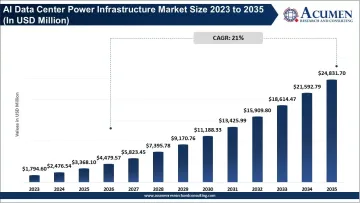
The AI data center power infrastructure market size was valued at $3,368.10 million in 2025. The market is seen to reach at $24,831.70 million by 2035; expanding at a CAGR of 21% during the forecast period of 2026-2035. The market is expanding due to rising artificial intelligence (AI) computing workloads, increasing GPU server deployments, and growing rack power density. Hyperscale investments, grid capacity constraints, and demand for reliable electricity are accelerating adoption of advanced power distribution, energy storage, and on-site generation systems.
Key Takeaways
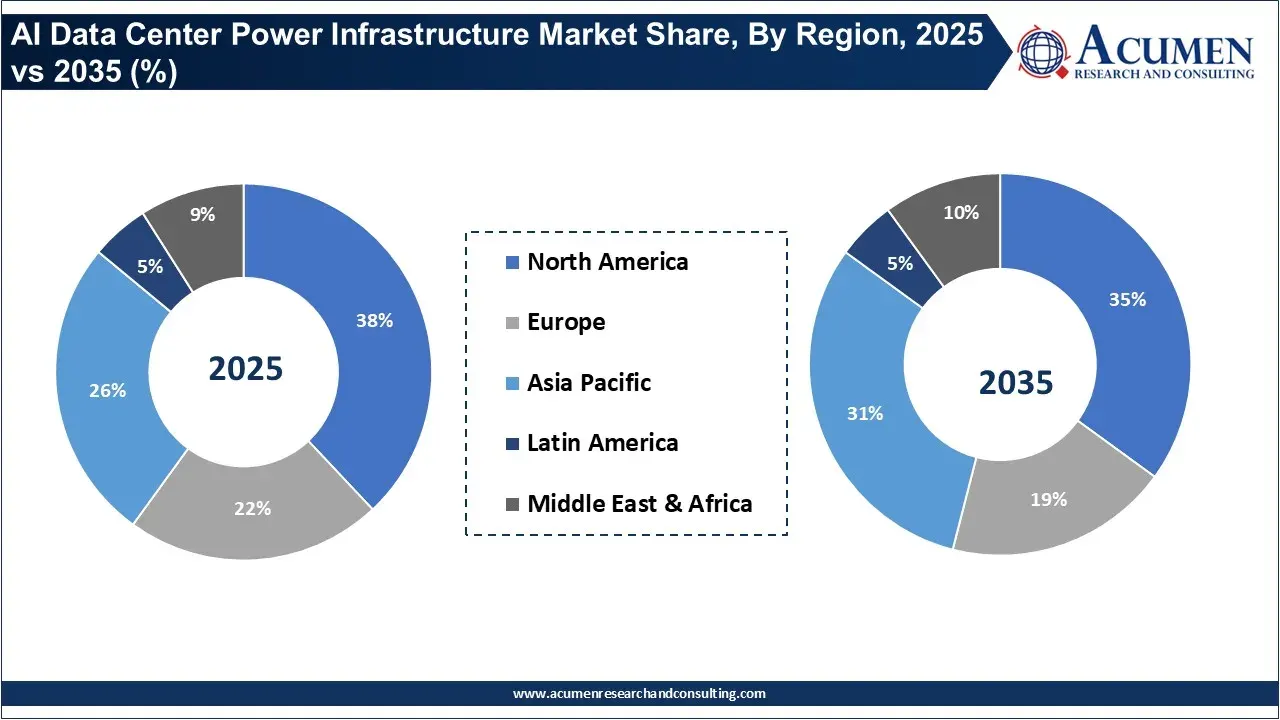
- By Region: North America dominated the regional segment with a 38.0% share in 2025, equivalent to USD 1,279.88 million. Its share is projected to reach 35.0% by 2035, supported by an established hyperscale data center ecosystem, strong cloud infrastructure investment, and growing demand for high-capacity AI computing facilities.
- By Component: Services (design, installation, maintenance) dominated the component segment with a 28.0% share in 2025, valued at USD 943.07 million. Demand is supported by the complexity of AI data center power infrastructure, increasing requirements for specialized engineering and system integration, and the need for ongoing maintenance of high-density electrical systems.
- By Power Architecture: AC distribution dominated the power architecture segment with an 88.0% share in 2025, generating USD 2,963.93 million. Its established infrastructure base, compatibility with conventional data center electrical systems, and widespread availability of supporting equipment continue to support its leading position.
- By Rack Power Density: The 50 to below 150 kW per rack category dominated the rack power density segment with a 50.0% share in 2025, equivalent to USD 1,684.05 million. Its leadership is supported by increasing deployment of GPU-based computing systems and the need for higher rack-level power capacity across hyperscale and colocation facilities.
- By Data Center Type: Hyperscale data centers dominated the data center type segment with a 50.0% share in 2025, generating USD 1,684.05 million. Demand is supported by large-scale AI infrastructure investments from cloud service providers and technology companies, which require substantial electrical capacity and reliable power distribution systems.
- By AI Workload: AI model training dominated the AI workload segment with a 60.0% share in 2025, valued at USD 2,020.86 million. Its leading position reflects the high computing and electricity requirements of training large AI models, which drive investment in high-capacity power distribution, backup systems, and energy management infrastructure.
- By Deployment Type: New-build AI facilities dominated the deployment type segment with an 82.0% share in 2025, generating USD 2,761.84 million. Demand is supported by the development of purpose-built AI data centers designed for high-density computing, scalable power infrastructure, and the growing electricity requirements of advanced AI workloads.
AI Data Center Infrastructure Market Size & Forecast
- Base Year Market Size (2025): $3,368.10 million
- Current Year Market Size (2026): $4,479.57 million
- Estimated Year Market Size (2035): $24,831.70 million
- Forecast Period CAGR (2026-2035): 21%
AI Data Center Power Infrastructure Market Overview
The global AI data center power infrastructure market is witnessing substantial expansion as artificial intelligence workloads increase electricity consumption and create demand for advanced power delivery systems. AI data centers require significantly higher power capacity than conventional facilities because of GPU-intensive computing, high-performance accelerators, and large-scale model training and inference operations.
The market encompasses critical power infrastructure, including uninterruptible power supply (UPS) systems, battery energy storage, switchgear, transformers, substations, busways, rack power distribution units (PDUs), backup generators, and on-site power generation technologies. Increasing rack power density is encouraging operators to modernize electrical architectures and adopt solutions capable of supporting high-capacity and continuous power delivery.
Technology and Architecture Analysis
- Uninterruptible Power Supply (UPS) Systems: UPS systems provide continuous power to critical IT infrastructure during grid interruptions and voltage fluctuations. Modular UPS configurations, lithium-ion battery integration, and high-efficiency power conversion are gaining importance as AI data centers require greater reliability and scalability.
- Battery Energy Storage Systems (BESS): Battery storage supports short-duration backup, power stabilization, peak-load management, and renewable energy integration. Increasing AI workload fluctuations are encouraging the deployment of advanced battery systems capable of responding to rapid changes in electricity demand.
- Medium-Voltage Switchgear and Distribution: Medium-voltage switchgear manages incoming electrical power and distributes it across data center infrastructure. Advanced switchgear solutions improve electrical protection, fault isolation, operational safety, and scalability for large AI facilities with substantial power requirements.
- Transformers and Substations: Transformers and substations convert and distribute electricity across different voltage levels required by data center equipment. High-capacity transformers, compact substations, and solid-state transformer technologies are becoming increasingly relevant as operators expand electrical capacity and explore next-generation distribution architectures.
AI Data Center Power Infrastructure Market Dynamics
Growth Drivers
- Rapid Expansion of AI Computing Infrastructure: Increasing deployment of GPUs, AI accelerators, and high-performance computing systems is significantly raising electricity requirements across data centers. Large-scale AI model training and inference operations require high-capacity and uninterrupted power delivery, encouraging investment in UPS systems, transformers, switchgear, and advanced rack-level distribution infrastructure.
- Increasing Rack Power Density and Hyperscale Investments: AI server racks are progressing toward substantially higher power densities, creating demand for advanced electrical architectures and high-capacity power distribution equipment. Hyperscale cloud providers and GPU infrastructure operators are investing in purpose-built facilities, strengthening demand for scalable power systems, battery storage, and integrated electrical infrastructure.
Restraints
- High Capital Investment and Infrastructure Costs: Deploying AI-ready power infrastructure requires substantial investment in transformers, substations, UPS systems, switchgear, backup generators, and electrical distribution networks. High equipment procurement and installation costs can increase project expenditure, extend investment recovery periods, and create financial barriers for smaller data center developers.
- Grid Capacity Constraints and Interconnection Delays: Limited electricity availability, transmission bottlenecks, and lengthy grid interconnection processes can delay the development of large AI data centers. In regions with constrained power infrastructure, developers may face difficulties securing sufficient electrical capacity, increasing project timelines and creating additional dependence on on-site generation solutions.
Key Opportunities
- Growing Adoption of HVDC and Advanced DC Distribution: The transition toward 800 V HVDC and 48/54 V rack-level DC architectures creates opportunities for power equipment manufacturers and technology providers. These systems can reduce conversion complexity and support higher rack power densities, encouraging innovation in solid-state transformers, DC protection equipment, power shelves, and advanced converters.
- Expansion of Behind-the-Meter Power and Energy Storage: Increasing grid constraints are creating opportunities for gas turbines, fuel cells, battery energy storage, and other on-site power solutions. Data center operators are exploring dedicated electricity generation and storage systems to improve energy security, manage peak demand, and support continuous AI computing operations.
Challenges
- Managing Rapidly Increasing and Variable Power Demand: AI workloads can generate substantial fluctuations in electricity consumption as computing clusters move between training, inference, and other intensive operations. Power infrastructure must accommodate changing loads without compromising voltage stability, equipment performance, or operational continuity, requiring sophisticated monitoring and power management capabilities.
- Equipment Supply Chain and Technology Standardization: Long manufacturing lead times for transformers, switchgear, generators, and power electronics can delay data center projects. In addition, the transition toward high-voltage DC architectures introduces challenges involving equipment compatibility, electrical protection, safety standards, and integration across suppliers and infrastructure platforms.
AI Data Center Infrastructure Market Segmental Insights
Component Insights
Services (design, installation, maintenance): Services dominated the component segment with a 28.0% share in 2025, generating USD 943.07 million. AI data centers require specialized electrical engineering, power-system integration, commissioning, and ongoing maintenance to support high-density computing environments. The complexity of coordinating UPS systems, switchgear, transformers, rack-level distribution, and backup power creates demand for end-to-end infrastructure services.
AI Data Center Power Infrastructure Market Share, By Component, 2025 & 2035 (%)
| Component | Revenue Share 2025 (%) | Revenue Share 2035 (%) |
|---|---|---|
| UPS & Battery Energy Storage | 19% | 16% |
| Switchgear & Medium-voltage Distribution | 11% | 10.50% |
| Transformers & Substations | 9.50% | 10.50% |
| Busways, Rack PDUs & Power Shelves | 11% | 15% |
| Backup Generators | 11% | 7% |
| On-site & Behind-the-meter Power | 5.50% | 9% |
UPS & battery energy storage: UPS and battery energy storage represented the second-largest component category with a 19.0% share in 2025, valued at USD 639.94 million. These systems help maintain uninterrupted power delivery, protect sensitive AI computing equipment, and provide short-duration backup during grid disturbances or generator transitions. Increasing rack power density and the need for power continuity are supporting investments in scalable UPS and battery configurations.
Power Architecture Insights
AC distribution: AC distribution dominated the power architecture segment with an 88.0% share in 2025, generating USD 2,963.93 million. Its established deployment base, compatibility with conventional data center electrical infrastructure, and broad availability of supporting equipment continue to underpin adoption. Existing facilities and many new data center designs rely on AC-based distribution across utility connections, transformers, switchgear, and power conversion systems.
AI Data Center Power Infrastructure Market Share, By Power Architecture, 2025 & 2035 (%)
| Power Architecture | Revenue Share, 2025 (%) | Revenue Share, 2035 (%) |
|---|---|---|
| AC Distribution (415/480 V) | 88% | 45% |
| DC Distribution (800 V HVDC, 48/54 V rack DC) | 12% | 55% |
DC distribution: DC distribution is expected to be the fastest-growing power architecture category, with a projected CAGR of 38.5% from 2026 to 2035. Its share is expected to rise from 12.0% in 2025 to 55.0% by 2035, with revenue reaching USD 13,657.44 million. The shift toward high-density AI accelerators is increasing interest in architectures that can reduce conversion stages and support efficient power delivery at rack level.
Rack Power Density Insights
50 to below 150 kW per rack: This category dominated the rack power density segment with a 50.0% share in 2025, generating USD 1,684.05 million. It represents an important deployment range for AI infrastructure that requires substantially greater power capacity than conventional enterprise racks while remaining compatible with a broader range of facility designs. Demand is supported by the expansion of GPU-based computing environments and the deployment of high-performance servers across hyperscale and colocation facilities.
AI Data Center Power Infrastructure Market Share, By Rack Power Density, 2025 & 2035 (%)
| Rack Power Density | Revenue Share, 2025 (%) | Revenue Share, 2035 (%) |
|---|---|---|
| Below 50 kW per rack | 22% | 8% |
| 50 to below 150 kW per rack | 50% | 30% |
| 150 to below 500 kW per rack | 24% | 37% |
| 500 kW per rack and above (MW-class) | 4% | 25% |
500 kW per rack and above (MW-class): The MW-class rack density category is expected to be the fastest-growing segment, registering a projected CAGR of 41.5% from 2026 to 2035. The emergence of highly concentrated AI computing clusters is creating demand for power architectures capable of supporting exceptionally high rack-level loads. This transition is expected to accelerate investment in advanced power shelves, high-voltage distribution, dedicated substations, and integrated power management solutions.
Data Center Type Insights
Hyperscale: Hyperscale data centers dominated the data center type segment with a 50.0% share in 2025, generating USD 1,684.05 million. Large cloud service providers and technology companies are investing in AI infrastructure to support model training, inference, and cloud-based AI services. Their large-scale facility expansions require substantial electrical capacity, resilient power systems, and coordinated infrastructure deployment.
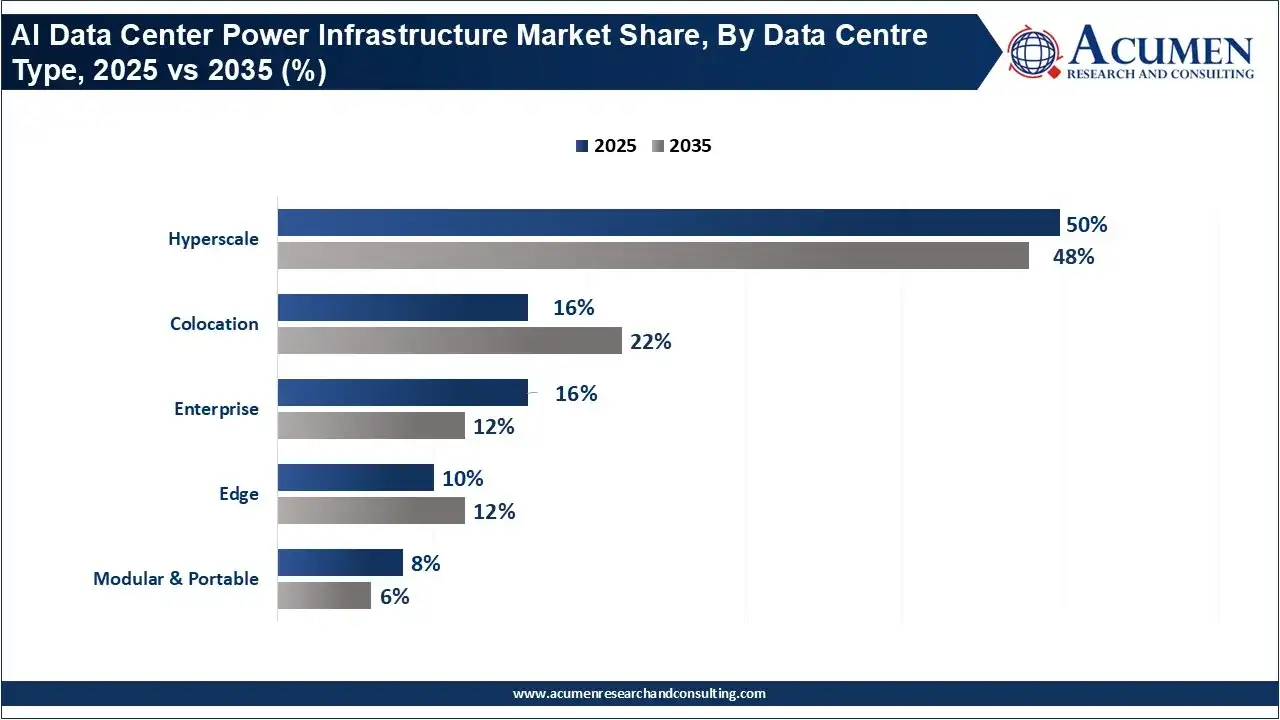
Colocation: Colocation is also the fastest-growing data center type, with a projected CAGR of 24.8% from 2026 to 2035. Its share is expected to increase from 16.0% in 2025 to 22.0% by 2035. Demand is supported by the growth of GPU cloud and neocloud providers, rising enterprise outsourcing of AI infrastructure, and the need for flexible access to high-performance computing capacity.
AI Workload Insights
AI model training: AI model training dominated the AI workload segment with a 60% share in 2025, generating USD 2,020.86 million. Training large AI models requires substantial computing capacity and concentrated clusters of high-performance accelerators, resulting in significant power infrastructure requirements. The segment is projected to reach USD 10,429.32 million by 2035, at a CAGR of 16.7%.
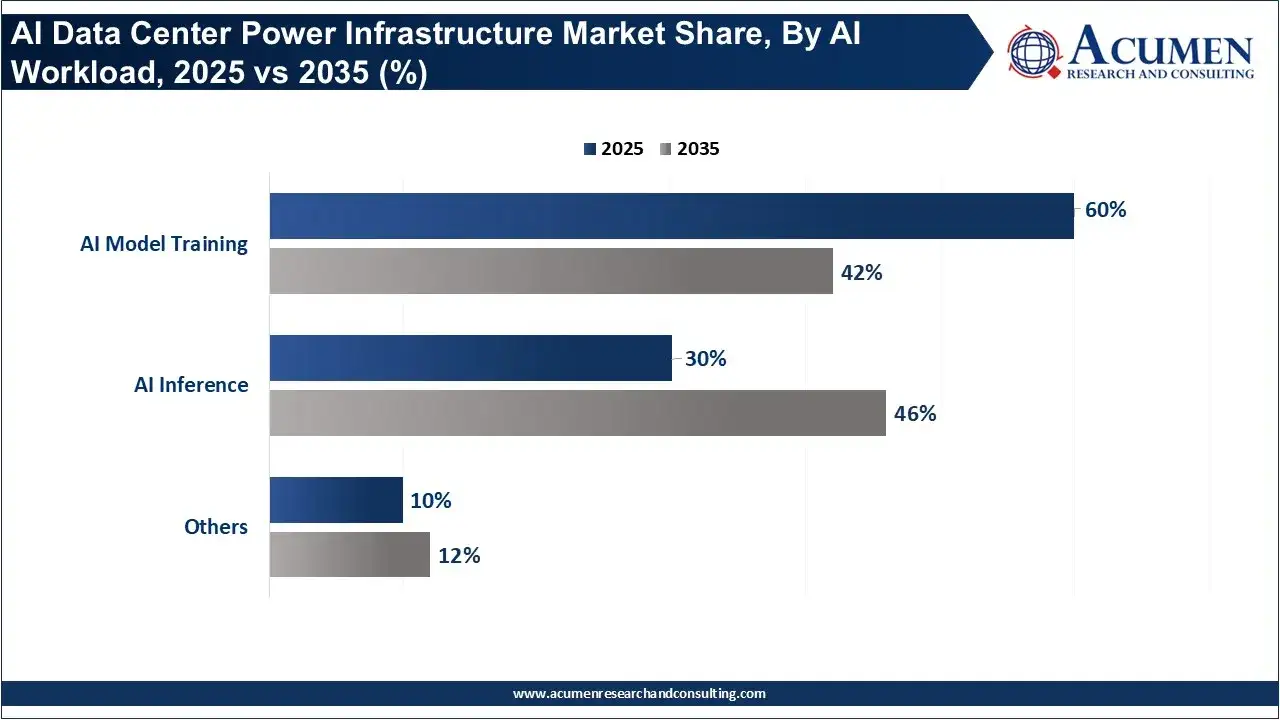
AI inference: AI inference is expected to be the fastest-growing AI workload category, registering a projected CAGR of 26.1% from 2026 to 2035. Its share is projected to rise from 30.0% in 2025 to 46.0% by 2035, with revenue reaching USD 11,422.58 million. Wider integration of AI into business applications and digital services is shifting infrastructure requirements beyond model development toward continuous, high-volume model execution.
Deployment Type Insights
New-build AI facilities: New-build AI facilities dominated the deployment type segment with an 82% share in 2025, generating USD 2,761.84 million. The rapid expansion of AI computing capacity is encouraging cloud providers, technology companies, and specialist data center developers to construct purpose-built facilities. The segment is projected to reach USD 18,623.78 million by 2035, at a CAGR of 19.9%.
Retrofit / upgrade of existing facilities: Retrofit and upgrade projects are expected to be the fastest-growing deployment category, with a projected CAGR of 24.9% from 2026 to 2035. Their share is expected to increase from 18.0% in 2025 to 25.0% by 2035, with revenue reaching USD 6,207.93 million. Data center operators are upgrading existing facilities to accommodate AI servers, higher rack power densities, and more demanding electrical requirements.
AI Data Center Infrastructure Market Regional Insights
Why Does North America Dominate the AI Data Center Infrastructure Market?
North America dominated the regional segment with a 38% share in 2025, generating USD 1,279.88 million. The region's leadership is supported by its mature hyperscale data center ecosystem, strong presence of major cloud service providers, and substantial investments in artificial intelligence infrastructure. The United States is a major center for AI model development and deployment, driving demand for high-capacity electrical systems, UPS and battery energy storage, switchgear, transformers, and advanced power distribution solutions.
The expansion of GPU-based computing facilities is also increasing the need for reliable power infrastructure capable of supporting higher rack densities and continuous operations. Furthermore, investments in new data center campuses and upgrades to existing facilities are creating opportunities for infrastructure suppliers and engineering service providers.
Why Is Asia-Pacific the Fastest-Growing Region in the AI Data Center Infrastructure Market?
Asia-Pacific is expected to be the fastest-growing regional market, registering a projected CAGR of 23.1% from 2026 to 2035. Its market share is expected to increase from 26.0% in 2025 to 31.0% by 2035, with revenue reaching USD 7,697.83 million. Growth is supported by expanding cloud infrastructure, rising AI adoption, and increasing investments in hyperscale and colocation facilities across major economies.
Countries such as China, Japan, India, Singapore, and South Korea are strengthening their digital infrastructure to support AI applications, cloud computing, and enterprise digitalization. The expansion of GPU-based data centers is creating demand for high-capacity transformers, advanced switchgear, UPS systems, battery energy storage, and rack-level power distribution. In addition, the development of regional data center hubs and growing demand for localized AI computing capacity are encouraging infrastructure investment.
Regulatory and Standards Landscape
| Country | Regulatory Authority / Framework | Key Regulations and Standards |
|---|---|---|
| United States | Federal Energy Regulatory Commission (FERC), National Fire Protection Association (NFPA), and state utility regulators | National Electrical Code (NFPA 70), NFPA 75, NFPA 110, and regional grid interconnection requirements |
| China | Standardization Administration of China (SAC), Ministry of Housing and Urban-Rural Development, and National Development and Reform Commission | GB 50174, GB 40879-2021, and national data center energy-efficiency policies |
| India | Bureau of Indian Standards (BIS), Bureau of Energy Efficiency (BEE), and Central Electricity Authority (CEA) | Energy Conservation Building Code (ECBC 2017), Energy Conservation and Sustainable Building Code (ECSBC 2024), BIS standards for PUE, CUE, CER and WUE, and CEA electrical safety regulations |
| Singapore | Infocomm Media Development Authority (IMDA) and Enterprise Singapore | SS 564 Green Data Centres, SS 715:2025 Energy Efficiency of Data Centre IT Equipment, and applicable electrical installation requirements |
| Germany | Federal Ministry for Economic Affairs and Energy, Federal Network Agency, and European Union institutions | German Energy Efficiency Act (EnEfG), EU Energy Efficiency Directive, EU data center reporting requirements, and applicable DIN/VDE electrical standards |
AI Data Center Power Infrastructure Market Competitive Landscape
- Schneider Electric (France)
- Vertiv Holdings (United States)
- Eaton Corporation (Ireland)
- ABB Ltd. (Switzerland)
- Siemens AG (Germany)
- Mitsubishi Electric Corporation (Japan)
- Delta Electronics, Inc. (Taiwan)
- Legrand SA (France)
- Cummins Inc. (United States)
- Caterpillar Inc. (United States)
Segments Covered
By Component
- UPS & Battery Energy Storage
- Switchgear & Medium-voltage Distribution
- Transformers & Substations (including solid-state transformers)
- Busways, rack PDUs & Power Shelves
- Backup Generators (diesel, gas, HVO)
- On-site & Behind-the-meter Power (gas turbines/engines, fuel cells, SMRs)
- Power Monitoring & Management Software
- Services (design, installation, maintenance)
By Power Architecture
- AC Distribution (415/480 V)
- DC Distribution (800 V HVDC, 48/54 V rack DC)
By Rack Power Density
- Below 50 kW per rack
- 50 to below 150 kW per rack
- 150 to below 500 kW per rack
- 500 kW per rack and above (MW-class)
By Data Center Type
- Hyperscale
- Colocation (including GPU cloud / neocloud facilities)
- Enterprise
- Edge
- Modular & portable
By AI Workload
- AI Model Training
- AI Inference
- Other AI/HPC Workloads (analytics, vision, scientific computing)
By Deployment Type
- New-build AI Facilities
- Retrofit / upgrade of Existing Facilities
By Region
- North America
- Europe
- Asia-Pacific
- Latin America
- Middle East & Africa
Looking for discounts, bulk pricing, or custom solutions? Contact us today at sales@acumenresearchandconsulting.com
Frequently Asked Questions

Related Market Research Reports
July 2026
December 2025
September 2024
July 2024
October 2026
September 2026
September 2026
September 2026