
Data Center Cooling Market Size, Share, Trends, Report 2026 To 2035
Data Center Cooling Market (By Component: Solutions, Services; By Cooling Technology: Direct-to-Chip Liquid Cooling, Immersion Cooling, Single-Phase Immersion Cooling, Two-Phase Immersion Cooling, Rear-Door Heat Exchanger (RDHx) Cooling, Others; By Cooling Mechanism: Single-Phase Liquid Cooling, Two-Phase Liquid Cooling; By Data Center Type: Hyperscale & Cloud Data Centers, Colocation Data Centers, Enterprise Data Centers, Edge & Distributed Data Centers, Others; By Rack Power Density: Below 20 kW/Rack, 20 to less than 50 kW/Rack, 50 to less than 100 kW/Rack, 100 to less than 200 kW/Rack, 200 kW/Rack and Above; By Deployment Type: New-Build Data Centers, Retrofit; By End-Use Industry: IT & Telecommunications, BFSI, Healthcare & Life Sciences, Government & Public Sector, Manufacturing) - Global Industry Analysis, Size, Share, Regional Analysis, Trends and Forecast 2026 - 2035
- Last Updated: 12 Oct 2026
- Report Code: ARC3995
- Category: ICT
Data Center Cooling Market Size & Forecast
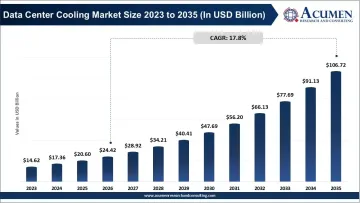
The global data center cooling market size was accounted for USD 20.60 billion in 2025 and is expected to reach USD 106.72 billion by 2035; growing at a CAGR of 17.8% during the forecast period from 2026 to 2035. The data center cooling market comprises equipment, systems, and services used to regulate temperatures and remove heat generated by servers, storage devices, and networking infrastructure. It includes air cooling, liquid cooling, chillers, cooling towers, and advanced thermal management solutions. Market growth is driven by expanding data center capacity, rising artificial intelligence (AI) workloads, increasing rack power density, and the need for energy-efficient cooling infrastructure.
- Base Year Market Size (2025): $20.60 billion
- Current Year Market Size (2026): $24.42 billion
- Estimated Year Market Size (2035): $106.72 billion
- Forecast Period CAGR (2026-2035): 17.8%
- Leading Region: North America (Revenue Share 40%)
Key Takeaway
- By region: North America dominated the data center cooling market with a 40% share in 2025, supported by established data center infrastructure, strong hyperscale cloud investments, and rising demand for advanced cooling systems to manage growing computing workloads.
- By component: Solutions dominated the market with a 72.0% share in 2025, driven by demand for cooling systems, fluid handling equipment, cooling fluids, and monitoring technologies that maintain thermal performance and support high-density data center operations.
- By cooling technology: Direct-to-chip liquid cooling led the market with a 48.0% share in 2025, supported by its ability to remove heat directly from processors and other high-performance components, particularly in AI and high-density computing environments.
- By cooling mechanism: Single-phase liquid cooling dominated the market with a 64.0% share in 2025, driven by its established implementation, relatively straightforward fluid management, and suitability for removing heat from increasingly powerful data center hardware.
- By data center type: HyperscaleWhat Is the Data Center Cooling Market? and cloud data centers held the leading position with a 41.0% share in 2025, supported by large-scale cloud infrastructure expansion, AI workloads, and the need for reliable cooling across high-capacity computing facilities.
- By rack power density: The 50 to below 100 kW per rack segment led the market with a 31.0% share in 2025, reflecting rising rack-level power requirements and growing demand for cooling systems capable of handling concentrated heat loads.
- By deployment type: New-build data centers dominated the market with a 58.0% share in 2025, driven by investment in purpose-built facilities designed to accommodate modern cooling architectures, higher rack densities, and expanding AI and cloud computing capacity.
- By end-use industry: IT and telecommunications dominated the market with a 41.0% share in 2025, supported by growing data traffic, cloud adoption, digital service delivery, and increasing computing requirements across telecommunications networks and IT infrastructure.
Recent Trends
- Growing Adoption of Liquid Cooling: Data center operators are increasingly adopting direct-to-chip and immersion cooling to manage the heat generated by high-density AI servers and high-performance computing systems.
- Rising Demand for AI-Ready Cooling Infrastructure: The expansion of AI training and inference workloads is increasing demand for cooling systems capable of supporting higher rack power densities and intensive computing operations.
- Integration of AI-Driven Cooling Management: Operators are deploying intelligent monitoring, predictive analytics, and automated controls to optimize cooling performance, improve energy efficiency, and reduce operating costs.
- Increasing Focus on Energy Efficiency: Data center developers are prioritizing high-efficiency chillers, free cooling, heat recovery, and optimized airflow management to reduce cooling-related energy consumption.
- Growing Interest in Water-Efficient Cooling: Concerns about water availability and sustainability are encouraging the adoption of air-cooled systems, closed-loop liquid cooling, and technologies designed to reduce water consumption.
Data Center Cooling Market Dynamics
Market Drivers
- Liquid Cooling Adoption: Direct-to-chip and immersion cooling technologies are gaining attention because liquids can transfer heat efficiently from high-power computing components. These systems help operators manage demanding thermal loads that conventional air-based infrastructure may struggle to accommodate.
- Operational Reliability: Continuous server operation requires stable temperature management to prevent thermal throttling, equipment degradation, and unplanned downtime. Data center operators are investing in precision cooling, automated controls, and real-time monitoring to protect critical workloads and maintain service availability.
- Water Conservation Priorities: Growing scrutiny of industrial water consumption is encouraging operators to evaluate closed-loop systems, dry cooling, and warm-water liquid cooling. These approaches can reduce dependence on evaporative cooling and improve the suitability of facilities in water-stressed locations.
Market Restraints
- High Installation Costs: Advanced cooling infrastructure requires specialized heat exchangers, pumps, coolant distribution units, piping, controls, and compatible server hardware. These capital requirements can delay implementation, particularly when existing facilities need extensive modifications to support new thermal architectures.
- Retrofitting Limitations: Existing data centers may lack sufficient space, structural provisions, piping layouts, or compatible electrical and mechanical infrastructure for advanced cooling systems. Retrofitting can disrupt operations and require customized engineering, making upgrades more difficult than installations in purpose-built facilities.
- Reliability Concerns: Liquid-based cooling introduces requirements for leak prevention, coolant quality management, corrosion control, and specialized maintenance. Uncertainty regarding long-term component performance and servicing procedures can discourage operators from replacing established cooling systems before reliability is demonstrated.
Market Opportunities
- Waste Heat Recovery: Data centers can capture thermal energy from cooling circuits and reuse it for district heating, commercial buildings, and industrial processes. Integrating heat exchangers and heat pumps creates opportunities to improve overall energy utilization and develop additional value from otherwise rejected heat.
- AI-Driven Cooling Controls: Intelligent software can combine temperature sensors, workload information, and predictive analytics to adjust cooling output dynamically. These systems create opportunities to reduce unnecessary energy consumption, identify thermal anomalies earlier, and coordinate cooling performance with changing computing demand.
- Modular Cooling Infrastructure: Prefabricated and modular cooling systems can help operators expand capacity alongside phased data center construction. Standardized cooling modules can simplify installation, support incremental investment, and reduce the engineering complexity associated with deploying new computing capacity across multiple facilities.
Market Challenges
- Extreme Weather Conditions: Rising temperatures and humidity can reduce the effectiveness of air-side economization and increase reliance on mechanical cooling. Research published in 2026 identifies growing climatic constraints on free cooling, making climate-resilient system design increasingly important.
- Technology Standardization: Differences in server designs, coolant specifications, rack configurations, and facility infrastructure complicate the deployment of standardized cooling solutions. Greater coordination among chipmakers, server manufacturers, cooling vendors, and data center operators is necessary to improve interoperability and simplify large-scale implementation.
Data Center Cooling Market Segmentation Insights
Component Insights
Solutions: Solutions dominated the component segment with a 72% share in 2025, supported by demand for cooling equipment, fluid handling systems, and monitoring technologies. As data centers expand to accommodate AI workloads and higher rack densities, operators continue to invest in integrated cooling infrastructure to maintain thermal stability and operational reliability.
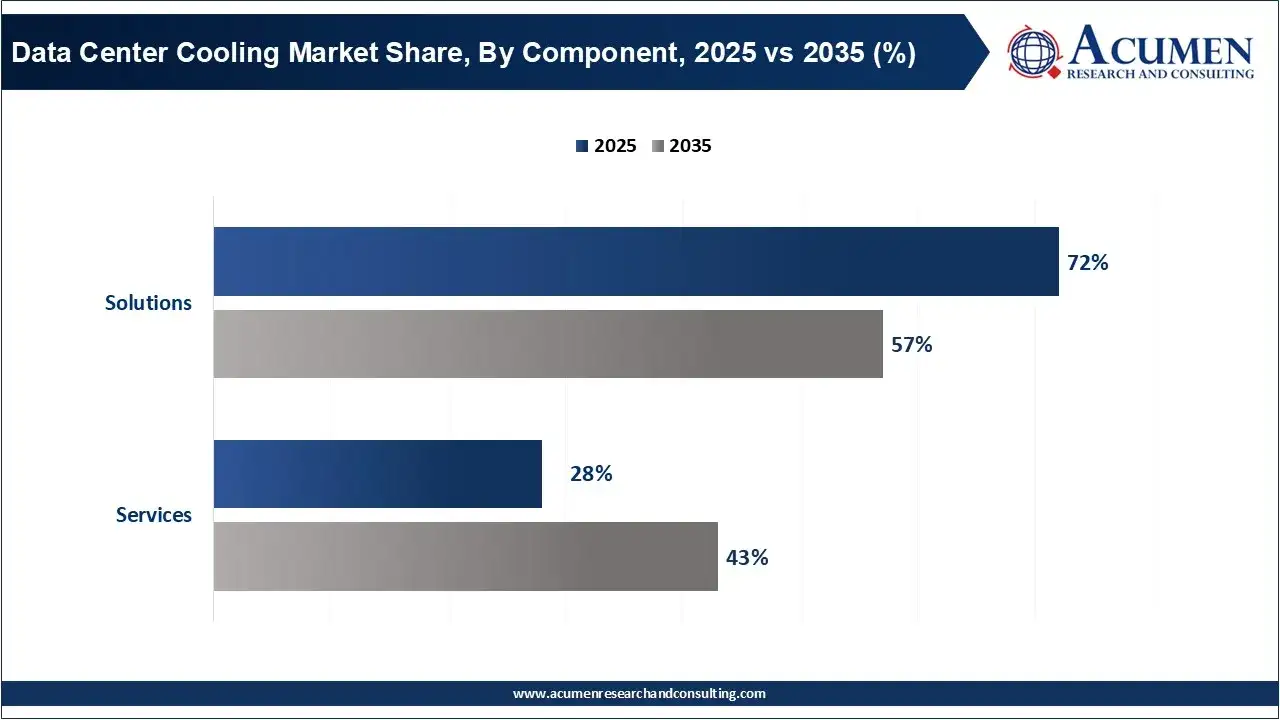
Services: Services accounted for a 28.0% share in 2025, reflecting the need for cooling system design, installation, maintenance, and ongoing operational support. Their share is projected to increase to 43.0% by 2035 as increasingly complex cooling infrastructure creates greater demand for specialized expertise and managed services.
Cooling Technology Insights
Direct-to-Chip Liquid Cooling: Direct-to-chip liquid cooling dominated the cooling technology segment with a 48.0% share in 2025, supported by its ability to remove heat directly from processors and other high-power components. Growing deployment of AI accelerators and high-performance computing systems is strengthening demand for this approach.
Immersion Cooling: Immersion cooling held the second-largest share at 27.0% in 2025, as data center operators explore alternatives for managing high thermal loads. The technology submerges servers or components in dielectric fluid, supporting efficient heat transfer in suitable system designs.
Rear-Door Heat Exchanger (RDHx) Cooling: Rear-door heat exchanger cooling accounted for 18.0% in 2025, offering a way to capture heat at the rack exhaust and reduce the cooling burden on the wider facility. It can be particularly relevant for operators seeking to manage increasing rack densities without completely redesigning existing data centers.
Data Center Type Insights
Hyperscale & Cloud Data Centers: Hyperscale data centers and cloud data centers dominated the segment with a 41.0% share in 2025, driven by large-scale cloud infrastructure, AI computing, and ongoing capacity expansion. Their concentrated computing loads and increasing rack power densities create substantial requirements for reliable, scalable cooling systems.
Colocation Data Centers: Colocation data center facilities represented the second-largest category, with a 30.0% share in 2025. Demand is supported by enterprises outsourcing infrastructure while requiring dependable uptime, flexible capacity, and cooling systems capable of serving customers with different power-density requirements.
Enterprise Data Centers: Enterprise data centers accounted for 18.0% in 2025, reflecting continued demand from organizations operating private IT infrastructure. Cooling investment is influenced by equipment modernization, workload growth, reliability requirements, and efforts to improve the energy efficiency of existing facilities.
Rack Power Density Insights
50 to less than 100 kW/Rack: This category dominated the rack power density segment with a 31.0% share in 2025, reflecting the growing need to manage substantial heat loads in high-performance computing environments. Cooling solutions must maintain stable operating temperatures while supporting increasingly demanding server configurations.
20 to less than 50 kW/Rack: This category held the second-largest share at 27.0% in 2025, representing data center environments with moderate to elevated rack power requirements. Operators in this range may use optimized air cooling, liquid-assisted systems, or other configurations depending on workload and facility design.
100 to less than 200 kW/Rack: This category accounted for 23.0% in 2025, highlighting demand from more power-intensive computing deployments. Higher rack densities increase the importance of direct heat removal, coolant distribution, and coordinated control of server and facility cooling systems.
Deployment Type Insights
New-Build Data Centers: New-build data centers dominated the deployment segment with a 58.0% share in 2025, supported by new capacity requirements from cloud providers, colocation operators, and AI infrastructure developers. New facilities can incorporate cooling architecture, power distribution, and rack layouts together from the design stage.
Retrofit / Existing Data Centers: Retrofit and existing data centers accounted for 42.0% in 2025, reflecting the need to modernize operating facilities as workloads and rack densities increase. Retrofitting enables operators to upgrade cooling capacity and improve efficiency while retaining existing buildings, although space, piping, and power constraints can complicate implementation.
End-Use Industry Insights
IT & Telecommunications: IT and telecommunications dominated the end-use industry segment with a 41.0% share in 2025, driven by cloud computing, digital services, network infrastructure, and expanding AI workloads. Reliable cooling is essential to maintaining server performance, network availability, and continuous service delivery.
Banking, Financial Services & Insurance (BFSI): BFSI represented the second-largest end-use category with a 16.0% share in 2025. Financial institutions rely on data center infrastructure for transaction processing, digital banking, risk analytics, and secure data storage, creating sustained demand for dependable thermal management.
Healthcare & Life Sciences: Healthcare and life sciences accounted for 11.0% in 2025, supported by growing use of digital health platforms, medical data storage, research computing, and data-intensive clinical applications. Cooling reliability is important for maintaining the availability of systems that support healthcare operations and scientific workloads.
Data Center Cooling Market Regional Insights
Which Region Dominated the Data Center Cooling Market in 2025?
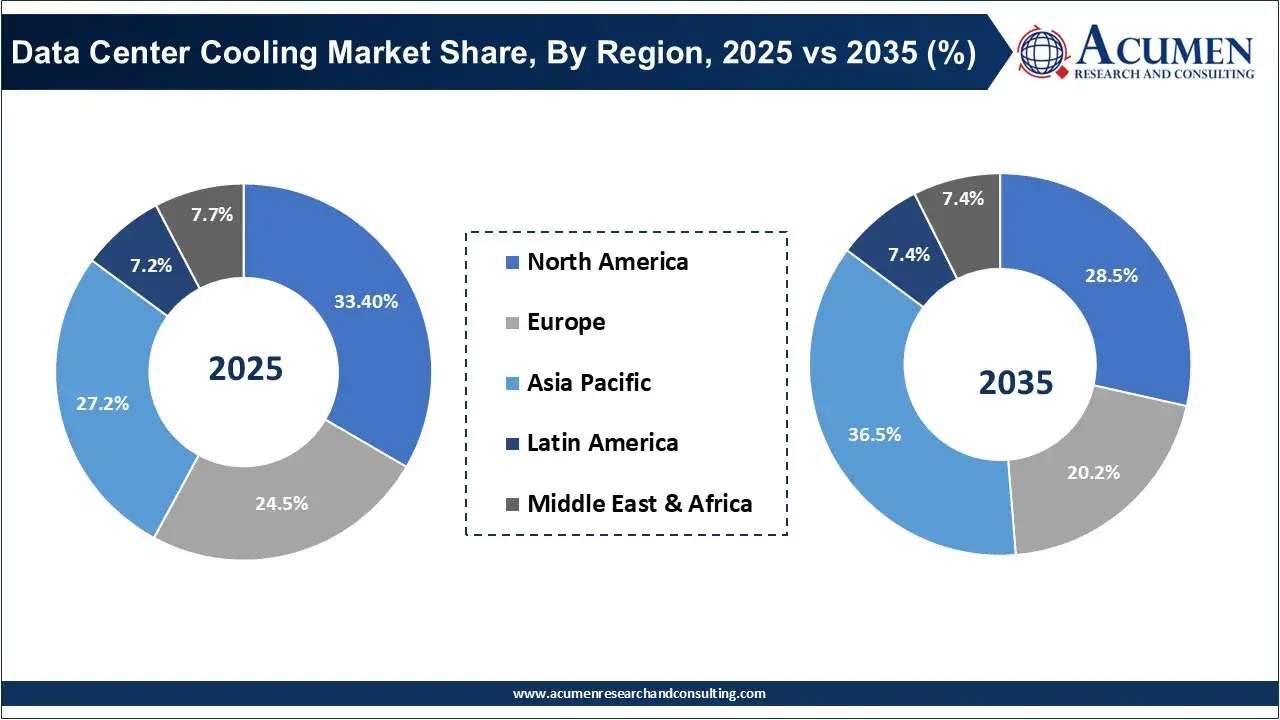
North America dominated the data center cooling market with a 40.0% share in 2025, equivalent to USD 8.24 billion. Its leadership reflects an established data center ecosystem, extensive cloud infrastructure, and growing demand for cooling systems capable of handling AI and high performance computing workloads. The United States is the region's principal market, supported by hyperscale cloud operators, major colocation providers, and continued investment in AI infrastructure.
Canada also contributes through data center development and demand for reliable, energy-efficient cooling systems. As operators expand capacity and modernize facilities, demand for advanced thermal management solutions is expected to remain strong, although North America's share is projected to decline to 35.0% by 2035 as other regions grow.
Which Region Is Expected to Grow Fastest in the Data Center Cooling Market?
Asia-Pacific is expected to be the fastest-growing regional market, registering a CAGR of 20.4% from 2026 to 2035. The region's market is projected to increase from USD 6.84 billion in 2026 to USD 36.28 billion by 2035, with its share rising from 28.0% in 2025 to 34.0% by 2035. China is a major contributor through large-scale digital infrastructure and cloud computing investment, while India is attracting data center development alongside rising digital services and AI demand.
Japan, Singapore, and other Southeast Asian markets also contribute through enterprise digitalization, cloud infrastructure, and colocation expansion. These developments are increasing demand for scalable cooling systems, liquid cooling technologies, and energy-efficient thermal management.
Data Center Cooling Market Adoption Across Enterprise Industries
| Enterprise industry | Data center cooling applications |
|---|---|
| IT and Telecommunications | Hyperscale cloud infrastructure, network equipment cooling, and AI computing workloads |
| BFSI | Thermal management for transaction processing, storage systems, and mission-critical computing |
| Healthcare | Cooling for medical data storage, digital health platforms, and high-performance research computing |
| Government and Defense | Secure data center operations, mission-critical systems, and high-availability infrastructure |
| Retail and E-commerce | Cooling for e-commerce platforms, digital payments, inventory systems, and customer analytics |
| Energy and Utilities | Thermal management for grid analytics, operational data platforms, and energy-sector computing |
| Manufacturing | Cooling for industrial data platforms, digital twins, simulation, and AI-enabled production systems |
| Cloud and Colocation Providers | Scalable cooling infrastructure for multi-tenant facilities, hyperscale deployments, and high-density AI racks |
Data Center Cooling Market Competitive Landscape
- Schneider Electric: Provides data center cooling systems, precision cooling, and Motivair liquid cooling solutions for high-density computing environments.
- Vertiv: Offers thermal management infrastructure, including precision cooling, coolant distribution units, and integrated liquid cooling systems.
- STULZ GmbH: Specializes in precision air conditioning and cooling solutions for data centers and mission-critical facilities.
- Johnson Controls International: Supplies chillers, building management systems, and integrated cooling technologies for large-scale data center operations.
- Daikin Industries: Provides air conditioning, chillers, and thermal management equipment for commercial and industrial data center facilities.
- Mitsubishi Electric: Offers air conditioning systems, chillers, and energy-efficient cooling technologies for data center infrastructure.
- Carrier Global Corporation: Supplies chillers and commercial HVAC technologies designed to support reliable thermal management.
- Trane Technologies: Provides large-scale cooling systems and advanced thermal management solutions for data centers, including liquid cooling through its LiquidStack business.
- Rittal GmbH & Co. KG: Offers IT cooling systems, including rack-based cooling and liquid cooling solutions for data center infrastructure.
Recent Developments
- September 2026: Schneider Electric introduced its WCDU coolant distribution unit, designed to integrate liquid cooling with air-cooling systems in high-density AI data centers. Each unit supports cooling capacity of up to 3.5 MW, offering operators greater flexibility for new facilities and retrofits.
Segments Covered in the Report
By Component
- Solutions
- Cooling Systems & Equipment
- Coolant Distribution & Fluid Handling Equipment
- Cooling Fluids
- Monitoring & Control Systems
- Other Components
- Services
- Design & Consulting
- Installation & Deployment
- Maintenance & Support
- Managed Cooling Services
- Other Services
By Cooling Technology
- Direct-to-Chip Liquid Cooling
- Immersion Cooling
- Single-Phase Immersion Cooling
- Two-Phase Immersion Cooling
- Rear-Door Heat Exchanger (RDHx) Cooling
- Other Liquid Cooling Technologies
By Cooling Mechanism
- Single-Phase Liquid Cooling
- Two-Phase Liquid Cooling
By Data Center Type
- Hyperscale & Cloud Data Centers
- Colocation Data Centers
- Enterprise Data Centers
- Edge & Distributed Data Centers
- Other Data Centers
By Rack Power Density
- Below 20 kW/Rack
- 20 to less than 50 kW/Rack
- 50 to less than 100 kW/Rack
- 100 to less than 200 kW/Rack
- 200 kW/Rack and Above
By Deployment Type
- New-Build Data Centers
- Retrofit / Existing Data Centers
By End-Use Industry
- IT & Telecommunications
- Banking, Financial Services & Insurance (BFSI)
- Healthcare & Life Sciences
- Government & Public Sector
- Manufacturing
- Others
By Region
- North America
- Europe
- Asia-Pacific
- Latin America
- Middle East & Africa
Looking for discounts, bulk pricing, or custom solutions? Contact us today at sales@acumenresearchandconsulting.com
Frequently Asked Questions

Other ICT Reports
December 2023
November 2020
February 2023
January 2024