
Data Center Colocation Market Size, Share, Report 2026 - 2035
Data Center Colocation Market (By Service Type: Traditional Colocations, Managed Colocation; By Service Scale: Retail Colocation, Wholesale Colocation; By Organization Size: Large Enterprises, SMEs; By End User: IT and Telecom, BFSI, Healthcare, Government and Defense, Media and entertainment, Retail, Research and Academics, Others) - Global Industry Analysis, Size, Share, Analysis, Trends and Forecast 2026 - 2035
- Last Updated: 20 Jan 2026
- Report Code: ARC3897
- Category: ICT
Data Center Colocation Market Size and Forecast 2026 - 2035
The global data center colocation market size was valued at USD 83.03 billion in 2025 and is projected to attain USD 306.74 billion by 2035, expanding at a compound annual growth rate (CAGR) of 13.9% during the forecast period from 2026 to 2035.
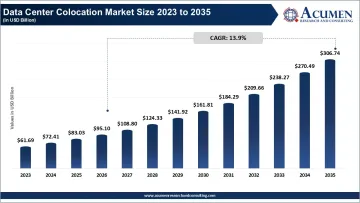
Data Center Colocation Market Highlights
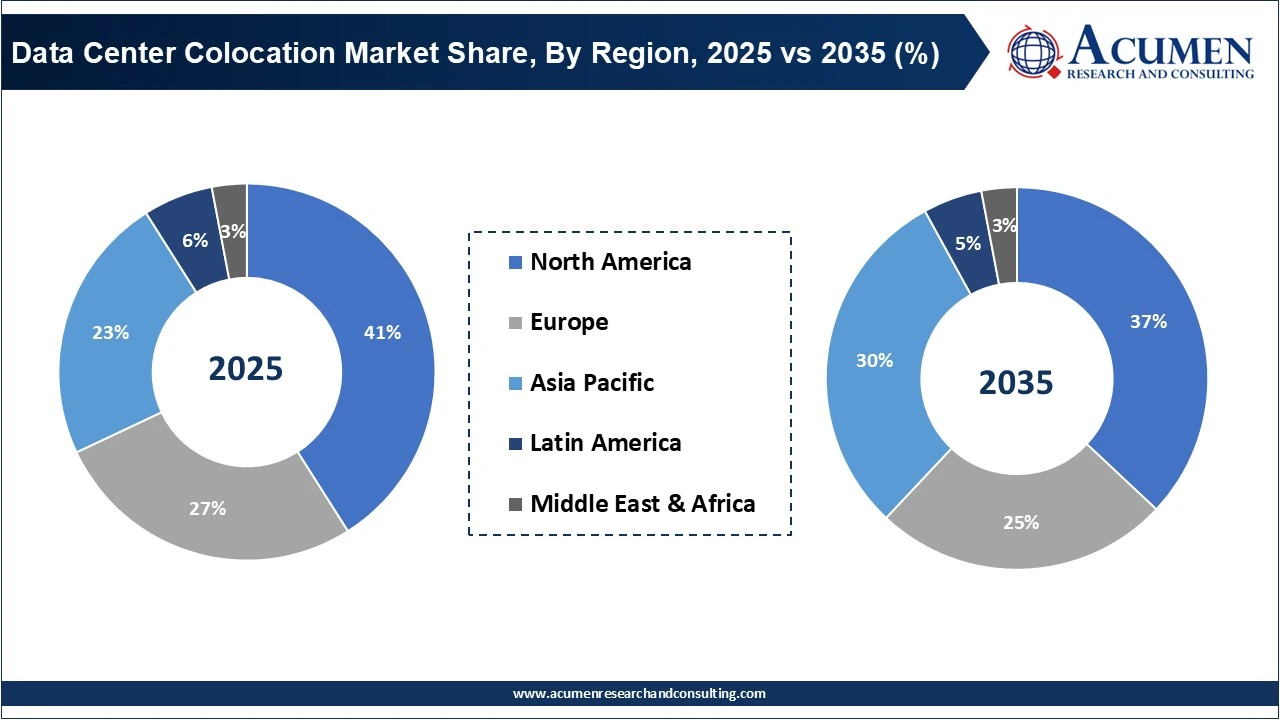
- In 2025 North America is expected to be the largest region, accounting for 41% of the global revenue in data center colocation market.
- Asia Pacific is projected to register the fastest CAGR of 17.3% from 2026 to 2035 in the data center colocation market.
- By service type, traditional colocation holds the largest market share, representing around 68% of the total market.
- By service scale, retail colocation dominates the market, accounting for approximately 72% share, followed by wholesale colocation with around 28% share.
- By end use, IT & telecom led the market, holding around 32% of the market share.
Data Center Colocation Market Overview
The data center colocation is the service used by businesses to use a shared data center facility for housing its own IT infrastructure instead of building a dedicated data center facility for own use. Instead of building and maintaining in-house data centers, organizations leverage colocation facilities to achieve higher trust ability, security, and operational efficiency. Data center colocation has become an essential component of modern digital infrastructure as business are increasingly adopting cloud computing, hybrid IT models, and data-intensive applications. Colocation data centers support wide range of end users including IT & telecom companies, BFSI institutions, governments, healthcare providers, and media firms, by offering scalable infrastructure with high uptime and global connectivity.
The growth of data center colocation market is primarily driven by rapid expansion of cloud services, hybrid and multi-cloud strategies, and rise in generated data across industries. Additionally, the growth in AI, IoT, 5G, and edge computing deployment is accelerating the need for low-latency and geographically distributed colocation facilities. The strong data security, regulatory compliance, and disaster recovery requirements, especially in BFSI and healthcare sectors, further supports the market expansion. Together, these factors are making colocation data centers as preferred solution for enterprises seeking scalable, secure, and future-ready IT infrastructure.
Data Center Colocation Market Dynamics
Market Drivers
Rising Adoption of Hybrid and Multi-Cloud IT Architectures
- Small and large enterprises across different industries are increasingly adopting hybrid and multi-cloud IT environments to improve performance, flexibility, and avoid dependence on a single cloud provider. Data center colocation facilities play a critical role in this transition by acting as neutral interconnection hubs that seamlessly links private infrastructure with multiple public cloud platforms. This creates an efficient workload distribution, enhanced data control, and improved cost management, making colocation a foundational element of modern enterprise IT strategies.
Increasing Need for Security, Reliability, and Scalability of Digital Infrastructure
- The demand for secure and scalable infrastructure reflects how widespread and severe cyber threats have become, forcing organizations to strengthen their IT environments. In 2025, according to Panda Security, over 82% cyber security professionals expressed concerns about increasingly sophisticated AI-powered attacks, and nearly 98% follow zero-trust security models to protect networks. This showcases the pressure on companies to adopt infrastructure that not only supports operational growth but also embeds strong defense against modern threats such as AI-driven pushing, malware, and ransom ware.
Market Restraints
Premium Investment and Long-Term Contractual Responsibility
- Despite offering long-term operational benefits, colocations adoption often need significant large amount of money for investment in servers, networking equipment and installation costs. Additionally, most colocation suppliers prefer long-term rental agreements, limiting flexibility for organization with evolving capacity needs. This financial and contractual rigidity can discourage acceptance, particularly in small and mid-sized organizations that prioritize short -term cost efficiency and operational agility.
Intensifying Competition from Public Cloud Service Providers
- Public cloud platforms continue to gain traction by providing highly scalable, fully managed, and pay-as-you-go infrastructure models. For non-critical or variable workload, enterprises increasingly prefer public cloud solution, due to their lower entry barriers and reduced operational complexity. This shift poses a competitive challenge for colocation providers, especially in segments where cost sensitivity and rapid scalability outright the need for direct infrastructure control.
Market Opportunities
Growth of 5G Connectivity and Network Infrastructure
- The global rollout of 5G is creating massive opportunity for colocation providers to reshape the backbone of telecommunications infrastructure. The expansion of 5G connectivity is expected to add nearly USD 1 trillion to the global economy by 2030, as it enables new and transformative applications for both consumers and business across industries. 5G will be dependent on a denser network of base stations and localized processing centers to handle the speed of data traffic. Colocation facilities that provide rich carrier-neutral interconnection options, which act as the main node for 5G data exchange.
Increasing Regulatory Compliance and Data Sovereignty Requirements
- Governments are imposing stricter data protection, localization, and compliance regulation, particular in highly regulated industries. Colocation data centers enable enterprises to maintain direct control over data placement while meeting jurisdiction-specific regulatory requirements. This makes colocation a practical and dependable alternative to public cloud solution for compliance-focused workloads, supporting long-term demand for regulated sectors such BFSI, healthcare, and governments as regulatory requirements continue to evolve.
Data Center Colocation Market Report Scope
| Attribute | Details |
|---|---|
| Data Center Colocation Market Size 2025 | USD 83.03 Billion |
| Data Center Colocation Market Forecast 2035 | USD 306.74 Billion |
| Data Center Colocation Market CAGR During 2026 - 2035 | 13.9% |
| Analysis Period | 2023 - 2035 |
| Base Year | 2025 |
| Forecast Data | 2026 - 2035 |
| Segments Covered | By Service Type, By Service Scale, By Organization Size, By End User, and By Geography |
| Regional Scope | North America, Europe, Asia Pacific, Latin America, and Middle East & Africa |
| Key Companies Profiled | Equinix, Digital Realty Trust, NTT Data (NTT Communications), CyrusOne, KDDI Corporation (Telehouse), China Telecom, QTS Realty Trust, CoreSite Realty Corporation, Cyxtera Technologies, Global Switch, Iron Mountain, ad ST Telemedia Global Data Centres (STT GDC) |
| Report Coverage | Market Trends, Drivers, Restraints, Competitive Analysis, Player Profiling, Covid-19 Analysis, Regulation Analysis |
Data Center Colocation Market Regional Analysis
- The North America data center colocation market size was estimated at USD 34.04 billion in 2025 and is expected to hit USD 113.49 billion by 2035 at a CAGR of 12.6% during the forecast period from 2026 to 2035.
- The Europe data center colocation market size was reached at USD 22.42 billion in 2025 and is forecasted to surpass USD 76.68 billion by 2035, with a CAGR of 12.9% from 2026 to 2035.
- The Asia-Pacific data center colocation market was valued at USD 19.10 billion in 2025 and is anticipated to surge USD 92.02 billion by 2035, expanding at a CAGR of 17.3% from 2026 to 2035.
Why does North America hold the largest share of the data center colocation market?
North America dominated the global data center colocation market with 41% revenue share, because of the presence of well-established digital infrastructure, high cloud adoption, and presence of major hyper scale cloud providers and telecom companies in the region. The United States, in particular, has key colocations hubs in regions like Northern Virginia, Silicon Valley, Dallas, and Chicago. Strong demand from sectors such as IT, telecom, BFSI, and large enterprises, along with wide use of hybrid and multi-cloud process, & high occupancy rates is supporting the market growth. The reliable power, connectivity, and regulatory frameworks are factors that can help for the region’s leadership in the market.
Why is the Asia-Pacific region driving faster growth in the data center colocation market?
Asia-Pacific is the fastest-growing region as digital adoption accelerates across emerging economies such as China, India, Southeast Asia, and Australia. Growth in e-commerce, digital banking, online entertainment, and 5G networks is creating high demand for scalable and efficient colocation facilities. The government initiatives for data localization and cyber security regulations for enterprises to host data locally are driving strong market expansion in the region.
Data Center Colocation Market Segmental Insights
The worldwide market for data center colocation is split based on service type, service scale, organization size, end-user and geography.
Service Type Insights
Traditional colocation segment dominated the market as enterprises, particularly in sectors where regulatory compliance and uninterrupted system performance are essential, continue to prioritize direct control over their IT infrastructure. Many organizations prefer this model to meet internal IT policies, performance requirements, and data governance standards without fully outsourcing infrastructure management. Additionally, traditional colocation aligns with hybrid and multiple-cloud strategies, where companies maintain private infrastructure alongside public cloud services.
| Service Type | Market Share, 2025 (%) | Key Highlights |
|---|---|---|
| Traditional Colocation | 68% | Enterprises prefer direct control over IT infrastructure for security and customization. |
| Managed Colocation | 32% | Growing demand for outsourced IT management and simplified operations drives adoption. |
Managed colocation segment is gaining popularity as organizations are increasingly seeking to reduce operational burden and IT management complexity. This model offers both physical data center and additional services like monitoring and remote management, making it especially attractive to small and medium-size business and companies that are actively upgrading their digital capabilities. The growing shortage of skilled IT professional and the need for predictable operating cost are accelerating the adoption of managed colocation data centers.
Service Scale Insights
Retail colocation holds the largest share of the market due to it's flexibility and broad applicability across small, mid-sized, and regional enterprises. Organization typically require limited rack space instead of large-scale facilities, making retail colocation a cost-effective and scalable option. With lower initial costs, flexible expansion, and the ability to support different types of workloads, retail colocation remains widely adopted across many industries.
| Service Scale | Market Share, 2025 (%) | Key Highlights |
|---|---|---|
| Retail Colocation | 72% | Small and mid-sized enterprises require flexible, scalable, and cost-efficient space. |
| Wholesale Colocation | 28% | Hyperscalers and large enterprises deploy entire data halls for high-capacity workloads. |
Wholesale colocation is experiencing rapid growth driven by hyperscale cloud providers, AI-driven workloads, and lager enterprises seeking high-capacity deployments. This segment involves leasing entire data halls or facilities, enabling customized power density and infrastructure design. Increasing investments in cloud expansion, artificial intelligence, and data-intensive computing are fueling the demand, making wholesale colocation a key contributor to future market expansion.
Organization Size Insights
Large enterprises dominated the market because of their massive infrastructure needs, global operations, and mission-critical application requirements. These organizations rely on colocation for hybrid cloud integrations, disaster recovery, and regulatory compliance. Large enterprises typically include Fortune 500 or large government agencies, and use colocation for their global operations, implement disaster recovery plans, and utilize hybrid cloud models. The scale of their enterprise infrastructure enables them to negotiate favorable terms while ensuring maximum uptime and adhering to stringent security certifications.
| Organization Size | Market Share, 2025 (%) | Key Highlights |
|---|---|---|
| Large Enterprises | 65% | Large-scale IT needs, hybrid cloud adoption, and regulatory compliance drive demand. |
| SMEs | 35% | Cost efficiency and lack of in-house IT resources encourage colocation adoption. |
SMEs represent the fastest-growing organization segment as digital transformation has gained momentum across smaller businesses in recent years. Limited capital budget and lack of in house expertise are driving SMEs toward colocation as cost-efficient alternative to on-premise data centers. Changing pricing models, retail colocation availability, and managed services are making colocation increasingly accessible and thereby supporting rapid adoption among SMEs.
End User Insights
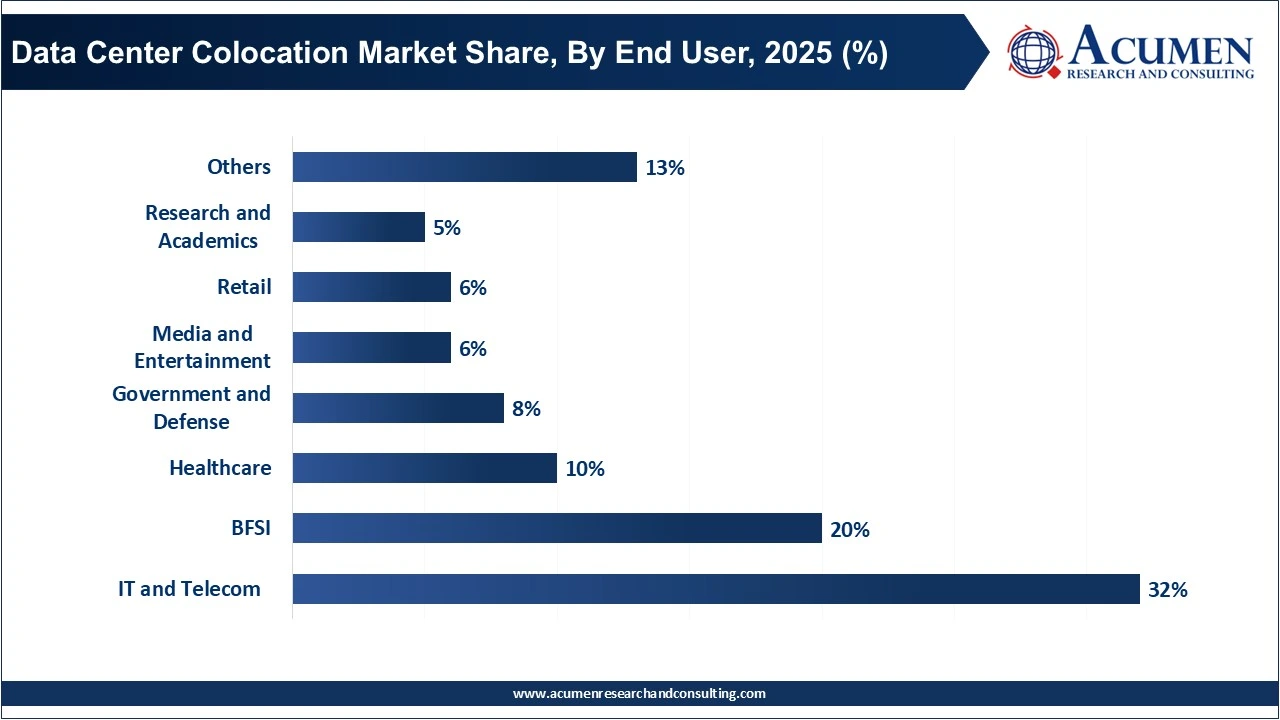
IT and telecom dominated with 32% market share driven by rollout of 5G networks and the need for high-speed content delivery. Telecom providers have been using colocation data centers for years to build their core network infrastructure and to establish edge compute nodes to reduce latency service levels for 5G networks. The continued growth of mobile data has necessitated these companies to use third-party data centers to be more agile as they grow their networks and find less expensive ways to scale. The merging of IT and telecom services and infrastructure in colocation hubs has helped develop a vibrant ecosystem where connectivity and compute are combined to set the stage for next-generation digital communications.
Healthcare industry is another critical segment, which is expected to showcase promising growth over the forecast period due to rapid digitization of patient records and rise in AI-supported medical diagnostic capabilities. Healthcare providers require professional colocation that provides very secure, highly available, and compliant environments to house and process sensitive health data. The shift to telemedicine and remote patient monitoring requires local computing for real-time responsiveness and data privacy.
| End User | Market Share, 2025 (%) | Key Highlights |
|---|---|---|
| IT and Telecom | 32% | High data traffic, cloud expansion, and network infrastructure needs drive demand for colocation. |
| BFSI | 20% | Digital banking, real-time payments, and compliance requirements fuel colocation adoption. |
| Healthcare | 10% | Secure patient data storage, analytics, and telehealth services require reliable infrastructure. |
| Government and Defense | 8% | Sensitive data handling and strict security standards increase colocation usage. |
| Media and Entertainment | 6% | Streaming, content delivery, and gaming demand high-performance, low-latency infrastructure. |
| Retail | 6% | E-commerce growth, online transactions, and customer data management drive colocation needs. |
| Research and Academics | 5% | Data-intensive research and computational projects rely on scalable computing resources. |
| Others | 13% | Industrial digitalization, IoT, and operational analytics require secure and scalable facilities. |
Data Center Colocation Market Players
- Equinix
- Digital Realty Trust
- NTT Data (NTT Communications)
- CyrusOne
- KDDI Corporation (Telehouse)
- China Telecom
- QTS Realty Trust
- CoreSite Realty Corporation
- Cyxtera Technologies
- Global Switch
- Iron Mountain
- ST Telemedia Global Data Centres (STT GDC).
Data Center Colocation Market Recent Developments
- In February 2025, Equinix launched PA13x data center in Meudon, France, with a new facility, focused on high‑performance and sustainable operations, including heat‑recovery systems and support for AI‑driven workloads.
- In May 2025, NTT Data announced plans to launch a data center real estate investment trust (REIT) in the Singapore Exchange, seeded with six colocation facilities across the US, Europe, and Singapore and totaling over 41,000 sqm and ~80 MW.
Data Center Colocation Market Segmentation
By Service Type
- Traditional Colocations
- Managed Colocation
By Service Scale
- Retail Colocation
- Wholesale Colocation
By Organization Size
- Large Enterprises
- Small & Medium Enterprises (SMEs)
By End User
- IT and Telecom
- Banking, Financial Services, and Insurance (BFSI)
- Healthcare
- Government and Defense
- Media and entertainment
- Retail
- Research and Academics
- Others (Energy, Manufacturing, and Transportation and Logistics)
By Region
- North America
- U.S.
- Canada
- Europe
- U.K.
- Germany
- France
- Spain
- Rest of Europe
- Asia-Pacific
- India
- Japan
- China
- Australia
- South Korea
- Rest of Asia-Pacific
- Latin America
- Brazil
- Mexico
- Rest of LATAM
- The Middle East & Africa
- South Africa
- GCC Countries
- Rest of the Middle East & Africa (ME&A)
Looking for discounts, bulk pricing, or custom solutions? Contact us today at sales@acumenresearchandconsulting.com
Frequently Asked Questions

Other ICT Reports
November 2023
June 2026
October 2026
August 2020