
Smart Retail Market Size, Share, Trends, Report 2026 - 2035
Smart Retail Market (By Solution: Hardware, Software; By Application: Visual Marketing, Smart Label, Smart Payment System, Intelligent System, Others) - Global Industry Analysis, Size, Share, Trends and Forecast 2026 to 2035
- Last Updated: 12 Dec 2025
- Report Code: ARC3867
- Category: Consumer Goods and Food and Beverages
Smart Retail Market Size and Forecast 2026 To 2035
The global smart retail market stood at USD 52.69 billion, and it is expected to reach around USD 686.21 billion by 2035, registering a 29.5% CAGR from 2026 to 2035.
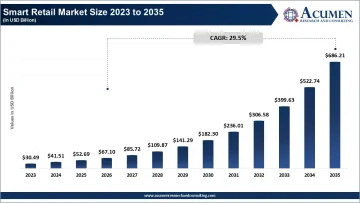
Smart Retail Market Highlights
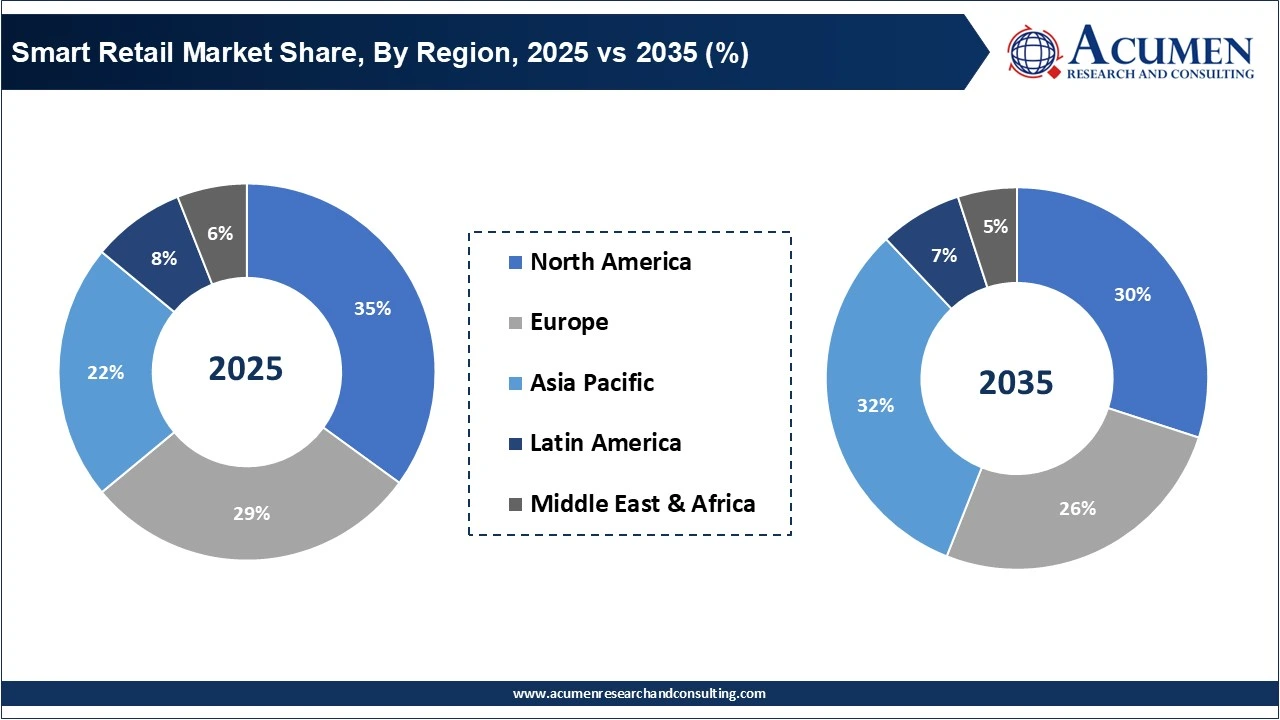
- By Region, the North America holds approximately 35% of the global smart retail market share in 2025.
- By Region, the Asia Pacific region accounts for about 22% market share and is projected to grow at a CAGR of 35% from 2026 to 2035.
- By solution, the hardware segment represents 65% of the total smart retail market share in 2025.
- By application, visual marketing account for 29% of the total market share, while smart payment system hold 25%.
Smart Retail Market Insights
The significant growth of smart retail market is due to the rapid digital transformations are being implemented throughout retail, where retailers are utilizing such emerging technologies as AI, IoT sensors and RFID tags, computer vision, and advanced analytics to provide improved store operations as well as enhanced customer experience. The demand by consumers has also increased for more personalized and seamless shopping experiences, real-time product information, and for quicker and easier payment methods. Additionally, the consumers demand for a more personalized, seamless shopping experience and the need for immediate product availability and easy payment methods have led retailers to make major investments in smart shelving systems, smart labeling solutions, automated checkout solutions, and Omni channel platforms. Additionally, the using smartphones and digital payment systems to create connected & integrated retail networks.
Another major factor for growth is further supported by retailers to increasing focus on operational optimization, controlling shrinkage, and improving inventory accuracy. Smart retail tools such as real-time tracking, predictive analytics will allow retailers to automate store processes, help reduce their labour costs and improve their ability to plan for future inventory demands within their supply chain. Government initiatives supporting digital commerce and the increasing popularity of self-service technology and the rise of cashless payments are all contributing to the expansion of opportunities for smart retail technology. There is considerable potential for smart retail technologies in the developing markets of Asia-Pacific, where the modernization of retail operations is occurring rapidly.
Smart Retail Market Dynamics
Market Drivers
Rising Demand for Personalized and Seamless Shopping Experiences
- The consumer demand for hyper personalization, ease of use, and zero friction while shopping is significantly contributed to the growth of the smart retail market. To accommodate these needs, retail firms are increasingly using AI-based recommendation engines, smart shelf technology, electronic signs and advertising, and customer information analysis to provide consumers with specific product recommendations, real-time discounts, and simple-to-use in-store navigation systems. Retailers are improving their relationships with customers through these types of increased interaction, leading to greater customer satisfaction, stronger brand loyalty, and better conversion rates at the point of sale through in-store shopping.
Increasing Adoption of IoT, Automation, and Smart Payment Systems
- Smart retail adoption is being driven by improved integration of internet of things sensors and RFID tags, along with increased use of automated checkout systems and mobile-based payments with the primary benefits being greater inventory accuracy, lower operational costs, elimination of stockouts and greater speed and convenience of checkout experience for customers through use of contactless payment methods. In addition to these advantages, automation also reduces reliance on manual labour, streamlining fulfillment and inventory management processes, providing retailers with a highly efficient return on investment on their technology investments.
Market Restraints
High Initial Implementation Costs and Integration Complexity
- The deploying smart retail infrastructure (SRI), such as sensors, radio frequency identification (RFID) networks, analytical software, and automated checkout systems poses some of the greatest challenges. Smart store technologies are difficult for many companies, especially small and medium-sized businesses, which often have limited financial resources available to invest in these and face significant technical challenges when integrating them with existing POS and ERP systems. These financial limitations slow down the ability of the market to adopt smart store technologies on a broad basis.
Data Privacy, Cybersecurity Risks, and Regulatory Concerns
- Privacy violations and cyber assaults are problems created by the dependence of smart retail on customer information, online device and real-time monitoring, and other connected gadgets. Retailers are being under more regulatory scrutiny in regard handle customer data, manage customer consent and provide digital security. There are many regulations that retailers need to be in compliance with in addition to more stringent regulations regarding mishandling of customer information (like GDPR). This creates many impediments for retailers in trying to modernize their businesses through rapid digital transformation.
Market Opportunities
Acceleration of Retail Digitalization in Emerging Markets & Omni-Channel Expansion
- Beyond traditional retail upgrades, the smart retail market is also offers opportunity to improve their businesses through new technologies as they modernize their retail ecosystems around Asia Pacific, Latin America, and parts of Middle East & Africa at an unprecedented pace. Retailers like supermarkets, hypermarkets, fashion chains, and convenience stores have increasingly begun to use AI enabled shelf units, smart label(s), automated checkout lanes, and digital payment systems as they expand their reach into many more semi-urban and rural areas. Additionally, this modernization trend is further accelerated by the rapid growth of omni-channel commerce where offline and online sales occur seamlessly due to an increase in the number of smartphones being used by consumers, an increase in digital wallets being utilized, and an increase in last-mile e-commerce logistics.
Expansion of Autonomous Stores, Cashless Payments, and AI-Driven Retail Automation
- Through the emergence of cashier less stores, computer vision-enabled checkouts, robotics-based automation and cloud-based retail management systems have created numerous opportunities for companies to experience growth. Retailers are increasing their reliance on automated retail technology to reduce dependence on employees, facilitate customer flow and support operating hours of 24/7. Companies that provide AI, Edge computing, and other automated retail technologies will continue to see the significant demand for these solutions in the coming years.
Report Scope
| Area of Focus | Details |
|---|---|
| Smart Retail Market Size 2025 | USD 52.69 Billion |
| Smart Retail Market Forecast 2035 | USD 686.21 Billion |
| Smart Retail Market CAGR During 2026 - 2035 | 29.5% |
| Segments Covered | By Solution, By Application, and By Geography |
| Regional Scope | North America, Europe, Asia Pacific, Latin America, and Middle East & Africa |
| Key Companies Profiled | NVIDIA Corporation, NXP Semiconductors, Amazon.com, Inc., Intel Corporation, LG Display Co., Ltd., Cisco Systems, Inc., Google, Honeywell International Inc., Huawei Technologies Co., Ltd., IBM Corporation, Ingenico, Fiserv, Inc., and NCR Corporation. |
| Report Coverage | Market Trends, Drivers, Restraints, Competitive Analysis, Player Profiling, Covid-19 Analysis, Regulation Analysis |
Smart Retail Market Regional Analysis
Why does North America dominates in the smart retail market?
North America currently dominates in the smart retail market because of its advanced retail infrastructure and early use of digital technology, as well as having some of the largest retailers in the world, such as Walmart, Amazon, Target, and Kroger, in this region. The North American region has made significant investment in artificial intelligence (AI), Internet of Things (IoT), Radio Frequency Identification (RFID), Cloud Analytic, and frictionless check out systems. In addition, a high level of adoption of digital payments supports North America’s leadership in the market, along with high consumer demand for personalized shopping experiences, rapid modernization of retail stores, and established technology ecosystems.
Why is Asia-Pacific the fastest-growing region in the smart retail market?
Asia Pacific is the fastest-growing region, due to rapid urbanization, the expansion of retail networks, and large-scale digital transformation across China, India, Japan and Southeast Asia. The e-commerce industry in this region continues to grow as smartphone penetration, along with government support for cashless payment system. These are driving the rapid adoption of smart payment solutions, digital signage, smart shelves and AI-based analytics. With investments from both global retailers and local companies, as well as rising consumer demand for convenience and technology-enabled retail experiences, Asia Pacific is the most prominent growth engine for the smart retail industry.
Smart Retail Market Segmental Insights
The worldwide market for smart retail is split based on solution, application, and geography.
Solution Insights
Hardware is currently the dominant solution in the smart retail market due to its position as a physical foundation to digitally transform retail. Hardware such as smart shelves, RFID systems, barcode scanners, interactive kiosks, smart carts and automated checkout terminals capture the high investment share. In recent, retailers invest heavily in hardware to support real-time inventory visibility, store automation and improved customer engagement. Additionally, the high initial capital expenditure for hardware, ongoing maintenance, as well as the prevalence of hardware adoption through large retailers has contributed to the increasing dominance of hardware within the smart retail segment.
| Solution | Market Share (%) | Key Highlights |
|---|---|---|
| Hardware | 65% | Dominant due to widespread use of smart shelves, RFID readers, sensors, kiosks, and automated checkout devices that form the physical backbone of smart retail infrastructure. |
| Software | 35% | Fastest-growing as retailers adopt AI analytics, cloud platforms, computer vision systems, digital payment software, and Omni channel management tools. |
Software is the fastest-growing solution, due to retailers are transitioning to cloud-based platforms. In addition to processing data in real-time and generating personalized recommendations for customers, software also allows retailers to use dynamic pricing, integrate their online and offline, and improve the accuracy of their operations. Additionally, with an increased number of retailers adapting to new forms of automation and improvements in technology enabled by computer vision and predictive analytics, retailers are now more likely to choose software solutions that are flexible, scalable, and inexpensive to implement while enhancing overall operational efficiency. The increasing growth of omnichannel retail, mobile commerce, and artificial intelligence-powered personalization solutions will create even greater opportunities for the software segment to grow significantly faster.
Application Insights
Visual marketing is currently dominant the market in the smart retail, due to retail organizations place a priority on digital displays, smart signage, augmented reality product displays, and engage customers in-store with regards to the buying process. The use of visual marketing through analytical methods has also facilitated improvement in brand visibility, launching targeted campaigns to retailers, and developing a customer’s shopping experience. Analytics based visual merchandising is allowing retailers to understand their customers’ preferences and providing real-time optimization of promotional opportunities. The widespread adoption of digital displays, dynamic content systems, and interactive displays, visual merchandising will continue to be one of the largest smart retail application categories in the world.
| Solution | Market Share (%) | Key Highlights |
|---|---|---|
| Visual Marketing | 29% | Leads the market as retailers heavily invest in digital signage, smart displays, and product visualization tools to boost engagement and influence purchasing decisions. |
| Smart Label | 18% | Growth supported by increasing use of RFID, electronic shelf labels, and automated pricing systems for real-time inventory and price accuracy. |
| Smart Payment System | 25% | Fastest-growing due to rising adoption of contactless payment, mobile wallets, NFC cards, and automated checkout technologies. |
| Intelligent System | 16% | Driven by AI-based analytics, store monitoring, customer tracking, and demand forecasting tools that enhance operational decision-making. |
| Others | 12% | Includes robotics, security systems, and emerging automation tools used for store management and in-store optimization. |
Smart payment systems is the fastest-growing segment, because of the global move toward contactless, cashless, and friction-less shopping experiences. Retailers are upgrading their payment systems as a result of consumers utilizing mobile wallets, QR code payments, NFC enabled cards, and automated checkout solutions. Using smart payment technologies reduce waiting times in queues, increase transaction security, and lessen customer congestion. The growth of digital payment, the increasing penetration of e-commerce, and consumers' preference for contact-free shopping following the pandemic continue to drive the growth of this fast growth segment within smart retail.
Smart Retail Market Players
- NVIDIA Corporation
- NXP Semiconductors
- Amazon.com, Inc.
- Intel Corporation
- LG Display Co., Ltd.
- Cisco Systems, Inc.
- Honeywell International Inc.
- Huawei Technologies Co., Ltd.
- IBM Corporation
- Ingenico
- Fiserv, Inc.
- NCR Corporation
Smart Retail Market Segmentation
By Solution
- Hardware
- Software
By Application
- Visual Marketing
- Smart Label
- Smart Payment System
- Intelligent System
- Others
By Region
- North America
- U.S.
- Canada
- Europe
- U.K.
- Germany
- France
- Spain
- Rest of Europe
- Asia-Pacific
- India
- Japan
- China
- Australia
- South Korea
- Rest of Asia-Pacific
- Latin America
- Brazil
- Mexico
- Rest of LATAM
- The Middle East & Africa
- South Africa
- GCC Countries
- Rest of the Middle East & Africa (ME&A)
Looking for discounts, bulk pricing, or custom solutions? Contact us today at sales@acumenresearchandconsulting.com
Frequently Asked Questions

Other Consumer Goods and Food and Beverages Reports
June 2022
July 2024
December 2020
June 2024