
AI Infrastructure Market Size, Share, Trends, Report 2026 To 2035
AI Infrastructure Market (By Offering: Compute, Memory, Storage, Networking, Infrastructure Software, AI Compute-as-a-Service; By Function: AI Model Training, AI Model Inference; By Deployment: Cloud, On-Premises, Hybrid; By Technology: Machine Learning, Deep Learning, Generative AI, Others; By End User: Cloud Service Providers, Enterprises, Government & Research Organizations, Others) - Global Industry Analysis, Size, Share, Regional Analysis, Trends and Forecast 2026 - 2035
- Last Updated: 17 Sep 2026
- Report Code: ARC3980
- Category: ICT
AI Infrastructure Market Size, Forecast 2026 To 2035
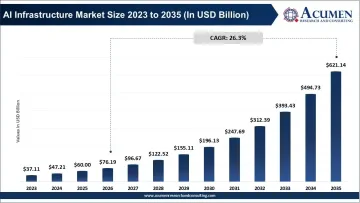
The global AI infrastructure market size was valued at USD 60 billion in 2025. The market is seen to reach by USD 621.14 billion by 2035; growing at a CAGR of 26.3% during the forecast period of 2026-2035. The rapid expansion of generative AI and large-scale AI workloads is driving demand for high-performance GPUs, AI accelerators, advanced networking, and data center capacity, with AI model inference projected to grow at a 31.5% CAGR from 2026 to 2035. Increasing enterprise adoption is further accelerating infrastructure investment, with enterprises accounting for 50.0% of the global AI infrastructure market in 2025 as organizations scale AI from experimentation to production applications.
Report Highlights
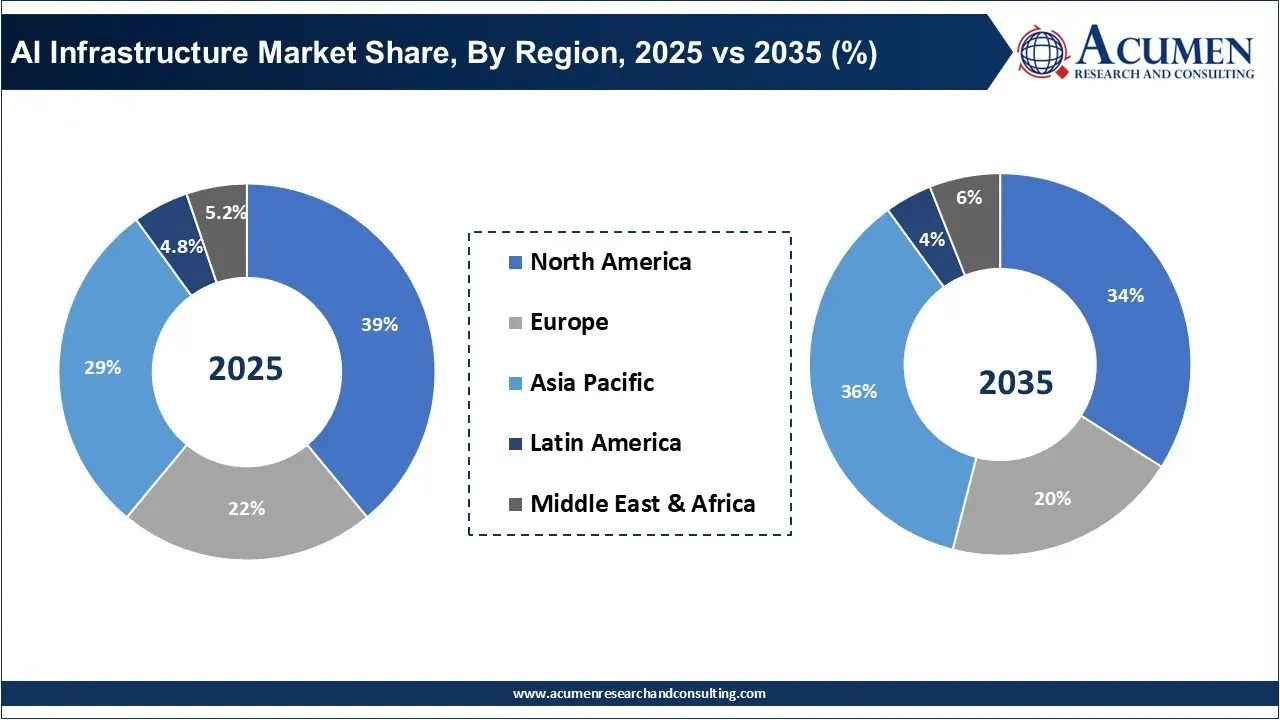
- By region, North America dominated the AI infrastructure market with a 39.0% share in 2025, supported by its mature cloud ecosystem, advanced data center infrastructure, strong semiconductor capabilities, and concentration of hyperscale technology companies.
- By region, Asia-Pacific was the second-largest market in 2025 with a 29.0% share and is projected to be the fastest-growing region, registering a 29.3% CAGR from 2026 to 2035, driven by expanding AI adoption, hyperscale data center investments, semiconductor development, and digital infrastructure expansion.
- By offering, compute dominated the market with a 50.0% share in 2025, while networking was the second-largest segment at 12.0% and is projected to grow at a 28.4% CAGR, supported by increasing demand for high-speed interconnects across AI data centers.
- By offering, infrastructure software is projected to be the fastest-growing segment, registering a 29.4% CAGR from 2026 to 2035, as organizations require advanced orchestration, workload management, resource optimization, and monitoring capabilities for increasingly complex AI infrastructure.
- By function, AI model training dominated the market with a 55.0% share in 2025, while AI model inference accounted for the remaining 45.0% and is projected to be the fastest-growing function with a 31.5% CAGR from 2026 to 2035, reflecting the shift toward production-scale AI deployments.
- By deployment, cloud dominated the AI infrastructure market with a 52.0% share in 2025, followed by on-premises deployment at 28.0%, while hybrid deployment is expected to expand from 20.0% in 2025 to 22.0% by 2035 as organizations combine private infrastructure with scalable cloud resources.
- By technology, machine learning dominated the market with a 38.0% share in 2025, followed by deep learning at 30.0%, as enterprises increasingly deploy AI across predictive analytics, computer vision, cybersecurity, automation, healthcare, and other applications.
- By technology, generative AI represented the third-largest technology segment with a 22.0% share in 2025 and is expected to remain a major source of infrastructure demand as organizations expand large language models, multimodal AI, AI assistants, and other generative applications.
- By end user, enterprises dominated the AI infrastructure market with a 50.0% share in 2025, followed by cloud service providers at 30.0%, as organizations across industries increasingly transition from experimental AI projects toward production-scale deployments.
- By end user, government and research organizations represented the third-largest segment with a 15.0% share in 2025, supported by national AI strategies, scientific computing, defense applications, public-sector digitalization, and investments in sovereign AI infrastructure.
Why Is AI Infrastructure Becoming the Backbone of the Global AI Economy?
AI infrastructure is becoming the backbone of the global AI economy as organizations move from AI experimentation toward large-scale deployment of machine learning, generative AI, and real-time inference applications. The market is being shaped by rising requirements for GPUs, AI accelerators, high-speed networking, memory, storage, data center capacity, and infrastructure software capable of supporting increasingly complex workloads. Together, these trends indicate that AI infrastructure is evolving from a supporting technology layer into a strategic foundation for enterprise digital transformation, national AI capabilities, and the broader AI economy.
AI Infrastructure Technology Adoption Analysis
- Global AI server shipments are forecast to grow by more than 28% year over year in 2026, according to TrendForce, reflecting continued expansion of accelerated computing infrastructure.
- Amazon, Microsoft, Google, Meta, and Oracle are collectively expected to spend close to $800 billion on AI infrastructure in 2026, demonstrating the scale at which leading technology companies are deploying compute, networking, storage, and data-center capacity.
- India's enterprise AI investment increased 119% over the previous year, compared with global growth of 110%, while AI accounted for 16.6% of the average IT budget of Indian organizations in 2026. This indicates that AI infrastructure is increasingly moving from experimental deployments into enterprise production environments.
- Inference is becoming a major infrastructure workload as organizations deploy AI models into customer-facing and operational applications. Gartner expects inference-related infrastructure spending to reach $23.3 billion in 2026, compared with $19 billion for training, indicating a shift in infrastructure demand from model development toward production AI workloads.
- NVIDIA's data-center business has become the primary commercial indicator of AI infrastructure adoption. NVIDIA reported $57 billion in quarterly revenue for Q3 FY2026, with continued demand for its data-center computing platforms driven by AI workloads.
- Increasing deployment of large GPU clusters is creating demand for high-speed networking, interconnects, optical components, and data-processing infrastructure. Networking is becoming an increasingly important component of AI cluster architecture as model sizes and distributed computing requirements expand.
AI Infrastructure Market Growth Drivers and Emerging Opportunities
Growth Drivers
- Generative AI commercialization: Generative AI is beginning to be commercialized at scale and is driving the construction of larger and more powerful computer environments. It is driving the purchase of large language models, multimodal models and autonomous systems/AI agents that require powerful GPUs, specialized AI accelerators, high-bandwidth memory, high-performance networking and scale-out storage.
- Rapid adoption of AI inference: AI inference workloads are rapidly transitioning from model training to inference in production environments that need to answer queries, support recommendations, transactions and autonomous decision-making at scale. This trend is resulting in increasing demand for low-latency compute, purpose-built servers, edge infrastructure and specialized networking.
Emerging Opportunities
- AI networking infrastructure: The expansion of large GPU clusters is creating new opportunities across high-speed Ethernet, InfiniBand, optical networking, switches, interconnects, and data-processing technologies. As AI clusters become larger and workloads become more distributed, efficient communication between computing nodes is becoming increasingly important.
- Sovereign AI infrastructure: Governments are increasingly investing in domestic computing capacity to reduce dependence on foreign technology providers and strengthen control over sensitive data and AI capabilities. Countries across Asia, the Middle East, and Europe are developing national AI strategies that are expected to generate additional infrastructure investment.
Market Challenges
AI infrastructure is becoming increasingly expensive and complex due to rapidly rising costs for accelerated computing, shortages of high-end semiconductors, soaring energy consumption, Power and cooling requirements for data center densities, high-density AI cluster deployment issues.
The infrastructure cost for generative AI and large-scale inference will put more pressure on network, memory, storage, cooling and electricity infrastructure making the AI infrastructure significantly more capital-heavy compared to traditional data centers.
In addition, organizations need to contend with issues such as cybersecurity, data sovereignty, regulatory compliance and interoperability challenges as they deploy AI in cloud, on-premises and hybrid environments.
AI Infrastructure Market Segmental Analysis
Offering Insights
Why Does Compute Remain the Core of AI Infrastructure Spending?
Compute led the infrastructure market in 2025, with a 50% global share. The excess scale needed to run AI workloads imposes much greater compute demand than for traditional enterprise workloads, particularly when training larger models, running deep learning applications, combining multimodal data sets, and providing real-time inference. As a result, GPUs, AI accelerators, CPUs, and customized computing architectures form the basis of the infrastructure layer of the AI ecosystem.
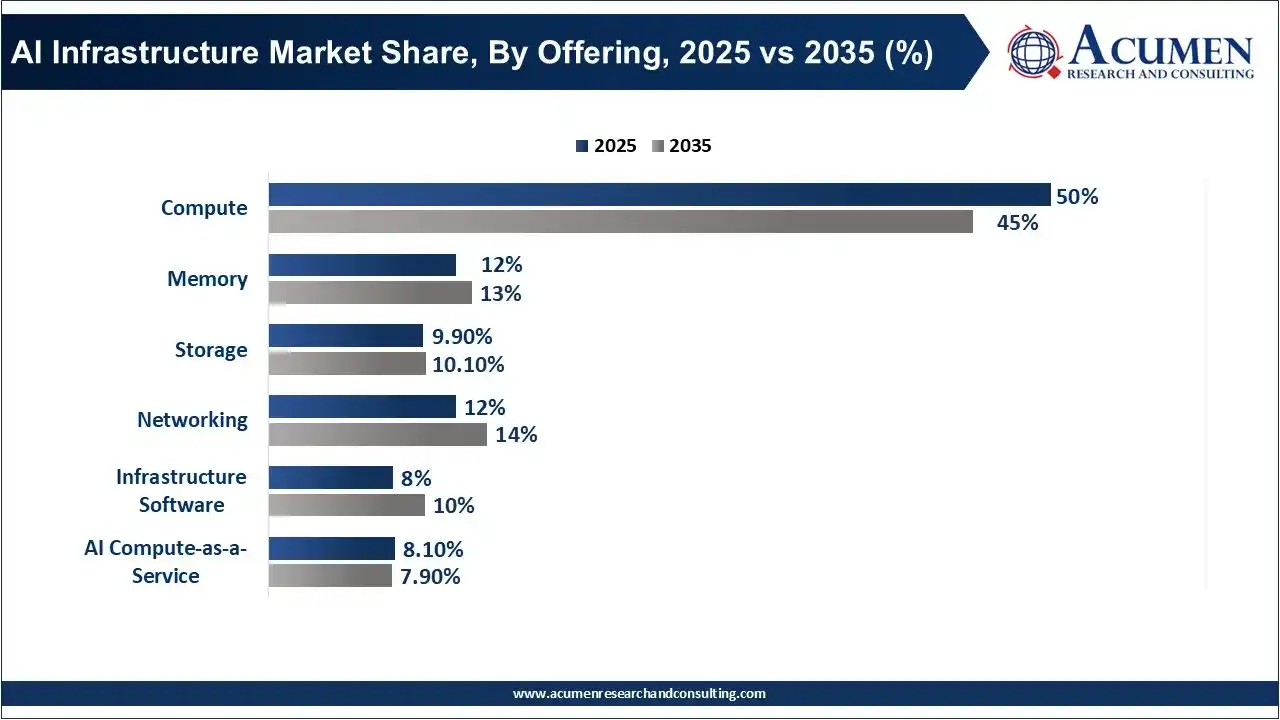
Networking The fastest-growing offering segment will be AI-specific networking, growing at a 28.4% CAGR from 2026 to 2035. As AI clusters grow in size, high-speed interconnects will play a critical role in transferring enormous volumes of data between GPUs, servers, storage, and network nodes. Advanced Ethernet, Infini Band, optical connectivity, and AI-optimized networking architectures will thus be an essential part of AI data center design.
Function Insights
Why Is AI Model Inference Becoming the Biggest Growth Opportunity?
AI model training continued to make up the largest proportion of the AI infrastructure market in 2025 at 55%, indicating the ongoing infrastructure investment for building and training more advanced AI models. Training need vast amounts of acceleration, high-performance networking, and large-memory infrastructure, in addition to high performance storage. Hyperscalers, AI builders, research bodies and large enterprises will still allocate investment to dedicated training infrastructure.
AI Infrastructure Market Share, By Function, 2025 (%)
| Function | Revenue Share, 2025 (%) | Revenue Share, 2025 (%) |
|---|---|---|
| AI Model Training | 55% | 35% |
| AI Model Inference | 45% | 65% |
AI model inference segment will also grow at the highest rate, with a CAGR of 31.5% for 2026-2035. This signals the transition of AI from the experimental environment to commercial real-world applications. Once trained, AI models rely on inference infrastructure to handle users' requests, transactions, recommendations, autonomous decision-making, searches, and other workloads.
Deployment Insights
Why Is Cloud Becoming the Preferred AI Infrastructure Model?
Cloud deployment held a 52% share of the AI infrastructure market in 2025 and will grow to 60% by 2035. Cloud infrastructure allows enterprises to have access to GPUs, CPUs, storage, networking, and AI development environments on demand without the need to build and maintain the physical infrastructure.
The model can particularly appeal to startups, software developers, research groups and companies that require a scalable AI workload. Cloud providers have an opportunity to pool the compute demands of multiple customers which can lead to higher usage of infrastructure and enable a customer to access higher end of AI hardware.
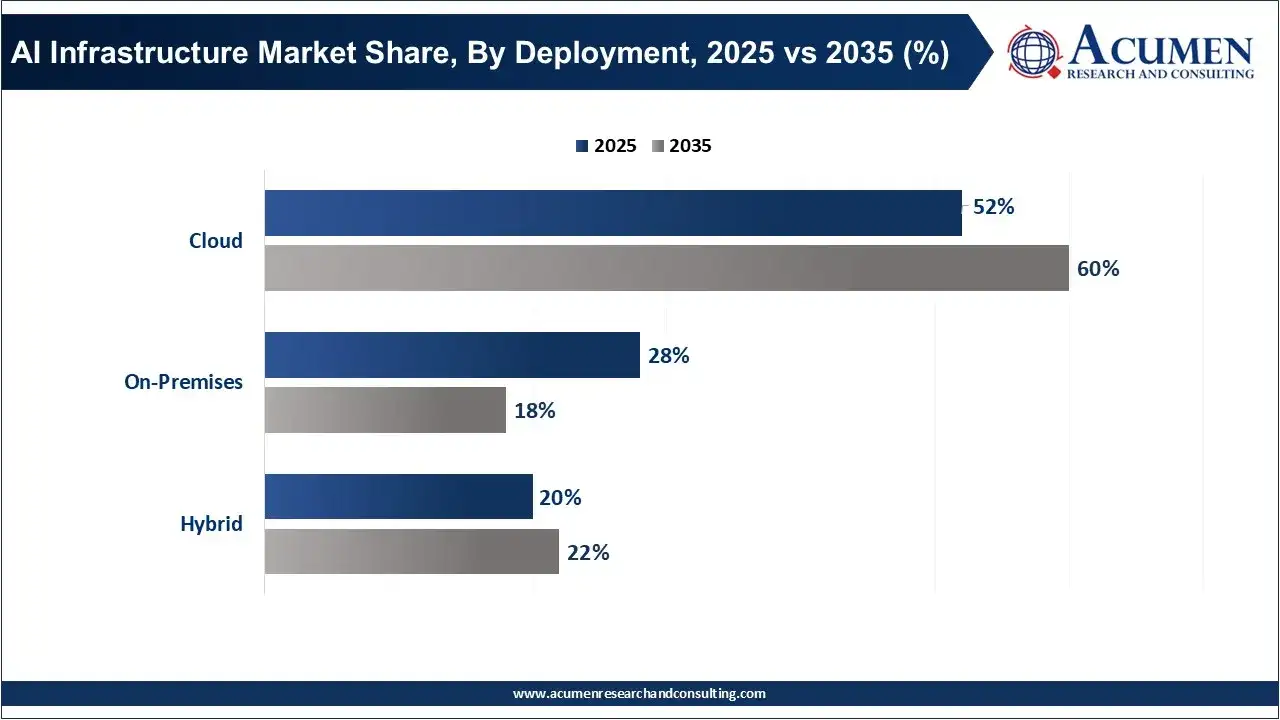
Hybrid deployment will become more prevalent during the forecast period, rising from 20% in 2025 to 22% in 2035. Firms with sensitive data or on-premises compliance requirements or invested already in data center resources are intermitting public cloud offerings with their private infrastructure. Hybrid cloud enables enterprises to retain control of sensitive workloads while having access to public cloud's elastic capabilities.
Technology Insights
Why Does Machine Learning Continue to Lead AI Infrastructure Demand?
The highest share of the AI infrastructure market in 2025 was generated by machine learning with 38%. Machine learning is an infrastructure technology used by many enterprise and consumer-facing applications like predictive analytics, recommendation engines, fraud detection, industrial automation, cyber security, healthcare analytics, and customer intelligence.
Because many industries are rapidly adopting machine learning technology, there is a need for large-scale processing servers, high-performance storage platforms, data processing platforms, and cloud infrastructure.
AI Infrastructure Market Share, By Technology, 2025 (%)
| Technology | Revenue Share, 2025 (%) |
|---|---|
| Machine Learning | 38% |
| Deep Learning | 30% |
| Generative AI | 22% |
| Other AI Technologies | 10% |
Deep learning accounted for 30% of the market in 2025, driven by its broad adoption in computer vision, speech recognition, driverless vehicles, medical imaging, natural language processing and other AI domains. Deep learning models use a lot of compute because they take large amounts of data and run it through large neural networks, increasing demand for GPUs, AI accelerators, high performance memory and specialized networking. The growth of generative AI, autonomous systems, smart manufacturing and AI-enabled healthcare will drive further growth in deep learning workloads.
End User Insights
Why Are Enterprises Driving the Largest Share of AI Infrastructure Demand?
Enterprises led the global market in 2025 at 50%, as organizations in financial services, healthcare, manufacturing, retail, telecommunications, automotive, logistics and professional services invested in the AI infrastructure needed to drive automation, analytics, generative AI, customer applications and operational decision-making.
Demand by organizations for enterprise-grade AI infrastructure is shifting away from experimental AI towards production AI. This requires investment not only in computing capacity but also in storage, networking, security, orchestration and infrastructure management.
AI Infrastructure Market Share, By End User, 2025 (%)
| End User | Revenue Share, 2025 (%) |
|---|---|
| Cloud Service Providers | 30% |
| Enterprises | 50% |
| Government & Research Organizations | 15% |
| Others | 5% |
Cloud service providers accounted for 30% of the market share, as the infrastructure layer on which AI developers and enterprises rely. Cloud providers continue to grow hyperscale AI-ready data centers and GPU capacity in response to surging demand for cloud AI workloads.
Government and research organizations comprised 15%, by country supported by national AI strategies, scientific computing, defence applications, public-sector digitalization and investments in sovereign AI infrastructure. These organizations are becoming more prominent in countries aiming for sovereign AI capabilities and more control over critical and strategic AI computing resources.
AI Infrastructure Market Regional Insights
Why Is North America Leading the AI Infrastructure Market While Asia-Pacific Records the Fastest Growth?
North America led the global AI infrastructure market in 2025, with 39% market share, owing to a well-established cloud computing ecosystem, mature data center infrastructure, robust semiconductor industry, and a high concentration of hyperscale technology firms. Demand in North America is led by the U.S., which sees a large amount of capital investment into AI-optimized data centers, GPU hardware, high-performance networking, high-performance computing (HPC) hardware, and infrastructure to run large training and inference workloads. North America's share is further reinforced by high levels of private-sector investment and widespread deployment of generative AI for enterprise use cases.
The United States remains the largest country-level market for North America, where increased deployment of hyperscale data centers and demand for accelerated computing are driving demand for GPUs, high-bandwidth memory, new networking technologies, liquid cooling, and AI-optimized data center architectures. Canada is also working to develop its AI infrastructure capabilities by investing in AI computing, research infrastructure, and data center capacity.
Why Is Asia-Pacific Emerging as the Fastest-Growing AI Infrastructure Market?
Asia-Pacific is expected to register the fastest growth, with a CAGR of 29.3% from 2026 to 2035. Its share is projected to increase from 29.0% in 2025 to 36% by 2035, reflecting rapidly expanding AI adoption, digital infrastructure investments, semiconductor development, and hyperscale data center construction. China, Japan, South Korea, India, Singapore, and Australia are becoming important AI infrastructure markets as governments and businesses prioritize sovereign computing capabilities and domestic AI ecosystems.
China is emerging as a major AI infrastructure investment hub because of its large technology industry, expanding domestic AI models, semiconductor initiatives, and extensive data center development. India is also becoming increasingly important as enterprises, government organizations, and technology providers invest in AI-ready data centers, cloud infrastructure, and accelerated computing. Japan and South Korea benefit from advanced semiconductor and electronics ecosystems, while Singapore continues to serve as an important regional data center and cloud infrastructure hub.
Leading Companies
| Company | Headquarters | Company Overview |
|---|---|---|
| NVIDIA | Santa Clara, California, U.S. | NVIDIA is a leading AI infrastructure provider supplying GPUs, networking platforms, accelerated computing systems, and software for large-scale AI training and inference. |
| AMD | Santa Clara, California, U.S. | AMD develops AI accelerators, CPUs, GPUs, and data-center platforms that support enterprise, cloud, and high-performance AI workloads. |
| Intel | Santa Clara, California, U.S. | Intel provides data-center processors, AI accelerators, networking technologies, and infrastructure solutions for enterprise and cloud environments. |
| Microsoft | Redmond, Washington, U.S. | Microsoft operates large-scale Azure AI infrastructure and develops proprietary AI accelerators alongside NVIDIA- and AMD-powered computing systems. |
| Amazon Web Services (AWS) | Seattle, Washington, U.S. | AWS provides cloud-based AI infrastructure through GPU instances, Trainium and Inferentia chips, AI servers, networking, and data-center services. |
| Alphabet (Google) | Mountain View, California, U.S. | Google develops TPU-based AI infrastructure and operates Google Cloud platforms supporting large-scale AI training and inference. |
| Meta Platforms | Menlo Park, California, U.S. | Meta operates large AI data centers and develops its MTIA accelerators while deploying NVIDIA and AMD systems for AI workloads. |
| Oracle | Austin, Texas, U.S. | Oracle provides GPU-based cloud infrastructure and large-scale AI data-center capacity for enterprises and AI developers. |
| Dell Technologies | Round Rock, Texas, U.S. | Dell supplies AI servers, storage, networking, and integrated infrastructure systems for enterprise and data-center AI deployments. |
| Hewlett Packard Enterprise (HPE) | Spring, Texas, U.S. | HPE provides AI servers, supercomputing, networking, storage, and liquid-cooled infrastructure for enterprise and high-performance computing environments. |
| CoreWeave | Roseland, New Jersey, U.S. | CoreWeave operates specialized GPU cloud infrastructure designed for AI training, inference, and high-performance computing workloads. |
| Arista Networks | Santa Clara, California, U.S. | Arista develops high-speed Ethernet networking platforms used to connect large-scale AI and cloud data-center clusters. |
Product Launch, Partnership and Ecosystem Analysis
- In September 2026, Qualcomm announced a long-term partnership with Amazon to develop and supply custom AI data-center chips, with Amazon potentially purchasing up to $60 billion of Qualcomm AI chips and related products. The partnership also covers advanced optical connectivity for AI data centers, strengthening Qualcomm's expansion into AI infrastructure and inference computing.
- In September 2026, Equinix launched Inference Exchange in collaboration with NVIDIA and Together AI to provide distributed AI inference infrastructure through Equinix's global data-center network. The platform combines NVIDIA enterprise reference architectures, Together AI's inference platform supporting more than 200 open-source models, and Equinix Fabric connectivity to support scalable enterprise AI deployments.
Segments Covered
By Offering
- Compute
- Memory
- Storage
- Networking
- Infrastructure Software
- AI Compute-as-a-Service
By Function
- AI Model Training
- AI Model Inference
By Deployment
- Cloud
- On-Premises
- Hybrid
By Technology
- Machine Learning
- Deep Learning
- Generative AI
- Other AI Technologies
By End User
- Cloud Service Providers
- Enterprises
- Government & Research Organizations
- Others
By Region
- North America
- Europe
- Asia-Pacific
- Latin America
- Middle East & Africa
Looking for discounts, bulk pricing, or custom solutions? Contact us today at sales@acumenresearchandconsulting.com
Frequently Asked Questions

Other ICT Reports
February 2024
July 2020
March 2023
May 2024