
Sovereign AI Market Size, Share, Trends, Report 2026 To 2035
Sovereign AI Market (By Sovereignty Architecture: Data Sovereignty, Infrastructure Sovereignty, Model Sovereignty, Platform/Operational Sovereignty, End-to-End Sovereignty; By Component: Hardware, Software, Services; By Deployment: On-Premises, Sovereign Cloud, Hybrid; By AI Technology/AI Workload: Generative AI, Predictive AI, Computer Vision, Natural Language AI/Speech AI, Autonomous AI, Other AI; By Application: Government & Public Services, Defense & National Security, Healthcare, Financial Services, Critical Infrastructure, Manufacturing & Industrial, Telecommunications, Enterprise & Other) - Global Industry Analysis, Size, Share, Growth, Regional Analysis, Trends and Forecast 2026 - 2035
- Last Updated: 31 Aug 2026
- Report Code: ARC3972
- Category: ICT
Sovereign AI Market Size, Forecast Report 2026 To 2035
The global sovereign AI market size was calculated at USD 39.72 billion in 2025 and is expected to reach at USD 248.59 billion by 2035; growing at a CAGR of 20.1% during the forecast period of 2026-2035.
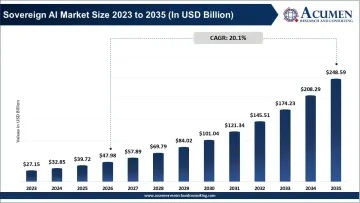
Report Highlights
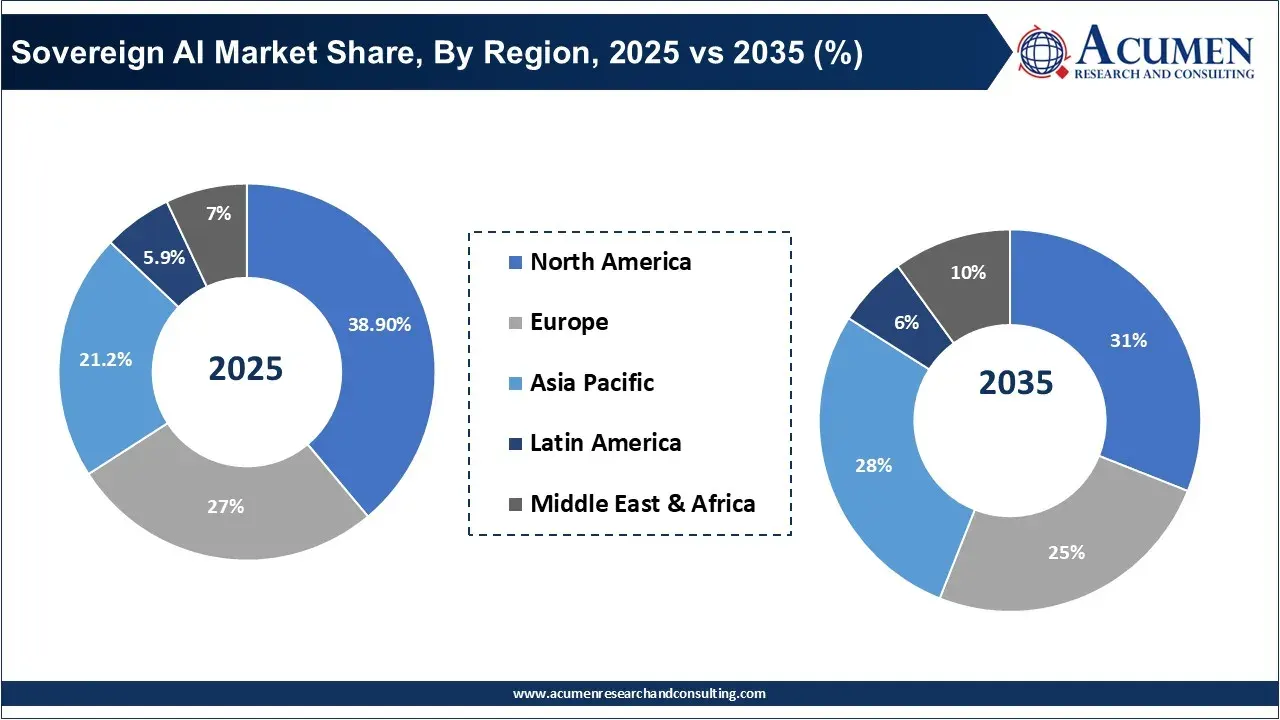
- By region, North America dominated the market with a 38.90% share in 2025 and is projected to maintain its leadership through 2035 despite its share declining to 31.00%, with revenue forecast to increase from $18.66 billion in 2026 to $77.06 billion by 2035 at a 17.1% CAGR.
- By region, Asia-Pacific represented the second-largest regional market with a 21.20% share in 2025 and is expected to increase its share to 28.00% by 2035 as governments expand domestic AI infrastructure, sovereign cloud capabilities and national AI initiatives.
- By region, Middle East and Africa is projected to be the fastest-growing regional market, with its share increasing from 7.00% in 2025 to 10.00% by 2035 and revenue reaching $24.86 billion by 2035 at a 24.9% CAGR.
- By sovereignty architecture, infrastructure sovereignty dominated the market with a 34.00% share in 2025, supported by continued investment in data centers, compute nodes, AI servers, accelerators, storage, networking and power infrastructure.
- By sovereignty architecture, model sovereignty is expected to gain importance, increasing from 18.00% in 2025 to 23.10% by 2035 as countries expand domestic foundation models, locally trained large language models and government-specific AI systems.
- By component, hardware dominated the market with a 49.00% share in 2025, driven by substantial investment in AI accelerators, GPUs, CPUs, servers, high-performance computing, networking and storage infrastructure.
- By component, software is projected to become the largest segment by 2035, increasing from 34.00% in 2025 to 40.00% as governments and enterprises prioritize controllable AI environments, model training, deployment and governance.
- By deployment, on-premises infrastructure dominated with a 43.00% share in 2025, supported by demand from defense, government, intelligence, financial services and critical infrastructure organizations requiring maximum control over data and physical infrastructure.
- By deployment, sovereign cloud is projected to become the dominant deployment model by 2035, increasing from 38.00% in 2025 to 48.00% as organizations seek scalable AI capabilities while maintaining data residency, jurisdictional control and regulatory compliance.
- By AI technology, generative AI dominated the market with a 36.00% share in 2025, driven by the adoption of large language models, AI assistants, government AI systems, enterprise copilots and locally controlled foundation models.
- By AI workload, predictive AI was the second-largest segment with a 24.00% share in 2025, supported by applications in government planning, financial services, defense, manufacturing, healthcare, energy and critical infrastructure.
- By application, government and public services dominated with a 23.00% share in 2025, reflecting strong demand for sovereign AI across citizen services, public administration, taxation, regulatory systems and government decision support.
- By application, defense and national security represented the second-largest segment with an 18.00% share in 2025, driven by demand for secure AI environments for intelligence, autonomous systems, cybersecurity, surveillance, battlefield decision support and threat detection.
What Is Sovereign AI and Why Is It Becoming a Strategic Priority for Governments?
Sovereign AI is a concept encompassing the ability of a country or its government to build, run and have full control of its own AI capacity. This involves having real leverage and influence over: computer equipment, computer resources, data, and models and software hosted in the cloud: but specifically the nation state that possesses and fully controls these aspects of its environment's computational and data infrastructure and its accompanying technology in its geographic boundaries.
Governments are moving towards sovereign AI, trying to overcome reliance of foreign technology companies, better protect the data of its citizens and its own security, and secure the AI capabilities even under situations such as geopolitical tensions and supply chain disruptions.
Many public-sector supported Sovereign AI projects are flourishing, the CNAS Sovereign AI Index lists some 184 government-backed Sovereign AI projects planned across the world covering 67 countries by mid-2026, up from merely one such venture in January 2023.
How Much Are Governments Investing in Sovereign AI?
| Country/Region | Investment / Commitment | Key investment focus |
|---|---|---|
| Saudi Arabia | $20 billion+ | AI data centers, GPUs, sovereign AI infrastructure, cloud computing and domestic AI capabilities |
| United Arab Emirates | $30 billion | Sovereign AI infrastructure, AI data centers, compute capacity and the Stargate UAE project |
| China | $98 billion+ | Domestic AI infrastructure, semiconductor capabilities, AI compute and technology self-reliance |
| France | €45 billion | AI data centers and large-scale AI infrastructure investment through SoftBank's planned projects |
| Brazil | $444.2 million | National AI supercomputing infrastructure, large language models and domestic AI capabilities |
| South Korea | $72 billion | Semiconductor, AI and future-technology infrastructure through its Future Response Fund |
Market Dynamics
How Is Geopolitical Competition Accelerating Sovereign AI Investments?
The accelerating wave of geopolitical competition is stimulating sovereign AI investments as nations begin to treat AI capabilities as fundamental national assets relating to economic competitiveness, defense, cybersecurity and technological sovereignty. The sanctions imposed on advanced semiconductors; fears of reliance on foreign technologies and vulnerable supply-chains; and rivalry among great AI powers; is promoting the rise of local AI computing hardware, national cloud services, domestic foundational models and home-made semiconductors.
This movement involves increased government spending and public-private partnerships with domestic businesses to build local ecosystems for the creation of AI technology, this has led to the creation of a market demand for sovereign data centers, AI accelerators, protected cloud services, AI software as well as model creations while further pushing for the avoidance of any reliance on foreign designed technological platforms.
What Hinders the Growth of Sovereign AI Market?
High cost and operational challenges of developing and maintaining sovereign AI infrastructure. In advanced data centers this often consists of complex GPUs, networking technology, power, and cooling infrastructure. Limited domestic semiconductor manufacturing capacity, reliance on imported AI chips and critical hardware, shortage in skilled AI specialists, and limited local datasets can hinder full technological sovereignty.
Regulatory fragmented environment, interoperability issues, longer infrastructure deployment times, and its large energy needs are other impediments to adoption. Smaller countries may find it uneconomical to invest significantly in their own end-to-end AI infrastructure; they would opt for hybrid or sovereign-cloud options.
Where Are the Biggest Investment Opportunities in Sovereign AI?
Biggest investment opportunities across sovereign AI will exist in AI Data Centers, sovereign cloud infrastructure, AI accelerators, chip manufacturing, high-performance computing, AI networking and domestic developed foundation models. It's also an attractive sovereign cloud opportunity as companies and governments look for scalable computing where the location and jurisdiction and security remain under their purview.
The opportunities are poised to be fueled by considerable capital from public-private partnerships, sovereign wealth funds, infrastructure funds and corporate strategic investments, as sovereign governments view AI infrastructure like any other critical national infrastructure.
Segmentation Insights
Sovereignty Architecture Insights
In 2025 infrastructure sovereignty captured 34.00% of the sovereign AI market. Sovereignty of infrastructure comprise of physical and computing infrastructure utilized to create and sustain AI capabilities; including data centers, compute nodes, AI servers, accelerators, data storage, networking hardware and power.
Sovereign AI countries, states and regions need a base level of infrastructure as prerequisite for any other type of government / enterprise spending. For that reason, investments in private infrastructure are likely to stay at the top of overall spending for the sovereign AI market.
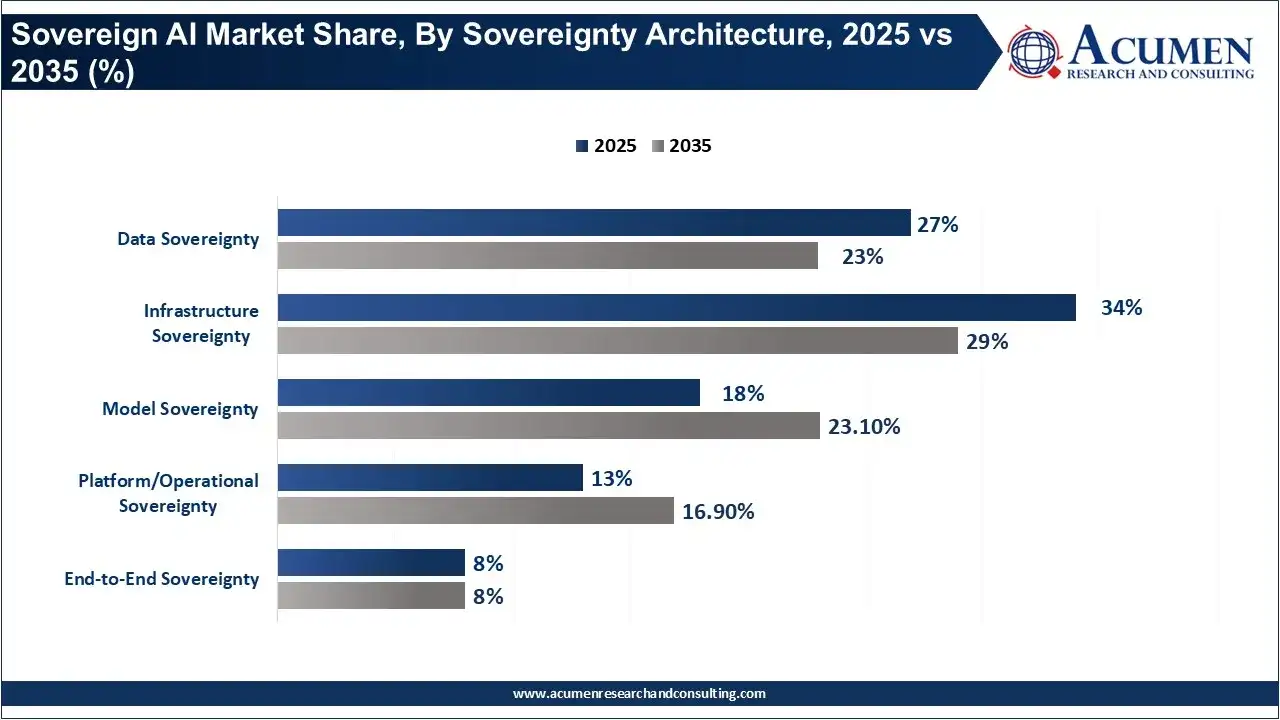
Model sovereignty accounted for 18.00% of the market in 2025, increasing to 23.10% by 2035. This represents one of the most significant structural shifts within the sovereign AI market. Unlike infrastructure sovereignty, which focuses on control of computing resources, model sovereignty concerns the ability to develop, own, customize, train and operate AI models according to national or organizational requirements.
The increase from 18.00% to 23.10% reflects growing demand for domestic foundation models, locally trained large language models, regional-language AI, government-specific models and AI systems that can operate without complete dependence on foreign model providers. Model sovereignty is particularly important for countries seeking to maintain control over sensitive government applications, defense systems and culturally or linguistically specific AI applications.
Component Insights
The market for sovereign AI in 2025 was heavily skewed towards hardware, which made up 49% of the market. The hardware portion of the market is expected to hold 39% by 2035; however hardware will still be a significant driver of sovereign AI investment. Hardware makes up the AI accelerators, the GPUs, the CPUs, AI servers, high performance computing environments and the networking hardware/storage and other physical components required to run AI workloads. Hardware is the primary market in 2025 because of the considerable capital investment in creating sovereign computer infrastructure.
Governments and enterprise organizations require hardware dedicated to AI processing, to gain control and independence from outside infrastructure and to allow sensitive AI workloads and infrastructure to be run in jurisdiction and security parameters as required.
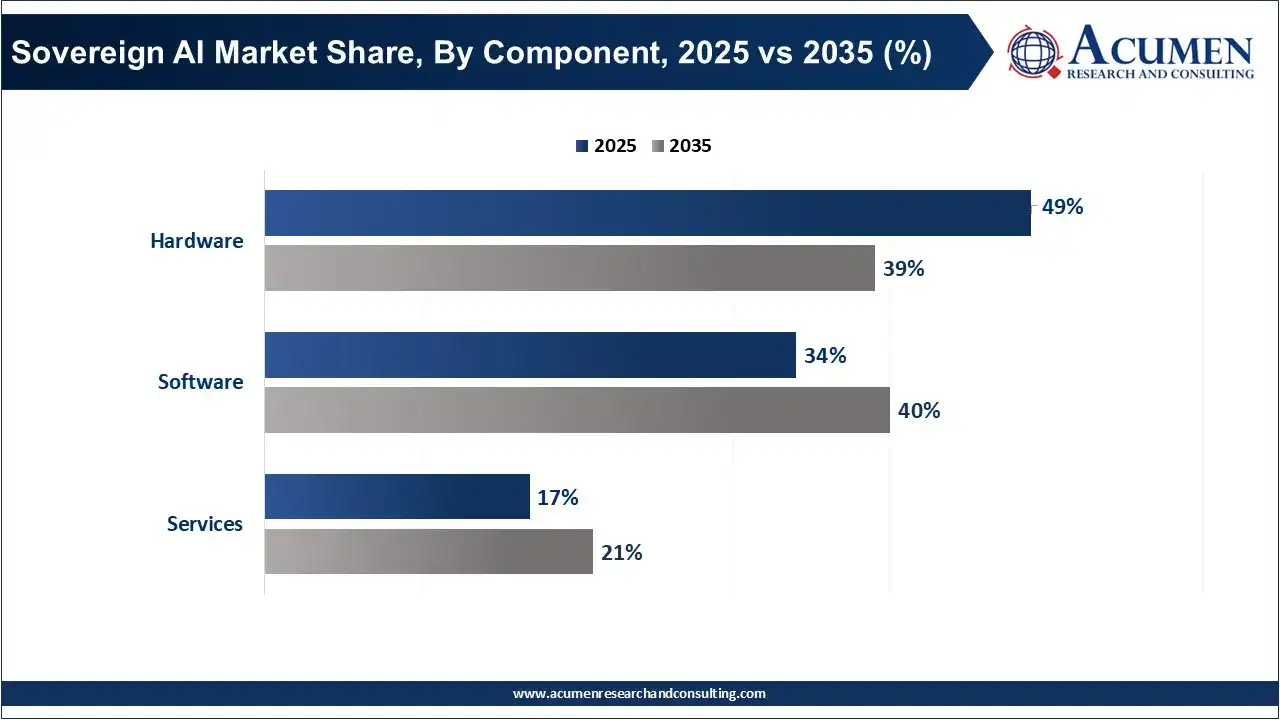
The segment software made up 34% of the sovereign AI market in 2025. The market for software is expected to expand by 2035 and exceed that for hardware; taking up 40% of the market for sovereign AI. Software gains value as governments and organizations begin to develop sovereign AI infrastructure; moving away from solely acquiring compute hardware to acquiring software which will help develop in-house controllable AI environments which will allow for custom built training and controlled application and governance of AI models.
Deployment Insights
On-premises deployment accounted for 43% of the sovereign AI market in 2025, making it the largest deployment model at the beginning of the forecast period. Revenue increased from $20.63 billion in 2026 and is projected to reach $77.06 billion by 2035, representing a 15.8% CAGR between 2026 and 2035.
On-premises infrastructure remains particularly important for defense, government, intelligence, financial services and critical infrastructure organizations where maximum control over physical infrastructure, data and access is required.
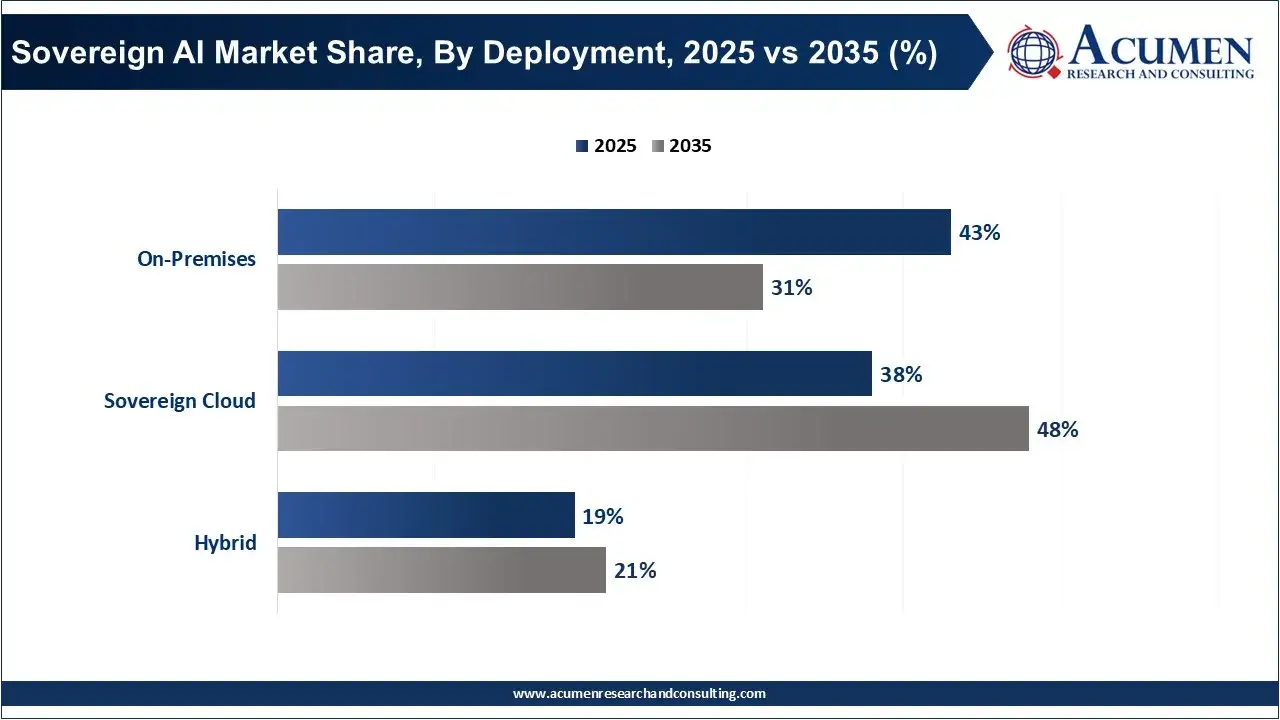
Sovereign cloud accounted for 38% of the market in 2025 and is projected to become the clear dominant deployment model by 2035, reaching 48.00%. The strong growth reflects the ability of sovereign cloud environments to combine cloud scalability with requirements related to data residency, jurisdiction, security, operational control and regulatory compliance.
Sovereign cloud is particularly attractive to governments and enterprises that do not want to build and maintain all AI infrastructure internally. It allows organizations to access advanced computing and AI capabilities while maintaining greater control over where workloads are processed and how sensitive information is managed.
AI Technology/AI Workload Insights
Generative AI was the leading category of the sovereign AI market in 2025 and comprised 36% of market share. This category's rise is correlated with increased implementation and adoption rates of large language models, generative AI assistant, government AI system, enterprise copilots and locally-controlled foundation models.
Generative AI holds particular importance for sovereignty since entities often demand a level of control over data-processing models-governments and companies may opt for local models, or sovereign models, such as when they do not want to rely on foreign AI, and require control over training data, deployed behavior and the environment where the models operate.
Sovereign AI Market Share, By AI Technology/AI Workload, 2025 (%)
| By AI Technology/AI Workload | Revenue Share, 2025 (%) |
|---|---|
| Generative AI | 36% |
| Predictive AI | 24% |
| Computer Vision | 15% |
| Natural Language AI/Speech AI | 11% |
| Autonomous AI | 8% |
| Other AI | 6% |
Predictive AI represented 24% of the market in 2025, making it the second-largest AI workload category. Predictive AI continues to have strong applications across government planning, financial services, defense, manufacturing, healthcare, energy and critical infrastructure. Its importance within sovereign AI arises from the use of sensitive national and enterprise datasets to support forecasting, risk management, resource allocation and operational decision-making.
Application Insights
The government and public services application segment was largest in the 2025 sovereign AI market, estimated to reach 23%. Government organizations, a major adopter, lead development and deployment owing to government organizations handling sensitive national data, control, AI, infrastructure and applications, and models. Such use applications range broadly in functions: citizen-facing services, decision support and public administration, taxation, national datasets, social services, regulatory systems and government production tools. Government applications as a sovereign sector underscores the sovereign AI role for national digitalization.
Sovereign AI Market Share, By Application, 2025 (%)
| By Application | Revenue Share, 2025 (%) |
|---|---|
| Government & Public Services | 23% |
| Defense & National Security | 18% |
| Healthcare | 11% |
| Financial Services | 13% |
| Critical Infrastructure | 12% |
| Manufacturing & Industrial | 9% |
| Telecommunications | 8% |
| Enterprise & Other | 6% |
Defense & national security accounted for 18.00% of the market in 2025, making it the second-largest application segment. Defense organizations require highly controlled AI environments for intelligence analysis, autonomous systems, cybersecurity, surveillance, battlefield decision support, logistics and threat detection.
Sovereign AI is particularly important in this application because dependence on foreign AI infrastructure or models can create strategic vulnerabilities. Consequently, defense organizations are likely to prioritize locally controlled infrastructure, secure models and restricted-access AI environments.
Sovereign AI Market Regional Insights
Role of North American Countries in Sovereign AI Market
North America held the lion’s share of the sovereign AI market size in 2025 with 38.90% of the overall market. Its market share is estimated to decrease to 31.00% in 2035 but will remain as the largest regional market in terms of absolute revenue over the forecast period. In absolute values, the North America sovereign AI market revenue grew from $15.45 billion in 2025 to $18.66 billion in 2026, and is forecast to increase to $77.06 billion by 2035, expanding at a CAGR of 17.1% from 2026 to 2035.
The region's supremacy can be attributed to its extensive AI infrastructure capabilities, advanced semiconductor environment, hyper-scaled cloud infrastructure, state support for AI technologies, advanced defense capabilities and large concentration of dominant AI technology players. The United States holds a competitive edge in AI accelerators, cloud computing, data centers, foundation models, cybersecurity, and high-performance computing. Thus, North America has a relatively mature foundation and a rich ecosystem to further develop its sovereign AI capabilities. National security concerns, defense AI goals, strategic computing power, domestic production of semiconductors, and protection of critical infrastructure are all expected to drive growth in this region. Enterprises in highly confidential industries such as banking, defense, healthcare and telecommunications also contributed toward the sovereign AI investment in the region.
How Is the U.S. Maintaining Its AI Infrastructure Leadership?
- Growing domestic semiconductor capacity: CHIPS and Science Act and corresponding industrial policies aim to expand domestic chip production, research and design, and the robustness of supply chains. Through its CHIPS program, the government has allocated $50 billion to build out U.S. Semiconductor ecosystem capability.
- Fostering robust domestic AI chip ecosystem: Investments in advance processors, memory chips, AI accelerators, packaging, and chip manufacturing continue to help the United States to keep apace in several important layers of the AI stack.
- Continuing AI accelerators’ primacy: The United States continues to have the most important role in a vast international ecosystem of semiconductor components and devices that are needed to build chips and machine that can learn and perform artificial intelligence.
- Building out AI data center capacity: Hyperscalers and technology firms are in the midst of enormous build-outs of AI data capacity that support enormous and ever-more computationally intensive AI tasks and training of generative AI Large language models.
- Power the AI infrastructure to serve the expanding need: Increasingly, the U.S. is considering of how the construction of electricity generation capacity needs to accompany large-scale computing infrastructure.
How is Middle East and Africa Growing at the Fastest Rate
Middle East & Africa constituted 7.00% of the sovereign AI market share in 2025 and this share is expected to grow to 10.00% by 2035. The total revenue from sovereign AI grew from $2.78 billion approximately in 2025 to $3.36 billion in 2026 and was anticipated to grow to reach $24.86 billion by 2035. The region is expected to witness a CAGR of 24.9% from 2026 to 2035, the highest growth rate among all other regional segments.
It marks robust growth with massive investments made in AI infrastructure, sovereign cloud, data centers, national AI initiatives and platforms, domestic AI models and various government policies with majority developments happening in Gulf Countries.
Sovereign AI investment is becoming strategic for governments compared to just enterprise tech investment. Some of the countries in the Middle East are trying to position as the AI regional centers with access to a combination of sovereign investment capital, massive data centers construction, vast energy sources, cloud services and sovereign AI strategy. Sovereign funds and government associated investing firms are also the most important player for AI infrastructure funding along with the global technology vendors.
Asia Pacific Sovereign AI Market Analysis:
In 2025, Asia-Pacific captured 21.20% of the sovereign AI market, the second-highest regional stake during this year. By 2035, its share will expand significantly to 28.00%, posting one of the sharpest increases among all regions. The Asia-Pacific Sovereign AI market size rose from $8.42 billion in 2025 to $10.17 billion in 2026 and is expected to rise to $69.61 billion in 2035. The CAGR for the region will be 23.8% from 2026-2035, making it the second Fastest Growing market after the Middle East and Africa region.
Strong growth in the region is due to escalating government initiatives to bolster national AI competencies and decrease their reliance on external technological providers while also building local computing power. Nations such as China, India, Japan, South Korea, Singapore are defining new ways of achieving AI sovereignty based on technological prowess, geopolitics and structure of industry.
How Is China Building AI Self-Reliance Under Semiconductor Restrictions?
- Promoting domestic AI-chip progress- China is placing greater bets on developing indigenous AI accelerators and domestic chip technologies in order to curtail its dependence on foreign suppliers of GPUs.
- Becoming a mainstream domestic alternative provider- Huawei has emerged as China’s main domestic solution, particularly for AI computing with its Ascend family of accelerators and accompanying computing systems.
- Bolstering SMIC's capacity- As China attempts to advance domestic advanced-node manufacturing capacity, Semiconductor Manufacturing International Corporation (SMIC) is viewed as pivotal in that bid.
- Creating a whole integrated local domestic silicon ecosystem-China’s move toward localization is not limited to designing and manufacturing the chips, but rather the whole local silicon value chain, from chip tools and materials, to packaging and memory among other things.
- Substituting restricted technologies with domestic alternatives- The local alternatives are increasingly being rolled out to substitute for American, European, Japanese and other foreign suppliers of technologies that China can no longer buy.
What Role Do Nvidia, AMD and Other AI Chip Providers Play in Sovereign AI?
AI chip providers play a foundational role in the development of sovereign AI because access to advanced computing hardware directly determines a country's ability to train, deploy and operate AI models independently. NVIDIA currently has the strongest position across sovereign AI infrastructure, with Counterpoint Research reporting that NVIDIA chips were used to train 92% of the sovereign AI LLMs covered in its July 2026 index. Its role extends beyond GPUs into networking, CUDA software, AI development tools and complete AI-factory architectures, allowing governments and enterprises to establish locally controlled AI computing environments.
AMD is strengthening its position as an alternative accelerator provider through its Instinct GPUs and open ROCm software ecosystem, including a strategic partnership with South Korea in July 2026 to support an open, heterogeneous sovereign AI infrastructure. Other providers, including Intel, Cerebras, Qualcomm and Rebellions, are also contributing to sovereign AI by offering alternative accelerators and inference-focused solutions.
Sovereign AI Public-Private Investment Framework
| Investment | Government / Public-Sector Role | Private-Sector Role | Key Investment Objective |
|---|---|---|---|
| AI Data Centers | Land allocation, permits, incentives, strategic procurement | Build and operate AI data centers | Expand domestic AI compute capacity |
| AI Chips & Accelerators | Subsidies, procurement commitments, semiconductor policies | Chip design, manufacturing, distribution | Reduce dependence on foreign AI hardware |
| Sovereign Cloud | Define sovereignty, security and residency requirements | Build and operate sovereign cloud platforms | Provide locally controlled scalable AI infrastructure |
| AI Foundation Models | Public datasets, grants, government demand | Develop, train and commercialize models | Build domestic model capabilities |
| AI Supercomputing | National computing programs and HPC facilities | Supply hardware, software and technical expertise | Establish strategic national compute capacity |
| Energy & Power Infrastructure | Grid development, energy policy and approvals | Power generation, transmission and renewable projects | Secure reliable power for AI infrastructure |
| AI Networking & Storage | Strategic procurement and standards | Develop networking, storage and data-center technologies | Strengthen domestic infrastructure stack |
Sovereign AI Market Competitive Landscape
Recent News
- In July 2026, NAVER, NVIDIA and Brookfield announced plans to expand South Korea's sovereign AI factory infrastructure, with the initial NVIDIA DSX AI factory at NAVER's GAK Sejong data center planned to increase from 55 MW to 200 MW by 2028. The project is designed to support sovereign AI infrastructure for enterprises, industries and government applications and demonstrates the growing use of public-private partnerships to build national-scale AI computing capacity.
- In August 2026, the Center for a New American Security reported that its Sovereign AI Index had identified 184 government-backed sovereign AI projects across 67 countries, compared with only one project tracked in January 2023. The sharp increase highlights how governments are increasingly investing in AI infrastructure, models and data capabilities to reduce technological dependence and strengthen national AI capacity.
Segments Covered
By Sovereignty Architecture
- Data Sovereignty
- Infrastructure Sovereignty
- Model Sovereignty
- Platform/Operational Sovereignty
- End-to-End Sovereignty
By Component
- Hardware
- Software
- Services
By Deployment
- On-Premises
- Sovereign Cloud
- Hybrid
By AI Technology/AI Workload
- Generative AI
- Predictive AI
- Computer Vision
- Natural Language AI/Speech AI
- Autonomous AI
- Other AI
By Application
- Government & Public Services
- Defense & National Security
- Healthcare
- Financial Services
- Critical Infrastructure
- Manufacturing & Industrial
- Telecommunications
- Enterprise & Other
By Region
- North America
- Europe
- Asia-Pacific
- Latin America
- Middle East & Africa
Looking for discounts, bulk pricing, or custom solutions? Contact us today at sales@acumenresearchandconsulting.com
Frequently Asked Questions

Other ICT Reports
April 2025
March 2024
November 2018
April 2021