
Predictive AI Market Size, Share, Growth, Report 2026 to 2035
Predictive AI Market (By Component: Software, Hardware, Services; By Technology: Machine Learning, Deep Learning, Natural Language Processing (NLP), Computer Vision, Reinforcement Learning; By Deployment: On-Premise, Cloud-Based, Hybrid; By Enterprise Size: Large Enterprises, Small & Medium Enterprises (SMEs); By Application: Customer Analytics, Demand Forecasting, Risk Analytics, Fraud Detection, Predictive Maintenance, Supply Chain Optimization, Healthcare Prediction, Others; By End Use Industry: BFSI, Healthcare, Retail, Manufacturing, IT & Telecom, Government, Energy, Transportation, Others) - Global Industry Analysis, Size, Share, Regional Analysis, Trends and Forecast 2026 - 2035
- Last Updated: 17 Jun 2026
- Report Code: ARC3940
- Category: ICT
Predictive AI Market Size, Forecast 2026 to 2035
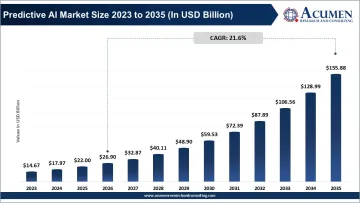
The global predictive AI market size was valued at $22 billion in 2025, it is expected to reach $155.88 billion by 2035. The market is growing at a CAGR of 21.6% during the forecast period 2026-2035. The predictive AI market is growing with the overall advancements in deep learning and need of proactive risk mitigation across finance, supply chain and healthcare sectors. The predictive AI market consists of technologies, software platforms, and the infrastructure to process historic and live data and then generate predictions about the likely outcome, behaviour or trend in the future. The market comprises predictive analytics software, AI training platforms, data integration services, cloud platforms, and consulting services, running in cloud, on-premise and hybrid deployments. Increasing enterprise digitalization, vast increase in big data availability and enhancement of AI computing power have driven widespread deployment of predictive AI technology.
Report Highlights
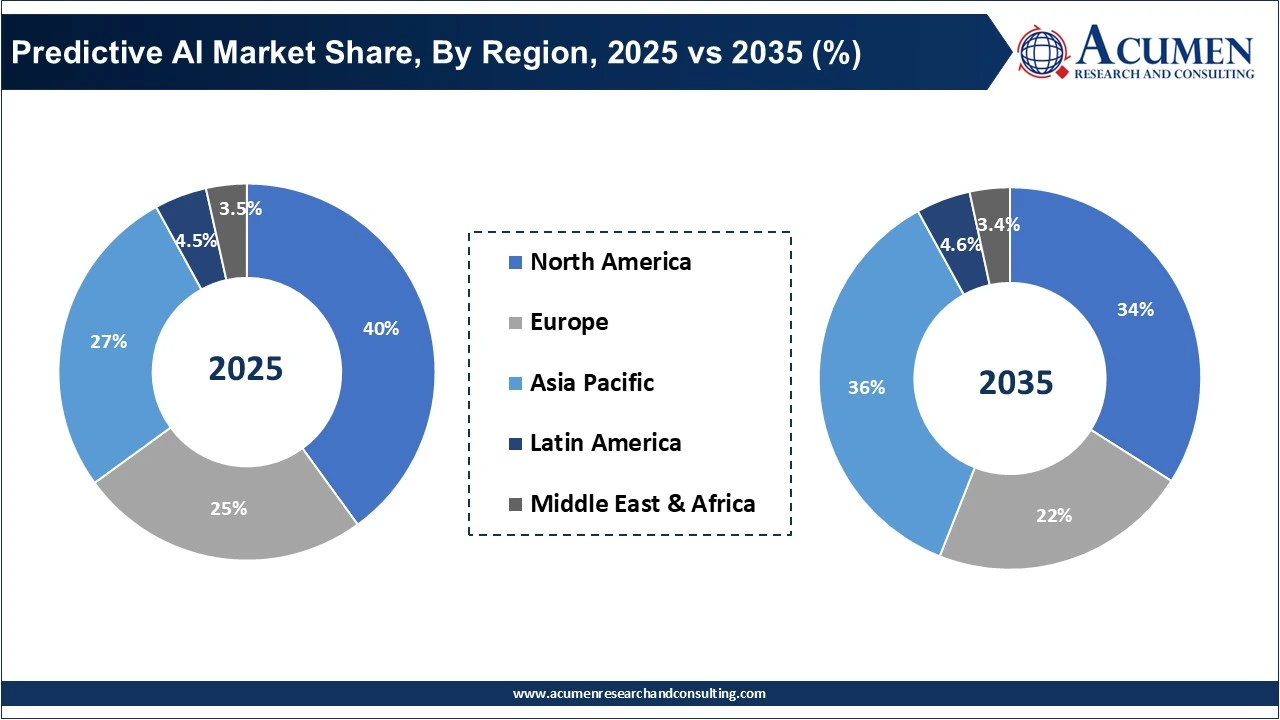
- By region, North America dominated the global predictive AI market in 2025 with 40% share driven by strong AI commercialization, advanced cloud ecosystems, and high enterprise-level adoption of predictive analytics.
- By region, Asia-Pacific is expected to witness the fastest CAGR of 25.5% during the forecast period due to aggressive AI investments, industrial automation expansion, digital transformation programs, and increasing government-backed AI initiatives across major economies.
- By component, the software segment dominated the predictive AI market in 2025 with 64% market share owing to the increasing enterprise dependency on AI-powered predictive software platforms, analytics engines, and automated forecasting systems for business intelligence and decision-making.
- By component, the hardware segment held the second-largest market share of 21% in 2025 due to rising demand for GPUs, CPUs, AI accelerators, and edge computing infrastructure required to support complex predictive model training and inference workloads.
- By technology, machine learning dominated the predictive AI market with 42% share in 2025 because of its wide commercial maturity, lower implementation complexity, and strong applicability in structured data analytics such as fraud detection, customer forecasting, and operational intelligence.
- By technology, deep learning accounted for the second-largest share of 26% in 2025 driven by its growing role in analyzing unstructured enterprise data including video, images, voice, and behavioral datasets for advanced predictive use cases.
- By deployment, cloud-based deployment led the market with 56% revenue share in 2025 due to strong enterprise demand for scalable infrastructure, centralized data accessibility, and faster predictive AI deployment across multi-location operations.
- By deployment, hybrid deployment is projected to grow at the fastest CAGR of 25.9% from 2026 to 2035 owing to rising enterprise preference for combining on-premise data security with cloud scalability for regulated and sensitive predictive workloads.
- By enterprise size, large enterprises dominated the market by holding 72% share in 2025 as they possess stronger AI budgets, advanced infrastructure, large-scale operational datasets, and multi-departmental predictive AI implementation capabilities.
- By enterprise size, SMEs accounted for the second-largest market share of 28% in 2025 and are projected to gain significant momentum due to growing availability of affordable SaaS-based predictive AI platforms and no-code forecasting tools.
- By application, customer analytics emerged as the dominant segment with 22% share in 2025 due to increasing demand for churn prediction, consumer behavior analysis, personalization engines, and targeted marketing optimization.
- By application, demand forecasting held the second-largest market share of 18% in 2025 driven by increasing supply chain volatility, seasonal planning complexity, and enterprise demand for inventory optimization.
- By end use industry, BFSI dominated the predictive AI market with 24% market share in 2025 owing to high adoption of predictive systems for fraud detection, risk modeling, loan default forecasting, and customer intelligence.
- By end use industry, manufacturing held the second-largest market share of 15% in 2025 due to rising adoption of predictive maintenance, production forecasting, supply chain optimization, and smart factory automation.
Market Dynamics
Driver
Rising Enterprise Data Volumes and Demand for Forecast-Driven Decision Making
The major factor spurring growth of the predictive AI market is the unprecedented explosion in enterprise data generation and increasing need to turn this data into forward-looking insight. Today enterprises have to deal with masses of data, which include customer, transaction, operational, machine based and so on, and manual methods cannot handle such massive data processing. Predictive AI allows companies to handle this data effectively, turning into more accurate prediction of the future.
For example retailers are applying predictive AI to predict the demand of their customer and stock the optimum inventory level. Similarly, financial institutions apply predictive AI to find the risk of fraud. Healthcare systems apply predictive models to know patient's deteriorations to avoid crises. Industries like manufacturing are applying predictive AI to estimate machine breakdown.
Restraint
Data Quality Challenges and Model Reliability Limitations
One of the key inhibitors of the predictive AI market is low data quality and challenges in upkeep of predictive models. Predictive AI relies upon an accurate and updated data pool. In most organizations, the data is usually scattered across various systems and sources, resulting in inconsistent data, which in turn impacts the predictions generated by the AI model.
Inaccurate prediction due to models based on incomplete or biased data leads to incorrect business decisions. For instance, in the healthcare, BFSI and manufacturing industries, prediction inaccuracies could lead to significant financial and operational damages.
Opportunity
Expansion of Real-Time Predictive AI and Autonomous Business Systems
The key future opportunity for the predictive AI market is in the growth of real-time predictive intelligence and autonomous enterprise systems. Predictive AI previously mostly operated in batch processing systems, but organizations are increasingly migrating to real-time decisioning, where predictions have to occur in a fraction of a second.
This is an area with significant opportunities, in fields including autonomous vehicles, industrial automation, fraud detection, cybersecurity, real-time customer engagement, etc. For example in financial services AI models can detect fraud within a few milliseconds during the actual transaction and in manufacturing, real time predictive systems can detect machine abnormalities immediately and prevent machinery failure.
Regional Insights
- The North America predictive AI market size was valued at $8.80 billion in 2025 and is expected to reach $53 billion by 2035, growing at a CAGR of 19.4% during the forecast period 2026-2035.
- The Europe predictive AI market size was estimated at $5.50 billion in 2025 and is forecasted to grow $34.29 billion by 2035, reflecting a CAGR of 19.8% from 2026-2035.
- The Asia-Pacific predictive AI market size reached at $5.94 billion in 2025 and is predicted to surpass $56.12 billion by 2035, expanding at a CAGR of 25.5% during the forecast period 2026-2035.
Which Region Dominated the Predictive AI Market in 2025?
North America held the largest in 2025 with 40% and is expected to sustain the position while expanding at a CAGR of 19.4% during the forecast period. The growing share of North America in predictive AI market can be attributed to a robust artificial intelligence ecosystem, strong enterprise technology adoption, highly developed cloud computing infrastructure and a massive concentration of AI-native software providers.
North America has successfully positioned itself as the leading commercialization hub of predictive AI where businesses across the sector are rapidly incorporating forecasting models, predictive analytics engines, and autonomous decision-making systems to enhance the core functionalities of business processes.
The region is further aided by a presence of major technology and cloud infrastructure providers like Microsoft Corporation, Google LLC, Amazon.com, Inc., IBM, Oracle Corporation, and Salesforce, Inc. that are extensively investing in predictive AI platforms, AI model orchestration, enterprise analytics and cloud-native AI tools.
United States has been the highest revenue generating country across the North America with the presence of one of the world’s largest enterprise AI spending ecosystem, where more than 72% of large enterprises across the U.S. Are leveraging predictive analytics in their business operations and nearly 61% of financial institutions are actively using predictive AI for their fraud & compliance monitoring requirements. The region of Canada has witnessed an increasing adoption in aspects of logistics optimization, healthcare forecasting and industrial AI systems.
Top Private Initiatives in North America
- Microsoft Corporation expanded predictive AI capabilities into its Azure AI ecosystem to enable enterprises to leverage forecasting, anomaly detection, and predictive maintenance models on over 60 global cloud regions.
- Amazon.com, Inc. Continued to expand its predictive AI offerings on AWS SageMaker and Bedrock platforms supporting over tens of thousands of enterprises in deployment of predictive demand, customer intelligence and supply chain forecasting models.
- Google LLC has scaled predictive AI across its cloud through Vertex AI enabling businesses to train and deploy machine learning forecasting models on integrated data lakes and enterprise cloud infrastructure.
- IBM is increasingly expanding its predictive analytics solution across Healthcare, BFSI and industrial automation through its new platformWatsonx supporting predictive risk and operational intelligence solutions.
- Salesforce, Inc. Continue to integrate predictive AI into CRM for enabling predictive sales forecasting and customer behavior analytics to over millions of enterprise users worldwide.
How are Asian Countries Growing in Predictive AI Market?
Asia Pacific is expected to display a CAGR of 25.5% during 2026-2035 with market share projected to surge from 27% in 2025 to 36% in 2035 thus making it the highest growing region in predictive AI market globally. Growth factors in Asia-Pacific primarily relate to rapid digitalization, increasing enterprise adoption of AI, high adoption rate of industrial automation, government-funded initiatives towards AI adoption, rising cloud investments.
Asia Pacific’s growth is distinctive as it covers massive industrial adoption and swiftly increasing digital economy. Key countries including China, India, Japan and South Korea are highly investing in predictive AI for improvement in productivity across industries, customer analysis, finance risk management systems and intelligent supply chains.
Within the Asia Pacific region, China remains the largest market due to its aggressive approach in AI industrialization and robust native cloud ecosystem. Organizations across China are quickly integrating predictive AI into their operational capabilities in manufacturing, fintech, logistics and e-commerce industries. The abundant consumer data pool available in the region supports predictive analytics on a large scale. Key revenue generators within China include recommendations driven by AI, dynamic pricing, and predictive forecasting models.
Asia-Pacific Government Investments in Predictive AI
- China is continuously implementing its Next Generation Artificial Intelligence Development plan, which promotes widespread deployment of predictive AI for applications within industrial automation, intelligent cities, digital manufacturing industries.
- India has launched IndiaAI Mission investing over 10,000crore, aimed at improving infrastructure of AI, adoption by organizations and innovation across predictive analytics domains.
- Japan is continued its investments as part of Society 5.0 vision integrating predictive AI across manufacturing, health care and logistics.
- South Korea has ramped up national investments in AI via the K-AI vision, focusing on industrial AI, predictive manufacturing and intelligent data infrastructure.
- Singapore is scaling up adoption of predictive AI via National AI Strategy 2.0 which includes heavy investment in financial services, predictive healthcare, urban intelligence systems.
Segmental Insights
Component Insights
The software segment held the largest market share of 64% in 2025 and is expected to rise further to 68% by 2035 making it largest segment by revenue across the predictive AI ecosystem. The software segment dominance is due to increase reliance of organizations on AI-powered predictive platforms, analytics engines, and algorithm deployment frameworks. Predictive AI software segment serves as the functional bedrock for operations where the data is ingestion, modeled, forecasted and then actions are automated decision making.
The demand for real-time business intelligence, forecasting engines, customer behavior prediction, and automated recommendation systems are accelerating software segment adoption significantly. The BFSI, retail, healthcare, and telecommunication sector increasingly utilize predictive software for customer churn, fraud detection, inventory optimization and financial risk assessment. Large-scale adoption of SaaS solutions has accelerated this segment where cloud-native predictive AI solutions reduce upfront implementation.
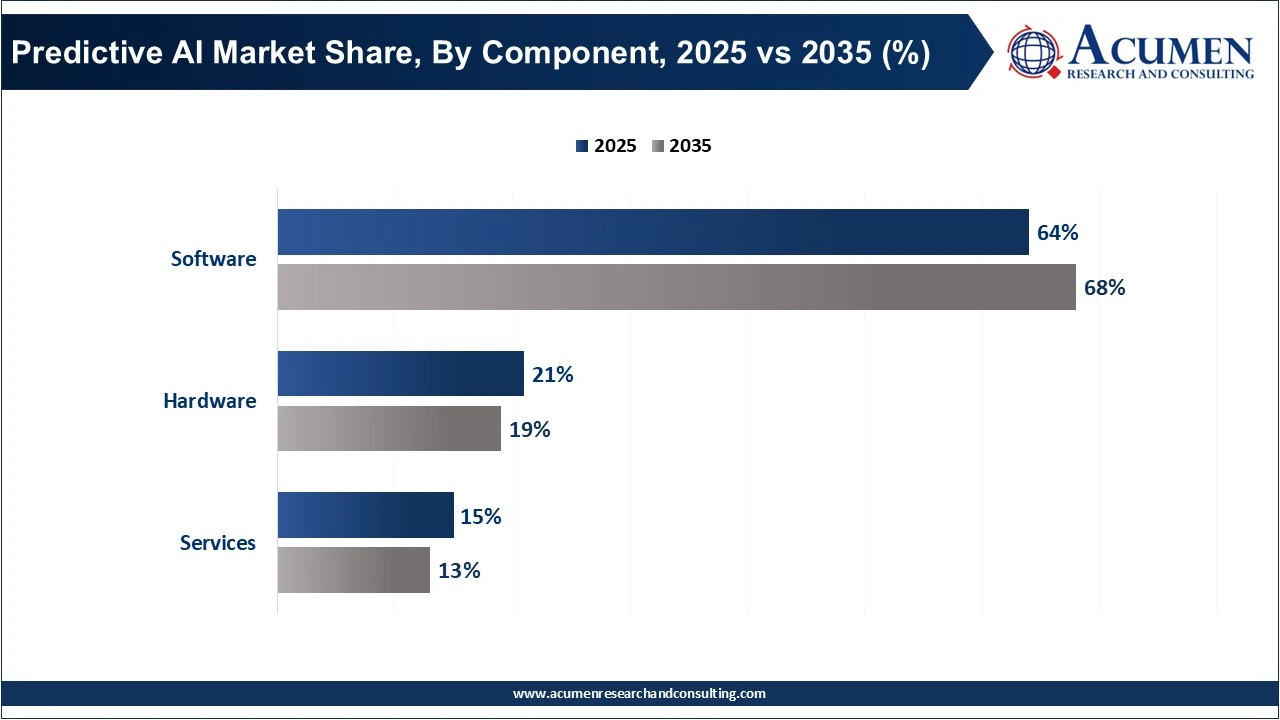
Hardware segment garnered 21% market share in 2025, being the second largest segment in this domain. Predictive AI workloads require powerful computational infrastructure which includes the GPUs, CPUs, edge processors and AI accelerators to assist model training and inferences. The growing complexity of predictive models demands high performance hardware solutions.
The manufacturing sector, autonomous system solutions and industrial automation domain relies heavily on the edge AI hardware for real-time execution of predictive models. Healthcare imaging and financial trading also depend on hardware-accelerated predictive solutions.
Technology Insights
Machine learning captured the largest market share of 42% in 2025 as the backbone of predictive AI. ML continues to be the most critical part of predictive AI systems owing to its capabilities to analyze large historical data, identify complex patterns and produce future probability outcomes. Given its flexibility in analyzing structured data systems, ML has been highly commercialized. Banking, financial services and insurance (BFSI) organizations are utilizing ML for predicting credit risks, detection of fraud, portfolio predictions etc.
Retail sectors are implementing ML for demand predictions and personalization of products and services. Similarly, manufacturing industries are using ML for predictive maintenance, optimizing production and efficiency. Higher maturity of ML models and low implementation complexity as compared to advanced neural systems will help maintain its leading position in the market.
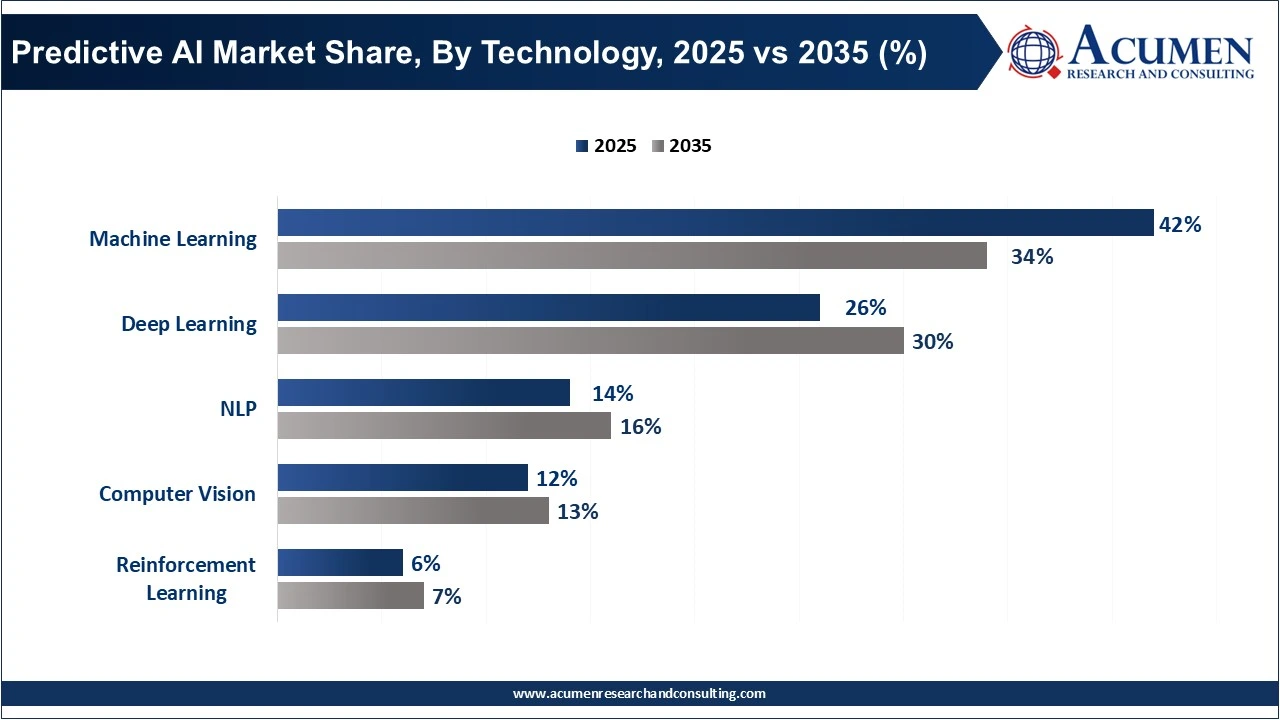
Deep learning held the second largest market share of 26% in 2025 and it is predicted to reach a share of 30% by 2035, indicating significant potential for growth in the long term. Deep learning is becoming crucial for predictive applications involving unstructured data like images, voice, video and behavior data. Medical care organizations have started utilizing deep learning for disease progression predictions and imaging analytics. Autonomous vehicles make use of this technology for predicting the movement behavior of an object. The escalating volume of unstructured enterprise data will be the most significant factor contributing to rapid growth.
Deployment Insights
The largest share of the market was the cloud-based deployment segment holding 56% of the market share in 2025, and will continue to rise over time to hold 60% by 2035 while growing at a CAGR of 22.5% during the forecast period. Increased enterprise demand for scalable compute infrastructure, quicker deployment of AI models, readily accessible centralized data, and reduced capex will continue to favor cloud deployment over the long term. Predictive AI models, being heavy on consistent data ingestion, re-training and scaled inferences, are ideal for deployment on cloud infrastructure owing to the elasticity that is required for these types of workloads.
The rapid adoption of cloud deployment will continue, particularly for industries characterized by large and growing volumes of data such as retail, banking, telecom, and healthcare. Predictive AI requires constant analysis of historical and real-time data, and cloud platforms help integrate this capability and enable better forecasts. Retailers will utilize cloud-based predictive AI to estimate and forecast demand across geographical regions, whereas BFSI entities can benefit from real-time fraud scoring and risk analytics.
Predictive AI Market Share, By Deployment, 2025 VS 2035 (%)
| Deployment | Revenue Share, 2025 (%) | Revenue Share, 2035 (%) |
|---|---|---|
| On-Premise | 28% | 18% |
| Cloud-Based | 56% | 60% |
| Hybrid | 16% | 22% |
The hybrid deployment segment is seen to experience highest CAGR of 25.9% for 2026-2035, making it the fastest growing deployment model for predictive AI systems. Organizations in certain sectors are becoming increasingly attracted to hybrid deployments, which combine on-premise systems for security and compliance with cloud infrastructure for scalability.
BFSI, government, defense, and healthcare sectors that deal with sensitive patient or national data will be the largest adopters of hybrid deployments for predictive AI, as certain aspects (such as compute) can be carried out on the cloud while most of the data continues to be on the on-premise infrastructure, avoiding compliance violations.
Enterprise Size Insights
Large enterprises constituted the largest part in terms of market share as they had accounted for 72% market share in 2025 and are expected to continue its supremacy throughout the forecast period. Large enterprises have increased financial capacity, internal AI resources and existing infrastructure which enables them to implement predictive AI at a much larger scale. These enterprises are able to utilize predictive AI services across more than one departments at once for areas such as demand forecasting, customer analytics, risk mitigation and fraud detection, process optimization etc.
Complex nature of the organization’s operations contributes to market leadership. The size of organization as large entities also possesses multi country operations and very complex supply chain operations, consequently any prediction mistake in such operations could result in huge loss and this is where predictive AI helps reduce uncertainties, increasing profitability and business agility.
Predictive AI Market Share, By Enterprise Size, 2025 VS 2035 (%)
| Enterprise Size | Revenue Share, 2025 (%) | Revenue Share, 2035 (%) |
|---|---|---|
| Large Enterprises | 72% | 62% |
| Small & Medium Enterprises (SMEs) | 28% | 38% |
Small and Medium Enterprises (SMEs) account for 28% of the market share in 2025, but are expected to witness increase to reach 38% by 2035, due to faster pace of adoption. Historically, organizations under SME segment faced hurdles in adoption of predictive AI owing to infrastructural and technical constraints. However, the burgeoning use of cloud-based AI technologies is changing this perspective.
Various affordable subscription-based AI models, no-code predictive analytics, API based forecasting services are making predictive AI affordable and accessible. Such small and medium enterprises utilize predictive AI for sales forecasting, customer churn prediction, pricing analysis, marketing performance etc.
Application Insights
The customer analytics application segment occupied the largest share of 22% in 2025, demonstrating the highest commercially developed application of predictive AI. Predictive models are applied across the board to define customer behavior and predicting buying intent and propensity and retention of customers.
The importance of customer analytics in the contemporary business models of a company is evident as global costs related to acquiring customers grow larger every year. Businesses utilize predictive AI to analyze the customer's buying behavior and purchasing tendencies and gain an understanding of the patterns before they fully emerge. Thus providing an edge in targeted advertisements.
Predictive AI Market Share, By Application, 2025 (%)
| Application | Revenue Share, 2025 (%) |
|---|---|
| Customer Analytics | 22% |
| Demand Forecasting | 18% |
| Risk Analytics | 16% |
| Fraud Detection | 12% |
| Predictive Maintenance | 14% |
| Supply Chain Optimization | 10% |
| Healthcare Prediction | 6% |
| Others | 2% |
Demand forecasting represented the second largest share of 18% in 2025. Demand forecasting remains one of the most important predictive AI application sectors as inventory management and balancing supply-demand greatly affect profitability of businesses.
Retail businesses have deployed predictive AI for forecasting demand patterns on the basis of seasonality, customer purchasing behavior, and market trends/ macro-economic conditions. Manufacturers have also applied this model to synchronize the supply of raw materials with their production process. Logistics businesses have adopted the model for optimizing their transportation load and delivery schedules. Following recent economic events and disruptions, volatility in the global supply chains has rapidly led to a rise in the adoption of predictive demand systems across the sectors.
End Use Industry Insights
BFSI segment held 24% market share in 2025 which makes it the largest end use industry in the predictive AI market. Financial institutions rely a lot on data intensive work, and also function in a risk-sensitive sector, which increases its dependence on predictive AI as an operational tool. Banks utilize predictive AI for modeling credit risk, detecting fraud, forecasting loan defaults, predicting customer lifetime value, while insurance companies apply it for predicting claims, optimizing underwriting, and fraud analytics.
Predictive AI Market Share, By End Use Industry, 2025 (%)
| End Use Industry | Revenue Share, 2025 (%) |
|---|---|
| BFSI | 24% |
| Healthcare | 12% |
| Retail | 13% |
| Manufacturing | 15% |
| IT & Telecom | 12% |
| Government | 8% |
| Energy | 6% |
| Transportation | 5% |
| Others | 3% |
Manufacturing segment held 15% market share in 2025. It stands as the second largest end use industry, with predictive AI transforming the manufacturing industry by enabling predictive maintenance, production forecasting, quality improvement, supply chain optimization and planning, and more. Companies utilize predictive models to study the working behavior of machinery and to forecast potential failures before they occur thereby reducing machine downtime and increasing productivity.
Predictive AI is used to optimally utilize labor, procurement of raw materials and energy consumed in a production process. The integration of predictive system in smart factories is through the IoT devices that enable constant tracking of machines and operation processes. Automotive manufacturing, industrial machinery manufacturing and semiconductor manufacturing are among the major users of this predictive AI.
Top Companies
- Microsoft Corporation
- Google LLC
- Amazon.com, Inc.
- IBM
- Oracle Corporation
- Salesforce, Inc.
- SAP SE
- SAS Institute
- DataRobot, Inc.
- Palantir Technologies
Recent News
- In June 2026, Researchers at Pennsylvanian School of Engineering and Applied Science developed an artificial intelligence-based model that improves antibiotic candidates. The model, ApexGO is built to analyze a set of molecules and suggest improvements to make more effective antibodies.
- In June 2026, AI firm, Cottonia announced that it has joined Matrix, a $BNB chain0based AI-led execution rollup. This partnership aims to advance blockchain intelligence with the integration of AI-driven predictive strategies into the chain network.
Market Segmentation
By Component
- Software
- Hardware
- Services
By Technology
- Machine Learning
- Deep Learning
- Natural Language Processing (NLP)
- Computer Vision
- Reinforcement Learning
By Deployment
- On-Premise
- Cloud-Based
- Hybrid
By Enterprise Size
- Large Enterprises
- Small & Medium Enterprises (SMEs)
By Application
- Customer Analytics
- Demand Forecasting
- Risk Analytics
- Fraud Detection
- Predictive Maintenance
- Supply Chain Optimization
- Healthcare Prediction
- Others
By End Use Industry
- BFSI
- Healthcare
- Retail
- Manufacturing
- IT & Telecom
- Government
- Energy
- Transportation
- Others
By Region
- North America
- Europe
- Asia-Pacific
- Latin America
- Middle East & Africa
Looking for discounts, bulk pricing, or custom solutions? Contact us today at sales@acumenresearchandconsulting.com
Frequently Asked Questions

Other ICT Reports
February 2023
December 2023
October 2022
September 2022