
Data Center Components Market Size, Share, Growth, Report 2026 To 2035
Data Center Components Market (By Components: IT Infrastructure, Power Infrastructure, Cooling Infrastructure, Racks & Enclosures, Monitoring & Management Systems, Physical Security & Safety, Other Components; By Data Center Type: Hyperscale Data Centers, Colocation Data Centers, Enterprise Data Centers, Edge Data Centers; By Data Center Size: Small Data Centers – Below 1 MW, Medium Data Centers – 1 MW to <10 MW, Large Data Centers – 10 MW to <50 MW, Mega/Hyperscale Facilities – 50 MW and Above; By Rack Density: Below 10 kW, 10–19 kW, 20–29 kW, 30–49 kW, 50–99 kW, 100 kW and Above; By End User: Hyperscale & Cloud Service Providers, Colocation Data Center Providers, Telecom Operators, Enterprises, Others) - Global Industry Analysis, Size, Share, Regional Analysis, Trends and Forecast 2026 - 2035
- Last Updated: 23 Sep 2026
- Report Code: ARC3986
- Category: ICT
Data Center Components Market Size, Forecast Report 2026 To 2035
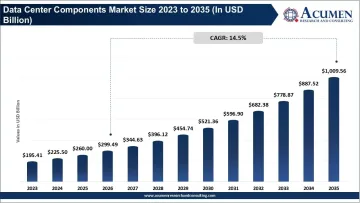
The global data center components market size was valued at USD 260 billion in 2025. The market is seen to reach at USD 1,009.56 billion by 2035; growing at a CAGR of 14.5% during the forecast period of 2026-2035. The rapid expansion of AI and cloud computing is accelerating demand for data center components as higher computing workloads require greater deployment of servers, networking equipment, power infrastructure, advanced cooling systems, high-density racks, and supporting physical infrastructure.
Report Highlights
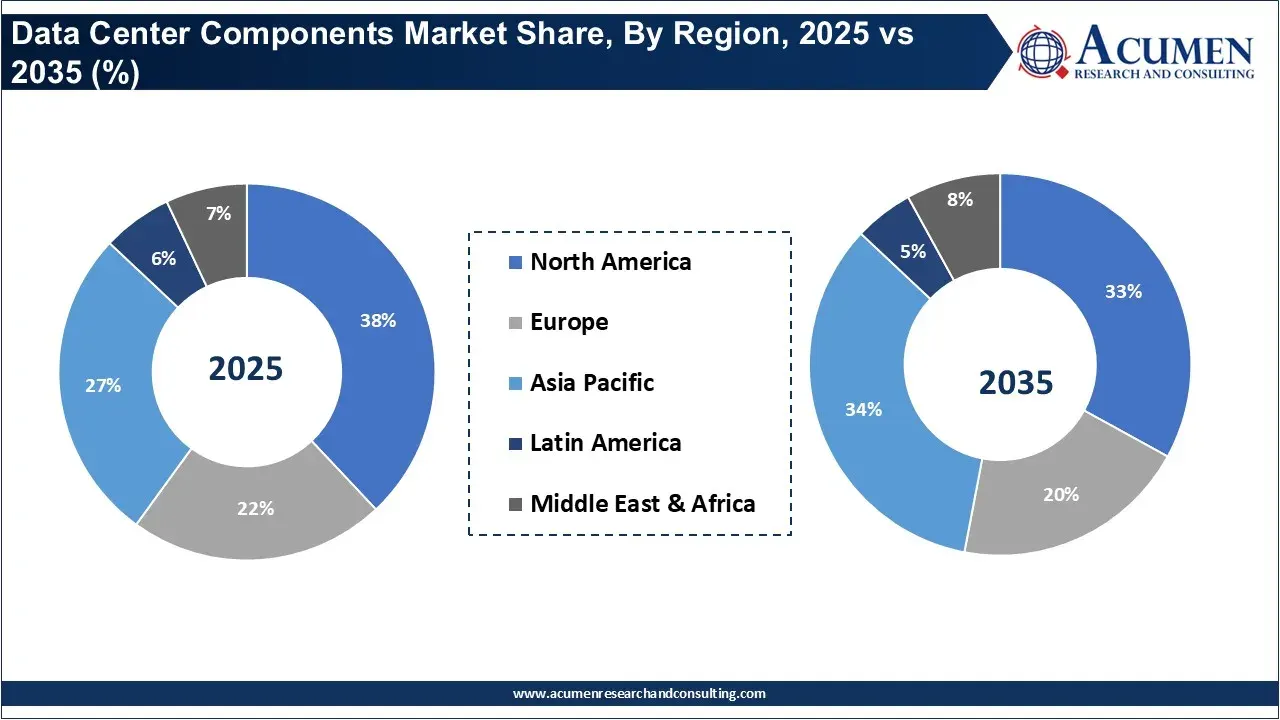
- By region, North America dominated the data center components market with a 38% share in 2025, supported by established hyperscale infrastructure, AI investment, advanced data center ecosystems, and strong demand for high-end servers, networking, power, cooling, and racks.
- By region, Asia-Pacific is expected to be the fastest-growing regional market at a 17.4% CAGR from 2026 to 2035, driven by accelerating cloud adoption, AI infrastructure investment, digitalization, and expanding data center capacity.
- By components, IT infrastructure dominated the data center components market with a 52% share in 2025, supported by rising demand for servers, storage, networking equipment, AI workloads, cloud services, and high-performance computing.
- By components, power infrastructure accounted for 14% of the market in 2025, driven by growing electricity requirements, backup power needs, power distribution, and electrical protection across increasingly energy-intensive data centers.
- By data center type, hyperscale data centers dominated the market with a 40% share in 2025, supported by expanding cloud platforms, AI workloads, large-scale storage requirements, and increasing demand for high-capacity computing and networking infrastructure.
- By data center type, enterprise data centers accounted for 27% of the market in 2025, although their share is expected to decline as enterprises increasingly adopt cloud, colocation, and managed infrastructure models.
- By data center size, large data centers of 10 MW to <50 MW dominated with a 35% share in 2025, supported by demand from large enterprise workloads, cloud and colocation deployments, and expanding digital services.
- By data center size, mega/hyperscale facilities of 50 MW and above represented the second-largest segment with a 28% share in 2025, driven by extensive computing requirements, high-density racks, advanced cooling, large electrical systems, and high-speed networking.
- By rack density, 10–19 kW racks dominated with a 28% share in 2025, reflecting their suitability for enterprise, cloud, colocation, and networking applications that require higher computing density without the extreme power and cooling requirements of AI and HPC environments.
- By rack density, 20–29 kW racks accounted for 22% of the market in 2025, supported by increasing computing power per rack and the need to expand processing capacity without proportionally increasing data center floor space.
- By end user, hyperscale and cloud service providers dominated with a 36% share in 2025, driven by continued investment in cloud infrastructure, AI computing, digital services, storage, networking, power, cooling, and high-density data center environments.
- By end user, colocation data center providers held the second-largest share at 24% in 2025, supported by continued infrastructure investments in power, cooling, racks, connectivity, security, and monitoring to accommodate multiple customers.
- By end user, enterprises accounted for 21% of the market in 2025, supported by ongoing requirements for business-critical computing, data management, cybersecurity, compliance, and operational continuity despite increasing adoption of cloud and colocation infrastructure.
Data Center Components Market Structure Across IT, Power, Cooling, and Physical Infrastructure
Data center components market is categorized into four major groups all interconnected with each other such as IT infrastructure, power infrastructure, cooling infrastructure, and physical infrastructure. IT infrastructure is the core part of all these components and includes servers, storage equipment, networking hardware, and associated hardware. Power infrastructure includes switchgear, transformers, power distribution units, UPSs, generators, and other equipment used to provide power.
Cooling infrastructure includes pumps, heat exchangers, chiller and cooling towers, free-cooling systems, liquid-cooling systems, and related components used to minimize the tendency of IT equipment to generate heat; physical infrastructure includes racks, enclosures, optical fiber, cabling, security, monitoring, and power management, and other physical components.
Data Center Components Market Investment Landscape
- Approximately $3 trillion of investment could be required through 2030 to add nearly 100 GW of global data center capacity, including infrastructure and technology spending.
- Global data center spending is anticipated to reach approximately $582 billion in 2026, with power and cooling equipment, storage hardware, and networking expected to represent about one-third of spending excluding chips.
- Nearly 100 GW of additional data center capacity is expected to come online between 2026 and 2030, potentially doubling global capacity over the period.
- Global data center electricity consumption is projected to reach 565 TWh in 2026, compared with 447 TWh in 2025, representing a 26% year-over-year increase.
- Global data center power demand is forecast to reach 132 GW in 2026, up from 104 GW in 2025, with demand projected to reach 290 GW by 2030.
- AI-optimized servers are expected to consume 175 TWh in 2026, compared with 95 TWh in 2025, representing approximately 84% year-over-year growth.
- Next-generation AI racks can reach approximately 370 kW in 2026, compared with less than 10 kW for many traditional data center racks, increasing requirements for high-capacity power distribution and liquid cooling.
- GenAI networking equipment spending is projected to increase from approximately $8 billion in 2023 to $34 billion in 2028, reflecting rising demand for high-speed connectivity within AI clusters.
How Is AI Changing Data Center Component Requirements? Know from Our Experts:
According to our experts at Acumen Research & Consulting, AI is transforming data center component requirements from conventional capacity-oriented infrastructure toward high-density, power-intensive, thermally optimized architectures. AI workloads require substantially greater computing capacity per rack, which increases demand not only for GPUs and AI servers but also for high-speed networking, advanced power distribution, liquid cooling, high-capacity storage, and specialized rack infrastructure.
| AI-driven Requirement | Recent Statistic | Implication for Data Center Components |
|---|---|---|
| Global data center electricity consumption | 565 TWh in 2026 | Increases demand for power distribution, UPS, generators and energy-management systems |
| Growth in electricity consumption | 26% YoY in 2026 | Accelerates investment in electrical infrastructure |
| Global data center power demand | 132 GW in 2026 | Creates greater requirements for transformers, switchgear and power distribution |
| AI-optimized server consumption | 175 TWh in 2026 | Increases demand for AI servers, accelerators and supporting infrastructure |
| AI server power growth | 84.2% YoY in 2026 | Drives rapid expansion of high-capacity power and cooling systems |
| AI share of data center power | 31% in 2026 | Makes AI infrastructure a major driver of component requirements |
Data Center Components Market Driver & Future Outlook
Market Drivers
- AI and generative AI adoption: The rapid deployment of AI training and inference workloads is increasing demand for GPU-based servers, high-speed networking, high-capacity storage and infrastructure capable of supporting substantially higher rack power densities.
- Expansion of hyperscale infrastructure: Cloud providers and large technology companies continue to expand data center capacity to support cloud services, AI platforms and digital applications, creating large-volume requirements for IT, power, cooling and physical infrastructure.
Future Outlook
- AI will increasingly determine infrastructure specifications: Future data centers are expected to be designed around AI workloads rather than simply adapting conventional infrastructure, increasing the importance of high-density racks, advanced cooling and high-capacity electrical systems.
- Power infrastructure will become a strategic component category: As electricity availability becomes a constraint on data center expansion, transformers, switchgear, UPS systems, power distribution and on-site generation are expected to receive greater investment.
How Are Supply Constraints Affecting Data Center Component Procurement?
Supply constraints are affecting procurement of data center components by adding to lead times, raising prices and requiring developers to buy critical components and equipment earlier in the development cycle. Transformers are a bottleneck of special concern as large single-phase units can have lead times of a year or more and shortages of electrical steel and other specialty materials limit production.
Meanwhile, AI accelerator and high-bandwidth memory availability continues to be strained as more manufacturers shift capacity to AI-related components. This is prompting a shift by data centre operators and hyperscalers toward a broader array of suppliers, sourcing several years in advance, securing long-term procurement arrangements, and evaluating regional manufacturing capacity.
Regional Insights
North America: Established Data Center Leadership Supported by Hyperscale Investment and High-Value Infrastructure Deployment
North America accounted for 38% of the data center components market in 2025, making it the largest regional market. The region is projected to record a CAGR of 12.7% from 2026 to 2035. The services and equipment used are enabled by hyperscale cloud densification, hyperscale cloud infrastructure, digital-platforms-at-scale, enterprise data-center solutions, and advanced data-center ecosystems.
Within North America, operators have been expanding investments in high-density infrastructure as they seek to scale infrastructure for AI and accelerated computing workloads, which is fueling demand for high end servers, networking gear, power infrastructure, cooling and racks, and monitoring.
The regional contribution will slow from 38% in 2025 to 33% in 2035, even as its absolute opportunity is still growing, although the share is estimated to decline as other regions, especially fast-growing regions, take a larger share of the world demand.
United States: Hyperscale Expansion and AI Infrastructure Reinforce Regional Component Demand
- The United States represents the principal country-level market within North America, supported by extensive cloud infrastructure, hyperscale data center development, enterprise digitalization, and increasing investment in AI computing capacity.
- The country's mature data center ecosystem creates demand across IT infrastructure, power systems, advanced cooling, racks, networking, monitoring, and physical security. The increasing deployment of AI accelerators and high-performance computing also raises requirements for higher-density racks and advanced thermal-management technologies.
Asia-Pacific: Fastest Regional Expansion as Cloud Adoption, AI Infrastructure, and Digitalization Accelerate Data Center Build-Out
Asia-Pacific made up 27% of the market in 2025 and is expected to grow to 34% by 2035, the market's biggest regional share increase in the provided forecast. The region had a market is expected to grow at a CAGR of 17.4% from 2026 to 2035.
Demand for data center components will grow as a result of this rapid digitalization, growing use of cloud services, increasing internet demand, investment in AI infrastructure, and new data center capacity deployment within leading tech markets. As Asia-Pacific's share of demand increases, the region will further cement its material role as a structural driver of the global data center ecosystem, with the region poised to contribute an increasing share of component demand out to 2035.
Power efficiency, high-density computing, cooling, networking equipment, and scalable data center facility architectures are set to continue to be critical as operators deploy new capacity, although legacy facilities will play a role.
India: Rapid Digitalization and Cloud Infrastructure Expansion Create New Component Opportunities
- India is another important country-level growth market within Asia-Pacific, driven by expanding digital services, cloud adoption, enterprise modernization, telecommunications infrastructure, and increasing demand for data processing capacity. Data center development is creating demand for servers, storage, networking equipment, power infrastructure, cooling systems, racks, and monitoring solutions.
- The country's growing digital ecosystem and increasing requirement for localized computing capacity also support continued investment in data center facilities. As new facilities are developed to serve cloud, enterprise, financial services, telecommunications, and AI-related workloads, India is positioned as an increasingly relevant demand center within the broader Asia-Pacific data center components landscape.
What Government Policies Are Shaping Data Center Infrastructure Investment?
| Region / Country | Policy / Initiative | Implications for Data Center Components & Infrastructure |
|---|---|---|
| United States | Executive Order on Accelerating Federal Permitting of Data Center Infrastructure, July 2025 | Supports faster deployment of power infrastructure, transmission equipment, cooling systems, racks and other components required for AI-oriented facilities. |
| European Union | Cloud and AI Development Act proposal, June 2026 | Creates demand for energy-efficient servers, cooling systems, power-management equipment and infrastructure designed around EU sustainability requirements. |
| Singapore | Digital Infrastructure Bill consultation, September 2026 | Encourages investment in efficient cooling, power systems, monitoring, resilience and other infrastructure components that support higher efficiency standards. |
| India | Uttar Pradesh Data Center Policy and 2026 policy framework | Supports demand for servers, power distribution, UPS, cooling, racks, networking and other components as new facilities and data center parks are developed. |
Data Center Components Market Segmental Insights
Components Insights
IT Infrastructure Maintains Market Leadership as Core Computing and Networking Requirements Expand
IT Infrastructure accounted for the biggest share of the data center components market in 2025, at 52%, rising to 55% of total in 2035. This success of this segments is indicative of the heavy reliance on servers, storage devices, networking equipment and related computer equipment to underpin the significant growth in workloads supported by data centers.
With the growing adoption of artificial intelligence, machine learning, cloud services, virtualization, high-performance computing, and data analytics within enterprise and cloud data centers, spending on computing and networking hardware remains a significant percentage of total data center component spending.
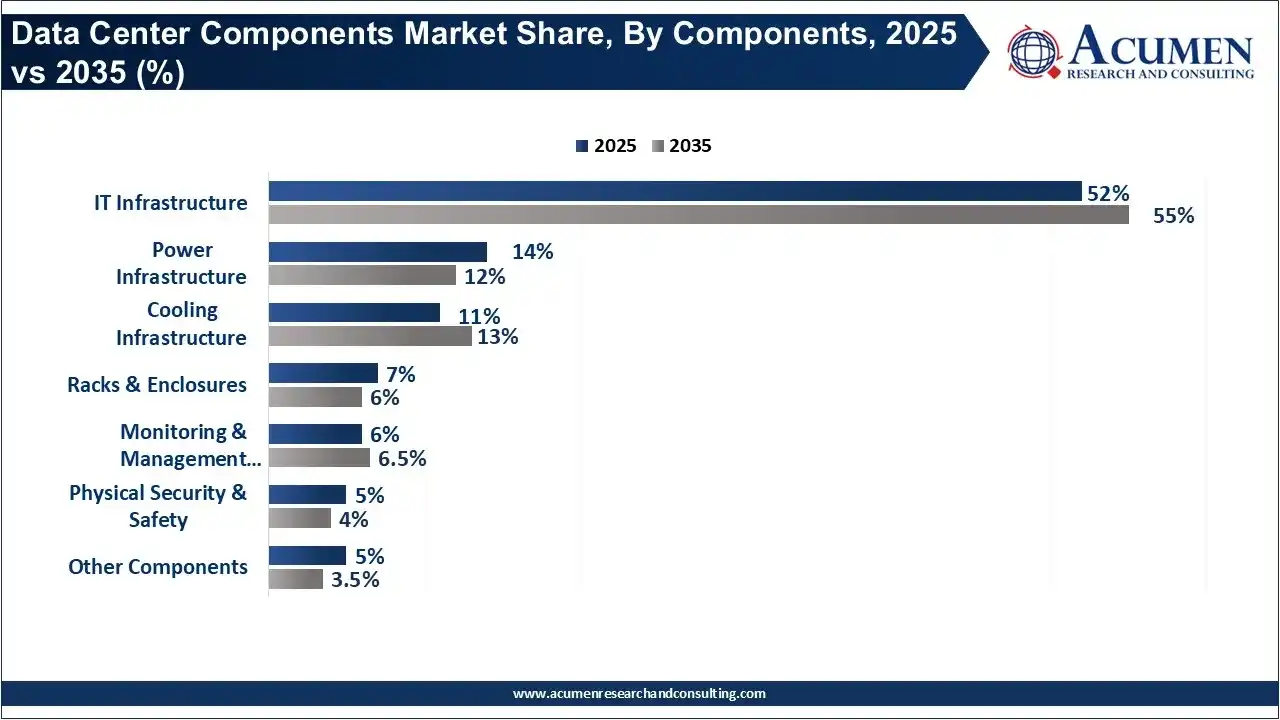
Power infrastructure accounted for 14% of the market in 2025. Power infrastructure is and will continue to be a vital part of data center buildouts as reliable, high-quality electricity is the basis of reliable computing. Power infrastructure in the data center comprises equipment associated with power distribution, backup power, electrical protection, and data center electrical infrastructure management. The use of AI and high performance computing increases electricity consumption per data center.
Data Center Type Insights
Hyperscale Data Centers Lead as Cloud, AI, and Large-Scale Digital Workloads Drive Facility Expansion
Hyperscale data centers comprised 40% of the total market in 2025 and they will be the largest segment of all data center types with their share rising substantially through 2035 to 48%. The growth in hyperscale data centers is driven by cloud computing expansion, increased usage of AI workload, hyperscale digital platforms, dedicated capacities in storage, and high volumes of online services. To host these aspects, hyperscale data centers consume large amounts of servers, network and power equipment, racks and containers, cooling, and software and monitoring.
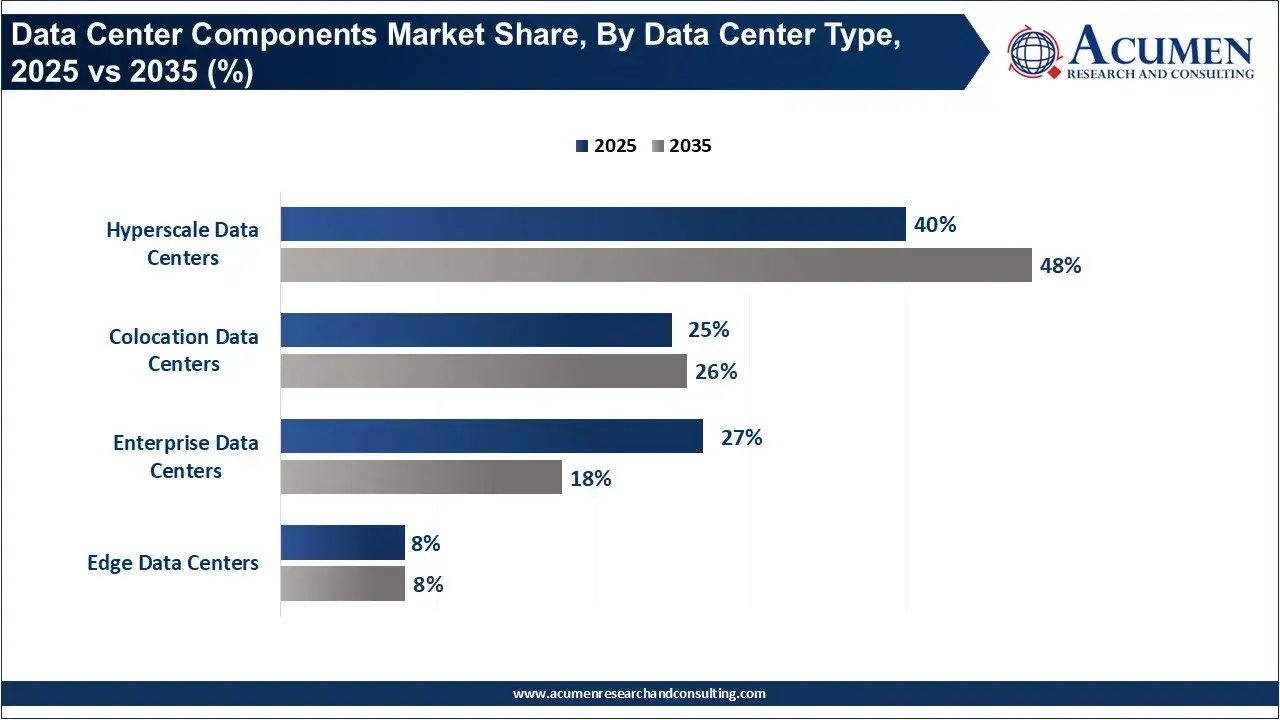
Enterprise Data Centers represented 27% of the market in 2025 but are projected to decline to 18% by 2035. Despite the decline in relative share, enterprise facilities continue to support organizations requiring dedicated computing environments for applications involving data security, regulatory requirements, operational continuity, and specialized workloads. However, increasing adoption of cloud computing, colocation, and managed infrastructure is changing how enterprises deploy computing capacity.
Data Center Size Insights
Large Data Centers Represent the Largest Facility-Size Segment
Large data centers (10 MW to <50 MW) represented 35% of the market in 2025, which made this the largest data center size group. Large data centers are an important size segment between smaller enterprise focused data centers and very large hyperscale campuses, combining high levels of computing power with more flexible deployment options.
Their market positioning on this front may be a reflection of demands for large enterprise workloads, support for cloud and colocation work, and an expanding digital services industry. Large facilities also bring significant investments in power equipment, cooling, racks, monitoring platforms and physical security.
Data Center Components Market Share, By Data Center Size, 2025 (%)
| By Data Center Size | Revenue Share, 2025 (%) |
|---|---|
| Small Data Centers — Below 1 MW | 12% |
| Medium Data Centers — 1 MW to <10 MW | 25% |
| Large Data Centers — 10 MW to <50 MW | 35% |
| Mega/Hyperscale Facilities — 50 MW and Above | 28% |
Mega/hyperscale facilities with capacity of 50 MW and above accounted for 28% of the market in 2025, making them the second-largest facility-size category. These facilities are particularly relevant to hyperscale cloud providers and large technology companies that require extensive computing capacity. Their infrastructure requirements are significantly broader because large campuses can contain substantial numbers of high-density racks, large electrical systems, advanced cooling infrastructure, and extensive networking environments.
Rack Density Insights
10–19 kW Racks Lead as Data Centers Transition Toward Higher-Density Infrastructure
In 2025, racks with a density of 10-19 kW comprised 28% of the market and will be the most popular rack density. This is a reflection of the growing use of computing equipment where power and cooling requirements are greater than standard low-density solutions, but not approaching the super-high densities used in high-performance computing (HPC) or the extremes of AI computing. The 10-19 kW range is a flexible solution for many enterprise, cloud, colocation and networking applications.
Data Center Components Market Share, By Rack Density, 2025 (%)
| By Rack Density | Revenue Share, 2025 (%) |
|---|---|
| Below 10 kW | 18% |
| 10–19 kW | 28% |
| 20–29 kW | 22% |
| 30–49 kW | 17% |
| 50–99 kW | 10% |
| 100 kW and Above | 5% |
The 20-29 kW category was 22% of the market in 2025. The strong share of the 20-29 kW range is due to the ongoing upward trend in computing power and higher rack density; larger computing systems and dense equipment configurations help users increase computing power without adding more data center space. Higher rack density enables operators to increase computing density in a rack without taking up additional floor space, but leads to elevated cooling and electrical requirements.
End User Insights
Hyperscale and Cloud Service Providers Represent the Largest Customer Group
Hyperscale & cloud service providers constituted the largest end-user segment in the data center components market 2025 at 36%. The strong end-user position of hyperscale and cloud providers reflects ongoing investment in cloud infrastructure, AI computing, digital services, storage capacity and total scale, as well as large deployments of networking components.
These end users demand large quantities of IT hardware, power, cooling, rack, monitoring and security components, meaning cloud platform operators are another key driver of component demand along the data center supply chain.
Data Center Components Market Share, By End User, 2025 (%)
| By End User | Revenue Share, 2025 (%) |
|---|---|
| Hyperscale & Cloud Service Providers | 36% |
| Colocation Data Center Providers | 24% |
| Telecom Operators | 9% |
| Enterprises | 21% |
| Government & Public Sector | 5% |
| Research & Academic Institutions | 3% |
| Others | 2% |
Colocation data center providers accounted for 24% of the market in 2025, making them the second-largest end-user category. Colocation operators continuously invest in facility infrastructure to accommodate multiple customers and support varying equipment requirements. Their demand spans power systems, cooling, racks, connectivity infrastructure, security, and monitoring solutions.
Enterprises represented another significant 21% of the market. Enterprise customers continue to require data center infrastructure for applications involving business-critical systems, data management, cybersecurity, compliance, and operational continuity. However, the increasing use of cloud and colocation infrastructure is reshaping enterprise procurement strategies and encouraging a combination of on-premises and external infrastructure.
Key Companies
North America
- NVIDIA
- Vertiv
- Eaton
- Dell Technologies
- Hewlett Packard Enterprise
- Supermicro
- Cisco Systems
- Arista Networks
- Broadcom
- Coherent
Europe
- Schneider Electric
- Siemens
- ABB
- Legrand
- STULZ
- Nokia
Asia Pacific
- Huawei Technologies
- Lenovo
- Fujitsu
- NEC Corporation
- Mitsubishi Electric
- Delta Electronics
- NTT Data
- Samsung Electronics
Product Launches, Partnerships and Expansion Strategies
- March 2026: NVIDIA introduced its Vera Rubin DSX AI Factory reference design, with Vertiv contributing simulation-ready power and cooling infrastructure models, validated interfaces and repeatable infrastructure building blocks. The collaboration is designed to integrate power, cooling and digital-twin simulation into AI factory deployment and reduce infrastructure integration complexity.
- March 2026: Eaton unveiled the Eaton Beam Rubin DSX platform in collaboration with NVIDIA, integrating power and cooling infrastructure into NVIDIA's Vera Rubin DSX AI Factory reference design and Omniverse DSX Blueprint. The platform is intended to support modular AI data center deployment while addressing power availability and accelerating grid-to-chip infrastructure buildout.
Segments Covered
By Components
- IT Infrastructure
- Power Infrastructure
- Cooling Infrastructure
- Racks & Enclosures
- Monitoring & Management Systems
- Physical Security & Safety
- Other Components
By Data Center Type
- Hyperscale Data Centers
- Colocation Data Centers
- Enterprise Data Centers
- Edge Data Centers
By Data Center Size
- Small Data Centers – Below 1 MW
- Medium Data Centers – 1 MW to <10 MW
- Large Data Centers – 10 MW to <50 MW
- Mega/Hyperscale Facilities – 50 MW and Above
By Rack Density
- Below 10 kW
- 10–19 kW
- 20–29 kW
- 30–49 kW
- 50–99 kW
- 100 kW and Above
By End User
- Hyperscale & Cloud Service Providers
- Colocation Data Center Providers
- Telecom Operators
- Enterprises
- Government & Public Sector
- Research & Academic Institutions
- Others
By Region
- North America
- Europe
- Asia-Pacific
- Latin America
- Middle East & Africa
Looking for discounts, bulk pricing, or custom solutions? Contact us today at sales@acumenresearchandconsulting.com
Frequently Asked Questions

Other ICT Reports
March 2023
November 2023
December 2024
January 2021