
Data Analytics Market Size, Share, Trends and Forecast 2026 to 2035
Data Analytics Market (By Analytics Type: Descriptive Analytics, Diagnostic Analytics, Predictive Analytics, Prescriptive Analytics; By Component: Software/Solution, Services; By Deployment: On-Premise, Cloud, Hybrid; By Enterprise Size: Large Enterprises, Small & Medium Enterprises (SMEs); By Industry Vertical: BFSI, IT & Telecom, Healthcare & Life Sciences, Retail & E-commerce, Manufacturing, Government & Public Sector, Energy & Utilities, Others) - Global Industry Analysis, Size, Share, Regional Analysis, Trends and Forecast 2026 - 2035
- Last Updated: 08 Oct 2026
- Report Code: ARC3094
- Category: ICT
Data Analytics Market Size and Growth
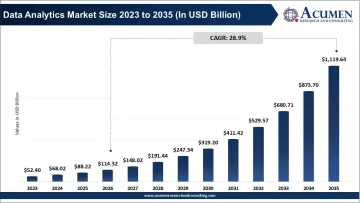
The global data analytics market size was valued at USD 88.22 billion in 2025. The market is expected to reach at USD 1,119.64 billion by 2035, while growing at a CAGR of 28.9% during the forecast period 2026 to 2035; highlighting the accelerating flow of capital toward technologies that depend heavily on high-quality data and advanced analytics.
- Current Value: USD 114.32 billion in 2026
- Forecast Value: USD 1,119.64 billion in 2035
- Growth Rate: 28.9%
- Regional Leaders: North America (33.4% share in 2025)
Report Highlights
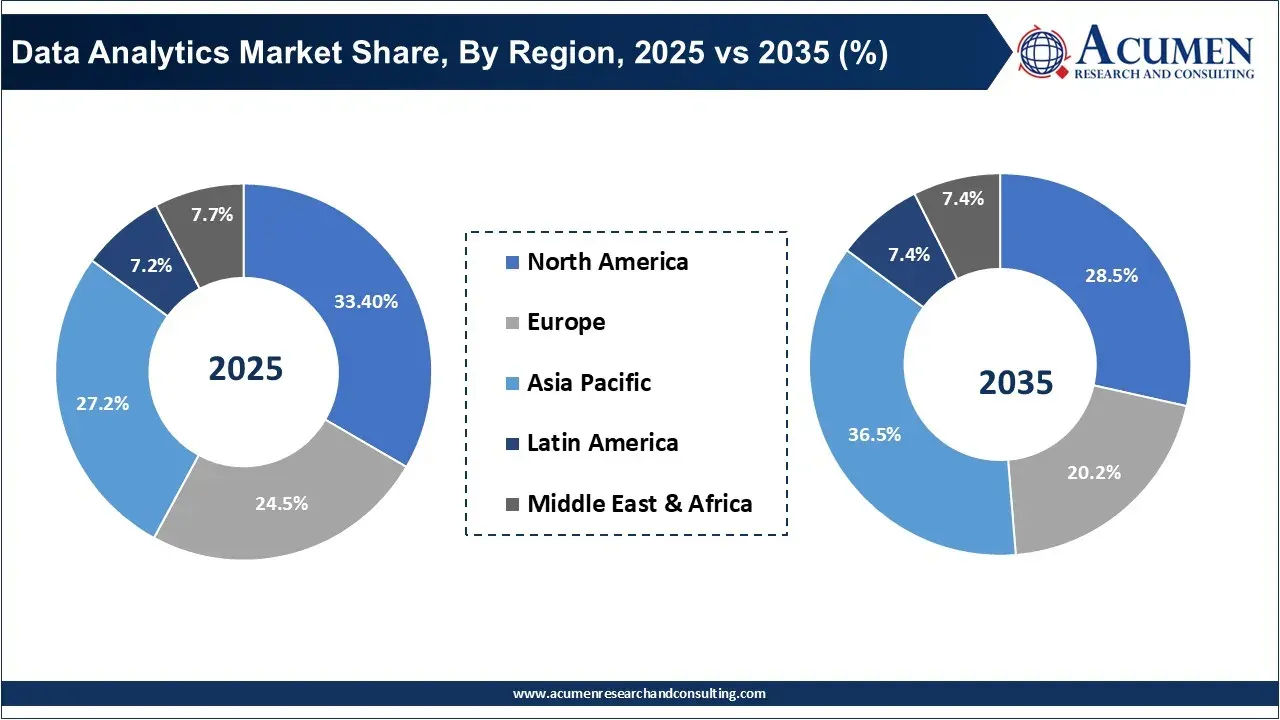
- By region, North America dominated the data analytics market with a 33.4% share in 2025, supported by its mature enterprise technology infrastructure, concentration of technology providers, cloud adoption, and early deployment of AI and advanced analytics.
- By region, Asia-Pacific is projected to be the fastest-growing regional market, with its share increasing from 27.2% in 2025 to 36.5% by 2035, driven by rapid digital transformation, expanding enterprise data volumes, cloud adoption, AI investments, and growing analytics adoption across emerging economies.
- By analytics type, predictive analytics dominated the market in 2025 with a 34% share, driven by increasing enterprise demand for forecasting, risk prediction, customer behavior analysis, and data-driven decision-making.
- By analytics type, prescriptive analytics is projected to record the largest share gain, increasing from 18% in 2025 to 24% by 2035, supported by growing adoption of optimization, AI-based recommendations, and automated decision-making.
- By component, software and solutions dominated the market in 2025 with a 68% share, supported by the growing adoption of integrated analytics platforms, self-service analytics, data visualization, and AI-enabled analytical capabilities.
- By component, services accounted for 32% of the market in 2025, supported by rising demand for analytics implementation, data integration, consulting, cloud migration, managed analytics, and specialized technical expertise.
- By deployment, on-premise accounted for the largest share of 64% in 2025, primarily due to the continued preference of enterprises handling sensitive and regulated data for greater control over their infrastructure and analytics environments.
- By deployment, hybrid is projected to be the fastest-growing segment with a 37.8% CAGR from 2026 to 2035, driven by enterprises seeking to combine on-premise data control with the scalability and flexibility of cloud analytics.
- By enterprise size, large enterprises dominated the market with a 68% share in 2025, owing to their larger data volumes, greater technology investments, dedicated analytics teams, and wider range of enterprise analytics applications.
- By enterprise size, SMEs are projected to increase their share from 32% in 2025 to 39% by 2035, supported by the growing accessibility of cloud analytics, SaaS platforms, self-service BI, low-code/no-code tools, and AI-assisted analytics.
- By industry vertical, BFSI dominated the market with a 21% share in 2025, driven by extensive analytics requirements for fraud detection, risk management, credit scoring, regulatory compliance, customer intelligence, and financial decision-making.
- By industry vertical, IT and telecom represented the second-largest segment with a 17% share in 2025, supported by extensive use of analytics for customer churn prediction, network optimization, demand forecasting, service quality management, and operational efficiency.
Data Analytics Market Ecosystem
The ecosystem of the data analytics market spans a wide range of players; technology providers, data infrastructure companies, cloud platforms, analytics software vendors, consulting and systems-integration companies, managed service providers (MSPs), data engineering firms, AI/ML professionals, and end users. At the base are data sources and their infrastructure-they are responsible for the generation, capture, storage, processing, and governance of structured and unstructured data on enterprise, government, Internet of Things (IoT), financial, healthcare, retail, industrial, and digital platforms.
On top of this, cloud providers and data-platform companies provide the computing, storage, data lakes/warehouses, integration, and processing infrastructure and services. On this layer, analytics software providers construct business intelligence (BI), visualization, predictive, and prescriptive models, as well as real-time and AI-powered applications for decision support.
Data Analytics Investment & Funding Landscape
- Global private investment in AI reached $344.7 billion in 2025, increasing 127.5% year over year and creating a major funding pool for AI-enabled analytics, data platforms, machine learning, and decision-intelligence technologies.
- Generative AI companies attracted $170.9 billion of global private investment in 2025, accounting for nearly half of total private AI investment and increasing more than 200% from 2024, strengthening funding for natural-language analytics and AI-assisted data interpretation.
- AI companies accounted for 61% of global venture capital investment in 2025, receiving $258.7 billion out of $427.1 billion in worldwide VC investment, demonstrating the growing concentration of venture funding around data- and AI-intensive technologies.
- AI-focused IT infrastructure and hosting companies attracted $109.3 billion in VC investment in 2025 alone, while cumulative investment in this category reached $256.1 billion between 2012 and 2025, supporting the infrastructure layer required for large-scale analytics and AI workloads.
- U.S.-based companies attracted approximately $194 billion, or 75%, of global AI VC deal value in 2025, compared with $15.8 billion for the EU27, $13.9 billion for China, and $13.8 billion for the U.K., illustrating the geographic concentration of private capital.
- U.S. investors represented about 56% of worldwide outgoing VC investment in AI in 2025 at $124 billion, followed by the U.K. at $20.7 billion, China at $17.2 billion, and EU27 investors at $14.5 billion.
- The average global AI private-investment event increased from $31.6 million in 2023 to $45.4 million in 2024, indicating increasing concentration of capital in larger technology and infrastructure companies.
Top Government Initiatives & Regulatory Framework to Support Data Analytics Industry
| Country/region | Government initiative / regulatory framework | Key highlights |
|---|---|---|
| European Union | Digital Europe Programme | €8.168 billion for 2021–2027, including €1.761 billion for AI and €2.020 billion for HPC |
| United States | National AI infrastructure policy | Executive Order issued in January 2025 |
| India | IndiaAI Mission | National mission supporting computing access, data quality, indigenous AI, talent, startups, and responsible AI |
| China | New Generation Artificial Intelligence Development Plan | National AI-development strategy |
| United Kingdom | UK AI Regulation Framework | Pro-innovation, risk-based regulatory approach |
| Singapore | Model AI Governance Framework / National AI initiatives | Government-led AI governance and adoption programs |
| Japan | AI Strategy and AI governance initiatives | Government-backed AI and digital-transformation programs |
Data Analytics Market Dynamics
Why Is AI-Powered Analytics Accelerating Enterprise Data Adoption?
The rapid integration of artificial intelligence, machine learning, generative AI, and natural-language interfaces into analytics platforms is emerging as a major growth driver for the data analytics market. Enterprises are moving beyond static dashboards toward systems capable of forecasting outcomes, identifying anomalies, generating insights, answering business questions in natural language, and recommending actions. This is expanding analytics adoption beyond specialist data teams and making analytical capabilities accessible to business users across finance, marketing, operations, supply chain, healthcare, and customer service.
Can Poor Data Quality and Governance Limit Data Analytics Adoption?
Reliable ROI from analytics investments continue to be undermined by issues such as the quality of data, scattered data sources, privacy needs, and poor governance practices. Many organizations have ample amounts of data but it's also inconsistent, outdated, incomplete, duplicative, or poorly defined, which can all lead to wrong results.
How Can Real-Time and Agentic Analytics Create New Growth Opportunities?
The transition from traditional batch-based analytics toward real-time, AI-assisted, and agentic analytics creates a significant opportunity for vendors to develop platforms that continuously interpret data and support or automate business decisions. Instead of requiring users to manually retrieve reports, next-generation analytics systems can monitor streaming data, detect changes, correlate events, generate insights, and trigger recommended actions.
For instance, data identifies agentic data streaming as an emerging capability for real-time intelligence and predicts that 40% of enterprises will leverage GraphRAG techniques by 2029 to improve the factual accuracy and reasoning capabilities of enterprise AI applications.
Regional Insights
How Did North America Dominate the Data Analytics Market in 2025?
North America was the top contributor with largest market share of 33.4% in data analytics market size in 2025 in the market landscape. Higher number of technology firms, developed enterprise IT infrastructure, higher adoption of the cloud and earlier introduction of artificial intelligence and machine learning solutions supported the leadership of the region in the market.
Enterprises across sectors such as financial services, telecom, retail, healthcare, manufacturing and technology has already started adopting higher level analytic solutions rather than initial descriptive and basic reporting to get their desired outcome.
The U.S. acts as the most dominant player in terms of market demand with sustained investments by enterprises across business intelligence, cloud, real time analytics, AI and big data solutions. Numerous enterprises across the U.S. have taken initiatives and also investing in developing analytical solutions to improve prediction models and support automated decision-making.
Major big tech companies including Cloud providers such as Microsoft, Google, AWS also has established well-built integrated technology ecosystem which also makes data analytics accessible for business.
Asia Pacific Data Analytics Market Outlook
Asia Pacific is anticipated to hold the fastest growth rate in all the regions, accounting more prominently to the world's data analytics demand in 2035 than in 2025. In fact, its share is projected to rise from 27.2% in 2025 to 36.5% by 2035 in what makes it one of the leading regions by the end of the projection period.
The region's upsurge is fueled by pervasive digital transformation across China, India, Japan, South Korea, Southeast Asia, and other emerging economies where organizations churn out exponentially growing amounts of transactional, customer, operational, machine generated, and Internet of Things data, thereby leading to higher demand for large data processing and analytical tools.
Regionally, Asia Pacific also shows substantial growth in adoption of AI, smart manufacturing, digital commerce, fintech, mobile computing, telecommunication, connected devices, and Industrial IoT, driven largely by increasing adoption across this sector. All these require highly advanced analytics like predictive and prescriptive capabilities.
India's digital economic expansion, China's vast technological landscape, Japan's competence with industrial automation and manufacturing, coupled with fast growing digital business ventures in Southeast Asia, bring more of continued long term demand.
Segmental Insights
Analytics Type Insights
In 2025, predictive analytics stood as the largest analytics-type segment within the market, representing 34% of the total market value. This dominance is a direct result of enterprises increasingly prioritizing an understanding of future potential over merely the analysis of past performance in order to inform and automate their future strategic and operational decisions.
Predominantly, predictive analytics leverage past and current data, with the support of mathematical, machine learning, and forecasting processes to discover patterns and establish likelihoods of future events, as these tools are being utilized across numerous business areas.
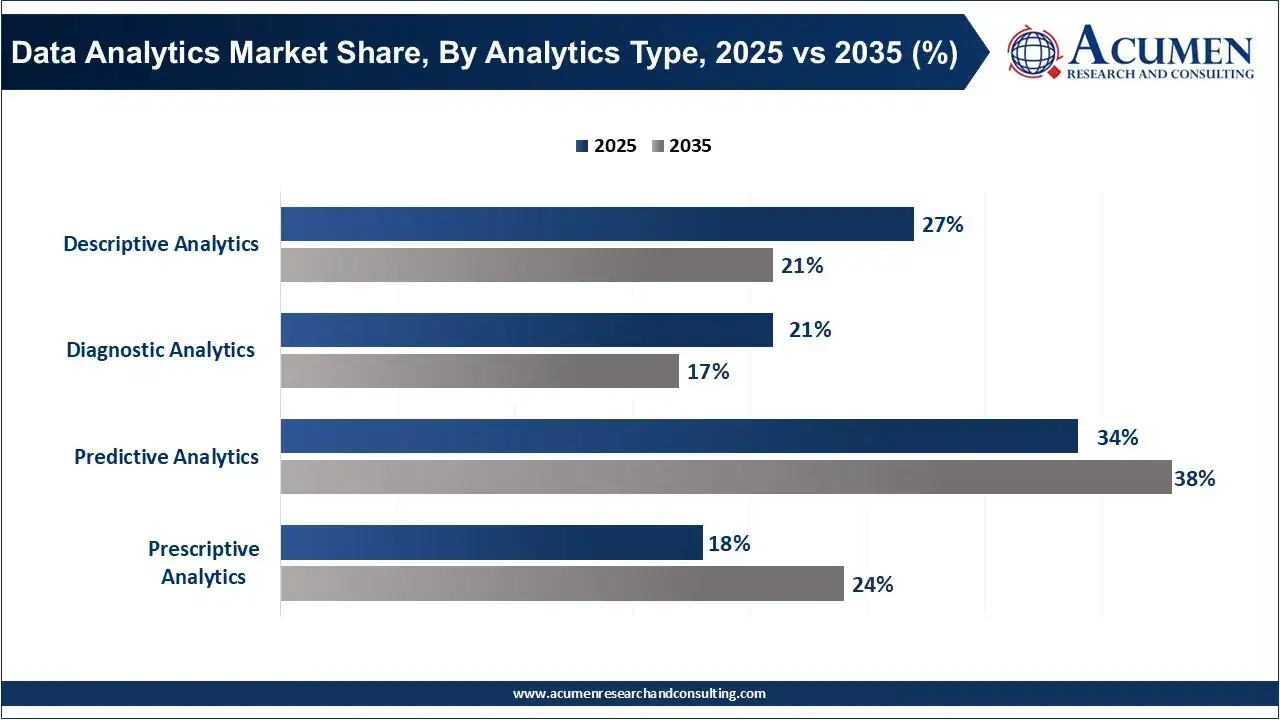
Prescriptive analytics is forecasted to represent the largest year-on-year gains, up by 6% points between 2025 to 24% by 2035. The prescriptive analytic offers a more robust analytics type than that of descriptive and predictive by incorporating predictions as well as optimization logic, rules-based systems, simulations and AI decision-making tools to suggest specific actions and ultimately guide businesses more towards automated/augmented decisions.
For an example, application for these includes optimizing inventory levels, inventory management systems, supply chain, pricing for various products, staff levels, product scheduling, resource management and in financial portfolio management and marketing campaign optimization.
Component Insights
The software and solutions segment dominated the market in 2025 with a share of 68% and is projected to grow the share up to 70% in 2035. Adoption of self-service analytics is also boosting demand for software. Contemporary analytics platforms enable business users to generate dashboards, execute queries, detect trends, and identify actionable insights on their own.
Data Analytics Market Share, By Component, 2025 & 2035 (%)
| Component | Revenue Share, 2025 (%) | Revenue Share, 2035 (%) |
|---|---|---|
| Software/Solution | 68% | 70% |
| Services | 32% | 30% |
Services accounted for 32.0% of the data analytics market in 2025, making them the second-largest component segment. Demand for analytics services is supported by the growing complexity of enterprise data environments and the shortage of specialized data engineering, data science, AI, and analytics professionals. Organizations increasingly require external expertise for data integration, analytics implementation, platform migration, model development, consulting, system integration, managed analytics, and ongoing maintenance.
Services are particularly important for enterprises that have adopted analytics platforms but lack the internal capabilities required to fully utilize them. Service providers help organizations connect fragmented data sources, establish data governance frameworks, migrate analytics workloads to cloud environments, develop customized predictive models, and integrate analytics into existing business applications.
Deployment Insights
On-premise deployment captured the largest share in 2025 due to the significant prevalence of on-premise analytics deployment, which accounted for 64.0%. Enterprises had been preferring their own infrastructure to ensure complete control over data, infrastructure, infrastructure and analytics environments.
The BFSI, government, healthcare, and other industrial sectors that have to manage extremely sensitive data have generally favored the use of their own (on-premise) IT infrastructure, with a focus on managing the storage and availability of data assets.
Some large enterprises that invest significantly on legacy IT have maintained the usage of on-premise analytics infrastructure and have been reluctant to replace the on-premise infrastructure due to significant cost, integration issues, and potential operational interference.
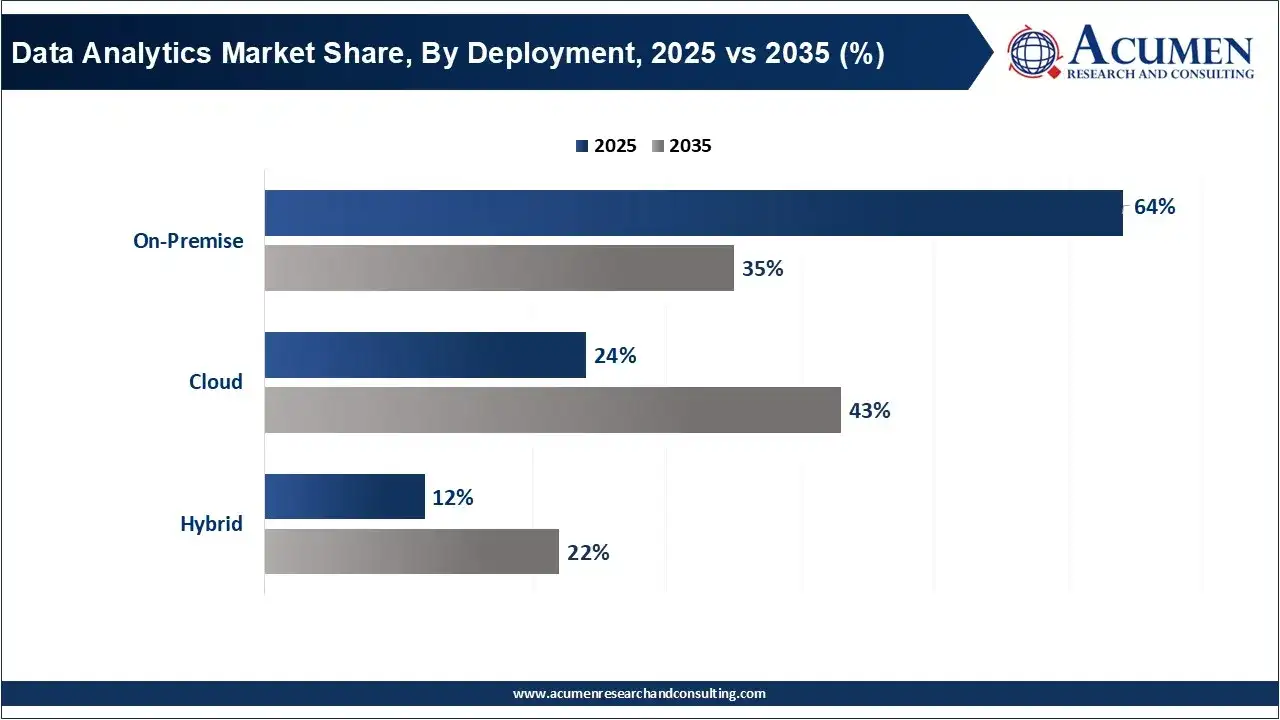
Hybrid deployment is estimated to be the fastest-growing deployment segment, with a CAGR of 37.8% during the forecast period 2026-2035 and growing from 12.0% in 2025 to 22.0% by 2035. Hybrid deployment offers both aspects of the control that enterprises usually seek with on-premise infrastructures and also offers scalability and flexibility features of the cloud services.
Therefore, it will become more suitable for the enterprises who are not able to shift there on-premise workloads to public cloud platforms and seeking cloud features such as analytics features through hybrid model.
Enterprise Size Insights
Large enterprises represent 68% of the data analytics market by 2025, making large organizations the leader among enterprise sizes. Their leadership is due in larger volumes of data, more complex technical infrastructure, deeper technological investments, full data teams, data and analyst operations, and a broader variety of use cases.
These firms work in many global markets and various functions as well as use many ERP systems, other general IT business functions, websites, apps and devices, supply chain processes and customer transactions to manage the disparate data needed for advanced analyses.
Data Analytics Market Share, By Enterprise Size, 2025 & 2035 (%)
| Enterprise Size | Revenue Share, 2025 (%) | Revenue Share, 2035 (%) |
|---|---|---|
| Large Enterprises | 68% | 61% |
| Small & Medium Enterprises (SMEs) | 32% | 39% |
SMEs are projected to increase their market share from 32.0% in 2025 to 39.0% by 2035. The increasing accessibility of analytics technologies is reducing many of the barriers that historically prevented smaller companies from adopting advanced analytics.
Cloud-based platforms, SaaS analytics, self-service business intelligence, low-code/no-code tools, embedded analytics, AI-assisted analysis, subscription pricing, and managed analytics services allow SMEs to access sophisticated capabilities without building large internal data teams.
Industry Vertical Insights
The BFSI industry vertical was the largest in 2025 by 21%. Financial institutions have traditionally been the most analytics intensive organizations since their business operations, with high volumes of structured data and transactional data, necessitate constant risk evaluations and regulatory compliances. Financial services providers have had one of the greatest stakes in data analytics for years, to enhance services and better manage risk.
IT and telecom industry represented 17% of the global market and was thus the second largest sector. Telecommunication providers use data Analytics to prevent churn and to analyze customer behavior and activity. A telecom service provider use real-time network data to analyze current congestion status in their network, predict impending future failure in their network and thus help network professionals in optimization of the network resources effectively and efficiently to deliver superior quality of service to their customers.
Competitive Landscape
- Microsoft: Microsoft competes through its Power BI analytics platform, Azure data services, Fabric, and AI capabilities, offering an integrated environment for enterprise data engineering, business intelligence, and advanced analytics.
- Google: Google combines BigQuery, Looker, Google Cloud, and AI technologies to provide scalable cloud-based data warehousing, visualization, machine learning, and analytics.
- Amazon Web Services: AWS provides a broad analytics ecosystem spanning data lakes, cloud data warehouses, real-time analytics, machine learning, and business intelligence through services such as Amazon Redshift and Amazon QuickSight.
- Salesforce: Salesforce integrates Tableau, Data Cloud, MuleSoft, and Informatica capabilities to connect customer data, analytics, governance, and AI-driven decision-making.
- Oracle: Oracle competes with cloud databases, autonomous data services, analytics applications, and AI-enabled enterprise data-management capabilities.
- SAP: SAP combines enterprise applications with SAP Analytics Cloud, SAP Datasphere, and AI capabilities to support analytics across finance, supply chain, human resources, and other business functions.
- IBM: IBM provides enterprise analytics, data management, AI, governance, and hybrid-cloud capabilities through its watsonx and broader data-and-AI portfolio.
- SAS: SAS specializes in advanced analytics, statistical modeling, predictive analytics, risk management, and AI solutions for highly regulated and data-intensive industries.
How Is M&A Reshaping the Data Analytics Vendor Landscape?
- M&A is driving competition away from singular analytical tool solutions towards end-to-end data and AI platforms, and buyers are buying their way to more fully vertically or horizontally integrate the various parts of the data lifecycle. The value proposition for these transactions is that they offer faster access to a breadth of features and data capabilities, including integration, data quality, governance, security, and AI, thereby enabling them to capture more segments of the customer data workflow.
- In May 2025, Salesforce announced an agreement to acquire Informatica for approximately $8 billion in equity value, targeting Informatica's capabilities in data integration, data quality, governance, metadata management, privacy, and master data management.
Segments Covered in the Report
By Analytics Type
- Descriptive Analytics
- Diagnostic Analytics
- Predictive Analytics
- Prescriptive Analytics
By Component
- Software/Solution
- Services
By Deployment
- On-Premise
- Cloud
- Hybrid
By Enterprise Size
- Large Enterprises
- Small & Medium Enterprises (SMEs)
By Industry Vertical
- BFSI
- IT & Telecom
- Healthcare & Life Sciences
- Retail & E-commerce
- Manufacturing
- Government & Public Sector
- Energy & Utilities
- Others
By Region
- North America
- Europe
- Asia-Pacific
- Latin America
- Middle East & Africa
Looking for discounts, bulk pricing, or custom solutions? Contact us today at sales@acumenresearchandconsulting.com
Frequently Asked Questions

Related Market Research Reports
November 2026
October 2026
September 2026
September 2026
September 2026
July 2026
June 2026
March 2026