
Japan AI Data Center Market Size, Share, Industry Report 2026 To 2035
Japan AI Data Center Market (By Component: Hardware, Software, Services; By Deployment: Cloud-Based, On-Premises, Hybrid; By Data Center Type: Hyperscale Data Centers, Enterprise Data Centers, Colocation Data Centers, Edge Data Centers, Modular & Portable Data Centers; By Application: AI Model Training, AI Model Inference, Big Data Analytics;, Others; By Industry Vertical: IT & Telecom, BFSI, Healthcare, Retail & E-commerce, Manufacturing, Others) - Industry Analysis, Size, Share, Growth, Trends And Forecast 2026 To 2035
- Last Updated: 09 Jul 2026
- Report Code: ARC3948
- Category: ICT
Japan AI Data Center Market Size, Forecast 2026 To 2035
The Japan AI data center market size accounted for USD 650 million in 2025 and is estimated to surpass USD 9,622.28 million by 2035 growing at a CAGR of 30.9% from 2026 to 2035. The overall rise in hyperscaler investments and sovereign AI initiatives in Japan, driven by commercialization of LLMs offer a sustainable potential for the market to grow.
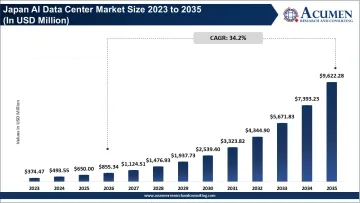
Report Highlights
- By component, hardware led the Japan AI data center market share in 2025 at 73% due to surging investments in GPU clusters, AI servers, high-speed networking equipment, and cutting-edge cooling systems.
- The services segment accounted for 13% market share in 2025 and is projected to grow at the highest CAGR through 2035 owing to the growing need for managed AI infrastructure, cloud migration, consulting, and operations support services.
- By deployment, cloud-based deployment commanded a 58% market share in 2025 due to the increasing adoption of scalable AI infrastructure by businesses and expanded investments in hyperscale cloud services.
- By deployment, hybrid deployment is projected to register the fastest CAGR of 35.4% over the forecast period as enterprises seek to balance scalability, security, regulatory compliance, and data sovereignty.
- By data center type, hyperscale data centers held the highest market share of 46% in 2025 as hyperscalers and telecommunications companies continue to make substantial investments in AI-ready data centers.
- Enterprise data centers secured the second-largest market share of 24% in 2025, attributed to increased AI integration in regulated sectors demanding stringent data controls.
- By application, AI model training led the market in 2025 with a 34% market share, fueled by substantial investments in large and foundation language models, and AI research infrastructure.
- The AI model inference segment accounted for a 22% market share in 2025 and is forecast to experience robust growth due to the escalating implementation of AI applications in production.
- By industry vertical, IT & telecom sector dominated the Japan AI data center market in 2025 with a market share of 30%, supported by ongoing investments in cloud infrastructure, hyperscale campus environments, and fiber optics.
- The manufacturing sector followed as the second-largest segment with a 16% market share in 2025, driven by enhanced AI adoption for smart manufacturing processes.
Can Japan Lead the Future of AI Data Centers?
Japan has established itself as a lead marketplace in Asia for AI-ready data centers with the transformative influence AI has brought to global digital infrastructure. With increased uptake of technologies like generative AI, large language models (LLMs), cloud computing, and high-performance computing (HPC) are fueling an escalating appetite for GPU-accelerated infrastructure capable of handling both AI training and inference workloads.
“We, at Acumen Research and Consulting predict that by 2030, close to 70% of all new data center capacity worldwide will be on account of AI workloads, where hyperscale AI data centers demand five to 10 times the amount of processing capacity and ten times the compute capacity per rack when compared with conventional enterprise data centers.”
Amazon Web Services (AWS) announced that it would invest approximately $15 billion by 2027 in building and enhancing its cloud and AI infrastructure within Japan, a clear indication that the e-commerce titan plans to shift beyond providing cloud services to becoming an AI compute hub.
AI Data Center Project Pipeline in Japan (2025-2035)
- Massive Scaling of Hyperscale AI Infrastructure - Global cloud hyperscalers are investing heavily and rapidly deploying massive AI capacity in Japan in order to satisfy global and domestic demand. AWS has committed JPY 2.26 trillion (US$15B) through 2027 to enhance its cloud and AI infrastructure in Tokyo and Osaka, whereas Microsoft is expanding its Azure AI capabilities through a US$2.9B investment in Japan that includes procuring NVIDIA GPUs.
- AI-Optimized GPU Data Centers - A new generation of hyperscale AI facilities is being designed from scratch using features such as liquid cooling, 50-100+ kW high-density racks, InfiniBand interconnects and large NVIDIA GPU clusters to power foundational model training and enterprise AI inferencing-redefining typical enterprise server configurations.
- Major AI Campus Builds Beyond Tokyo - The development of hyperscale AI campuses is shifting away from only Tokyo into more power-friendly and land-available markets such as Osaka, Hokkaido, Chiba and others.
- Government-backed Domestic AI Supercomputing - National and research institutions are continuing to invest in domestic sovereignty capabilities. For example, the ABCI 3.0 AI supercomputer which becomes operational in 2025 will utilize 6,128 NVIDIA H200 GPUs and reach performance over 6 exaflops (FP16), placing it as one of the most powerful AI infrastructure in Japan.
- Enterprise Colocation Expansion for AI - Leading colocation providers, including NTT Global Data Centers, Equinix, MC Digital Realty, KDDI (Telehouse), and Colt DCS are scaling their AI-Ready colocation capacity, driven by enterprise organizations choosing to lease rather than build their own GPU clusters for AI workloads.
Government Incentives for AI Data Centers in Japan
AI and Semiconductor Investment Support:
- The Japanese government has invested more than ¥10 trillion ($65+ billion) in public support to build out the country's AI and semiconductor industries through subsidies, tax credits and strategic investments.
Green Transformation (GX) Incentives:
- The government offers financial incentives that guide data center developers to integrate renewables, energy-efficient cooling, battery storage, and carbon reduction initiatives that align with Japan’s goal of achieving carbon neutrality by 2050.
Digital Garden City Nation Initiative:
- Government initiatives to broaden digital infrastructure to regional cities provide momentum for AI data center investment outside of Tokyo and Osaka through both infrastructure enhancement and regional digital transformation initiatives.
Subsidies for High-Performance Computing (HPC):
- The Japanese government provides national funding to support the development of next-generation AI computing infrastructure through AI supercomputers, research facilities and universities to foster innovation.
Tax Benefits for Strategic Investments:
- Companies making investments in digital infrastructure, advanced AI, and energy efficient technologies may be eligible for investment tax credits, accelerated depreciation and other tax incentives under several industrial promotion regimes.
Renewable Energy Integration:
- Policies promote long-term PPA's (power purchase agreements) for renewable energy, on-site renewables generation, and energy storage to support renewable data center operations.
Japan AI Data Center Market Dynamics
Driver
Rising AI Computing Demand is Accelerating Hyperscale Data Center Investments
Hypergrowth of Gen AI, enterprise AI and LLMs are rapidly driving the need for increased high performance computing (HPC) infrastructure in Japan. The heavy demand of compute-intensive, GPU-based servers, ultra-dense server rack cabinets, high-performance, advanced cooling infrastructure and extremely low latency networking required by AI workloads is resulting in data center operators and hyperscalers building more AI ready data centers across Japan. The already thriving digital economy of Japan, with increasing adoption of AI throughout its major industry sectors, manufacturing, healthcare, financial services and automotive; continues to spur the expansion of next generation AI infrastructure in the country.
Restraint
Limited Power Availability and Grid Constraints
Even with the investment rush, lack of power is the major roadblock for AI data centers in Japan. An AI data center draws considerably more power than an ordinary one, putting local grids, especially in large metro areas such as Tokyo and Osaka, to the test. An escalating price of electricity, a long timeline for a connection to the grid, as well as a growing number of mandates around green energy, all lead providers to look elsewhere where renewable energy sources and improved power transmission capacity are more readily available.
Opportunity
Sovereign AI Wave in Japan
Japan aims to boost domestic AI sovereign capabilities and the nation’s competitive standing in technological expertise, data privacy and digital resiliency. Japanese governmental organizations, research bodies, semiconductor and cloud enterprises are all looking to expand domestic use of national AI computing capabilities, and thus are directing investments into domestic AI supercomputers, national AI platforms and HPC infrastructure in their push to achieve less reliance on international computing resources. These moves signal strong ongoing demand in the AI-optimized data center sector.
Expecting the use of cutting-edge AI-optimized data centers that utilize GPU- clusters, as well as networking and energy-efficiency to expand going forward, the National Institute of Advanced Industrial Science and Technology ( AIST) in Japan has revealed its newest supercomputer, the ABCI 3.0 in 2025, that can include 6,128 NVIDIA H200 GPUs and providing greater than 6 exaflops ( FP16) of AI compute for Japanese research.
Japan AI Data Center Market Segmental Insights
Component Insights
Hardware generated the majority of the share of 73% of the Japan AI data center market in 2025. GPU clusters, AI servers, high-speed networking equipment, storage, and advanced cooling solutions play a significant role to handle high-intensity workloads driven by artificial intelligence technologies.
As AI data centers require more GPUs, AI chips, and interconnect speeds than traditional cloud solutions, the demand for specialized hardware that efficiently powers AI workloads such as the training and deployment of large language models (LLMs) , generative AI applications and enterprise AI solutions continues to surge.
Japanese data center operators, such as NTT Global Data Centers, SoftBank, KDDI, SAKURA internet and IIJ, have invested heavily in AI-enabled infrastructure solutions, including NVIDIA GPU hardware, AI accelerators, liquid cooling and high-bandwidth networking.
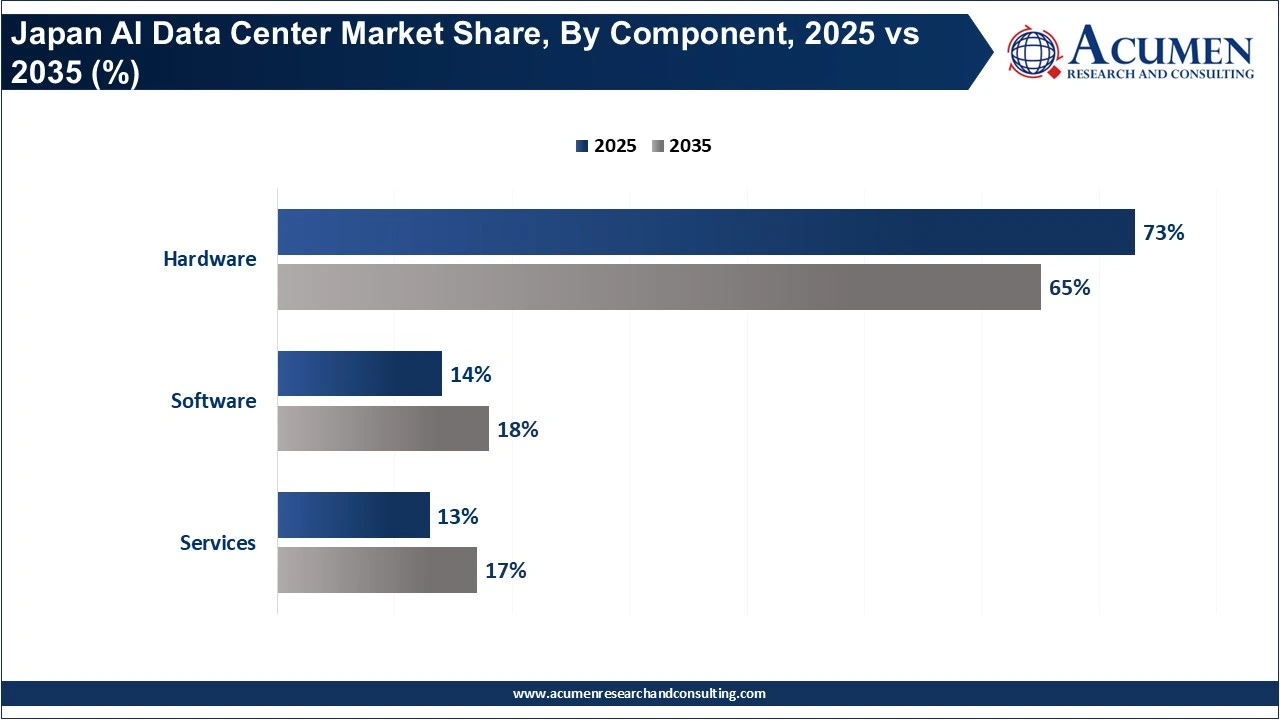
Services, which held 13% share in 2025, is predicted to increase at the notable CAGR over the forecast period, as companies increasingly demand specialized expertise for deploying and managing artificial intelligence infrastructure. Companies moving towards implementing artificial intelligence technologies have started moving from building in-house expertise towards cloud managed services. There is a shortage of AI infrastructure and data center engineers in Japan, leading to increasing demand for professional and managed services.
Deployment Insights
In 2025, cloud-based deployment accounted for the largest market share at 58% and is anticipated to remain the leader in the future. The shift toward cloud-based AI infrastructure in Japanese businesses is attributed to the scalable computing resources offered without major initial capital expenditure. The demand for elastic GPU power is essential for AI model training and inferencing, enterprise analytics and the rise of generative AI. However, public clouds efficiently provide such a capacity when compared to on-premises.
Hyperscale cloud providers such as AWS, Microsoft Azure, Oracle Cloud and Google Cloud, alongside local providers such as NTT, IIJ and SAKURA internet, continue to expand their footprint in Japan, fostering increased cloud adoption throughout the nation.
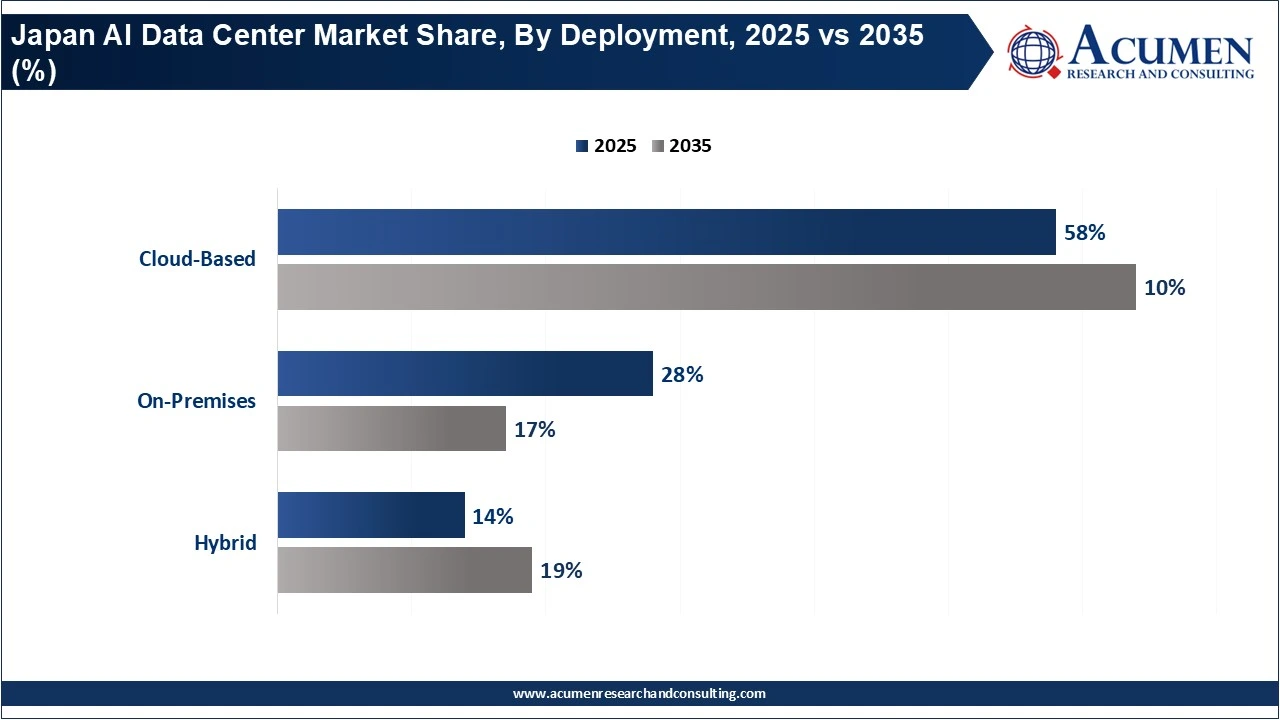
Hybrid deployment is projected to register the highest CAGR of 35.4% by 2035. Companies across various sectors are increasingly adopting hybrid deployment as a way to secure the advantages of public cloud services in tandem with on-premises facilities seeking to strike an ideal balance between scalability, security, compliance, and flexibility in their IT operations.
Enterprises dealing with confidential data including banking institutions, health care organizations, defense companies, and governmental organizations are deploying a hybrid approach to control the data located on premises while benefiting from public cloud services in case of high-end compute resource requirements and AI model training. Japanese companies are adopting a hybrid approach to AI by using domestic resources for storing confidential datasets, whereas high-end computing and large-scale AI development resources are consumed from cloud.
Data Center Type Insights
Hyperscale data centers was the largest market segment with 46% in 2025, as hyperscale cloud operators and telco players are expanding AI compute capacity throughout Japan. While Tokyo and Osaka continue to attract most of hyperscale development thanks to mature connectivity ecosystem, submarine cable connectivity, enterprise demand and the availability of cloud availability zones, developers are moving towards regional markets where large-scale campuses with significant power availability can be built.
Japan AI Data Center Market Share, By Data Center Type, 2025 (%)
| Data Center Type | Revenue Share, 2025 (%) |
|---|---|
| Hyperscale Data Centers | 46% |
| Enterprise Data Centers | 24% |
| Colocation Data Centers | 18% |
| Edge Data Centers | 8% |
| Modular & Portable Data Centers | 4% |
The enterprise data center sector was the second largest in 2025 and held a 24% market share in the AI data center market in Japan. High demand for artificial intelligence in enterprises operating in finance, healthcare, manufacturing, telecommunications and government which, in many cases, are highly regulated, continue to drive enterprise investment. Enterprise AI data centers enable them to deploy customized solutions and offer a higher level of flexibility in computing, deploy company AI model and incorporate artificial intelligence solutions into their IT environment.
Application Insights
AI model training captured the biggest market share of 34% in 2025 with companies investing substantially in large language models, multimodal AI, industrial AI platforms, and enterprise foundation models. Japan is also a fast growing R&D market that is fueling investment in training infrastructure by universities, research centers, government bodies and private technology corporations, a trend that should continue given a burgeoning market for domestic and sovereign AI initiatives.
Japan AI Data Center Market Share, By Application, 2025 (%)
| Application | Revenue Share, 2025 (%) |
|---|---|
| AI Model Training | 34% |
| AI Model Inference | 22% |
| Big Data Analytics | 14% |
| Computer Vision Processing | 10% |
| Natural Language Processing (NLP) | 9% |
| Autonomous Systems & Robotics | 6% |
| Cybersecurity & Fraud Detection | 5% |
AI model inference commanded 22% of the market share in 2025 and is anticipated to witness healthy expansion due to increased production deployments of models. Machine learning applications such as chatbots, enterprise and mobile intelligence, manufacturing processes, finance and health all demand inference capabilities. Unlike training, inferencing models are expected to be geographically dispersed, ultra-low-latency, high-performance systems and, therefore, drive investment in the development of AI inference platforms, edge devices, and AI accelerators over the forecast period.
Industry Vertical Insights
IT & telecom segment led the market in 2025 with a 30% share, driven by strong investment in cloud infrastructure, hyperscale campuses, telecom network buildouts and AI service platforms. Japan has world-class telecom infrastructure, national fiber networks, extensive 5G services, a rapidly growing cloud presence, all contributing to strong growth in its AI data centers. Investment in hyperscale data centers, AI networking and edge AI infrastructure will help Japan cement its status in the decade ahead.
Japan AI Data Center Market Share, By Industry Vertical, 2025 (%)
| Industry Vertical | Revenue Share, 2025 (%) |
|---|---|
| IT & Telecom | 30% |
| BFSI | 15% |
| Healthcare | 8% |
| Retail & E-commerce | 10% |
| Manufacturing | 16% |
| Government & Defense | 7% |
| Media & Entertainment | 5% |
| Automotive | 6% |
| Energy & Utilities | 3% |
Manufacturing sector was the second largest market verticals segment with 16% of market share as one of the world's leading economies. Japanese automakers, electronics companies, robotics and industrial machinery players are aggressively incorporating AI into production and operations to enhance predictive maintenance, digital twins, quality inspections and automated robotics.
Recent News
- March 2025: Microsoft announced the expansion of its AI and cloud infrastructure in Japan by introducing Azure High Performance Computing (HPC) capacity powered by advanced NVIDIA GPUs. The expansion is part of Microsoft's previously announced USD 2.9 billion investment to strengthen Japan's AI computing capabilities and meet the growing demand for generative AI workloads.
Top Companies
- Fujitsu Limited (Kawasaki, Kanagawa): Provides AI servers, HPC systems, storage, and infrastructure technologies.
- NEC Corporation (Tokyo): Networking, AI platforms, digital infrastructure for data centers.
- Hitachi, Ltd. (Tokyo): Energy management, cooling and digital infrastructure for AI.
- KDDI Corporation (Tokyo): AI ready data centers through Telehouse, cloud infrastructure.
- SoftBank Corp. (Tokyo): Investing in AI infrastructure, GPU clusters, large-scale AI data center campuses.
- Internet Initiative Japan (Tokyo): Enterprise cloud, data center, AI infrastructure services.
- IDC Frontier Inc. (Tokyo): SoftBank subsidiary running AI ready cloud, data center infrastructure.
- SAKURA internet Inc. (Osaka): Cloud provider investing in GPU infrastructure for generative AI.
Segments Covered
By Component
- Hardware
- Software
- Services
By Deployment
- Cloud-Based
- On-Premises
- Hybrid
By Data Center Type
- Hyperscale Data Centers
- Enterprise Data Centers
- Colocation Data Centers
- Edge Data Centers
- Modular & Portable Data Centers
By Application
- AI Model Training
- AI Model Inference
- Big Data Analytics
- Computer Vision Processing
- Natural Language Processing (NLP)
- Autonomous Systems & Robotics
- Cybersecurity & Fraud Detection
By Industry Vertical
- IT & Telecom
- BFSI
- Healthcare
- Retail & E-commerce
- Manufacturing
- Government & Defense
- Media & Entertainment
- Automotive
- Energy & Utilities
Looking for discounts, bulk pricing, or custom solutions? Contact us today at sales@acumenresearchandconsulting.com
Frequently Asked Questions

Other ICT Reports
December 2025
November 2023
September 2024
September 2026