May 2023

Enterprise AI Market (By Deployment Mode: Cloud-based AI, On-premise; By Technology: Machine Learning & Deep Learning, Natural Language Processing, Computer Vision, Speech Recognition, Others; By Organization Size: Large Enterprises, Small & Medium Enterprises; By Application: Business Intelligence & Analytics, Security & Risk Management, Customer Support & Experience, Marketing & Advertising Management, Process Automation, Human Resource & Recruitment; By Industry Vertical: IT & Telecommunications, BFSI, Healthcare & Life Science, Retail & E-commerce, Automotive & Transportation, Media & Advertising, Others) - Global Industry Analysis, Size, Share, Regional Analysis, Trends and Forecast 2026 To 2035
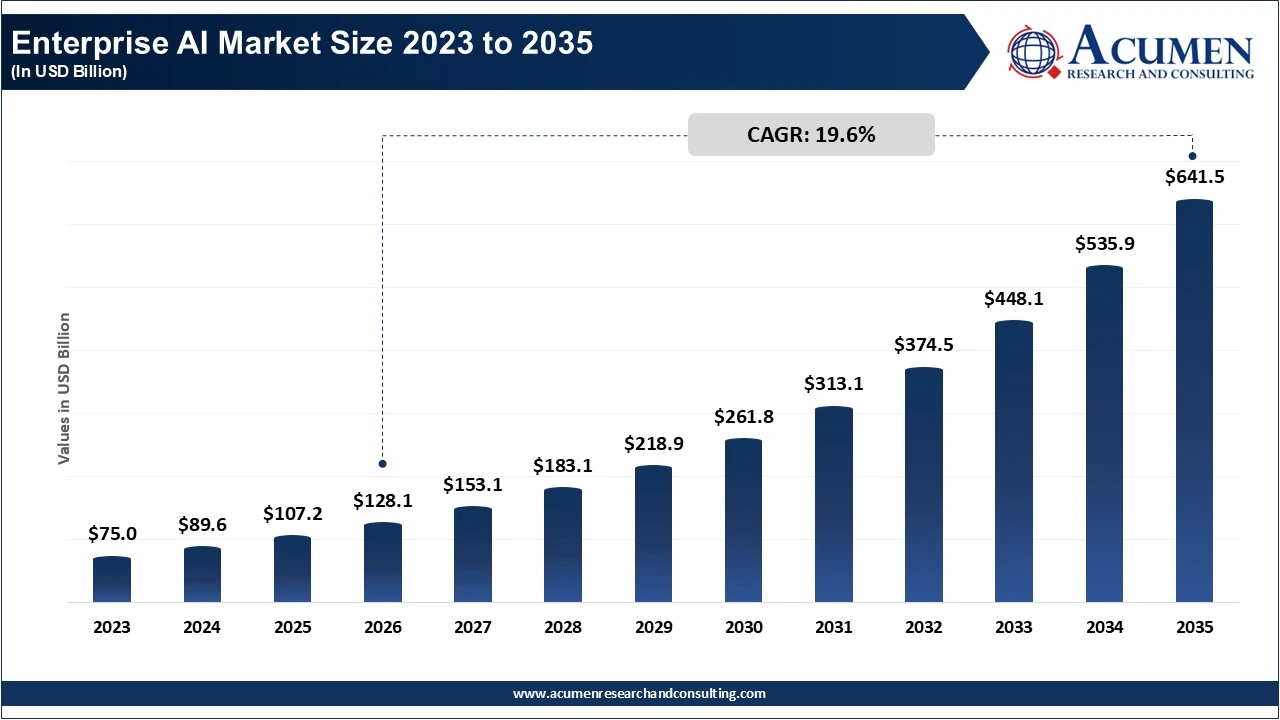
The global enterprise AI market size was worth at USD 107.16 billion in 2025 and is estimated to surpass around USD 641.47 billion by 2035 growing at a CAGR of 19.6% from 2026 to 2035. The overall rising rate of automation in complex workflow to enhance operational efficiency offers a boosting factor for the enterprise AI market to grow.
What is Enterprise AI & How is the Market Growing?
The use of AI and associated systems to automate processes, improve decision making and improve customer experiences is what enterprise AI is all about. Enterprise AI is designed to scale, integrate with current business systems and comply with regulations in order to provide quantifiable returns on investment (ROI). With an enormous amount of enterprise data being created, there is a demand for transforming this data into actionable insights and as a result the global enterprise AI market is rapidly expanding. To help streamline their operations and create personalized customer experiences, businesses have begun using AI-based analytical tools, automation tools and generative AI tools.
Cloud computing is also fueling market growth by making AI more accessible and scalable. Cloud-based AI platforms allow organizations to deploy advanced AI models without large upfront infrastructure investments, enabling faster experimentation and innovation. As a result, AI adoption is spreading beyond large enterprises to mid-size businesses and startups.
Major Industries Implementing Enterprise AI & its Aspects
| Industry | Key Use | Adoption Trends |
| Banking & Financial Services | Fraud detection, risk analytics and AML monitoring | AI-driven fraud detection can cut fraud loss by 30-35% in BFSI. |
| Healthcare | Medical imaging, drug discovery and predictive diagnosis | AI is accelerating drug discovery by 40% in 2026. |
| Retail & E-commerce | Demand forecasting, chatbots and visual search | E-commerce companies are using AI to reduce downtime and optimize quality control |
| Telecom | Network optimization and consumer service automation | AI automation can reduce network OPEX by 40% in general |
Enterprise-Wide Digital Transformation and Data Explosion
The sheer growth in the volume of enterprise data along with the growing pressure of digital transformation is one of the most potent drivers for the enterprise AI market. Today, each organization produces terabytes of data from various interactions with their customers, IoT devices, supply chain, digital networks etc., in both structured and unstructured form. Conventional analytics platforms have failed to offer real time insights into these huge data streams, leading the organizations to adopt AI-driven analytics, automation and decision intelligence. For example, retailers are using AI to manage and forecast demands as well as inventory in real-time, and banks are using it to quickly scan millions of transactions for potential fraud.
Data Privacy, Governance, and AI Skill Shortage
Since AI systems necessitate high-quality data to run effectively, organizations frequently deal with data silos, compliance issues and stringent data privacy laws. Sectors like government, finance and healthcare are particularly burdened with complex regulations that hinder the deployment of AI systems and affect their costs. Another issue to be considered is the lack of specialized AI talent. The enterprises seldom find data scientists, AI engineers and AI governance professionals experienced enough to build enterprise AI systems.
Generative AI and AI Copilots Transforming Enterprise Productivity
Generative AI, coupled with AI copilots, represent a huge new opportunity for the enterprise landscape. Companies are increasingly using AI assistants to help their workers write copy, generate code, perform analysis, summarize documents, and automate tedious tasks, and this will drive AI into more of the everyday functions and departments of a business- HR, marketing, finance, and customer service, not just IT and Analytics.
North America led the market with the largest share of 36% in 2025. Being the largest revenue generating marketplace, the region has strong digital economy. The region massively benefits from strong digital economy, early adoption of advanced technologies and heavily-deployed cloud infrastructure. Enterprises in North American countries are experimenting with AI with embedding it deeply into core operations. Additionally, e-commerce businesses leveraging enterprise AI in customer engagement and decision-making processes.
World leading AI startups have headquarters in countries like U.S. and Canada which boosts the overall growth of the market for upcoming years with easy and rapid rate of adoption for advanced technologies. EY, based in the United States started deploying enterprise AI to augment human potential at exponential value. With the deployment the company stated that an approximate 6.5x in-year ROI for telco company was achieved through AI insights. They also mentioned that fragmented data became structured and trusted for autonomous decisions with the help of this.
Major Drivers for Enterprise AI Market’s Growth in the U.S & Canada
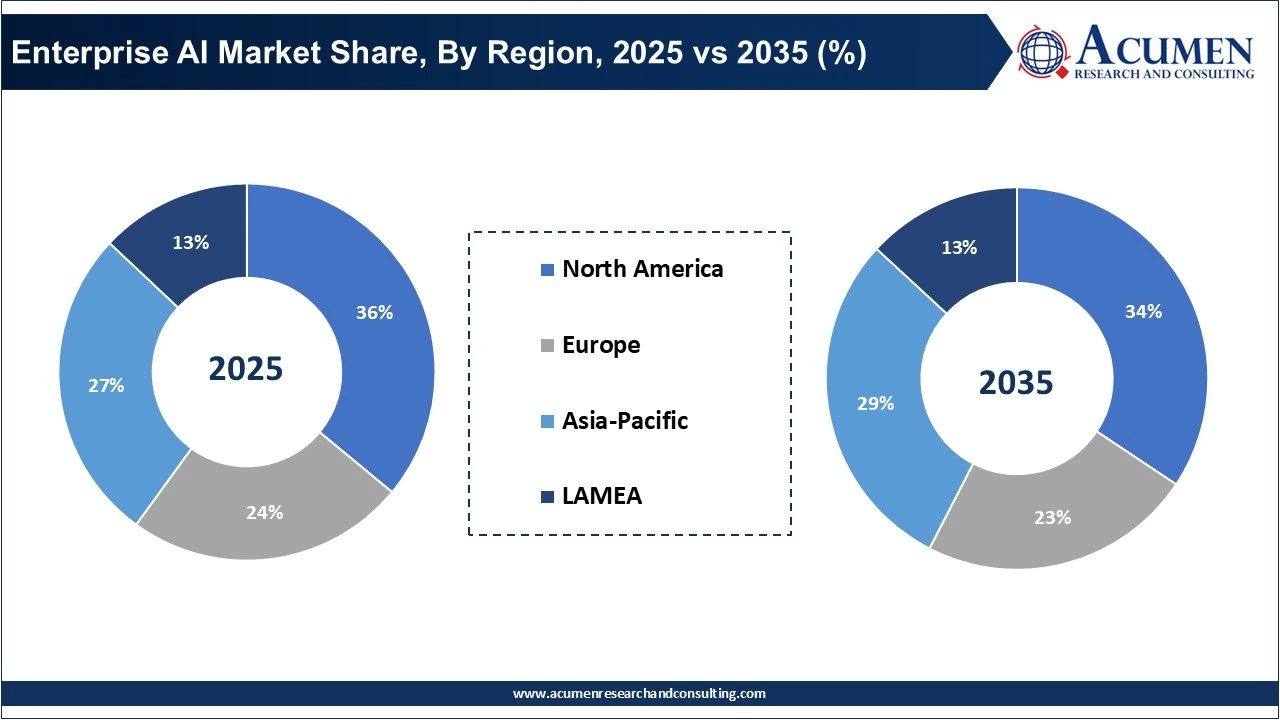
While being the fastest growing marketplace, Asia Pacific held 27% share in 2025. Asia Pacific is witnessing this growth due to rapid digitalization, growing internet penetration and strong government support for AI initiatives. AI penetration in Asia Pacific can be massively seen in e-commerce, manufacturing and smart city projects. The region, especially in China and Japan is home to major fastest growing AI-based companies. Large populations, heavy use of data and digital economies fuel AI innovation.
The vast majority of 58% market share was held by cloud segment in 2025. Organizations looking to deploy AI as quickly as possible will choose the cloud to eliminate the need for costly upfront infrastructure investments, while still allowing them to explore AI applications before budgeting for a production project. For example, many major retail and fintech organizations can ramp up their AI pilot programs to a 6-8 week timeline, rather than the 4-6 month timeline they would traditionally experience, due to the availability of ready-to-use AI products and APIs provided by cloud service providers. As a result of their increasing emphasis on digital transformation, organizations will continue to adopt cloud solutions as their primary method of implementing enterprise AI solutions.
Enterprise AI Market Share, By Deployment Mode, 2025 (%)
| Deployment Mode | Revenue Share, 2025 (%) |
| Cloud-Based | 58% |
| On-Premises | 42% |
In addition to the rapid growth of cloud-based AI, the on-remise segment held 42% of significant market share in 2025. Although cloud-based AI is convenient and requires no dedicated hardware, organizations that handle highly confidential or regulated data, such as banks, healthcare companies and government entities, often have much stricter requirements regarding the security and compliance of their IT environment. Therefore, on-premise AI will play an increasingly important role in these types of organizations. Many large organizations are now pursuing hybrid AI strategies by combining the flexibility of cloud-based AI with the security and compliance of their on-premise deployments.
In 2025, the machine learning and deep learning segment held 44% market share while dominating it. By utilizing these technologies, systems can take input from data, detect patterns in the data, and forecast future outcomes. These features are fundamentally altering how companies operate in almost every function. As organizations increasingly leverage machine learning and deep learning technologies to support their decision-making processes, businesses are seen utilizing predictive analytics to help them effectively forecast their demand, optimize pricing, and better manage their supply chain.
On the other hand, the natural language processing segment held second largest share of 22% in 2025. Companies are now dealing with an unprecedented volume of text-based information (e.g., emails, contracts, customer chats, and social media posts). With the widespread use of AI-based chatbots and virtual assistants, customer service is now benefiting from the delivery of instant responses, reducing the cost of operations, and providing continuous support in real-time.
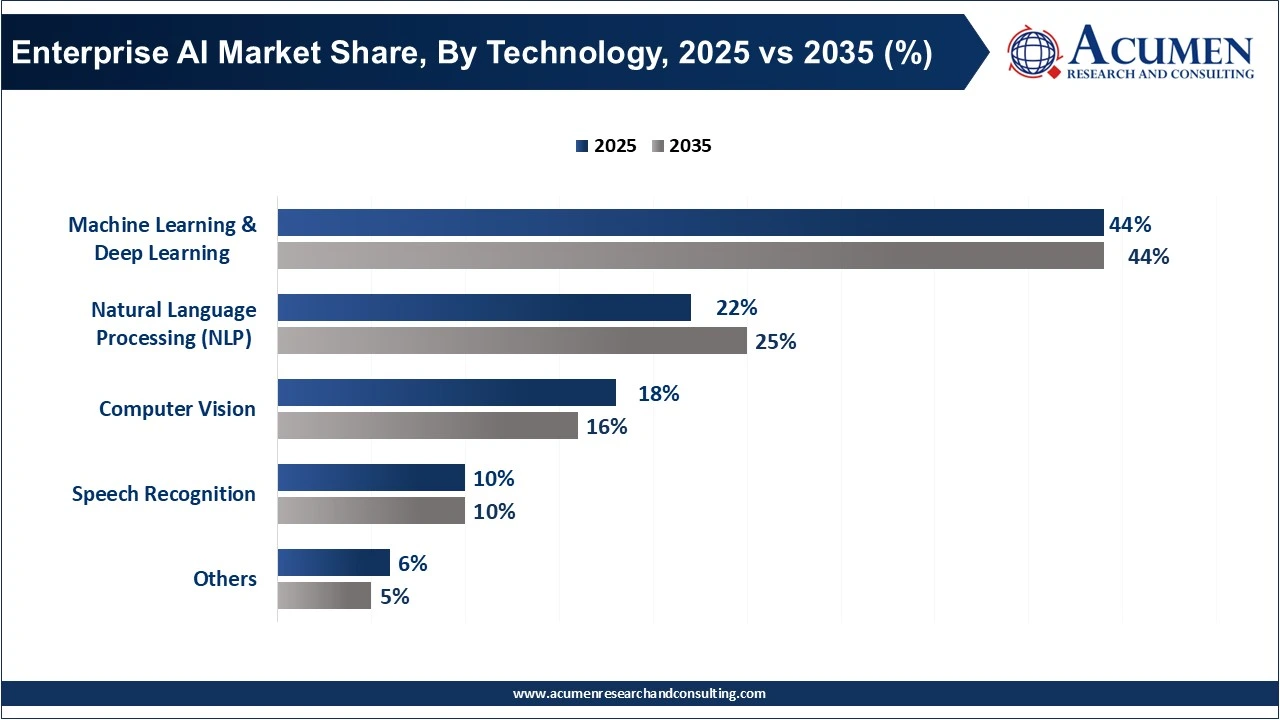
The computer vision segment accounted for 18% market share in 2025. Computer vision gives machines the ability to interpret images and video data, which opens up many new possibilities and opportunities for many industries. For example, AI-powered cameras are used to inspect products in the manufacturing industry for quality control, while computer vision in retail is used to monitor customer behaviour in retail environments to improve store layouts and inventory.
In 2025, the large enterprises segment held 60% of share in 2025. Enterprise AI adoption is mostly driven by large enterprises because they have the resources needed to implement it on a large scale, access to huge amounts of data; an extensive IT infrastructure; and access to experts in AI all of which are essential to successfully deploying enterprise AI. Many organizations of this size are beginning to use AI in all of their different departments (e.g., financial, human resources, marketing, operations, etc.). AI is no longer a fringe technology; it has become essential for organizations to maintain a competitive advantage.
Enterprise AI Market Share, By Organization Size, 2025 (%)
| Organization Size | Revenue Share, 2025 (%) |
| Large Enterprises | 60% |
| Small & Medium Enterprises (SMEs) | 40% |
On the other hand, the small and medium enterprises segment accounted for 40% of the enterprise AI market by 2025. The growing availability of affordable cloud-based platforms, subscription-based AI tools, and ready-made solutions are contributing to the increasing recognition by SMEs that AI can be more than just available only to large organizations. SMEs primarily use enterprise AI in areas where they can obtain quick, measurable results, for instance, marketing automation, sales forecasting, and customer service. The continuing improvement in the user-friendliness and price of AI tools will also lead to a substantial increase in SME adoption of enterprise AI.
The business intelligence and analytics segment held 37% share in 2025. AI-enabled Business Intelligence has come to be the backbone behind modern enterprises making their decisions. Businesses are no longer just reporting on what has happened. Instead, they are now focusing on predictive and prescriptive analytics that will help forecast consumer demand, identify operational bottlenecks, and simulate future scenarios of their business. AI powered dashboards now compile data from several enterprise systems, including CRM, ERP, and supply chain platforms, to help organizations make quicker and better educated decisions. The other major contributing factor to business intelligence & analytics adoption is the increasing demand for real-time decision intelligence. Businesses are now expecting immediate insight into sales performance, operational efficiency, and customer behavior.
Enterprise AI Market Share, By Application, 2025 (%)
| Application | Revenue Share, 2025 (%) |
| Business Intelligence and Analytics | 37% |
| Security and Risk Management | 18% |
| Customer Support and Experience | 14% |
| Marketing and Advertising Management | 12% |
| Process Automation | 11% |
| Human Resource and Recruitment | 8% |
The security and risk management applications carried 18% of the market share in 2025. Digital ecosystems are expanding at an accelerating rate, thus growing an enterprise's threat profile to include increased exposure to cybersecurity, fraud, and regulatory risks. AI has emerged as a vital tool in enterprise security for enabling behavioral analytics, continuous monitoring, and real-time threat detection.
Beyond enterprise security, AI is an integral tool in the realm of enterprise risk and compliance. Large organizations and corporations, in addition to financial and healthcare providers, are implementing AI to monitor for compliance to regulatory frameworks and identify suspicious transaction activities.
IT & Telecommunications has taken center stage, with 34% share in 2025. The IT & telecommunications sector is a central hub for the digital economy and as a result generates huge amounts of operational & customer data on a daily basis. Optimizing complex networks, cloud infrastructure and digital services requires ongoing monitoring, optimization and automation where AI plays a huge part. IT and telecommunications use AI widely for network traffic prediction, IT service automation and predicting system failures.
Telecom providers & IT service companies are increasingly adopting AI for improved customer service, increased uptime & optimized costs of infrastructure. With an increase in cloud computing, 5G technology and digital services, the adoption of smart automation is increasing. Hence, the leading sector to adopt enterprise AI remains IT & telecommunications.
Enterprise AI Market Share, By Industry Vertical, 2025 (%)
| Industry Vertical | Revenue Share, 2025 (%) |
| IT & Telecommunications | 34% |
| BFSI | 21% |
| Healthcare and Life Sciences | 16% |
| Retail and E-commerce | 13% |
| Automotive and Transportation | 8% |
| Media & Advertising | 5% |
| Others | 3% |
On the other hand, the BFSI segment held 21% share in 2025. Being an already data intensive sector, BFSI is a very natural industry for AI adoption. BFSI sector is currently using AI to improve fraud detection, automation of risk assessment and customer onboarding process. These machines are able to process millions of transactions simultaneously to identify abnormal patterns and reduce losses. Furthermore, financial engagement and innovation of financial services is also being revolutionized by AI.
Banks and fintech firms are currently using AI for personalized financial advice, automated loan approvals and optimizing digital banking. With an increasing number of digital transactions, the stringent need of regulation and automation is pushing banks and BFSI to rely more on the adoption of AI in the banking & financial services industry.
By Deployment Mode
By Technology
By Organization Size
By Application
By Industry Vertical
By Region
Looking for discounts, bulk pricing, or custom solutions? Contact us today at [email protected]

May 2023
October 2021
August 2017
December 2025
Trusted Market Intelligence | 2026–2035 Insights | Designed to Support Faster, Smarter Decisions
Thank you! Our team will reach out to you soon.