
Data Center Passive Optical Network (PON) Equipment Market Size, Share, Growth, Report 2026 To 2035
Data Center Passive Optical Network (PON) Equipment Market (By Equipment Type: PON Optical Line Terminals (PON OLTs), PON ONTs/ONUs and Optical Modems, Passive Optical Splitters, Other; By PON Technology: GPON, XG-PON, XGS-PON, 25G-PON, 50G-PON, Others; By Application: Out-of-Band Management (OOBM), Data Center Infrastructure Management (DCIM), Others; By Data Center Type: Hyperscale Data Centers, Colocation Data Centers, Enterprise Data Centers, Government and Defense Data Centers, Others; By Deployment Architecture: Dedicated PON OOBM, Hybrid PON-Ethernet OOBM, PON-based DCIM, Others; By Endpoint Type: Servers, Network Equipment, Storage Equipment, Power and Cooling Equipment, Others) - Global Industry Analysis, Size, Share, Regional Analysis, Trends and Forecast 2026 - 2035
- Last Updated: 21 Sep 2026
- Report Code: ARC3982
- Category: ICT
Data Center Passive Optical Network (PON) Equipment Market Size, Forecast Report 2026 To 2035
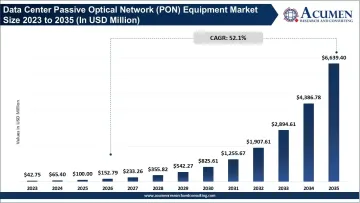
The data center passive optical network (PON) equipment market size was valued at $100 million in 2025. The market is observed to reach at $6,639.40 million by 2035; growing at a promising CAGR of 52.1% during the forecast period of 2026-2035. Growth in AI workloads and hyperscale data center expansion is increasing the need for scalable, low-power management connectivity across rapidly expanding data center environments. At the same time, operators are looking to reduce active switching equipment, cabling complexity, power consumption, and operational overhead, creating an opportunity for PON-based architectures, particularly for out-of-band management.
Report Highlights
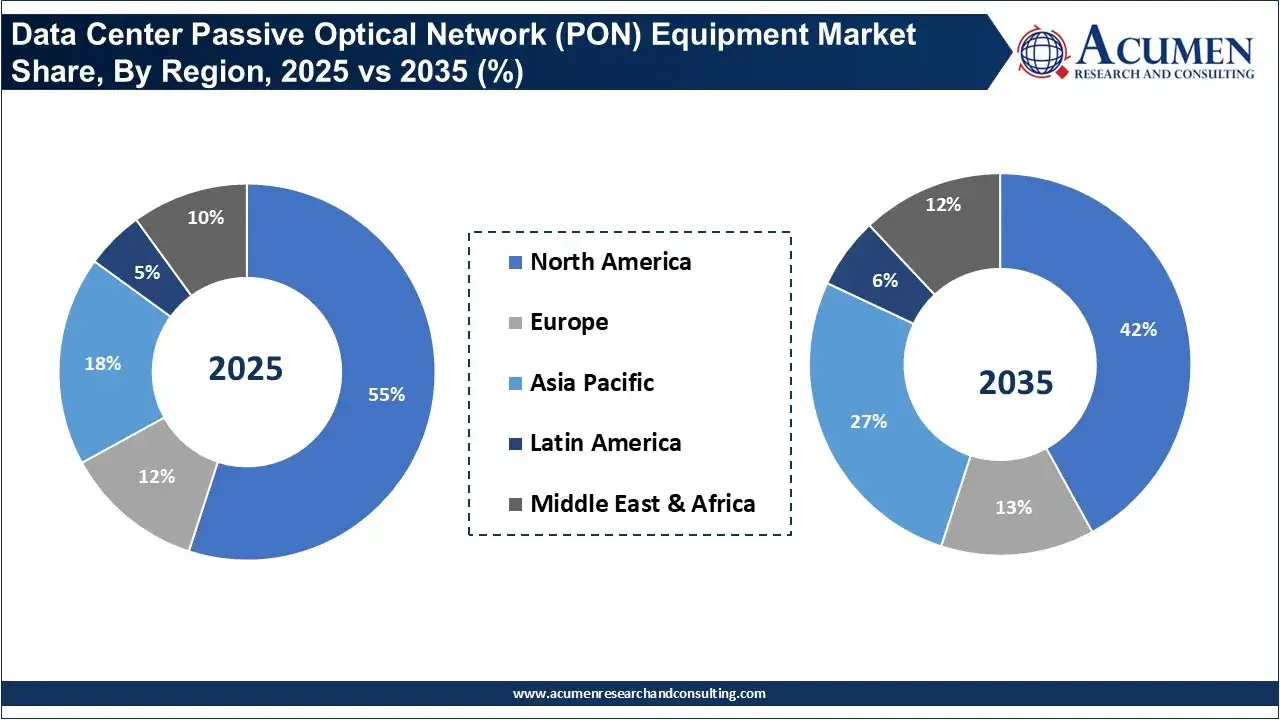
- By region, North America dominated the data center PON equipment market with a 55% share in 2025, supported by its large hyperscale, cloud, AI, and data center infrastructure base and growing demand for efficient management architectures.
- By region, Asia-Pacific is projected to be the fastest-growing regional market, with its share increasing from 18% in 2025 to 27% by 2035 and recording a 59.1% CAGR from 2026 to 2035, supported by expanding data center infrastructure and rising demand for high-capacity optical connectivity.
- By equipment type, PON ONTs/ONUs and optical modems dominated the market with a 55% share in 2025, supported by their role as endpoint-level devices that connect servers and other managed equipment to centralized PON infrastructure.
- By equipment type, PON optical line terminals (OLTs) held the second-largest position with a 32% share in 2025, reflecting their role in centrally aggregating large numbers of optical management connections across data center environments.
- By PON technology, XGS-PON dominated the market with a 55% share in 2025, supported by its higher capacity compared with legacy GPON and its suitability for increasingly demanding data center management networks.
- By PON technology, 25G-PON is projected to record the fastest growth, increasing from a 15% share in 2025 to 35% by 2035, driven by rising bandwidth requirements across AI-focused and hyperscale data center infrastructure.
- By application, out-of-band management (OOBM) dominated the market with an 88% share in 2025, as data center operators increasingly require independent management connectivity for monitoring, troubleshooting, and recovering critical infrastructure.
- By application, data center infrastructure management (DCIM) accounted for 10% of the market in 2025, supported by the use of optical connectivity for monitoring infrastructure while reducing dependence on complex active Ethernet management networks.
- By data center type, hyperscale data centers dominated the market with a 50% share in 2025, reflecting the strong suitability of centralized point-to-multipoint PON architectures for managing thousands of endpoints across large-scale facilities.
- By data center type, colocation data centers represented the second-largest segment with a 30% share in 2025, driven by the need for scalable and centralized management connectivity across high-density, multi-customer facilities.
- By deployment architecture, dedicated PON OOBM dominated the market with a 65% share in 2025, reflecting demand for an independent management network that can remain accessible when the primary production network becomes unavailable.
- By deployment architecture, hybrid PON-Ethernet OOBM accounted for 25% of the market in 2025, supported by its ability to combine PON's centralized optical architecture with existing Ethernet infrastructure during phased network migrations.
- By endpoint type, servers dominated PON connectivity with a 50% share in 2025, reflecting the large number of server endpoints requiring continuous remote monitoring, troubleshooting, and out-of-band management.
- By endpoint type, network equipment accounted for 25% of the market in 2025, as routers, switches, and other networking devices require independent management connectivity to maintain access during production-network failures.
Market Overview and Strategic Outlook
The data center PON equipment market is transitioning from a narrowly focused outgrowth of traditional fiber access into a new infrastructure paradigm for data center operations. PON allows centralized point-to-multipoint structure in which a single OLT can multiplex aggregate connections to a large number of optical modems or ONTs positioned in the vicinity of racks of servers or other managed equipment.
In hyperscale and AI-focused data centers, where large populations of endpoints will be required, this architecture increasingly applies when traditional per-rack Ethernet management network architectures become complicated and costly. It is also trending toward higher speeds like XGS-PON and 25G-PON as network operators are leaning toward 10+G capacity while preserving the efficiency and efficiency of passive optical network infrastructure.
“The expert panel at Acumen Research & Consulting suggest that PON ONTs/ONUs and optical modems accounted for 55% of the equipment segment in 2025, while XGS-PON represented 55% of the PON technology segment. Out-of-band management accounted for 88% of application demand, and hyperscale data centers represented 50% of deployments in 2025.”
Government Initiatives and Regulatory Landscape
| Country | Government initiative / regulatory development | Highlights for data center PON equipment |
|---|---|---|
| United States | Federal and state-level programs continue to support AI, cloud, semiconductor, and digital infrastructure development. | Expansion of AI and hyperscale infrastructure can increase demand for scalable and energy-efficient data center connectivity and management networks. |
| China | National digital infrastructure and computing initiatives continue to emphasize cloud computing, data infrastructure, and computing capacity. | Large-scale computing infrastructure supports demand for optical networking and higher-capacity PON technologies. |
| Japan | Japan continues to strengthen digital infrastructure and AI-related computing capabilities as part of its broader digital transformation agenda. | Investment in advanced data infrastructure creates opportunities for high-speed optical connectivity and data center management architectures. |
| South Korea | Government initiatives supporting AI, semiconductors, cloud infrastructure, and digital transformation are expanding the country's advanced computing ecosystem. | Growth in AI and high-density computing infrastructure can support adoption of high-capacity optical networking technologies. |
| Germany | European and German digital infrastructure policies increasingly emphasize secure, sustainable and energy-efficient digital infrastructure. | Energy efficiency requirements can increase interest in lower-power data center management architectures such as PON-based OOBM. |
| Singapore | In September 2026, Singapore introduced its Digital Infrastructure Bill, proposing licensing regimes covering the security and resilience of major cloud services and data centers and the environmental sustainability of data center operations. | The focus on resilience and sustainability supports demand for infrastructure architectures that can reduce power consumption while maintaining reliable management connectivity. |
| India | India's 2026–27 Budget proposed a tax holiday through 2047 for eligible foreign cloud providers using India-based data centers, as part of efforts to position the country as a global cloud and AI infrastructure hub. | Expansion of cloud and AI data centers creates opportunities for optical networking, OOBM, and other scalable infrastructure technologies. |
What Is Driving Data Center PON Equipment Adoption?
The adoption of data center PON equipment is primarily driven by the scale and complexity of hyperscale, cloud and AI data center deployment where traditional Ethernet-based management networks result in a large number of active switches and a lot of cabling. PON offers a high-level point-to-multipoint architecture where a central OLT platform can be deployed with passive optical distribution to large numbers of powered endpoints.
This architecture is particularly attractive for out-of-band management because it provides an independent management path for servers, networking equipment and other critical infrastructure even when the production network is down. With the number of racks increasing, the rise in server population, the desire to improve energy efficiency and the need to reduce installation and operations expense, the business case for PON is growing.
How Is the AI Data Center Boom Creating New Opportunities for PON Equipment?
The expansion of AI data centers is creating an opportunity for PON equipment by increasing the number, density, and operational importance of infrastructure endpoints that require continuous management. AI facilities typically deploy high-density computing systems and increasingly complex supporting infrastructure, making power consumption, rack space, cabling, and network resilience important considerations beyond the primary production network. PON-based OOBM can address this requirement by moving the management connectivity to a centralized optical architecture with passive distribution and compact optical modems at the endpoint.
Segmentation Insights
Equipment Type Insights
Which PON Equipment Is Capturing the Largest Share of Data Center Deployments?
PON ONTs/ONUs and optical modems accounted for 55% of the equipment segment in 2025 and are expected to grow to 62% in 2035. Their success comes from the fact that they are also at the end of the PON architecture, where the optical signals are converted into the Ethernet, serial, or other management interfaces that equipment at the data center needs.
Optical ONTs/ONUs or modems are designed to sit near the managed equipment, at rack or top-of-rack level, in a PON-based OOBM architecture.
That means a large number of endpoints can be fed back to a management site using the centralized optical switching architecture without the need for a dedicated active Ethernet management switch in every rack.
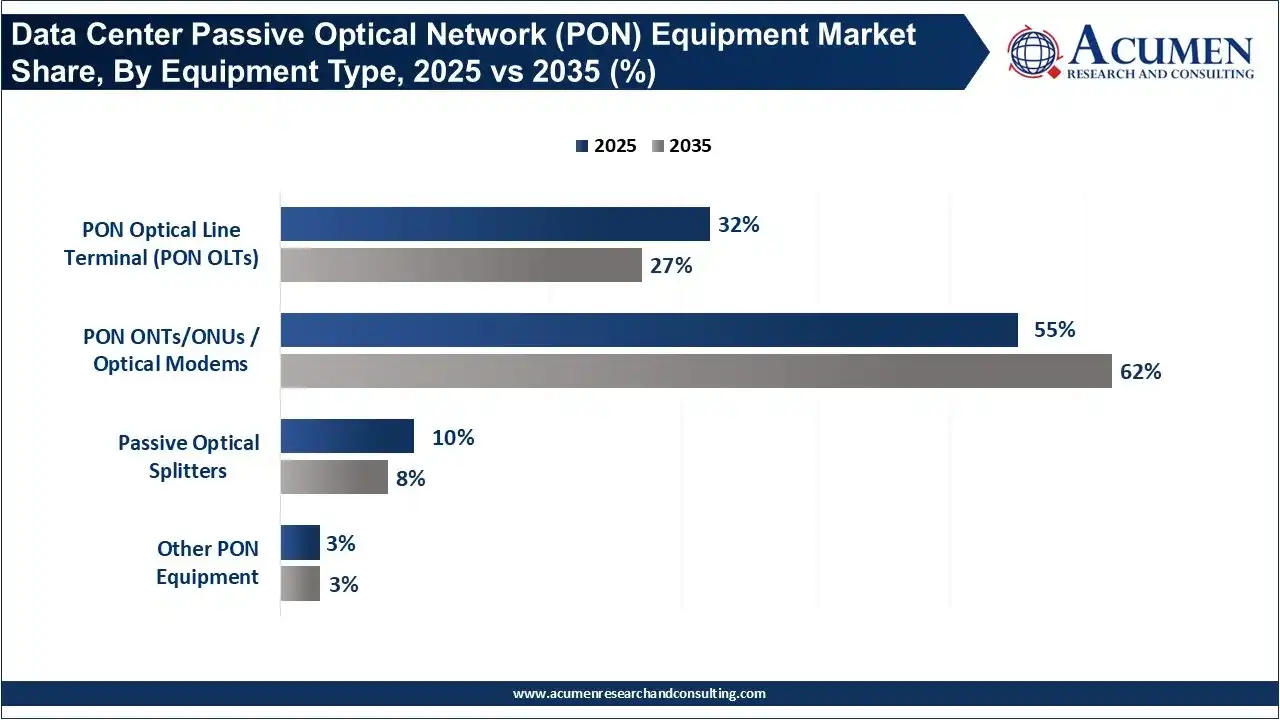
PON OLTs accounted for 32% of the equipment segment in 2025, making them the second-largest category. OLTs perform the centralized aggregation function in a PON architecture, connecting the optical distribution network to the broader management infrastructure.
Their role becomes particularly important in large data centers because a centralized OLT can aggregate connections from numerous ONTs. Nokia's data center PON architecture describes the OLT as the central optical switch capable of connecting and managing thousands of devices through a point-to-multipoint architecture.
PON Technology Insights
PON Technology Adoption: From GPON to 50G-PON
XGS-PON comprised 55% of the market in 2025, making it the most prevalent PON technology in the supplied segmentation. It is indicative of the migration away from legacy GPON towards more robust optical architectures that are better suited to handling data center administration now and in the future.
XGS-PON offers significant capacity headroom compared to GPON while still maintaining the core passive optical nature of the architecture. This makes it a good fit for data centers where operators are seeking higher capacity without the plethora of active switches found in traditional Ethernet-based management networks.
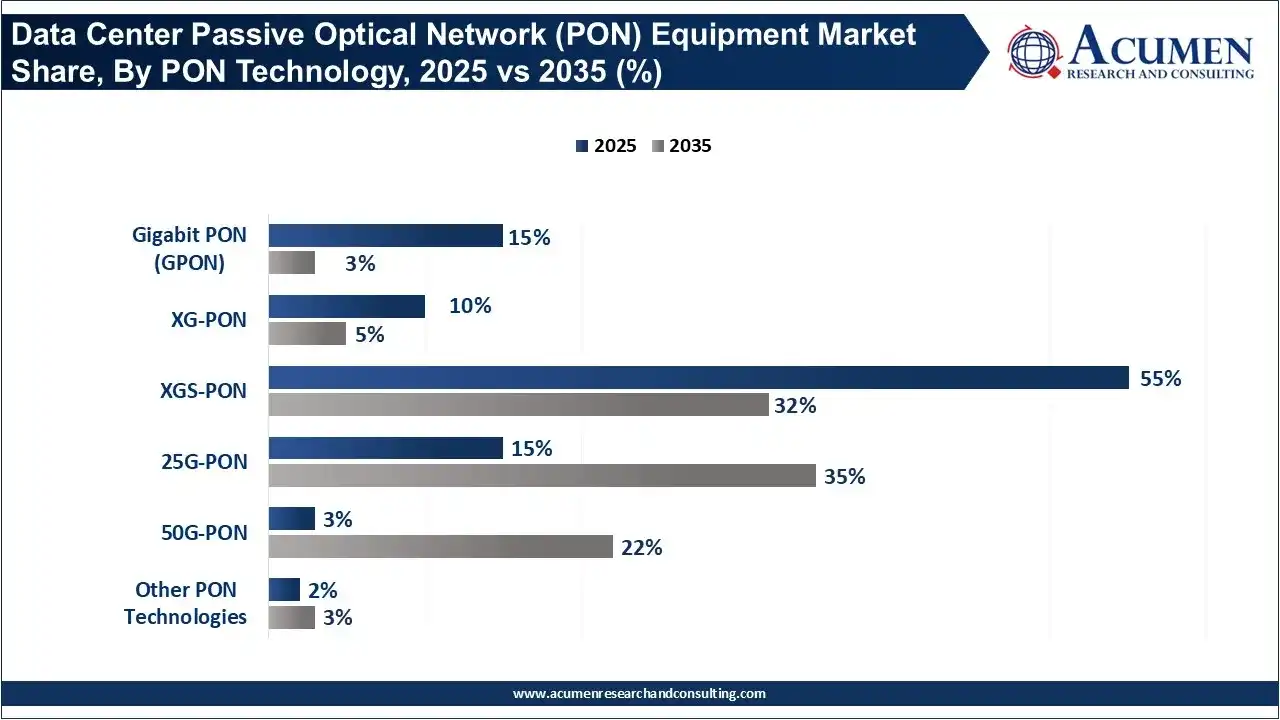
25G-PON was 15% in 2025 and is forecast to rise to 35.0% in 2035, the largest increase for the PON technologies in the tables below. This changeover is due to the increase in bandwidth needs for AI-focused and hyperscale data center infrastructure.
Higher-speed PON becomes more relevant when operators want to support more endpoints and higher aggregate management traffic without giving up the benefits of passive infrastructure. The 25GS-PON MSA Group defines 25GS-PON as a technology that delivers higher-speed symmetric connectivity. Version 4 of its specification was released in 2026.
Application Insights
Why Is Out-of-Band Management Becoming the Core PON Application?
Out-of-band management was the largest application segment in 2025, at 88%, by far the largest application as it provides an independent path for monitoring, troubleshooting and recovering data center critical elements even when the production network is not reachable.
PON-based OOBM architectures replacing a multitude of active management switches with a common passive fiber distribution infrastructure are advantageous for OOBM, where Nokia estimates a PON-based architecture can reduce active switches by 90%, power requirements by 50% and operational effort by 80%.
Data Center Passive Optical Network (PON) Equipment Market Share, By Application, 2025 (%)
| By Application | Revenue Share, 2025 (%) |
|---|---|
| Out-of-Band Management (OOBM) | 88% |
| Data Center Infrastructure Management (DCIM) | 10% |
| Others | 2% |
Data center infrastructure management provided 10% in 2025. The use of PON-based data center infrastructure monitoring and management provides optical connectivity without the need for a complex and expensive Ethernet-based management network, simplifying the physical infrastructure.
The opportunity has matured thanks to the overall PON market expansion outside of broadband access networks, to the point where industry reports are now monitoring PON deployments for data center infrastructure management and management, not just access.
Next-generation fiber-optic networks for data centers, data center infrastructure management and out-of-band management, as well as data-center specific PON infrastructure, are further enabled by PON being deployed outside of broadband access networks.
Data Center Type Insights
Which Data Center Models Are Driving PON Equipment Adoption?
Hyperscale data centers represented 50% of the market in 2025 and were the largest type of data center, largely due to the vast infrastructure operated by hyperscalers and where thousands of endpoints generate large management-network overhead. The point-to-multipoint topology of PON is ideal at this scale as a single optical platform could connect hundreds or thousands of endpoints while limiting the number active switching elements. Nokia claims that the PON-based OOBM architecture will enable the connection and management of thousands of endpoints from a centralized platform.
Data Center PON Equipment Market Share, By Data Center Type, 2025 (%)
| By Data Center Type | Revenue Share, 2025 (%) |
|---|---|
| Hyperscale | 50% |
| Colocation | 30% |
| Enterprise | 12% |
| Government/Defense | 5% |
| Other | 3% |
Colocation facilities accounted for 30.0% in 2025. Colocation operators manage infrastructure for multiple customers and therefore require scalable, resilient management architectures that can support large numbers of physical and logical endpoints.
PON can provide a centralized management layer while keeping the optical distribution network passive between the central switching location and endpoint devices. This architecture can help reduce active equipment and simplify cabling in facilities where rack density and space utilization are important operational considerations.
Deployment Architecture Insights
Which PON Deployment Architecture Is Emerging as the Preferred Model?
Dedicated PON OOBM accounted for 65.0% in 2025, establishing it as the dominant deployment architecture. The model provides a separate optical management network dedicated to out-of-band connectivity rather than sharing the production data network.
This separation is important because OOBM is intended to remain accessible when the primary network experiences an outage or configuration problem. PON can reinforce this separation while reducing the number of active devices required throughout the data center.
Data Center PON Equipment Market Share, By Deployment Architecture, 2025 (%)
| By Deployment Architecture | Revenue Share, 2025 (%) |
|---|---|
| Dedicated PON OOBM | 65% |
| Hybrid PON-Ethernet OOBM | 25% |
| PON-based DCIM | 8% |
| Other Architectures | 2% |
Hybrid PON-Ethernet OOBM represented 25.0% in 2025. This architecture combines the optical efficiency and centralized aggregation of PON with Ethernet connectivity where existing infrastructure, device compatibility, or operational requirements make a complete PON migration impractical.
The hybrid model can therefore function as a transition architecture for data center operators that already have Ethernet-based management networks but want to introduce PON into selected sections of the facility. Multi-technology platforms are increasingly supporting this migration approach, with vendors developing solutions capable of accommodating different generations of PON on common infrastructure.
Endpoint Type Insights
PON Connectivity Across Servers, Network and Infrastructure Equipment
Servers accounted for 50% of all endpoint implementations in 2025, the largest category. The outsized prominence of servers illustrates the broad deployment of servers within the data center, and the need to remotely manage, monitor, troubleshoot, and recover servers 24x7.
As data centers scale up the number of servers to support cloud and AI workloads, the number of management endpoints connecting into the OOBM infrastructure will grow. PON enables these endpoints to be connected on optical modems near the equipment, while a common OLT infrastructure consolidates the management connections.
Data Center PON Equipment Market Share, By Endpoint Type, 2025 (%)
| By Endpoint Type | Revenue Share, 2025 (%) |
|---|---|
| Servers | 50% |
| Network Equipment | 25% |
| Storage Equipment | 12% |
| Power & Cooling Equipment | 8% |
| Other Managed Devices | 5% |
Equipment made up 25% of endpoints in 2025. Routers, switches, optical networking equipment, and other network equipment have independently managed connectivity since all faults in the production network could otherwise prevent operators from accessing the infrastructure to fix the faults.
PON-based OOBM provides an alternate management path that remains active while the production network is down. For that reason, dedicated PON management architectures are a natural solution for network equipment.
Regional Insights
- The North America data center PON equipment market size was valued at $55 million in 2025 and is observed to reach at $2,788.55 million by 2035; expanding at a CAGR of 47.6% over the forecast period from 2026 to 2035.
- The Europe data center data center PON equipment market size was valued at $12 million in 2025. The market is observed to reach at $863.12 million by 2035; growing at a promising CAGR of 53.4% during the forecast period of 2026-2035.
- The Asia-Pacific data center data center PON equipment market size was estimated at $18 million in 2025 and is anticipated to reach at $1,792.64 million by 2035; growing at a CAGR of 59.1% from 2026 to 2035.
- The LAMEA data center data center PON equipment market was valued at $15 million in 2025 and is expected to reach at $1,195.09.40 million by 2035; growing at a CAGR of 55.2% from 2026-2035.
Which Region is Driving the Data Center PON Equipment Market?
North America held the top position in the market with a 55% share in 2025. North America's market position is the result of hyperscale, cloud, and large-scale data center infrastructure being concentrated in the region, as well as data center operators' growing need for an efficient management network in these data centers that are becoming larger and more complex.
North America also is well placed for PON-based OOBM as the region's data center operators are looking at architectures that can minimize active network devices and connections, cabling, power consumption, and operational complexity.
Nokia, for example, is positioning PON-based OOBM for AI and cloud data centers. It notes that its Aurelis architecture has the potential to eliminate 90% of active switches, 50% or more of power consumption, and 80% of operational effort.
North America's position is also supported by the increasing deployment of AI-oriented data center infrastructure. AI workloads are increasing rack density and management complexity, making the separation of management traffic from production networks increasingly important.
Asia Pacific Data Center PON Equipment Market Outlook
Asia-Pacific represented 18.0% of the market in 2025 and is projected to reach 27.0% by 2035, making it the fastest-growing regional segment in the supplied segmentation, with a 59.1% CAGR from 2026 to 2035.
The region's growth is supported by expanding data center capacity, increasing cloud adoption, digital infrastructure investment, and the development of large-scale facilities capable of supporting AI and other high-performance workloads. The shift toward higher-density data centers increases the importance of efficient management architectures because operators must manage larger numbers of servers, network devices, storage systems, and other endpoints.
The technology transition toward 25G-PON and 50G-PON can further support the regional opportunity. Industry activity is already moving toward higher-speed PON technologies, with the 25GS-PON MSA Group releasing version 4 of its specification in 2026 and vendors developing platforms capable of supporting 25G and 50G PON.
Which are the Leading Countries for Data Center PON Equipment Market?
| Country | Key Market Characteristics | Key PON Opportunity |
|---|---|---|
| United States | Large hyperscale and AI data center ecosystem with continued investment in high-density infrastructure | PON-based OOBM, hyperscale deployments, energy-efficient management networks |
| China | Major PON technology and optical networking ecosystem with extensive fiber infrastructure | XGS-PON, 25G-PON, 50G-PON and large-scale optical infrastructure |
| Japan | Mature data center and fiber infrastructure supported by advanced telecommunications capabilities | High-speed PON, enterprise data centers and infrastructure management |
| South Korea | Strong cloud, semiconductor and AI infrastructure ecosystem | High-speed PON for AI-ready and high-density data centers |
| Germany | Major European data center market with increasing focus on energy efficiency and sustainable infrastructure | PON-based OOBM, efficient data center connectivity and DCIM |
| Singapore | Important Asia-Pacific data center hub with hyperscale and colocation activity | Space- and power-efficient PON architectures for hyperscale and colocation facilities |
Data Center PON Equipment Market Vendor Landscape
- Nokia – Nokia provides PON OLT and ONT technologies and has expanded specifically into data center OOBM with its Aurelis for Data Centers solution, launched in March 2026.
- Huawei – Huawei has a broad optical access portfolio covering GPON, XGS-PON and next-generation PON technologies for high-capacity fiber networks.
- ZTE – ZTE develops PON OLT, ONT and optical access platforms spanning multiple generations of PON technology and high-speed fiber connectivity.
- Ciena – Ciena has developed DCOM, a PON-based data center out-of-band management solution, and reported deployments involving Meta and additional hyperscaler customers.
- Broadcom – Broadcom supplies PON silicon and networking components supporting technologies including GPON, XGS-PON and higher-speed PON architectures.
- ADTRAN – ADTRAN provides fiber access and optical networking equipment serving communications providers, enterprises and other network operators.
- Calix – Calix develops broadband access platforms and PON technologies spanning optical line terminals, ONTs and network management capabilities.
- CommScope – CommScope offers fiber-optic infrastructure and broadband networking equipment supporting PON-based access architectures and optical connectivity.
Recent Breakthroughs
- In March 2026, Nokia launched Aurelis for Data Centers, a purpose-built PON-based out-of-band management solution designed for AI and cloud data center environments. Nokia said the architecture can reduce active switches by 90%, deliver at least 50% power savings and reduce operational effort by 80%. The solution combines an OLT, remotely managed optical modems and a centralized command platform for managing thousands of endpoints.
- In June 2026, Ciena reported that its DCOM PON-based data center out-of-band management solution was gaining traction among hyperscale customers. The company said DCOM had been deployed with Meta, while a second hyperscaler had placed initial orders and a third was progressing through laboratory qualification. Ciena also linked the solution's momentum to the growing requirements created by AI infrastructure expansion.
Segments Covered
By Equipment Type
- PON Optical Line Terminals (PON OLTs)
- PON ONTs/ONUs and Optical Modems
- Passive Optical Splitters
- Other PON Equipment
By PON Technology
- GPON
- XG-PON
- XGS-PON
- 25G-PON
- 50G-PON
- Other PON Technologies
By Application
- Out-of-Band Management (OOBM)
- Data Center Infrastructure Management (DCIM)
- Other Applications
By Data Center Type
- Hyperscale Data Centers
- Colocation Data Centers
- Enterprise Data Centers
- Government and Defense Data Centers
- Other Data Centers
By Deployment Architecture
- Dedicated PON OOBM
- Hybrid PON-Ethernet OOBM
- PON-based DCIM
- Other Architectures
By Endpoint Type
- Servers
- Network Equipment
- Storage Equipment
- Power and Cooling Equipment
- Other Managed Devices
By Region
- North America
- Europe
- Asia-Pacific
- Latin America
- Middle East & Africa
Looking for discounts, bulk pricing, or custom solutions? Contact us today at sales@acumenresearchandconsulting.com
Frequently Asked Questions

Other ICT Reports
February 2023
August 2026
February 2020
June 2023