
Surface Computing Market Size, Share, Forecast 2026 to 2035
Surface Computing Market (By Component: Hardware, Software; By Display Type: Flat Display, Curved Display; By End Use: BFSI, Healthcare, Retail, Automotive, Hospitality, Others) - Global Industry Analysis, Size, Share, Trends and Forecast 2026 to 2035
- Last Updated: 17 Dec 2025
- Report Code: ARC3873
- Category: ICT
Surface Computing Market Size and Forecast 2026 - 2035
The global surface computing market size accounted for USD 87.0 billion in 2025 and is estimated to reach around USD 1,523.1 billion by 2035 growing at a CAGR of 33.3% from 2026 to 2035. The rising demand for intuitive, natural, and immersive user interfaces across consumer and enterprise environments is driving the growth or the surface computing market. Moreover, the expansion of touch-enabled solutions across diverse verticals continues to support the market demand.
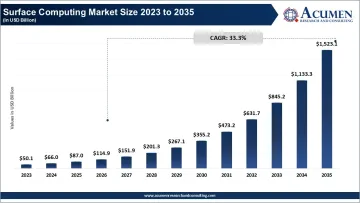
Report Highlights
- By Region, the North America surface computing market leads the market and has garnered a revenue of USD 31.4 billion in 2025.
- By Region, the Asia-Pacific surface computing market is projected to grow at a CAGR of 34.1% from 2026 to 2035.
- By Component, hardware segment represents 85% of the total market share in 2025.
- By Display Type, flat display projects segment accounts for over 95% of the market share in 2025.
- By End Use, the retail sector accrued 29% of the surface computing market share in 2025.
Currently, the market is at a revolutionary phase that is characterized by rapid technological innovations and rising consumer demand for intuitive and interactive computing applications. Surface computing applications integrate a wide range of devices, including interactive kiosks, touch-enabled screens, and multi-user interfaces, which have become predominant in large number of areas such as healthcare, education, and retail, among others. Integration of technologies like AI and machine learning in surface computing applications are enhancing user experience altogether by making interactions highly efficient and smooth.
With organizations looking forward to enhanced productivity and engagement, the adoption of these advanced solutions will grow further, thereby driving the market growth. Additionally, ongoing development in user interface design is restructuring the way people interact with technology. Emphasis on voice commands and natural gestures highlights the urge towards more user-friendly systems that meet the needs of many demographics. This may trigger the growth of more advanced applications that tap into the capabilities of surface computing, further increasing its adoption across industries. While the market witnesses growth and is expected to expand further, stakeholders need to stay aligned with evolving technologies and consumer preferences to reap the most from new market opportunities.
Surface Computing Market Dynamics
Market Drivers
Growing Innovations in Touch Technology
- The development in touch technologies has brought immense momentum into the surface computing market. Capacitive and optical touch screens are making it easier for users to interact with devices in an intuitively responsive way. This is not just a trend, but a fundamental shift in user interaction with technology. The market for industrial touch screen display is projected to grow at over USD 6.0 Billion by 2032, which reflects growth on the track. As touch technology continues to become more advanced, demand from sectors like education, healthcare, and entertainment is expected to increase, leading to significant growth in the surface computing market. The integration of these technologies into everyday devices seamlessly is likely to redefine user experiences, thus driving the market growth.
Growing Emphasis on User Interface
- Studies have shown that a business focusing on enhancing user experience can ensure a rise in customer retention. As companies face challenges in competitive environments, the demand for surface computing solutions that offer users great experiences is bound to boost. This trend emphasizes that user-centric design is critical in shaping the future of the surface computing market.
Market Restraints
High Cost of Implementation and Maintenance
- Surface computing technologies typically involve highly sophisticated components such as large interactive display screens, touch sensors, highly efficient processors, and robust protection layers. Additionally, surface computing systems call for software development that is specifically geared towards ensuring seamless multi-touch interactions. Such high capital costs pose a significant adoption barrier to small, medium, and large enterprises, particularly learning institutions and government departments that operate on low capital budgets.
Technical Complexity and Integration Challenges
- Complexity in technology, together with issues of integration, is another significant factor that hampers the surface computing industry growth. The adoption of surface computing platforms may need to be efficiently interfaced with the overall IT infrastructure, software, and data networks, which might not be easy with legacy systems. There might also be issues of compatibility, need for software adaptation, and lack of standardization with respect to the platforms. In addition, scaling to a certain level of performance in real-world conditions, such as vulnerability to lighting, wear, dust, and damage, might vary.
Market Opportunities
Expansion of Interactive Displays
- The rising requirement for interactive displays is a highly influencing the growth of the surface computing market. Companies, as well as educational institutes, are gradually resorting to interactive displays to make collaboration easier and learning more interactive. According to the latest projections, the global market for display technology is estimated to reach US$ 210 Bn by 2030. This is because there is a rising need for more interactive spaces, where people can interact with the content in real-time. As a result, with the increasing acceptance of interactive technologies for enhancing productivity, the market is set to expand significantly. The rising acceptance of interactive displays in meeting rooms, classrooms, and other common areas clearly indicates the potential for growth in the market.
Incorporation of Augmented Reality
- The adoption of Augmented Reality (AR) in surface computing devices is on the verge of becoming a revolutionary force in the market. Augmented Reality is a technology that improves user interaction experiences by projecting digital information in the real world. The healthcare, real estate, and shopping sectors are experiencing a significant surge in the adoption of AR to increase user engagement and optimize efficiency. The global augmented reality and virtual reality market size was valued at USD 81.77 billion in 2025 and is estimated to reach around USD 1980.81 billion by 2035, growing at a CAGR of 37.5% from 2026 to 2035. This indicates that there is a massive potential opportunity available for surface computing solutions that support Augmented Reality implementation. The need for differentiability in businesses is a contributing factor that is set to increase the adoption of Augmented Reality-enabled surface computing devices, thus fueling the market growth. It is estimated that by 2028, there will be over 1,187 million mobile AR users across the world.
Surface Computing Market Report Scope
| Attributes | Details |
|---|---|
| Surface Computing Market Size 2025 | USD 87.0 Billion |
| Surface Computing Market Forecast 2035 | USD 1,523.1 Billion |
| Surface Computing Market CAGR During 2026 – 2035 | 33.3% |
| Analysis Period | 2023 – 2035 |
| Base Year | 2025 |
| Forecast Data | 2026 – 2035 |
| Segments Covered | By Component, By Display Type, By End Use, and By Geography |
| Key Companies Profiled | Apple Inc., Dell Inc., Microsoft Corporation, Lenovo, Planar Systems, Inc., Sony Corporation, Fujitsu Limited, LG Electronics Inc., HP Inc., and Samsung Electronics Co. Ltd. |
| Report Coverage | Market Trends, Drivers, Restraints, Competitive Analysis, Player Profiling, Covid-19 Analysis, Regulation Analysis |
Surface Computing Market Regional Analysis
Geographically, North America accounts for the largest share of the surface computing market, mainly because of the innovative technological infrastructure and a flourishing ecosystem of innovation that contribute to the dominance in the surface computing market. Industries including retail, healthcare, finance, and others are harnessing the power of surface computing technology for improving consumer experiences, streamlining business operations, and staying competitive in the digital landscape.
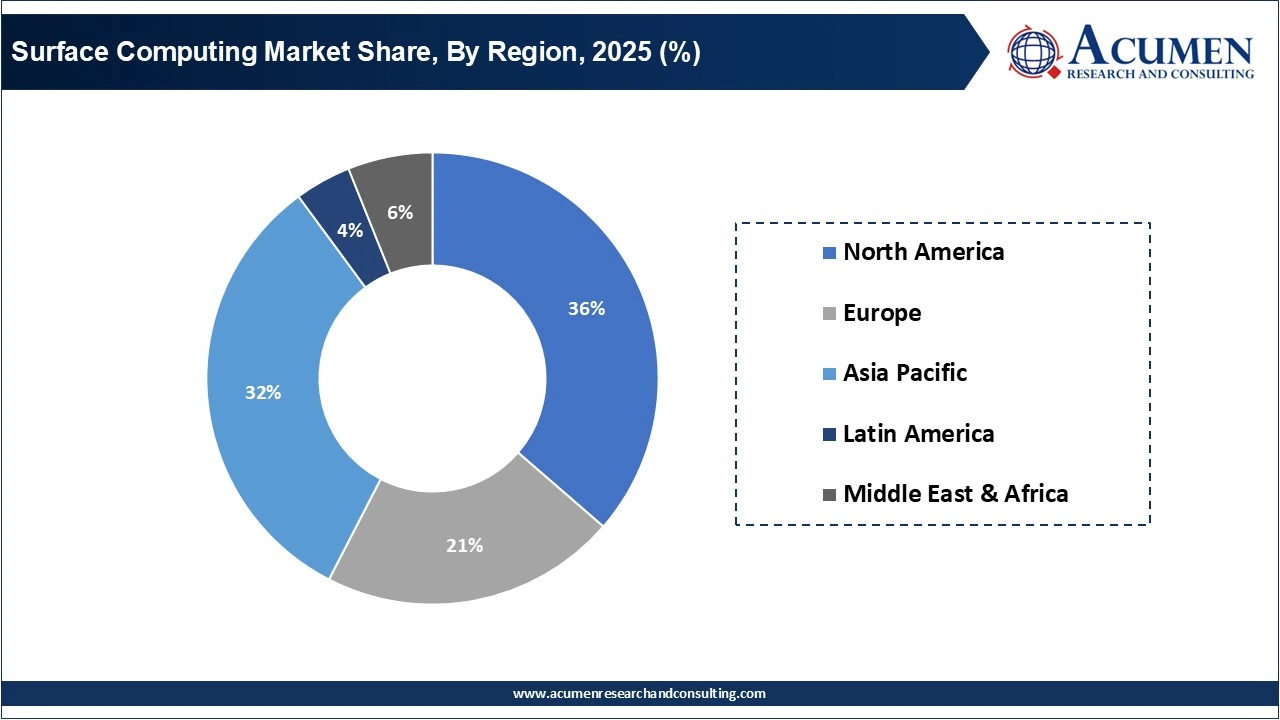
There is expected to be a considerable growth of the surface computing market in the Asia-Pacific region. The growth is driven by the growing demand for touch-based and interactive solutions that are evident across various sectors. Moreover, the region is experiencing a rising emphasis on local advancements and the development of cost-effective solutions in surface computing to address a diverse market.
| Component | Market Share (%) | Key Highlights |
|---|---|---|
| North America | 36% | The innovative technological infrastructure and a flourishing ecosystem of innovation contribute to the dominance of North America in the surface computing market. |
| Europe | 21% | A key trend being seen in Europe is the wider adoption of surface computing solutions for retail, healthcare, and smart public spaces, driven by exceptional digital infrastructure and continuous enterprise digital transformation projects. |
| Asia-Pacific | 32% | The growth is driven by the growing demand for touch-based and interactive solutions that are evident across various sectors. |
| MEA | 6% | The MEA region is progressing to become a high-growth area for surface computing, which is fueled by smart city initiatives, luxury retail growth, and government-driven digitalization initiatives. |
| Latin America | 4% | The adoption of surface computing technologies is gradually taking place in Latin America, owing to the rising spending on modernization, digitization, and interactive informational systems. |
Surface Computing Market Segmental Insights
The worldwide market for surface computing is split based on component, display type, end use, and geography.
Component Insights
According to the surface computing industry analysis, hardware dominated the market. This is attributed to the growing demand for digital technology in the businesses to improve the operational performance. Nonetheless, the software segment is projected to witness the fastest CAGR over the forecast period. The growing demand for touch-based solutions and innovative application-based systems are projected to offer profitable opportunities for the market growth over the forecast period.
| Component | Market Share (%) | Key Highlights |
|---|---|---|
| Hardware | 85% | The increasing demand for digital interfaces in the businesses to improve the operational performance is fueling the market growth. |
| Software | 15% | The growing demand for touch-based solutions and innovative application-based systems are driving the market demand. |
Display Type Insights
The flat display segment dominates the surface computing sector. Flat displays are the most utilized display type in the surface computing market because of their affordability, ease of integration, and wide applications in collaborative workspaces, education, and commercial settings. The additional advantages of using flat displays are their standardized form factors, high durability, and ease of deployment with existing software and mounting systems, making them a preferred option for large-scale deployments. Their availability in multiple sizes and resolutions further reinforces their strong market position for deployment across interactive kiosks, conference rooms, classrooms, and public information systems.
| Display Type | Market Share (%) | Key Highlights |
|---|---|---|
| Flat Display | 95% | Flat displays are the most utilized display type in the surface computing market because of their affordability, ease of integration, and wide applications in collaborative workspaces, education, and commercial settings. |
| Curved Display | 5% | The ability of curved displays to provide an immersive visual experience, coupled with high user engagement for retail, gaming, and experiential installations, is driving the trend toward their use in premium surface computing applications. |
End Use Insights
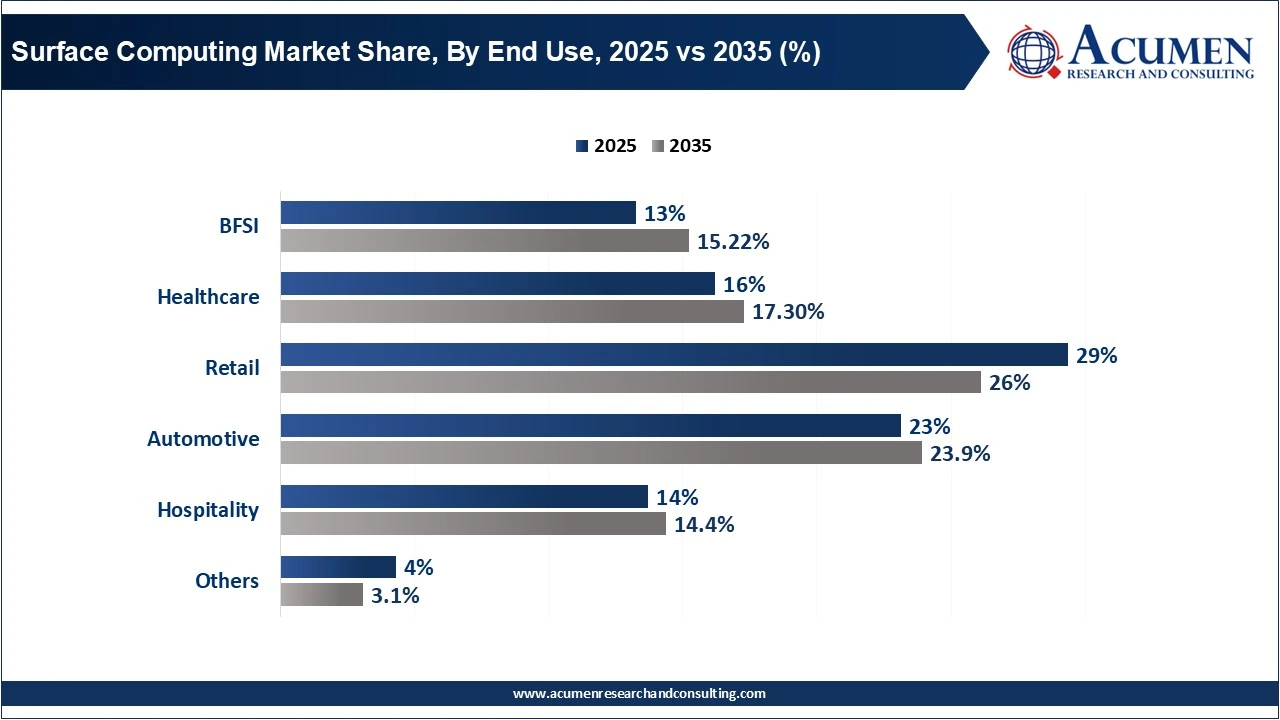
According to surface computing market forecast, among these, the retail segment is projected to dominate the industry. The rising demand for interactive shopping experiences, led by the increased adoption rate of touch-enabled technology is fueling the segment demand. Surface computing is transforming the retail sector by integrating the digital and physical environments, offering interactive touchscreens for custom-made shopping (comparisons, catalogs, self-checkout), enabling data-driven decisions, augmenting engagement with AR/gesture technology, streamlining inventory with the help of mobile devices (such as Microsoft Surface Pro for the staff), and developing immersive brand experiences, thereby driving sales and efficiency while reducing paper waste.
| End Use | Market Share (%) | Key Highlights |
|---|---|---|
| BFSI | 13% | Financial institutions are deploying surface computing solutions to enable appealing customer experiences. These solutions include interactive kiosks, digital advisory tables, and collaborative visualization of data. |
| Healthcare | 16% | Healthcare organizations are investing in innovative solutions that aim to optimize patient care. |
| Retail | 29% | The rising demand for interactive shopping experiences, led by the increased adoption rate of touch-enabled technology is fueling the segment demand. |
| Automotive | 23% | Automotive players are leveraging surface computing to improve customer engagement by providing immersive vehicle configurators, design collaboration, and interactive showroom experiences. |
| Hospitality | 14% | Surface computing interfaces are being used by hotels and travel service providers for self-service check-ins, interactive concierge services, and personalized guest experiences. |
| Others | 4% | Other sectors involve education and public services, which are increasingly employing surface computing to facilitate interactive learning, information access, and collaborative environments. |
Surface Computing Market Players
- Apple Inc.
- Dell Inc.
- Microsoft Corporation
- Lenovo
- Planar Systems, Inc.
- Sony Corporation
- Fujitsu Limited
- LG Electronics Inc.
- HP Inc.
- Samsung Electronics Co. Ltd
Surface Computing Market Segmentation
By Component
- Hardware
- Software
By Display Type
- Flat Display
- Curved Display
By End Use
- BFSI
- Healthcare
- Retail
- Automotive
- Hospitality
- Others
By Region
- North America
- U.S.
- Canada
- Europe
- U.K.
- Germany
- France
- Spain
- Rest of Europe
- Asia-Pacific
- India
- Japan
- China
- Australia
- South Korea
- Rest of Asia-Pacific
- Latin America
- Brazil
- Mexico
- Rest of LATAM
- The Middle East & Africa
- South Africa
- GCC Countries
- Rest of the Middle East & Africa (ME&A)
Looking for discounts, bulk pricing, or custom solutions? Contact us today at sales@acumenresearchandconsulting.com
Frequently Asked Questions

Other ICT Reports
August 2021
October 2024
February 2023
December 2025