
AI-Powered Surgical Software Market Size, Share, Trends, Report 2026 To 2035
AI-Powered Surgical Software Market (By Software Type: Surgical Planning & Simulation Software, Intraoperative AI & Computer Vision Software, Surgical Navigation & Guidance Software, AI Clinical Decision-Support Software, Others; By Deployment: On-Premise, Cloud-Based, Hybrid; By Technology: Machine Learning & Deep Learning, Computer Vision, Natural Language Processing, Generative AI, Others; By Application: Preoperative Planning & Assessment, Intraoperative Guidance & Navigation, AI-Assisted Robotic Surgery, Surgical Imaging & Visualization, Clinical Decision Support, Others; By Surgery Type: General Surgery, Orthopedic Surgery, Neurosurgery, Urological Surgery, Gynecological Surgery, Others; By Surgical Approach: Robotic-Assisted Surgery, Laparoscopic & Endoscopic Surgery, Open Surgery, Others; By End User: Hospitals, Ambulatory Surgical Centers, Specialty Surgical Centers & Clinics, Academic & Research Medical Centers, Others) - Global Industry Analysis, Size, Share, Regional Analysis, Trends and Forecast 2026 - 2035
- Last Updated: 05 Oct 2026
- Report Code: ARC3994
- Category: Healthcare and Pharmaceuticals
AI-Powered Surgical Software Market Overview and Growth
The global AI-powered surgical software market size was valued at USD 1.75 billion in 2025 and is seen to reach USD 24.55 billion by 2035, while expanding at a promising CAGR of 30.2% during the forecast period of 2026-2035. Growing adoption of AI-assisted robotic surgery, real-time surgical guidance, medical imaging analysis, and predictive clinical decision support is accelerating demand for AI-powered surgical software.
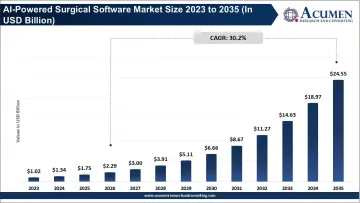
AI-powered surgical software uses machine learning, computer vision, predictive analytics, and other AI technologies to support preoperative planning, surgical navigation, intraoperative decision-making, robotic-assisted procedures, and postoperative outcome analysis. Adoption is expanding as healthcare providers seek greater surgical precision, workflow efficiency, and data-driven clinical support.
Key Takeaways
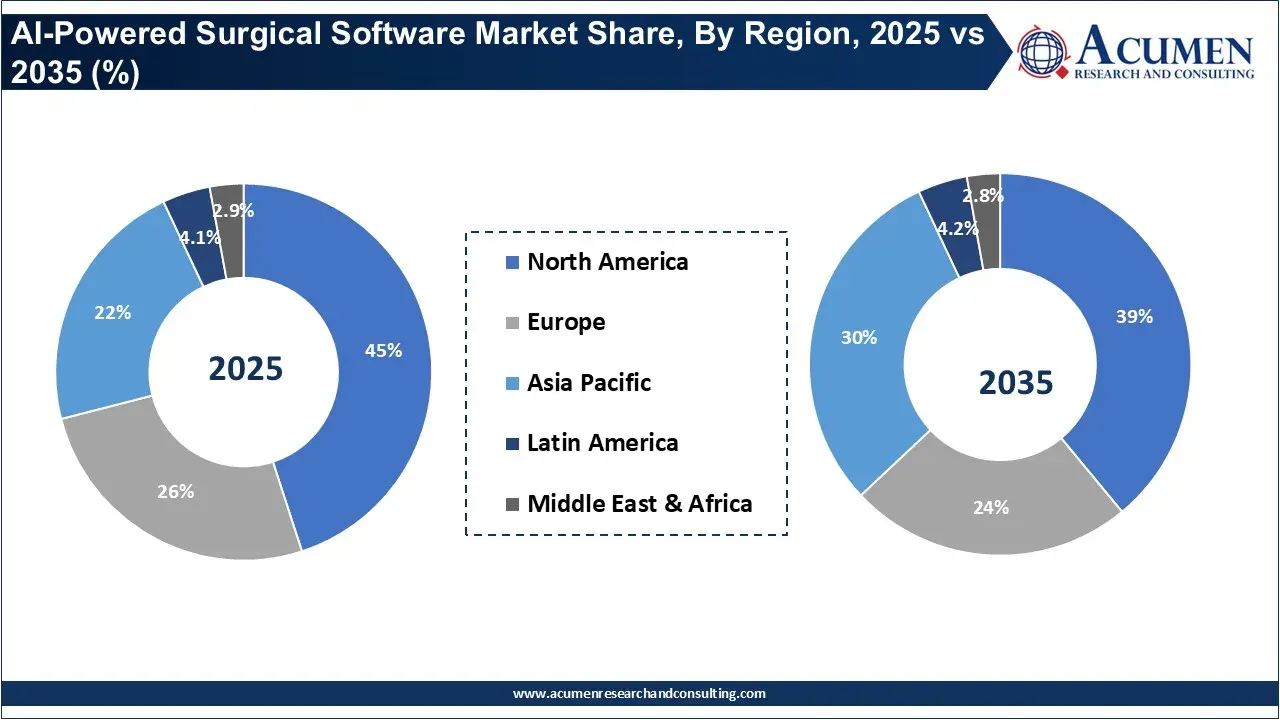
- By region: North America dominated the market with a 45.0% share in 2025, supported by advanced healthcare infrastructure, early AI adoption, and strong investment in surgical technologies.
- By software type: Surgical Planning & Simulation Software dominated with a 24.0% share in 2025, driven by growing demand for AI-enabled surgical planning, simulation, and preoperative assessment.
- By deployment: On-premise deployment dominated with a 43.0% share in 2025, supported by healthcare providers' focus on data security, infrastructure control, and integration with existing clinical systems.
- By technology: Machine Learning & Deep Learning dominated with a 43.0% share in 2025, driven by widespread use in medical image analysis, surgical planning, clinical decision support, and outcome prediction.
- By application: AI-Assisted Robotic Surgery dominated with a 25.0% share in 2025, supported by increasing integration of AI with robotic platforms for surgical planning, visualization, and intraoperative assistance.
- By surgery type: General Surgery dominated with a 22.0% share in 2025, supported by its high procedure volume and growing adoption of AI-powered planning, navigation, and robotic surgical technologies.
- By surgical approach: Robotic-Assisted Surgery dominated with a 43.0% share in 2025, driven by rising adoption of robotic platforms and integration of AI-based navigation, computer vision, and surgical planning.
- By end user: Hospitals dominated with a 62.0% share in 2025, supported by high surgical volumes, advanced infrastructure, and greater investment capacity for AI-enabled surgical technologies.
Market Size & Forecast
- Base Year Market Size (2025): $1.75 billion
- Current Year Market Size (2026): $2.29 billion
- Estimated Year Market Size (2035): $24.55 billion
- Forecast Period CAGR (2026-2035): 30.2%
Key Growth Factors
- AI Surgical Imaging: Increasing availability of high-quality medical imaging and intraoperative video is expanding opportunities for AI-powered software to support image segmentation, anatomical identification, surgical planning, and intraoperative guidance. These capabilities can help convert complex clinical images into actionable information, supporting broader adoption of software across digitally enabled surgical workflows.
- Digital Surgery Adoption: Hospitals are increasingly integrating digital technologies such as surgical navigation, robotic platforms, 3D visualization, and connected operating-room systems. AI-powered software can operate across these platforms to analyze clinical and procedural data, creating a broader technology ecosystem for automated assistance, decision support, surgical planning, and postoperative analysis.
- Complex Procedure Demand: Growing complexity of neurosurgical, orthopedic, cardiovascular, and minimally invasive procedures is increasing demand for software that can support surgeons with patient-specific information. AI can analyze imaging and procedural data to assist with planning, anatomical recognition, and workflow guidance, supporting more data-driven approaches to complex surgical interventions.
Market Dynamics
Growth Drivers
- Surgical Decision Support: AI software can analyze imaging, patient information, and intraoperative data to provide decision-support information during surgical workflows. Increasing availability of multimodal clinical data is enabling applications ranging from anatomical identification and procedure planning to risk prediction and intraoperative assistance, expanding the role of AI beyond conventional diagnostic software.
- Robotic Integration: Integration of AI software with robotic surgical systems is creating demand for intelligent capabilities such as anatomical recognition, instrument tracking, motion analysis, workflow identification, and procedural assistance. As robotic surgery expands, software developers can add AI functionality to existing platforms, creating new applications across minimally invasive and complex surgical procedures.
- Personalized Planning: AI-powered software can process patient-specific imaging and clinical information to support individualized surgical planning. Automated segmentation, 3D anatomical modeling, procedure simulation, and treatment planning can help surgeons evaluate patient-specific characteristics before surgery, supporting demand for software that improves preparation and procedural decision-making.
Key Restraints
- Clinical Validation: AI-powered surgical software requires extensive validation to demonstrate safety, accuracy, reliability, and clinical usefulness. Performance can vary across patient populations, imaging equipment, hospitals, and surgical techniques, requiring developers to conduct rigorous testing and external validation before healthcare providers can confidently integrate these technologies into clinical workflows.
- Integration Costs: Implementing AI surgical software can require integration with electronic health records, imaging systems, robotic platforms, navigation technologies, and hospital IT infrastructure. These requirements can increase deployment costs and implementation time, particularly for hospitals operating legacy systems or multiple technology platforms that lack standardized interoperability.
- Regulatory Requirements: AI-enabled medical devices and software must meet regulatory requirements covering safety, effectiveness, cybersecurity, software modifications, and lifecycle management. The FDA's framework for AI-enabled devices emphasizes the importance of managing these technologies across their total product lifecycle, increasing compliance requirements for developers of continuously evolving surgical AI software.
Key Opportunities
- AI Surgical Navigation: AI can enhance surgical navigation by automating anatomical segmentation, image registration, structure recognition, and intraoperative guidance. This creates opportunities for software capable of adapting navigation information to patient-specific anatomy and changing surgical conditions, particularly across neurosurgery, orthopedics, spinal surgery, ENT, and other image-guided procedures.
- Predictive Surgery: Growing availability of clinical and procedural datasets is creating opportunities for predictive software that can estimate surgical risks, postoperative complications, treatment response, and recovery outcomes. Such applications could help clinicians incorporate patient-specific risk information into surgical planning and postoperative management while expanding AI applications throughout the surgical care pathway.
- Automated Workflow Analysis: AI-powered computer vision can analyze surgical video to identify instruments, procedural stages, and workflow patterns. This creates opportunities for software that supports procedure documentation, quality monitoring, surgical training, workflow optimization, and performance analysis, potentially extending AI applications beyond direct clinical decision support into broader operating-room management.
Key Challenges
- Data Bias: AI surgical software depends on representative datasets covering different patient populations, imaging systems, surgical techniques, and clinical environments. If training data are incomplete or geographically concentrated, models may perform differently when deployed elsewhere. Developers therefore need diverse datasets and external validation to improve reliability across real-world healthcare settings.
- Explainability Concerns: Surgeons may be reluctant to rely on AI-generated recommendations when the reasoning behind an output is difficult to understand. Explainability is particularly important when software supports high-risk clinical decisions. Developers must balance sophisticated machine-learning capabilities with interfaces that provide clinically meaningful information without creating excessive cognitive workload.
- Workflow Adoption: AI software must provide clear clinical value without disrupting established surgical workflows. Surgeons and operating-room teams need appropriate training, reliable system performance, interoperability, and human oversight. If AI introduces additional steps, delays, alerts, or technical complexity without demonstrable benefits, hospitals may face difficulties achieving consistent adoption across surgical departments.
Regional Insights
North America AI-Powered Surgical Software Market: How Does the Region Lead Adoption?
The North America AI-powered surgical software market size was valued at USD 0.79 billion in 2025 and is expected to hit USD 9.58 billion by 2035, expanding at a CAGR of 28.1% over the forecast period of 2026-2035. North America accounted for the largest revenue share. The North American adoption of advanced medical technology, widespread use of surgical robotics technology, high investment in AI-enabled healthcare, and well-established healthcare ecosystem are factors fueling the market growth.
The U.S. has been leading the development and clinical adoption of AI-powered surgical devices, such as AI-enabled computer vision, surgical analytics, robotic-assisted surgery, and clinical decision-support tools. The prevalence of research on robotic-assisted total knee arthroplasty in the U.S. also highlights the growing use of robotic applications in surgical care.
The region's clinical implementation is also likely to benefit from more intensive focus and greater use of artificial intelligence (AI) as applied to existing surgical platforms instead of stand-alone software applications. AI applications are being added to surgical visualization, intraoperative analytics, case documentation, navigation and robotics.
- United States: The U.S. represents the region's largest technology and clinical adoption center, supported by extensive hospital infrastructure, established robotic-surgery programs, medical-device innovation, and increasing integration of AI into surgical platforms. Research on robotic-assisted knee replacement has documented the expanding use of robotic assistance across U.S. surgical settings.
- Canada: Canada is expanding its use of robotic and AI-enabled surgical technologies, particularly through tertiary hospitals and specialized surgical programs. However, adoption remains uneven across healthcare facilities, with published Canadian surgical literature highlighting that robotic colorectal surgery uptake has historically lagged behind adoption in many U.S. centers.
Europe AI-Powered Surgical Software Market: How Is Digital Healthcare Infrastructure Supporting AI Adoption?
The Europe AI-powered surgical software market size was estimated at USD 0.46 billion in 2025 and is projected to surpass USD 5.89 billion by 2035, growing at a CAGR of 29% during the forecast period of 2026-2035. Europe was the second largest regional market in 2025. This was driven by increasing digital-healthcare infrastructure, rising adoption rates of AI, further enhanced medical device capacity and increased investment in AI-enabled clinical solutions, according to a 2026 European Commission report. Among healthcare organizations in 31 European countries, 94% reported they already use or have plans to introduce AI.
Among other potential enabling factors, this region is building AI-powered surgical software capacity with new computing infrastructure, EHR systems, health-data interoperability and policy programs.
The EU's average eHealth maturity score was at 87% in 2025, while regional programs, such as AICare@EU and the European Health Data Space, are working to tackle data, regulation, organizational and clinical hurdles to AI adoption.
- Germany: Germany benefits from a strong medical technology and robotics ecosystem, providing an important base for AI-enabled surgical systems, computer-assisted procedures, and advanced clinical technologies. Its established healthcare infrastructure and industrial robotics capabilities support the development and integration of AI across surgical workflows.
- United Kingdom: The UK is an important market for AI-enabled healthcare research and clinical implementation, with healthcare organizations increasingly exploring AI for clinical decision support, medical imaging, workflow optimization, and advanced surgical applications. Its combination of academic medical research and large-scale healthcare infrastructure supports the development and evaluation of AI-enabled surgical technologies.
Asia-Pacific AI-Powered Surgical Software Market: Why Is the Region Growing Faster Than Other Markets?
The Asia-Pacific AI-powered surgical software market size was accounted for USD 0.39 billion in 2025 and is anticipated to reach USD 7.37 billion by 2035, while expanding at a CAGR of 34.7% from 2026 to 2035. Asia-Pacific is projected to be the fastest-growing regional market from 2026 to 2035. The region's growth is supported by expanding hospital infrastructure, rising healthcare technology investments, increasing adoption of robotic-assisted procedures, and growing demand for AI-powered medical imaging, surgical planning, navigation, and clinical decision-support software. China, Japan, South Korea, and India are developing increasingly sophisticated healthcare AI and surgical technology ecosystems.
The region is also moving from AI research toward practical clinical applications. In China, for example, an AI orthopedic surgery planning platform developed in Beijing received EU CE certification in 2025 after already obtaining recognition in China and the U.S., demonstrating the growing international development and commercialization of AI-powered surgical software from Asia.
- China: China is emerging as a major developer and adopter of AI-powered surgical technologies, particularly in orthopedic surgery, surgical robotics, medical imaging, and AI-based preoperative planning. The development of AIJOINT, which uses deep learning to segment bones, reconstruct anatomy, identify landmarks, and support implant selection, illustrates the increasing sophistication of China's AI-assisted surgical software ecosystem.
Segmental Insights
Software Type Insights
Surgical Planning & Simulation Software: Surgical Planning & Simulation Software dominated the software type segment with 24.0% share in 2025, supported by increasing demand for patient-specific surgical planning, three-dimensional anatomical visualization, procedure simulation, and preoperative risk assessment. AI-enabled planning platforms help surgeons analyze medical images and develop personalized surgical strategies before procedures.
Intraoperative AI & Computer Vision Software: Intraoperative AI & Computer Vision Software represented the second-largest software category with 22.0% share in 2025, driven by the increasing use of real-time image analysis, anatomical recognition, surgical tracking, and computer vision during procedures. Growing integration of AI with surgical cameras, endoscopic systems, and robotic platforms is expanding the role of computer vision in intraoperative decision-making.
AI-Powered Surgical Software Market, By Software Type, 2025 & 2035 (%)
| Software Type | Revenue Share, 2025 (%) | Revenue Share, 2035 (%) |
|---|---|---|
| Surgical Planning & Simulation Software | 24% | 21% |
| Intraoperative AI & Computer Vision Software | 22% | 27% |
| Surgical Navigation & Guidance Software | 20% | 21% |
| AI Clinical Decision-Support Software | 15% | 14% |
| Surgical Analytics & Outcome Intelligence Software | 13% | 13% |
| Other Software | 6% | 4% |
Surgical Navigation & Guidance Software: Surgical Navigation & Guidance Software accounted for 20.0% share in 2025, supported by demand for precise anatomical localization, real-time surgical guidance, image registration, and procedure tracking. These platforms are increasingly integrated with medical imaging, robotic systems, and intraoperative technologies to improve surgical precision and support minimally invasive procedures.
Deployment Insights
On-Premise: On-Premise deployment dominated the deployment segment with 43.0% share in 2025, reflecting healthcare providers' requirements for greater control over sensitive patient data, system infrastructure, cybersecurity, and integration with hospital information systems. Large hospitals and healthcare organizations continue to use on-premise environments for AI-powered surgical applications that require integration with existing clinical and imaging infrastructure.
Cloud-Based: Cloud-Based deployment represented the second-largest category with 37.0% share in 2025, supported by the scalability, remote accessibility, centralized data management, and lower infrastructure requirements offered by cloud platforms. Cloud deployment is increasingly enabling AI-powered surgical software to process large clinical datasets, support collaborative workflows, and facilitate software updates across healthcare networks.
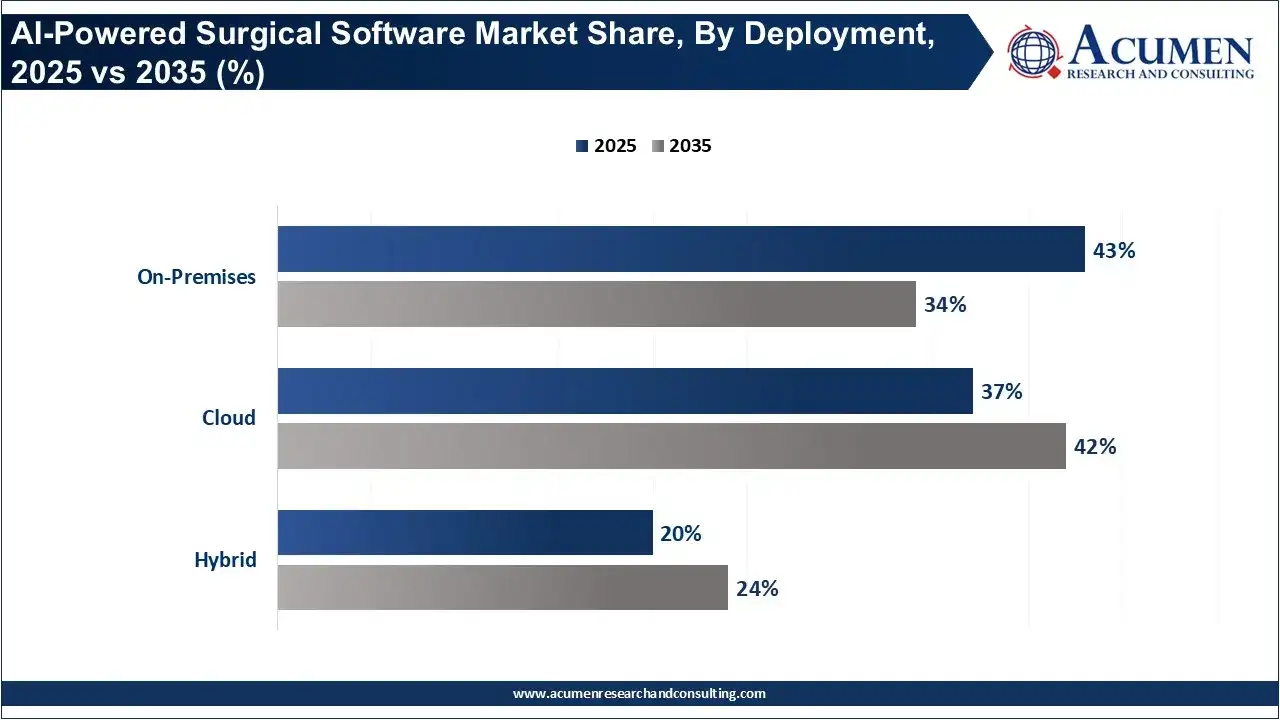
Hybrid: Hybrid deployment accounted for 20.0% share in 2025 and is projected to be the fastest-growing deployment segment, expanding at a 32.8% CAGR from 2026 to 2035. Hybrid architectures combine the security and control of on-premise infrastructure with the scalability of cloud computing, making them suitable for healthcare organizations seeking to process sensitive surgical data locally while using cloud resources for AI model development, analytics, storage, and collaboration.
Technology Insights
Machine Learning & Deep Learning: Machine Learning & Deep Learning dominated the technology segment with 43.0% share in 2025, supported by their extensive use in medical image analysis, surgical outcome prediction, clinical decision support, anatomical recognition, risk assessment, and personalized surgical planning. Deep learning models are increasingly being trained on large clinical and imaging datasets to identify patterns and support complex surgical workflows.
Computer Vision: Computer Vision represented the second-largest technology category with 30.0% share in 2025, driven by its growing application in real-time surgical image interpretation, anatomical structure recognition, instrument tracking, surgical video analysis, and intraoperative guidance. Integration with endoscopic, laparoscopic, microscopic, and robotic imaging systems is expanding the use of computer vision during surgery.
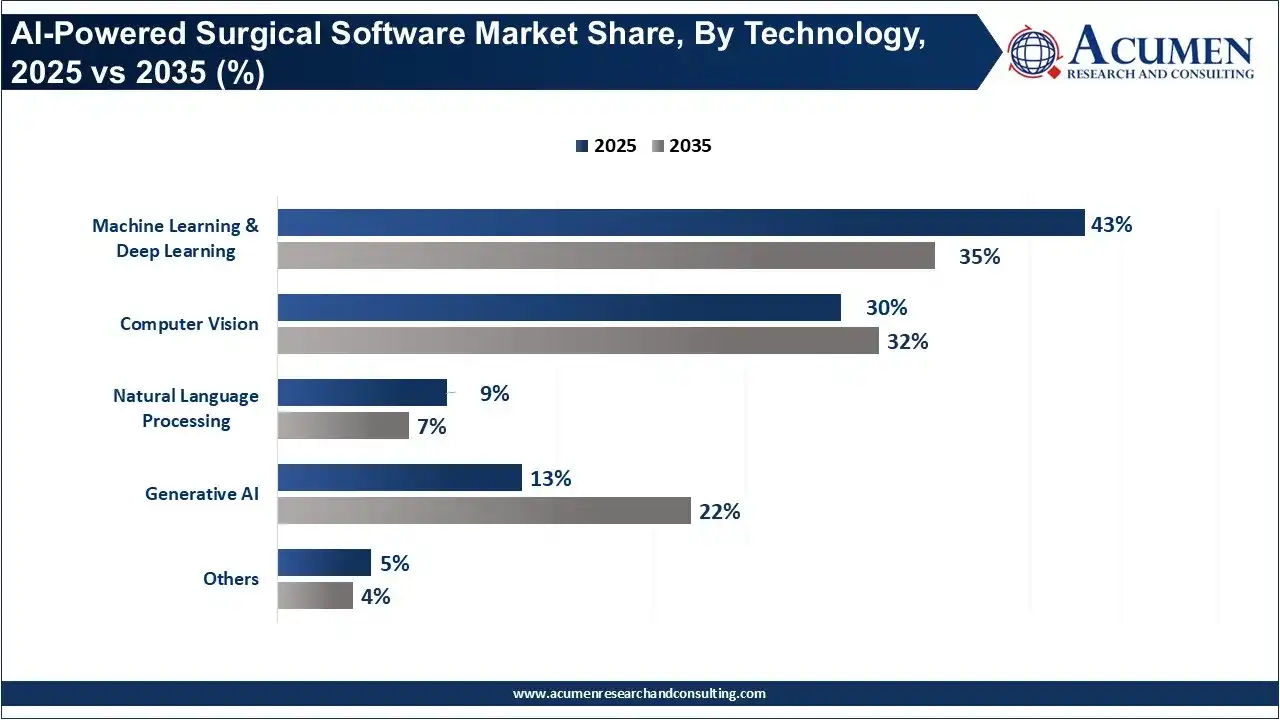
Generative AI: Generative AI accounted for 13.0% share in 2025, supported by its emerging applications in surgical documentation, clinical decision support, medical image interpretation, patient-specific planning, surgical knowledge retrieval, and generation of clinical insights from multimodal healthcare data. Increasing development of healthcare-specific foundation models is expected to broaden the role of generative AI across preoperative, intraoperative, and postoperative workflows.
Application Insights
AI-Assisted Robotic Surgery: AI-Assisted Robotic Surgery dominated the application segment with 25.0% share in 2025, driven by increasing integration of artificial intelligence with robotic surgical platforms to support surgical planning, anatomical identification, instrument control, image analysis, and intraoperative guidance. AI capabilities are expanding the functionality of robotic systems beyond mechanical assistance toward more data-driven and intelligent surgical workflows.
Intraoperative Guidance & Navigation: Intraoperative Guidance & Navigation represented the second-largest application with 20.0% share in 2025, supported by growing demand for real-time anatomical visualization, surgical navigation, image registration, instrument tracking, and procedure guidance. AI-powered navigation tools help surgeons interpret complex anatomical information and maintain procedural accuracy during minimally invasive and image-guided interventions.
Preoperative Planning & Assessment: Preoperative Planning & Assessment accounted for 16.0% share in 2025, supported by increasing use of AI to analyze medical images, reconstruct patient anatomy, assess surgical risks, simulate procedures, and develop personalized treatment plans. Integration with CT, MRI, ultrasound, and other medical imaging modalities is strengthening the role of AI in patient-specific surgical preparation.
Surgery Type Insights
General Surgery: General Surgery dominated the surgery type segment with 22.0% share in 2025, supported by the high volume and broad range of procedures performed across hospitals and surgical centers. AI-powered surgical software is increasingly being applied to preoperative planning, intraoperative visualization, robotic assistance, surgical navigation, workflow optimization, and postoperative outcome analysis in general surgical procedures.
Orthopedic Surgery: Orthopedic Surgery represented the second-largest surgery type with 18.0% share in 2025, driven by increasing adoption of computer-assisted surgery, robotic-assisted orthopedic procedures, 3D surgical planning, image-guided navigation, and AI-based anatomical analysis. Growing demand for precision in joint replacement, spine procedures, and other orthopedic interventions is supporting software adoption.
Neurosurgery: Neurosurgery accounted for 15.0% share in 2025, supported by the need for highly precise anatomical visualization, surgical navigation, image-guided intervention, and patient-specific planning. AI-powered software can integrate complex imaging data and assist surgeons in identifying critical anatomical structures and developing personalized approaches for complex neurological procedures.
Surgical Approach Insights
Robotic-Assisted Surgery: Robotic-Assisted Surgery dominated the surgical approach segment with 43.0% share in 2025, supported by increasing adoption of surgical robotics and growing integration of AI-powered planning, computer vision, navigation, and intraoperative decision-support capabilities. The combination of robotic platforms and AI software is enabling more data-driven and precise surgical workflows across multiple specialties.
Laparoscopic & Endoscopic Surgery: Laparoscopic & Endoscopic Surgery represented the second-largest surgical approach with 32.0% share in 2025, driven by increasing use of minimally invasive procedures and AI-powered image analysis. Computer vision and machine learning technologies are being integrated with laparoscopic and endoscopic systems for anatomical recognition, lesion detection, instrument tracking, and intraoperative visualization.
Open Surgery: Open Surgery accounted for 20.0% share in 2025, supported by the continued use of open procedures for complex surgeries that require direct anatomical access. AI-powered imaging, planning, decision-support, and outcome-analysis software can support these procedures by providing surgeons with additional clinical and anatomical insights before and during surgery.
End User Insights
Hospitals: Hospitals dominated the end-user segment with 62% share in 2025, supported by their large surgical volumes, advanced medical infrastructure, access to multidisciplinary clinical teams, and higher capacity to invest in AI-enabled surgical technologies. Hospitals are increasingly deploying surgical planning, navigation, robotic surgery, computer vision, clinical decision-support, and postoperative analytics platforms.
Ambulatory Surgical Centers: Ambulatory Surgical Centers represented the second-largest end-user category with 15% share in 2025, supported by the increasing shift toward minimally invasive and same-day surgical procedures. AI-powered software can help these centers improve surgical planning, workflow coordination, intraoperative guidance, and postoperative monitoring while supporting efficient use of operating-room resources.
Specialty Surgical Centers & Clinics: Specialty Surgical Centers & Clinics accounted for 11% share in 2025, driven by increasing specialization in orthopedic, neurological, cardiovascular, ophthalmic, gynecological, and other surgical procedures. These facilities are adopting AI-powered software to support specialized surgical planning, image-guided procedures, clinical decision-making, and patient outcome analysis.
Key Companies
- Intuitive Surgical, Inc.
- Medtronic plc
- Johnson & Johnson MedTech
- Stryker Corporation
- Zimmer Biomet Holdings, Inc.
- Brainlab AG
- CMR Surgical Ltd.
- Proximie Ltd.
- Caresyntax GmbH
- Activ Surgical, Inc
Investment and Partnership Landscape
September 2026: Medtronic announced a strategic partnership with Cornerstone Robotics involving an approximately $700 million investment and distribution rights for Cornerstone’s Sentire surgical system in selected international markets. The partnership expands Medtronic’s robotic-assisted surgery portfolio and combines the Sentire platform with its Hugo robotic system and connected surgical ecosystem, including digital and AI-enabled capabilities.
June 2025: Johnson & Johnson partnered with NVIDIA and Amazon Web Services to launch the Polyphonic AI Fund for Surgery, offering up to $100,000 in grant funding along with mentorship and computing resources for developers working on AI-based surgical decision support, data engineering, AI governance, and surgical efficiency.
Segments Covered
By Software Type
- Surgical Planning & Simulation Software
- Intraoperative AI & Computer Vision Software
- Surgical Navigation & Guidance Software
- AI Clinical Decision-Support Software
- Surgical Analytics & Outcome Intelligence Software
- Other Software
By Deployment
- On-Premise
- Cloud-Based
- Hybrid
By Technology
- Machine Learning & Deep Learning
- Computer Vision
- Natural Language Processing
- Generative AI
- Other AI Technologies
By Application
- Preoperative Planning & Assessment
- Intraoperative Guidance & Navigation
- AI-Assisted Robotic Surgery
- Surgical Imaging & Visualization
- Clinical Decision Support
- Surgical Workflow Optimization
- Postoperative Analytics & Outcome Prediction
- Others
By Surgery Type
- General Surgery
- Orthopedic Surgery
- Neurosurgery
- Urological Surgery
- Gynecological Surgery
- Cardiovascular Surgery
- Gastrointestinal Surgery
- Thoracic Surgery
- Other Surgical Specialties
By Surgical Approach
- Robotic-Assisted Surgery
- Laparoscopic & Endoscopic Surgery
- Open Surgery
- Other Surgical Approaches
By End User
- Hospitals
- Ambulatory Surgical Centers
- Specialty Surgical Centers & Clinics
- Academic & Research Medical Centers
- Others
By Region
- North America
- Europe
- Asia-Pacific
- Latin America
- Middle East & Africa
Looking for discounts, bulk pricing, or custom solutions? Contact us today at sales@acumenresearchandconsulting.com
Frequently Asked Questions

Other Healthcare and Pharmaceuticals Reports
April 2021
April 2025
July 2024
May 2024