
Clinical Decision Support System Market Size, Share, Report 2026 To 2035
Clinical Decision Support System Market (By Product: Standalone CDSS, Integrated EHR with CDSS, Integrated CPOE with CDSS, Integrated CDSS with Other Systems; By Component: Hardware, Software, Services; By Type: Therapeutic CDSS, Diagnostic CDSS; By Deployment Model: Cloud-based, On-premise, Hybrid/Web-based; By Model: Knowledge-based CDSS, Non-Knowledge-based CDSS; By Level of Interactivity: Passive CDSS, Active CDSS; By Application; By End User) - Global Industry Analysis, Size, Share, Regional Analysis, Trends and Forecast 2026 - 2035
- Last Updated: 08 Jun 2026
- Report Code: ARC357
- Category: Healthcare and Pharmaceuticals
Clinical Decision Support System Market Size, Forecast 2026 to 2035
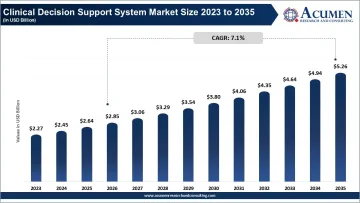
The clinical decision support system market was valued at $2.64 billion in 2025, it is estimated to reach $5.26 billion by 2035. It is expected to grow at the CAGR of 7.1% during the forecast period 2026-2035. The market is witnessing rapid integration of AI and other associated advanced models; this creates massive potential for the market to grow. Additionally, the rising emphasis over workflow automation and predictive analytics will help the clinical decision support system market to boom.
Report Highlights
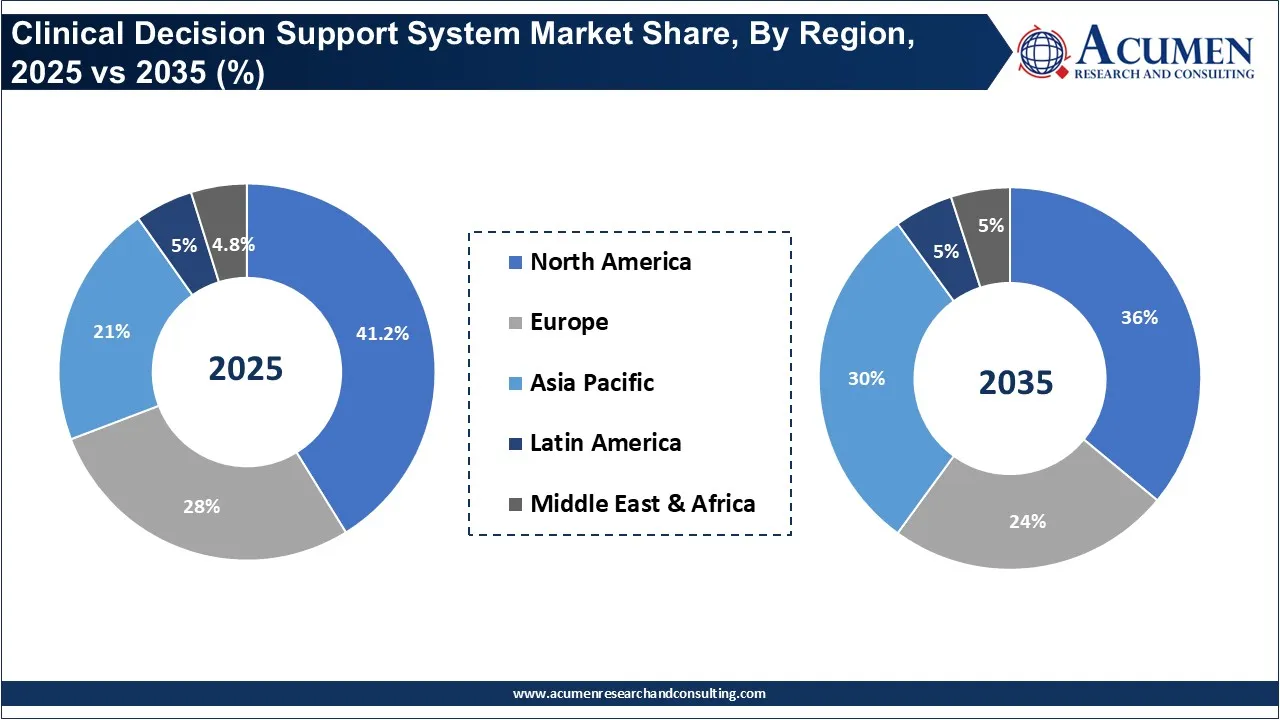
- By region, North America dominates the global clinical decision support system market with a share of 41.20% in 2025 due to developed IT infrastructure of the healthcare industry, higher rate of EHR adoption and considerable healthcare spending.
- Asia Pacific is anticipated to grow at a swift CAGR of 11.4% during the forecast period owing to rapid digital transformation in healthcare, increasing investment in the healthcare sector and widespread adoption of health IT systems.
- By product, the market was dominated by integrated EHR with CDSS which accounted for 36% of the market in 2025 due to growing penetration of EHRs and need for clinical decision support for physicians at the time of workflow.
- Integrated CDSS with other systems captured second major market share of 30% in 2025 owing to growing integration of decision support tools with laboratory, pharmacy, radiology and population health management systems.
- By component, software accounted for the dominant share of 61% in the market in 2025 owing to rising adoption of AI-enabled clinical decision tools, predictive analytics and advanced healthcare applications.
- The services are expected to register the fastest CAGR of 9.0% over the forecast period due to the growing demand for implementation, integration, training, consulting and maintenance services.
- By type, diagnostic CDSS dominated the market with 56% of the market share in 2025 due to the increasing reliance of healthcare professionals on advanced diagnostic tools to improve accuracy and minimize clinical errors.
- Therapeutic CDSS represented 44% of the market in 2025 due to the rising demand for personalized treatment recommendations and medication optimization.
- By deployment model, on-premise captured the dominant market share of 42% in 2025 owing to its inherent capability of enhanced data security, regulatory compliance and greater control over the healthcare infrastructure.
- Cloud-based system captured second largest market share of 38% in 2025 owing to its scalability, cost-effectiveness and simplified system accessibility.
- By model, the market was dominated by knowledge-based CDSS which accounted for 65% of the market share in 2025 owing to the reliance of such systems on established clinical guidelines, evidence-based practices and transparent recommendation mechanisms.
- Non-knowledge-based CDSS occupied 35% of the market share in 2025 owing to growing adoption of AI and ML techniques in clinical decision-making.
- By level of interactivity, the active CDSS accounted for the dominant market share of 69% in 2025 due to rising adoption of automated alerts, reminders and recommendations among healthcare providers to improve clinical outcomes and patient safety.
- Passive CDSS captured 31% of the market share in 2025 due to continuous need for clinician-directed access to decision support information.
- By application, the market was dominated by medication management which accounted for 28% share in 2025 owing to the growing need to reduce medication errors and healthcare costs.
- Clinical guidelines captured second largest market share of 18% in 2025 owing to the increasing adoption of evidence-based treatment protocols.
- By end user, ambulatory care accounted for a substantial market share in 2025 owing to the increasing volume of outpatient care, need for chronic disease management and growing decentralization of healthcare services.
- Inpatient settings contributed significantly to the market revenue in 2025 owing to rising use of CDSS tools in complex clinical decision making and patient monitoring.
Can AI & Machine Learning Improve Clinical Decision Support Systems? Latest Statistics & Adoption Data (2025–2026)
- By mid-2025, over 70% of physicians in the U.S. were utilizing AI-driven clinical support and triage solutions, illustrating the accelerating adoption of AI in healthcare workflows for expedited diagnosis and care coordination.
- In 2024, US federal health IT data indicated that 71% of hospitals utilized predictive AI tools integrated with their Electronic Health Records (EHRs) in 2024 as opposed to 66% in 2023, exhibiting the increased pace of machine learning adoption for patient risk stratifications and workflow optimization.
- In 2025, clinical trials conducted in Kenyan healthcare clinics displayed 16% and 13% decreases in diagnostic and treatment errors, respectively, after the implementation of AI-enabled clinical decision support systems.
- Industry leaders predict potential annual savings of up to USD 360 billion dollars in US healthcare with full integration of AI through improved diagnosis, workflow automation, and advanced analytics.
Market Dynamics
Driver
Rapid Expansion of Healthcare Digitalization and EHR Adoption
The rising adoption of the digital transformation in the healthcare system across the world is also another leading cause of growth in the clinical decision support system market. Healthcare providers are keenly investing in electronic health records, healthcare analytics, interoperable digital platform to increase the quality of care, enhance workflow, and streamline clinical processes, especially for better patient care. CDSS solutions are integral to convert the clinical information in a way that the clinician gets real-time recommendations and guidance for effective evidence-based decision making, minimize diagnostic mistakes, and improve overall treatment quality. Regulations by the government to promote the use of IT in healthcare also push the market ahead.
Restraint
Data Privacy Concerns and Complex System Integration
Despite there is vast potential in the market, issues related to data privacy, cybersecurity and regulatory compliances still hinder market expansion to a greater extent. The major reason is the integration of the CDSS system with the old existing health infrastructure which costs a high amount of money, requires adequate technical expertise, and may require alterations in workflow. Such a process takes longer and also dissuades medium or small-sized health institutions.
Opportunity
Growing Adoption of Artificial Intelligence and Predictive Analytics
The incorporation of AI, machine learning and predictive analytics into CDSS platforms will create significant growth opportunities for the market players. AI-based systems can process large amount of clinical data, predict the chances of occurrence of a disease and suggest optimized therapies and personalized interventions. The adoption of personalized medicine and evidence-based practices is projected to drive the growth of AI-based decision support systems during the forecast period.
Segmental Insights
Product Insights
Integrated EHR with CDSS segment led the market and held a market share of 36% in 2025, owing to increase in adoption of Electronic Health Record systems in various hospitals and healthcare facilities across the globe. Increasing adoption of EHR solutions by healthcare professionals is leading to greater preference of integrated systems wherein patient records are linked with clinical decision support features so that real-time recommendations are easily accessible by clinicians within their workflow, thereby enhancing diagnostic accuracy, minimizing medication errors and improving treatment planning while reducing work fatigue.
Additionally, favorable governmental policies encouraging EHR adoption, coupled with push for interoperability standards among stakeholders in healthcare is driving the installation of integrated EHR-CDSS solutions globally across both developing and developed regions.
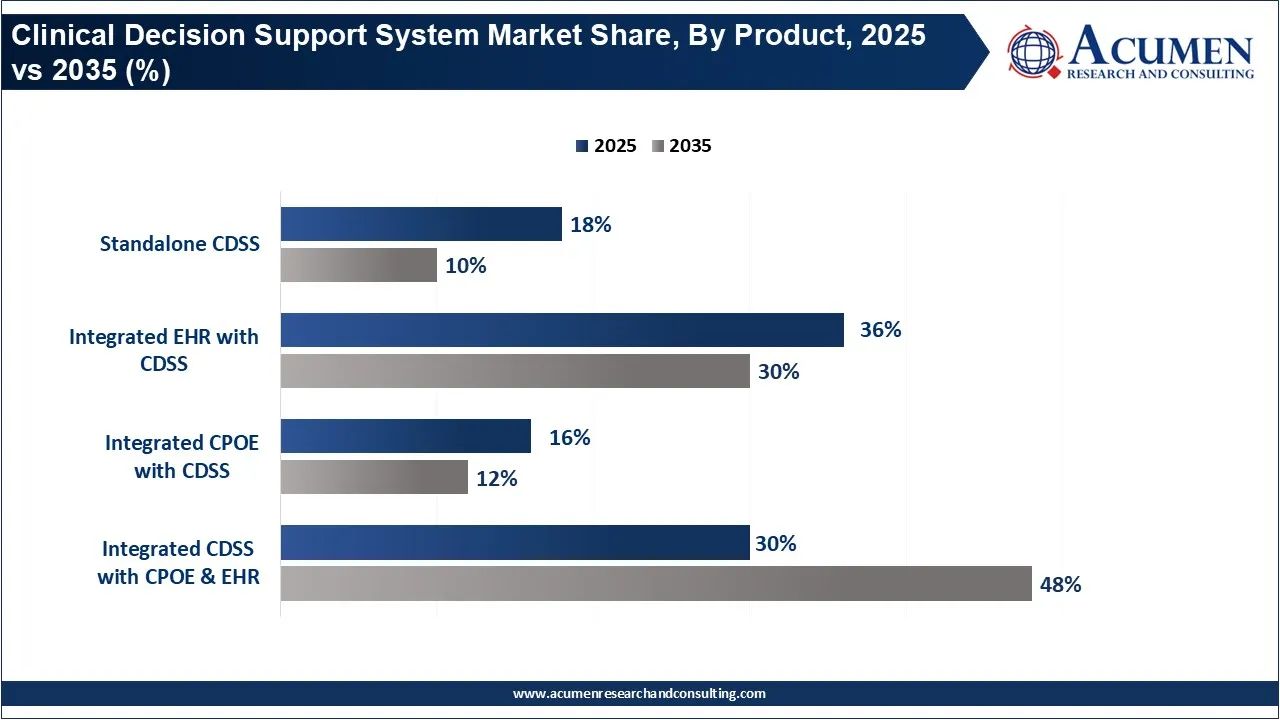
Integrated CDSS with other systems segment was the second largest and occupied a market share of 30% in 2025. The rise in the market share is due to the integration of clinical decision support systems with lab information systems, radiology information systems, pharmacy management systems, population health management solutions, etc.
The focus in the market is shifting towards cohesive digital environments that ensure easy access and exchange of data and comprehensive management of patients. Growing need for comprehensive multidisciplinary care co-ordination and desired clinical outcomes is pushing towards installation of integrated CDSS systems that are not integrated to Electronic Health Records only.
Component Insights
Software segment dominated the market in 2025 at 61% share, attributed to the growing implementation of advanced clinical decision algorithms, artificial intelligence technology, predictive analytic technology, and evidence-based recommendation engines. The sustained innovation of software functionality has enabled the providers to enhance the diagnostic, treatment selection, patient monitoring, and workflow process.
Increasing investments in healthcare digital transformation and cloud-based clinical applications have fueled the demand for the software segment. Moreover, the growing demand for interoperable and scalable decision-support platforms will contribute to the continued growth of this segment over the forecast period.
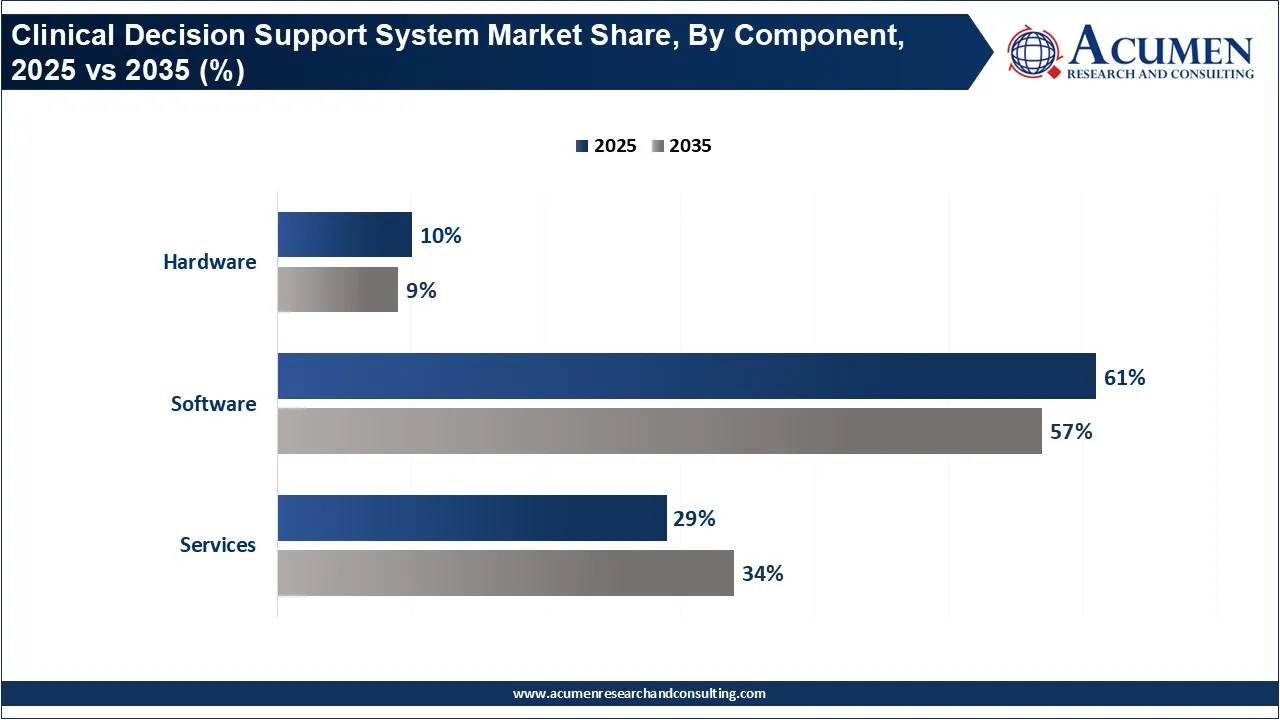
Services segment is anticipated to register the fastest CAGR of 9.0% during the forecast period, owing to rising adoption for implementation, integration, consulting, customization, training, and maintenance services. Healthcare providers require support from experts in implementing increasingly sophisticated CDSS platforms, so as to have the correct deployment, regulations adherence, further contributing to the segment growth. Additionally, service providers are continuously being required to provide system support, optimization, and ongoing maintenance to increase return on investment and user adoption rates.
Type Insights
Diagnostic CDSS led the market and acquired 56% market share In 2025, due to the increasing requirement for precise as well as prompt disease diagnosis. Diagnostic CDSS solutions offer assistance to the health practitioners to analyze the data provided by the patients, potential diseases and diagnose the differences in between. The increased burden of chronic diseases, the emergence of critical illness as well as the increasing pool of diagnostic information led to a demand for diagnostic CDSS solutions, supported by increasing developments in AI and ML.
CDSS Market Revenue Share, By Type, 2025 (%)
| Type | Revenue Share, 2025 (%) |
|---|---|
| Therapeutic CDSS | 44% |
| Diagnostic CDSS | 56% |
Therapeutic CDSS occupied the second largest market share of 44% in 2025. These systems have assisted medical professionals by providing options for the most appropriate treatment regimen, tracking therapeutic outcomes, and warning of possible drug-drug interactions. The need for a more patient-centric approach and precision medicine have helped in gaining momentum for therapeutic decision support solutions for the next few years.
Deployment Model Insights
On-premise segment held its dominant position with 42% share in the market owing to growing tendency among healthcare institutions to keep a stronger hold over critical healthcare infrastructure as well as the confidential information of patients. Hospitals and large healthcare networks opt for on-premise model as it guarantees compliance to stringent data privacy regulations and cyber-security standards. Moreover, these models allow higher level of customization and interoperability options making it feasible for the sophisticated healthcare organizations with huge functional demands.
CDSS Market Revenue Share, By Deployment Mode, 2025 (%)
| Deployment Mode | Revenue Share, 2025 (%) |
|---|---|
| Cloud-based | 38% |
| On-premise | 42% |
| Hybrid/Web-based Systems | 20% |
Cloud-based deployment secured second largest market share of 38% in 2025, as they have lower initial capital investments, scalability features and flexibility for rapid deployment. Healthcare providers are readily accepting the additional benefits such as ability to access system from any location, automatic system updates and better interoperability that comes along with cloud based models. Increased investment in healthcare cloud infrastructure and digital health schemes will spur the market growth for cloud based models in the projection period.
Model Insights
Knowledge-based CDSS held 65% of the market in 2025. This system is considered as more trustworthy for doctors as it is based on traditional knowledge, the available evidence in literature, expert knowledge and rule-based systems. The systems, giving the recommendations with logic, also help in increasing the reliability for the health care providers and regulatory bodies. Widely used across all major hospitals, clinics and academic medical institutions, their use is being supported by updates of the clinical guidelines.
CDSS Market Revenue Share, By Model, 2025 (%)
| Model | Revenue Share, 2025 (%) |
|---|---|
| Knowledge-based CDSS Solutions | 65% |
| Non-Knowledge-based CDSS Solutions | 35% |
The non-knowledge based systems is the next growing sector of the CDSS market and accounted for a share of around 35% in 2025. The advancement of artificial intelligence and machine learning in clinical predictions will enhance the segment growth. Machine learning approaches help to find patterns and identify disease progression and further facilitate the treatment options. Large scale investment is expected to boost the segment growth over the years.
Level of Interactivity Insights
Active CDSS systems dominated the market in 2025 with 69% share as these tools actively send prompts, reminders, warnings and suggestions to the clinicians in the process of patient care. These systems provide a reduction in medication errors, enhance the compliance of the care provider towards clinical guidelines, and aid in better patient care outcomes and safety. The growing emphasis on preventive care and the need for improved quality are thus promoting healthcare institutions to adopt active decision support systems in diverse clinical situations.
CDSS Market Revenue Share, By Level of Interactivity, 2025 (%)
| Level of Interactivity | Revenue Share, 2025 (%) |
|---|---|
| Passive CDSS | 31% |
| Active CDSS | 69% |
Passive CDSS solutions held share of 31% in 2025 as they are being increasingly adopted in health care settings where clinicians prefer to retrieve decision support information by will and not by being prompted. This is mostly due to the fact that this approach has proved to be more flexible and does not create a higher burden of alert fatigue, an issue that physicians raise against these solutions.
Application Insights
The medication management application segment garnered the highest market share at 28% in 2025 owing to increasing concerns about decreasing the number of ADRs, medication errors and decreasing healthcare expenses. The CDSS systems are used to alert clinician at the time of determining drug dosage, drug interaction alert, check allergy with patient medications and in giving prescription. Issues such as, patients’ safety are increasingly being addressed in the clinical settings.
CDSS Market Revenue Share, By Application, 2025 (%)
| Application | Revenue Share, 2025 (%) |
|---|---|
| Medication Management Support | 28% |
| Clinical Guidelines & Pathway Support | 18% |
| Diagnostic Decision Support | 16% |
| Clinical Reminders & Preventive Care Support | 12% |
| Predictive Risk Analytics | 10% |
| Treatment Planning & Care Management | 11% |
| Others | 5% |
Clinical guidelines held the second largest market share of 18% in 2025, due to increase in demand among health organizations, which tend to standardize their treatment processes to improve quality consistency. Clinical decision support tools that provide guidance for best practice using clinical guidelines help clinicians streamline patient care, minimize variations in treatment, and ensure consistent, high-quality outcomes.
End User Insights
Ambulatory care settings held a significant share in the market in 2025, due to rapid shift toward the ambulatory care settings and the increase in management of chronic diseases. Healthcare professionals in the ambulatory care settings are more increasingly implementing CDSS to improve treatment planning, diagnostic processes, and patient monitoring. The increasing number of patients at the ambulatory care settings, the high demand for less expensive health care solutions in an outpatient environment are the drivers for this market segment.
Inpatient settings occupied a major segment in the market. The health professionals make use of the CDSS systems to guide them in providing best treatment possible for the critically ill patients and further improving patient safety. The rapid adoption of digital healthcare technologies and advancements in the health care systems is the main driver of the market segment.
Regional Insights
Why is North America Leading the Clinical Decision Support System Market?
North America led the market with 41.20% share in 2025. The region remained the largest with the widespread adoption of healthcare information technologies, strong healthcare expenditure and presence of leading market participants. Favorable government policies and promotion of EHR implementation creates another potential for the market to boom. Additionally, rising investments in AI, healthcare analytics and digital health innovations continue to strengthen regional market.
The U.S. held the largest share of the clinical decision support system market owing to the well-established healthcare IT infrastructure of the region, its widespread adoption of EHR, and its heavy investments in AI-driven healthcare technologies. Government initiatives such as the HITECH Act and interoperability regulations issued by the ONC paved the way for the digital transformation of healthcare in various hospitals and clinics.
Asia Pacific Clinical Decision Support System Market: Fastest Growing Regional Hub
The Asia Pacific clinical decision support system market is predicted to be the fastest growing regional segment at the CAGR of 11.4% during the forecast period due to rising digitalization of healthcare facilities in developing countries, an increasing uptake of AI-based healthcare platforms, and rising investments in hospital IT infrastructure. Countries within this region are relentlessly focusing on updating the healthcare facilities to ensure better patient outcomes, lower diagnostic errors, and effectively cope with the growing patient burden due to aging population and the rise of chronic diseases.
Government supported programs are aggressively focusing on smart hospitals, telemedicine, digital health, and AI-assisted diagnostics in countries such as China, Japan, India, and South Korea. Growing smart phone penetration, widespread cloud adoption, and the expansion of electronic medical records further fuel the regional market.
India Emerging as a Major Growth Engine for Clinical Decision Support Systems
The Indian market for clinical decision support systems is poised for robust growth due to rapidly increasing healthcare digitalization, extensive government backing in the digital health domain, and rising adoption of AI technologies in hospitals. The Ayushman Bharat Digital Mission (ABDM) is facilitating rapid progress toward the development of digital health records and interoperable healthcare platforms throughout India.
India's massive population burden, which suffers from several chronic diseases, the dearth of doctors and medical practitioners in the rural areas, and an ever-growing patient base encourages hospitals to integrate AI-powered diagnostic tools and decision-support systems to increase efficiency and minimize delays in treatment.
Key Players
- McKesson Corporation
- Oracle
- Siemens Healthineers AG
- Allscripts Healthcare, LLC
- athenahealth, Inc.
- NextGen Healthcare Inc.
- Koninklijke Philips N.V.
- IBM
- Agfa-Gevaert Group
- Wolters Kluwer N.V.
- Becton, Dickinson and Company
- Cabot Technology Solutions
- GE HealthCare
- Nordic
- BeeKeeperAI
- BSCO Industries, Inc.
- Epic Systems Corporation
Recent News
- February 2026, Oracle Health enhanced its AI powered Clinical Digital Assistant capabilities to all hospital systems in North America enabling workflow automation, accuracy in clinical documentation and real time integration of decision support within EHRs.
- January 2026, Epic Systems, announced broader integration of generative AI enabled clinical decision support capabilities into its EHR to offer predictive alerts of patient risk, automated treatment recommendations and AI powered clinical documentation to providers.
- November 2025, Microsoft collaborated with Apollo Hospitals to enhance AI enabled health analytics and clinical decision support in India, concentrating on precision medicine, cloud enabled healthcare analytics, predictive monitoring of patients.
Segments Covered in the Report
By Product
- Standalone CDSS
- Integrated EHR with CDSS
- Integrated CPOE with CDSS
- Integrated CDSS with Other Systems
By Component
- Hardware
- Software
- Services
By Type
- Therapeutic CDSS
- Diagnostic CDSS
By Deployment Model
- Cloud-based
- On-premise
- Hybrid/Web-based
By Model
- Knowledge-based CDSS
- Non-Knowledge-based CDSS
By Level of Interactivity
- Passive CDSS
- Active CDSS
By Application
- Medication Management
- Clinical Guidelines
- Diagnostic Decision Support
- Clinical Reminders
- Predictive Risk Analytics
- Treatment Planning
- Others
By End User
- Ambulatory Care Settings
- Inpatient Settings
By Region
- North America
- Europe
- Asia-Pacific
- Latin America
- Middle East & Africa
Looking for discounts, bulk pricing, or custom solutions? Contact us today at sales@acumenresearchandconsulting.com
Frequently Asked Questions

Related Market Research Reports
May 2026
March 2024
January 2024
September 2022
May 2025
September 2020
February 2023
December 2023