
Medical Devices Market Size, Share, Forecast Report 2026 To 2035
Medical Devices Market (By Product Type: Diagnostic Devices, Therapeutic Devices, Surgical & Interventional Devices, Patient Aids & Medical Supplies; By Device Class: Class I, Class II, Class III; By Application: Cardiovascular Diseases, Orthopedics, Diagnostic Imaging, Diabetes Care, Neurology, Others; By End User: Hospitals Ambulatory Surgical Centers (ASCs), Diagnostic Centers, Specialty Clinics, Home Healthcare Settings, Academic & Research Institutes) - Global Industry Analysis, Size, Share, Regional Analysis, Trends and Forecast 2026 - 2035
- Last Updated: 08 Jun 2026
- Report Code: ARC1749
- Category: Healthcare and Pharmaceuticals
Medical Devices Market Size, Forecast 2026 to 2035
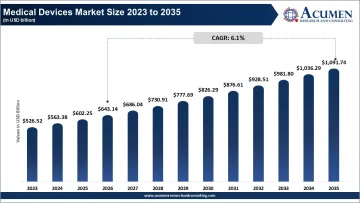
The global medical devices market size was valued at USD 602.25 billion in 2025 and is projected to exceed around USD 1,091.74 billion by 2035, reflecting a CAGR of 6.1% from 2026 to 2035. The overall technological advancements in medical devices, especially for diagnostic purposes has offered potential growth factor for the medical devices market to grow.
Report Highlights
- By region, North America accounted for the largest market share of the medical devices market at 39% in 2025. A high healthcare spending and the consistent adoption of advanced medical technologies are driving the North American market growth.
- On the basis of region, Asia Pacific is predicted to grow with a CAGR of 7.8% at the fastest pace during the forecast period. The developing healthcare infrastructure and the accessibility of medical services have boosted regional market growth.
- On the basis of product type, therapeutic devices accounted for the largest share of the medical devices market at 34% in 2025. A growing demand for treatment-centered medical technologies in several disease segments is driving market growth.
- The diagnostic devices segment accounted for the second-largest share of 29% of the medical devices market in 2025. Early diagnosis of diseases and a higher preference toward preventive healthcare services have boosted market growth for diagnostic devices.
- On the basis of device class, Class II devices held the largest market share of 58% in 2025. A wide array of applications in various hospitals and clinics are helping these devices in expanding their market share.
- The Class I devices segment accounted for the second-largest share of 22% of the medical devices market in 2025. A consistent demand for basic medical supplies for healthcare are supporting segment growth.
- On the basis of application, cardiovascular diseases occupied the largest market share of 24% in 2025. The rising incidence of heart related ailments in the worldwide population is creating a robust market demand for cardiovascular devices.
- The neurology segment held a market share of 10% in 2025 and is anticipated to exhibit the fastest growth rate during the forecast period. Advancements in the neurodiagnostic and neurostimulation medical devices are driving market growth.
- On the basis of end user, hospitals occupied the largest market share of 52% in 2025. A high patient turnover rate and widespread usage of medical devices in hospitals are fueling market growth.
- Ambulatory surgical centers are expected to register the fastest growth rate at a CAGR of 8.1% during the forecast period. The increasing popularity of outpatient procedures is driving market growth in this segment.
Market Dynamics
Driver
Rising Burden of Chronic Diseases and Aging Population Driving Medical Device Adoption
One of the main driving forces for the growth in the market is the rising incidence of chronic diseases, including cardiovascular diseases, diabetes, cancer, respiratory and neurological conditions. Healthcare providers are turning to high-end diagnostic, monitoring, treatment and surgical devices to manage their patients better and deliver an increased quality of care and better patient outcome management.
Another important factor that will create consistent demand in the market is the growing elderly population throughout the world. As they will depend more on frequent medical attention, procedures for diagnoses, and assistive devices like mobility aids, implantable medical devices and equipment for home healthcare, it is reasonable to assume a consistent increase in medical device demand from the elderly.
Restraint
Stringent Regulatory Approval Processes and Product Compliance Requirements
Regulatory frameworks for medical devices are stringent and address safety, effectiveness and quality. Approval from agencies such as the US FDA, European regulatory bodies and other national bodies often requires considerable clinical testing, documentation and procedures. These regulatory requirements can raise development costs, lengthen the product launch cycle and represent a significant barrier to entry for smaller manufacturers. Changing compliance requirements, post-market surveillance and cybersecurity regulations for connected devices only make development and commercialization of medical devices more complex.
Opportunity
Expansion of Smart, Connected, and AI-Enabled Medical Devices
A key area for expansion within the medical devices market is the increasing use of smart & connected health technologies. Technologies like artificial intelligence, Internet of Medical Things (IoMT), remotely monitored patients, wearable technologies, and cloud-based medical technologies are changing healthcare delivery processes. AI based diagnostic tools may help doctors with disease diagnosis and the monitoring devices connected remotely can monitor the patients health data in real-time. Devices like wearable health devices, smart glucose monitors, cardiac monitors and remote patient management systems are growing among health professionals and users.
Segmental Analysis
Product Type Insights
The therapeutic devices segment held the leading share of 34% in the medical devices market in 2025. The therapeutic devices include products such as, infusion pumps, dialysis equipment, respiratory therapy devices, cardiac rhythm management devices, etc. Increasing prevalence of chronic diseases, growing aging population and expanding demand for long term disease management solutions have significantly contributed to the segment's leading position.
Healthcare providers are adopting technologically advanced therapeutic devices to improve treatment results, shorten hospital stay and enhance patient monitoring. Technological advancements in the minimally invasive treatment and smart connected devices is further driving the market.

Diagnostic devices segment generated the share of 29% in the medical devices market in 2025 and thus the second leading segment. Diagnostic devices play an important role in early disease detection, patient screening and clinical decisions in hospitals, laboratories and diagnostics centers. Expanding application of preventive healthcare, growing volume of diagnostic testing and increasing adoption of advanced imaging and laboratory technologies are the key drivers for the segment growth. Technological innovations in the molecular diagnostics, point-of-care testing and AI-enabled diagnostic devices are creating opportunities in the diagnostic devices segment.
Device Class Insights
Class II medical devices generated the largest share with more than 58% share in 2025. Class II medical devices are used in numerous medical disciplines and health care settings; some of them include infusion pumps, surgical drapes, diagnostic imaging machines, power wheel chairs and different types of monitors. Class II medical devices are monitored with a moderate level of regulation. Growing adoption of the category is being attributed to their extensive use across different medical specializations. Increasing health spending and expanding medical equipment sector supported with new technological development drives this market segment.
Medical Devices Market Revenue Share, By Device Class, 2025 (%)
| Device Class | Revenue Share, 2025 (%) |
|---|---|
| Class I (Low-risk devices) | 22% |
| Class II (Moderate-risk devices) | 58% |
| Class III (High-risk devices) | 20% |
Class I medical devices was projected to register 22% of the market in 2025. Bandages, examination gloves, handheld surgical instruments and fundamental supplies are classified in class I medical devices. Segment expected to register constant demand owing to constant demand across hospitals, ambulatory surgical centers, hospitals, and clinics and health care facilities. Rise in health utilization and increasing number of patients drives the segment growth.
Application Insights
The cardiovascular diseases segment dominated the medical devices market and occupied 24% of the market share in 2025. This segment includes devices for diagnosis, monitoring, treatment and management of the cardiovascular diseases including implantable cardiac devices, cardiac monitors, pacemaker, stents etc. The growing burden of the cardiovascular diseases, lifestyle related disorders and hypertension has been a prominent growth driver for the cardiovascular devices across the globe. The increased awareness of early diagnosis and advances in minimal invasive surgical procedures also contributed to market growth.
Medical Devices Market Revenue Share, By Application, 2025 (%)
| Application | Revenue Share, 2025 (%) |
|---|---|
| Cardiovascular Diseases | 24% |
| Orthopedics | 15% |
| Diagnostic Imaging | 13% |
| Diabetes Care | 9% |
| Neurology | 10% |
| Respiratory Care | 8% |
| Oncology | 7% |
| Ophthalmology | 6% |
| General Surgery | 5% |
| Others | 3% |
The neurology segment was responsible for 10% market share in 2025 and is projected to grow at the highest CAGR. The neurology segment includes brain monitoring systems, neurostimulation devices, spinal cord stimulators and neurological diagnostic systems. High prevalence of neurological diseases like Alzheimer disease, parkinson disease, stroke, epilepsy etc. has increased the need of novel and innovative devices which will fuel the market growth during forecast period. in brain computer interfaces and neurodiagnostic technologies also drives market growth.
End User Insights
Hospitals represented the largest segment of the medical devices market, with a share of 52% of total revenue in 2025. Hospitals remain the dominant end user of medical devices as they are the largest contributors in terms of volume of surgical operations, patient admissions, and diagnostic services performed in any healthcare setting. Continued adoption of cutting-edge medical technologies, rising healthcare infrastructure investments, and surging demand for specific treatments continue to solidify this segment's dominance. They also possess higher purchasing power and have access to more sophisticated medical equipment as compared to other healthcare settings.
Medical Devices Market Revenue Share, By End User, 2025 (%)
| End User | Revenue Share, 2025 (%) |
|---|---|
| Hospitals | 52% |
| Ambulatory Surgical Centers (ASCs) | 12% |
| Diagnostic Centers | 10% |
| Specialty Clinics | 9% |
| Home Healthcare Settings | 11% |
| Academic & Research Institutes | 6% |
The ambulatory surgical centers segment is projected to expand at a significant CAGR of 8.1% during the forecast period. ASCs are out-patient surgical settings where same-day surgical procedures are performed. The segment is garnering considerable traction due to the increasing cost-effectiveness of these centers, shorter patient recovery periods, and operational efficiencies. Increasing preference among patients towards out-patient procedures, coupled with the increasing number of minimally invasive surgical procedures, will further propel the growth of this segment. Medical institutions are also investing in an expanding network of ASCs, as a means to relieve the pressure on hospitals, and widen access to specialty surgical procedures.
Regional Insights
North American Medical Devices Market Analysis
North America held the largest share of 39% of the global medical devices market in 2025 and is expected to retain its position for the entire forecast period. Key contributing factors to this leadership include a high level of advanced healthcare infrastructure, robust healthcare reimbursement schemes, a high level of expenditure on healthcare, rapid technological advancement and a significant presence of dominant global medical device manufacturing firms. Increasing rates of chronic diseases, the expanding volume of surgical procedures, a growing elderly population and swift adoption of AI-based healthcare technology all contribute to the growth of the North American market.
The United States contributes to the largest share of the North American medical devices market owing to substantial investment in modern healthcare, robotic surgery, diagnostic imaging and cardiovascular equipment, as well as solutions for minimally invasive treatment. According to the Centers for Medicare & Medicaid Services (CMS), spending on healthcare in the US rose by 4.1% to around USD 4.5 trillion in 2022, which accounts for close to 17.3% of the country's GDP. Furthermore, the United States boasts one of the world's most extensive medical technology innovation ecosystems, driven by large R&D spending, favorable reimbursement structures and prompt approval of cutting-edge healthcare technologies.
United States Market Analysis
The United States dominates the North American medical devices market due to advanced healthcare infrastructure, high per capita healthcare spending and the presence of a number of key medical device manufacturers. The country is a global leader in medical innovation, especially in robotic surgery, cardiovascular devices, orthopedic implants, diagnostic imaging equipment and AI-based healthcare solutions. Growing prevalence of chronic diseases such as cardiovascular disorders, diabetes, obesity and neurological diseases are driving the demand for therapeutic and diagnostic devices. Long-term growth is sustained by a rise in the use of minimally invasive surgical techniques and tele-health services.

Asia Pacific Medical Devices Market Analysis
The Asia-Pacific region is expected to exhibit the fastest CAGR of 7.8% in the global medical devices market over the forecast period as a result of rapid urbanization, expanding healthcare infrastructure, increased disposable incomes and a rise in health consciousness. The demand for diagnostic devices, patient monitoring equipment, surgical instruments, implantable devices and home healthcare products is rising quickly throughout the region.
The increasing volume of the aged population and a greater prevalence of chronic illnesses such as diabetes, cardiovascular diseases, cancer and respiratory disease is a significant contributor to rising demand for advanced medical technology across developing countries. Governments in Asia-Pacific are investing substantial amounts in the development of healthcare facilities, hospital expansions, medical tourism and the manufacturing of medical devices domestically.
India Medical Devices Market Analysis
The increase in healthcare investment, the rise of medical tourism and a rapidly expanding private healthcare sector are turning India into one of the most attractive markets for medical devices in Asia-Pacific. At present, India is the fourth-largest medical devices market in Asia and is placed within the top 20 countries worldwide. The market is being fueled by growing health awareness, an escalating burden of chronic disease and the rising adoption of diagnostic technology.
Top Companies
- Medtronic
- Johnson & Johnson Services, Inc.
- Koninklijke Philips N.V.
- F. Hoffmann-La Roche Ltd.
- Boston Scientific Corporation
- Baxter International Inc.
- Fresenius Medical Care AG
- GE Healthcare
- Ethicon LLC
- Siemens Healthineers AG
- Stryker
- Abbott
- BD
- Cardinal Health
Recent Developments
- March 2026 - Medtronic released its next generation AI-enabled surgical navigation platform for enhanced accuracy in minimally invasive spine and orthopaedic surgery and enhance its sophisticated surgical devices.
- January 2026 - GE HealthCare developed a portable advanced ultrasound imaging system embedded with AI powered diagnostics for effective point of care and emergency services and a solution to achieve precision through this integration and portable nature.
- October 2025 - Philips released a new robotic assisted image guided therapy platform for cardiovascular and minimally invasive surgery procedures that would enhance the real time imaging accuracy.
Market Segmentation
By Product Type
- Diagnostic Devices
- Therapeutic Devices
- Surgical & Interventional Devices
- Patient Aids & Medical Supplies
By Device Class
- Class I (Low-risk Devices)
- Class II (Moderate-risk Devices)
- Class III (High-risk Devices)
By Application
- Cardiovascular Diseases
- Orthopedics
- Diagnostic Imaging
- Diabetes Care
- Neurology
- Respiratory Care
- Oncology
- Ophthalmology
- General Surgery
- Others
By End User
- Hospitals
- Ambulatory Surgical Centers (ASCs)
- Diagnostic Centers
- Specialty Clinics
- Home Healthcare Settings
- Academic & Research Institutes
By Region
- North America
- Europe
- Asia-Pacific
- Latin America
- Middle East & Africa
Looking for discounts, bulk pricing, or custom solutions? Contact us today at sales@acumenresearchandconsulting.com
Frequently Asked Questions

Other Healthcare and Pharmaceuticals Reports
February 2021
June 2021
April 2021
October 2022