
AI in Neurosurgery Market Size, Share, Trends, Report 2026 To 2035
AI in Neurosurgery Market (By Component: Software, Hardware, Services; By Deployment: On-Premise, Cloud-Based, Hybrid; By Technology: Machine Learning & Deep Learning, Computer Vision, Natural Language Processing, Generative AI, Others; By Application: Diagnosis & Preoperative Assessment, Surgical Planning & Simulation, Intraoperative Navigation & Guidance, AI-Assisted Robotic Neurosurgery, Others; By Neurosurgical Procedure: Neuro-Oncology Surgery, Cerebrovascular Surgery, Spine & Spinal Cord Surgery, Functional Neurosurgery, Others; By Imaging Modality: MRI, CT, Intraoperative Ultrasound, Optical & Video Imaging, Multimodal/Fusion Imaging, Others; By End User: Hospitals, Ambulatory Surgical Centers, Specialty Neurosurgery & Neurology Centers, Academic & Research Medical Centers, Others) - Global Industry Analysis, Size, Share, Regional Analysis, Trends and Forecast 2026 - 2035
- Last Updated: 01 Oct 2026
- Report Code: ARC3992
- Category: Healthcare and Pharmaceuticals
AI in Neurosurgery Market Overview and Insights
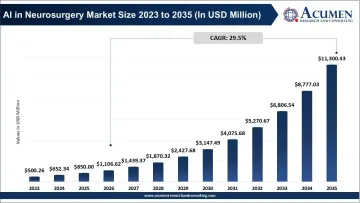
The global AI in neurosurgery market size was valued at USD 850 million in 2025 and is forecasted to reach at USD 11,300.43 million by 2035, while expanding at a promising CAGR of 29.5% during the forecast period of 2026-2035. Growing adoption of AI-driven medical imaging, surgical planning, navigation, and clinical decision support technologies is accelerating AI integration across neurosurgical workflows, supported by improving diagnostic performance and expanding regulatory authorization of AI-enabled medical devices.
Report Highlights
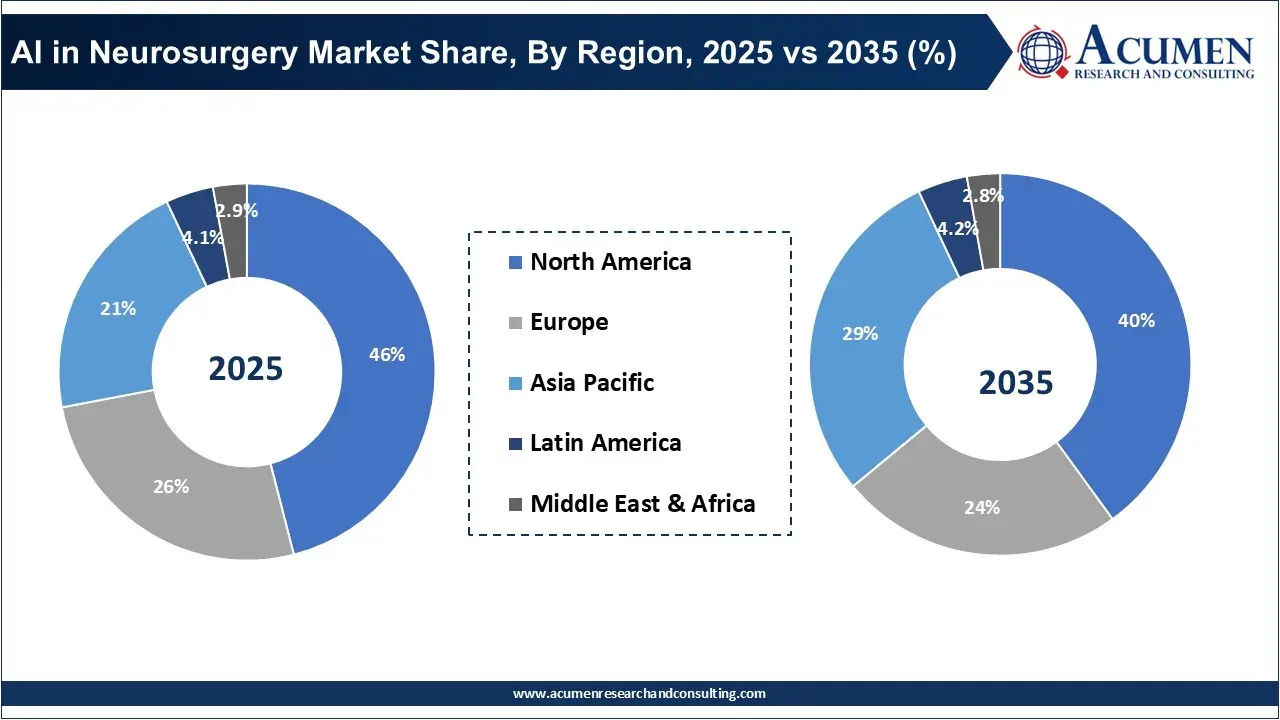
- By region: North America dominated the market with a 46.0% share in 2025, supported by advanced neurosurgical infrastructure, established adoption of image-guided and robotic technologies, and strong investment in AI-enabled healthcare solutions.
- By component: Software dominated the component segment with a 57.0% share in 2025, driven by increasing integration of AI across medical image analysis, surgical planning, navigation, clinical decision support, and outcome prediction.
- By deployment: On-premise deployment dominated with a 48.0% share in 2025, supported by healthcare providers' preference for direct control over sensitive patient data, computing infrastructure, security, and integration with existing clinical systems.
- By technology: Machine learning and deep learning dominated the technology segment with a 43.0% share in 2025, supported by applications in medical image analysis, segmentation, prediction, trajectory planning, and clinical decision support.
- By application: Diagnosis and preoperative assessment dominated the application segment with a 21.0% share in 2025, driven by increasing use of AI for medical image interpretation, tumor detection, anatomical segmentation, and patient-specific surgical assessment.
- By neurosurgical procedure: Neuro-oncology surgery dominated the procedure segment with a 26.0% share in 2025, supported by growing use of AI for brain tumor detection, segmentation, surgical planning, navigation, and intraoperative tissue assessment.
- By imaging modality: MRI dominated the imaging modality segment with a 34.0% share in 2025, driven by its extensive use for detailed visualization of brain structures, tumors, lesions, and other neurological conditions.
- By end user: Hospitals dominated the end-user segment with a 61.0% share in 2025, supported by their advanced neurosurgical departments, imaging infrastructure, specialized clinical teams, and greater capacity to integrate AI-enabled surgical technologies.
Market Size & Forecast
- Base Year Market Size (2025): $850 million
- Current Year Market Size (2026): $41,106.62 million
- Estimated Year Market Size (2035): $11,300.43 million
- Forecast Period CAGR (2026-2035): 29.5%
How is AI Used in Neurosurgery?
Artificial intelligence is used in neurosurgery to analyze medical images, identify abnormalities, support diagnosis, plan surgical procedures, provide intraoperative navigation, assist robotic systems, and predict patient outcomes. AI primarily acts as a decision-support and workflow-enhancement technology, helping neurosurgeons process complex clinical, imaging, and procedural data more efficiently.
- AI-Assisted Diagnosis: Machine learning and deep learning models analyze MRI, CT, PET, and other medical images to identify brain tumors, hemorrhages, strokes, aneurysms, lesions, and other neurological abnormalities.
- Medical Image Segmentation: AI automatically identifies and segments tumors, blood vessels, brain structures, and other anatomical regions, providing more detailed information for diagnosis and surgical planning.
- Surgical Planning: AI analyzes patient-specific imaging and anatomical data to help surgeons determine surgical approaches, optimize trajectories, identify critical structures, and simulate potential procedures before surgery.
- Intraoperative Navigation: AI can combine preoperative imaging with real-time surgical data to support instrument tracking, anatomical localization, and navigation during procedures, helping surgeons maintain awareness of critical structures.
Growth Factors
- AI Neuroimaging Growth: Increasing use of AI for MRI and CT analysis is expanding applications across brain tumors, stroke, intracranial hemorrhage, aneurysms, and spinal conditions. A 2025 systematic review covering 193 studies found that neuro-oncology represented 52.69% of diagnostic AI studies, demonstrating the growing role of AI in neurosurgical imaging and diagnosis.
- Complex Surgical Planning: Increasing complexity of neurosurgical procedures is creating demand for technologies that can analyze patient-specific anatomy and support preoperative planning. AI is being investigated for tumor segmentation, anatomical mapping, surgical navigation, prognosis, and intraoperative assistance, enabling more data-driven approaches to procedures involving highly sensitive neurological structures.
- Digital Neurosurgery Adoption: The integration of 3D imaging, robotics, artificial intelligence, and digital-twin technologies is expanding the digital neurosurgery ecosystem. These technologies are being developed across preoperative planning, intraoperative navigation, surgical assistance, and postoperative management, creating a broader technological base for AI-enabled neurosurgical applications.
AI in Neurosurgery Adoption Rate
- Diagnostic performance: AI models achieved median diagnostic accuracies above 85% across most neurosurgical categories in the 193-study systematic review, although performance varied considerably by application and dataset.
- External validation rate: A 2025 systematic review of publicly available neurosurgical AI datasets found that 97.7% of studies trained an AI model, but only 22.6% performed external validation, highlighting the gap between model development and broader clinical deployment.
- Public AI application availability: Only 7.1% of publicly available neurosurgical AI dataset studies provided a public application, while 20.2% shared their code, indicating limited reproducibility and accessibility of deployed AI tools.
AI in Neurology Market Dynamics
Key Drivers
- Diagnostic Accuracy: Growing evidence of strong AI performance in neurosurgical imaging is encouraging further development of diagnostic applications. A systematic review found median diagnostic accuracies above 85% across most evaluated categories, while models for intracranial hemorrhage and stroke demonstrated particularly strong performance, supporting continued research into AI-assisted neuroimaging.
- Surgical Precision: AI-assisted planning, image analysis, navigation, and robotic technologies are creating opportunities to support precision during complex neurosurgical procedures. AI can help identify anatomical structures, analyze surgical images, and provide intraoperative information, supporting surgeons in procedures where small positional errors can have significant clinical consequences.
- Predictive Analytics: Growing availability of clinical, imaging, and postoperative datasets is enabling AI models to support prognosis and treatment planning. Applications include predicting patient outcomes, tumor characteristics, treatment response, and postoperative risks, expanding AI beyond diagnosis toward decision support throughout the neurosurgical care pathway.
Key Restraints
- Limited Validation: Many AI models remain dependent on retrospective or single-center datasets, limiting confidence in their performance across different hospitals, scanners, patient populations, and clinical workflows. Recent methodological research continues to identify concerns around external validation, data leakage, calibration, and reporting quality in AI neuroimaging studies.
- High Implementation Costs: Deploying AI in neurosurgery can require specialized imaging infrastructure, computing resources, software integration, cybersecurity systems, and trained personnel. Hospitals may also need to modify existing clinical workflows and invest in integration with electronic health records and surgical platforms, increasing the overall cost of adopting AI-enabled neurosurgical technologies.
- Regulatory Complexity: AI systems used for diagnosis, surgical planning, or intraoperative decision support must satisfy demanding requirements for safety, performance, validation, and clinical oversight. Continuous software updates can further complicate regulatory management, particularly when algorithms evolve after deployment or are intended to support high-risk neurosurgical decisions.
Key Opportunities
- AI Surgical Navigation: AI-enhanced navigation systems can combine medical imaging, anatomical models, computer vision, and real-time information to assist surgeons during complex procedures. Opportunities are emerging across neuro-oncology, vascular neurosurgery, spinal surgery, and functional neurosurgery, particularly where accurate anatomical localization and image-guided intervention are critical.
- AI Robotics: Combining artificial intelligence with neurosurgical robotics creates opportunities for automated image analysis, instrument tracking, microscope assistance, workflow recognition, and precision support. Research is already exploring AI-driven robotic microscope assistance, while broader robotic systems are being investigated for increasingly complex neurosurgical procedures.
- Remote Neurosurgery: AI-assisted platforms could expand access to specialized neurosurgical expertise by supporting remote interpretation, surgical planning, clinical decision support, and technology-assisted procedures. This opportunity is particularly relevant in regions with shortages of neurosurgeons, where recent research has identified AI and robotics as potential tools for increasing neurosurgical capacity.
Key Challenges
- Data Bias: AI models can produce inconsistent results when training data do not adequately represent different patient populations, imaging equipment, disease characteristics, or healthcare environments. Recent research in global neurosurgery found that models trained using local data could outperform models transferred from other regions, highlighting the importance of representative datasets and local validation.
- Clinical Trust: Neurosurgeons need to understand when AI recommendations are reliable and when human judgment should override algorithmic outputs. Limited interpretability, unfamiliar recommendations, and concerns about responsibility can restrict adoption. Recent reviews identify algorithmic bias, transparency, explainability, and clinician trust as continuing barriers to wider clinical integration.
- Workflow Integration: AI tools must integrate smoothly with imaging systems, electronic health records, surgical navigation platforms, operating-room equipment, and established clinical workflows. Poor integration can increase cognitive workload rather than reduce it. Successful deployment therefore requires interoperability, appropriate human oversight, reliable real-time performance, and evidence that the technology improves clinical workflows.
AI in Neurosurgery Market Segmental Insights
Component Insights
Software: Software dominated the component segment with 57.0% share in 2025, supported by the increasing use of AI algorithms for medical image analysis, surgical planning, navigation, clinical decision support, and outcome prediction. Growing integration of AI into neurosurgical workflows is strengthening demand for software platforms that can interpret complex clinical and imaging data.
Hardware: Hardware represented the second-largest component category, with 29.0% share in 2025, supported by demand for AI-enabled neurosurgical robotic systems, navigation and imaging platforms, tracking devices, and AI computing infrastructure. Hardware provides the physical and computational foundation required to capture clinical data and support AI-enabled surgical procedures.
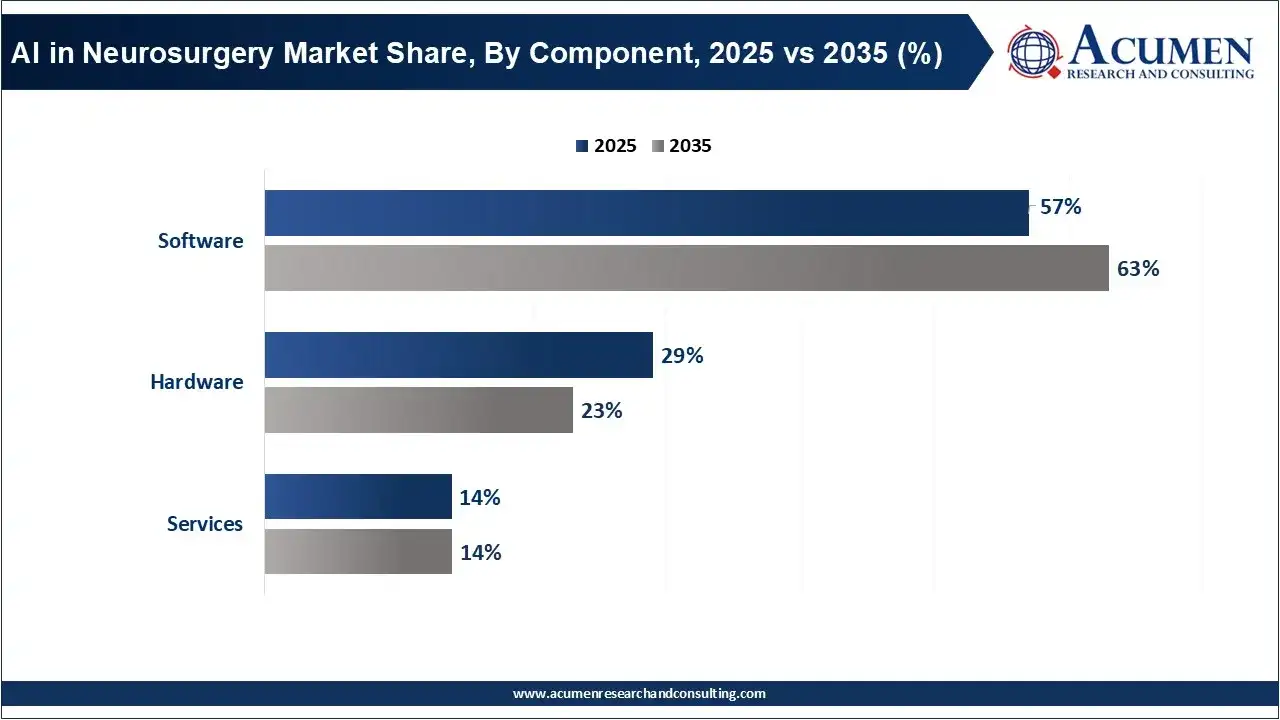
Services: Services accounted for 14.0% share in 2025, covering implementation, integration, maintenance, training, consulting, and AI optimization activities. Healthcare providers require specialized services to integrate AI technologies with existing neurosurgical infrastructure, train clinical teams, maintain system performance, and continuously upgrade AI-enabled platforms.
Deployment Insights
On-Premise: On-premise deployment dominated the deployment segment with 48.0% share in 2025, supported by healthcare organizations' requirements for direct control over sensitive patient data, computing infrastructure, system access, and clinical applications. The model remains important for neurosurgical environments where imaging and patient information must be processed within controlled hospital infrastructure.
Hybrid: Hybrid deployment is projected to be the fastest-growing deployment model, at a 32.2% CAGR from 2026 to 2035, supported by its ability to combine hospital-based infrastructure with cloud computing capabilities. Hybrid architectures can enable flexible AI processing while allowing healthcare organizations to retain sensitive clinical data and critical applications within controlled environments.
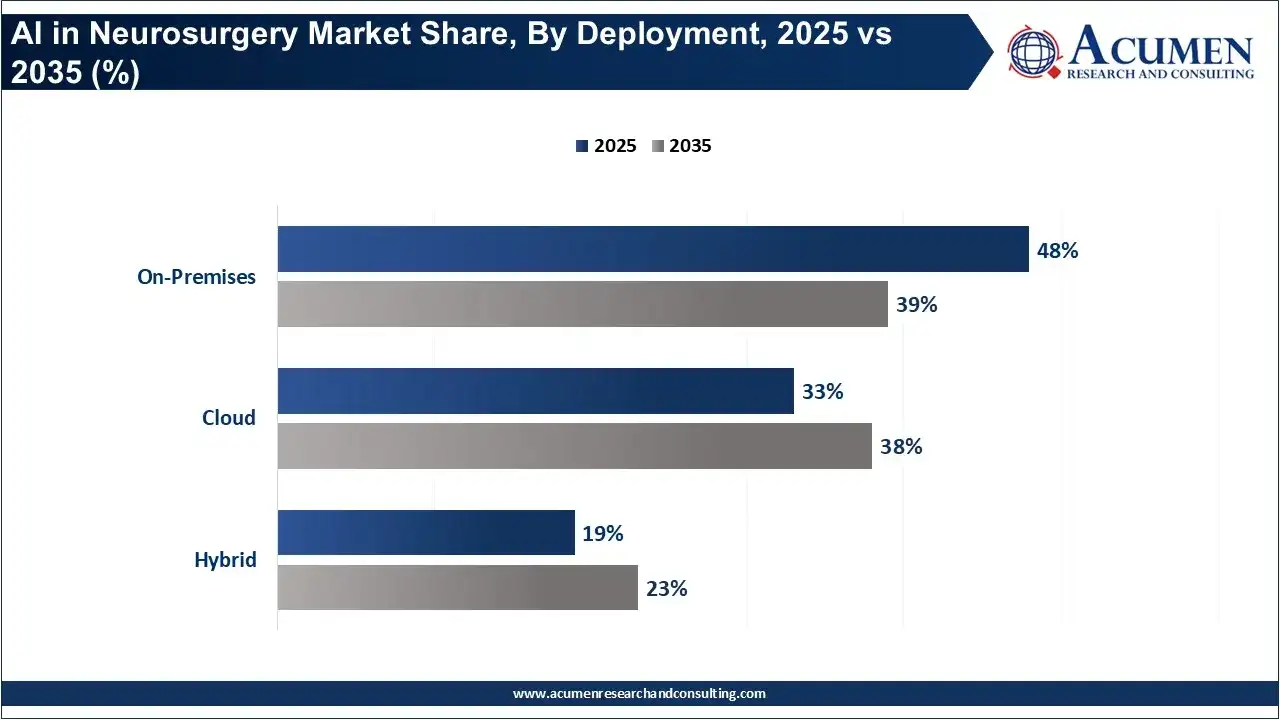
Cloud-Based: Cloud-based deployment represented the second-largest category with 33.0% share in 2025, supported by demand for scalable computing, centralized AI model management, remote software updates, and flexible access to advanced analytics. Cloud infrastructure can reduce dependence on dedicated local computing resources and facilitate collaboration across hospitals, research institutions, and technology providers.
Technology Insights
Machine Learning & Deep Learning: Machine learning and deep learning dominated the technology segment with 43.0% share in 2025, supported by applications in medical image analysis, segmentation, prediction, trajectory planning, and clinical decision support. These technologies can identify patterns within complex imaging and clinical datasets, making them central to the development of AI-enabled neurosurgical applications.
Computer Vision: Computer vision represented the second-largest technology category, with 29.0% share in 2025, supported by increasing use of AI for surgical image interpretation, anatomical identification, instrument tracking, and intraoperative visualization. Computer vision enables neurosurgical systems to analyze visual information from cameras, imaging platforms, and surgical environments during procedures.
Generative AI: Generative AI accounted for 12.0% share in 2025 and is expected to expand rapidly as healthcare organizations explore AI for clinical documentation, medical information synthesis, surgical planning assistance, and decision-support workflows. Increasing development of specialized healthcare AI models is creating additional opportunities for generative technologies in neurosurgical applications.
Application Insights
Diagnosis & Preoperative Assessment: Diagnosis and preoperative assessment dominated the application segment with 21.0% share in 2025, supported by the extensive use of AI for medical image interpretation, tumor detection, anatomical segmentation, and patient-specific risk assessment. AI tools can process complex diagnostic information and help clinicians evaluate surgical requirements before neurosurgical procedures.
Intraoperative Navigation & Guidance: Intraoperative navigation and guidance represented the second-largest application category, with 19.0% share in 2025, driven by demand for precise localization and real-time surgical guidance. AI can combine imaging, anatomical information, tracking data, and surgical inputs to support accurate instrument positioning and navigation during complex procedures.
Surgical Planning & Simulation: Surgical planning and simulation accounted for 18.0% share in 2025, supported by increasing adoption of patient-specific digital models, trajectory planning, anatomical visualization, and procedure simulation. AI-enabled planning platforms allow clinicians to evaluate different surgical approaches before treatment and support more structured preparation for complex neurosurgical interventions.
Neurosurgical Procedure Insights
Neuro-Oncology Surgery: Neuro-oncology surgery dominated the neurosurgical procedure segment with 26.0% share in 2025, supported by the complexity of brain tumor diagnosis, localization, resection planning, and intraoperative tissue identification. AI technologies can assist with tumor segmentation, surgical planning, image interpretation, and navigation, creating strong opportunities for AI adoption across brain tumor procedures.
Spine & Spinal Cord Surgery: Spine and spinal cord surgery represented the second-largest procedure category, with 22.0% share in 2025, supported by the need for precise anatomical planning, imaging, navigation, and instrument positioning. AI-enabled systems can process spinal imaging and assist clinicians with surgical planning, trajectory optimization, and intraoperative guidance across complex procedures.
Cerebrovascular Surgery: Cerebrovascular surgery accounted for 16.0% share in 2025, supported by the need for rapid imaging interpretation, anatomical assessment, surgical planning, and precise intervention in complex vascular conditions. AI can assist in identifying vascular abnormalities, analyzing imaging datasets, and supporting treatment planning for aneurysms, vascular malformations, and related conditions.
Imaging Modality Insights
MRI: MRI dominated the imaging modality segment with 34.0% share in 2025, supported by its importance in detailed visualization of brain structures, tumors, lesions, and soft tissue. AI-powered MRI analysis can improve image segmentation, anatomical identification, tumor characterization, and preoperative planning, making MRI a major data source for neurosurgical AI applications.
CT: CT represented the second-largest imaging modality, with 24.0% share in 2025, supported by its widespread use for rapid anatomical assessment, trauma evaluation, and surgical planning. AI can assist in automated image interpretation, segmentation, abnormality detection, and reconstruction, enabling faster analysis of CT datasets in neurosurgical workflows.
Multimodal/Fusion Imaging: Multimodal and fusion imaging accounted for 18.0% share in 2025, supported by the increasing need to combine information from MRI, CT, PET, ultrasound, and other imaging sources. AI can help align and interpret multimodal datasets, providing surgeons with more comprehensive anatomical and pathological information for planning and intraoperative decision-making.
End User Insights
Hospitals: Hospitals dominated the end-user segment with 61.0% share in 2025, supported by their concentration of advanced neurosurgical departments, imaging infrastructure, operating rooms, specialized clinical teams, and technology budgets. Large hospitals are also better positioned to integrate AI with existing navigation, imaging, robotic, data-management, and electronic health record systems.
Specialty Neurosurgery & Neurology Centers: Specialty neurosurgery and neurology centers represented the second-largest end-user category, with 17.0% share in 2025, supported by their focus on complex neurological conditions and specialized procedures. These centers can adopt AI technologies targeted toward advanced imaging, surgical planning, navigation, precision intervention, and patient-specific treatment strategies.
Academic & Research Medical Centers: Academic and research medical centers accounted for 12.0% share in 2025, supported by their role in clinical research, AI development, validation studies, medical innovation, and technology evaluation. These institutions provide important environments for testing emerging neurosurgical AI applications and translating research-based technologies into clinical workflows.
AI in Neurosurgery Market Regional Insights
North America AI in Neurosurgery Market Analysis
North America led the AI in neurosurgery market in 2025 with a share of 46%, owing to the well-established neurosurgical and healthcare infrastructure, wide-scale adoption of surgical robotics and image-guided systems, high AI research footprint, and the presence of key medTech companies. Furthermore, the presence of a significant private-sector investment in medical AI-enabled technology is catalyzing the commercialization of neurosurgical and clinical AI platforms.
Venture capital and strategic investors are now funding AI-enabled medical-devices, surgical robots, neurotechnology, and brain-computer-interfaces companies, to advance the development and testing of technologies from the research and clinical validation stages to commercialization.
The various private hospital networks and health systems are making significant investments in advanced imaging, navigation, robotics, and AI platforms and infrastructure, leading to institutional demand for their use in neurosurgery.
Asia Pacific AI in Neurosurgery Market Analysis
Asia-Pacific was the fastest-growing regional market, expanding at a 34.2% CAGR from 2026 to 2035, driven by increasing healthcare digitization, expanding neurosurgical capacity, growing adoption of medical robotics and advanced imaging, and rising investment in AI-enabled healthcare technologies. The region's growth is further supported by expanding healthcare expenditure and technology adoption across China, Japan, South Korea, India, and other emerging markets.
Private investors and technology companies are increasing funding for healthcare AI, medical robotics, digital health, and neuro-technology startups, supporting development and commercialization of AI-enabled surgical solutions.
Private hospitals and healthcare groups are expanding advanced surgical and imaging infrastructure, creating opportunities for AI-assisted navigation, surgical planning, robotic surgery, and intraoperative decision-support technologies.
Top 5 Countries Investing in AI for Neurosurgery: Regulations & Government Programs
United States
- The regulatory system in the U.S. for AI-enabled medical devices is extensive, and the U.S. Food and Drug Administration (FDA) reviews AI-enabled devices through the 510 (k), De Novo, and premarket approval routes.
- The FDA has approved more than 1,600 AI-enabled medical devices (but these numbers also apply to healthcare generally, not just to neurosurgery).
- FDA also released draft guidance for premarket submissions for robotically assisted surgical devices, including guidance on non-clinical testing, clinical data, and labeling.
United Kingdom
- The UK has set up a National Commission on the Regulation of AI in Healthcare' which is being led by the Medicines and Healthcare products Regulatory Agency (MHRA) to advise on potential future regulation of AI-enabled healthcare technologies.
- UK government offered 113 million via the AI in Health and Care Awards for testing and evaluation of 86 AI technologies in imaging and diagnostics.
- One example of AI in neurological care is AI-assisted analysis of brain scans during an acute stroke. This has now been introduced to every stroke unit across England.
- The UK 10 Year Health Plan highlights AI and robotics as disruptive technologies in healthcare and includes projects on AI infrastructure and government, workforce training, and deploying validated AI diagnostic tools.
Germany
- Germany is investing at the federal level in digital infrastructure, AI, research facilities, and sovereign health-data capability to build up infrastructure that is relevant to the development of clinical AI.
- 65 million for AI living labs and sovereign health-data infrastructure in the U.S. federal investment plans, to foster the testbed ecosystem for healthcare AI applications.
- The thriving medical-technology and research environment in Germany further facilitates the use of applications including medical imaging, surgical navigation, robotics, and clinical decision-support systems.
- Brainlab, a major German medical-technology company in image-guided surgery and digital operating-room technologies based in Munich, where its systems are used worldwide.
China
- In addition, high-end medical imaging devices, high-end medical robot devices and AI medical equipment have been identified by the NMPA as key focus areas for the development of high-end medical devices.
- Third-party liability is relevant to AI-assisted neurosurgery as an important technological layer in surgical navigation and assistive neurosurgery is comprised of medical imaging, robotic platforms and AI-enabled devices.
- As such, China's growing medical-technology ecosystem is starting to pave the way for regulation and commercialization of AI-enabled imaging, robotics and other advanced surgical tools.
Japan
- Japan as a mature market for medical robotics, the latest advanced imaging and the most mature digital healthcare technologies, Japan is an important country for the current application of neurosurgery assisted by AI.
- The medical-device regulations in Japan are administered by the Pharmaceuticals and Medical Devices Agency (PMDA) and the Ministry of Health, Labour and Welfare. This is the regulatory framework for AI-enabled medical devices in Japan.
- An elderly population combined with a mature robotics ecosystem lead to a demand for technologies to support clinical decision-making, imaging, minimally invasive procedures and surgical accuracy.
AI in Neurosurgery Use Cases
| Use Case | Companies / Technologies Involved |
|---|---|
| AI-Assisted Surgical Navigation | Brainlab, Medtronic |
| Robotic Neurosurgery | Zimmer Biomet, Medtronic |
| Brain Tumor Imaging & Analysis | GE HealthCare, Siemens Healthineers |
| Surgical Planning & Visualization | Brainlab, Synaptive Medical |
| Intraoperative Brain Imaging | Brainlab, Synaptive Medical |
| Deep Brain Stimulation Planning | Medtronic, Brainlab |
| Robotic Radiosurgery | Accuray |
| AI-Based Surgical Data Analysis | Johnson & Johnson MedTech, NVIDIA |
| Brain-Computer Interface Integration | Precision Neuroscience, Medtronic |
| AI-Enabled Surgical Robotics | Intuitive Surgical, Medtronic |
AI in Neurosurgery Pricing & Cost Factors
- $50,000–$200,000: Cart-based intraoperative ultrasound systems used in brain-tumor surgery have been estimated within this range, while neurosurgical ultrasound probes can add approximately $10,000–$30,000.
- $1 million–$10 million: Dedicated intraoperative MRI infrastructure has been estimated within this range, making it one of the highest-capital-cost technologies associated with advanced image-guided neurosurgery.
- $400,000–$500,000: Stimulated Raman histology platforms have been reported at approximately this capital cost, with the technology providing intraoperative tissue characterization capabilities relevant to brain-tumor surgery.
- $3,500: An augmented-reality head-mounted display used as an additional layer over neuronavigation has been estimated at approximately $3,500, while the underlying neuronavigation infrastructure can add approximately $150,000–$400,000.
Key Companies
- Medtronic plc (U.S.)
- Brainlab SE (Munich, Germany)
- Zimmer Biomet Holdings, Inc. (U.S.)
- Stryker Corporation (U.S.)
- Intuitive Surgical, Inc. (U.S.)
- Synaptive Medical Inc. (Toronto, Ontario, Canada)
- Precision Neuroscience Corporation (U.S.)
- Accuray Incorporated (U.S.)
- Globus Medical, Inc. (U.S.)
- Siemens Healthineers AG (Erlangen, Germany)
Partnerships, Product Launches & Investments
- January 2026: Precision Neuroscience and Medtronic announced a strategic partnership to integrate Precision's Layer 7 brain-computer interface with Medtronic's StealthStation surgical navigation system, combining functional brain information with real-time 3D structural navigation for neurosurgical applications.
- June 2025: Johnson & Johnson MedTech launched the Polyphonic AI Fund for Surgery, an initiative designed to accelerate AI solutions for challenges before, during, and after surgery, with NVIDIA and Amazon Web Services participating in the evaluation committee. J&J reported that nearly 95% of surveyed healthcare professionals supported greater AI integration into daily healthcare practices.
Segments Covered
By Component
- Software
- Medical Image Analysis & Segmentation Software
- Neurosurgical Planning & Simulation Software
- Navigation & Guidance Software
- Intraoperative AI & Computer Vision Software
- Clinical Decision-Support Software
- Surgical Analytics & Outcome Prediction Software
- Other Software
- Hardware
- AI-Enabled Neurosurgical Robotic Systems
- AI-Enabled Navigation & Imaging Systems
- Sensors, Cameras & Tracking Devices
- AI Computing & Processing Hardware
- Other Hardware
- Services
- Implementation & Integration Services
- Support, Maintenance & Upgrade Services
- Training & Consulting Services
- Managed & AI Optimization Services
- Other Services
By Deployment
- On-Premise
- Cloud-Based
- Hybrid
By Technology
- Machine Learning & Deep Learning
- Computer Vision
- Natural Language Processing
- Generative AI
- Other AI Technologies
By Application
- Diagnosis & Preoperative Assessment
- Surgical Planning & Simulation
- Intraoperative Navigation & Guidance
- AI-Assisted Robotic Neurosurgery
- Intraoperative Imaging & Computer Vision
- Clinical Decision Support
- Postoperative Monitoring & Outcome Prediction
- Others
By Neurosurgical Procedure
- Neuro-Oncology Surgery
- Cerebrovascular Surgery
- Spine & Spinal Cord Surgery
- Functional Neurosurgery
- Epilepsy Surgery
- Neurotrauma Surgery
- Pediatric Neurosurgery
- Other Neurosurgical Procedures
By Imaging Modality
- MRI
- CT
- Intraoperative Ultrasound
- Optical & Video Imaging
- Multimodal/Fusion Imaging
- Others
By End User
- Hospitals
- Ambulatory Surgical Centers
- Specialty Neurosurgery & Neurology Centers
- Academic & Research Medical Centers
- Others
By Region
- North America
- Europe
- Asia-Pacific
- Latin America
- Middle East & Africa
Looking for discounts, bulk pricing, or custom solutions? Contact us today at sales@acumenresearchandconsulting.com
Frequently Asked Questions

Related Market Research Reports
October 2026
October 2026
June 2026
May 2026
December 2024
March 2024
November 2023
May 2023