
AI-assisted Surgery Market Size, Share, Trends, Report 2026 To 2035
AI-assisted Surgery Market (By Component: Software, Hardware, Services; By Deployment: On-Premise, Cloud-Based, Hybrid; By Technology: Machine Learning & Deep Learning, Computer Vision, Natural Language Processing, Generative AI, Others; By Application: Preoperative Planning & Risk Assessment, Intraoperative Navigation & Guidance, AI-Assisted Robotic Surgery, Surgical Decision Support, Surgical Imaging & Visualization, Others; By Surgery Type: General Surgery, Orthopedic Surgery, Neurosurgery, Cardiovascular Surgery, Others; By Surgical Approach: Robotic-Assisted Surgery, Laparoscopic & Endoscopic Surgery, Open Surgery, Others; By End User: Hospitals, Ambulatory Surgical Centers, Specialty Clinics & Surgical Centers, Academic & Research Medical Centers, Others) - Global Industry Analysis, Size, Share, Regional Analysis, Trends and Forecast 2026 - 2035
- Last Updated: 02 Oct 2026
- Report Code: ARC3993
- Category: Healthcare and Pharmaceuticals
AI-assisted Surgery Market Overview and Growth Insights
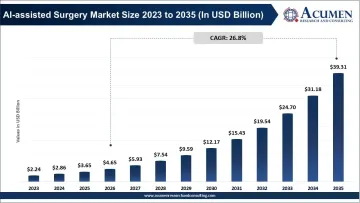
The global AI-assisted surgery market size was estimated at USD 3.65 billion in 2025 and is expected to reach USD 39.31 billion by 2035; growing at a promising CAGR of 26.8% during the forecast period 2026 to 2035. The increasing adoption of robotic-assisted surgical platforms, AI-enabled image analysis, computer vision, and data-driven surgical planning is accelerating the integration of artificial intelligence into surgical workflows.
The AI-powered surgery market is transitioning from mostly experimental stages to an increasing focus on clinical validation and adoption. Growing adoption of AI-powered surgery encompasses the use of numerous applications in the clinical space, with research expanding, clinical validation broadening, and AI increasingly incorporated into surgical decision-support and workflow applications. A systematic review published in 2026 found 188 studies related to AI and surgical scene understanding, and a separate review found 61 studies related to AI in surgical practice.
Report Highlights
- By region: North America dominated the market with a 45.0% share in 2025, supported by advanced healthcare infrastructure, established robotic surgery adoption, and strong investment in AI-enabled surgical technologies.
- By component: Software dominated the component segment with a 48.0% share in 2025, driven by increasing integration of AI algorithms across surgical planning, navigation, imaging, analytics, and clinical decision support.
- By deployment: On-premise deployment dominated with a 46.0% share in 2025, supported by healthcare providers' preference for direct control over sensitive clinical data, infrastructure, security, and system integration.
- By technology: Machine learning & deep learning dominated the technology segment with a 42.0% share in 2025, supported by widespread applications in surgical imaging, prediction, pattern recognition, planning, and decision support.
- By application: AI-assisted robotic surgery dominated the application segment with a 27.0% share in 2025, supported by the integration of intelligent planning, computer vision, navigation, analytics, and software-enabled assistance into robotic surgical platforms.
- By surgery type: General surgery dominated the surgery type segment with a 23.0% share in 2025, supported by high procedure volumes and broad application of robotic assistance, imaging, navigation, planning, and AI-enabled decision-support technologies.
- By surgical approach: Robotic-assisted surgery dominated with a 44.0% share in 2025, supported by established deployment of robotic platforms and increasing integration of AI-based planning, computer vision, navigation, imaging, and analytics.
- By end user: Hospitals dominated the end-user segment with a 64.0% share in 2025, supported by high surgical volumes, advanced clinical infrastructure, and greater capacity to deploy AI-enabled robotic, imaging, navigation, and decision-support technologies.
AI-Assisted Surgery Market Size & Forecast
- Base Year Market Size (2025): $3.65 billion
- Current Year Market Size (2026): $4.65 billion
- Estimated Year Market Size (2035): $39.31 billion
- Forecast Period CAGR (2026-2035): 26.8%
Key Growth Factors
- AI-Enabled Medical Devices: Growing availability of AI-enabled medical devices is expanding the technology base for AI-assisted surgical applications. The FDA maintains a continuously updated list of authorized AI-enabled medical devices and notes that such technologies can support diagnosis, treatment, clinical decision-making, and other healthcare functions, creating a broader environment for surgical AI adoption.
- Minimally Invasive Surgery: Increasing use of minimally invasive procedures is supporting demand for technologies that improve surgical visualization, navigation, planning, and instrument control. Computer-assisted surgical systems can assist surgeons during complex procedures through small incisions, while AI can add image analysis, anatomical recognition, decision support, and workflow assistance to these platforms.
- Robotic Procedure Growth: Rising utilization of robotic-assisted surgery is expanding the installed base on which AI-enabled surgical capabilities can be developed and deployed. Intuitive reported approximately 3.15 million procedures using da Vinci systems in 2025, an increase of about 18% from 2024, demonstrating continued expansion of technology-assisted surgical procedures.
AI-Assisted Surgery Market Adoption Rate 2026
- AI-Enabled Medical Devices: More than 1,600 AI-enabled medical devices had been authorized for marketing in the U.S. by 2026, indicating continued commercialization of AI technologies across healthcare.
- Robotic Surgical System Installations: More than 11,395 da Vinci surgical systems were installed globally by March 2026, representing approximately 12% year-over-year growth.
- Robotic Surgery Procedure Volume: Approximately 3.15 million da Vinci procedures were performed globally in 2025, representing around 18% growth from 2024.
- Annual Robotic System Placements: Intuitive Surgical placed approximately 1,721 da Vinci systems in 2025, compared with 1,526 systems in 2024, representing approximately 13% growth.
- da Vinci 5 Adoption: Approximately 870 da Vinci 5 systems were placed in 2025, compared with 362 in 2024, representing approximately 140% growth in placements of the newer platform.
- Robotic Procedure Growth in 2026: Worldwide da Vinci procedure volume increased approximately 16% year over year in Q1 2026, demonstrating continued growth in robotic-assisted surgical utilization.
- AI Surgical Research Volume: A 2026 systematic review analyzed 188 studies focused on AI-based surgical scene understanding, demonstrating the expanding research base supporting computer vision and AI-assisted intraoperative applications.
AI-Assisted Surgery Market Dynamics
Key Drivers
- Surgical Precision: AI-assisted technologies can analyze imaging, anatomical structures, and intraoperative information to provide surgeons with additional decision-support capabilities. Integration with navigation and robotic systems can help identify relevant anatomical features and support complex procedures, increasing demand for technologies designed to improve visualization, planning, precision, and consistency during surgery.
- Clinical Decision Support: Increasing availability of medical imaging, patient records, intraoperative video, and other clinical datasets is creating opportunities for AI-based decision support during surgical workflows. AI systems can identify patterns and generate information that supports healthcare decisions, although clinical validation and appropriate human oversight remain important requirements for deployment.
- Surgical Automation: Advances in computer vision, machine learning, robotics, and real-time data processing are expanding the potential applications of AI across surgical workflows. AI can support tasks such as image interpretation, surgical navigation, instrument tracking, workflow recognition, and procedural assistance, encouraging technology developers to integrate intelligent capabilities into surgical platforms.
Market Restraints
- High System Costs: AI-assisted surgery can require expensive robotic platforms, imaging systems, specialized instruments, software, infrastructure, and maintenance. Healthcare providers must evaluate the initial capital investment alongside utilization levels, staffing requirements, training, and reimbursement considerations, which can slow adoption among hospitals with limited budgets or lower surgical volumes.
- Limited Clinical Evidence: AI-assisted surgical technologies require robust clinical validation demonstrating safety, effectiveness, reliability, and meaningful clinical value. Evidence requirements can increase development timelines and costs, particularly for systems that provide decision support or adaptive functionality. Healthcare providers may also require additional evidence before integrating emerging technologies into established surgical workflows.
- Regulatory Complexity: AI-enabled medical devices must address regulatory requirements related to safety, effectiveness, transparency, software modifications, monitoring, and lifecycle management. The FDA's 2025 draft guidance specifically addressed AI-enabled devices across their total product lifecycle, illustrating the regulatory complexity developers must manage as surgical AI systems become increasingly sophisticated.
Opportunities & Future Outlook
- AI Surgical Navigation: AI-powered navigation can combine medical imaging, anatomical models, computer vision, and real-time information to support surgeons during complex procedures. Development of more accurate and responsive navigation platforms creates opportunities across neurosurgery, orthopedics, spinal surgery, ENT, and other specialties where precise anatomical localization can influence procedural planning and execution.
- Personalized Surgery: AI can analyze patient-specific imaging, clinical information, and anatomical characteristics to support customized surgical planning. This creates opportunities for software that generates individualized surgical pathways, predicts procedural requirements, assists with implant or instrument selection, and provides patient-specific decision support across increasingly data-driven surgical workflows.
- AI-Robotics Integration: Integrating AI capabilities with robotic surgical platforms creates opportunities for intelligent assistance, including anatomical recognition, instrument tracking, motion analysis, workflow guidance, and real-time decision support. Continued expansion of robotic surgery provides an established technological platform for adding AI functionality, while new software capabilities can expand the usefulness of existing systems.
Market Challenge
- Data Quality: AI-assisted surgical systems depend on large, representative, high-quality datasets for development and validation. Differences in imaging equipment, patient populations, surgical techniques, clinical environments, and data labeling can affect model performance. Ensuring reliable and representative data across hospitals and demographic groups therefore remains a major development and deployment challenge.
- Surgeon Trust: Adoption depends on surgeons understanding how AI systems generate recommendations and when those recommendations should be relied upon. Concerns surrounding explainability, unexpected outputs, workflow disruption, and responsibility for AI-supported decisions can affect acceptance. Developers therefore need transparent interfaces, appropriate human oversight, and evidence demonstrating practical clinical value.
- Safety Governance: AI-assisted surgery requires continuous oversight because software performance can be affected by model changes, new datasets, hardware configurations, and clinical environments. WHO emphasizes lifecycle-based evaluation, monitoring, governance, and risk-benefit assessment for AI in healthcare, making post-market surveillance and clear accountability important challenges as surgical AI adoption expands.
AI-Assisted Surgery Use Cases
| Use Case | AI-Assisted Function | Surgical Application | Companies / Platforms |
|---|---|---|---|
| Preoperative Surgical Planning | AI-based image analysis, anatomical modeling, procedure planning and patient-specific recommendations | Orthopedic, neurosurgical and general procedures | Medtronic AiBLE™, Brainlab, Zimmer Biomet ROSA®, Stryker Mako® |
| Intraoperative Image Guidance | Real-time imaging, anatomical visualization and navigation support | Brain, spine, orthopedic and minimally invasive surgery | Brainlab Loop-X®, Medtronic AiBLE™, Siemens Healthineers |
| Surgical Navigation | AI-enabled planning, image registration and navigation assistance | Spine, cranial and orthopedic surgery | Medtronic, Brainlab, Stryker |
| Robotic-Assisted Surgery | Robotic assistance, digital planning, motion control and data-enabled surgical execution | General, urological, gynecological and orthopedic surgery | Intuitive Surgical da Vinci®, Medtronic Hugo™, CMR Surgical Versius®, Johnson & Johnson MedTech |
| Computer Vision | Surgical video analysis, instrument recognition, anatomy recognition and procedure-phase analysis | Minimally invasive and robotic surgery | Intuitive Surgical, Medtronic Touch Surgery™, Asensus Surgical |
| Surgical Instrument Tracking | Real-time tracking and digital positioning of surgical instruments | Orthopedic and minimally invasive procedures | Stryker Mako®, Smith+Nephew CORI®, Brainlab |
| Tumor and Tissue Identification | AI-assisted image interpretation and tissue/perfusion analysis | Cancer and image-guided surgery | Activ Surgical, Brainlab, Siemens Healthineers |
| Surgical Performance Analysis | Analysis of surgical video and procedure data to identify workflow and performance patterns | Surgeon training, quality improvement and robotic surgery | Medtronic Touch Surgery™, Intuitive Surgical |
| Postoperative Outcome Prediction | AI-based analysis of surgical and patient data to identify risks and outcome patterns | Postoperative monitoring and clinical decision support | Medtronic, Intuitive Surgical and digital surgery platforms |
| Surgical Workflow Optimization | Analysis of operating-room and procedural data to identify workflow inefficiencies | Hospitals and operating rooms | Medtronic, Proximie, Caresyntax |
| Autonomous or Semi-Autonomous Surgical Tasks | AI and robotic systems performing defined surgical tasks under varying levels of surgeon supervision | Experimental and emerging applications | Intuitive Surgical, research institutions and emerging surgical robotics companies |
AI-Assisted Surgery Market Segmental Insights
Component Insights
Software: Software dominated the component segment with 48.0% share in 2025, because AI algorithms form the intelligence layer of modern surgical systems. Surgical planning, computer vision, navigation, analytics, and decision-support applications increasingly process clinical and imaging data, enabling healthcare providers to integrate AI capabilities across preoperative, intraoperative, and postoperative workflows.
Hardware: Hardware represented the second-largest component category, 37.0% share in 2025 supported by demand for AI-enabled robotic systems, navigation platforms, imaging equipment, sensors, cameras, and processing infrastructure. These systems provide the physical and computational foundation required to capture, process, interpret, and act on surgical data during clinical procedures.
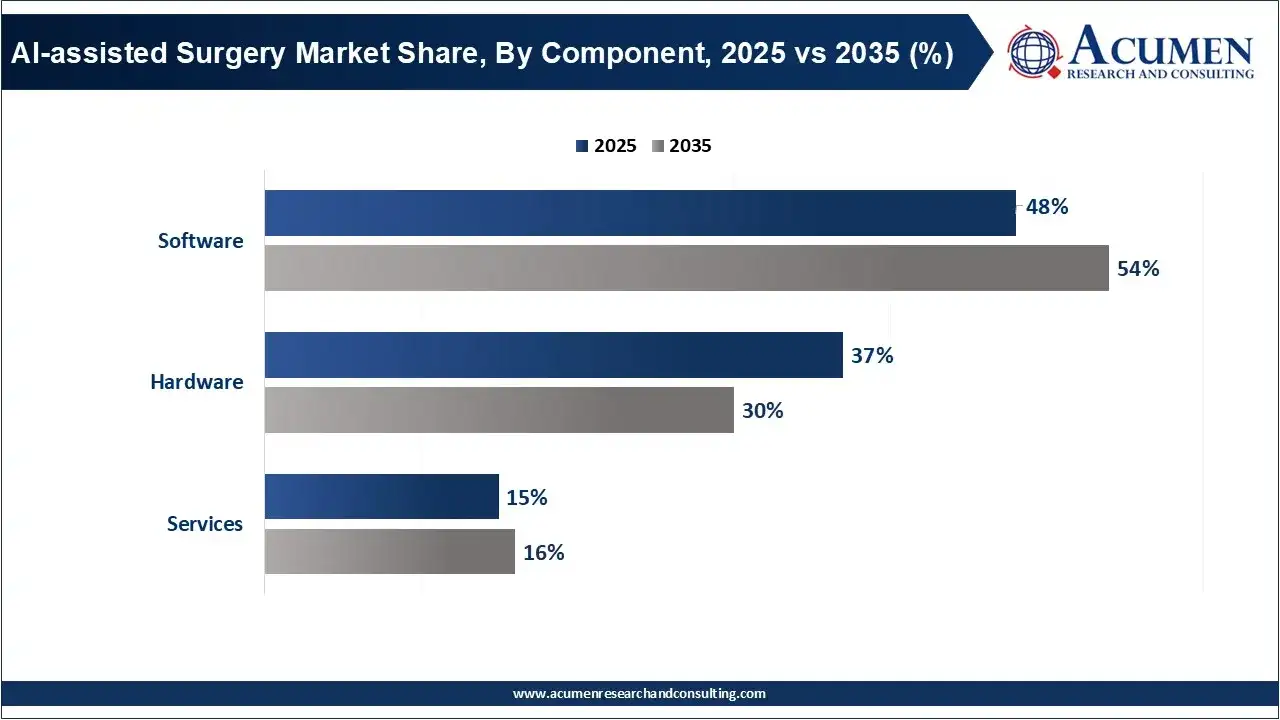
Services: Services accounted for the smallest component category, 15.0% share in 2025, covering implementation, integration, training, consulting, maintenance, technical support, and optimization. Healthcare organizations increasingly require specialized services to connect AI platforms with existing hospital infrastructure, train clinical personnel, maintain system performance, and manage technology upgrades.
Deployment Insights
On-Premise: On-premise deployment dominated the market with 46.0% share in 2025, because healthcare providers often prioritize direct control over sensitive patient information, computing infrastructure, clinical systems, and cybersecurity. Local deployment also supports applications requiring low latency and direct connectivity with imaging, navigation, robotic, and operating-room equipment.
Cloud-Based: Cloud-based deployment is projected to register the fastest growth at 28.7% CAGR from 2026 to 2035, as healthcare organizations seek scalable computing, centralized AI model management, remote analytics, streamlined software updates, and flexible data infrastructure. Cloud platforms can also support collaboration between distributed facilities and technology providers.
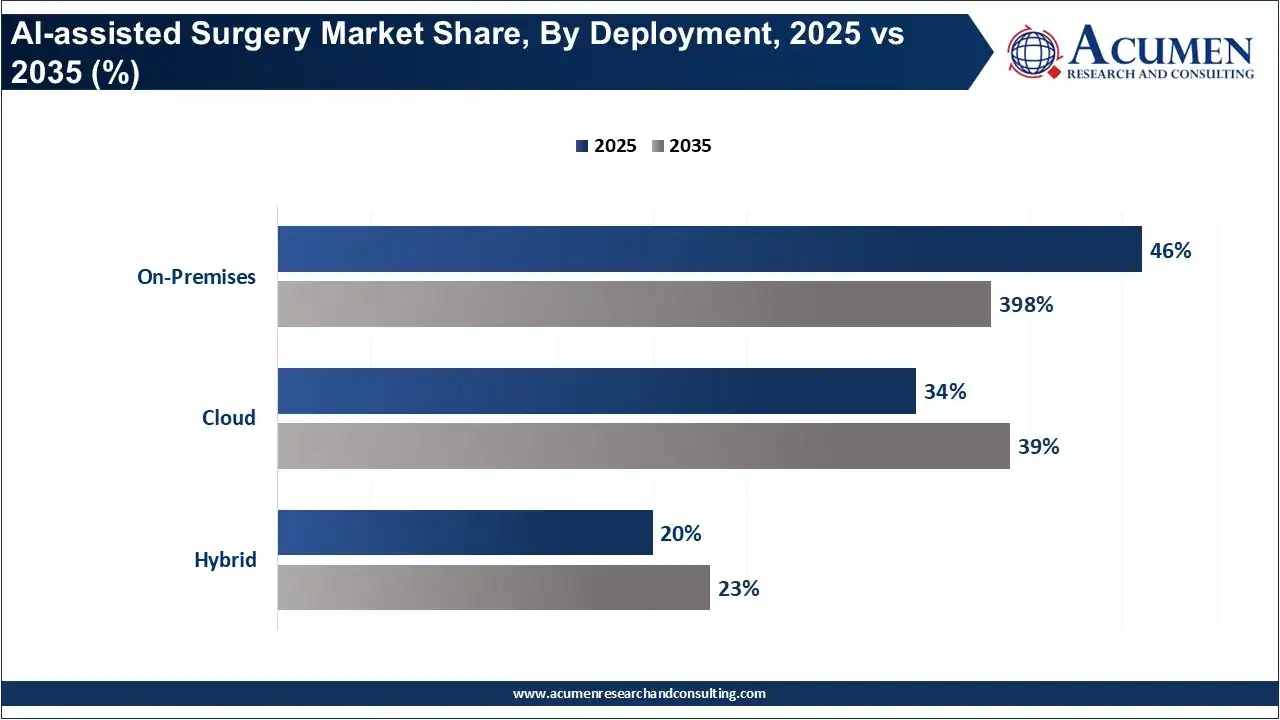
Hybrid: Hybrid deployment is projected to experience similarly rapid expansion at 28.7% CAGR from 2026 to 2035 by combining local processing with cloud capabilities. Healthcare organizations can retain sensitive surgical information locally while using cloud infrastructure for analytics, model development, software management, storage, and scalable computational requirements.
Technology Insights
Machine Learning & Deep Learning: Machine learning and deep learning dominated the technology segment, with 42.0% share in 2025, supported by applications in medical image analysis, surgical prediction, pattern recognition, risk assessment, clinical decision support, and computer vision. Their ability to identify complex relationships within large clinical datasets supports widespread application across surgical workflows.
Computer Vision: Computer vision represented the second-largest technology category, at 31.0% share in 2025, driven by applications including surgical video analysis, anatomical recognition, instrument tracking, procedure-phase identification, image interpretation, and intraoperative visualization. Growing availability of surgical video and imaging data continues to support development of computer-vision-based surgical applications.
Natural Language Processing: Natural Language Processing supported applications at 10.0% share in 2025, involving surgical documentation, clinical information extraction, medical record analysis, voice-enabled interfaces, and interpretation of unstructured clinical information. Its role is expanding as healthcare organizations seek to convert narrative clinical data into structured information usable within digital surgical workflows.
Generative AI: 18.0% share by 2035, generative AI is projected to gain substantial importance across surgical applications, including clinical summarization, documentation, knowledge retrieval, personalized decision support, simulation, training, and natural-language interaction. Its growth reflects increasing experimentation with foundation models and generative systems for complex clinical information management.
Application Insights
AI-Assisted Robotic Surgery: AI-assisted robotic surgery dominated the application segment, at 27.0% share in 2025, supported by integration of intelligent planning, computer vision, navigation, analytics, and software-enabled assistance into robotic platforms. Growing utilization of robotic procedures provides an established environment for incorporating increasingly sophisticated AI capabilities into surgical workflows.
Preoperative Planning & Risk Assessment: Preoperative planning and risk assessment represented a significant application category, at 15.0% share in 2025, with AI supporting anatomical analysis, patient-specific modeling, procedure planning, risk identification, and simulation. These capabilities allow surgical teams to evaluate complex patient information and prepare more detailed intervention strategies before surgery.
Intraoperative Navigation & Guidance: Intraoperative navigation and guidance represented the second-largest application category, with 21.0% share in 2025, supported by AI-enabled anatomical localization, image registration, visualization, and real-time guidance. These technologies are particularly relevant to complex procedures requiring precise positioning and continuous interpretation of anatomical information during surgery.
Surgery Type Insights
General Surgery: General surgery dominated the surgery type segment, at 23.0% share in 2025, supported by the high volume and broad range of procedures performed across hospitals and surgical centers. AI technologies are increasingly integrated into general surgery through robotic assistance, surgical planning, computer vision, navigation, imaging, and decision-support applications.
Orthopedic Surgery: Orthopedic surgery accounted for 18.0% share in 2025, supported by growing adoption of robotic-assisted procedures, AI-enabled surgical planning, and advanced imaging technologies. Increasing demand for precision in joint replacement, spine, and trauma procedures is creating opportunities for AI-based navigation, anatomical analysis, personalized planning, and intraoperative guidance.
Neurosurgery: Neurosurgery represented 15.0% share in 2025, supported by the need for high precision in complex procedures involving the brain, spine, and nervous system. AI technologies are increasingly applied to surgical planning, medical imaging, navigation, anatomical identification, and robotic assistance, helping surgeons analyze complex structures and support precise interventions.
Surgical Approach Insights
Robotic-Assisted Surgery: Robotic-assisted surgery dominated the surgical approach segment, at 44.0% share in 2025, supported by established deployment of robotic surgical platforms across major specialties. AI-enabled planning, computer vision, navigation, imaging, analytics, and software-based assistance are increasingly being integrated into these robotic environments, expanding intelligent capabilities across surgical workflows.
Laparoscopic & Endoscopic Surgery: Laparoscopic and endoscopic surgery represented the second-largest approach, at 31.0% share in 2025, supported by strong opportunities for computer vision, surgical video analysis, anatomical recognition, workflow identification, and AI-enabled intraoperative assistance. Large volumes of procedural video data also support development of AI applications across minimally invasive surgical workflows.
Open Surgery: Open surgery accounted for 20.0% share in 2025, supported by its continued use across complex procedures requiring direct anatomical access and surgeon-controlled intervention. AI technologies are increasingly being applied to open surgery through preoperative planning, medical imaging, decision support, anatomical analysis, and postoperative outcome prediction.
End User Insights
Hospitals: Hospitals dominated the end-user segment, at 64.0% share in 2025, supported by their high surgical procedure volumes, advanced clinical infrastructure, and greater capacity to invest in AI-enabled surgical technologies. Hospitals also provide multidisciplinary environments where robotic systems, imaging platforms, AI software, and integrated surgical workflows can be deployed across multiple specialties.
Ambulatory Surgical Centers: Ambulatory surgical centers accounted for 16.0% share in 2025, supported by increasing demand for minimally invasive procedures, shorter hospital stays, and efficient outpatient surgical workflows. AI technologies can assist these centers through surgical planning, robotic assistance, imaging, workflow optimization, and decision support while supporting efficient utilization of limited clinical resources.
Specialty Clinics & Surgical Centers: Specialty clinics and surgical centers represented 10.0% share in 2025, supported by increasing specialization of surgical care and adoption of targeted AI-enabled technologies. These facilities are incorporating AI applications for procedure planning, imaging, navigation, robotic assistance, and clinical decision support across focused specialties requiring advanced surgical capabilities.
AI-Assisted Surgery Market Regional Insights
North America: Established Robotic Surgery Infrastructure Supports Regional Leadership
North America dominated the AI-assisted surgery market with 45.0% share in 2025, supported by advanced healthcare infrastructure, high adoption of robotic surgery, strong investment in medical AI, and widespread availability of advanced imaging and surgical technologies. The region's mature ecosystem of hospitals, technology developers, research institutions, and specialized surgical centers provides a strong foundation for integrating AI across preoperative planning, intraoperative guidance, robotic surgery, and postoperative analytics.
- United States: The United States represents the primary regional market, supported by extensive deployment of robotic surgical platforms, high healthcare technology expenditure, and continued development of AI-enabled medical devices and surgical software. Leading hospitals and academic medical centers are increasingly adopting AI for surgical planning, imaging, navigation, robotic assistance, and clinical decision support.
- Canada: Canada is expanding AI-assisted surgery adoption through investments in digital health infrastructure, medical research, surgical robotics, and AI-enabled clinical technologies. Academic hospitals and specialized healthcare institutions are increasingly participating in the development and evaluation of AI applications for surgical imaging, navigation, decision support, and minimally invasive procedures.
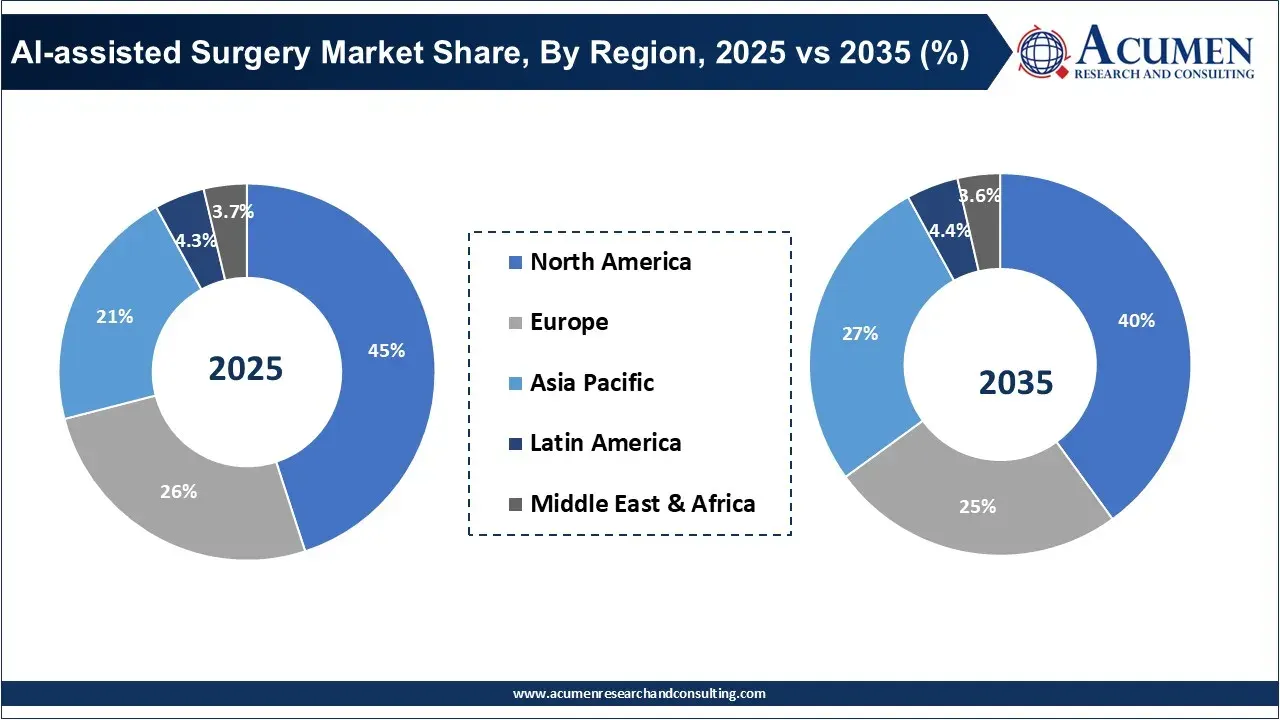
Asia-Pacific: Rapid Healthcare Digitization Makes the Region the Fastest-Growing Market
Asia-Pacific accounted for 21.0% share in 2025 and is projected to register the fastest CAGR of 30.3% from 2026 to 2035, increasing from $0.98 billion in 2026 to $10.61 billion by 2035. Market expansion is supported by rising healthcare expenditure, modernization of hospitals, increasing surgical volumes, growing adoption of robotic systems, and expanding investments in AI and digital healthcare infrastructure. Japan, China, South Korea, India, and other emerging markets are increasingly developing capabilities for AI-enabled surgical technologies.
- China: China is expanding its AI-assisted surgery ecosystem through investments in medical AI, surgical robotics, advanced imaging, and healthcare digitization. Major hospitals and technology developers are increasingly developing and deploying intelligent surgical platforms, while domestic innovation in robotics and AI is supporting broader adoption across specialized surgical applications.
- Japan: Japan represents an established market for surgical robotics and AI-enabled healthcare technologies, supported by an aging population, advanced medical infrastructure, and strong expertise in robotics. Healthcare institutions are increasingly integrating robotic assistance, AI-based imaging, navigation, and surgical planning technologies to support precision and efficiency across complex procedures.
Top Companies
- Intuitive Surgical, Inc.: Develops the da Vinci robotic surgery platform and is expanding its AI strategy around surgical data, advanced analytics, computer-assisted capabilities, and AI-enabled surgical workflows, supported by data from more than 20 million da Vinci procedures.
- Medtronic plc: Participates in AI-assisted surgery through its Hugo™ Robotic-Assisted Surgery system and Touch Surgery™ digital ecosystem, which uses AI-powered postoperative analysis and surgical performance insights.
- Johnson & Johnson MedTech: Advancing AI-enabled and digitally connected surgery through its OTTAVA™ robotic surgical system, which combines robotic technology, automated features, surgical instruments, and an open digital ecosystem for data-driven surgery.
- Stryker Corporation: Integrates robotics, 3D imaging, intraoperative planning, haptic technology, and digital guidance through its Mako SmartRobotics™ platform for orthopedic procedures including knee, hip, spine, and shoulder surgery.
- Zimmer Biomet Holdings, Inc.: Develops AI and data-enabled robotic surgery technologies through its ROSA® Robotics platform, including intelligent surgical planning, intraoperative data, robotic assistance, and personalized orthopedic procedures.
- Siemens Healthineers AG: Provides AI-enabled medical imaging, surgical navigation, and digital technologies that support image-guided and data-driven surgical workflows, connecting diagnostic imaging with intraoperative decision-making.
- GE HealthCare Technologies Inc.: Applies artificial intelligence, medical imaging, visualization, and digital technologies to support image-guided procedures and data-driven clinical workflows across surgical and interventional care.
- Brainlab AG: Develops digital surgery and image-guided technologies that combine surgical planning, navigation, visualization, and AI-enabled data analysis to support precision across multiple surgical specialties.
Partnerships, Product Launches & Investments
- September 2026: Medtronic and Cornerstone Robotics announced a strategic partnership involving an approximately $700 million investment by Medtronic in Cornerstone Robotics, along with distribution rights for Cornerstone's Sentire surgical system in selected markets outside the U.S. Medtronic also highlighted ongoing development of real-time AI capabilities within its Hugo robotic-assisted surgery ecosystem.
- September 2026: Proximie, AWS, Deloitte and NHS hospitals launched a year-long AI operating-theatre evaluation across 104 operating theatres, endoscopy suites and catheterisation laboratories at eight UK hospital sites. The programme will use Proximie's Intelligence Suite to analyze surgical and operational data, with the participating sites expected to cover more than 20,000 procedures annually.
Segments Covered
By Component
- Software
- Surgical Planning Software
- Intraoperative AI Software
- Surgical Navigation & Guidance Software
- AI Clinical Decision-Support Software
- Surgical Analytics Software
- Other Software
- Hardware
- AI-Enabled Surgical Robotic Systems
- AI-Enabled Navigation & Imaging Systems
- Sensors & Cameras
- Computing & Processing Hardware
- Other Hardware
- Services
- Implementation & Integration Services
- Training & Consulting Services
- Support Services
- Maintenance & Upgrade Services
- Managed & AI Optimization Services
- Other Services
By Deployment
- On-Premise
- Cloud-Based
- Hybrid
By Technology
- Machine Learning & Deep Learning
- Computer Vision
- Natural Language Processing
- Generative AI
- Other AI Technologies
By Application
- Preoperative Planning & Risk Assessment
- Intraoperative Navigation & Guidance
- AI-Assisted Robotic Surgery
- Surgical Decision Support
- Surgical Imaging & Visualization
- Workflow & Procedure Optimization
- Postoperative Analytics & Outcome Prediction
- Others
By Surgery Type
- General Surgery
- Orthopedic Surgery
- Neurosurgery
- Cardiovascular Surgery
- Urological Surgery
- Gynecological Surgery
- Gastrointestinal Surgery
- Thoracic Surgery
- Others
By Surgical Approach
- Robotic-Assisted Surgery
- Laparoscopic & Endoscopic Surgery
- Open Surgery
- Others
By End User
- Hospitals
- Ambulatory Surgical Centers
- Specialty Clinics & Surgical Centers
- Academic & Research Medical Centers
- Others
By Region
- North America
- Europe
- Asia-Pacific
- Latin America
- Middle East & Africa
Looking for discounts, bulk pricing, or custom solutions? Contact us today at sales@acumenresearchandconsulting.com
Frequently Asked Questions

Other Healthcare and Pharmaceuticals Reports
October 2024
November 2020
April 2023
August 2023