
AI in Healthcare Market Size, Share, Forecast Report 2026 To 2035
AI in Healthcare Market (By Technology: Machine Learning, Deep Learning, Natural Language Processing, Computer Vision, Generative AI, Others; By Component: Software, Hardware, Services; By Deployment: Cloud-based, On-premise, Hybrid; By End User: Healthcare Providers, Healthcare Payers, CROs, Other By Application: Clinical AI, Operational & Administrative AI, Virtual Care & Patient Engagement AI, Drug Discovery & Life Sciences AI, Population Health & Public Health AI) - Global Industry Analysis, Size, Share, Regional Analysis, Trends and Forecast 2026 - 2035
- Last Updated: 09 Jun 2026
- Report Code: ARC3936
- Category: Healthcare and Pharmaceuticals
AI in Healthcare Market Size, Forecast 2026 To 2035
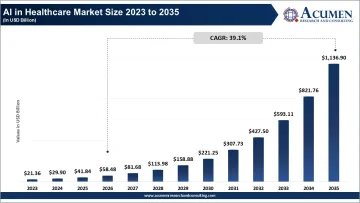
The global AI in healthcare market size was valued at USD 41.84 billion in 2025 and is estimated to surpass around USD 1,136.90 billion by 2035 growing at a CAGR of 39.1% from 2026 to 2035. The rising emphasis on predictive maintenance and large-scale application of machine learning and computer vision by healthcare providers create a significant opportunity for the market to grow. Additionally, countries such as U.S., China, India, Japan and many European countries are being supported by government initiatives and funding that are associated with rapid adoption of AI; this creates a sustaining potential for the AI in healthcare market to expand.
Report Highlights
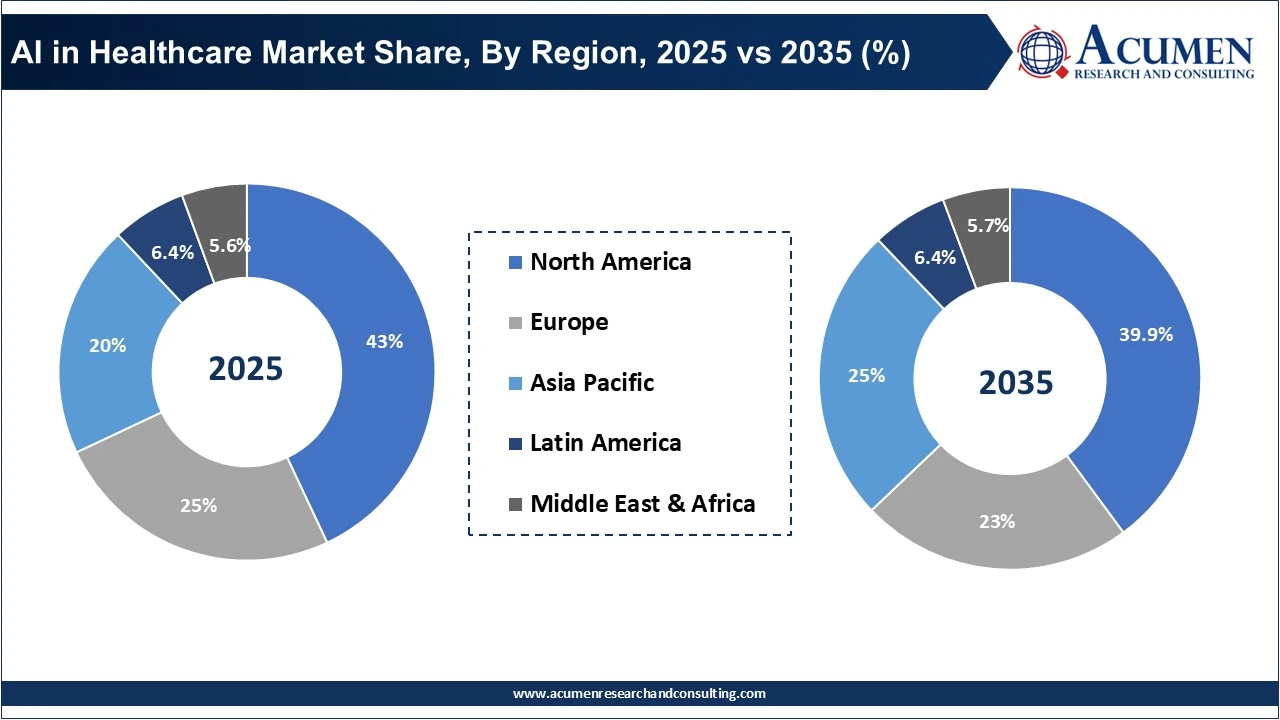
- By region, North America led the market with 43% market share in 2025 owing to the support by advanced healthcare infrastructure and strong investments from technology giants.
- By region, Europe accounted for 25% of the market in 2025 driven by growing healthcare digitization and government-backed innovation programs.
- By region, Asia Pacific is projected to grow at the fastest CAGR of 42.5% during the forecast period, fuelled by rapid healthcare modernization and government initiatives promoting AI-enabled healthcare ecosystems.
- By technology, the machine learning segment 30% share in 2025 due to its extensive use in disease diagnosis.
- By technology, generative AI is expected to grow at the fastest rate of CAGR of 50.2% during the forecast period as healthcare organizations increasingly adopt large language models and AI-driven drug discovery platforms.
- By component, the software segment emerged as the leading one with 63% market share in 2025 because AI software platforms served as the backbone of healthcare AI deployments.
- By component, the services segment is expected to grow at a notable rate of 39.1% over the forecast period as healthcare organizations increasingly seek external expertise for AI implementation.
- By deployment, the cloud-based segment dominated the market with 55% share in 2025 as hospitals, government agencies, and large healthcare institutions continued prioritizing data security, regulatory compliance, and direct control over sensitive patient information.
- By end-user, the healthcare providers segment dominated with 46% in 2025, driven by increasing adoption of AI-powered diagnostics, clinical decision support systems, patient monitoring technologies, and workflow automation solutions across hospitals and specialty care facilities.
- By pharmaceutical and biotechnology companies segment represented the second-largest with 22% share in 2025 in 2025 as AI continues to accelerate drug discovery, clinical trial optimization, biomarker identification, and precision medicine development.
- By application, the clinical AI segment dominated the market with 42% in 2025 due to growing demand for accurate disease diagnosis, personalized treatment planning, predictive healthcare analytics, and improved clinical outcomes.
- By application, the operational and administrative AI segment held the second-largest share of 20% in 2025 as healthcare organizations increasingly leverage AI to automate billing, claims processing, appointment scheduling, workforce management, and other resource-intensive administrative functions.
How is Artificial Intelligence’s Adoption Booming in Healthcare Sector?
The overall medical industry is being revolutionized by artificial intelligence (AI), leading to enhanced diagnostic precision, simplified clinical processes, more effective drug development, and a more personalized patient experience. With health systems all over the world struggling with increased patient volumes, lack of personnel, rising instances of chronic diseases and spiraling costs of operation, AI has come to the fore as an indispensable technological tool to promote efficiency and offer a more personalized and precise course of treatment.
Growth in medical data has spurred many organizations toward incorporating artificial intelligence (AI). EHR, medical imaging equipment, wearables, genomic databases, telehealth solutions and remote monitoring services are contributing to the exponential accumulation of both structured and unstructured data on a daily basis. Government interventions and healthcare digitalization initiatives have also significantly aided the assimilation of AI. Investments by nations like the U.S., China, India, the U.K. and Singapore into updating health systems, fostering a digital infrastructure and driving artificial intelligence innovation are proving to be influential.
Market Dynamics
Driver
Rising Demand for Early Disease Detection
The increasing need for accurate diagnosis, timely disease detection and enhanced clinical decision-making processes is one of the key factors that fuels the adoption of AI in healthcare industry. The need for increased volume of patients, the ever-rising burden of chronic diseases, and the lack of efficient medical professionals are some of the major challenges being faced by the healthcare industry across the globe. AI solutions assist to overcome these challenges as it helps the healthcare professionals to quickly process large volume of patient information, detect the symptoms, recognize the disease patterns and provide clinically actionable insights in real time.
The quick adoption of telemedicine, wearable devices and remote patient monitoring devices is creating immense amount of healthcare data which necessitates for a strong analytical platform. Increasing expenditure on healthcare sector coupled with the constant effort towards the ongoing digital transformation process in the hospital network and health care organizations will boost the growth of the market over the forecast period.
Restraint
Data Privacy Concerns and Regulatory Challenges Limit Widespread Implementation
Although, AI has a huge potential in healthcare, its widespread use has encountered numerous problems with respect to data privacy, security and regulatory compliance. AI applications depend on enormous amounts of patients data to develop algorithms and make correct predictions. Since, patient's data is a very sensitive information, protection of data is a primary concern for healthcare providers, patients as well as regulatory bodies.
Healthcare providers also need to abide by the complicated regulations concerning the patient data and security of the information. Unapproved access, data breaches, algorithm opacity and unethical uses of patient's information raise major concerns regarding the application of AI solutions, thereby leading to delay.
Opportunity
Focus on Generative AI and Precision Medicine
The rise of generative AI and precision medicine represents a vast opportunity for players operating in the AI in healthcare market. AI systems that use generative AI technologies are automating work processes in healthcare which include clinical documentation, generation of medical reports, patient engagement through virtual health assistants and knowledge management systems, and much more. Providers are actively considering generative AI solutions that lower the administrative burden, help physicians be more productive, and improve patient interaction.
The life sciences and pharmaceutical industries are contributing to the growing new market through AI driven drug discovery and development. These applications offer efficiency and reduced time-to-market in the drug development pipeline, accelerating target discovery and molecule design, trial efficiency, and biomarker identification. As more providers and life sciences companies shift their operational systems to the cloud, generative AI and precision medicine will lead to the growth of additional revenue streams in the next 10 years.
Regional Insights
North America’s Global Powerhouse Driving AI-Led Healthcare Transformation
North America held the largest share in the global AI in healthcare market and generated nearly 43% of the total in 2025. The region has always been the nexus for AI in healthcare due to the advanced healthcare infrastructure and widespread digitalization of the sector. It is estimated that the region would lead the market over the forecast period at a CAGR of 37.8%.
The leadership position of the region can be attributed to increased expenditure on healthcare systems in the country. The USA alone spends over $ 4.9 trillion in healthcare, which accounts for nearly 17% of the country's GDP and has emerged as the largest healthcare spender across the world. Increasing cost of healthcare along with increasing burden of chronic diseases has prompted for faster deployment of AI in healthcare sector to improve overall efficiency.
AI is currently being implemented in clinical decision making, radiology, pathology, predictive analysis, drug development, and hospital management workflow and patient engagement systems. Availability of EHRs, increased use of cloud computing, and adoption of telemedicine and remote patient monitoring systems have generated massive amount of healthcare data that could be leveraged with the use of AI.
United States AI in Healthcare Market Trends
- The U.S. holds the biggest share in the North American market for AI in healthcare. Highly digitized healthcare ecosystem coupled with sophisticated research institutions and burgeoning healthcare technology startups in this market make the U.S. a leading player.
- With over 6,000 hospitals and healthcare systems in the U.S. undertaking digital transformation, AI finds immense opportunities in healthcare applications.
- From AI-powered diagnostic solutions, clinical decision support systems to predictive analytical platforms, the utilization of these technologies is on an increasing trend across healthcare organizations.
- The U.S. also pioneers in AI-powered drug discovery, where numerous pharmaceutical companies use machine learning and generative AI to shorten drug development timeframes and lower the cost of drug discovery.
Europe’s Digital Health Infrastructure to Expand the Market’s Presence
In 2025, Europe represented a share of approximately 25% of the global AI in the healthcare market, which makes it the second-largest market regionally. This region enjoys robust healthcare infrastructure, regulatory control, continuous investment in digital healthcare, and increasing government support for artificial intelligence implementation. The workforce shortage and increasing chronic disease burden, as well as a rapid aging population, push healthcare systems in Europe towards adopting AI-driven solutions in order to increase the efficiency of healthcare services and outcomes for patients.
Healthcare providers adopt AI for diagnosis, hospitals management, patient monitoring, radiology, pathology, and automation of administrative procedures. Germany remains the second-largest market in terms of healthcare AI in Europe. This region has one of the largest healthcare systems on the continent, with an annual spending on health exceeding 500 billion euro, and supports digitisation of health services and investments in digital therapeutics.
Asia Pacific Emerging as the Fastest-Growing Frontier for Healthcare Artificial Intelligence
Asia Pacific is expected growth at the fastest pace of 42.5% in the forecast period. Factors driving the significant growth of the Asia Pacific market are increasing healthcare infrastructure, rise in healthcare spending, rising healthcare digitalization efforts, rising penetration of smart-phones and increasing government support for AI.
Asia Pacific has over half of the global population and is currently struggling from challenges like lack of physicians, prevalence of chronic diseases and ever-increasing health care demand. AI technology has thus gained importance in the region to improve healthcare access, efficiency and quality.
Governments in Asia Pacific region are encouraging AI innovation through national AI strategy, health care modernization plans and partnerships with the public and private organizations. The demand for AI technology is also increasing from large companies providing technology solutions and healthcare providers, owing to these investments.
India AI in Healthcare Market Trends
- There is tremendous market potential in India, along with over 950 million internet users. These factors have built the bedrock for AI-driven health services.
- India also has a shortage in healthcare professionals as there is one doctor per over 1,400 people, and so this has resulted in high demand for AI-driven diagnostics, telemedicine, and clinical decision support systems.
- Healthcare expenditure is also continually rising in India as the total healthcare spending reached over $370 billion in 2025, and it is expected to exceed $600 billion in 2030.
- Increasing healthcare investments mean more hospitals and healthcare professionals will be able to adopt new technologies like AI in order to increase operational efficiency and patient results.
- Furthermore, India has a thriving startup economy that is leading the way in healthcare AI adoption. With over 10,000 health-tech startups in the country and numerous ones specializing in AI diagnostics, pathology, radiology, oncology, and patient interaction, India is a strong contender.
- Companies such as Qure.ai, Niramai, HealthPlix and SigTuple are making international names for themselves by developing and implementing AI applications that are improving disease detection and access to care.
Segmental Insights
Technology Insights
Machine Learning Dominated the AI in Healthcare Market with 30% Share in 2025
Machine learning was the leading technology segment in AI in healthcare market by share at around 30% in 2025 owing to the broad application of ML models to analyze the massive volume of structured and unstructured healthcare data and enable the system to detect patterns, predict events and aid the medical professionals in decision making process. Healthcare organizations are using the machine learning algorithms for disease diagnosis, patient risk stratification, predictive analytics, optimizing the medical treatment plans, analyzing medical images, managing hospital resources etc.
By 2025 major hospitals integrated machine learning models more commonly for early diagnosis of sepsis, cardiovascular risk analysis, cancer diagnosis, and monitoring of intensive care units. As machine learning systems continuously learn with greater data exposure they have cemented their status as the most common type of AI implemented in the health care industry.
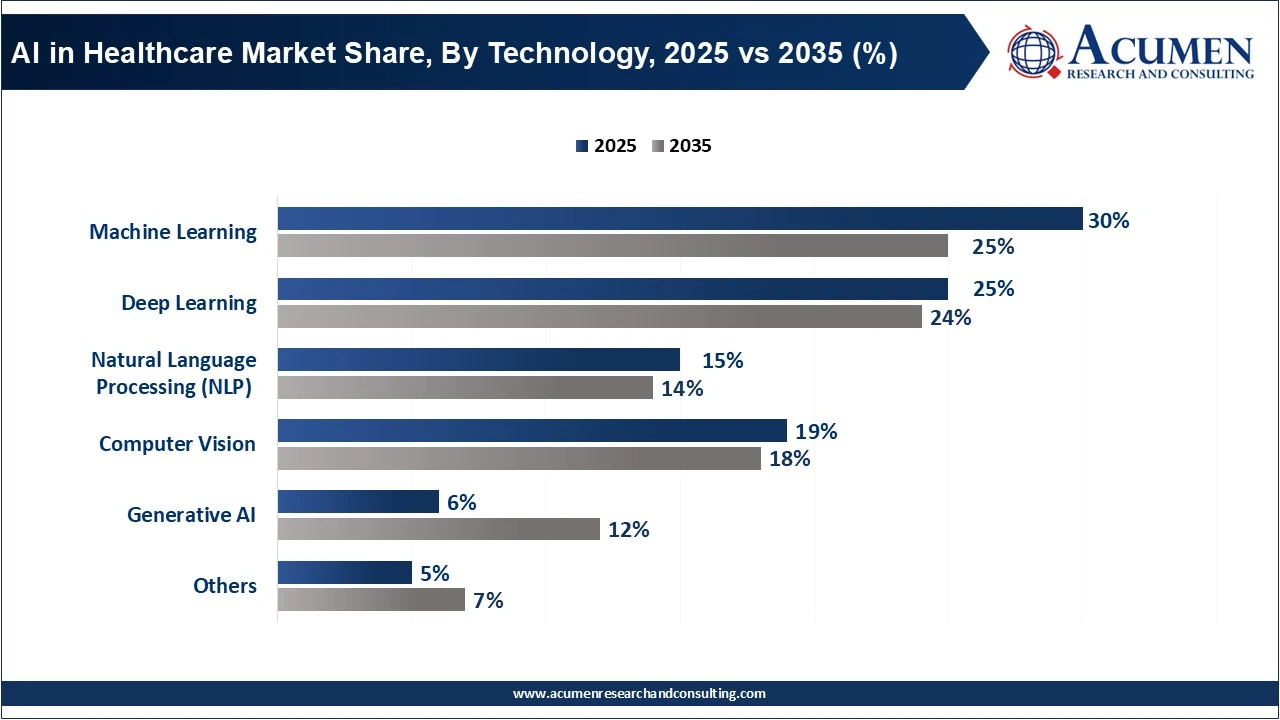
Generative AI to exhibit the most rapid CAGR of 50.2% through the forecast period due to its capability to drive transformative applications in the clinical, administrative and research sectors. The rapid development and increased adoption of LLMs, multimodal AI systems, and improved generative technology will further expand its impact on health care.
Component Insights
Software Dominated the Market with 63% Share in 2025
Software sector held the highest share of the total market, sharing around 63% in 2025. AI software platforms form the core of healthcare AI implementation and offer tools and capabilities such as data analysis, clinical decision support, predictive analytics, medical imaging interpretation, workflow automation etc. The growing investments by healthcare providers on the AI software solutions can be attributed to scalability, flexibility, and ease of integration of the software in the healthcare infrastructure.
The growth of cloud computing and digital health technology has also facilitated the use of AI software in healthcare organizations. AI-enabled software platforms help healthcare institutions in enhancing diagnosis accuracy, lowering operating costs, improving patient engagement, and streamlining clinical workflows. Constant updates to software and algorithm enhancement offers long-term benefits for healthcare organizations and helps in maintaining its market leadership.
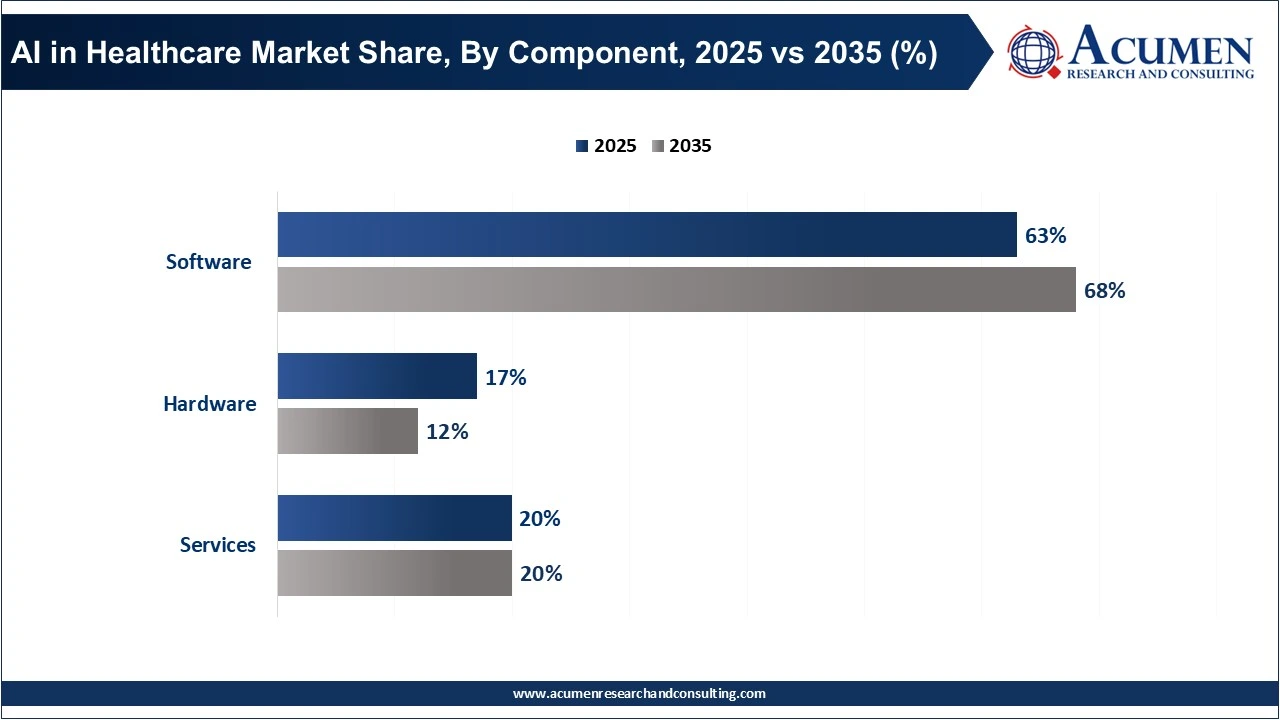
Services segment will witness a CAGR of 39.1% over the forecast period. Increasing demand from healthcare organizations for professional support on the implementation, integration, maintenance, consulting and workforce training for AI solutions drives the segment. Many healthcare organizations are not equipped with the in-house capabilities to develop, implement and manage AI solutions, hence, demand for the services providers are substantial.
Deployment Insights
Cloud-Based Deployment Dominated the Market with 55% Share in 2025
Cloud-based segment held a prominent share in the AI in healthcare market owing to scalability, affordability and availability. Healthcare entities increasingly prefer the cloud platform to manage, store and process huge amounts of healthcare data. Cloud infrastructure facilitates faster deployment of AI applications as well as lower capital investment for physical infrastructure unlike on-premise deployments. The ever-increasing adoption of telehealth, remote monitoring and various digital healthcare solutions is contributing to this growth.
Leading cloud providers like Amazon Web Services, Microsoft Azure and Google Cloud are investing heavily in developing dedicated AI solutions and are thereby promoting the growth of the cloud-based AI in healthcare market.
AI in Healthcare Market Revenue Share, Deployment Mode, By 2025 (%)
| Deployment Mode | Revenue Share, By 2025 (%) |
|---|---|
| Cloud-based | 55% |
| On-premise | 30% |
| Hybrid | 15% |
On-premises segment, in 2025, held a significant share in the AI in healthcare market due to data security issues, regulatory compliance concerns and also due to organizational decisions to maintain direct infrastructure. Major hospitals, medical colleges and government bodies prefer to implement on-premise deployments due to a desire to maintain absolute control over patient data and security of the information being collected and stored. Healthcare bodies following rigid data privacy laws are seen to invest in on-premise infrastructure.
End User Insights
Healthcare Providers Dominated the Market with 46% Share in 2025
The healthcare providers end-use segment held the dominant share of the global AI in healthcare market in 2025, estimated at around 46% of the total market revenue. This dominant share can be attributed to the increasing adoption of AI-based clinical decision support systems, diagnostics, predictive analytics platforms, patient monitoring, and automation technologies in hospitals, ambulatory care centers, and specialty clinics.
Growing demand to improve patient outcomes along with decreasing operational costs and workforce shortage have forced healthcare providers to embrace AI technology. Artificial Intelligence enables to enhance the diagnostic accuracy, provide personalized treatment, reduce the burden on physicians, and streamline hospital operations.
AI in Healthcare Market Revenue Share, End User, By 2025 (%)
| End User | Revenue Share, By 2025 (%) |
|---|---|
| Healthcare Providers | 46% |
| Healthcare Payers | 14% |
| Pharmaceutical & Biotechnology Companies | 22% |
| Contract Research Organizations (CROs) | 7% |
| Government & Public Health Agencies | 6% |
| Others | 5% |
The pharmaceutical and biotechnology end-use segment held the second-largest share of the market revenue in 2025, accounting for almost 22%. The rising research costs and the complexity of the drug development process have driven the growth of AI across the entire pharmaceutical value chain. A conventional drug development process takes over 10 years and a sum of over a billion U.S. Dollars for development, thus hindering effective drug research. However, AI technologies have accelerated the drug development process, helping in identifying efficient and potential drug candidates.
Application Insights
Clinical AI Led the Market with 42% Share in 2025
The clinical AI segment with an estimated share of over 42% in 2025 dominated the market. AI in clinical applications have a significant market share in the global AI in healthcare market, which can be attributed to an increased requirement for accurate diagnosis, personalized treatment planning, prediction of potential health risks, clinical decision support systems, improved patient care outcomes. Clinical AI solutions are essential in combating challenges posed by increasing patient volumes, shortages in healthcare professionals, and a high prevalence of chronic diseases in healthcare systems around the world.
AI in Healthcare Market Revenue Share, Application, By 2025 (%)
| Application | Revenue Share, By 2025 (%) |
|---|---|
| Clinical AI | 42% |
| Operational & Administrative AI | 20% |
| Virtual Care & Patient Engagement AI | 13% |
| Drug Discovery & Life Sciences AI | 18% |
| Population Health & Public Health AI | 7% |
Operational & administrative AI held the second position with around 20% of the global AI in healthcare market share in 2025. Operational and Administrative AI has gained substantial traction owing to efforts of various stakeholders to reduce healthcare operational inefficiencies and the huge operational expenditure required to handle numerous administrative tasks, also contributing to reducing the rising healthcare costs globally.
Administrative processes contribute to a larger portion of healthcare costs and these processes are often a time-consuming and paper-intensive part of operations in the healthcare sector. Some of the activities that the segment covers includes scheduling of appointments, medical billing and claims management, coding, revenue cycle management, and work-force planning, among others.
Top Players
- Microsoft
- Amazon
- NVIDIA
- Oracle
- IBM
- GE HealthCare
- Siemens Healthineers
- Philips
- Medtronic
- Johnson & Johnson
- IQVIA
- Tempus AI
- Aidoc
Recent News
- Mayo Clinic and Microsoft collaborated in June 2026 to build the next-generation AI model focused on health. This new technology combines Mayo Clinic's clinical knowledge and de-identified health data with Microsoft's AI and cloud technology. The collaboration seeks to enhance diagnostic speed, personalized treatment recommendations and clinical decisions.
- Cleveland Clinic announced that over one million patient encounters have been recorded by its AI-powered ambient clinical documentation platform. The platform streamlines the documentation process, alleviates the administrative burden and increases patient engagement.
Market Segmentation
By Technology
- Machine Learning
- Deep Learning
- Natural Language Processing (NLP)
- Computer Vision
- Generative AI
- Others
By Component
- Software
- Hardware
- Services
By Deployment
- Cloud-based
- On-premise
- Hybrid
By End User
- Healthcare Providers
- Hospitals
- Ambulatory Care Centers
- Specialty Clinics
- Healthcare Payers
- Private Insurers
- Government Health Plans
- Contract Research Organizations (CROs)
- Pharmaceutical & Biotechnology Companies
- Government & Public Agencies
- Other
By Application
- Clinical AI
- Operational & Administrative AI
- Virtual Care & Patient Engagement AI
- Drug Discovery & Life Sciences AI
- Population Health & Public Health AI
By Region
- North America
- Asia Pacific
- Europe
- Latin America
- Middle East and Africa
Looking for discounts, bulk pricing, or custom solutions? Contact us today at sales@acumenresearchandconsulting.com
Frequently Asked Questions

Other Healthcare and Pharmaceuticals Reports
April 2025
October 2024
December 2025
March 2025