
AI in Biotechnology Market Size, Share, Industry Report 2026-2035
AI in Biotechnology Market (By Component: Hardware, Software, Services; By Application: Drug Discovery & Development, Clinical Trials & Optimization, Medical Imaging, Diagnostics, Others; By End User: Pharmaceutical Companies, Biotechnology Companies, Academic & Research Institutes, Healthcare Providers, CRO & CDMO, Others) - Global Industry Analysis, Size, Share, Regional Analysis, Trends and Forecast 2026 - 2035
- Last Updated: 09 Jun 2026
- Report Code: ARC3925
- Category: Healthcare and Pharmaceuticals
AI in Biotechnology Market Size, Forecast 2026 to 2035
The global AI in biotechnology market size was valued at USD 4,130 million in 2025 and is estimated to surpass around USD 26,944.59 million by 2035 growing at a CAGR of 20.6% from 2026 to 2035. The emphasis over biotech startups especially in developing countries create a significant opportunity for the market to grow.
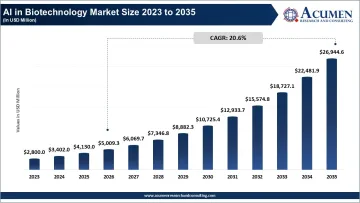
Report Highlights
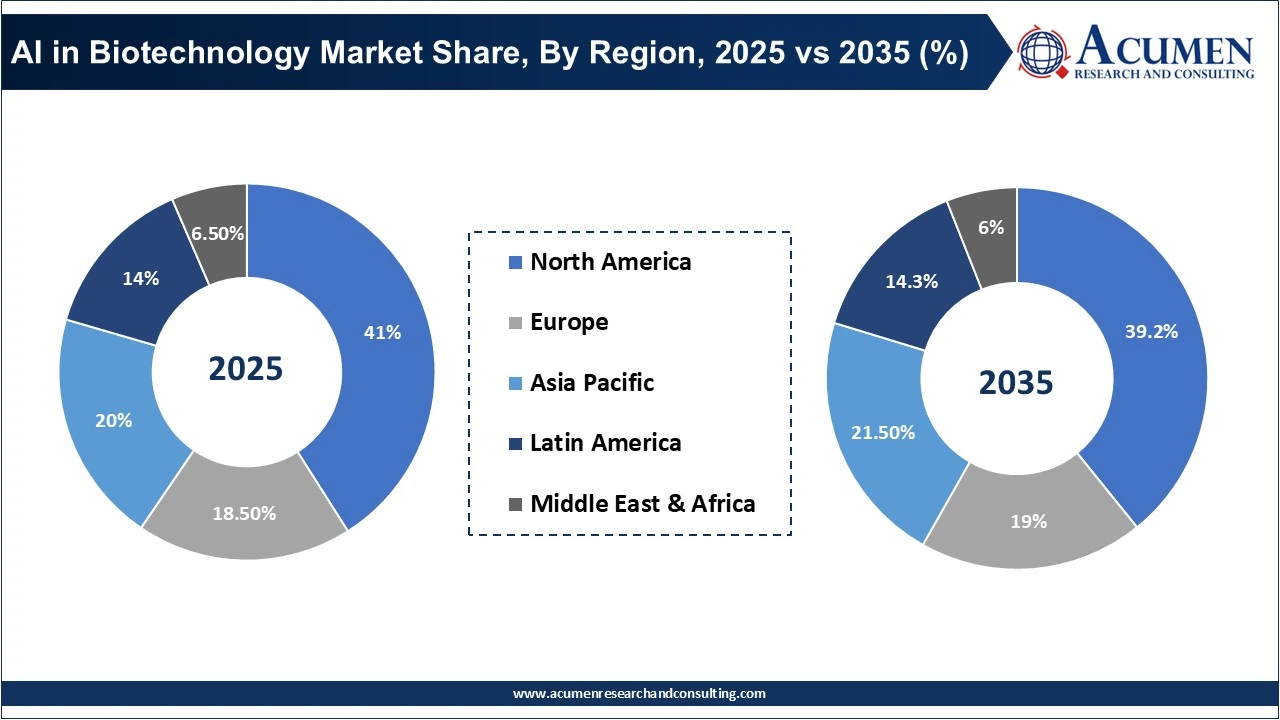
- In 2025, North America dominated the AI in biotechnology market with revenue share of 41%, owing to the robust pharmaceutical and biotech industry players, especially in the U.S.
- Asia Pacific is seen to grow at the fastest rate during the forecast period considering the government initiatives and domestic innovation efforts in developing Asian country, for instance India.
- By component, the software segment led the market in 2025 and captured 49.40% of the total revenue share, owing to the rising demand of complex and regulated software solutions with customization.
- By component, the hardware segment is seen to grow at a notable rate during the forecast period due to the requirement of specialized hardware for genomic sequencing and protein holding.
- By application, the drug discovery and development segment held the largest share of 35% in 2025 with the rising rate of targets for drug optimization.
- By application, the clinical trials and optimization segment is seen to grow at the fastest rate during the forecast period owing to the demand of patient recruitment and its automation with advanced technologies.
- By end user, the pharmaceutical companies segment led the market in 2025, accounting for a revenue share of 36% owing to the rate of innovative and novel drug development.
- By end user, the biotechnology companies segment is expected to grow at the fastest rate considering the overall acceleration in research and R&D costs across the globe.
What is Artificial Intelligence in Biotechnology & Its Key Applications:
AI in biotechnology is the application of machine learning, deep learning, and data analytics technologies in order to pace up biological research, drug discovery, diagnostics and bio-manufacture. AI techniques can extract pattern in biological data sets such as protein structures, DNA sequences, laboratory records and clinical records which cannot be recognized by using previous techniques. AI in biotechnology market consists of software platforms, AI algorithms, cloud-based analysis tools and associated services which are utilized to facilitate biological research, clinical development, diagnostics and bio-manufacture processes in the pharmaceutical, biotech, healthcare and agricultural industry. Driven by the investment in AI-based drug discovery, the demand for personalized medicine and growing access of large biological data.
Key Applications of AI in Biotechnology
- Drug Discovery & Development - AI helps in identifying drug targets and predicting drug-protein interactions, as well as in designing new molecules and optimizing drug candidates.
- Precision Medicine - AI models analyse large genomic datasets and support personalized treatment plans based on genetic profiles.
- Clinical Trial Optimization - AI-powered patient recruitment and eligibility matching alongside predictive analytics can be done with AI models’ help.
- Biomanufacturing - AI holds the capability of predictive maintenance and quality control in production while improving cell culture processes.
What Benefits Does AI Bring to Clinical Trials and Precision Medicine? Know from Our Experts
Our analysts at Acumen Research & Consulting are seeing the impact of AI in biotechnology strongly backed up by real world data and uptake. AI enabled clinical trial design and patient recruitment platforms have shown to reduce the timeline of clinical trials by 20-30%, with patient recruitment being shortened by nearly 40% (a high cost in the drug development process).
As a result of this research performed by experts across the board, pharma are increasingly incorporating AI into their R&D pipeline, and industry surveys have shown over 70% of pharma and biotech companies are actively funding the research and development of AI-enabled platforms to drive drug discovery and clinical development. Automation combined with the application of real-world data is revolutionizing the economics of drug development and leading to higher success rates and more personalized, outcome based healthcare.
AI in Biotechnology Market Statistics: Research Studies, Innovations & Adoption
- A recent study done by Boston Consulting Group (BCG) found that generative AI effectively reduces molecular design time by 25% and cuts overall time required in medical writing.
- AI-driven biotech programs are projected to account for 30%+ of new drug pipelines by the end of 2026, signaling a structural shift in how medicines are discovered and developed.
- Yet another study proves that generative AI platforms save 23-38% time for identification of drug candidate which is 8 months instead of 4.5 to 5 years.
- Global funding for AI-focused biotech companies exceeded $10–12 billion annually in recent years, with strong participation from venture capital and pharmaceutical partnerships.
- AI-enabled platforms are expected to deliver 2–3× faster target identification compared with traditional research methods.
Report Scope
| Attribute | Details |
|---|---|
| Market Size in 2025 | USD 4130 Million |
| Market Size in 2035 | USD 26,944.59 Million |
| CAGR 2026 to 2035 | 20.6% |
| Analysis Period | 2022 - 2035 |
| Base Year | 2025 |
| Forecast Data | 2026 - 2035 |
| Segments Covered | By Component, By Application, By End User, By Region |
| Regional Scope | North America, Europe, Asia Pacific, Latin America, and Middle East & Africa |
| Key Companies Profiled | AstraZeneca, Bristol-Myers Squibb, Merck KGaA, Johnson & Johnson, Novartis AG, Deep Genomics, NIVDIA, Verge Genomics, Recursion Pharmaceuticals |
| Report Coverage | Market Trends, Drivers, Restraints, Competitive Analysis, Player Profiling, Covid-19 Analysis, Regulation Analysis |
AI in Biotechnology Market Dynamics
Driver
Rising Need to Reduce Drug Discovery Time and Costs
The number one reason for the widespread adoption of AI in biotechnology is the immense pressure to decrease the time, expense and rate of failure in traditional drug discovery. A conventional new drug cost more than $2 billion to develop and can take between 10-15 years and the failure rate during clinical trials can be very high. By enabling faster target identification, molecular screening and modeling the predictive capabilities of drug actions, AI can cut this process short. Algorithms have been developed that can identify molecules from millions of chemical compounds in a few days rather than years which enhances the productivity of researchers significantly.
Already, companies are using AI to accelerate initial drug discovery by up to 50-60% and bring therapies into clinical trials more quickly than previously possible. This is particularly important for emerging diseases, rare diseases, and diseases like cancer and neurodegeneration.
Restraint
Data Privacy, Regulatory Complexity, and Validation Challenges
Even with rapid growth, the AI in biotechnology market is likely to face considerable hurdles to data governance, regulatory approval, and the validation of AI outputs. Biotechnology deals extensively with private patient information and genomics which is subject to significant privacy regulations and ethics, and for the clinical trial domain, AI will require approval for algorithm transparency, consistency and reproducibility from regulatory bodies. These hurdles will translate to a rise in compliance costs and time for many smaller biotechnology businesses and research institutions.
Opportunity
Expansion of Precision Medicine and Multi-Omics Research
A key opportunity in AI biotechnology, especially going forward, lies in the accelerating growth of precision medicine. Genomics, proteomics, metabolomics and the wider range of multi-omics techniques are producing massive quantities of data on biological systems that cannot be analyzed without intelligent analysis. These large, heterogeneous data sets will be integrated and interpreted by AI to develop and guide personalized therapies for individual patients. Demand is growing significantly for AI platforms capable of identifying biomarkers and disease risk, as well as delivering optimized treatment plans. Individualized therapy will likely become increasingly important in the medical world and will require AI based biotechnology.
AI in Biotechnology Market Segmental Insights
Component Insights
In 2025, the software segment held the dominant market share, owing to the rising need for automated platforms, high-end analytics, and the requirement for regulatory compliance in the AI in biotechnology market. The high demand for bioinformatic software, predictive analytics software, and laboratory automation platforms has increased among the market players for the purpose of genomic analysis, clinical trials, drug discovery, etc. These AI-powered solutions are useful for the computation of large biological data sets and for identifying drug targets, while accurately predicting molecular structures.
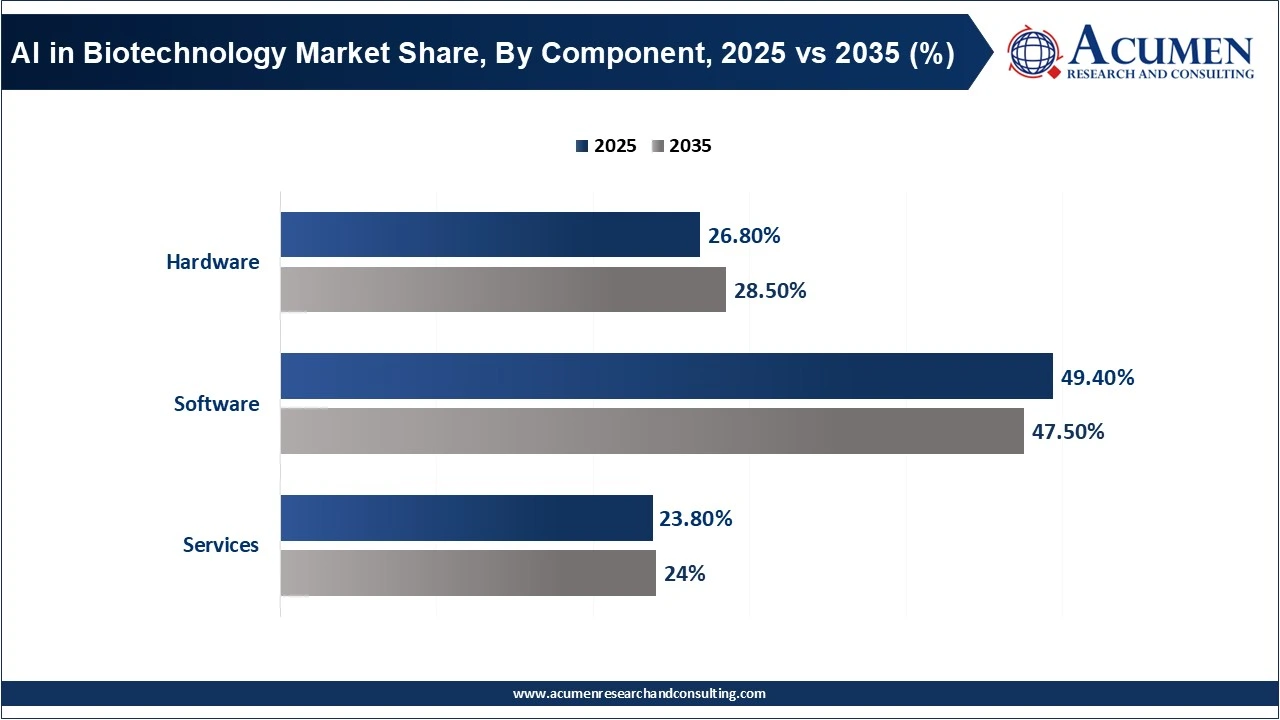
Hardware segment is expected to witness significant growth rate in the predicted timeframe with respect to the growing demand for high-computation hardware. AI-driven biotechnology demands the use of advanced sequencing machines, high-performance GPUs and high-end lab automation machines in order to process huge amount of genomic data and protein structures. Increasing demand for High-throughput screening, NGS and CRISPR has resulted in high demand for the computer clusters and edge hardware devices.
Application Insights
In 2025, the drug discovery and development segment led the market. Artificial Intelligence is revolutionizing how new drugs are discovered and developed as it is able to analyze millions of molecular compounds, predict interaction between drugs and target receptors and simulate biological processes so that the research duration is reduced significantly. AI in drug discovery has been successful to reduce the duration of drug discovery for cancer, rare and infectious diseases, and with increasing number of AI drugs pipelines in pipeline and collaborations among the biotech and pharma companies, this segment leads in growth and potential.
AI in Biotechnology Market Share, By Application, 2025 (%)
| Application | Revenue Share, 2025 (%) |
|---|---|
| Drug Discovery & Development | 35% |
| Clinical Trials & Optimization | 21% |
| Medical Imaging | 17% |
| Diagnostics | 15% |
| Others | 12% |
The fastest growing segment is expected to be clinical trials and optimization since AI is being used in patient recruitment, trial designing and continuous monitoring during trials. One of the main challenges in clinical research has been patient recruitment; this usually results in delay and increases the cost of trials. AI based systems identify patients automatically through Electronic Medical Records (EMRs) wearables and genomic data. Furthermore, AI based analysis can improve the trial success rate by predicting how patients might respond to treatment and the potential risks of adverse events at an early stage.
End User Insights
In 2025 pharmaceutical sector carried the largest share in the market, as it is the largest investor of AI in drug development and precision medicine. Large pharma companies have started to invest more on the whole value chain from target identification, drug design to clinical trials and optimization of manufacturing using AI. Competition is increasing to introduce innovative drugs more quickly in the market that is the reason for heavy investment in AI based collaborations, platforms and digital labs. Pharmaceutical companies are looking for high ROI as well as reducing drug failures and the overall cost of the research and development.
AI in Biotechnology Market Share, By End User, 2025 (%)
| End User | Revenue Share, 2025 (%) |
|---|---|
| Pharmaceutical Companies | 36% |
| Biotechnology Companies | 20% |
| Academic & Research Institutes | 11% |
| Healthcare Providers | 13% |
| CRO & CDMO | 14% |
| Others | 6% |
On the other hand, the biotechnology companies segment is expected to register a speedy growth in the prediction period, owing to the rising R&D spending and the establishment of new AI native biotech startups. The new tech startup firms are now using AI based research models, and implementing machine learning and automation since the early stages of drug development, and several companies were founded on the AI-first approach. In specific to biotechnology sector the rise of gene therapy, synthetic biology and precision medicine, and the importance of AI in them.
AI in Biotechnology Market Regional Insights
Rapid Adoption of Technology & Regulatory Momentum to Support North America’s Dominance
The North America AI in biotechnology market size was valued at USD 1,693.30 million in 2025 and is estimated to surpass around USD 10,562.28 million by 2035 growing at a CAGR of 20% from 2026 to 2035. In 2025 North America was the dominant region, due to their well-developed digital health ecosystem, access to venture capital financing and the swift adoption of AI technologies in areas like drug discovery, genomics, and clinical trials.
The United States maintained its dominance of the North American market. In 2025 alone a large number of U.S. based biotech and pharma companies invested over $12 billion in AI in drug discovery and development, an increase of approximately 3 compared to 2020. The duration of AI-enabled drug discovery is approximately 30-50% shorter in the U.S. for oncology and rare disease pipelines and more than 65% of early-stage drug discovery processes now utilize machine learning techniques, marking a definite transition from experimental use to operational integration for the pharmaceutical industry.
Government funding also has an important part to play in North America as AI in genomics, synthetic biology and pandemic preparedness continue to be prioritized through grants and programs from both BARDA and the NIH. Decentralized trial systems supported by AI in the U.S. Achieved improved efficiency by 40% for patient enrollment and achieved 20-25% lower dropout rates.
Booming Drug Manufacturing in India & China to Support Asia’s Market to Grow Rapidly
The Asia-Pacific AI in biotechnology market size was estimated at USD 826 million in 2025 and is expected to hit around USD 5,793.09 million by 2035 growing at a CAGR of 21.5% from 2026 to 2035. Throughout the forecast period, Asia-Pacific is predicted to be the fastest growth region. Large patient populations, government supported AI strategies and fast increasing biotech manufacturing capacity all contribute to regional growth. Digital health promotion and AI-based biologics production are few other factors to support the market’s expansions
China leads the growth trend for the region. As of 2025, China generates nearly 30% of global genomics data in the world, supported by national precision medicine plans and AI implementation into hospitals. Over 35% increase year on year in Chinese biotech companies' AI investments especially in AI-enabled protein folding, gene editing, and biologics manufacturing. AI-enabled drug discovery platforms in China reduced target identification by 40%, boosting local companies to compete globally.
India is another rising hot spot owing to expanding biotech startups and robust digital health infrastructure. National Digital Health Mission, and BioE3 policy are all expediting the uptake of AI across diagnostics and genomics in India. China is predicted to accommodate more than 250 AI-driven healthtech and biotech startups in India by 2026, India is emerging as preferred location for AI-enabled decentralised trials due to lower costs and a diverse patient pool.
AI in Biotechnology Market Top Companies
- AstraZeneca
- Bristol-Myers Squibb
- Merck KGaA
- Johnson & Johnson
- Novartis AG
- Deep Genomics
- NIVDIA
- Verge Genomics
- Recursion Pharmaceuticals
Recent News
- In March 2026, Eli Lilly and Company made a significant strategic deal with Insilico Medicine in order to speed up the drug design processes using AI technologies. This deal, worth up to 2.75 billion dollars with an initial payment of 115 million dollars will support a transition of generative-AI-designed molecules into clinical development. This alliance emphasizes the increasing belief of the larger pharmaceutical sector into AI-designed molecules and the speed at which AI-driven discovery pipelines have been put to commercial use.
- In 2025, NVIDIA made further advances to its collaboration with SES AI Corporation in order to enhance the company's Molecular Universe. By using cutting edge GPU-power infrastructure, the two companies are able to conduct molecular simulations and discover new materials throughout the life sciences and biotech sectors. This will enable better experimentalization and more rapid scientific discovery within the field of biotechnology.
Market Segmentation
By Component
- Hardware
- Software
- Services
By Application
- Drug Discovery & Development
- Clinical Trials & Optimization
- Medical Imaging
- Diagnostics
- Others
By End User
- Pharmaceutical Companies
- Biotechnology Companies
- Academic & Research Institutes
- Healthcare Providers
- CRO & CDMO
- Others
By Region
- North America
- United States
- Canada
- Europe
- Germany
- United Kingdom
- France
- Italy
- Spain
- Asia Pacific
- China
- Japan
- South Korea
- India
- Singapore
- Latin America
- Brazil
- Mexico
- Argentina
- Middle East & Africa
- UAE
- Saudi Arabia
- South Africa
Looking for discounts, bulk pricing, or custom solutions? Contact us today at sales@acumenresearchandconsulting.com
Frequently Asked Questions

Other Healthcare and Pharmaceuticals Reports
June 2022
December 2024
December 2024
September 2024