
Airborne ISR Market Size, Share, Trends, Report 2026 To 2035
Airborne ISR Market (By Platform: Fixed-Wing Aircraft, Rotary-Wing Aircraft, UAVs, Aerostats/HAPS; By Aircraft Type: Military Aircraft, Government & Homeland Security Aircraft, Commercial/Special Mission Aircraft; By Range/Endurance: Short-Endurance (<10 hours), Medium-Endurance (10–24 hours), Long-Endurance (>24 hours); By Payload: Electro-Optical (EO)/Infrared (IR), Radar, SIGINT/ELINT/COMINT, Multi-INT; By End User Military, Homeland Security, Intelligence Agencies, Law Enforcement; By Application: Military ISR, Counterterrorism, Border Surveillance, Maritime Domain Awareness, Others) - Global Industry Analysis, Size, Share, Growth, Trends, Regional Analysis And Forecast 2026 To 2035
- Last Updated: 30 Jun 2026
- Report Code: ARC3944
- Category: Aerospace And Defence
Airborne ISR Market Size, Forecast 2026 To 2035
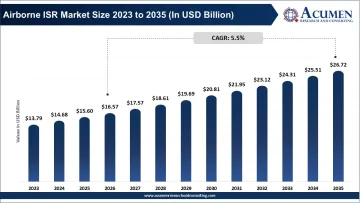
The global airborne ISR market size was estimated at USD 15.60 billion in 2025 and is estimated to surge around USD 26.72 billion by 2035 growing at a CAGR of 5.5% from 2026 to 2035. The overall increase in integration of AI-enabled analytics, hyperspectral sensors and synthetic aperture radar (SAR) has offered a massive potential to the airborne ISR market to boom rapidly in recent years. Additionally, emphasis over defense and security budget and efforts in increasing energy-infrastructure monitoring in developed as well as developing areas also offer opportunity for the market to boom.
Report Highlights
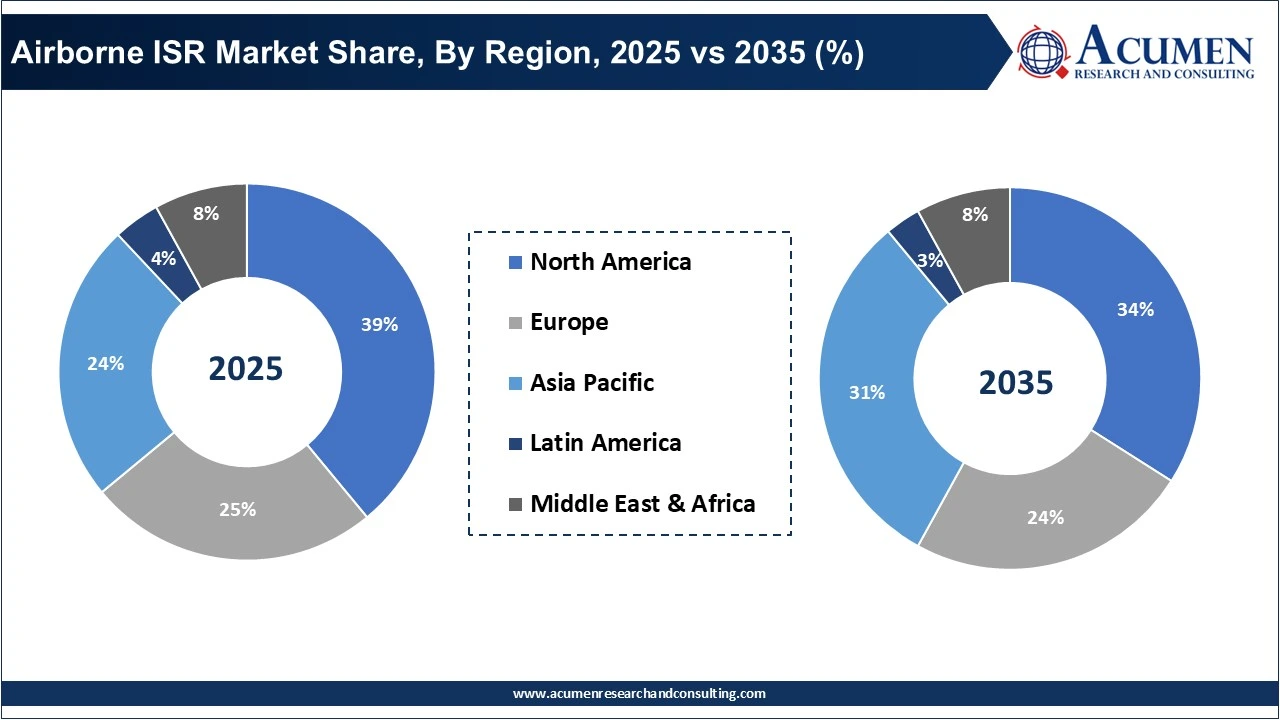
- North America dominated the airborne ISR market with a 39% share of revenue in 2025 due to increased defense spending, robust intelligence modernization initiatives, and widespread deployment of UAV-based and multi-domain ISR systems in the U.S. And Canada.
- Asia-Pacific is expected to record the fastest growth at an 8.5% CAGR during 2026-2035, driven by the increasing border conflicts, growing demand for maritime surveillance, and expanding indigenous development of UAV and AEW&C systems by countries such as China, India, Japan, and South Korea.
- By platform, the fixed-wing aircraft segment accounted for the highest share of 46% in 2025, thanks to the superior range, higher payload-carrying capability, and flexibility for strategic operations like maritime patrol, airborne early warning, and electronic intelligence.
- By platform, UAVs held the second largest share of 31% in 2025 and are likely to witness the fastest platform growth by 2035 with greater use of autonomous ISR platforms to minimize operational risks.
- By aircraft type, the military aircraft garnered 82% of the market share in 2025, with their critical role in gaining tactical information during combat and identifying threats.
- By aircraft type, the government and homeland security aircraft segment had a share of 13% in 2025, predicted to grow at the fastest rate of 7.1% CAGR owing to the increasing needs for anti-smuggling and border surveillance activities.
- By range/endurance, the medium-endurance segment recorded the largest market share of 42% in 2025, representing a cost-effective solution for tactical and regional surveillance operations.
- By range/endurance, long-endurance captured 30% share in 2025, spurred by increasing requirement for persistent monitoring missions using systems like Global Hawk and MQ-9B.
- By payload, the Electro-Optical (EO)/Infrared (IR) payload segment accounted for 39% share of the market in 2025, primarily utilized for real-time visualization of day-night operations and detection of targets.
- By payload, the radar segment held the second largest share of 27% in 2025, supported by the use of Synthetic Aperture Radar (SAR) for wide area monitoring.
- The military end user generated the maximum revenue with 74% of the market share in 2025, driven by increasing reliance on ISR for combat intelligence and threat management.
- The homeland security segment gained 12% share in 2025, with growing government investments for the protection of border territories, vital infrastructure, and anti-terrorism initiatives.
- By application, the military ISR held the largest share of 58% in 2025, due to their pivotal functions in obtaining battle information, target tracking, EW, and battle damage assessment.
- By application, counter-terrorism segment accounted for 11% of market share in 2025, supported by an increase in surveillance system deployments to monitor and neutralize threat posed by militants.
- By application, border surveillance accounted for 10% of the total market share in 2025, as governments across the world look to tighten the control over territorial boundaries.
What is Airborne ISR?
Airborne ISR (Intelligence, Surveillance & Reconnaissance) lies at the center of modern defense and its security applications. The industry revolves around the collection, analysis and dissemination of crucial intelligence that too in real-time. Modern airborne ISR systems are well equipped with advanced radar systems and eletrco-optical as well as signal intelligence payloads.
The airborne ISR market describes the global industry that is dedicated to designing, integrating and implementing intelligence, surveillance and reconnaissance platforms used in defense, security, commercial monitoring, and homeland security environments. The global airborne ISR market, in large part, is expected to be characterized by geopolitical tensions, defense upgrade programs, and the desire for instant intelligence to maintain robust vigil. This makes it an imperative segment of the aerospace and defense industry globally.
Emerging Trends in Airborne ISR Industry: Public & Private Initiatives (2026)
- The U.S. Air Force conducted the inaugural "Ringleader" sensor fusion exercise in 2026 to connect airborne, space and ground-based sensors and to develop one-stop intelligence. In support of the broader U.S. military emphasis on multi-domain ISR, the service has moved to increase ISR efficiency to reduce ISR processing times and improve target accuracy.
- In May 2026, Sweden's Saab and U.S. based General Atomics performed the world's first UAV airborne early warning flight using Saab’s LoyalEye radar system integrated onto the latter’s MQ-9B aircraft platform, in what signals a move from ISR manned aircraft towards lower-cost UAV surveillance.
- By September 2026, the Indian Air Force is planning to receive the final operational clearance for its indigenously developed Netra airborne early warning and control aircraft system, augmenting its airborne surveillance and intelligence for battlefield targeting under the national defense self-reliance regime. The deployment underlines growing public investments in India’s ISR capabilities.
- The U.S. National Reconnaissance Office significantly increased its funding commitment to intelligence startup BlackSky by an amount of over $150 million in 2026, specifically earmarked for boosting the development of AI-powered large area surveillance services. This underscores increasing government spending to couple airborne and space-based surveillance sources to maximize intelligence.
- India's emerging private defense startup ecosystem has started making its entry into airborne ISR, with Indian defense tech startup Flying Wedge Defense & Aerospace revealing concepts for an AI-piloted combat aircraft that would include autonomous sensor fusion and swarming capabilities by the end of 2026.
- Airborne ISR needs become increasingly reliant on a cyber-secure architecture to be successful as governments seek to build enhanced and robust systems leveraging cryptography, anti-jamming technologies, and secure cloud-enabled processing to support sensitive surveillance missions from cyberattacks.
Market Dynamics
Driver
Rising Demand for Real-Time Multi-Domain Intelligence in Modern Warfare
With the evolving nature of warfare and border conflicts gaining complexity, there's massive driver settled for the airborne ISR market as governments and military departments invest in on-demand intelligence to enable quick tactical decisions. The main advantage of airborne ISR systems over their traditional counterparts is they enable an always-on battlefield picture with the integration of radar, electro-optical, infrared, and signal intelligence in a single, operating architecture.
The advent of guided missiles and robotic military apparatus has created demand for real-time operational context, and live situation intelligence of the target and combat zone. Another aspect that influences airborne ISR demand is multi-domain military operations encompassing land, air, sea, space and cyber capabilities.
Restraint
High Operational Costs and Complex System Integration
One of the major hurdles to be encountered within the ISR space in terms of aerial platforms is that procurement, operation and integration costs associated with smart sensing systems. High levels of technology in terms of sophisticated radar sensors, AI enhanced analysis capabilities, comm relay systems and secure communications can be incredibly costly in terms of both outright purchase and running costs.
These will be necessary for future ISR aircraft and, what further increases complexity for smaller nations with tight budgets, many intelligence payloads now need to coexist on the same airframes and the integration between both modern and previous generation systems is something of a engineering feat. The cost of securing information on such a high tempo network and ever-increasing scale is another significant challenge.
Opportunity
Expansion of Unmanned and Autonomous ISR Platforms
The dramatic developments in unmanned aerial system (UAS) are offering a significant growth market for airborne ISR. Military entities globally is moving in the direction of ISR UAV-centered platforms as these are far more lengthy-term in endurance with lessen crew risks and reduced functioning price tags than manned aviation.
Autonomous drones with AI focused on targeted recognition, in mixture with fused sensor technology, have ability of sustained surveillance in contested environments with enhanced intelligence outcomes. Future progress areas within swarming drone technology and networked aircraft are probable in tactical reconnaissance, border and maritime observation in politically volatile areas.
Segmental Insights
Platform Insights
The fixed-wing aircraft was dominant with 46% share in 2025 on account of high operational ranges, payload capacity and operational versatility for various strategic applications such as Airborne Early Warning (AEW), Maritime Patrol, and electronic intelligence. Such platforms remain fundamental for various defense roles with aircraft like Boeing’s P-8 Poseidon and Saab’s GlobalEye continue to be heavily used for persistent surveillance operations in military & naval sectors. Such platforms can integrate multiple payload systems, allowing a significant operational advantage.
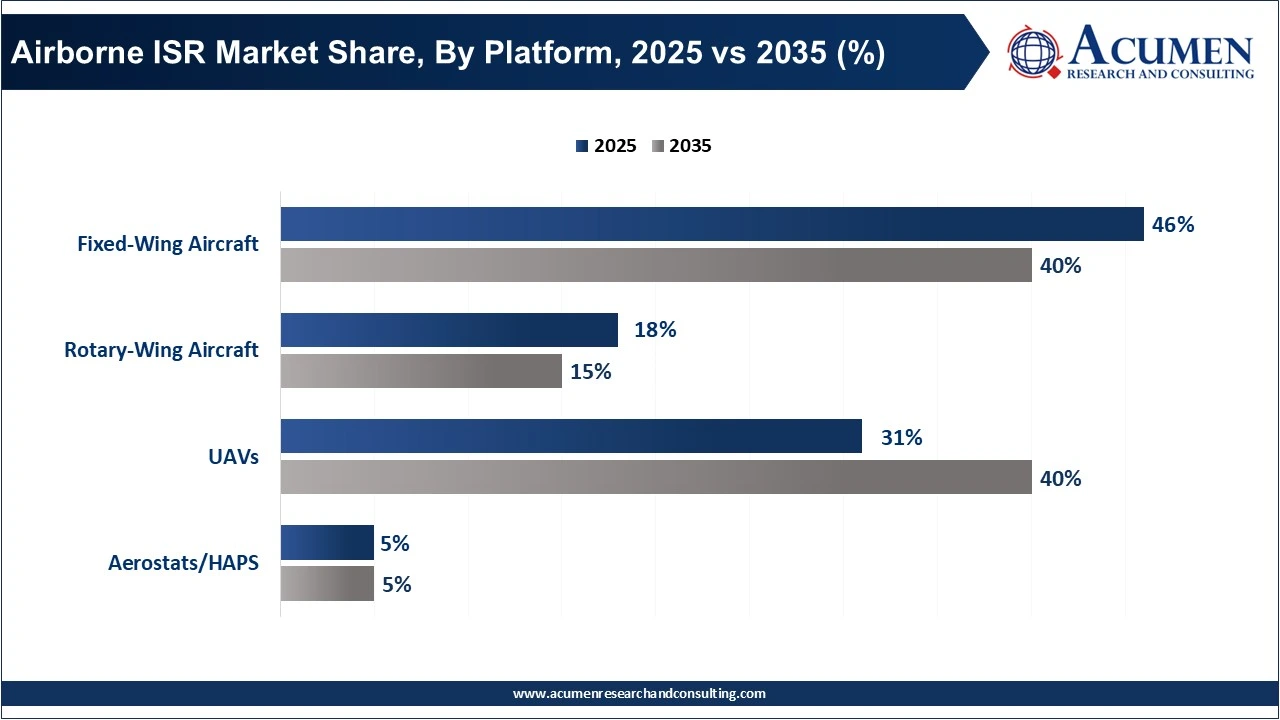
Unmanned Aerial Vehicles (UAVs) occupied the second largest share of 31% in 2025 and expected to emerge as the most growing and largest platform by 2035 at 40% share. These reflect a growing inclination towards unmanned systems, especially the preferred use of autonomous systems with reduced operational costs and endurance time. Systems such as General Atomics’ MQ-9 Reaper, Northrop Grumman’s RQ-4 Global Hawk are extensively used in critical areas such as hostile operations, border security, counter terrorism operations with flight time greater than 30 hours.
Aircraft Type Insights
The military aircraft held a market share of 82% in 2025 and the market is valued USD 13.58 billion, estimated to be $21.38 billion by 2035 and is growing at a CAGR of 5.2%. High dependency of the military on ISR to attain tactical advantages such as enhanced battlefield awareness, threat detection, and precision targeting is driving the market. Today's warfare relies heavily on ISR Aircraft to guide strategic and tactical mission planning.
Increase in purchase of specialized ISR jets and ISR drones for military purposes by major economies like the US, China, NATO, and India is a key trend in the market segment.
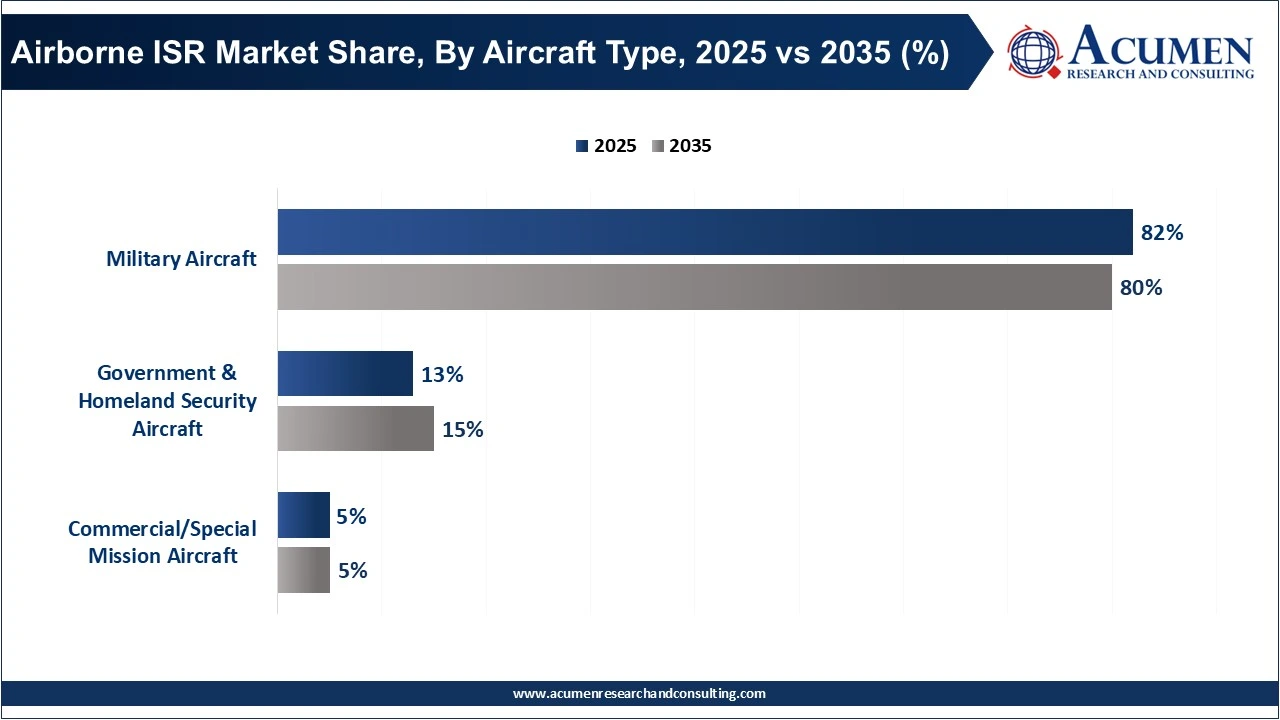
Government & homeland security aircraft captured 13% of the market in 2025 and is the most promising segment and is anticipated to grow at the fastest rate of CAGR 7.1% by 2035 in terms of revenue and the market value will be $4.01 billion. Factors contributing to the expansion of the segment include an increase in homeland security requirements to protect the countries, surveillance for anti-smuggling operations and border monitoring activities. Nations under migration and cross border security pressure such as Europe have witnessed significant expansion in homeland ISR.
Range/Endurance Insights
Medium-endurance platforms possessed the highest share at 42% in 2025 as they have optimum cost, efficiency, duration of mission to serve regional monitoring, and tactical mission purposes. This also includes domestic operations and homeland surveillance systems as a popular choice in frontier supervision and surveillance gathering systems.
Airborne ISR Market Share, By Range/Endurance, 2025 (%)
| Range/Endurance | Revenue Share, 2025 (%) |
|---|---|
| Short-Endurance (<10 hours) | 28% |
| Medium-Endurance (10–24 hours) | 42% |
| Long-Endurance (>24 hours) | 30% |
The long-endurance segment possessed the second highest share of 30% in 2025 and one of the key segments in this domain, since there is rising demand for prolonged surveillance of battle-zones and oceanic surfaces by drones such as MQ-9B and Global Hawk, which fall under the long endurance platforms.
Payload Insights
Electro-Optical (EO)/Infrared (IR) payloads captured the highest share in the market at 39% in 2025 owing to their vital functions such as day-night imaging, target acquisition, and thermal surveillance. These sensors are pivotal to modern ISR missions as they are crucial for providing real-time visual intelligence and surveillance, even under adverse conditions like fog or the absence of light. The adoption of EO/IR systems has witnessed significant growth, especially in surveillance, border monitoring, and search & rescue operations.
Airborne ISR Market Share, By Payload, 2025 (%)
| Payload | Revenue Share, 2025 (%) |
|---|---|
| Electro-Optical (EO)/Infrared (IR) | 39% |
| Radar | 27% |
| SIGINT/ELINT/COMINT | 19% |
| Multi-INT | 15% |
Radar payloads captured the second highest market share of 27% in 2025. Radar sensors continue to be a crucial tool in a variety of surveillance operations, including wide-area monitoring, object tracking, and weather-independent reconnaissance. Integrated Synthetic Aperture Radar (SAR) on both manned and unmanned ISR vehicles has become increasingly popular in recent years, particularly for intelligence gathering over ground and maritime areas.
End User Insights
The military end-user segment captured the largest market share in the airborne ISR market in 2025, accounted for 74%, owing to increasing strategic importance of the intelligence, surveillance and reconnaissance system to combat the warfare. It represents a growing significance of intelligence, surveillance and reconnaissance system that enable the air forces of various countries to facilitate accurate real-time combat intelligence, target acquisition, threat detection, electronic warfare and battlefield management and so on.
Airborne ISR Market Share, By End User, 2025 (%)
| End User | Revenue Share, 2025 (%) |
|---|---|
| Military | 74% |
| Homeland Security | 12% |
| Intelligence Agencies | 10% |
| Law Enforcement | 4% |
The homeland security end-user segment accounted for second largest market share of 12% in 2025 due to rising investment in border surveillance, counter-terrorism measures, disaster response and protection of critical infrastructure. It is utilized for the effective supervision of various cross-border areas, for countering anti-smuggling actions, tracking terrorist operations, controlling immigration flow across borders. For instance, US is significantly expanding aerial monitoring on borders, while other countries are intensifying the surveillance along their maritime boundaries and in specific migration routes.
Application Insights
Military ISR segment accounted for largest market share of 58% in 2025 and was driven by the significant application of military ISR in the combat, strategic defense and intelligence mission. Real-time Intelligence ISR, airborne ISR deployment is one of the leading trends in the defense sector across the world. The growth of ISR in the combat, electronic warfare, and targeted strike, target detection, battlefield damage assessment, and signal intelligence activities drives demand in this segment.
Airborne ISR Market Share, By Application, 2025 (%)
| Application | Revenue Share, 2025 (%) |
|---|---|
| Military ISR | 58% |
| Counterterrorism | 11% |
| Border Surveillance | 10% |
| Maritime Domain Awareness | 8% |
| Search & Rescue | 4% |
| Disaster Response | 3.5% |
| Environmental Monitoring | 3% |
| Critical Infrastructure Protection | 2.5% |
The counter-terrorism market share was the second highest at 11% in 2025 and is spurred by an increasing concern for insurgency, networks, and extremist groups and asymmetry of warfare. Governments deploy surveillance systems, electronic sensors and monitoring intelligence for detecting unusual movement of suspects, tracking militants, and countering counter-terrorism activities.
Governments across high-risk region like Middle East, Africa, and parts of south Asia increasingly demand the use of counter-terrorism based intelligence gathering systems.
The border surveillance segment share was approximately 10% in 2025 as governments around the globe emphasize on tightening territorial integrity against illegal migration and activities such as trafficking and smuggling along land and sea boundaries. Key geographical regions driving the demand include Indian border with China, US border with Mexico, south China sea.
Regional Insights
Which Region Dominated the Airborne ISR Market in 2026?
North America held the largest market share of the airborne ISR market, accounting for a share of 39% in 2025. The United States, with its dominant defense infrastructure, has significant intelligence modernization initiatives, which further fuel the market in this region. This market earned $6.08 billion in 2025 and is predicted to reach $9.08 billion by 2035.
Initiatives such as the U.S. Air Force’s Ringleader sensor fusion concept, the increasing acquisition of MQ-9 Reaper and RQ-4 Global Hawk UAVs and the continued integration of satellite-based intelligence collection with manned platforms are changing North American airborne ISR. Meanwhile the strong regional focus on border security, homeland defence and counter-terrorism has spurred increasing demand for UAVs and ISR aircraft.
Moreover, Canada is contributing to regional development through investment in both maritime and airborne ISR for surveillance activities in the rapidly becoming geopolitical centre of gravity that is the Arctic. These factors ensure North America remains the most technologically mature and critically relevant global airborne ISR market due to the constant churn of new technologies supported by high levels of defence expenditure.
How is Asia Pacific Considered to be the Fastest Growing Marketplace in Airborne ISR Industry?
The Asia-Pacific airborne ISR market is poised to witness the fastest growth, expanding at a CAGR of 8.5% from 2026 to 2035, from $3.98 billion to $8.28 billion in 2035. Its share is expected to increase from 24% in 2025 to 31% by 2035. The rise in border tensions, growing demand for maritime surveillance capabilities in the South China Sea, and expanding adoption of locally developed unmanned aerial vehicle (UAV) systems will drive the regional market growth.
Countries like China, India, Japan, and South Korea are actively undertaking defense modernization programs, including India’s Netra AEW&C program and the development of advanced long-endurance surveillance drones in China. Elsewhere, China is developing and fielding growing range of long-duration UAV and airborne surveillance technologies to enhance maritime surveillance over contested waters.
Japan and South Korea are boosting spending on radar surveillance aircraft and on artificial intelligence enabled airborne early warning and signal intelligence(ISR) platforms designed to deter proliferation of military capability within the region, as increased partnerships between governments and local industries spurs autonomous development of ISR capabilities and artificial intelligence sensors and data fusion systems will further drive growth for Asia-Pacific's aerial ISR capabilities.
Top 5 Countries with Massive Defense Budget; Supporting Airborne ISR Market
| Country | Estimated Defense Budget (2026) | Airborne ISR Market Significance |
|---|---|---|
| United States | $962 billion | The largest defense spender globally, heavily investing in advanced ISR aircraft, UAV fleets, AI-powered sensor fusion, and space-integrated intelligence systems. Programs like the RQ-4 Global Hawk, MQ-9 Reaper, and E-7 Wedgetail directly strengthen market growth. |
| China | $246 billion | Rapid military modernization and regional surveillance expansion in the South China Sea and Taiwan Strait are accelerating procurement of long-endurance drones, AEW&C systems, and SIGINT aircraft. |
| Russia | $109 billion | Ongoing conflict-driven defense priorities have increased ISR dependency for battlefield monitoring, electronic warfare, and border reconnaissance, especially through upgraded reconnaissance aircraft and drones. |
| India | $79 billion | Rising border tensions with China and Pakistan, combined with indigenous programs like Netra AEW&C and UAV development under Make in India, are driving strong airborne ISR investments. |
| Saudi Arabia | $78 billion | Regional security concerns and border surveillance needs are fueling investments in ISR aircraft, maritime patrol systems, and electronic intelligence platforms for critical infrastructure and oil asset protection. |
Top Companies
- Lockheed Martin
- Northrop Grumman
- L3Harris Technologies
- Raytheon Technologies
- Boeing
- Airbus
- Saab AB
- General Atomics
- Leonardo S.p.A.
Recent News
- June 2026 - BlackSky was awarded more than $150 million from the NRO for the build-out of AI-enabled, wide-area intelligence systems and space-based observation. This demonstrates the growing synergy of space-based and airborne ISR to bolster battlefield ISR and speed development of the next-generation surveillance systems.
- May 2026 - The world’s first unmanned airborne early warning mission flight occurred when Saab AB combined Saab’s LoyalEye radar on the MQ-9B drone, and worked in cooperation with General Atomics.
Segments Covered
By Platform
- Fixed-Wing Aircraft
- Rotary-Wing Aircraft
- UAVs
- Aerostats/HAPS
By Aircraft Type
- Military Aircraft
- Government & Homeland Security Aircraft
- Commercial/Special Mission Aircraft
By Range/Endurance
- Short-Endurance (<10 hours)
- Medium-Endurance (10–24 hours)
- Long-Endurance (>24 hours)
By Payload
- Electro-Optical (EO)/Infrared (IR)
- Radar
- SIGINT/ELINT/COMINT
- Multi-INT
By End User
- Military
- Homeland Security
- Intelligence Agencies
- Law Enforcement
By Application
- Military ISR
- Counterterrorism
- Border Surveillance
- Maritime Domain Awareness
- Search & Rescue
- Disaster Response
- Environmental Monitoring
- Critical Infrastructure Protection
By Region
- North America
- Europe
- Asia-Pacific
- Latin America
- Middle East & Africa
Looking for discounts, bulk pricing, or custom solutions? Contact us today at sales@acumenresearchandconsulting.com
Frequently Asked Questions

Other Aerospace And Defence Reports
August 2023
December 2024
April 2024
December 2024