
Artificial Intelligence Sensor Market Size, Share, Industry Report 2026 to 2035
AI Sensor Market (By Sensor Type: Image & Vision Sensors, Motion & Inertial Sensors, Pressure Sensors, Temperature Sensors, Proximity & Distance Sensors, Acoustic Sensors, Chemical & Environmental Sensors, Others; By Component: Hardware, Software, Services; By Deployment: Edge AI Sensors, Cloud-Connected AI Sensors; By End-User Industry: Automotive & Transportation, Consumer Electronics, Industrial & Manufacturing, Healthcare & Medical Devices, Aerospace & Defense, Retail & E-Commerce, Others) - Global Industry Analysis, Size, Share, Growth, Trends, Regional Analysis And Forecast 2026 To 2035
- Last Updated: 24 Jun 2026
- Report Code: ARC3942
- Category: ICT
Artificial Intelligence Sensor Market Size, Forecast 2026 to 2035
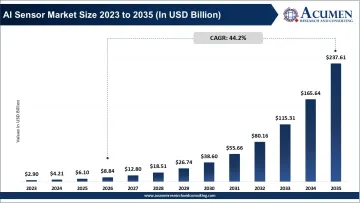
The global artificial intelligence (AI) sensor market size was calculated at $6.10 billion in 2025, it is expected to reach at $237.61 billion by 2035. The market is expected to grow at the CAGR of 44.2% during the forecast period of 2026-2035. The overall integration of AI-enabled sensors by automotive industry by combining LiDAR cameras and radar has created mass opportunity for the market to expand. Additionally, application for industrial automation and real-time tracking carries potential for the market to grow.
Report Highlights
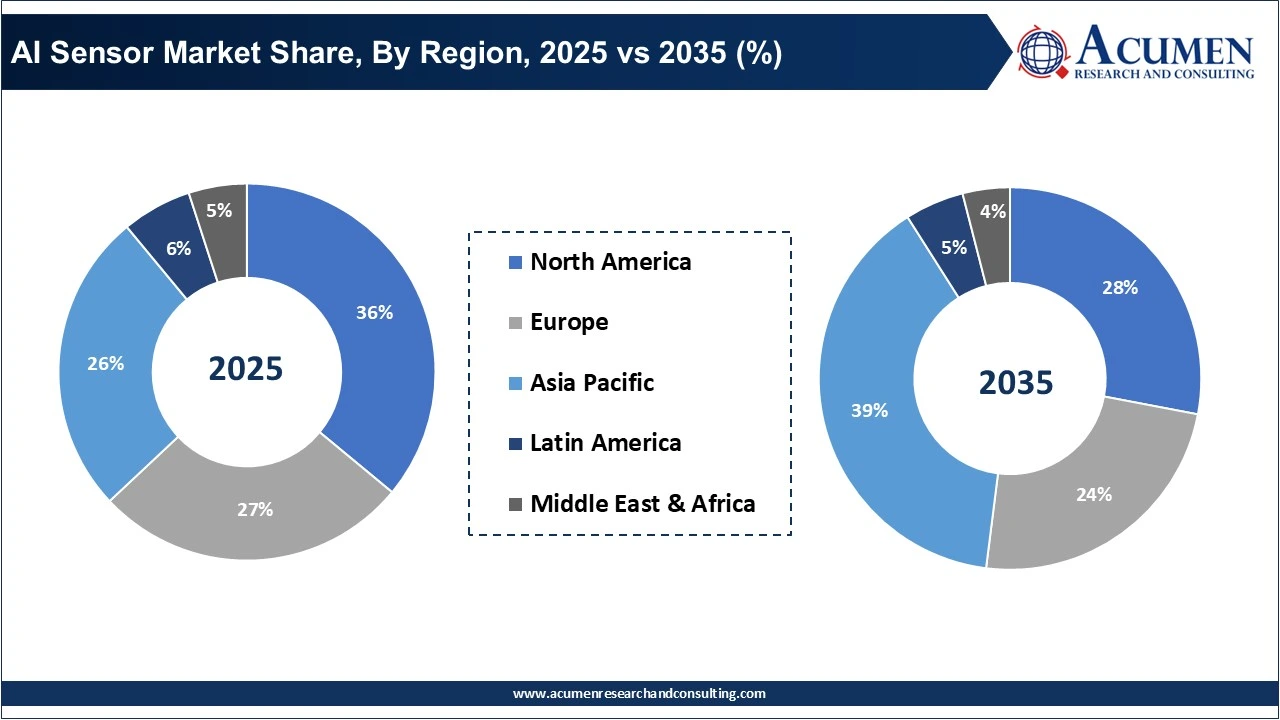
- By region, North America region led the market accounting for a share of 36.0% in 2025 and will gain further momentum in the coming years. It can be attributed to the adoption of AI-based sensing systems in its early stages by autonomous vehicles, robots, healthcare devices and presence of well-established chip industry that supports AI infrastructure.
- By region, Asia Pacific region held the second leading market position with a share of 26.0% in 2025 and the market is expected to exhibit the highest CAGR of 50.8% owing to huge adoption of industrial automation, significant electronics production volume and massive deployment of robotics technologies & smart sensors across various end use sectors such as China, Japan, South Korea and India.
- By sensor type, image & vision sensors generated the largest market share of 34.0% in 2025 and are likely to maintain its supremacy over the period. Its large share can be accounted by the high demand across robotics and automotive applications for computer vision functionalities such as object detection, navigation and inspection.
- By sensor type, the proximity & distance sensors captured the second largest market share of 17.8% in 2025 which is attributed to the growing adoption in advanced technologies like autonomous cars, robotics & collisions avoidance systems using high definition mapping.
- By component, hardware segment accounted for the largest share of 68.0% in 2025 and are expected to maintain its dominance in the coming years. It is dominated by the use of various sensor devices such as cameras, LiDAR, radar and on-board computer chips that contain sensing technology as the driving force behind AI algorithms.
- By component, the software segment held the second leading market share of 22.0% in 2025, fueled by increasing requirement of complex AI sensor fusion techniques, Machine Learning models and real time analytic software for intelligent processing of data.
- By deployment, the edge AI sensors captured a largest market share of 62.0% in 2025 and are anticipated to dominate the market in the coming years owing to extreme real time computing needs, low latency requirements for autonomous vehicles and robots and to overcome connectivity challenges in industrial applications.
- By deployment, the cloud connected AI sensors secured the second major position with a share of 38.0% in 2025 and will further grow with high pace due to large amount of data generated by the IoT-enabled devices, requirement for global remote monitoring & maintenance, and training big ML models at a global scale to serve various applications.
- By end-user industry, the automotive & transportation segment garnered the largest market share of 27.0% in 2025, which can be attributed to heavy integration of AI sensors in vehicle navigation, collision avoidance systems and ADAS technology that relies extensively on real time perception and navigation to facilitate drivers.
- By end-user industry, the consumer electronics segment acquired the second largest market share of 20.0% in 2025 driven by the widespread integration of AI sensors across the range of consumer electronic products such as smartphones, Wearable computers and AR/VR headsets for personalized user experience, security and contextually relevant applications.
What are Artificial Intelligence Sensors & Their Industry Applications
AI sensors are sophisticated perception technologies that pair existing hardware such as cameras, LiDAR, radar, motion sensors, and environmental sensors with on-device or networked AI algorithms that support real-time data processing, interpretation, and decision-making. As a result, where traditional sensors measure the external world and return data alone, AI sensors use their integrated intelligence to process and interpret information.
In industry, AI sensors are supporting autonomous vehicles detecting pedestrians and other road users, tracking lanes, avoiding obstacles-while others in manufacturing lines contribute to the rise of predictive maintenance and robotic process control, and still others are at work on the operating table, enabling new robotic surgery and patient monitoring capabilities in medicine.
But those applications represent just the tip of the iceberg. They’re also finding use in consumer devices, warehousing robots and self-driving forklifts, and even assisting the next generation of autonomous transportation in logistics.
Market Dynamics
Driver
Increasing Adoption of Autonomous Systems, and Real-time Edge Intelligence
Growth of autonomous systems in industrial, automotive and robotic sectors where real-time sensor data processing occurs at the edge rather than in the cloud is stimulating the artificial intelligence sensor market. In particular, automotive companies are opting for the on-board deployment of Artificial intelligence chips that enables autonomous driving where a split-second decision by the vehicle based on input from its embedded cameras or LiDAR can have critical consequences on the car.
Furthermore, industrial robots are getting equipped with multi-sensor based intelligence solutions that can boost production efficiency; industrial robotic sensors can automate operations, reduce down times, and increase performance with regard to complex assembly processes or automated inspection systems, all of which will result in growing artificial intelligence sensor adoption in factory automation as the demand for smart manufacturing which is driven by steadily growing penetration rates in factories worldwide continue to increase across sectors.
Restraint
High System Cost and Integration Complexity Hampering Market Growth
Although adoption is gathering steam, the adoption of AI sensors is hampered by costly setup and a need to integrate multiple system pieces, a major barrier for most companies to deploy. In order to generate sufficiently robust insights, AI sensor systems integrate sophisticated hardware that typically includes high resolution image sensors, radar arrays, and potent AI processors, leading to a higher overall system cost compared to traditional sensors.
Small and medium sized companies, specifically are yet not able to afford a solution for large scale deployment of AI sensors apart from large corporations and technology savvy industries. Even a minor mistake in sensor calibrations of the sensor fusion systems can lead to inefficiency and system shutdown in many health related and self-driving applications, this hampers the overall expansion of the market.
Opportunity
Scaling Smart Ecosystems and New Age Autonomous Applications
The Artificial Intelligence (AI) sensor market continues to show immense growth prospects from widespread adoption in smart ecosystems ranging from smart cities to smart factories and connected autonomous driving systems. As AI-driven infrastructure continues to be proliferated across the world, robust demand for smart sensor applications for continuous acquisition of real-time information, analytics, and learning across connected systems arises. There is a massive growth prospect in precision agriculture due to the integration of Artificial Intelligence Sensors in crop analysis, soil health assessment, and fully automated operations.
Regional Insights
How Did North America Dominate the Artificial Intelligence Sensor Market in 2025?
North America accounted for the largest market share of 36.0% in the artificial intelligence sensor market in 2025. Early adoption of AI sensors in autonomous vehicles, industrial automation, and healthcare diagnostics, coupled with the presence of robust semiconductors innovation and wide AI infrastructure made North America the leading market. Strong application of AI sensing system in smart mobility platforms and robotics drives the market in North America.
- The U.S. has the largest contribution and in this market, the fleet testing for autonomous vehicles surpassed the cumulative total miles of 12 million per year, demanding robust LIDAR, radar and image sensors. The automotive sector is rapidly adopting artificial intelligence, Autonomous vehicle (AV) industry has over 1 million vehicles on test on American roads.
- Furthermore, with a wide array of smart sensors used in robot manufacturing across industrial and non-industrial segments- such as industrial robots density in America reached 119 installations per 10,000 workers, thus driving the market for AI sensing systems.
Also, strong presence of industrial and commercial robotics sector helps enhance AI sensing systems penetration. Over 44,000 industrial robots installation per year in North America further strengthens its market position as AI sensors play key role in industrial robot automation (e.g. motion sensing, machine vision, process automation) that contributes significantly to driving the global market value.
Why Is Asia Pacific the Fastest-Growing Region in the Artificial Intelligence Sensor Market?
Asia Pacific occupied the market share of 26.0% in 2025 and is estimated to rise to 39.0% by 2035 at a market CAGR of 50.8% over the forecast period. Key factors attributing to the growth of Asia Pacific market include growing industrialization, increasing semiconductor production capabilities, rapidly booming consumer electronics sector, and growing use of AI-embedded products for smart systems, and autonomous driving technology.
- China constitutes more than 30.0% of worldwide electronics manufacturing, generating massive opportunities in the market for image sensors, touch and proximity sensors, and other sensors for this device sector.
- Besides the major market participants like China and India, other regional market participants include Japan and South Korea who continue to be the global leaders in robotics technology.
The number of industrial robot installation for industrial applications grew year-on-year across the region; the density of industrial robots per 10,000 employees in South Korea currently stands at more than 1,000 robots. Increased investment in smart cities infrastructure, AI security systems, advanced health systems, electric vehicles (EVs), and an expanding IoT market ecosystem further complement the market for AI sensors.
Segmental Insights
Sensor Type Insights
By far, image and vision sensors wa the dominant market segment with share of 34.0% in 2025, which further will hold over 39.0% by 2035. They represent cornerstone of the vision systems deployed in the computer vision domain to conduct object recognition, face detection, autonomous navigation, automated assembly line guidance, and quality assessment in industrial applications. From smart car safety, robotic vision, digital camera to healthcare, vision sensors enable AI based decision making in systems.
Currently, the percentage of industrial robots that are integrated with a vision sensor has surpassed 80% globally, where it enables inspection, robotic navigation and object placement. A continuous adoption of smart camera-equipped devices and AI based visual intelligence applications in segments like retail, logistics, healthcare adds to market dynamics of this segment.
AI Sensors Market Share, By Sensor Type, 2025 & 2035 (%)
| Sensor Type | Revenue Share, 2025 (%) | Revenue Share, 2035 (%) |
|---|---|---|
| Image & Vision Sensors | 34% | 39% |
| Motion & Inertial Sensors | 18.20% | 16% |
| Pressure Sensors | 10% | 8% |
| Temperature Sensors | 8% | 6% |
| Proximity & Distance Sensors | 17.80% | 21% |
| Acoustic Sensors | 5% | 5% |
| Chemical & Environmental Sensors | 4% | 3% |
| Others | 3% | 2% |
Proximity and distance sensors became second largest segment in global artificial intelligence sensor market share with a 17.8% market share in 2025 to reach over 21.0% in 2035. These sensors are the main component to calculate the distance to an object which helps in robotics navigation and in cars for collision avoidance and parking.
Another application is for automation in manufacturing process and in a variety of consumer electronic device in which distance computation and proximity detection is vital. Proximity and distance sensing system is witnessing a tremendous growth due to deployment of LiDAR in the automobiles for their respective autonomous driving.
Component Insights
The hardware segment held maximum 68.0% of the market in 2025 owing to its high demand owing to the growing need of sensing device comprising physical sensors such as cameras, inertial sensors, thermal sensors, radar, as well as AI chips. Hardware is seen to be at the core of all the sensing systems for AI, since all data acquired, monitored, analyzed, processed and transmitted from sensors with hardware interaction.
The increasing deployment of edge AI devices, with an estimated 3.5 billion connected devices globally by 2025, spurred significant demand for hardware. The constant innovation in semiconductor technologies as well as increasing miniaturization of sensors are all widening the hardware scope.
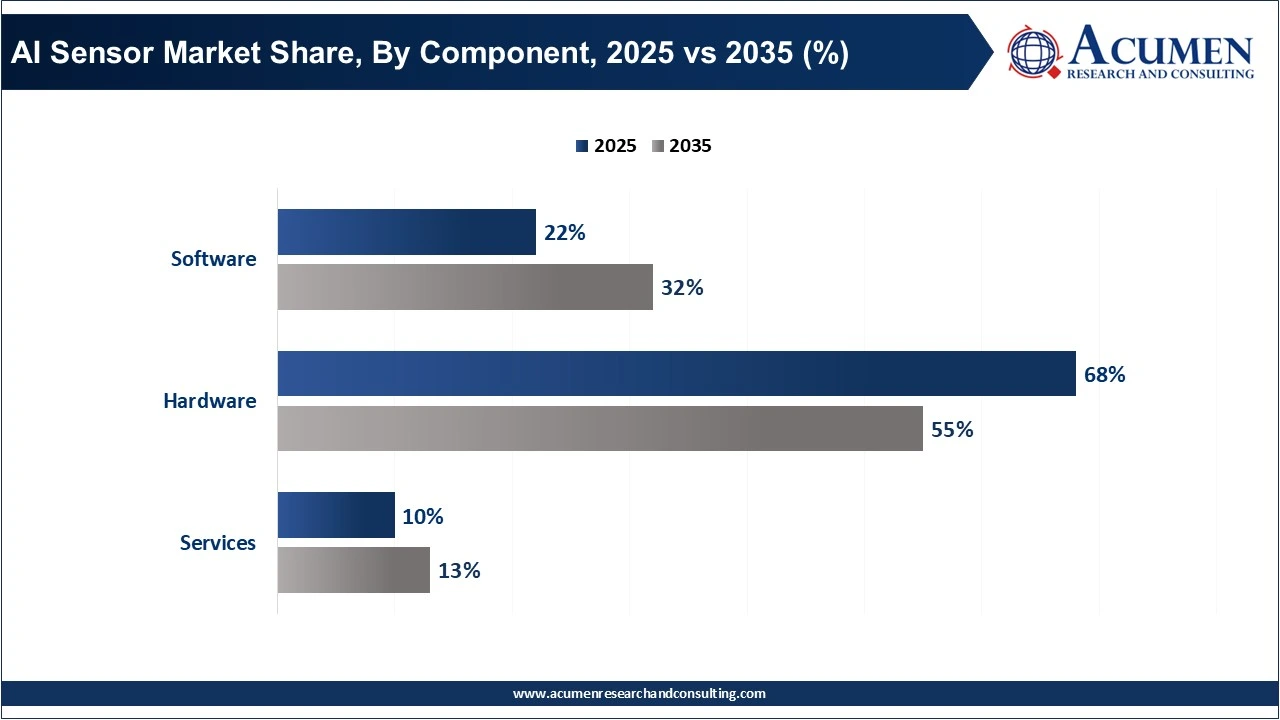
Software segment commanded a share of 22.0% in 2025 and is projected to account for 32.0% share in 2035, due to increase in demand of the AI inference engine, sensor fusion technology and machine learning algorithms and frameworks. Software provides essential context to sensor data and transforms the stream into an actionable intelligence by implementing complex real-time data analysis, predictive modelling, as well as dynamic and autonomous decision-making capabilities.
The adoption of multi-sensor fusion in a wide range of applications such as autonomous driving, as well as robotics and the growth in its demand has fueled the software market as, algorithms are needed to thread different sensory data into a precise model of the world.
Deployment Insights
Edge AI sensors is expected to retain dominance throughout the forecasted period with a market share of 62.0% in 2025, growing to 74.0% by 2035 with a CAGR of 47.0%. Edge AI sensors are anticipated to witness rapid growth owing to a rise in demand from various devices that process real-time data at device-level to minimize latency. This technology is mainly required to drive data driven decision-making without connecting to cloud in smart devices such as autonomous vehicles, intelligent devices and others.
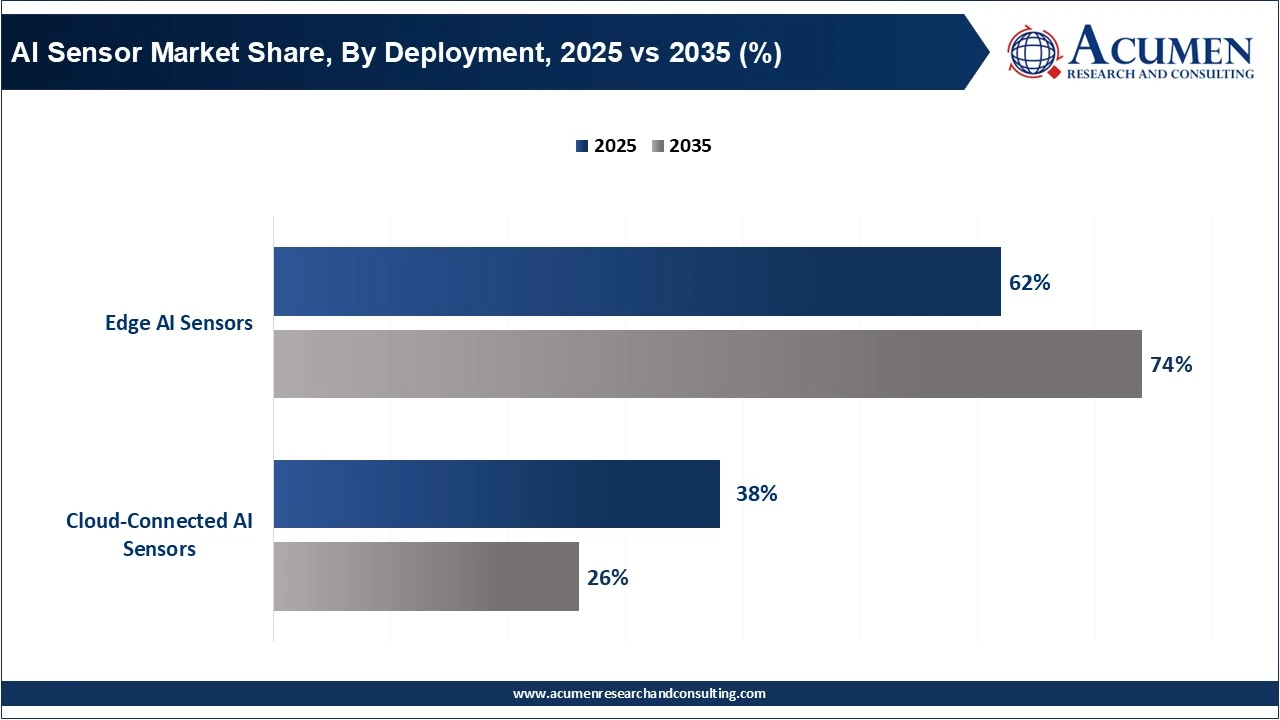
Cloud-connected AI sensors have accounted for a market share of 38.0% in 2025 owing to features such as centralized data storage, cloud-based analytics, remote access and scalable, powerful cloud AI processing. In industrial IOT ecosystems, connected AI is essential for large-scale industrial robots and machines that rely on integrated IT systems.
In a scenario where Industrial Internet has a global installed base of 123 billion connected devices that is projected to reach 800 billion devices by 2030 and with increasing demand to extract insights from the immense volume of generated data, these systems are significant for collecting large volumes of data.
End User Industry Insights
The automotive & transportation segment held the highest share of the Artificial Intelligence (AI) sensor market with 27.0% of the total market share in 2025. This is due to the rising use of AI powered sensing systems for self-driving cars, ADAS and electric vehicle technologies. The current generation of cars utilizes an accumulation of imaging sensors, radar, LiDAR, proximity, IMU sensors for enhanced awareness in their immediate environment.
Furthermore, development in autonomous car testing fleet is expanding globally where many companies are using millions of autonomous miles per year in their cars, thus spurring the adoption of automated driving and intelligent sensing in the automotive sector globally.
AI Sensors Market Share, By End User Industry, 2025 (%)
| End User Industry | Revenue Share, 2025 (%) |
|---|---|
| Automotive & Transportation | 27% |
| Consumer Electronics | 20% |
| Industrial & Manufacturing | 16% |
| Healthcare & Medical Devices | 9% |
| Aerospace & Defense | 6% |
| Retail & E-Commerce | 4.80% |
| Energy & Utilities | 4% |
| Agriculture | 3% |
| Telecommunications | 2.80% |
| Smart Buildings & Smart Cities | 5.20% |
| Others | 2.20% |
In 2025, consumer electronics was the second most prominent sector in the market holding 20.0% of the global share. The pervasive usage of AI powered sensing systems in wearable device, smartphone, smart home appliances, and augmented and virtual reality platforms contributes to the significant share of this sector in the overall AI sensor market. Modern smartphones and many wearables incorporate number of image, inertial sensors (IMU), touch sensors, depth sensors for facial recognition and biometric sensors for gesture control to detect users or even surrounding environment.
Recent News
- In April 2026, Hesai Group introduced a next-generation color-capable LiDAR system designed for autonomous driving applications, enabling detection of X, Y, Z coordinates along with velocity, reflectivity, and color information. This upgrade significantly enhances real-time object recognition, traffic signal interpretation, and environmental mapping accuracy in autonomous mobility systems.
- In May 2026, Ouster Inc. launched the REV8 Color LiDAR platform, a mass-produced sensor capable of capturing high-resolution 3D spatial data along with full-color imaging in a single device. Built on its L4 Ouster silicon architecture, the sensor eliminates the need for separate depth and camera systems, improving efficiency in robotics, autonomous vehicles, and industrial automation applications.
Top Companies
- NVIDIA Corporation
- Intel Corporation
- Sony Group Corporation
- Samsung Electronics Co., Ltd.
- Bosch Sensortec (Robert Bosch GmbH)
- Texas Instruments Incorporated
- STMicroelectronics N.V.
- Qualcomm Technologies, Inc.
- Honeywell International Inc.
- Omron Corporation
Segments Covered
By Sensor Type
- Image & Vision Sensors
- Motion & Inertial Sensors
- Pressure Sensors
- Temperature Sensors
- Proximity & Distance Sensors
- Acoustic Sensors
- Chemical & Environmental Sensors
- Others
By Component
- Hardware
- Software
- Services
By Deployment
- Edge AI Sensors
- Cloud-Connected AI Sensors
By End-User Industry
- Automotive & Transportation
- Consumer Electronics
- Industrial & Manufacturing
- Healthcare & Medical Devices
- Aerospace & Defense
- Retail & E-Commerce
- Energy & Utilities
- Agriculture
- Telecommunications
- Smart Buildings & Smart Cities
- Others
By Region
- North America
- Europe
- Asia Pacific
- Latin America
- Middle East & Africa
Looking for discounts, bulk pricing, or custom solutions? Contact us today at sales@acumenresearchandconsulting.com
Frequently Asked Questions

Other ICT Reports
December 2024
November 2023
January 2025
May 2021