
Artificial Intelligence Robots Market Size, Share, Growth, Report 2026 to 2035
Artificial Intelligence Robots Market (By Robot Type: Service Robots, Industrial Robots, By Mobility Type, Stationary Robots, Mobile Robots; By Technology: Machine Learning (ML), Deep Learning, Computer Vision, Natural Language Processing (NLP), Reinforcement Learning, Context-Aware Computing; By End User: Manufacturing, Automotive, Healthcare & Life Sciences, Logistics & Transportation, Retail & E-commerce, Defense & Security, Energy & Utilities, Others) - Global Industry Analysis, Size, Share, Growth, Trends, Regional Analysis And Forecast 2026 To 2035
- Last Updated: 22 Jun 2026
- Report Code: ARC3004
- Category: ICT
Artificial Intelligence Robots Market Size, Forecast Report 2026 To 2035
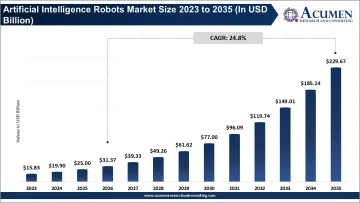
The global artificial intelligence robots market size was calculated at $25 billion in 2025, the market is estimated to reach at $229.67 billion by 2035; growing at a CAGR of 24.8% during the forecast period of 2026-2035. The expansion of smart factories, electronics manufacturing, and warehouse automation has significantly strengthened demand for AI robots, promoting the market’s expansion.
Report Highlights
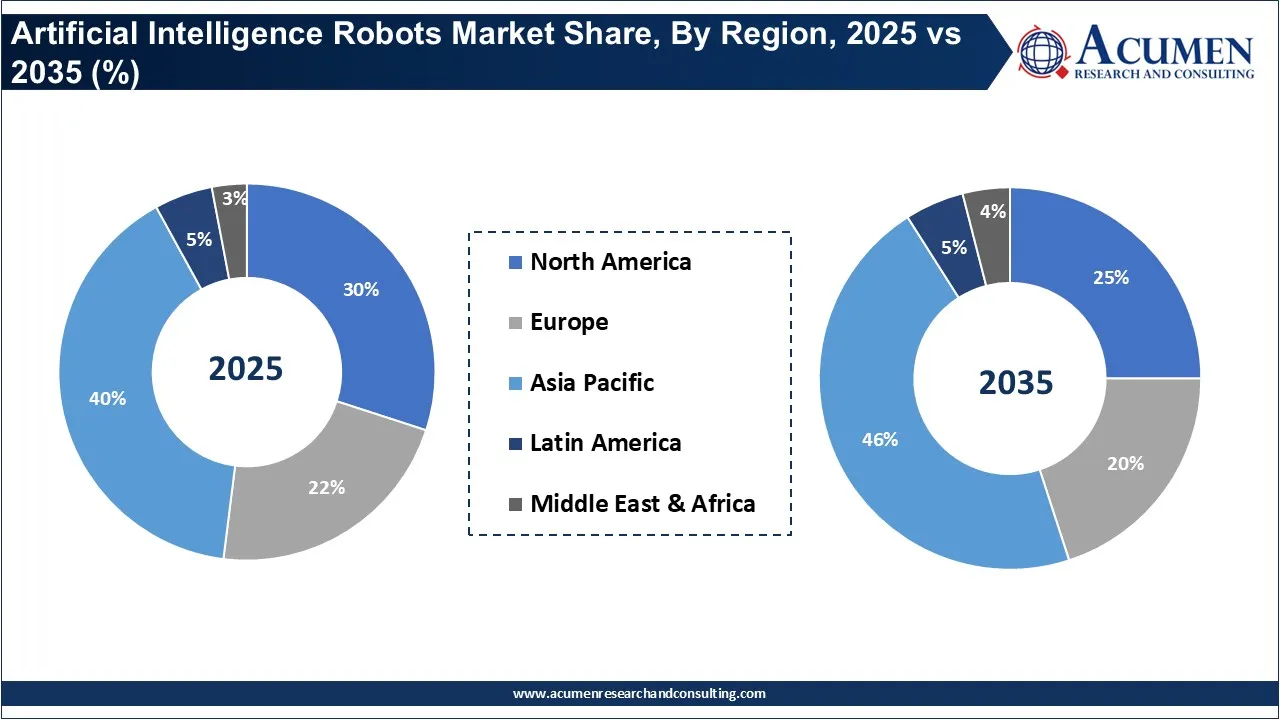
- Asia-Pacific dominated the AI robots market with a 40% share in 2025 due to its strong industrial manufacturing base, high-volume electronics production, semiconductor fabrication capacity, and aggressive robotics adoption across China, Japan, South Korea, and India.
- The Middle East & Africa is projected to grow at the fastest CAGR of 28.8% through 2035 driven by rising investments in smart city infrastructure, industrial automation, oil & gas robotics, and national AI transformation strategies.
- By robot type, industrial robots accounted for the largest market share of 58% in 2025 as industries increasingly deploy AI-driven robots for welding, assembly, inspection, painting, and material handling to improve speed, precision, and operational efficiency.
- Service robots are expected to witness the fastest CAGR of 28.3% during the forecast period due to their expanding applications in healthcare, logistics, hospitality, retail, domestic services, and defense sectors.
- By mobility type, stationary robots held the dominant share of 62% in 2025 owing to their widespread use in fixed industrial environments where high precision, repeatability, and high-speed production are critical.
- Mobile robots captured the second-largest market share of 38% in 2025 due to their increasing deployment in warehouse automation, hospital logistics, agricultural operations, and autonomous delivery systems.
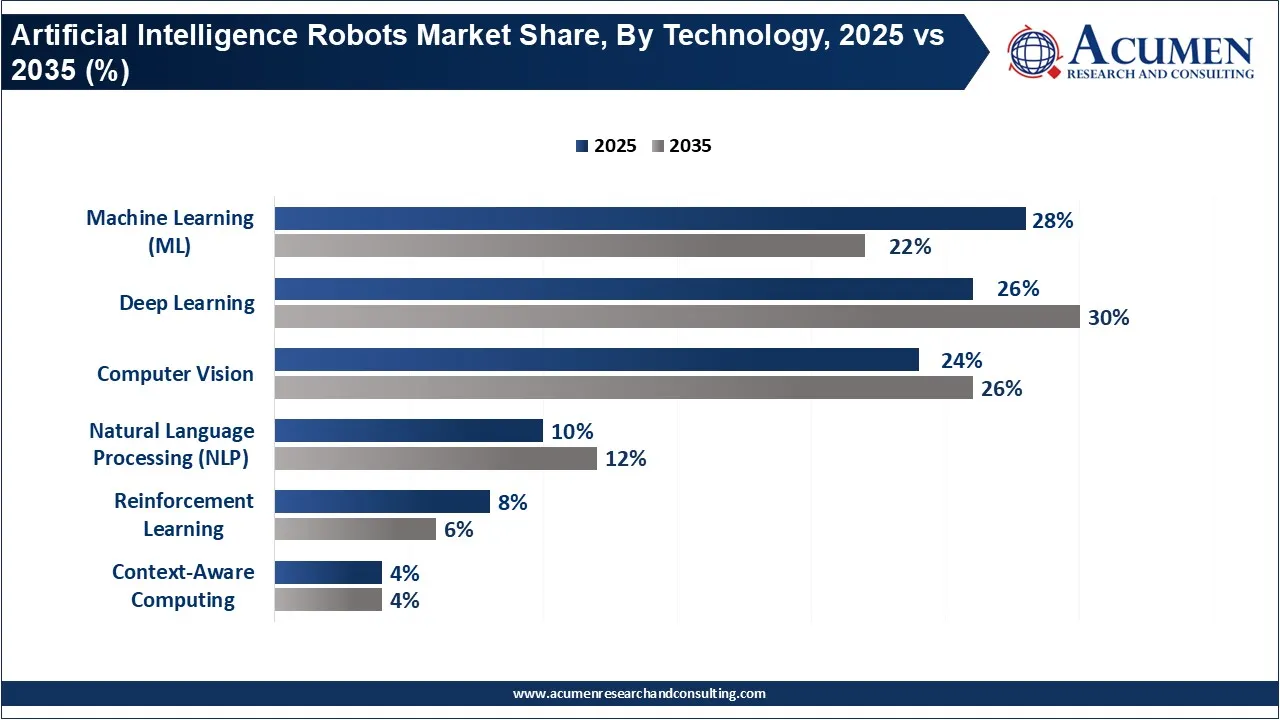
- By technology, machine learning dominated the market with a 28% share in 2025 as it remains the foundational AI technology for predictive maintenance, process optimization, autonomous decision-making, and adaptive robotic behavior.
- Natural language processing is expected to register the highest CAGR of 27.3% through 2035 driven by growing demand for human-machine interaction, voice-enabled robotics, contextual communication, and intelligent service robots.
- By end user, manufacturing accounted for the largest market share of 28% in 2025 due to large-scale deployment of AI robots across assembly lines, quality inspection systems, packaging operations, and smart production facilities.
- Logistics & transportation held the second-largest market share of 18% in 2025 supported by rapid e-commerce expansion, warehouse automation growth, rising autonomous delivery demand, and increasing supply chain optimization requirements.
Market Dynamics
Driver
Increased Industrial Automation and Labor Cost Savings
One of the biggest driving forces behind the market for AI robots is the increasing pressure on industrial sectors to improve productivity, optimize operational costs and maintain consistency of output. Manufacturers within industries like automotive, electronics, semiconductor, and heavy engineering are moving towards AI robotic systems for tasks which are repetitive, labor intensive and precision critical.
These robots helps businesses reduce human errors, increase throughput, and assure 24/7 uptime. The labor shortage in developed economies such as USA, Japan and Germany is encouraging a shift toward robotics-driven manufacturing. In the automotive manufacturing, AI robots helps increase assembly productivity by 30% and reduce production downtime by nearly 20%.
Restraint
High Initial Investment and Complex integration
The high upfront capital investment costs involved in the setup of AI robots is one of the biggest limitations on the market. AI robots require the procurement of substantial investment in hardware like sensors, LiDAR systems, cameras, robot arms, processors, GPUs, AI acceleration chipsets and significant amount of investments in software and infra upgrades.
Certain sensitive applications in healthcare, defense and critical infra Industries has strict regulations on reliability and safety, hence they have to focus on various other concerns including the capability of AI robots before integrating them widely into the system.
Opportunity
Rise of Service Robots and Human-Centric Automation
The proliferation of service robots forms one of the largest long-term opportunities within the AI robots market. Service robots will eventually redefine business sectors beyond the current realm of industrial robots and bring forth transformations in Healthcare, Retail, Logistics, Hospitality, and Home Automation industries.
Healthcare services sector will be the key growing sector, AI robots is actively being used in various aspects like surgical processes, remote monitoring of patients, elderly care, Rehabilitation procedures, and drug delivery. Aging global population leads to increased demand of the care robots especially in Japan, South Korea, and other European countries. As the capabilities of AI technology grow with progress of natural language processing, deep learning and contextual intelligence, the commercial viability of these robots will become more robust.
Regional Insights
- The North America artificial intelligence robots market size was valued at $7.50 billion in 2025 and is estimated to reach at $57.42 billion by 2035; growing at a CAGR of 22.3% from 2026-2035.
- The Europe artificial intelligence robots market size was estimated at $5.50 billion in 2025 and is calculated to record $45.93 billion by 2035; expanding at a CAGR of 23.4% during the forecast period 2026 to 2035.
- The Asia-Pacific artificial intelligence robots market size was accounted for $10 billion in 2025 and is generated revenue $105.65 billion by 2035; growing at a CAGR of 26.7% from 2026 to 2035.
Large Investments & Electronic Production Made Asian Countries Lead the AI Robots Industry
In 2025, Asia-Pacific accounted for largest share in the artificial intelligence robots market at 40% and is expected to remain the leading regional market for years. This is driven by a massive industrial manufacturing eco-system, an enormous electronics production market and wafer fabrication capability, and the rapid penetration of automation across major economies in the region, including China, Japan, South Korea, and India.
- China dominates global industrial robot installation with more than 290,000 robot units installed in 2025, contributing about half the global installations each year. Large manufacturing presence for EV, batteries, electronics and semiconductor manufacturing is creating huge demand for AI-powered robots from industries. Large manufacturers such as BYD, and Foxconn have consistently invested in increasing their smart manufacturing lines with the assistance of AI robotics.
- Japan is one of the leading countries for industrial robot manufacturing and produces about 45% of all industrial robots globally. Leading robotics manufacturers like Fanuc and Yaskawa Electric are making significant investment into future generation AI robotics for both industrial and service applications.
- Robot density in South Korea is the highest in the world and stands above 1,000 robots per 10,000 manufacturing workers. Large investment in robot production facilities is expected by leading semiconductor manufacturers such as Samsung Electronics, SK Hynix and many others due to presence of high volume precision electronics manufacturing.
Middle East & Africa to Witness Rapid Rate of Growth by 2035
Middle East & Africa region is expected to exhibit a growth of 28.8% CAGR in the given forecast period and is considered as one of the fast emerging markets for AI robotics. The region holds currently a small part in the global revenue but expected to grow at a high rate as governments are making significant investments in industrial diversification, smart cities, energy automation and AI infrastructure modernization.
Nations like Saudi Arabia and United Arab Emirates are among the top countries for robotics investment in this region due to their visionary plans to boost their economies with national digitalization strategies. Saudi Arabia has allocated billions of dollars through its Vision 2030 for robotics, AI infrastructure and smart manufacturing facilities. Mega projects like NEOM are creating large scale demands for robots for supply chain and logistics, smart city security, energy and transportation systems.
Top Countries in AI Robots Market: Investments, Production & Drivers
| Country | Key Investments & Production | Growth Drivers |
|---|---|---|
| China | The country installed over 290,000 industrial robots in one year, accounting for nearly 48% of global robot installations. It contributes over 31% of total global manufacturing output. | Strong state subsidies, “Made in China 2025,” labor cost increases, factory modernization |
| United States | The U.S. invested more than $62 billion in AI robotics, autonomous systems, and industrial automation in 2025. | AI innovation ecosystem, venture capital, labor shortages, reshoring of manufacturing |
| Japan | Japan produces nearly 45% of the world’s industrial robots and invested over $ 22 billion in industrial AI robotics in 2025. | Aging population, high labor costs, strong robotics manufacturing base |
| Germany | Over 35% of Europe’s automotive robotics demand comes from Germany alone. Manufacturing automation contributes heavily to Germany’s EUR 2.3 trillion industrial economy. | Industry 4.0 leadership, labor efficiency, advanced manufacturing exports |
| South Korea | South Korea invested over $14 billion in AI robotics and smart manufacturing systems in 2025. | Semiconductor dominance, labor shortages, government smart factory grants |
Segmental Insights
Robot Type Insights
Industrial robots held the largest share of the global artificial intelligence robots market with 58% of the total revenue in 2025. This was due to the widespread use of industrial automation across automotive manufacturing, electronics production, semiconductor manufacturing, metalworking, packaging, and heavy engineering. Robots are widely used for high-volume production processes as they offer extreme speed, accuracy and efficiency.
Integration of AI has allowed industrial robots to do more than just simple programmed tasks. AI robots are now capable of predictive maintenance, adaptive motion, defect detection, self-correction and real time quality assurance. In automotive production, welding robots, painting robots, assembly robots, and inspection robots offer over 90% precision accuracy.
Service robots is projected to grow at the fastest CAGR at a rate of 28.3% from 2026 to 2035 due to the diverse application areas of robotics beyond industrial ones, especially within service industries like healthcare, hospitality, retail, domestic work, agriculture and defense.
In the health sector, surgical robots, rehabilitation robots, domestic and elderly care robots and hospital logistic robots were commercially expanded. AI-based surgical robots were used for more than 12 million operations annually throughout the world. Robotic warehouses that use the benefits of autonomous technology are helping to cut order fulfillment time by nearly 35%, making them a key ingredient for e-commerce success.
Mobility Type Insights
Stationary robots held the largest share in mobility, representing 62% of share in 2025. Stationary robots are an entrenched part of fixed production lines that demand high accuracy, high speeds and consistent throughput. Stationary robots are essential for many high-speed, repetitive tasks such as machining, welding, painting, assembly and inspection across various industrial sectors including automotive production, electronics manufacturing, metals production, and the semiconductor industry. These stationary robots have integrated AI to improve predictive maintenance, defect detection, and overall productivity.
Artificial Intelligence Robots Market Share, By Mobility Type, 2025 (%)
| Mobility Type | Revenue Share, 2025 (%) |
|---|---|
| Stationary Robots | 62% |
| Mobile Robots | 38% |
Mobile robots captured 38% share of the AI robots market in 2025. Mobile robots are the second largest mobility type in the market and will grow in importance rapidly because of their increasing applications in industries such as logistics, healthcare, retail, agriculture, and defense and security. Unlike stationary robots that are tethered to a fixed workspace stationary robots are an essential tool when operating and maneuvering around dynamic, variable work environments.
Technology Insights
Machine learning contributed to the largest market share by holding 28% share in 2025, as its technology is largely responsible for performing the underlying functions in Industrial Automation, predictive maintenance, robotics process optimization, autonomous decision-making, etc. The machine learning algorithms allow robots to improve the performance on the historical as well as the real-time operational data; hence these technologies provide high efficiency for various industrial sectors that often have dynamic situations.
The machine learning technology helps the robots in manufacturing to streamline their workflow, anomaly detection, reduction in downtime, and optimize energy efficiency. In the case of logistics, it improves path planning, warehouse optimization and even enables accurate demand forecasting. The Healthcare Robotics technology also relies on ML to facilitate patient monitoring, diagnosing and surgical performance.
The natural language processing segment is anticipated to grow with the highest CAGR of 27.3% in the AI robots market by the year 2035 and this is driven by the rise in demand of human-machine communication, voice interaction, conversation Intelligence and contextual understanding. It is gaining more importance since robots are increasingly finding their way in to customer based services rather than industrial applications.
The Natural Language Processing (NLP) can be clearly observed in healthcare, retail, customer service and hospitality service robots and these machines use the technology for voice recognition, language translation, sentiment analysis and even context aware responses. It is quite obvious to see that AI assistants, humanoid robots, cobots rely heavily on this technology to enhance their human interaction and functionality efficiency.
End User Insights
The largest share of market end user was manufacturing in 2025, representing 28% of market share. As robotics is implemented widely on manufacturing lines it can be utilized for various activities including assembly, welding, inspection, packaging, materials handling and more.
There are significant and growing demands in manufacturing for higher productivity, lower labor costs, consistent quality control, and shorter manufacturing cycles, the demand for which is met with the help of AI robots to a great extent and the human effort can be minimized while avoiding mistakes, which can also reduce machine down times.
- In 2025 there were in excess of $ 210 billion worth of investments in smart factories across the globe, and robotics holds the largest part of those investments. It is believed that AI robots provide industrial production companies with a competitive edge over the other competitors.
Artificial Intelligence Robots Market Share, By End User, 2025 (%)
| End User Type | Revenue Share, 2025 (%) |
|---|---|
| Manufacturing | 28% |
| Automotive | 14% |
| Healthcare & Life Sciences | 12% |
| Logistics & Transportation | 18% |
| Retail & E-commerce | 10% |
| Defense & Security | 8% |
| Agriculture | 3% |
| Energy & Utilities | 5% |
| Others | 2% |
The second largest end user segment in 2025 was logistics & transportation, which made up 18% of the market. Increased rates of e-commerce and supply chain complexity at global level combined with demand for increased speed in delivery makes AI robots an integral component in the logistics sector. In the sector robots are utilized for picking, sorting, transport, and inventory management of goods in warehouse facilities. Autonomous delivery robots are commonly used for last mile delivery of products in the logistics sector.
Key Players
- SoftBank
- Blue Frog Robotics
- NVIDIA
- Harman International Industries
- Intel
- Alphabet
- IBM
- Hanson Robotics
- Xilinx
- Microsoft
- ABB
- Fanuc
Segments Covered
By Robot Type
- Service Robots
- Industrial Robots
- By Mobility Type
- Stationary Robots
- Mobile Robots
By Technology
- Machine Learning (ML)
- Deep Learning
- Computer Vision
- Natural Language Processing (NLP)
- Reinforcement Learning
- Context-Aware Computing
By End User
- Manufacturing
- Automotive
- Healthcare & Life Sciences
- Logistics & Transportation
- Retail & E-commerce
- Defense & Security
- Agriculture
- Energy & Utilities
- Others
By Region
- North America
- Europe
- Asia-Pacific
- Latin America
- Middle East & Africa
Looking for discounts, bulk pricing, or custom solutions? Contact us today at sales@acumenresearchandconsulting.com
Frequently Asked Questions

Other ICT Reports
October 2023
February 2024
June 2022
December 2022