
Artificial Intelligence as-a-Service (AIaaS) Market Size, Share, Report 2026 To 2035
Artificial Intelligence as-a-Service (AIaaS) Market (By Service Type: IaaS, PaaS, SaaS; By Technology: Machine Learning, NLP, Computer Vision, Speech Recognition & AI, Generative AI, Other; By Deployment Model: Public Cloud, Private Cloud, Hybrid Cloud; By Enterprise Size: Large Enterprises, Small & Medium Enterprises (SMEs); By End User: BFSI, IT & Telecommunications, Healthcare & Life Sciences, Retail & E-commerce, Manufacturing, Energy & Utilities, Other) - Global Industry Analysis, Size, Share, Growth, Regional Analysis, Trends and Forecast 2026 - 2035
- Last Updated: 02 Sep 2026
- Report Code: ARC3974
- Category: ICT
Artificial Intelligence as-a-Service (AIaaS) Market Size, Forecast Report 2026 To 2035
The global artificial intelligence as-a-service market size was valued at USD 21.50 billion in 2025 and is observed to reach at USD 346.05 billion by 2035; while growing at a CAGR of 32% during the forecast period of 2026-2035. Growing enterprise adoption of cloud-based AI solutions is driving AIaaS demand by enabling businesses to access advanced AI capabilities without major investments in in-house infrastructure and expertise.
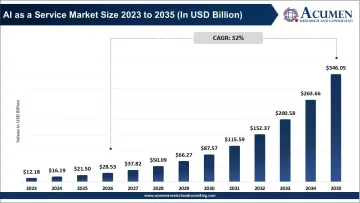
Report Highlights
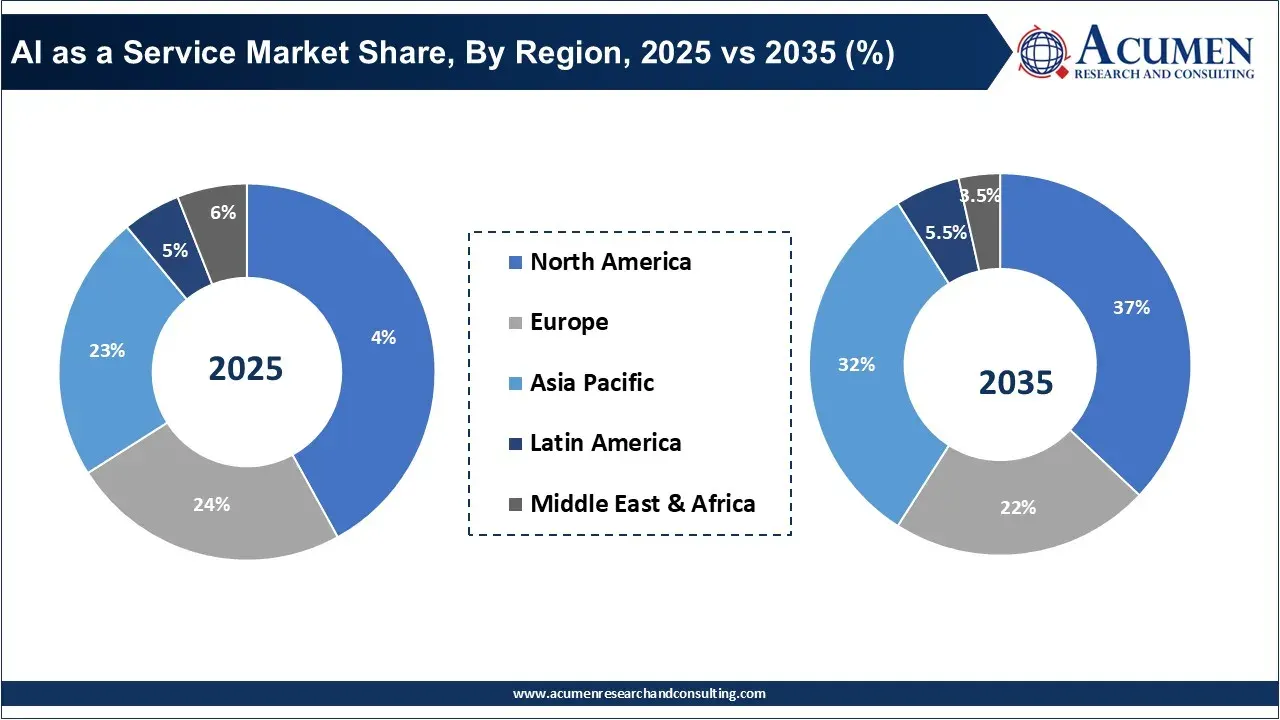
- By region, North America accounted for the largest share of the AIaaS market at 42.0% in 2025, supported by its mature technology ecosystem, established cloud infrastructure, major AI providers, and strong enterprise AI adoption.
- By region, Europe held a 24.0% share of the AIaaS market in 2025, with enterprise automation, digital transformation, cloud adoption, and increasing demand for structured AI deployment supporting regional growth.
- By region, Asia-Pacific accounted for 23.0% of the AIaaS market in 2025 and is the fastest-growing regional market, driven by rapid digitalization, cloud adoption, manufacturing AI, expanding data-center capacity, and sovereign-AI initiatives.
- By service type, software-as-a-service led the AIaaS market with a 55% share in 2025, primarily due to the availability of ready-to-use AI applications such as copilots and AI agents that reduce infrastructure and management requirements.
- By service type, platform-as-a-service accounted for 27% of the AIaaS market in 2025, supported by increasing enterprise demand for cloud-based platforms to build, fine-tune, deploy, and manage proprietary AI models.
- By technology, machine learning held the largest share of the AIaaS market at 29% in 2025, owing to its broad applicability across established enterprise use cases such as forecasting, recommendations, fraud detection, optimization, and predictive analytics.
- By technology, generative AI is projected to be the fastest-growing segment, increasing from a 25% share in 2025 to 40% by 2035, as generative capabilities become integrated across copilots, content generation, conversational AI, coding, enterprise search, multimodal applications, and AI agents.
- By deployment model, public cloud dominated the AIaaS market with a 55% share in 2025, driven by scalable computing resources, faster deployment, and lower upfront infrastructure requirements compared with private and hybrid environments.
- By deployment model, hybrid cloud is expected to be the fastest-growing segment, increasing its share from 27% in 2025 to 35% by 2035, as enterprises seek to combine public cloud scalability with the security and control of private or on-premises infrastructure.
- By enterprise size, large enterprises dominated the AIaaS market with a 68% share in 2025, supported by larger AI budgets, complex workloads, stronger technical capabilities, and greater capacity to deploy enterprise-grade AI platforms.
- By enterprise size, small and medium enterprises accounted for 32% of the AIaaS market in 2025, as subscription-based AI services reduce upfront costs and make AI capabilities more accessible for automation, customer engagement, and productivity.
- By end user, IT and telecommunications held the largest share of the AIaaS market at 19% in 2025, supported by its strong exposure to cloud computing, software development, networking, IT infrastructure, and early AI adoption.
- By end user, BFSI was the second-largest segment with a 17% share in 2025, driven by demand for AI-powered data analytics, automated financial processes, risk management, and data-driven decision-making.
What Is the Artificial Intelligence as-a-Service (AIaaS) Market?
Artificial Intelligence as-a-Service (AIaaS) market comprises of delivery of the AI features to various end users in cloud-based platform subscription or usage based delivery. The service allows end users like the companies to use the benefits of AI technologies, without building, maintaining, and developing extensive infrastructural facilities for themselves.
AIaaS vendors provide the machine learning, natural language processing, generative AI, computer vision, predictive analytics, AI agents, and model training and AI applications through an underlying elastic cloud based environment, enabling them to lower their capital expenses for technology infrastructure and scale their computer resources in accordance to their demand. There is a rising demand for automation to move forward from merely experimenting with AI in individual projects to deploying repeatable AI services.
What Are the Most Important AIaaS Use Cases Across Industries?
| Industry | Major AIaaS use cases | Key Application |
|---|---|---|
| IT & Telecommunications | AI agents, predictive analytics, network optimization, coding assistants, cybersecurity, customer-service automation | Reduces operational costs, improves network performance, and accelerates software development |
| BFSI | Fraud detection, credit scoring, risk analytics, algorithmic decision-making, customer-service chatbots, document processing | Improves risk management, transaction monitoring, compliance, and customer experience |
| Healthcare & Life Sciences | Medical imaging, clinical decision support, drug discovery, patient analytics, virtual assistants, medical documentation | Supports faster diagnosis, research, workflow automation, and personalized care |
| Retail & e-commerce | Recommendation engines, demand forecasting, dynamic pricing, inventory optimization, customer analytics, conversational commerce | Improves personalization, sales conversion, inventory management, and customer engagement |
| Manufacturing | Predictive maintenance, quality inspection, computer vision, production optimization, digital twins, supply-chain forecasting | Reduces downtime, improves product quality, and increases production efficiency |
| Automotive & Transportation | Autonomous systems, predictive maintenance, route optimization, driver assistance, fleet analytics | Enhances safety, asset utilization, logistics efficiency, and vehicle performance |
| Energy & Utilities | Load forecasting, predictive maintenance, grid optimization, energy-demand prediction, asset monitoring | Improves reliability, resource utilization, and operational efficiency |
| Logistics & Supply Chain | Demand forecasting, route optimization, warehouse automation, inventory prediction, shipment tracking | Reduces transportation costs and improves supply-chain visibility |
Artificial Intelligence as-a-Service Market Dynamics
Driver
Growing enterprise adoption of cloud-based AI
The rapid rise of cloud-based AI is a leading force for the AIaaS market, as companies demand access to advanced AI models and technologies rather than incurring the costs of infrastructure and experts needed to build them. With AIaaS, organizations benefit from utilizing machine learning, generative AI, analytics and AI agents from cloud platforms and only paying the rate based on usage. Enterprise spending on AI is also shifting from innovation projects to recurring tech expenditure.
Restraint
Rising AI infrastructure and usage costs
High and unpredictable AI operating costs remain a key restraint, particularly for enterprises deploying generative AI at scale. Expenses associated with GPU computing, inference, token consumption, data storage, model training, security, integration, and continuous monitoring can increase rapidly as usage expands. Gartner notes that enterprises are placing greater emphasis on AI usage efficiency, cost control, and measurable outcomes as spending becomes increasingly usage-driven.
Opportunity
Expansion of specialized and agentic AI services
Opportunities abound for AIaaS providers offering tailored services in specific industries and business functions due to the increasing need for domain-specific and autonomous AI models. Worldwide spending on domain-specific and specialized generative AI models is forecasted to grow from $1.58 billion in 2025 to $4.91 billion in 2026 (a growth of 210%), according to Gartner.
As organizations embrace the rise of specialized models, AIaaS vendors have a prime opportunity to offer industry-tailored models, ready-made workflows, controls and AI agents providing a better performance fit, while managing cost, reliability, and compliance needs.
Artificial Intelligence as-a-Service Market Segmentation Insights
Offering Insights
The software-as-a-service segment led the AIaaS market in 2025 by a majority with 55%. The segment leadership is largely due to the easy availability of ready-made AI applications (copilots/ AI agents) which can provide access to artificial intelligence tools without much management and creation burden in managing infrastructure. The software-as-a-service based solutions can meet diverse enterprise needs with available applications making a major point of entry for organization adoption of AI in business processes.
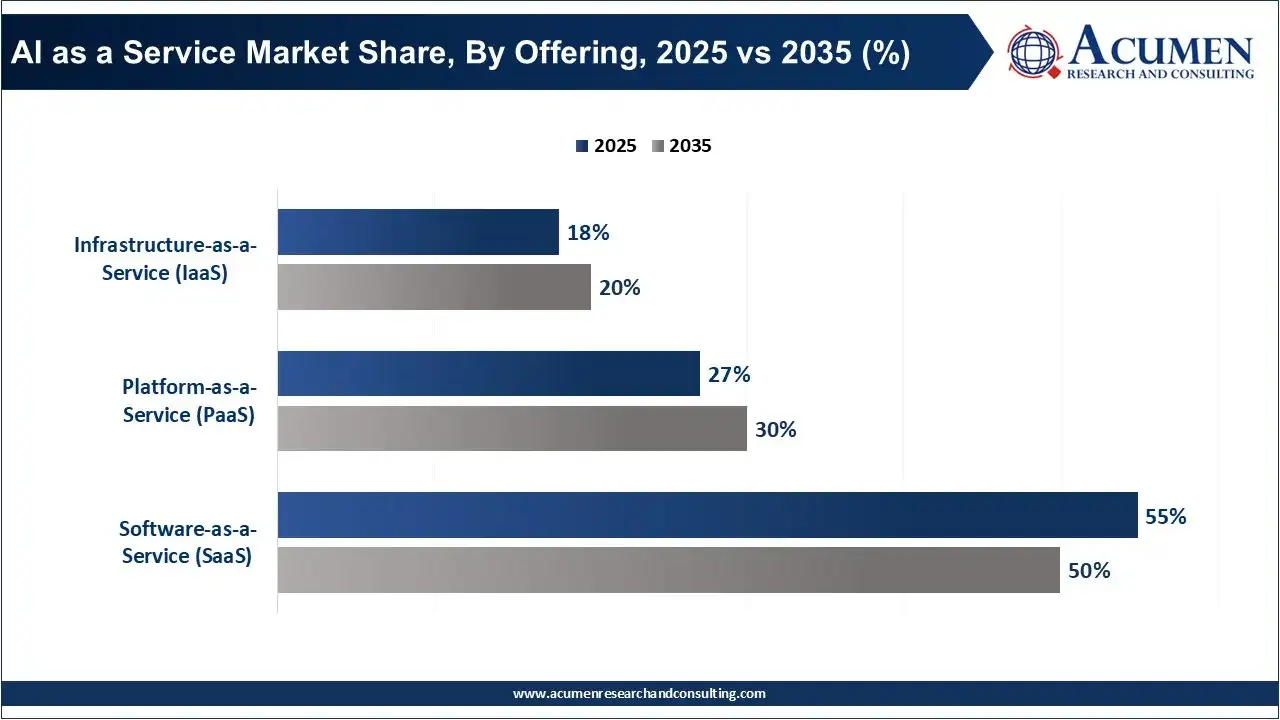
Platform-as-a-Service (PaaS) accounted for 27% of the AIaaS market in 2025 and is projected to increase to 30% by 2035. The expansion of PaaS reflects the increasing requirement among enterprises to build, fine-tune, deploy, and manage proprietary AI models through cloud-based AI platforms and APIs. As organizations move from experimenting with AI toward operational deployment, platforms that support the complete AI development and management lifecycle become increasingly important.
Technology Insights
As one of the major categories under AIaaS technologies, machine learning technology held majority market share of 29% in 2025 due to its versatility in all mature enterprise AI use cases such as forecasting, recommendations, fraud detection, optimization etc. Machine Learning remain a base technology for wide deployment in the AIaaS where an ability in predicting and analyzing things are required for the enterprise AI.
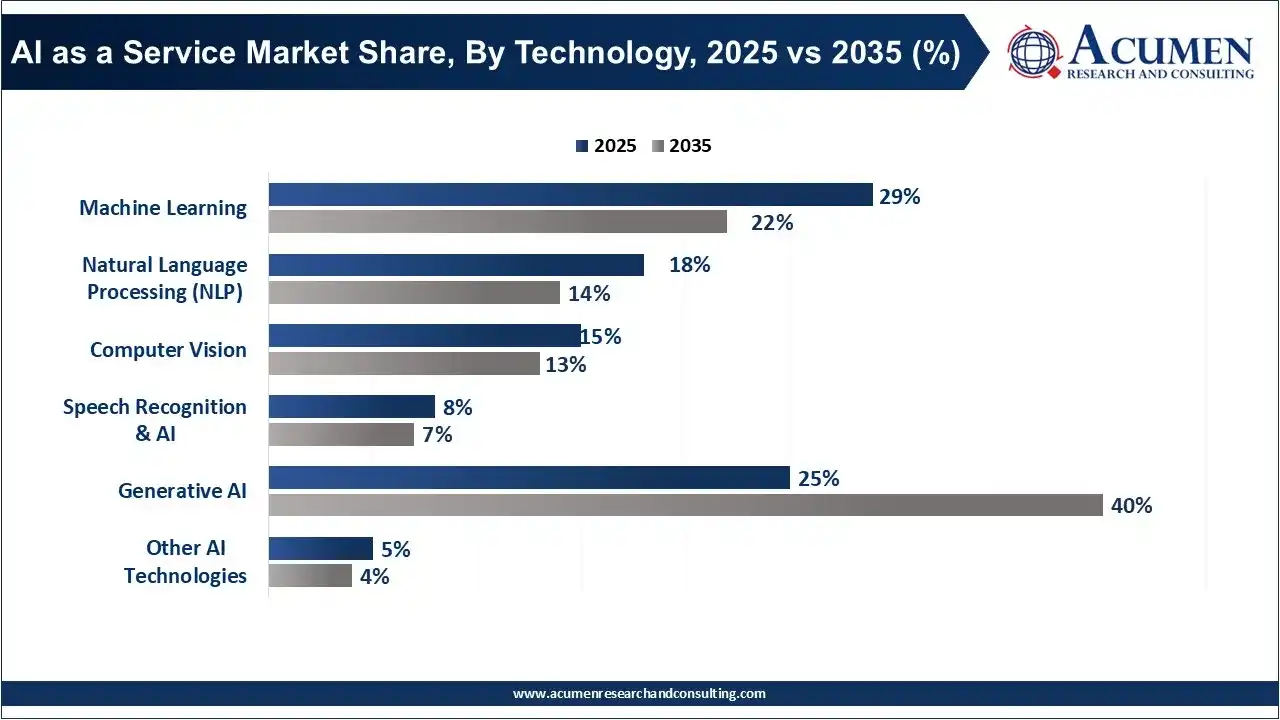
The fastest growing technology segment for AIaaS is generative AI from 25% in 2025 to 40% in 2035 thus has gained much share and made generative AI the most dominantly applied technologies set. Generative AI, as an underlying technology layer over many AIaaS application cases, including copilot, content generation, conversational AI, coding, enterprise search, multimodal application, AI agent and so on.
Rather than remaining confined to a standalone application category, generative capabilities are increasingly integrated into multiple enterprise AI services, allowing their growth to influence several areas of the wider AIaaS market simultaneously.
Deployment Model Insights
Public cloud dominated the deployment segment, with 55% share in 2025. Factors such as availability of scalable compute and lower upfront investments, along with quicker deployment times of AI infrastructure, can be attributed to its supremacy over private and hybrid cloud.
Such deployments do not demand huge financial investments into developing owned infrastructure, making public cloud quite favorable to companies that plan to deploy AI functionalities with substantial and yet less of an upfront capital commitment.
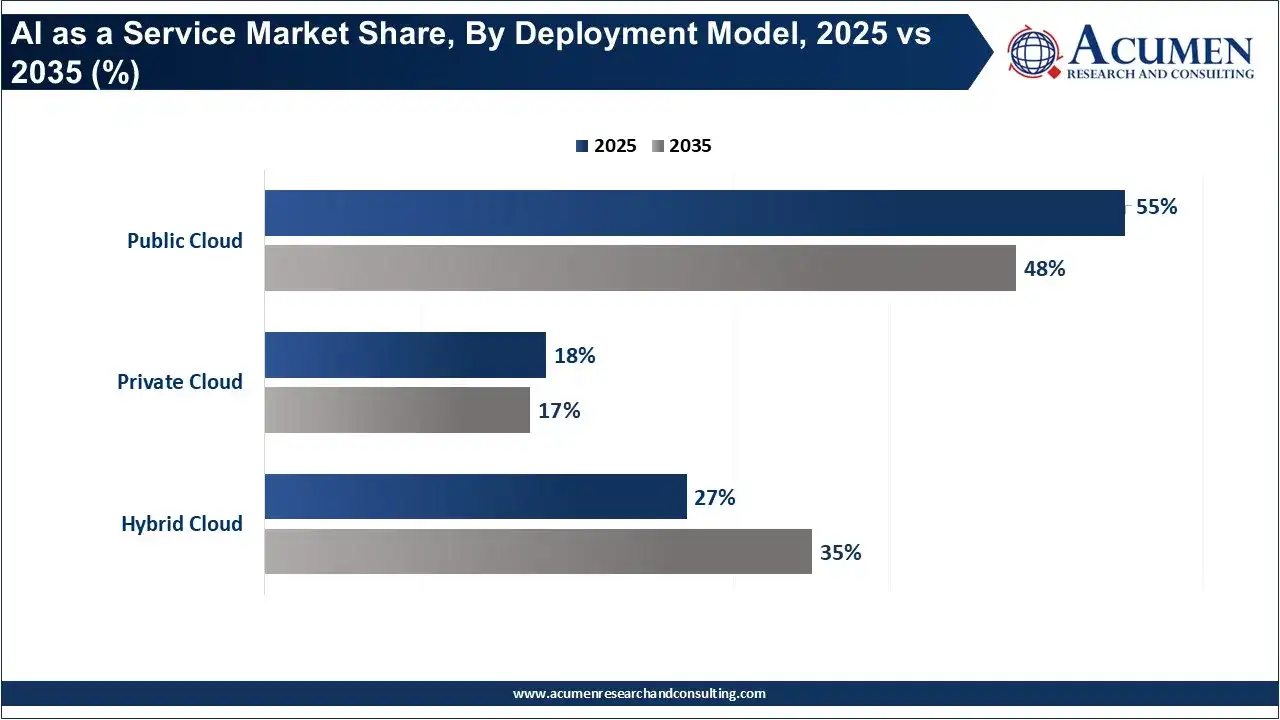
Hybrid cloud is projected to be the fastest-growing deployment model, increasing its share from 27% in 2025 to 35% by 2035. Hybrid cloud will take greater share at a faster pace than other deployment modes because companies intend to exploit both the scale of public cloud with on-premises and private local infrastructure control.
A multitude of overlapping corporate prerequisites contribute to this development of the hybrid deployment. Businesses might implement public cloud service as needed for scalable compute and flexible deployment scenarios while keeping delicate and critical business data within private or on-premises data centers if and when security or optimization necessities dictate so. This is particularly true for businesses running diverse workloads and sensitive information.
Enterprise Size Insights
Large enterprises accounted for 68% of the AIaaS market in 2025, making them the dominant enterprise-size segment. Their leadership is associated with greater AI budgets, complex workloads, and earlier adoption of enterprise-grade AI platforms. Large organizations typically have greater financial and technical capacity to implement AI across multiple business functions and to support sophisticated workloads requiring scalable infrastructure, model management, and enterprise-level governance.
AIaaS Market Share, By Enterprise Size, 2025 (%)
| Enterprise Size | Revenue Share, 2025 (%) |
|---|---|
| Large Enterprises | 68% |
| Small & Medium Enterprises (SMEs) | 32% |
Small & Medium Enterprises (SMEs) represented 32% of the market in 2025. The segment is expected to gain share as subscription-based AI services reduce upfront investment requirements and cloud AI becomes easier to deploy. SMEs are increasingly positioned to use AIaaS for automation, customer engagement, and productivity, allowing them to access AI capabilities without replicating the extensive infrastructure and technical resources traditionally associated with enterprise AI deployment.
End User Insights
IT and telecommunications was by far the largest sector contributing to the market in 2025, holding 19% of market share. The sector had high naturally occurring exposure in areas such as cloud computing, software development, networking and IT infrastructure. Technology-orientated businesses also among the first movers on the back of adopting various AI platform solutions have given IT and Telecommunications a well-established set of customers from which to draw early AIaaS market share.
AIaaS Market Share, By End User, 2025 (%)
| End User | Revenue Share, 2025 (%) |
|---|---|
| BFSI | 17% |
| IT & Telecommunications | 19% |
| Healthcare & Life Sciences | 11% |
| Retail & E-commerce | 10% |
| Manufacturing | 12% |
| Energy & Utilities | 7% |
| Government & Public Sector | 6% |
| Media & Entertainment | 5% |
| Transportation & Logistics | 5.90% |
| Other Industries | 7.10% |
However, there is likely to be movement away from the tech focus over time; with IT & Telecom’s marketshare expected to fall due to penetration of other industries using AIaaS for operational efficiencies, business operations management, automation of workflow automation, or custom applications.
BFSI was the second largest segment accounting for 17% of the AIaaS market share in 2025. The sector has strong interest in AIaaS with a deep need for data analytics to drive more informed decisions and automate more financial processing for operations such as automation and risk management.
BFSI is suited to the AIaaS space for it offers organisations the opportunity to access powerful AI resources without the upfront investment in AI expertise and infra needed to deploy it from a customer-facing perspective, though this too is becoming more pervasive within other industry sectors.
Artificial Intelligence as-a-Service Market Regional Insights
Why Is North America Expected to Remain the Largest AIaaS Market?
During the forecast period, North America is expected to continue dominating the regional Artificial Intelligence as-a-Service (AIaaS) market. However, its market share was 42.0% in 2025. During the year 2026 and 2035, the market in North America will exhibit a tremendous CAGR of 30.1%. This can be attributed to three significant factors such as developed technology ecosystem, prevalence of cloud-based artificial intelligence infrastructure and high enterprise interest in artificial intelligence capability within North America.
Furthermore, the established market of the North America for AIaaS solution providers acts as the robust ground in which the adoption of technology driven enterprises is high with the requirement of a scalable solution for their existing demand.
How Is Europe’s Artificial Intelligence as-a-Service Market Evolving?
Another notable regional market for AI as-a-Service is Europe, which is estimated to account for around 24.0% of the total AIaaS market size in 2025. In 2035, this figure is expected to decline to 22%. This slight dip in market share is largely due to quicker expansion of AIaaS market in other regions, especially in Asia-Pacific. In 2026, Europe’s AIaaS market size is estimated at nearly $6.85 billion and is expected to grow to $76.13 billion by 2035, with a CAGR of 30.7% over 2026 to 2035. Increased demand from the enterprise users for automation capabilities coupled with intelligent cloud computing enabled through cloud technology contributes to the expansion of the European market size.
European region is expected to perform strongly as it represents existing vast technology market coupled with continuous adoption of the technology by enterprises which makes this market one of the biggest contributor to the total AIaaS market revenue.
Why Is Asia-Pacific the Fastest-Growing Regional AIaaS Market?
Asia-Pacific region is the fastest-growing regional market for artificial intelligence as-a-service (AIaaS), and is on track to grow from 23.0% share of the overall market in 2025 to 32.0% in 2035. By revenue, the region’s AIaaS market was sized at $6.56 billion in 2026 and is expected to reach $110.74 billion in 2035, growing at a 36.9% CAGR over 2026–2035. The increasing share indicates that AIaaS usage is shifting from mature technology markets to quickly growing economies that see their enterprises embracing cloud based AI solutions. Rapid digital transformations in the region, coupled with expanding uptake of enterprise technology and increasing need for scalable AI infrastructure, are expected to power sustained high deployment of AIaaS through the region.
AIaaS Market Leading Companies
- Microsoft (Redmond, Washington, U.S.)
- Amazon Web Services (Seattle, Washington, U.S.)
- Google (Mountain View, California, U.S.)
- IBM (Armonk, New York, U.S.)
- Oracle (Austin, Texas, U.S.)
- Salesforce (San Francisco, California, U.S.)
- NVIDIA (Santa Clara, California, U.S.)
- Alibaba Cloud (Hangzhou, China)
- DataRobot (Boston, Massachusetts, U.S.)
- H2O.ai (Mountain View, California, U.S.)
Which AI Technologies Are Driving AIaaS Adoption?
| AI Technology | Role in AIaaS adoption |
|---|---|
| Machine Learning | Enables predictive analytics, forecasting, recommendation engines, fraud detection, optimization, and automated decision-making across enterprise applications. |
| Generative AI | Drives demand for AIaaS through content generation, coding, conversational AI, enterprise search, copilots, multimodal applications, and AI agents. |
| Natural Language Processing | Enables AIaaS applications to understand, process, and generate human language for chatbots, virtual assistants, document analysis, and customer-service automation. |
| Computer Vision | Supports image and video analysis for applications such as quality inspection, security, healthcare imaging, retail analytics, and autonomous systems. |
| Deep Learning | Provides advanced capabilities for complex pattern recognition, speech processing, image analysis, and large-scale AI applications requiring sophisticated neural networks. |
| AI Agents | Accelerate AIaaS adoption by enabling autonomous systems to execute multi-step tasks, interact with enterprise applications, and automate complex workflows. |
| Predictive Analytics | Helps enterprises use historical and real-time data to forecast outcomes, identify risks, optimize operations, and improve strategic decision-making. |
AIaaS Market Recent News
- In August 2026, Amazon Web Services expanded Amazon Bedrock by making OpenAI GPT-5.6 models available to customers in India with India Geo cross-Region inference. The development enables organizations with in-country inference requirements to access OpenAI models through Bedrock while keeping inference within India. The move strengthens Amazon Bedrock's position as a managed AI platform providing enterprises with access to multiple advanced AI models.
- In August 2026, IBM announced a strategic partnership with OpenAI focused on helping enterprises deploy AI across core business operations and complex workflows. The collaboration also targets secure AI deployment and cyber resilience through initiatives including OpenAI Daybreak. The partnership expands IBM's enterprise AI ecosystem while giving organizations additional pathways to integrate advanced AI capabilities into business processes.
Segments Covered
By Service Type
- Infrastructure-as-a-Service (IaaS)
- AI Compute-as-a-Service
- AI Storage-as-a-Service
- AI Networking & Accelerated Infrastructure Services
- Platform-as-a-Service (PaaS)
- AI/ML Development Platforms
- Model Training & Fine-Tuning Services
- Model Deployment & Inference Services
- MLOps & Model Management Platforms
- AI/ML APIs & Foundation Model Services
- Software-as-a-Service (SaaS)
- AI Productivity & Copilot
- Conversational AI & Virtual Assistant
- AI Analytics & Business Intelligence
- AI Content Generation
- Intelligent Automation & AI Agent
- Industry-Specific AI Applications
By Technology
- Machine Learning
- Natural Language Processing (NLP)
- Computer Vision
- Speech Recognition & AI
- Generative AI
- Other AI Technologies
By Deployment Model
- Public Cloud
- Private Cloud
- Hybrid Cloud
By Enterprise Size
- Large Enterprises
- Small & Medium Enterprises (SMEs)
By End User
- BFSI
- IT & Telecommunications
- Healthcare & Life Sciences
- Retail & E-commerce
- Manufacturing
- Energy & Utilities
- Government & Public Sector
- Media & Entertainment
- Transportation & Logistics
- Other Industries
By Region
- North America
- Europe
- Asia-Pacific
- Latin America
- Middle East & Africa
Looking for discounts, bulk pricing, or custom solutions? Contact us today at sales@acumenresearchandconsulting.com
Frequently Asked Questions

Other ICT Reports
October 2024
August 2026
November 2022
April 2026