
Artificial General Intelligence Market Size, Share, Report 2026 to 2035
Artificial General Intelligence Market (By Component: Hardware, Software, Services; By Technology: Machine Learning, Deep Learning, Natural Language Processing (NLP), Computer Vision, Reinforcement Learning, Neuro-Symbolic AI, Cognitive Computing; By Deployment Mode: Cloud-Based, On-Premise, Hybrid; By Autonomy Level: Human-in-the-loop AGI, Human-supervised AGI, Semi-autonomous AGI, Fully Autonomous AGI; By Application; By End User) - Global Industry Analysis, Size, Share, Regional Analysis, Trends and Forecast 2026 - 2035
- Last Updated: 26 Jun 2026
- Report Code: ARC3938
- Category: ICT
Artificial General Intelligence Market Size, Share, Report 2026 to 2035
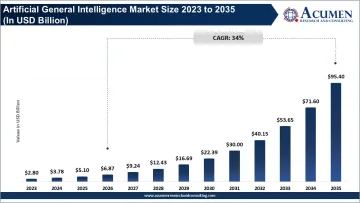
The global artificial general intelligence market size was valued at $5.10 billion in 2025 and is estimated to surpass around $95.40 billion by 2035 growing at a CAGR of 34% from 2026 to 2035. The overall rising demand for training data in order to boost computational power and massive private as well as public investments create potential opportunities for the market to grow. Additionally, focus on national AI budgets, especially in developing countries and public-private AI partnerships create significant growth factors for the artificial general intelligence market to expand.
Report Highlights
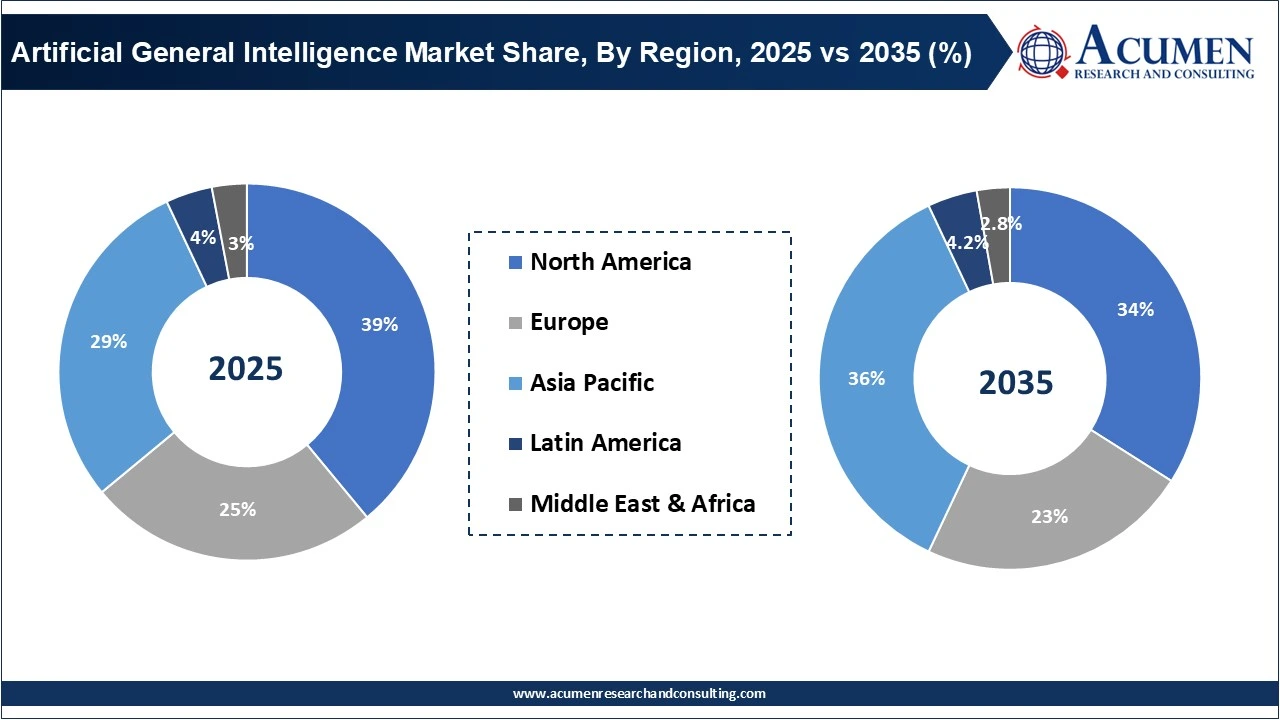
- North America captured 39% share of the market share in 2025 due to high concentration of AI infrastructure providers, semiconductor leaders, hyperscale cloud providers, and deployment of enterprise AI across industries.
- The Asia-Pacific is predicted to be the fastest growing market registering a CAGR of 37.2% by 2035 fueled by growth in robotics, AI chipsets, cloud infrastructure, and government-led AI innovation programs across China, Japan, South Korea and India.
- By component, hardware dominated the market with a share of 45% in 2025 by components as AGI systems need substantial computing power including GPUs, TPUs, AI accelerators, memory systems, and data center expansion.
- By component, software represented the second largest market segment holding 40% share of market share in 2025 due to an increase in development of foundation models, reasoning engines, orchestration platforms and enterprise grade deployment platforms for AGI.
- By technology, deep learning technique occupied the largest market share of 28% in 2025 as the most used framework behind multimodal AI, large language models, advanced reasoning and foundation model training.
- By technology, neuro-symbolic AI technique is predicted to exhibit the highest CAGR of 44.7% by the end of the forecast period, driven by an improvement in logical reasoning, explainability, and generalization by combining neural networks with symbolic reasoning.
- By deployment mode, cloud-based platforms held a majority share of 58% of the market revenue in 2025 by deployment modes due to their ability to provide scaled computing power and flexibility in terms of infrastructure and implementation.
- By deployment mode, on-premise deployment commanded 27% of the market share in 2025 as big organizations and governments look for data security and privacy, coupled with an on-premise approach towards the AGI workloads to attain greater control of infrastructure.
- By autonomy level, human-in-the-loop AGI segment dominated the market share of 43% in 2025 as large organizations and governments continued to employ human intervention to enhance decision quality, reduce risk, and maintain compliance regulations.
- By autonomy level, human supervised AGI held a share of 33% in 2025 due to the demand of partially autonomous AI systems which still requires human supervision and intervention to ensure effective decision making in high-risk and sensitive operations.
- By application, the virtual assistants and digital agents segment led the market with 22% share of the market revenue in 2025 driven by increased commercialization of AI copilots, enterprise assistants, conversational AI for customer service and intelligent assistants for increasing productivity.
- By application, decision intelligence captured a share of 18% in 2025 due to the rapid adoption of AGI by enterprises to enhance business performance, strategic planning, and automating decisions in business operations.
- By end user, IT & telecommunication segment accounted for 24% share of the market share in 2025 as this was one of the first segments to adopt AGI, specifically for software development, cloud solutions, business process automation, and digital infrastructure enhancement.
- By end user, BFSI segment occupied 16% of the market share in 2025 due to the increased implementation of AGI for fraud detection systems, automated trading, customer relationship management, and risk management systems.
What is Artificial General Intelligence and How Does the Market Works?
Artificial General Intelligence (AGI) is an assumed sector of artificial intelligence, which has a capacity to learn, reason, comprehend and apply knowledge across a wide variety of tasks and topics on par with human intelligence, or above. Instead of Narrow AI, which is meant for narrow applications like language translating, image recognizing or recommending things, AGI could be applied for cross-domain knowledge transfer, solving unforeseen problems, adaptation to different environments and execution of complex mental tasks independently.
The market operates based on AI models' development, computation facilities, cloud services, semiconductor technologies, R&D organizations and adoption in enterprises. Tech organizations allocate large funds to develop foundation AI models, advanced semiconductors, AI data centers and machine learning research in order to enhance capabilities of the AI systems. The artificial general intelligence value is generated via a few revenue streams that include subscription for the AI software, AI cloud services, AI infrastructure, consulting services and AI enterprise applications as well as sector-specific AI solutions.
Artificial Intelligence & Workforce Transformation: Key Statistical Data
- 170 million new jobs will be created worldwide by 2030 while the displacement of 92 million existing jobs can be expected by the year owing to AI, automation and other technology shifts-net job growth worldwide of 78 million.
- 86% of employers predict AI and information-processing technologies will transform their businesses by 2030. Thus, AI is the single biggest workforce-shaping technology predicted.
- 48% of organizations predict they will redeploy staff rather than lose jobs owing to AI.
- One 2026 survey into workforce developments revealed that 51.8% of employees were already using generative AI at work.
- The survey also stated that generative AI had cut employee work-time by some 3.8%, indicating that real productivity improvements in knowledge occupations had already been measured.
Report Scope
| Attribute | Details |
|---|---|
| AGI Market Size 2025 | USD 5.10 Billion |
| AGI Market Forecast 2035 | USD 65.40 Billion |
| AGI Market CAGR During 2026 - 2035 | 34% |
| Analysis Period | 2022-2035 |
| Base Year | 2025 |
| Forecast Data | 2026 - 2035 |
| Segments Covered | By Component, By Technology, By Deployment Mode, By Autonomy Level, By Application, By End User, By Region |
| Regional Scope | North America, Europe, Asia Pacific, Latin America, and Middle East & Africa |
| Key Companies Profiled | OpenAI, Google DeepMind, Anthropic, Microsoft, NVIDIA, Meta Platforms, Amazon Web Services, IBM, Tesla, xAI |
| Report Coverage | Market Trends, Drivers, Restraints, Competitive Analysis, Player Profiling, Covid-19 Analysis, Regulation Analysis |
Market Dynamics
Driver
Growing Investments in Foundation Models and AI Infrastructure
The artificial general intelligence market is fueled by an un-precedented level of investment in cutting edge AI models, high performance computing systems and AI R&D. Massive technology organizations, and governmental entities, are pumping billions of dollars into developing next generation AI systems with sophisticated reasoning, planning and autonomous capabilities. The accelerating proliferation of AI data centers, custom GPUs, AI accelerators and cloud based AI infrastructure systems will empower increasingly more powerful AI models. Enterprise desire for automation, sophisticated intelligent assistants, and tools for scientific discovery, plus demands for AI driven work flow efficiency are continually driving demand and investment for AGI related technology.
Restraint
Ethical Concerns and Regulatory Uncertainty
The market for artificial general intelligence also faces significant obstacles, including ethical issues, regulatory challenges and the substantial need for computing power. The costs of training cutting-edge AI models are immense, and this involves significant spending on computational capacity, energy usage, data infrastructure, and skilled human capital. Simultaneously, countries around the globe are legislating and issuing AI regulations covering aspects of transparency, accountability, security, privacy, intellectual property rights and algorithmic bias. Information about misinformation, security threats and job displacement, combined with ethical concerns about the potential misuse of powerful AI, may cause slower adoption.
Opportunity
Emergence of Autonomous AI Agents and Industry-Wide Cognitive Automation
However, the biggest opportunity within the market resides in the creation of agentic AIs, which can be responsible for undertaking lengthy, multi-step tasks autonomously and with minimal human interaction. As AI systems continue to evolve beyond content generation towards cognition, planning, and execution-in domains such as customer service, software development, medical diagnostics, scientific discovery, financial services, and cybersecurity as well as operations within other enterprise systems, organizations are likely to increasingly deploy AGI-based agents as digital colleagues, thereby enabling greater workforce productivity while decreasing costs. Ultimately, market adoption of agentic AIs and AGI-based platforms will continue to disrupt knowledge work and unlock trillions of dollars in economic value in the next 10-15 years.
Segmental Insights
Component Insights
Hardware was the largest segment in the artificial general intelligence (AGI) market and accounted for 45% of total market share in 2025. The sheer computational capacity required for the rapid advancement of AGI models solidifies the necessity for the hardware infrastructure as the bedrock of the entire ecosystem.
High performance computing hardware, high performance GPUs, high performance TPUs, AI accelerators, high performance memory chips, advanced CPUs, network hardware, and semiconductor based architectures are the key enabling components for large scale AGI models to be trained and deployed.
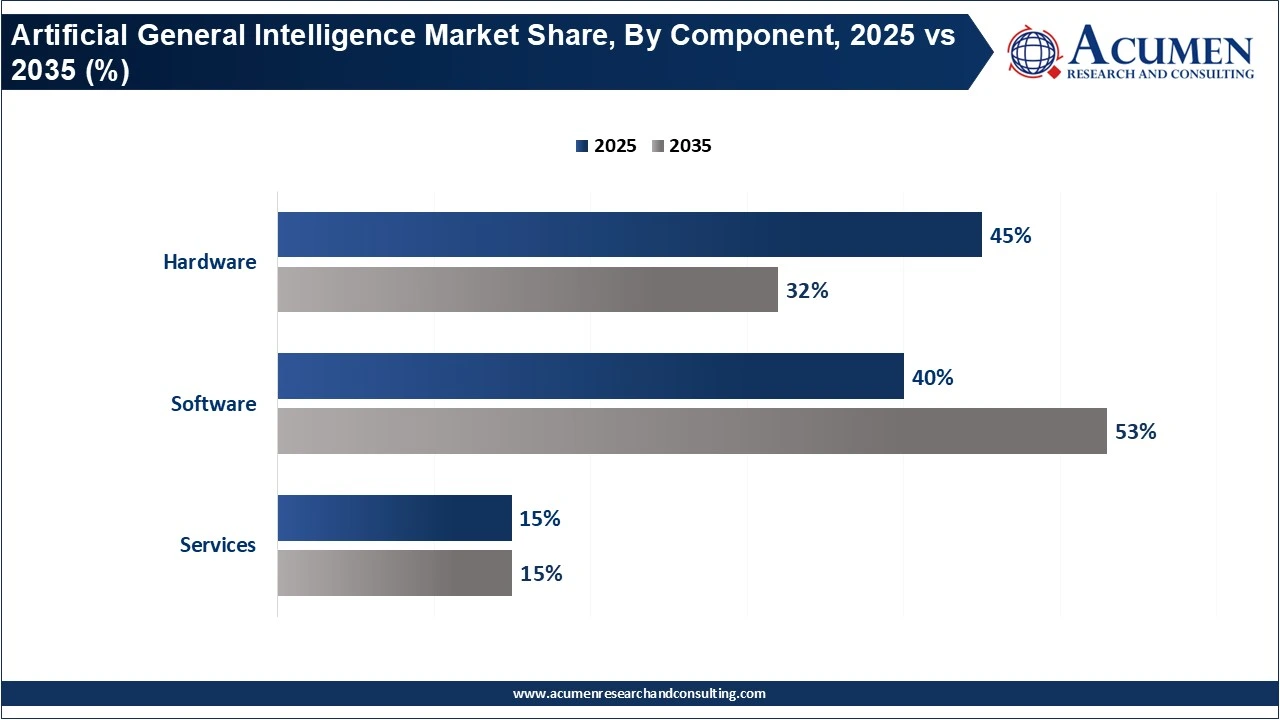
Software held 40% of market share in 2025 and is one of the quickest developing components in the AGI market. Although hardware enables the infrastructure to operate, software constitutes intelligence. Software is the model architecture, orchestration, reasoners, memories, agentic architectures and frameworks required. The need for scalable, customizable, adaptable AGI software frameworks is gaining momentum across all industries as enterprises grow increasingly towards leveraging the power of artificial general intelligence.
Growing commercialization of foundation models, enterprise copilots, multi agent systems and autonomous reasoners has contributed to accelerating software spending across all industries.
Technology Insights
The deep learning segment dominated the market share, with 28% in 2025. Deep learning is the base architecture of large language models, multimodal AI systems, image generation models, speech systems, and advance reasoning platforms. The deep neural networks in AGI system enables it to process a massive volume of data and to learn patterns. Furthermore, the performance of deep neural networks in AGI systems can be continuously enhanced to improve across the task.
The increasing size of foundation models and the trend of developing more capable multimodal intelligence systems, are driving the evolution of the deep learning in AGI development. Leading AGI companies are heavily investing in enhancing their existing model size, developing effective training approaches, and investing in innovative neural architectures that can boost reasoning capability in AGI systems. As the AGI systems become more adept in understanding the world, it will likely rely more heavily on deep learning to develop in the future.
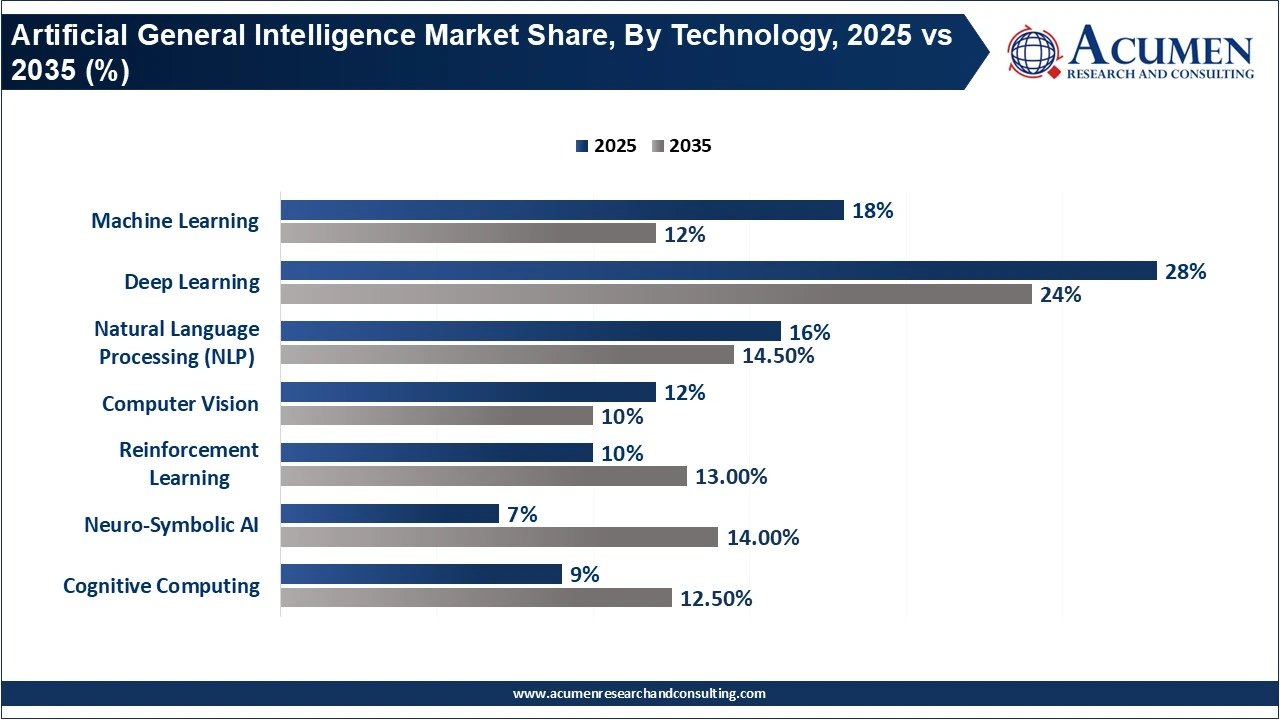
The neuro-symbolic AI segment is expected to witness the highest growth rate in terms of CAGR 44.7% during the forecast period on account of its ability to bridge neural learning with symbolic reasoning. Companies are increasingly interested in neuro-symbolic systems since, besides pattern recognition and information extraction, AGI systems need to be able to perform reasoning, plan and make decisions in a structured way, similar to human beings.
Deployment Mode Insights
The cloud-based segment led the market with a 58% share in 2025. AGI applications and tools demand huge computational power that is available in the cloud in a well-distributed, flexible, and scaled infrastructure. Cloud infrastructure also provides cost-effective access to high-performance computing without significant upfront investment. The increasing availability of highly capable AGI tools on cloud platforms from major cloud service providers like Microsoft Azure, AWS, and Google cloud is fueling the cloud deployment market.
These companies are continuously launching AI specific services that facilitate faster, scalable, and economical development of AGI models and applications, enhancing their usability. Global integration and real-time access to these powerful technologies are other major benefits provided by the cloud deployment model that make this sector one of the dominant sources of AGI market growth.
Artificial General Intelligence Market Share, By Deployment Mode, 2025 (%)
| Deployment Mode | Revenue Share, 2025 (%) |
|---|---|
| Cloud-Based | 58% |
| On-Premise | 27% |
| Hybrid | 15% |
On-premise deployment held a 27% market share in 2025, driven by large enterprises and government bodies that deal with sensitive and highly classified data. Certain industries such as defense, banking, healthcare, and critical infrastructure often favor on-premise deployment to maintain total security over their data and ensure governance and regulatory compliance. Increasingly, organizations are considering on-premise deployment of AGI as a secure alternative to the third-party cloud due to rising data privacy concerns, IP security issues, and government regulations. The large IT infrastructure already present within large organizations allows for smooth integration of the existing AGI application.
Autonomy Level Insights
Human-in-the-loop AGI was the leading segment in 2025 with a market share of 43% of overall revenue. In the human-in-the-loop AGI systems, human supervision is retained during AGI operations which is vital in minimizing risks, enhancing the quality of outputs and maintaining accountability. Organizations are preferring supervised AGI systems, as there is still challenge from technical and ethical perspective in fully autonomous systems.
This category has high relevance in highly sensitive industries like healthcare, law, financial services, and defense which need human verification in decision-making for important functions. This system assists the organizations in developing faith and confidence towards AGI systems gradually increasing the level of automation.
Artificial General Intelligence Market Share, By Autonomy Level, 2025 (%)
| Autonomy Level | Revenue Share, 2025 (%) |
|---|---|
| Human-in-the-loop AGI | 43% |
| Human-supervised AGI | 33% |
| Semi-autonomous AGI | 21% |
| Fully autonomous AGI | 3% |
In 2025, market share of human-supervised AGI in 2025 was 33%. Many organizations are inclined to use semi-independent systems which can perform tasks in an independent way with human intervention. These systems enable balancing efficiency and control and are useful for the tasks like customer support, business intelligence, content creation and operational automation. An increase in the adoption of enterprise AI copilots and digital agents is fueling this segment with enterprises using the supervised AGI to gain operational efficiencies while lowering operational risks.
Application Insights
Virtual assistants and digital agents held the biggest segment share in 2025, with 22% of the AGI market. This segment has boomed because of the dramatic rise of enterprise copilots, AI assistants, intelligent chatbots, and autonomous digital workers. Businesses of all kinds are now deploying AGI based digital agents in to processes, which can perform all tedious and time-consuming activities efficiently.
The adoption rate is growing drastically in the conversational AGI, enterprise knowledge assistant, and intelligent customer care system markets. AGI based digital agents act as the main entry points for the new era of commercial AGI, and it is especially important to sectors such as software development, HR, finance and customer care.
Artificial General Intelligence Market Share, By Application, 2025 (%)
| Application | Revenue Share, 2025 (%) |
|---|---|
| Autonomous Systems | 10% |
| Virtual Assistants & Digital Agents | 22% |
| Research & Knowledge Discovery | 15% |
| Decision Intelligence | 18% |
| Healthcare Diagnostics & Drug Discovery | 7% |
| Robotics & Automation | 9% |
| Cybersecurity & Threat Intelligence | 5% |
| Content Generation & Creativity | 12% |
| Others | 2% |
Decision intelligence generated 18% share in the AGI market in 2025. It is becoming an essential application for AGI systems. Enterprises are deploying AGI powered decision intelligence tools and platforms to facilitate strategic planning, forecasting, risk analysis and operational improvement and efficiency. These systems offer significant speed increases over conventional analytical tools to data ingestion and insights derivation, and the demand for them is becoming increasingly strong across all sectors as enterprises strive for data-driven competitive advantages, especially in sectors such as finance, supply chain management, healthcare and retail.
End User Insights
The Information Technology (IT) and telecommunication segment registered for 24% in 2025, the highest share. This sector is the earliest and fastest adopter of AGI technologies which are being integrated with software development, network optimization, cloud services, cybersecurity, and enterprise automation.
The technology companies are developing AGI-powered developer tools, digital assistants, code-generation systems and infrastructure automation platforms. The increasing demand for productivity, scalability and innovation makes this segment one of the fastest growing segment in the AGI market.
Artificial General Intelligence Market Share, By End User, 2025 (%)
| End User | Revenue Share, 2025 (%) |
|---|---|
| Information Technology & Telecommunications | 24% |
| Healthcare & Life Sciences | 12% |
| Banking, Financial Services & Insurance (BFSI) | 16% |
| Manufacturing | 11% |
| Retail & E-commerce | 8% |
| Government & Defense | 9% |
| Education | 4% |
| Media & Entertainment | 5% |
| Automotive & Transportation | 6% |
| Others | 14% |
Banking, Financial Services and Insurance (BFSI) sector held a market share of 16% in 2025 making it the second largest end-user segments. Financial institutions are adopting AGI technologies in fraud detection, algorithmic trading, customer analytics, credit scoring, and risk management. Increasing adoption of digital banking and growing trend in fintech innovations and real-time financial intelligence is driving the demand for AGI in the BFSI sector. Since financial services firms manage a large volume of transaction and behavioral data AGI technologies are an integral part of increasing efficiency, combating fraud and improving customer satisfaction.
Regional Insights
- The North America artificial general intelligence market size was valued at $1.99 billion in 2025 and is projected to exceed around $32.44 billion by 2035 growing at a CAGR of 31.9% from 2026 to 2035.
- The Europe artificial general intelligence market size was estimated at $1.28 billion in 2025 and is expected to surpass around $21.94 billion by 2035 growing at a CAGR of 32.7% from 2026 to 2035.
- The Asia-Pacific artificial general intelligence market size reached at $1.48 billion in 2025 and is anticipated to reach around $34.35 billion by 2035 growing at a CAGR of 37.2% from 2026 to 2035.
What Made North America Lead Artificial General Intelligence Market in 2025?
North America dominated the artificial general intelligence (AGI) market with 39% of the global share in 2025. Its leading position was maintained owing to the highly advanced AI ecosystem, strong deep-tech backbone, and largest concentration of world-class AI developers and cloud providers. The region still serves as a focal point for AGI innovation, driven by considerable investments in large-scale computing infrastructures, chip manufacturing, foundation models, and enterprise AI adoption.
The region boasts unparalleled spending on AI infrastructure. In 2025, North America's U.S.-based hyperscale cloud players jointly poured in over $250 billion on AI data center expansion, high-end chip development and cloud computing infrastructure. It also accounts for over 45% of global AI startup funding and a substantial share for AGI and generative AI related ventures, multi-agent systems and autonomous applications. More than 60% of US' Fortune 500 companies are currently adopting AI copilot/enterprise intelligence systems within their business operations, reinforcing the region's business lead.
Asia-Pacific Artificial General Intelligence Market Highlights:
The Asia-Pacific region is anticipated to achieve the highest growth rate with a CAGR of 37.2% until 2035 and is therefore considered the fastest-growing market for AGI. The acceleration is fueled by the robust national AI plans, increasing deployment of robots, enhancement of AI chip manufacturing and escalating adoption of smart automation in industries such as manufacturing, healthcare, finance, and city infrastructure. Key nations including China, Japan, South Korea, and India are heavily investing in AI and AGI research and industrialization.
As an example, China's AI industry is expected to reach more than $150 billion by 2030, whilst Japan and South Korea remain at the forefront of robotics density and smart manufacturing applications. Asia-Pacific is currently holding the majority (more than 55%) of global industrial robot installations, providing the region a solid groundwork for developing and implementing AI enabled robots and autonomous systems. It also serves as one of the fastest-expanding market for AI chips, edge computing hardware, and semiconductor fabrication facilities.
Recent News
- June 2026- WisdomTree launched the first ETF in Europe focused on the infrastructure enabling the development of artificial general intelligence (AGI), which refers to an AI that is able to outperform human intelligence in all cognitive functions. WisdomTree AI Infrastructure UCITS ETF (WAGI) has an initialTER of0.50% and is listed on the Deutsche Boerse, Borsa Italiana and SIX Swiss Exchange, with London Stock Exchange (LSE) listing imminent.
Major Players
- OpenAI
- Google DeepMind
- Anthropic
- Microsoft
- NVIDIA
- Meta Platforms
- Amazon Web Services
- IBM
- Tesla
- xAI
Segments Covered in the Report
By Component
- Hardware
- Software
- Services
By Technology
- Machine Learning
- Deep Learning
- Natural Language Processing (NLP)
- Computer Vision
- Reinforcement Learning
- Neuro-Symbolic AI
- Cognitive Computing
By Deployment Mode
- Cloud-Based
- On-Premise
- Hybrid
By Autonomy Level
- Human-in-the-loop AGI
- Human-supervised AGI
- Semi-autonomous AGI
- Fully Autonomous AGI
By Application
- Autonomous Systems
- Virtual Assistants & Digital Agents
- Research & Knowledge Discovery
- Decision Intelligence
- Healthcare Diagnostics & Drug Discovery
- Robotics & Automation
- Cybersecurity & Threat Intelligence
- Content Generation & Creativity
- Others
By End User
- Information Technology & Telecommunications
- Healthcare & Life Sciences
- Banking, Financial Services & Insurance (BFSI)
- Manufacturing
- Retail & E-commerce
- Government & Defense
- Education
- Media & Entertainment
- Automotive & Transportation
- Others
By Region
- North America
- Europe
- Asia-Pacific
- Latin America
- Middle East & Africa
Looking for discounts, bulk pricing, or custom solutions? Contact us today at sales@acumenresearchandconsulting.com
Frequently Asked Questions

Other ICT Reports
February 2024
December 2022
January 2023
January 2023