
Automated Cell Therapy Manufacturing Market Size, Share, Growth, Report 2026 To 2035
Automated Cell Therapy Manufacturing Market (By Component: Automated Platforms & Instruments, Consumables & Single-Use Kits, Software, Services; By Automation Type: End-to-End Integrated Platforms, Modular Unit-Operation Systems, Robotic Workcells & Automated Factories; By Workflow Step: Cell Collection Processing, Separation & Isolation, Activation, Genetic Modification & Transduction, Cell Expansion, Others; By Cell Therapy Type: CAR-T Cell Therapies, TCR-T & TIL Therapies, NK & CAR-NK Cell Therapies, Stem Cell Therapies, Others; By Therapy Model: Autologous, Allogeneic, By Scale of Operation, Preclinical & Process Development, Clinical, Commercial; By End User: Pharmaceutical & Biotechnology Companies, CDMOs, Academic Medical Centres & Hospitals, Research Institutes) - Global Industry Analysis, Size, Share, Analysis, Trends and Forecast 2026 - 2035
- Last Updated: 12 Nov 2026
- Report Code: ARC4006
- Category: Healthcare and Pharmaceuticals
Automated Cell Therapy Manufacturing Market Insight 2026 To 2035
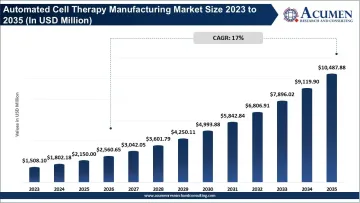
The global automated cell therapy manufacturing market size was valued at USD 2,150 million in 2025 and is expected to reach at USD 10,487.88 million by 2035; expanding at a CAGR of 17% during the forecast period from 2026 to 2035. Rising demand for scalable cell therapies, expanding clinical pipelines, commercialization of CAR-T treatments, labor-intensive manual workflows, pressure to improve batch consistency, and investment in biomanufacturing infrastructure are accelerating adoption of automated cell processing, closed systems, robotics, and integrated production platforms.
Automated Cell Therapy Manufacturing Market Size & Forecast
- Base Year Market Size (2025): $2,150 million
- Current Year Market Size (2026): $2,560.65 million
- Estimated Year Market Size (2035): $10,487.88 million
- Forecast Period CAGR (2026-2035): 17%
- Leading Region: North America (revenue share 46% in 2025)
Key Takeaways
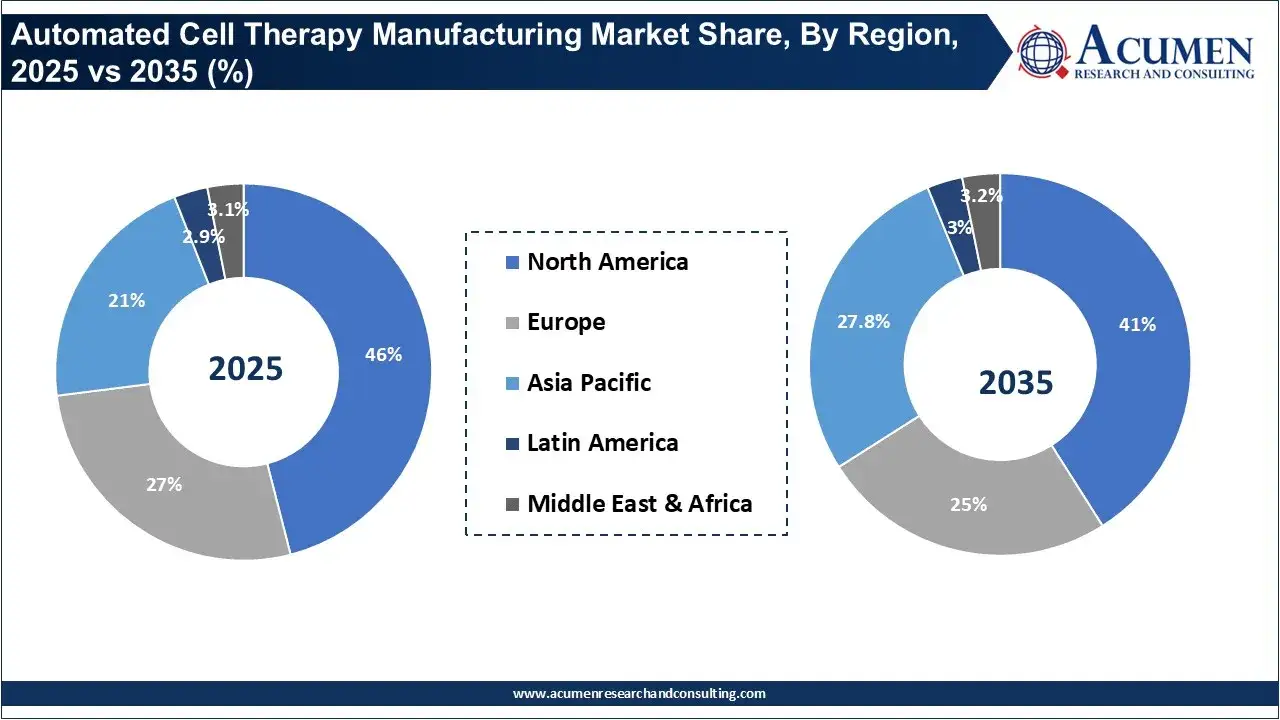
- By Region: North America dominated the regional segment with a 46% share in 2025, equivalent to USD 989.00 million. Its share is projected to reach 41.0% by 2035, supported by an established cell therapy ecosystem, strong biotechnology investment, advanced clinical research infrastructure, and early adoption of automated manufacturing technologies.
- By Component: Consumables & single-use kits dominated the component segment with a 42% share in 2025, valued at USD 903.00 million. Their demand is supported by recurring consumption across cell processing workflows, contamination-control requirements, and the growing adoption of closed, single-use manufacturing systems.
- By Automation Type: Modular unit-operation systems dominated the automation type segment with a 50.0% share in 2025, equivalent to USD 1,075.00 million. Their adoption is supported by flexible integration into existing manufacturing facilities, lower initial implementation complexity, and the ability to automate individual cell processing stages.
- By Workflow Step: Cell expansion dominated the workflow step segment with a 30% share in 2025, valued at USD 645.00 million. Its leading position reflects the importance of achieving consistent cell growth, therapeutic cell yields, and scalable production while maintaining product quality.
- By Cell Therapy Type: CAR-T cell therapies dominated the cell therapy type segment with a 52% share in 2025, equivalent to USD 1,118.00 million. Their dominance is supported by established clinical and commercial applications, growing demand for personalized cancer treatments, and continued investment in automated CAR-T manufacturing processes.
- By Therapy Model: Autologous therapies dominated the therapy model segment with a 72% share in 2025, valued at USD 1,548.00 million. Their leading position is driven by established patient-specific treatment approaches, particularly in CAR-T applications, and the need for controlled manufacturing processes that preserve individual patient cell identity and quality.
- By Scale of Operation: Clinical manufacturing dominated the scale of operation segment with a 50% share in 2025, equivalent to USD 1,075.00 million. Its position reflects the substantial number of cell therapy candidates progressing through clinical development and the need for reliable, compliant manufacturing capacity to support clinical trials.
- By End User: Pharmaceutical & biotechnology companies dominated the end-user segment with a 50% share in 2025, valued at USD 1,075.00 million. Their demand is supported by internal cell therapy development pipelines, investment in manufacturing capabilities, and the need for greater control over production processes, quality, and commercialization timelines.
Automated Cell Therapy Manufacturing Market Overview
The automated cell therapy manufacturing market is gaining importance as pharmaceutical and biotechnology companies increasingly adopt advanced manufacturing technologies to improve the scalability, consistency, and efficiency of cell-based therapies. Traditional cell therapy production involves complex, labor-intensive processes, including cell collection, isolation, activation, genetic modification, expansion, harvesting, and cryopreservation.
Automation technologies, including robotic cell handling systems, automated bioreactors, closed processing platforms, and integrated manufacturing software, are transforming these workflows by reducing manual intervention and supporting standardized production. Growing commercialization of CAR-T therapies, expansion of allogeneic cell therapy development, increasing investments in advanced biomanufacturing infrastructure, and demand for decentralized production models are creating new opportunities for automation technology providers.
Key Trends and Industry Developments
- Growing Adoption of Integrated Manufacturing Platforms: Cell therapy manufacturers are increasingly adopting integrated platforms that combine cell processing, expansion, harvesting, and quality control within standardized manufacturing workflows.
- Increasing Demand for Closed-System Manufacturing: Closed and functionally closed processing technologies are gaining adoption as manufacturers seek to minimize contamination risks, reduce manual handling, and improve aseptic processing efficiency.
- Expansion of Robotic Cell Processing: Robotics-based manufacturing platforms are emerging as an important solution for automating repetitive cell handling operations, improving process consistency, and supporting parallel production.
- Integration of Artificial Intelligence in Manufacturing: AI-enabled process monitoring, predictive analytics, and automated quality assessment are creating opportunities to improve manufacturing control and identify process deviations.
Future Investment and Capacity Expansion Opportunities
- Pharmaceutical companies are increasing investments in specialized cell therapy manufacturing facilities to support commercial production, improve manufacturing capacity, and accommodate growing demand for advanced therapies. Investments exceeding US$1 billion in individual manufacturing facilities highlight the scale of infrastructure development.
- Investments exceeding €140 million in specialized manufacturing and competence centers demonstrate opportunities for expanding the production capacity of quality-critical materials, consumables, and components required for cell and gene therapy manufacturing.
- Funding rounds exceeding US$250 million for automated cell therapy manufacturing companies demonstrate growing investor interest in integrated production platforms, robotic processing, and technologies designed to improve manufacturing scalability.
- Increasing demand for GMP-compliant production infrastructure is encouraging CDMOs to expand cleanroom capacity. Individual facility expansions involving 4 to 6 ISO 7 cleanroom suites represent a 50% increase in available manufacturing suites.
- Next-generation automated cell therapy platforms targeting up to 4-fold increases in production output within existing cleanroom space are creating investment opportunities in integrated processing equipment and manufacturing optimization technologies.
- Investments in manufacturing facilities exceeding 85,000 square feet demonstrate opportunities for developing specialized production environments with multiple qualified GMP manufacturing suites to support clinical and commercial cell therapy programs.
Regulatory and Quality Landscape
| Regulatory authority / framework | Regulatory requirement | Application to automated cell therapy manufacturing |
|---|---|---|
| U.S. FDA: 21 CFR Part 210 and 211 | Current Good Manufacturing Practice (CGMP) requirements | Establishes manufacturing controls, equipment suitability, documentation, quality systems, and production standards applicable to commercial manufacturing. |
| U.S. FDA: 21 CFR Part 1271 | Human Cells, Tissues, and Cellular and Tissue-Based Products (HCT/Ps) requirements | Addresses donor eligibility, establishment registration, tracking, and relevant manufacturing controls, depending on product classification and regulatory pathway. Covers general biological product requirements, testing, potency, safety, and applicable product specifications. |
| U.S. FDA: 21 CFR Parts 600 and 610 | Biological product standards | Covers general biological product requirements, testing, potency, safety, and applicable product specifications. |
| FDA: Potency Assurance Guidance (November 2026) | Science- and risk-based potency assurance | Recommends integrating potency controls into manufacturing design, material control, in-process testing, and lot-release assays. |
| FDA: CMC Flexibilities Guidance (May 2026) | Chemistry, Manufacturing, and Controls requirements | Provides guidance on appropriate CMC flexibilities during cell and gene therapy development and preparation for biologics license applications. |
Automated Cell Therapy Manufacturing Market Dynamics
Growth Drivers
- Increasing Demand for Cell and Gene Therapies: Rising development of CAR-T therapies, stem cell treatments, tumor-infiltrating lymphocyte therapies, and other advanced cellular treatments is driving demand for automated manufacturing systems. Pharmaceutical and biotechnology companies are increasingly adopting automation to improve production consistency, reduce manual handling, and support the growing clinical and commercial pipelines of cell-based therapeutics.
- Growing Need for Scalable and Reproducible Manufacturing: Increasing complexity of cell therapy production is creating demand for automated platforms that standardize cell isolation, activation, expansion, transduction, harvesting, and formulation processes. Automation helps reduce operator-dependent variability, improve batch reproducibility, and support the transition from small-scale clinical manufacturing to larger commercial production.
- Rising Labor Costs and Contamination-Control Requirements: Manual cell therapy manufacturing requires specialized personnel and extensive hands-on processing, increasing operational costs and contamination risks. Automated closed-system manufacturing platforms minimize human intervention, improve aseptic processing, and reduce the likelihood of cross-contamination, encouraging adoption among contract development and manufacturing organizations (CDMOs) and biopharmaceutical manufacturers.
Restraints
- High Capital Investment and Implementation Costs: Automated cell therapy manufacturing systems require substantial investments in specialized equipment, robotics, software, cleanroom infrastructure, and process integration. Smaller biotechnology companies and academic manufacturing facilities may face financial limitations when adopting advanced automation platforms, particularly during early-stage clinical development.
- Complexity of Integrating Automated Manufacturing Platforms: Cell therapy production involves multiple interconnected biological processes that vary across therapeutic modalities and manufacturing protocols. Integrating automated equipment with existing laboratory infrastructure, quality management systems, analytical instruments, and manufacturing execution systems can create technical challenges and increase implementation timelines.
- Limited Standardization Across Cell Therapy Manufacturing Processes: Differences in cell sources, therapeutic applications, manufacturing protocols, and product specifications make it difficult to develop universally compatible automation platforms. Equipment manufacturers must accommodate application-specific requirements, limiting interoperability and increasing customization, validation, and qualification costs.
Key Opportunities
- Expansion of Allogeneic Cell Therapy Manufacturing: Growing interest in allogeneic cell therapies is creating opportunities for automated manufacturing platforms capable of supporting larger production batches and standardized workflows. Unlike autologous therapies, which require individualized patient-specific manufacturing, allogeneic approaches can support the development of off-the-shelf products, increasing demand for scalable cell expansion, harvesting, formulation, and cryopreservation systems.
- Development of Fully Integrated Closed-System Manufacturing Platforms: Advances in robotics, artificial intelligence, process analytical technologies, and digital monitoring are creating opportunities for integrated manufacturing systems. Platforms combining cell isolation, processing, expansion, harvesting, and final formulation can reduce manual intervention, improve process control, and support consistent manufacturing outcomes across production facilities.
- Increasing Adoption by CDMOs and Decentralized Manufacturing Facilities: Growing outsourcing of cell therapy production is encouraging CDMOs to invest in automated manufacturing infrastructure. In parallel, decentralized manufacturing models create opportunities for compact, modular, and standardized automation systems that enable production closer to treatment centers while supporting quality assurance, chain of identity, and chain of custody requirements.
Challenges
- Maintaining Cell Viability and Therapeutic Potency During Automation: Cell therapy manufacturing involves sensitive biological materials that can respond differently to mechanical handling, temperature fluctuations, processing conditions, and extended manufacturing cycles. Automated systems must preserve cell viability, phenotype, functionality, and therapeutic potency throughout isolation, expansion, processing, and storage.
- Ensuring Regulatory Compliance and Process Validation: Automated manufacturing platforms must meet stringent requirements for sterility assurance, process consistency, electronic records, equipment qualification, and batch traceability. Manufacturers must validate automated workflows and demonstrate that system performance remains consistent across production batches, facilities, and therapeutic applications.
- Managing Data Integration and Manufacturing Traceability: Automated cell therapy production generates large volumes of process, quality, and patient-specific manufacturing data. Integrating equipment software, laboratory information management systems, manufacturing execution systems, and electronic batch records while maintaining data integrity, cybersecurity, and end-to-end traceability remains a significant operational challenge.
Automated Cell Therapy Manufacturing Market Segmentation Insights
Component Insights
Automated Platforms & Instruments: Automated platforms and instruments dominated the component segment with a 40.0% share in 2025, generating USD 860.00 million in revenue. Demand is supported by increasing adoption of automated cell processing equipment, integrated manufacturing platforms, robotic handling systems, and automated bioreactors.
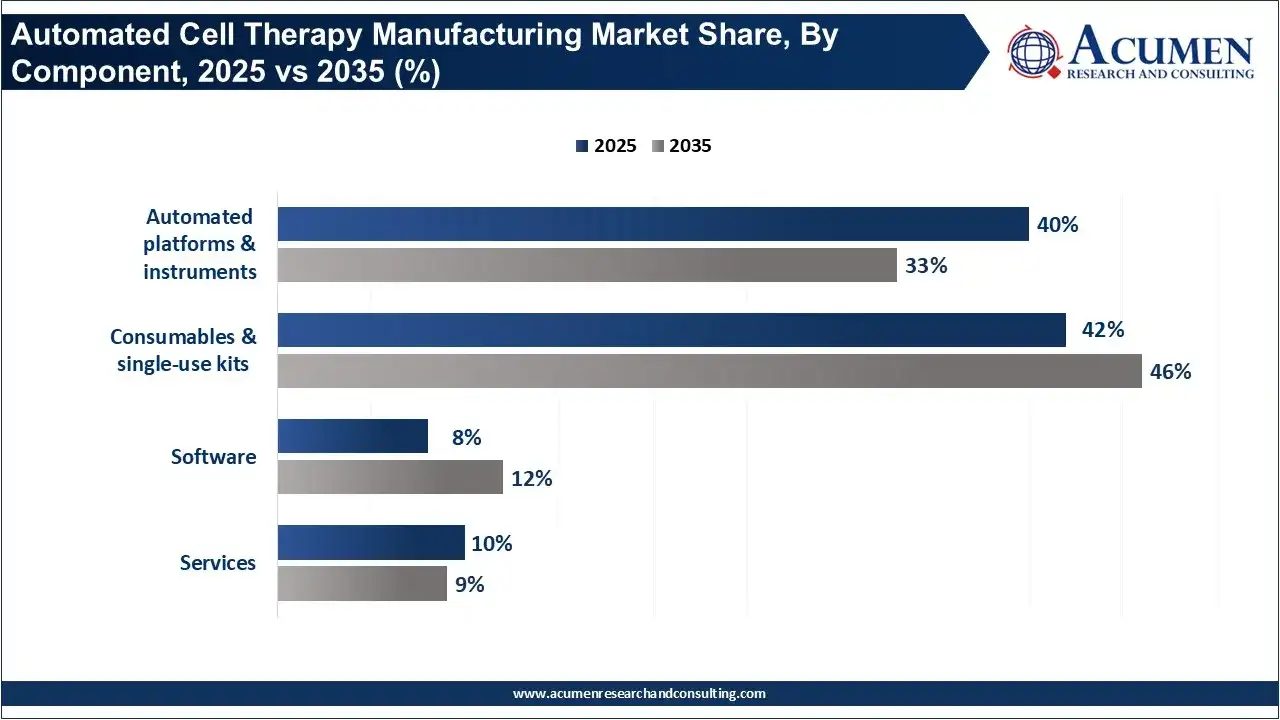
Consumables & Single-Use Kits: Consumables and single-use kits represented the largest component category with a 42.0% share in 2025, generating USD 903.00 million. Their demand is driven by recurring requirements for sterile tubing assemblies, processing kits, bags, filters, connectors, and single-use bioprocessing components.
Automation Type Insights
End-to-End Integrated Platforms: End-to-end integrated platforms accounted for a 42.0% share in 2025, generating USD 903.00 million. These systems combine multiple manufacturing operations, including cell processing, activation, expansion, harvesting, and quality monitoring, within coordinated production environments.
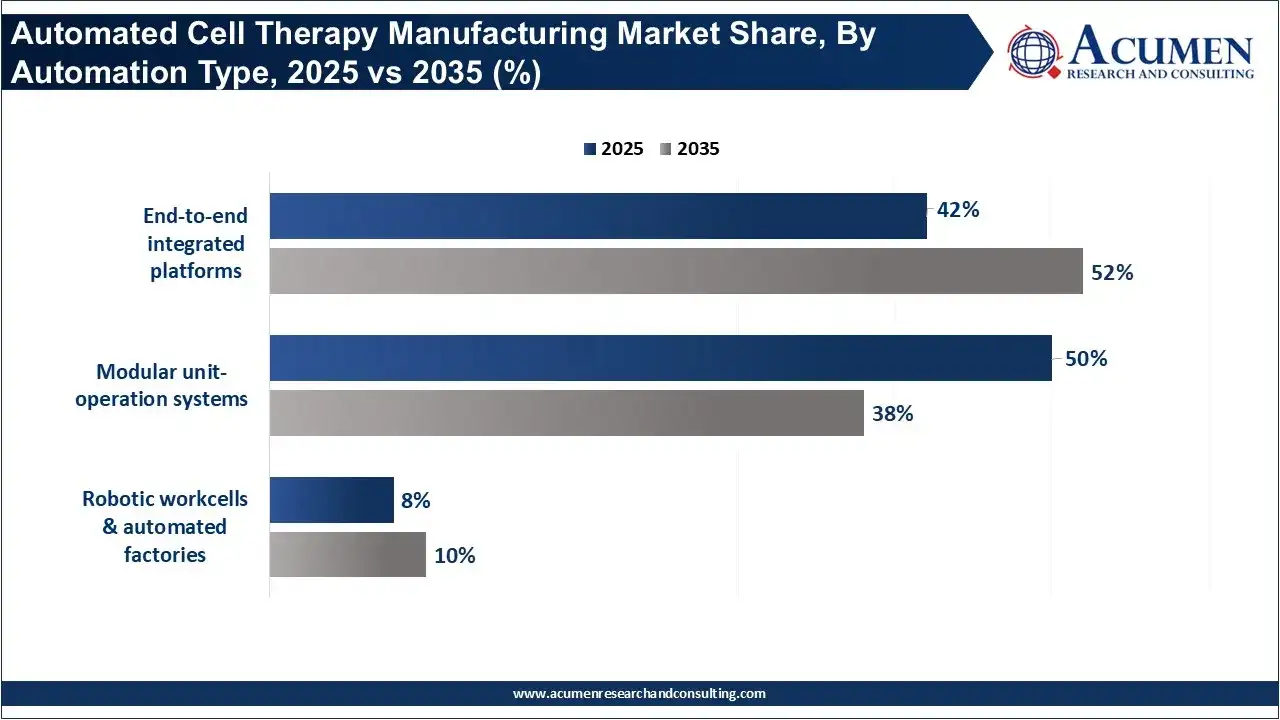
Modular Unit-Operation Systems: Modular unit-operation systems dominated the automation type segment with a 50.0% share in 2025, generating USD 1,075.00 million. Their adoption is supported by the flexibility to automate individual manufacturing stages without replacing entire production workflows.
Workflow Step Insights
Cell Collection Processing, Separation & Isolation: Cell collection processing, separation, and isolation accounted for a 20.0% share in 2025, generating USD 430.00 million. These processes represent important early-stage manufacturing activities, involving the preparation and separation of target cells from collected biological materials. Demand for automated separation systems, closed processing equipment, and standardized cell handling solutions is supporting segment growth. The segment is expected to reach USD 1,887.82 million by 2035, expanding at a CAGR of 15.7%.
Activation, Genetic Modification & Transduction: Activation, genetic modification, and transduction represented an 18.0% share in 2025, generating USD 387.00 million. These manufacturing stages are particularly important in engineered cell therapies, including CAR-T and TCR-T products, where cells undergo activation and genetic modification before expansion. Increasing adoption of automated process control, controlled reagent delivery, and closed-system technologies is supporting demand for specialized manufacturing solutions. The segment is projected to reach USD 1,887.82 million by 2035, registering a CAGR of 17%.
Cell Therapy Type Insights
CAR-T Cell Therapies: CAR-T cell therapies dominated the cell therapy type segment with a 52.0% share in 2025, generating USD 1,118.00 million. The segment's leadership is supported by the commercialization of CAR-T treatments, expanding clinical development programs, and the complexity of manufacturing genetically engineered T cells. Automation is increasingly important across cell isolation, activation, genetic modification, expansion, and harvesting to improve production consistency.
TCR-T & TIL Therapies: TCR-T and tumor-infiltrating lymphocyte therapies accounted for an 8.0% share in 2025, generating USD 172.00 million. Growing research into engineered T-cell receptors and tumor-derived immune cell therapies is creating demand for specialized manufacturing platforms. Automated cell selection, activation, expansion, and processing systems can support reproducibility across complex manufacturing workflows.
Therapy Model Insights
Autologous: Autologous cell therapies dominated the therapy model segment with a 72.0% share in 2025, generating USD 1,548.00 million. The segment's leadership is supported by the established commercialization of patient-specific cell therapies, particularly CAR-T treatments, which require specialized manufacturing workflows for individual patients. Automation plays an important role in standardizing cell collection, isolation, genetic modification, expansion, and formulation while minimizing manual handling and process variability.
Allogeneic: Allogeneic cell therapies accounted for a 28.0% share in 2025, generating USD 602.00 million. The segment is expected to experience the fastest growth within the therapy model category, supported by increasing development of donor-derived cell therapies and growing interest in scalable manufacturing approaches.
Scale of Operation Insights
Preclinical & Process Development: Preclinical and process development operations accounted for a 24.0% share in 2025, generating USD 516.00 million. Demand is supported by the growing number of cell therapy candidates requiring process optimization, analytical development, and manufacturing feasibility assessments before clinical advancement.
Clinical: Clinical manufacturing dominated the scale of operation segment with a 50.0% share in 2025, generating USD 1,075.00 million. Its leadership reflects the substantial manufacturing requirements associated with early- and late-stage clinical development programs. Cell therapy developers require controlled production environments, GMP-compliant equipment, validated processing workflows, and reliable quality testing to support clinical trials.
End User Insights
Pharmaceutical & Biotechnology Companies: Pharmaceutical and biotechnology companies dominated the end-user segment with a 50.0% share in 2025, generating USD 1,075.00 million. These companies represent major adopters of automated manufacturing technologies as they develop, commercialize, and scale cell therapy pipelines.
CDMOs: Contract development and manufacturing organizations accounted for a 30.0% share in 2025, generating USD 645.00 million. The segment is expected to experience significant growth as cell therapy developers increasingly outsource specialized manufacturing activities to reduce infrastructure investments and access established GMP capabilities. CDMOs are expanding automated production suites, integrated cell processing platforms, and analytical testing infrastructure to accommodate multiple clinical and commercial manufacturing programs.
Automated Cell Therapy Manufacturing Market Regional Insights
North America Automated Cell Therapy Manufacturing Market
North America dominated the automated cell therapy manufacturing market with a 46.0% share in 2025, generating USD 989.00 million in revenue. The region's leadership is supported by its established biotechnology ecosystem, increasing commercialization of cell therapies, advanced biopharmaceutical manufacturing infrastructure, and strong investments in automated production technologies. The presence of major pharmaceutical companies, specialized CDMOs, and cell therapy technology developers further supports regional demand.
Growing adoption of closed-system processing, integrated manufacturing platforms, and robotic automation is encouraging manufacturers to improve production consistency and commercial scalability. North America's market share is projected to moderate to 41.0% by 2035, while its revenue is expected to reach USD 4,300.03 million, expanding at a CAGR of 15.6% during 2026–2035.
- United States: Leads regional adoption through advanced cell therapy research, commercial manufacturing infrastructure, and investments in automated bioprocessing technologies.
- Canada: Supports market development through its growing cell therapy research ecosystem, biotechnology investments, and specialized advanced therapy manufacturing capabilities.
Asia-Pacific Automated Cell Therapy Manufacturing Market
Asia-Pacific is projected to be the fastest-growing regional market, registering a CAGR of 20.2% during 2026–2035. The regional market generated USD 451.50 million in 2025, representing a 21.0% share, and is expected to reach USD 2,915.63 million by 2035. Its market share is projected to increase to 27.8%, reflecting expanding biotechnology manufacturing capabilities, increasing clinical research activities, and investments in advanced therapy infrastructure.
China, Japan, South Korea, and India are strengthening their positions through cell therapy development, biopharmaceutical manufacturing investments, and growing demand for automated processing technologies.
Increasing adoption of closed manufacturing systems, automated cell expansion platforms, and integrated production solutions is expected to support regional growth. The expansion of CDMOs and the development of commercial-scale cell therapy facilities will create additional opportunities for automation suppliers.
- China: Benefits from expanding cell therapy development, biotechnology manufacturing investments, and increasing demand for commercial-scale automated production infrastructure.
- Japan: Supports regional growth through advanced regenerative medicine research, established biopharmaceutical capabilities, and investments in cell processing technologies.
Company Profiles
- Miltenyi Biotec (Germany): A leading cell and gene therapy technology provider, offering the CliniMACS Prodigy platform for integrated and automated cell processing, including cell separation, activation, cultivation, and harvesting.
- Provides cell therapy manufacturing technologies, including the Sefia Cytiva (United States): platform, supporting automated cell processing, washing, concentration, and formulation workflows.
- Lonza (Switzerland): A major contract development and manufacturing organization (CDMO) with extensive cell and gene therapy manufacturing capabilities and experience in advanced therapy production.
- Thermo Fisher Scientific (United States): Supplies bioprocessing equipment, cell culture technologies, single-use systems, and manufacturing solutions supporting scalable cell therapy production.
- Sartorius (Germany): Develops bioprocessing equipment, single-use technologies, cell culture systems, and process analytics for advanced therapy manufacturing.
- Terumo BCT (United States): Specializes in automated cell collection, separation, and processing technologies, supporting the manufacturing of cellular therapies.
- Cellares (United States): Develops integrated automated manufacturing platforms, including Cell Shuttle and Cell Q, designed to automate cell therapy production and quality control.
- Ori Biotech (United Kingdom): Develops the IRO automated manufacturing platform, combining hardware, consumables, software, and analytics for scalable cell therapy production.
- Cellular Origins (United Kingdom): Develops the Constellation robotic manufacturing platform, integrating automated material handling and cell processing technologies for large-scale cell therapy production.
- PBS Biotech (United States): Provides single-use bioreactor technologies and scalable cell culture systems supporting the expansion and manufacturing of cell-based therapies.
- Multiply Labs (United States): Develops robotic manufacturing systems designed to automate labor-intensive cell and gene therapy production processes and improve manufacturing scalability.
- Octane Medical Group (United States): Develops automated manufacturing technologies for personalized cell and gene therapies, including the Cocoon platform for integrated cell processing.
Segments Covered
By Component
- Automated Platforms & Instruments
- Consumables & Single-Use Kits
- Software (MES, Process Control, Data Analytics)
- Services (Installation, Validation, Maintenance)
By Automation Type
- End-to-End Integrated Platforms
- Modular Unit-Operation Systems
- Robotic Workcells & Automated Factories
By Workflow Step
- Cell Collection Processing, Separation & Isolation
- Activation, Genetic Modification & Transduction
- Cell Expansion
- Formulation, Fill-Finish & Cryopreservation
- Quality Control & Release Testing
- Others (Harvest, Sampling, Logistics)
By Cell Therapy Type
- CAR-T Cell Therapies
- TCR-T & TIL Therapies
- NK & CAR-NK Cell Therapies
- Stem Cell Therapies (HSC, MSC, iPSC-Derived)
- Others (Dendritic Cells, Tregs, Other Immune Cells)
By Therapy Model
- Autologous
- Allogeneic
- By Scale of Operation
- Preclinical & Process Development
- Clinical
- Commercial
By End User
- Pharmaceutical & Biotechnology Companies
- CDMOs
- Academic Medical Centres & Hospitals (Point-of-Care)
- Research Institutes
By Region
- North America
- Europe
- Asia-Pacific
- Latin America
- Middle East & Africa
Looking for discounts, bulk pricing, or custom solutions? Contact us today at sales@acumenresearchandconsulting.com
Frequently Asked Questions

Related Market Research Reports
May 2023
October 2023
September 2022
April 2024
June 2024
September 2023
May 2023
May 2023