
Automated EV Battery Swapping Market Size, Share, Trends, Report 2026 To 2035
Automated EV Battery Swapping Market (By Service Type: Pay-Per-Swap, Subscription-Based, Battery Leasing/Battery-as-a-Service, Hybrid / Bundled Models; By Vehicle Type: Two-Wheelers, Three-Wheelers, Passenger Cars, Light Commercial Vehicles, Medium & Heavy Commercial Vehicles, Buses; By Automation Level: Fully Automated Battery Swapping, Semi-Automated Battery Swapping; By Network Model: Open/Public Network, Closed/Fleet-Dedicated Network, Semi-Open Network) - Global Industry Analysis, Size, Share, Regional Analysis, Trends and Forecast 2026 - 2035
- Last Updated: 22 Sep 2026
- Report Code: ARC3984
- Category: Automotive And Transportation
Automated EV Battery Swapping Market Size and Forecast Report 2026 To 2035
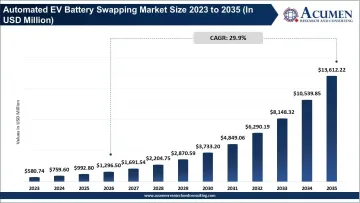
The global automated EV battery swapping market size was valued at USD 992.80 million in 2025 and is expected to reach at USD 13,612.22 million by 2035; while growing at a CAGR of 29.9% during the forecast period of 2026-2035. The infrastructure landscape is increasingly shifting toward shared and standardized networks, creating a strong growth opportunity for the automated EV battery swapping market. CATL and Sinopec announced plans in April 2025 to build at least 500 battery-swapping stations during 2025, with a long-term target of 10,000 stations.
Key Highlights
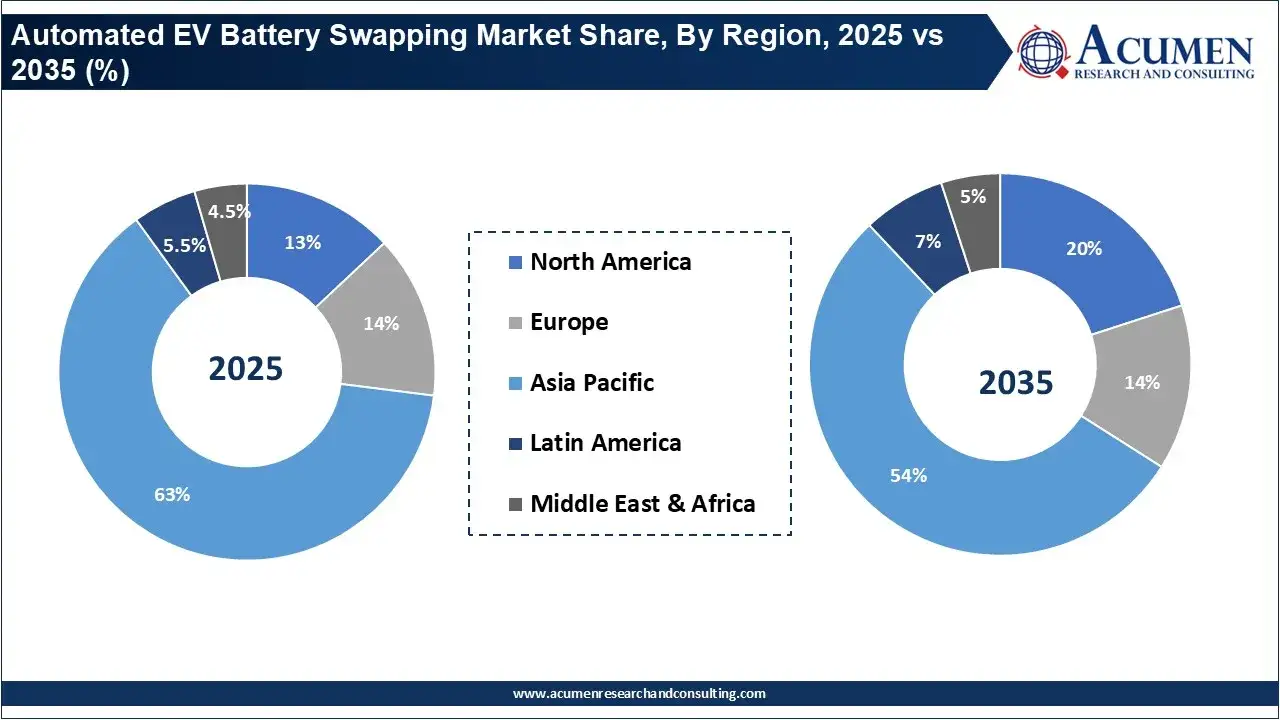
- By region, Asia Pacific dominated the automated EV battery swapping market in 2025 with a 63% share, supported by China's large-scale swapping ecosystem, strong EV and battery manufacturing base, and expanding battery-as-a-service models across Asia.
- By region, North America is expected to record the fastest growth through 2035 at a 36.2% CAGR, with its share projected to increase from 13% in 2025 to 20% by 2035 as automated swapping gains traction across passenger and commercial EV applications.
- By service type, subscription-based battery swapping dominated the automated EV battery swapping market in 2025, accounting for 42% share, supported by recurring usage patterns and bundled services such as battery access, charging, software, maintenance, and battery-health monitoring.
- By service type, pay-per-swap represented the second-largest segment in 2025 with a 25% market share, driven by its flexibility for occasional users, commercial vehicles, and markets where swapping infrastructure is still developing.
- By vehicle type, passenger cars dominated the automated EV battery swapping market in 2025 with a 48% share, supported by growing demand for faster energy replenishment and fully automated swapping systems that minimize driver intervention.
- By vehicle type, medium and heavy commercial vehicles held the second-largest share at 17% in 2025, as fleet operators increasingly value reduced vehicle downtime, higher asset utilization, and dedicated swapping infrastructure across logistics and freight operations.
- By automation level, fully automated battery swapping dominated the market in 2025 with a 65% share, driven by increasing integration of automated vehicle positioning, battery identification, extraction, replacement, reconnection, and battery-health validation.
- By automation level, semi-automated swapping accounted for 35% of the market in 2025, supported by lower infrastructure complexity and suitability for fleet depots and early-stage markets where utilization may not yet justify fully autonomous systems.
- By network model, closed/fleet-dedicated networks dominated the market in 2025 with a 45% share, reflecting the economic advantage of predictable vehicle routes, centralized battery inventories, and controlled swapping demand.
- By network model, open/public networks captured 40% of the market in 2025, supported by their ability to serve multiple compatible EV users and improve station utilization as battery standardization and interoperability advance.
Market Overview: Technology, Infrastructure and Business Model Evolution
The automated EV battery swapping market is expanding from a segment focusing solely on energy-replacement services to a total infrastructure environment which involves robotic battery swap stations, Battery-as-a-Service (BaaS), fleet operation, battery life cycle management and grid-interactive energy services. The greatest support for the commercial scale-up can be found in China.
- “By February 2026, NIO achieved its 100 million battery swap, average swapping takes 3 minutes on average through its 335 PSS across China. The company reported that its cumulative swaps had delivered 5.28 billion kWh of energy and saved users 83.41 million hours compared with conventional charging. By early 2026, NIO had deployed 3,790 Power Swap Stations worldwide, including 1,020 stations along major Chinese highways, and planned another 1,000 stations during 2026.”
Investment and Funding Landscape
- NIO has invested RMB 18 billion in charging and battery-swapping infrastructure, establishing 8,541 combined charging and Power Swap Stations in China and completing more than 96 million battery swaps by early January 2026. The company also targets more than 10,000 charging stations and 10,000 battery-swapping stations by 2030, demonstrating the capital intensity and long-term infrastructure commitment required to scale the sector.
- CATL and NIO announced capital cooperation of up to RMB 2.5 billion, equivalent to approximately $345.6 million, alongside their March 2025 battery-swapping partnership. The cooperation is intended to support network development, technical standards and greater battery compatibility across vehicle platforms.
- CATL and Sinopec committed to at least 500 battery-swapping stations in 2025, with a long-term target of 10,000 stations, creating one of the largest announced infrastructure-investment programs in the sector.
- CATL's Choco-Swap ecosystem had 1,470 stations across 99 cities by 2026, while its next phase targets 4,000 integrated charge-and-swap stations by year-end 2026. The company and its automotive partners are targeting more than 100,000 shared energy-replenishment facilities by 2028, indicating a substantial shift toward network-scale infrastructure investment.
- Battery Smart raised approximately ₹124 crore ($13 million) in debt financing in July 2026 from responsAbility Investments AG to expand its battery-swapping network in India. The financing is being directed toward scaling its BaaS model for electric two- and three-wheelers.
- Ample previously raised $160 million in Series C funding, demonstrating that investment interest extends beyond China into modular robotic swapping technology in North America.
Market Dynamics
What Advanced Technologies Shape the Market’s Growth?
Advanced technologies are evolving automated battery swapping into a more complex integrated platform for robotics, artificial intelligence, battery intelligence, and energy management. Robotic swapping incorporates automated vehicle docking, removal, and insertion in around 3 minutes (based on a platform such as NIO's), while artificial intelligence can optimize battery placement according to current demand based on the battery state of health, chemistry, temperature and charge level, maximizing inventories and stock-out reduction.
The merging of high power charging, battery swapping, and energy storage in one platform also allow operators to optimize electricity use depending on the condition of the power grid and user demand, and has begun to develop toward a grid-interactive swapping service. NIO's network has already contributed to over 740 million kWh of electricity load shifting and proves the potential for switched out batteries acting as responsive grid assets.
What Challenges the Automated EV Battery Swapping Market’s Expansion?
Standardization proves to be the trickiest hurdle: automated swapping relies on a perfect fit between the car mechanical structure, the battery size, electrical connection, the communications protocol, and the battery management algorithm. The emphasis by CATL and NIO on standardization and open networks, highlights just how critical interoperability has shifted beyond the technical into the realm of strategy.
Another constraint of the EV-battery swap solution has been high capital outlay, since, in addition to a battery-swapping facility, operators need to acquire battery stock, charge devices, grid infrastructure as well as land and software. Consequently, usage plays a major role: a low-volume service point may involve considerable idle battery stock capital cost, in contrast to a high-duty cycle in a commercial vehicle fleet in which fixed and inventory cost are diluted among a greater number of battery changes.
Where Are the Biggest Investment Opportunities in Automated EV Battery Swapping?
The strongest investment opportunities in the automated EV battery swapping market are expected to emerge across the broader ecosystem rather than being limited to individual swapping stations. Battery-as-a-Service (BaaS) platforms offer recurring revenue through subscriptions, leasing, and per-swap payments while separating battery ownership from vehicle ownership, with India's Battery Smart securing ₹124 crore in financing in 2026, highlighting growing investor interest in the model.
Commercial fleet swapping represents another attractive opportunity, as delivery fleets, electric three-wheelers, taxis, and other high-utilization vehicles can generate frequent battery exchanges, supporting higher station utilization and potentially faster investment payback. Meanwhile, the shift toward shared swapping networks is creating opportunities for infrastructure that can serve multiple OEMs, supported by CATL and NIO's efforts toward shared standards and network resources.
Government Initiatives & Funding
| Country | Government initiative / policy | Funding / numerical support |
|---|---|---|
| China | Provincial EV charging and battery-swapping infrastructure programs | Pilot funding allocated for EV charging and battery-swapping facilities |
| India | PM E-DRIVE Scheme | ₹10,900 crore total outlay; ₹2,000 crore for public EV charging infrastructure |
| India | TDB-DST Automated Battery Swapping Project | Government financial assistance; amount not disclosed |
| Taiwan | Government-supported battery-swapping standardization and infrastructure | NT$200,000 construction subsidy for Gogoro; 300 GoStations fully funded/subsidized by CPC |
| Japan | Government-backed EV charging and battery-swapping infrastructure development | Public support through national EV infrastructure and demonstration programs |
| Indonesia | National EV ecosystem and battery-swapping infrastructure initiatives | Government support through EV infrastructure and domestic battery-industry programs |
Segmental Insights
Service Type Insights
In 2025, subscription-based battery swapping services captured 42% of the market share. These subscription models will continue to be the most favored service model even in the year 2035. The subscription dominance shows how recurrent the battery-swapping service tends to be.
Compared to regular charging services in the EVs, where you pay based on what is consumed (electricity). Swapping can cover service bundled like charging, station, software, repairs and battery health status check and others service together.
The economics of subscriptions in battery swapping makes even more sense in high mileage use. It shows, how your overall cost per ride in battery swapping decreases as you increase the number of rides due to decreased time and increased number of rides.
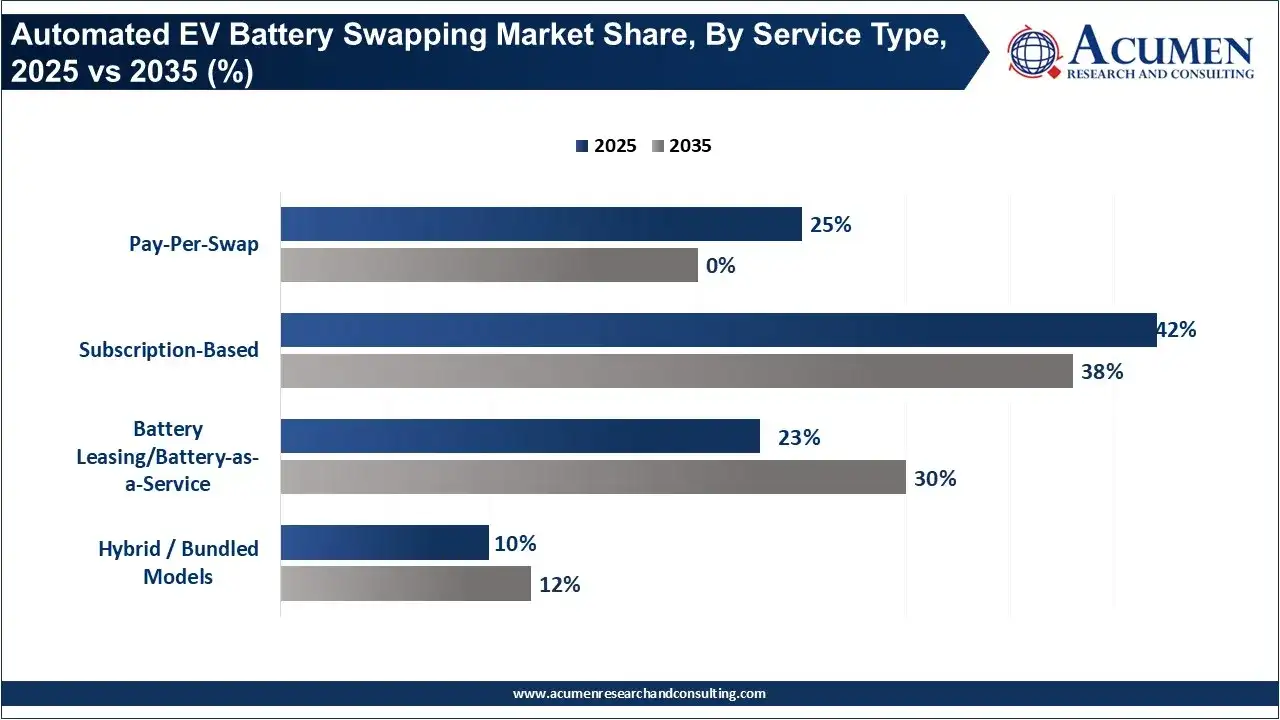
Pay-per-swap accounted for 25% of the market in 2025 and is therefore the second-largest service type. This model has an advantage in markets where battery swapping infrastructure is still developing because users do not need to commit to a recurring subscription before they have sufficient access to stations.
Pay-per-use can also support occasional users, tourists, commercial vehicles operating across different regions, and customers who want flexibility rather than a long-term service commitment. However, the model can generate less predictable recurring revenue for infrastructure operators compared with subscription services.
Vehicle Type Insights
In 2025, passenger cars accounted for a majority 48% of the overall automated EV battery swapping market. Automated battery swapping system can efficiently serve passengers, who place great importance on the decreased charging time.
Compared with refilling gasoline, automated battery swapping system requires merely a place for putting the vehicles and can greatly simplify the process; it enables drivers to drive into the station, fix position of the vehicles, trigger the service and then drive off, without taking on a heavy battery personally.
- Commercial uptake example from China-NIO: Power Swap Station automatically detects, accesses, and replaces the vehicle's battery in place upon a vehicle entry, it can conduct the fully-automated swap and supports diversified models; currently it has upgraded up to forth generation with each station capable of up to 480 swaps each day.
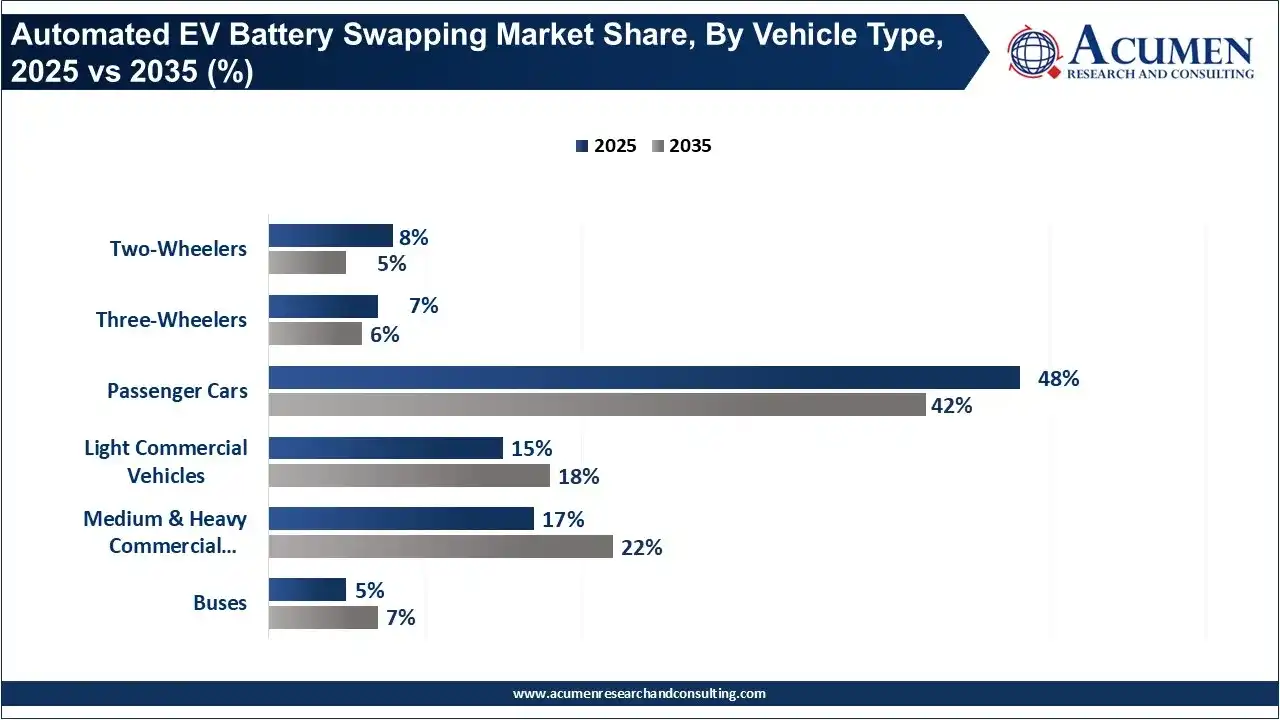
Medium and heavy commercial vehicles accounted for 17% of the market in 2025, making them the second-largest category. These vehicles have an important structural advantage for battery swapping because downtime directly affects fleet revenue and asset utilization. A truck that remains connected to a charger for an extended period is unavailable for transportation activities, whereas swapping can potentially return it to service much faster.
Commercial fleets also operate along predictable routes and schedules, making dedicated swapping infrastructure easier to justify economically. Fleet operators can establish stations at logistics hubs, distribution centers, industrial parks, ports, mining locations, and major freight corridors.
- The commercial-vehicle opportunity is already visible in China. Research on battery-swappable vehicles in China shows that logistics and specialized commercial vehicles form an important part of the commercial swapping ecosystem.
Automation Level Insights
By 2025, the proportion of fully automated swapping captured 65% of the total market compared with a 35% share for semi-automated swapping. The increased proportion have been achieved due to the general industrial trend toward reduced human intervention.
As an industry, fully automated swapping provides potential for integration with: vehicles and location in terms of positioning, identification of batteries; the locking and unlocking systems; extraction; replacement; electrical reconnection and validation of battery health.
This system has the potential to maintain a more robust outcome while increasing the number of battery changes the station could facilitate. This will have specific benefits particularly in high utilization passenger as well as commercial service.
Automated systems are significant when considering vehicle batteries are a significant mass element; additional demands will be placed on having adequately trained people and greater operation/safety complexity within manually changing.
Automated EV Battery Swapping Market Share, By Automation Level, 2025 (%)
| Automation Level | Revenue Share, 2025 (%) |
|---|---|
| Fully Automated Battery Swapping | 65% |
| Semi-Automated Battery Swapping | 35% |
Semi-automated battery swapping represented 35% of the market in 2025. This model can remain relevant in early-stage markets because it provides some of the speed and standardization benefits of swapping without requiring the full capital investment and technological complexity associated with fully autonomous infrastructure.
Semi-automated systems may be particularly useful for fleet depots, smaller swapping facilities, and markets where labor costs remain comparatively low or infrastructure utilization is not yet sufficient to justify highly sophisticated automated stations.
Network Model Insights
In 2025, closed/fleet-dedicated networks dominated the automated EV battery swapping market, holding a 45% market share. The high share for fleet-dedicated networks demonstrates the economic feasibility of building battery swapping stations. Logistics companies are rather investing in swapping equipment at their central distribution facility, manage a consistent pool of charged batteries for its vehicles, and schedule battery recharging and replacement, unlike the unpredictability of public traffic.
Automated EV Battery Swapping Market Share, By Network Model, 2025 (%)
| Network Model | Revenue Share, 2025 (%) |
|---|---|
| Open/Public Network | 40% |
| Closed/Fleet-Dedicated Network | 45% |
| Semi-Open Network | 15% |
Open/public networks accounted for 40% of the market in 2025, only five percentage points behind closed/fleet-dedicated networks. Public networks are important because they allow a larger number of compatible EV users to access swapping infrastructure and can increase station utilization across different vehicle owners.
The success of public networks depends heavily on interoperability. If every vehicle manufacturer uses a different battery design, connector, mechanical interface, and software architecture, a public station may serve only a limited number of vehicles. Standardized battery formats can therefore significantly increase the commercial attractiveness of open networks.
Automated EV Battery Swapping Market Regional Insights
Asia-Pacific Dominated the Automated EV Battery Swapping Market in 2025
Asia Pacific dominated the automated EV battery swapping market in 2025, claiming a 63% share of the worldwide market, far outweighing Europe at 14% and North America at 13%. According to the experts, the regional market leadership appears tied to the cluster of EV manufacturing, battery production, swap infrastructure, and EV deployment taking hold in places like China, Taiwan, India and other emerging Asian markets, the Asia-Pacific region is anticipated to retain its position as the largest regional market through 2035.
A critical part of China's role in the market is that battery swapping is no longer limited to pilots and has evolved into full commercial operations. While passenger vehicles have seen the largest usage of automated swap solutions, commercial fleets, and specialty electric vehicles further define the target market for this area.
- NIO reports, in its fleet status by the end of 2025, 3,737 Power Swap Stations worldwide and more than 96 million battery swaps performed overall. Its newest generation stations utilize LiDAR, and NVIDIA computing technologies to automate the swap process thus giving a measure of the volume this could achieve in a mature ecosystem.
The region also benefited from the advent of battery-as-a-service business models, and battery platform standards. NIO's BaaS model decouples ownership of the battery from vehicle ownership, allowing a customer to subscribe to usage of a battery as an instead of an outright purchase.
Similar to NIO, Gogoro has also created a battery subscription based model on its swapping ecosystem, centered on its electrical two-wheeler lineup. These examples of the battery swapping network not only show station deployment, but integrated, holistic systems that include vehicles, batteries, power management, and software as well as ongoing service provision.
North America is Expected to Grow at the Fastest Rate Through 2035
North America will be the most rapid growth market, growing at a CAGR of 36.2% over 2026-2035. Its market size is expected to grow from 13% of the global market in 2025 to 20% by 2035 and this region will become an increasingly important market.
The growth drivers that are expected to power the market size are high utilization EVs where idle time has an impact on economics of the operation. Fleet operators, delivery companies, mobility services providers and any commercial EV user would be highly inclined to adopt the benefits of battery swapping since it significantly cuts short an idle time between charging stations and makes the EV back to operation swiftly without a long hour of charging.
The North America market is a crucial zone for swapping services provider to gain knowledge of the entire network setup tailored for respective fleet operations prior to build the fully publicly accessible swap infrastructure. Swapping infrastructure can be managed as a wholly contained facility with control on the availability of batteries and vehicle types with favorable on the charging schedules/ utilization and operation hours which make it significant in both the commercial and fleet segment.
Automated Battery Swapping Regulatory Landscape
| Country/Region | Regulatory / Policy Framework | Key Regulatory Focus |
|---|---|---|
| China | National and provincial EV charging and battery-swapping policies | Infrastructure deployment, battery standardization, interoperability, safety and grid integration |
| India | Battery Swapping and Charging Station Guidelines, 2025 | Station standards, safety, interoperability, infrastructure support and upstream electrical infrastructure |
| Taiwan | Government-backed battery-swapping infrastructure programs | Battery specifications, interoperability, station deployment and localization |
| European Union | EU alternative-fuels and vehicle safety framework | Charging infrastructure, electrical safety, battery sustainability, recycling and vehicle type approval |
Top Companies
Recent News: Product Launches, Partnerships & Acquisitions
- In March 2025, CATL and NIO announced a strategic partnership to accelerate battery-swapping infrastructure and establish greater compatibility across EV models. The companies also agreed to pursue battery-standard alignment and broader network development, strengthening the industry's shift from proprietary swapping systems toward more interoperable infrastructure.
- In February 2026, NIO completed its 100 millionth battery swap, marking one of the largest operational milestones for automated EV battery swapping globally. NIO reported 3,790 Power Swap Stations worldwide and plans to add another 1,000 stations during 2026, demonstrating the increasing scale of automated swapping as an alternative to conventional charging.
Segments Covered
By Service Type
- Pay-Per-Swap
- Subscription-Based
- Battery Leasing/Battery-as-a-Service
- Hybrid / Bundled Models
By Vehicle Type
- Two-Wheelers
- Three-Wheelers
- Passenger Cars
- Light Commercial Vehicles
- Medium & Heavy Commercial Vehicles
- Buses
By Automation Level
- Fully Automated Battery Swapping
- Semi-Automated Battery Swapping
By Network Model
- Open/Public Network
- Closed/Fleet-Dedicated Network
- Semi-Open Network
By Region
- North America
- Europe
- Asia-Pacific
- Latin America
- Middle East & Africa
Looking for discounts, bulk pricing, or custom solutions? Contact us today at sales@acumenresearchandconsulting.com
Frequently Asked Questions

Other Automotive And Transportation Reports
September 2020
April 2024
October 2024
August 2024