
Autonomous Vehicle Damage Detection Market Size, Share, Trends, Report 2026 To 2035
Autonomous Vehicle Damage Detection Market (By Offering: Software, Hardware, Service; By Technology: Computer Vision, LiDAR-based, Radar-based, Ultrasonic, Multimodal, Others; By Deployment Mode: Cloud, On-premises, Hybrid; By Application: Insurance claims & underwriting, Fleet & mobility operations, Vehicle inspection & condition assessment, Collision repair & repair estimation, Rental, leasing & remarketing, Accident, Other; By Vehicle Type: Passenger vehicles, Commercial vehicles; By End User: Insurance companies, Automotive OEMs, Fleet operators, Rental & leasing companies, Others) - Global Industry Analysis, Size, Share, Growth, Regional Analysis, Trends and Forecast 2026 - 2035
- Last Updated: 19 Aug 2026
- Report Code: ARC3965
- Category: Automotive And Transportation
Autonomous Vehicle Damage Detection Market Size and Forecast Report 2026 To 2035
The global autonomous vehicle damage detection market is valued at USD 2,211.52 Million in 2025 and is projected to reach USD 13,470.41 Million by 2035, expanding at a compound annual growth rate (CAGR) of 19.8% during the forecast period from 2026 to 2035.
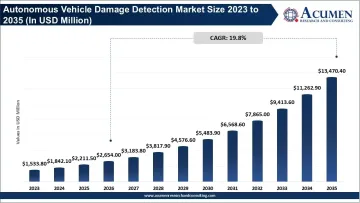
Report Highlights
- By region, North America dominated the market with 38% share in 2025, supported by its advanced automotive ecosystem, established insurance industry, high AI adoption, and strong demand for automated claims and inspection solutions.
- By region, Asia Pacific is emerging as the fastest-growing regional market, with a projected CAGR of 23.1%, driven by expanding automotive production, growing digitalization, increasing insurance penetration, and rising adoption of AI-powered vehicle inspection technologies.
- By offering, software / AI platforms dominated the market with 55% share in 2025, reflecting their central role in AI-powered image analysis, damage classification, severity assessment, and automated inspection workflows.
- By offering, hardware / inspection equipment held the second-largest share of 28% in 2025, supported by increasing deployment of high-resolution cameras, LiDAR systems, and sensor-based inspection infrastructure.
- By technology, computer vision / image-based AI led the market with 58% share in 2025, driven by its ability to detect visible vehicle damage quickly and integrate easily with existing inspection and claims workflows.
- By technology, multimodal / sensor fusion accounted for the second-largest share of 20% in 2025, supported by the integration of cameras, LiDAR, radar, ultrasonic sensors, and vehicle data for more comprehensive damage assessment.
- By deployment mode, cloud deployment dominated with 42% share in 2025, owing to its scalability, centralized data processing, real-time analytics, and suitability for multi-location inspection networks.
- By deployment mode, hybrid deployment held the second-largest share of 40% in 2025, reflecting demand for solutions that combine cloud scalability with localized data processing and greater control over sensitive inspection data.
- By deployment mode, on-premises deployment accounted for 18% share in 2025, supported by growing requirements for data security, regulatory compliance, customization, and low-latency processing.
- By application, insurance claims & underwriting dominated with 30% share in 2025, as insurers increasingly use AI-powered damage assessment to accelerate claims processing, improve estimation accuracy, and reduce manual inspection requirements.
- By application, fleet & mobility operations held a 25% share in 2025, driven by the need for standardized and high-volume vehicle inspections across fleet, rental, logistics, and shared-mobility operations.
- By vehicle type, passenger vehicles dominated with 62% share in 2025, supported by their large global vehicle population and frequent use in insurance assessments, sales, rentals, servicing, and post-accident inspections.
- By vehicle type, commercial vehicles held the second-largest share of 38% in 2025, driven by increasing adoption among logistics, delivery, rental, and fleet operators seeking faster and standardized inspection processes.
- By end user, insurance companies led the market with 31% share in 2025, reflecting strong demand for faster claims settlement, consistent damage assessment, fraud reduction, and lower inspection costs.
- By end user, automotive OEMs represented the fastest-growing segment, accounting for 25% share in 2025, as manufacturers increasingly deploy automated inspection technologies across production, quality control, pre-delivery, and after-sales processes.
How Is AI Transforming Vehicle Damage Detection and Inspection?
The autonomous vehicle damage detection market is shifting towards greater digitalization of vehicle inspection and claims management workflow across the automotive, insurance, and mobility sectors. Convectional manual inspection methods are increasingly being replaced by AI-driven computer vision and deep learning systems that have capable of detecting, classifying, and assessing vehicle damage with high accuracy under real-world conditions. These autonomous systems significantly reduce inspection like, eliminated subjectively, and improve consistency in damage evaluation.
Latest Trends
- The integration of damage detection algorithms with cloud platforms, edge devices, and connected vehicle ecosystems is enabling real-time analysis and seamless data sharing, making automated inspections more efficient and scalable.
- Another significant growth factor is strongly supported by rising demand from insurance providers, fleet operators, and mobility service companies seeking to optimize operational efficiency and reduce costs. Insurance companies are adopting autonomous damage detection system to increase claims settlement, minimize fraud, and support remote and contactless inspections are being implemented to meet customers increasing expectation for faster and more transparent service.
- At the same time, the expansion of rental, leasing, and commercial fleet operations is increasing the need for frequent, standardized inspection to reduce vehicle downtime and protect each assets value. Continuous advancements in artificial intelligence, expanding access to vehicle image data, and increased investments in digital transformations initiatives by automotive OEMs and technology provided are creating strong long-term potential and positioning the autonomous vehicle damage detection market for sustained expansion.
Market Dynamics
Market Drivers
1. Evolution of High-Precision Computer Vision Sensor
Advancements in high-precision computer vision sensors and multispectral imaging technologies are significantly improving the accuracy and reliability of automated vehicle damage detection. Modern systems increasingly combine high-definition cameras with LiDAR and ultrasonic sensors to create a comprehensive 360-degrre view of the vehicle. This sensor fusion approach enables the detection of not only visible surface-level damage such scratches and dents, but also deeper structural issues, including misaligned components that may compromise vehicle safety systems. By providing a complete and precise assessment of vehicle condition, these next-generations sensing technologies are enhancing the effectives of autonomous damage detection and supporting safer vehicle operations.
2. Demand for Cost-Efficient and Standardized Repair Workflows
The automotive industry is witnessing a growing demand for cost-efficient, consistent, and standardized repair workflows, particularly as vehicle systems become more complex and safety-critical. Repairs for autonomous and advanced vehicles must strictly adhere to OEM specifications to ensure proper recalibrations of sensor and electronic systems. Automated damage detection systems play essential role by generating accurate, real-time damage assessments that support instant repair estimates, and work order creation. Standardized repair process help to reduce cost variability, improve service quality, and ensure that all critical components are inspected and serviced during each repair cycle.
Market Restraints
1. One of the key restraints in the autonomous vehicle damage detection market
The significant barrier in the autonomous vehicle damage detection market is the high initial investment and integration complexity associated with deploying advanced inspection systems. Implementing AI-driven damage detection system requires advanced sensors, high-resolution imaging equipment, cloud or edge computing infrastructure, and smooth integration with existing insurance, fleet management, or automotive OEM platforms. For small and Mid-sized organization, these upfront costs and technical demands can act as barrier to adoption. In additionally, integrated automated damage detection into established workflows often involves redesigning processes, employee training, and customization system, which can extend deployments timelines and increase overall implementation costs.
2. Data Quality Limitations and Regulatory Compliance Challenges
Another significant restraint involves limitations in data quality and challenges with regulatory compliance. Autonomous damage detection systems depend on large volumes of accurate and diverse image and sensor data to deliver reliable results. Variations in lighting conditions, weather, vehicle designs, and regional operating environments can affect detection accuracy if models are not properly trained and calibrated. Furthermore, strong data privacy regulations and concerns surrounding vehicle data ownership may restrict cloud-based deployments in certain regions. These regulatory and data governance requirements increase implementation complexity and can delay system deployment, which may limit broader market adoption.
Market Opportunities
1. Expansion of Electric Vehicles, Shared Mobility, and Commercial Fleets
A significant opportunity for the autonomous vehicle damage detection market lies in the rapid expansion of electric vehicles, shared mobility, and large-scale commercial fleets. These vehicles require frequent and consistent inspection to maintain safety standards and reduced downtime. Automated damage detection enables fleet operations and mobility providers to perform fast, standardized inspection across multiple locations without relying on manual processes. As fleet sizes expand and vehicle utilizations rates increase, the demand for scalable and automated inspection solution is expected to increase significantally.
2. Untapped Automotive Opportunities in the Emerging Asia-Pacific Market
The Asia-Pacific region, particularly countries such as China, India, and those in Southeast Asia, represents a largely untapped growth opportunity for the autonomous vehicle damage detection market. These economies are rapidly advancing smart mobility initiatives and, in many cases, are moving away from traditional manual inspection processes by adopting fully automated inspection hubs. This accelerated adoption of digital and automated infrastructure is creating strong demand for advanced damage detection technologies than can support high vehicle volumes while maintaining inspection accuracy and efficiency. In addition, increasing government supported for electric and autonomous vehicle adoption across the region is creating a favorable environment for the deployments of automated inspection system.
Regional Insights
- The North America autonomous vehicle damage detection market is valued at USD 840.38 million in 2025 and is expected to hit USD 4714.64 million by 2035, expanding at a CAGR of 18.7% from 2026 to 2035.
- The Europe autonomous vehicle damage detection market size was estimated at USD 643.45 million in 2025 and is projected to reach USD 3367.60 million by 2035, rising at a CAGR of 17.4% from 2026 to 2035.
- The Asia-Pacific autonomous vehicle damage detection market size reached at USD 552.88 Million in 2025 and is forecasted to hit USD 4310.53 million by 2035, growing at a CAGR of 23.1% from 2026 to 2035.
North America dominated the autonomous vehicle damage detection market with 38% share in 2025, driven by the regions advanced automotive ecosystem and early adoption of artificial intelligence technologies. The presence of leading insurance companies, automotive OEMs, and technology provides has accelerated the deployment of automated damage detection solutions across insurance claims professing, fleet management, and dealership inspections. High labor costs and strong demand for faster, more transparent claims settlement have further encouraged insures and fleet operating to replace manual inspections with AI-powered systems. In additions, supportive regulatory frameworks, strong digital instruments, and widespread use if connected vehicle have created a environment where automated inspection technologies can scale efficiently, reinforcing North Americas leadership in the market.
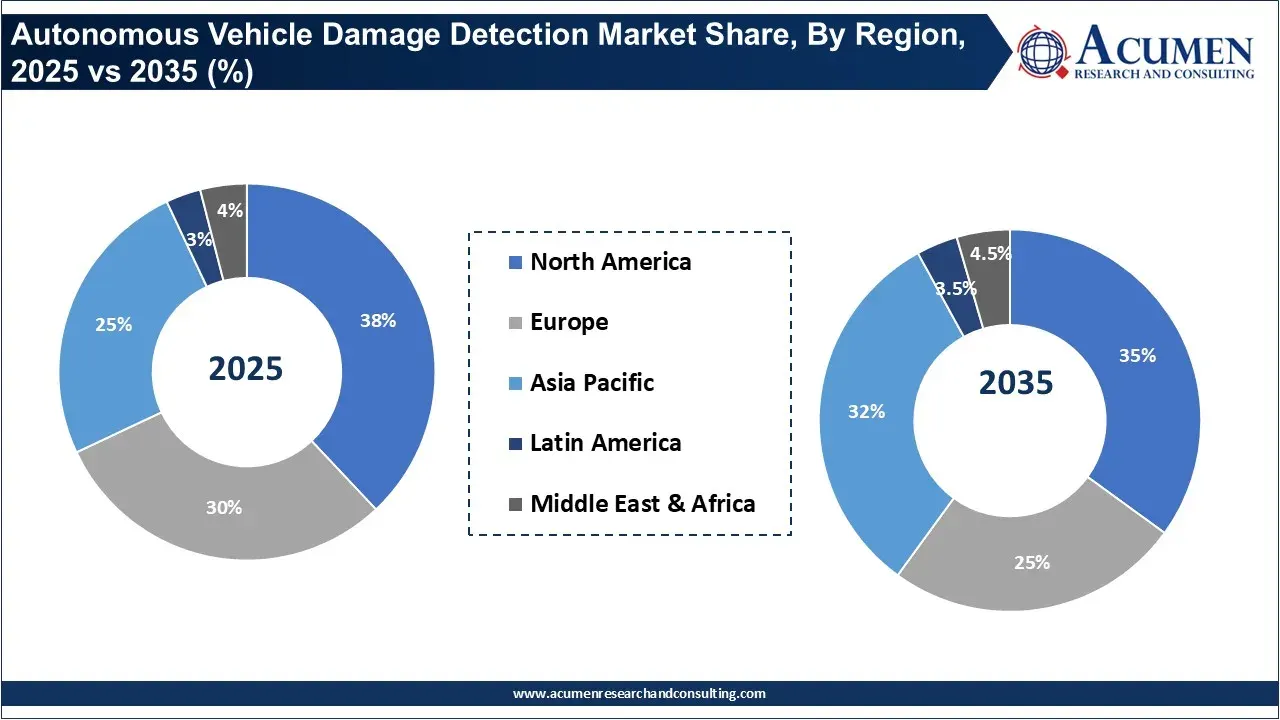
The Asia Pacific region as emerging as the fastest growing market at a CAGR of 23.1% during the forecast period; supported by rapid expansion of the automotive industry and accelerating adoption of smart mobility initiatives. Countries such as China, India, Japan, and South Korea are witnessing increase investment in electric vehicles, autonomous driving technologies and intelligence transportation systems, all of which require reliable and scalable damage detection solution. The growing presence of large commercial fleets, ride-hailing services, and vehicle rental platforms is further driving demand for automated inspection to manage vehicle health at scale. Moreover government-backed digital information programs and cost-sensitive market condition are encoring the adoption of cloud-based and AI drive inspecting platforms, positioning Asia-Pacific as key growth engine for the market over the coming years.
Segmentation Insights
Offering Insights
Software/AI platforms segment held a dominated position with 55% market share in 2025 in the autonomous vehicle damage detection market because it acts as the core intelligence, controlling and analyzing the entire inspection process. Software platforms powered by artificial intelligence and computer vision for analyze vehicle images, identify damage, determine severity, and convert insights into actionable outputs for insurers, fleet operators, and automotive manufacturers. Continuous advancements in algorithms, data processing, and model training further enhance accuracy and reliability, this advancement is key contribute to the growth of autonomous vehicle damage detection market.
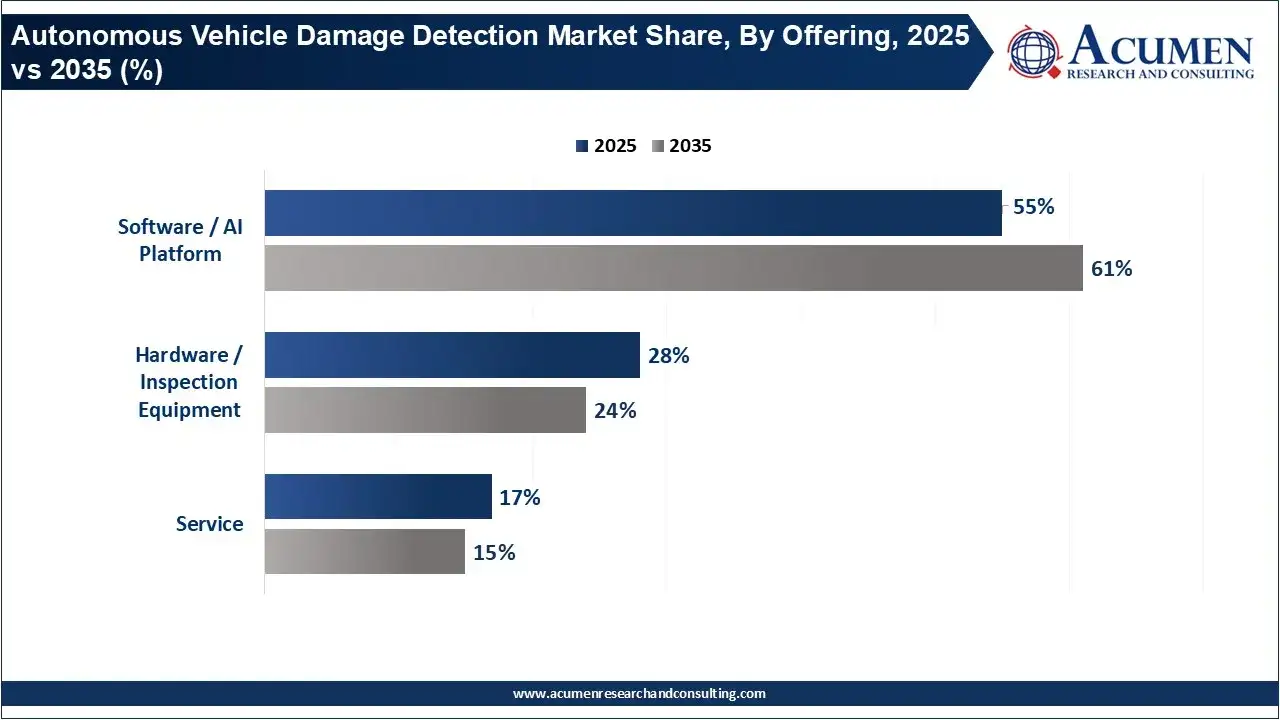
Hardware/ inspection equipment segment held the second largest share of 28% in 2025, as physical inspection infrastructure becomes an essential part of automated damage detection system. The increasing use of high-resolution cameras, LiDAR units, and sensor-based scanning equipment in inspection lanes, fleet depots, and smart service centers is driving strong demand for advanced hardware systems. As the need for higher accuracy grows and inspection volumes continue to rise, organizations are making significant investments in advanced and reliable sensing technologies to ensure precise and efficient vehicle assessments. This growing reliance on automated inspection environment is accelerating the expansion of the hardware segment across global markets.
Technology Insights
Computer vision led the market with 58% market share, due to its established role in identifying visible vehicle damage, including scratches, dents, and surface irregularities. According to align minds recent statistics show that, automated vehicle damage detection, powered by computer vision technology, has significantly increased the speed and accuracy of inspection, and reduced human error by 90%. In Addition, reliable, cost-effectiveness, and ease of integrations into existing inspection workflows have led to increasing adoption across insurance assessments, rental operations, and dealership inspections.
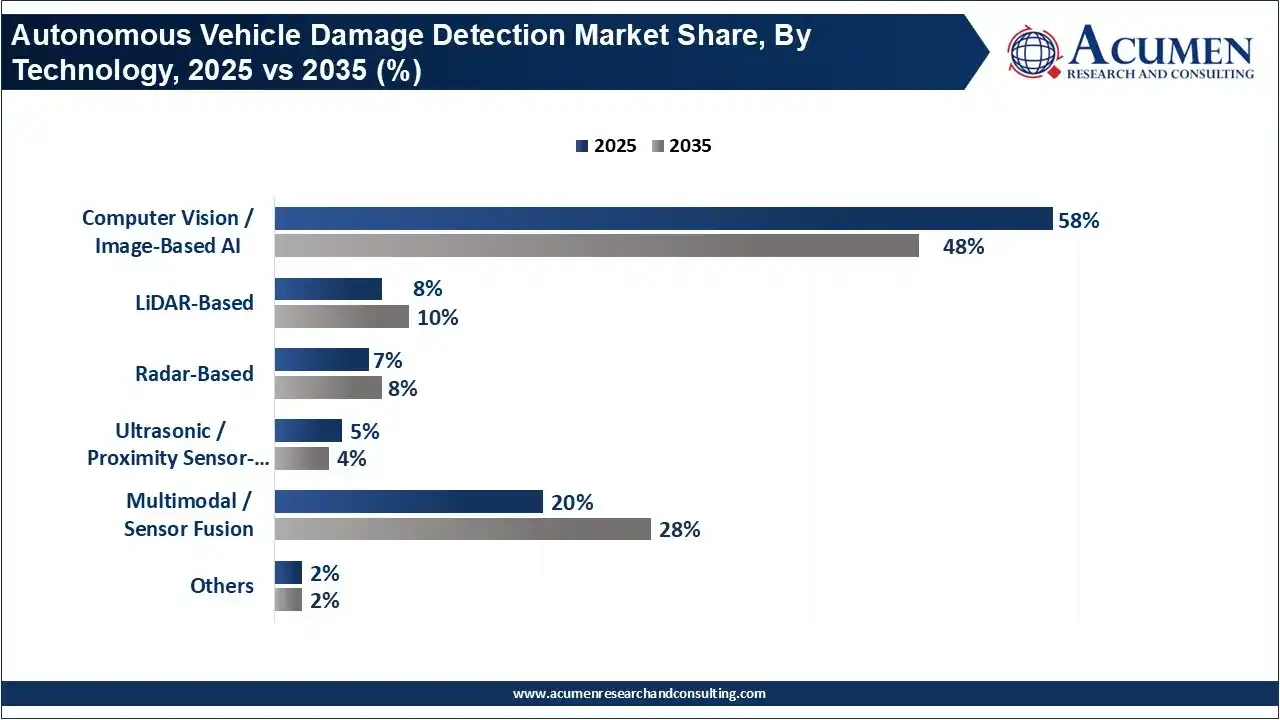
Multimodal/sensor fusion segment, on the other hand, held the second largest share of the market while contributing 20% in 2025. Its growth is supported by the ability to combine data from multiple sources, including cameras, LiDAR, radar, ultrasonic sensors, vehicle diagnostics, and other connected systems, to create a more comprehensive assessment of vehicle condition. By correlating information from different sensors, these systems can improve damage identification, distinguish between cosmetic and structural issues, and reduce false detections under challenging lighting, weather, or viewing conditions. The increasing integration of sensor fusion with AI-based computer vision and automated claims platforms is further strengthening its adoption across automotive, insurance, fleet, and mobility applications.
Deployment Mode Insights
Cloud-based deployment dominated the market with 42% in 2025, due to its scalability, operational flexibility, and ability to support multi-location inspection networks. Cloud platforms enables real-time data processing, centralized analytics, and seamless integration with insurance costs and continuous software updates further enhance their appeal, particularly or insurers and fleet operator managing large volumes of inspection. These advantages have positioned cloud-based solutions as the preferred deployment model across the majority of commercial segment.
On the other hand, the hybrid segment held the second largest share of the market contributing to 40% share, its significant market position is supported by the growing preference for hybrid solutions that combine the advantages of multiple technologies or powertrain configurations, offering greater flexibility, efficiency, and performance across diverse applications. Increasing demand for solutions that can balance cost, operational efficiency, and sustainability is further supporting adoption of hybrid systems.
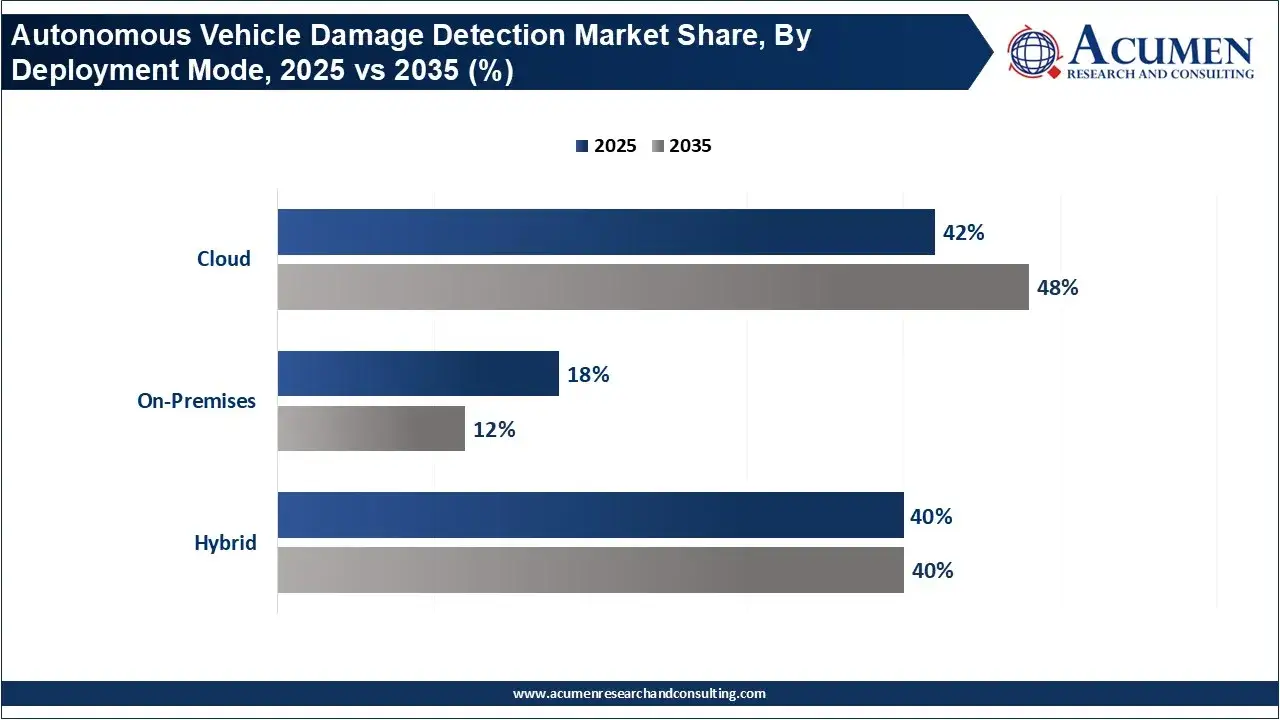
On-premises deployment is witnessing rapid growth, which also held 18% market share in 2025; as organizations place greater emphasis on data security, regulator compliance, and system control. Automotive OEMs, government fleet, and enterprises operating in highly regulated environment are increasingly adopting on-site solution to retain full ownership of vehicle data and inspection workflows. The ability to customize systems and reduce latency is further strengthening the appeal of on-premises deployments. As data governance requirements become more strengths, this deployment model is gaining traction and expanding at a faster pace within the market.
Application Insights
The insurance claims & underwriting segment dominated the autonomous vehicle damage detection market with 30% share as insurers are increasingly leveraging automated systems to streamline clean processing. These platforms allow insurer to quickly assess vehicle damage, generate accurate estimated, and reduced reliance on manual inspections, which are often time-consume and prone to errors. The ability the adoption of automated damage detection in the insurance sector, making in the largest application segment in the market.
| Application | Revenue Share, 2025 (%) |
|---|---|
| Insurance Claims & Underwriting | 30% |
| Fleet & Mobility Operations | 25% |
| Vehicle Inspection & Condition Assessment | 15% |
| Collision Repair & Repair Estimation | 12% |
| Rental, Leasing & Remarketing | 8% |
| Accident / Incident Investigation | 6% |
| Others | 4% |
The fleet & mobility operations market held 25% share in 2025, supported by the growing need for faster, standardized, and cost-efficient vehicle inspections across fleet operators, rental companies, logistics providers, ride-hailing platforms, and shared-mobility services. AI-powered damage detection enables operators to automate vehicle condition assessments, identify new damage quickly, maintain digital inspection records, and reduce inspection time across large fleets. The increasing number of high-utilization commercial and mobility vehicles, combined with the need to minimize downtime and maintenance costs, is further driving adoption of automated inspection solutions in fleet and mobility operations.
Vehicle Type Insights
Passenger cars dominated the market with 62% share in 2025, because they account for the largest share of vehicle in use globally and require frequent inspections throughout their lifecycle. These vehicles are commonly involves in services such as sales, rental, insurance assessments, and servicing, which creates a continuous needs for fast and reliable inspection solutions. Passenger car dominate the autonomous vehicle damage detection market due to their large global production volumes and widespread use across personal, shared, and mobility service applications. The high frequent of insurance claims, routine inspection, and post-accident assessments associated with passenger vehicles has driven strong demand for automated damage detection solution. In addition, the integration of advanced driver assistance systems and connected vehicle technologies in passenger car has made accurate and reliable damaged assessment more critical, reinforcing the segment leading position in the market.
| Vehicle Type | Revenue Share, 2025 (%) | Revenue Share, 2035 (%) |
|---|---|---|
| Passenger Vehicles | 62% | 57% |
| Commercial Vehicles | 38% | 43% |
Commercial vehicles represented as the second largest shareholder with 38% in 2025, as fleet operators increasingly adopt automated damage detection large vehicle fleets efficiently. Logistics companies, ride-hailing platforms, rental services, and delivery providers rely on rapid and standardized inspection to reduced vehicle and control maintenance costs. Automated damage detection enables consistent assessment across multiple locations while ensuring safety compliance, which is particularly important for high-utilization commercial fleets.
End User Insights
Insurance companies segment led the market with 31% share in 2025, as they require faster, miore accurate, and reliabe claims processing while mininize the risk of fraud. Automated system helps insurers to reduce human error, process large column of claims quickly, and ensure consistency across assessments. The cost saving, improved customer experience, and enhanced operational efficiency associated with these technologies have made insurance companies the largest and most established user group in the market.
| End User | Revenue Share, 2025 (%) |
|---|---|
| Insurance Companies | 31% |
| Automotive OEMs | 25% |
| Fleet Operators | 29% |
| Rental & Leasing Companies | 10% |
| Others | 5% |
Automotive OEMs represent the fastest growing segment in the market, which also held a share of 25% in the market; as manufactures adopt automated damage detection systems to ensure vehicle quality, safety, and compliance with regulatory standards. These technologies allow OEMS to perform consistent inspection during production, pre-delivery, and post-service maintenance, ensuring vehicles met strict quality benchmarks. As OEMs increasingly invest in digital inspection, their adoption of autonomous damage detection solution expanding at as raid pace.
Key Players
- Tractable - Uses AI-powered computer vision to automate vehicle damage assessment and claims estimation, helping insurers and automotive companies accelerate the claims process.
- Click-Ins - Focuses on AI and computer-vision-based vehicle inspection and damage detection for insurance, fleet and automotive applications.
- UVEye - Provides automated vehicle inspection systems using AI and sensor-based technologies for dealerships, fleets, rental companies and automotive stakeholders.
- Mitchell International - Offers AI-driven damage analysis through its Mitchell Intelligent Damage Analysis platform, supporting automated claims and repair-estimation workflows.
- CCC Intelligent Solutions - Combines AI, claims-management software and automotive data to automate vehicle damage assessment and insurance workflows.
- Solera Holdings - Provides AI-powered vehicle claims and damage-detection solutions through its Audatex and Qapter platforms, supported by extensive vehicle-repair data.
- ProovStation - Develops automated vehicle inspection systems designed to capture and assess vehicle condition efficiently for automotive, rental and fleet applications.
- Claim Genius - Provides AI-based vehicle damage assessment with an API-oriented approach that can be integrated into insurers' and automotive companies' digital claims workflows.
- ControlExpert - Focuses on automated claims processing and vehicle inspection technologies, helping insurers and fleet operators digitize damage assessment workflows.
- AudaExplore (Audatex) - Provides automated vehicle identification, damage assessment, repair estimation and claims-management capabilities as part of Solera's automotive software ecosystem.
- ClickMotive - Applies automotive technology and digital tools to support vehicle-related inspection and damage-management workflows.
- Deepomatic - Provides computer-vision technology for automated visual inspection, supporting applications where AI-based image analysis can improve consistency and operational efficiency.
Recent Developments
- June 2026, UVeye + CARFAX: UVeye and CARFAX launched an integration combining automated vehicle inspection data with CARFAX vehicle history and recall information, giving dealerships a more comprehensive view of vehicle condition and history during inspection and sales processes.
- In January 2025, Tractable and CCC Intelligent Solution resolved a long-standing legal dispute through a settlement, bringing greater clarity and stability to the market for AI- driven damage assessment technologies.
Segments Covered
By Offering
- Software / AI platform
- Hardware / inspection equipment
- Service
By Technology
- Computer vision / image-based AI
- LiDAR-based
- Radar-based
- Ultrasonic / proximity sensor-based
- Multimodal / sensor fusion
- Others
By Deployment Mode
- Cloud
- On-premises
- Hybrid
By Application
- Insurance claims & underwriting
- Fleet & mobility operations
- Vehicle inspection & condition assessment
- Collision repair & repair estimation
- Rental, leasing & remarketing
- Accident / incident investigation
- Other
By Vehicle Type
- Passenger vehicles
- Commercial vehicles
By End User
- Insurance companies
- Automotive OEMs
- Fleet operators
- Rental & leasing companies
- Others
By Region
- North America
- Europe
- Asia Pacific
- Latin America
- Middle East & Africa (MEA)
Looking for discounts, bulk pricing, or custom solutions? Contact us today at sales@acumenresearchandconsulting.com
Frequently Asked Questions

Other Automotive And Transportation Reports
October 2024
May 2026
September 2024
June 2021