
Bepirovirsen Market Size, Share, Trends and Forecast 2026 To 2035
Bepirovirsen Market (By Baseline HBsAg Level: ≤100 IU/mL, >100 to ≤1,000 IU/mL, >1,000 to ≤3,000 IU/mL; By HBeAg Status: HBeAg-Negative, HBeAg-Positive; By End User: Hospital Hepatology & Gastroenterology Centers, Specialty Clinics, Community Health Centers & Others; By Distribution Channel: Specialty Pharmacies, Hospital Pharmacies, Retail & Online Pharmacies) - Global Industry Analysis, Size, Share, Regional Analysis, Trends and Forecast 2026 - 2035
- Last Updated: 23 Oct 2026
- Report Code: ARC4000
- Category: Healthcare and Pharmaceuticals
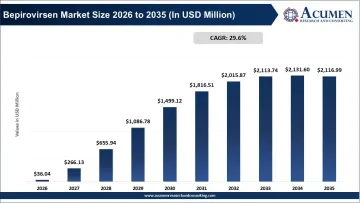
Bepirovirsen Market Size and Forecast 2026 to 2035
Key Takeaways
- By region: North America is seen to dominate the bepirovirsen market in 2027, accounting for a 73.86% share and generating USD 196.56 million in revenue.
- By baseline HBsAg level: The >100 to ≤1,000 IU/mL segment is expected to dominate the baseline HBsAg category in 2027, with a 38.0% share.
- By HBeAg status: HBeAg-negative patients will dominate the HBeAg status segment in 2027, accounting for 84.0% of the market and generating $ 223.55 million.
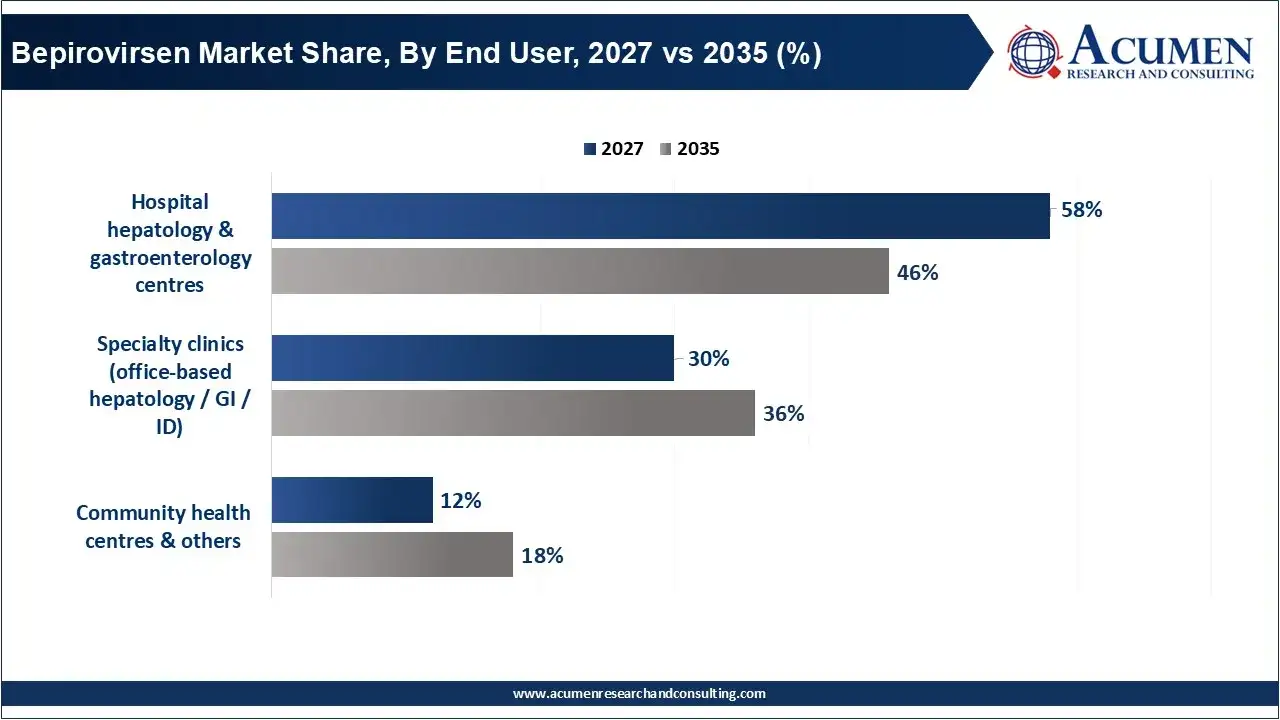
- By end user: Hospital hepatology and gastroenterology centres will dominate the end-user segment in 2027, with a 58.0% share and $154.35 million.
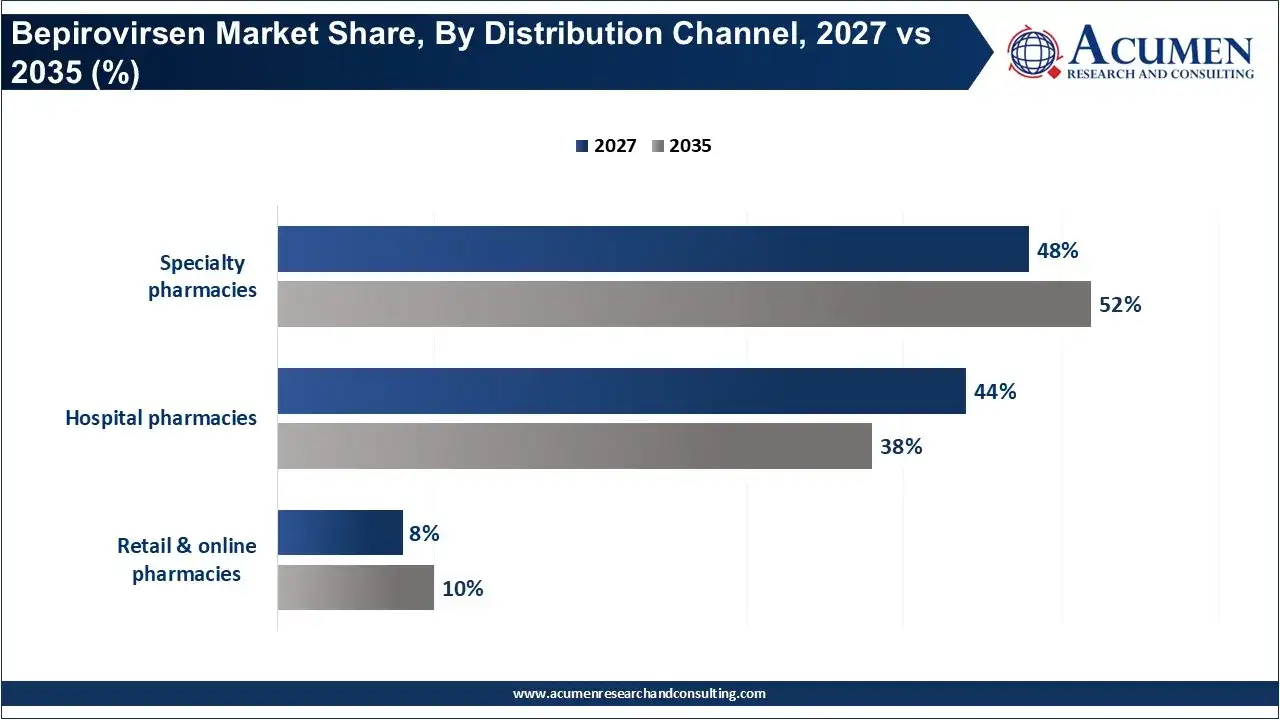
- By distribution channel: Specialty pharmacies will dominate the distribution channel segment in 2027, accounting for a 48.0% share and generating $127.74 million in revenue.
Key Findings
- The FDA based its approval on two Phase III trials, B-Well 1 and B-Well 2, in which 19% of patients who received bepirovirsen achieved a functional cure compared to none who received placebo.
- The commercial opportunity arises from the presence of about 1.7 million patients with chronic hepatitis B in the United States where market players have traditionally won long-term hold on sale.
- Among participants with baseline HBsAg levels of 1,000 IU/mL or less, 200 of 768 patients, or 26%, achieved functional cure, compared with 0 of 393 patients in the placebo group. This highlights the importance of baseline viral-marker levels in assessing treatment outcomes.
Regulatory Landscape and Future Outlook
| Regulatory authority / market | Current regulatory status | Key regulatory requirements |
|---|---|---|
| United States (FDA) | Approved on October 20, 2026 | Approved for eligible adults without cirrhosis who meet the specified antiviral treatment, HBV DNA and HBsAg criteria. Companion diagnostic testing is authorized. |
| Japan (MHLW) | Approved on August 24, 2026 | Approval covers eligible adults with chronic hepatitis B who meet the specified prior-treatment and viral-marker criteria |
| European Union (EMA / European Commission) | Regulatory review was reported by GSK in March 2026; a final authorization should be verified against current official records. | Assessment of clinical efficacy, safety, manufacturing quality and the proposed product information. |
| China (NMPA) | Regulatory review was reported in March 2026; current approval status requires verification against official NMPA announcements. | Review of clinical evidence, product quality and local regulatory requirements. |
Bepirovirsen Market Dynamics
Growth Drivers
- Advancement in Chronic Hepatitis B Treatment: The need for more effective treatments for chronic hepatitis B is encouraging pharmaceutical developers to investigate therapies such as bepirovirsen, an antisense oligonucleotide designed to reduce hepatitis B viral proteins and potentially support functional cure strategies; which apparently acts as a major driver for hibsago market.
- Growing Focus on Novel Therapeutics: Advances in oligonucleotide chemistry, targeted RNA suppression, and clinical development are supporting research into antisense medicines, creating opportunities for bepirovirsen and other nucleic acid-based therapies targeting chronic viral infections.
Restraints
- Uncertainty Around Treatment Response: Bepirovirsen response may vary according to patient characteristics, baseline hepatitis B surface antigen levels, and other clinical factors, potentially limiting the proportion of patients who achieve a functional cure.
- High Clinical Development Costs: Developing a novel oligonucleotide therapy requires extensive clinical testing, specialized manufacturing, and regulatory review. These requirements can increase development expenses and create uncertainty around commercialization timelines and investment returns.
Opportunities
- Expansion of Eligible Patient Populations: FDA approval of Hibsago for specific adults with chronic hepatitis B creates opportunities to identify eligible patients through quantitative hepatitis B surface antigen testing and improve treatment access through specialist-led care pathways.
- International Regulatory Expansion: Regulatory approvals across additional markets could expand commercial access to bepirovirsen, particularly in regions with substantial chronic hepatitis B burdens and established diagnostic and antiviral treatment infrastructure.
- Development of Functional Cure Treatment Pathways: Bepirovirsen's potential to enable sustained viral control after treatment discontinuation creates opportunities for new care pathways combining patient selection, biomarker monitoring, and individualized treatment decisions.
Challenges
- Patient Eligibility and Treatment Selection: The approved indication covers a defined patient population, including adults without cirrhosis who meet specified antiviral treatment, viral suppression, and HBsAg criteria. Identifying eligible patients accurately will be important for market adoption.
- Safety Monitoring and Clinical Management: Potential serious liver reactions and thrombocytopenia require careful patient assessment and regular laboratory monitoring, creating additional clinical management requirements for healthcare providers and treatment centers.
Segmental Analysis
Baseline HBsAg Level Analysis
| Baseline HBsAg Level | Revenue Share, 2027 (%) | Revenue Share, 2035 (%) |
|---|---|---|
| <=100 IU/mL | 32% | 26% |
| >100 to <=1,000 IU/mL | 38% | 39% |
| >1,000 to <=3,000 IU/mL | 30% | 35% |
HBeAg Status Analysis
Bepirovirsen Market Share, By HBeAg Status, 2027 & 2035 (%)
| HBeAg Status | Revenue Share, 2027 (%) | Revenue Share, 2035 (%) |
|---|---|---|
| HBeAg-negative | 84% | 82% |
| HBeAg-positive | 16% | 18% |
End User Analysis
Distribution Channel Analysis
Bepirovirsen Market Regional Analysis
North America to Dominate the Bepirovirsen Market
- The U.S. Food and Drug Administration (FDA) approved Hibsago (bepirovirsen), developed by GSK, on October 20, 2026, for adults with chronic hepatitis B without cirrhosis who have received nucleos(t)ide analogue therapy for at least six months, have suppressed HBV DNA levels and have hepatitis B surface antigen (HBsAg) levels of 3,000 IU/mL or less.
- The commercial opportunity for hibsago will depend on its U.S. launch price, insurance coverage and patient affordability. Commercial insurers, Medicare and Medicaid may influence access through their respective coverage and reimbursement requirements.
- Hibsago's revenue potential will depend on the number of eligible patients identified, physician adoption, treatment completion, net pricing and insurance coverage.
Europe to Act as the Fastest-growing Marketplace
| Region | Revenue Share, 2027 (%) | Revenue Share, 2035 (%) |
|---|---|---|
| North America | 73.86% | 46.42% |
| Europe | 6.76% | 25.10% |
| Japan | 16.09% | 8.61% |
| China | 3.29% | 9.94% |
| Rest of APAC | 0% | 6.51% |
| Latin America | 0% | 1.75% |
| MIddle East & Africa | 0% | 1.68% |
“Japan is projected to account for 16.09% of the Bepirovirsen Market in 2027, generating USD 42.83 million in revenue. Its share is expected to decline to 8.61% by 2035, with revenue reaching USD 182.20 million.”
- Japan approved bepirovirsen for adults with chronic hepatitis B who meet the specified clinical eligibility criteria. The treatment is intended for use alongside existing nucleos(t)ide analogue therapy, with patient selection based on hepatitis B surface antigen (HBsAg) and hepatitis B virus (HBV) DNA levels.
- Japan has an estimated one million people living with chronic hepatitis B, with the disease associated with approximately 4,000 deaths annually. Nationwide screening and treatment initiatives provide an established foundation for identifying patients who may benefit from new therapies.
- Japan's national health insurance system provides the framework for medicine reimbursement and patient access. The commercial opportunity for Hibsago will depend on its official reimbursement price, patient cost-sharing arrangements and coverage conditions.
- "China is expected to hold 3.29% of the bepirovirsen market in 2027 with revenue of $8.75 million. China is estimated to hold 9.94% of the market by 2035 with a revenue of $210.36 million."
- China has a large chronic hepatitis B patient population, offering a potential uptake for new treatments that could lead to functional cure.
- The NMPA review of bepirovirsen was announced as accepted in March 2026. In May 2026, GSK revealed the companies had entered a strategic collaboration with Sino Biopharmaceutical to develop and commercialise bepirovirsen in China.
- The public health infrastructure in China and the existing clinical practice of antiviral therapy in chronic hepatitis B may support market adoption.
Competitive Landscape
- GSK plc: GSK is the commercial rights holder and developer of Hibsago (bepirovirsen), which received U.S. FDA approval in October 2026.
- Ionis Pharmaceuticals, Inc.: Ionis discovered bepirovirsen and partnered with GSK for its development and commercialization.
- Aligos Therapeutics: Aligos is developing pevifoscorvir sodium (ALG-000184), an oral capsid assembly modulator for chronic hepatitis B, alongside ALG-170675, an investigational antisense oligonucleotide.
- Arrowhead Pharmaceuticals, Inc. and Janssen: Arrowhead and Janssen have investigated JNJ-3989, also known as ARO-HBV, an RNA interference-based candidate designed to reduce hepatitis B viral proteins.
- Arbutus Biopharma Corporation: Arbutus has developed AB-729, an investigational RNA interference therapy designed to reduce hepatitis B surface antigen and other viral proteins.
Segments Covered
- ≤100 IU/mL
- >100 to ≤1,000 IU/mL
- >1,000 to ≤3,000 IU/mL
- HBeAg-Negative
- HBeAg-Positive
- Hospital Hepatology & Gastroenterology Centers
- Specialty Clinics (Office-Based Hepatology, Gastroenterology & Infectious Disease)
- Community Health Centers & Others
- Specialty Pharmacies
- Hospital Pharmacies
- Retail & Online Pharmacies
- North America
- Europe
- Asia-Pacific
- Japan
- China
- Rest of Asia-Pacific
- Latin America
- Middle East & Africa
Looking for discounts, bulk pricing, or custom solutions? Contact us today at sales@acumenresearchandconsulting.com
Frequently Asked Questions

Other Healthcare and Pharmaceuticals Reports
May 2024
December 2023
October 2024
June 2022