
Biologics CDMO Market Size, Share, Trends, Forecast Report 2026 To 2035
Biologics CDMO Market (By Service Type: Contract Manufacturing – Drug Substance, Contract Manufacturing – Drug Product / Fill-Finish, Process Development, Cell Line Development, Analytical, Quality Control (QC) & Other Services; By Molecule Type: Monoclonal Antibodies, Antibody-Drug Conjugates (ADCs) & Bioconjugates, Recombinant Proteins & Enzymes, Vaccines, Cell & Gene Therapies, mRNA & Other Biologics; By Expression System: Mammalian, Microbial, Others; By Manufacturing Technology: Stainless-Steel Bioreactors, Single-Use Bioreactors; By Development Stage: Clinical, Commercial; By Biologic Type: Innovator Biologics, Biosimilars; By Therapeutic Application; By End User) - Global Industry Analysis, Size, Share, Regional Analysis, Trends and Forecast 2026 - 2035
- Last Updated: 26 Oct 2026
- Report Code: ARC4002
- Category: Healthcare and Pharmaceuticals
Biologics CDMO Market Size, Forecast 2026 To 2035
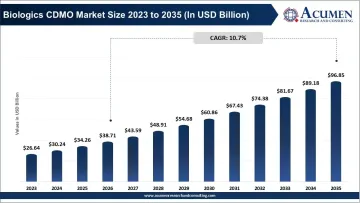
The global biologics CDMO market size was valued at $34.26 billion in 2025. The market is observed to reach at $96.85 billion by 2035 from $38.71 billion in 2026; while expanding at a CAGR of 10.7% during the forecast period. The biologics CDMO market is expanding as pharmaceutical companies outsource complex drug manufacturing, biologics pipelines advance, and demand for specialized production capacity increases. Rising investment in biotechnology, growing demand for monoclonal antibodies, and the need for compliant, scalable manufacturing are strengthening outsourcing opportunities.
- Base Year Market Size (2025): $34.26 billion
- Current Year Market Size (2026): $38.71 billion
- Estimated Year Market Size (2035): $98.85 billion
- Forecast Period CAGR (2026-2035): 10.7%
Key Takeaways
- By region: North America dominated the Biologics CDMO Market with a 38.0% share in 2025, generating USD 13.02 billion in revenue. Asia-Pacific is the fastest-growing region, with a projected CAGR of 12.9% from 2026 to 2035, and is expected to reach USD 31.96 billion by 2035.
- By service type: Contract manufacturing drug substance dominated the service type segment with a 52.0% share in 2025, generating USD 17.82 billion in revenue. Analytical, QC, and other services are projected to grow at the fastest rate, with a CAGR of 11.8% from 2026 to 2035.
- By product type: Monoclonal antibodies, including bispecifics, dominated the product type segment with a 56.0% share in 2025, generating USD 19.19 billion in revenue. Antibody-drug conjugates (ADCs) and bioconjugates are projected to grow at the fastest rate, with a CAGR of 15.9% from 2026 to 2035.
- By expression system: Mammalian expression systems dominated the expression system segment with a 76.0% share in 2025, generating USD 26.04 billion in revenue. Other expression systems, including insect, plant, and cell-free systems, are projected to grow at the fastest rate, with a CAGR of 12.7% from 2026 to 2035.
- By manufacturing technology: Stainless-steel manufacturing dominated the manufacturing technology segment with a 60.0% share in 2025, generating USD 20.56 billion in revenue. Single-use manufacturing technology is projected to gain share from 40.0% in 2025 to 53.0% by 2035, supported by its flexibility, scalability, and faster facility turnaround.
- By development stage: Commercial-stage manufacturing dominated the development stage segment with a 62.0% share in 2025, generating USD 21.24 billion in revenue. Commercial-stage manufacturing is projected to grow at a CAGR of 11.1% from 2026 to 2035, supported by increasing demand for large-scale biologics production.
- By biologic type: Innovator biologics dominated the biologic type segment with an 80.0% share in 2025, generating USD 27.41 billion in revenue. Biosimilars are projected to grow at the fastest rate, with a CAGR of 13.6% from 2026 to 2035, supported by increasing demand for cost-effective biologic therapies.
- By therapeutic application: Oncology dominated the therapeutic application segment with a 42.0% share in 2025, generating USD 14.39 billion in revenue. Metabolic and endocrine applications are projected to grow at the fastest rate, with a CAGR of 13.5% from 2026 to 2035.
- By end user: Large pharmaceutical companies dominated the end-user segment with a 48.0% share in 2025, generating USD 16.44 billion in revenue. Small and emerging biotechnology companies are projected to grow at the fastest rate, with a CAGR of 12.1% from 2026 to 2035, driven by increasing reliance on outsourced development and manufacturing capabilities.
What Is the Biologics CDMO Market?
The biologics CDMO market includes providers of outsourced development, process development optimization, analytical testing, and commercial manufacturing services to support development and production of biologic drugs. Biologics CDMOs enable biopharmaceutical companies to develop and produce monoclonal antibodies, recombinant proteins, vaccines, ADCs, and other complex biologics by utilizing contract manufacturing expertise, sophisticated manufacturing equipment, reducing facility investments, accelerating their development timelines, and increasing production scale-up.
Recent Trends
- Expansion of integrated manufacturing services: CDMOs are combining process development, analytical testing, clinical production, and commercial manufacturing to support biologics throughout the product lifecycle.
- Increasing demand for monoclonal antibody production: Continued development of antibody-based therapies is supporting demand for mammalian cell culture, purification, and large-scale manufacturing capabilities.
- Investment in advanced biologics manufacturing: Providers are developing specialized capabilities for antibody-drug conjugates, recombinant proteins, and other complex biologic modalities.
- Adoption of single-use bioreactor technologies: Single-use systems can improve production flexibility, reduce cleaning requirements, and support multiproduct manufacturing operations.
- Growth of continuous and intensified processing: Manufacturers are evaluating advanced production methods to improve process efficiency, optimize facility utilization, and reduce manufacturing bottlenecks.
Investment Outlook: Where Will Capital Flow Through 2035?
- FUJIFILM Biotechnologies opened an approximately £400 million expanded facility in Teesside in February 2026, adding up to 19,000 liters of single-use bioreactor capacity for antibody manufacturing and process development.
- Samsung Biologics completed its acquisition of GSK's Rockville facility on March 31, 2026, adding 60,000 liters of drug-substance capacity and bringing its total global capacity to 845,000 liters.
- Samsung Biologics announced a rights offering expected to raise approximately KRW 3 trillion (US$2.2 billion) in August 2026 to fund its growth strategy, including the planned PolyPeptide Group acquisition and Bio Campus II investment.
- AGC Biologics secured a multiyear agreement for five commercial biologics programs at its planned Yokohama site in July 2026. The contract was reported to be worth hundreds of millions of dollars, with the customer securing half of the facility's mammalian manufacturing capacity.
- Bora Biologics expanded its US commercial manufacturing platform in July 2026, reporting 20,000 liters of installed single-use capacity across two FDA-registered facilities, with the platform scalable to 30,000 liters.
Regulatory and Quality Landscape
| Country / region | Regulatory authority | Key regulatory framework |
|---|---|---|
| United States | Food and Drug Administration (FDA) | Current Good Manufacturing Practice (cGMP); biologics requirements under 21 CFR Parts 210, 211, and applicable provisions of Part 600; biologics license requirements |
| European Union | European Medicines Agency (EMA) and national competent authorities | EU GMP guidelines, EudraLex Volume 4, and applicable EU pharmaceutical legislation |
| United Kingdom | Medicines and Healthcare products Regulatory Agency (MHRA) | UK GMP requirements, applicable UK medicines legislation, and relevant product authorization requirements |
| Japan | Pharmaceuticals and Medical Devices Agency (PMDA) and Ministry of Health, Labour and Welfare (MHLW) | Good Manufacturing Practice requirements under Japan's Pharmaceuticals and Medical Devices Act and applicable ministerial ordinances |
| China | National Medical Products Administration (NMPA) | Drug Administration Law, applicable Good Manufacturing Practice requirements, and biologics registration requirements |
| India | Central Drugs Standard Control Organisation (CDSCO) and relevant State Licensing Authorities | Drugs and Cosmetics Act and Rules, applicable Schedule M GMP requirements, and relevant New Drugs and Clinical Trials Rules |
Biologics CDMO Market Dynamics
Growth Drivers
- Expanding Biologics Pipeline: Increasing development of monoclonal antibodies, recombinant proteins, vaccines, and other biologic therapies is driving demand for specialized contract development and manufacturing services, enabling pharmaceutical and biotechnology companies to access advanced production capabilities.
- Increasing Outsourcing by Biopharmaceutical Companies: Pharmaceutical companies and biotechnology startups are outsourcing biologics development and manufacturing to reduce capital expenditure, access specialized expertise, and accelerate clinical development and commercialization without building extensive in-house infrastructure.
- Rising Demand for Complex Biologics: Growing development of bispecific antibodies, antibody-drug conjugates, and other advanced biologics is increasing demand for CDMOs with specialized capabilities in cell culture, purification, bioconjugation, and sterile manufacturing.
Restraints
- High Capital Investment Requirements: Biologics manufacturing facilities require substantial investment in bioreactors, cleanrooms, purification systems, quality control laboratories, and specialized equipment, creating significant financial barriers for new market entrants and capacity expansion.
- Stringent Regulatory Compliance Requirements: Biologics CDMOs must maintain rigorous quality management systems, validated manufacturing processes, and regulatory inspection readiness across markets. Compliance requirements increase operating costs and can delay technology transfer, process validation, and commercial production.
- Manufacturing Capacity Constraints: Limited availability of suitable production capacity for specialized biologics, including antibody-drug conjugates and cell and gene therapies, can extend project timelines and restrict the ability of CDMOs to accommodate new client programs.
Opportunities
- Expansion of Cell and Gene Therapy Manufacturing: Growing development of advanced therapies creates opportunities for CDMOs to provide specialized viral vector production, cell processing, analytical testing, and small-batch manufacturing services tailored to complex therapeutic modalities.
- Adoption of Advanced Bioprocessing Technologies: Single-use bioreactors, continuous manufacturing, perfusion systems, and process automation offer opportunities to improve production flexibility, reduce changeover requirements, and enhance manufacturing efficiency across biologics development and commercial production.
- Emerging Market Manufacturing Expansion: Investments in biopharmaceutical infrastructure across Asia-Pacific and other emerging markets create opportunities for CDMOs to establish regional facilities, serve local biotechnology companies, and support global pharmaceutical supply chains.
Challenges
- Technology Transfer and Scale-Up Complexity: Transferring biologics manufacturing processes from research laboratories or client facilities to commercial production requires careful optimization of process parameters, analytical methods, and quality controls to maintain product consistency and yield.
- Maintaining Product Quality and Batch Consistency: Biological products are sensitive to changes in temperature, processing conditions, raw materials, and manufacturing environments. Ensuring consistent product quality across batches remains essential for regulatory compliance and commercial supply reliability.
- Supply Chain Vulnerabilities: Dependence on specialized raw materials, single-use components, resins, filters, and other critical manufacturing inputs can expose CDMOs to procurement delays, cost fluctuations, and production interruptions, making supply chain resilience a strategic priority.
Biologics CDMO Market Segmental Insights
Service Type Insights
Contract Manufacturing – Drug Substance: Drug substance manufacturing dominated the service segment with a 52.0% share in 2025, valued at USD 17.82 billion. Demand is driven by the technical complexity of biologic production, the need for specialized bioreactors and purification systems, and pharmaceutical companies' reliance on external partners for scalable active biologic ingredient manufacturing.
Contract Manufacturing – Drug Product / Fill-Finish: Drug product and fill-finish services accounted for 20.0% of the market in 2025, valued at USD 6.85 billion, ranking second. Demand is supported by the need for sterile filling, formulation, inspection, and packaging of biologics into vials, prefilled syringes, and other delivery formats.
Biologics CDMO Market Share, By Service Type, 2025 & 2035 (%)
| Service Type | Revenue Share, 2025 (%) | Revenue Share, 2035 (%) |
|---|---|---|
| Contract manufacturing - Drug substance | 52% | 49% |
| Contract manufacturing - Drug product / fill-finish | 20% | 21% |
| Process development | 13% | 14% |
| Cell line development | 5% | 5% |
| Analytical, QC & other services | 10% | 11% |
Process Development: Process development represented 13.0% of the market in 2025, valued at USD 4.45 billion, ranking third. Demand is driven by the need to optimize cell culture, fermentation, purification, and scale-up processes before clinical and commercial production. CDMOs help clients improve process consistency, manufacturing efficiency, and technology transfer readiness.
Molecule Type Insights
Monoclonal Antibodies: Monoclonal antibodies dominated the product segment with a 56.0% share in 2025, valued at USD 19.19 billion. Demand is supported by their widespread use in oncology, immunology, and inflammatory diseases, alongside the need for specialized mammalian cell culture, purification, and commercial-scale production capabilities.
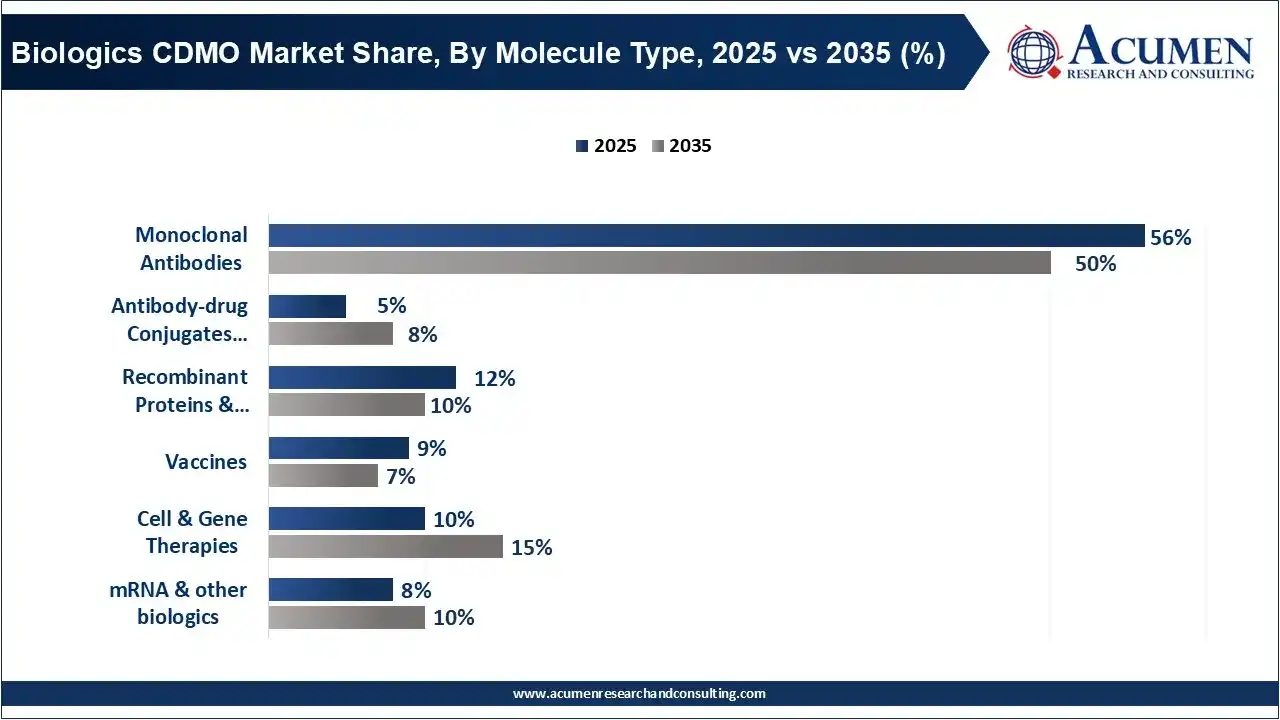
Recombinant Proteins & Enzymes: Recombinant proteins and enzymes accounted for 12.0% of the market in 2025, valued at USD 4.11 billion, making them the second-largest category based on the supplied segment shares. Demand is supported by their applications in therapeutic treatments, enzyme replacement, and other biologic medicines requiring specialized production and purification processes.
Expression System Insights
Mammalian (CHO, HEK293, and Others): Mammalian expression systems dominated the segment with a 76.0% share in 2025, valued at USD 26.04 billion. Demand is supported by their widespread use in monoclonal antibody and complex recombinant protein production, particularly where appropriate protein folding and post-translational modifications are essential.
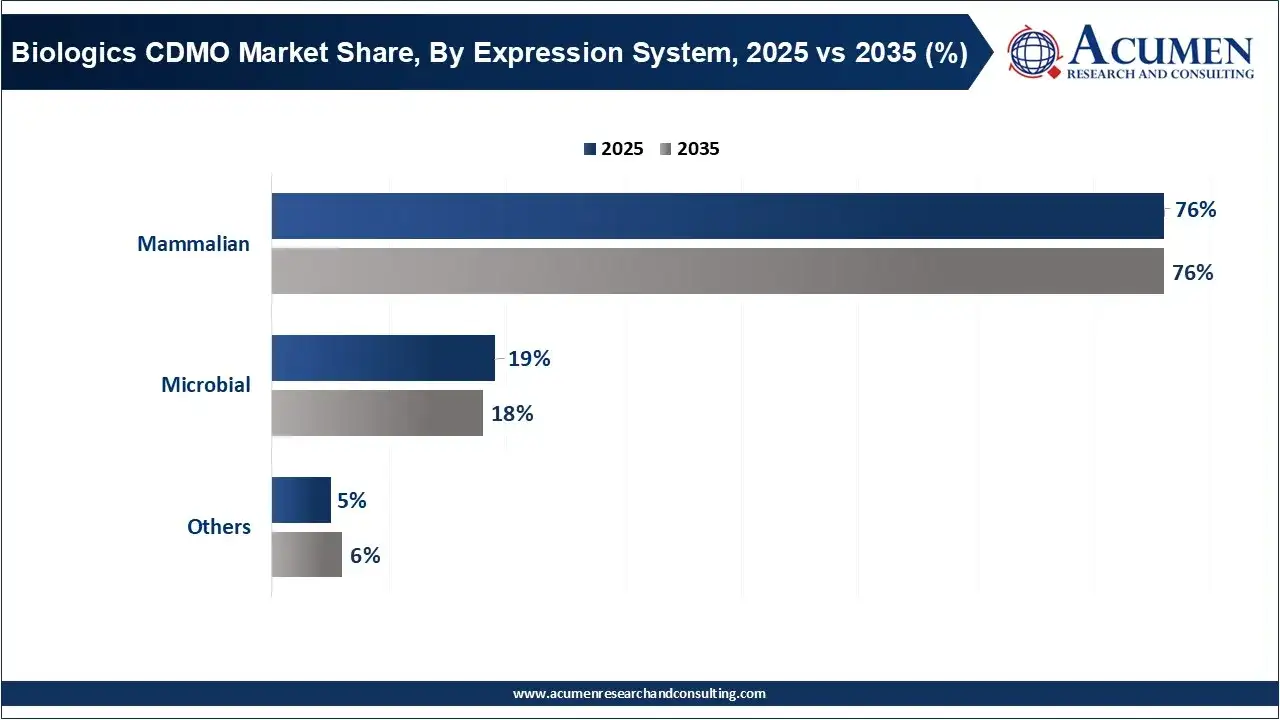
Microbial (Bacterial & Yeast): Microbial expression systems accounted for 19.0% of the market in 2025, valued at USD 6.51 billion, ranking second. Demand is supported by their use in producing selected recombinant proteins, enzymes, and other biologics, with potential advantages in production speed and process economics for suitable molecules.
Bioreactor Type Insights
Stainless-Steel Bioreactors: Stainless-steel systems dominated the technology segment with a 60.0% share in 2025, valued at USD 20.56 billion. Their adoption is supported by established large-scale manufacturing infrastructure, durability, and suitability for sustained commercial production across established biologics processes.
Biologics CDMO Market Share, By Bioreactor Type, 2025 & 2035 (%)
| Bioreactor Type | Revenue Share, 2025 (%) | Revenue Share, 2035 (%) |
|---|---|---|
| Stainless-steel | 60% | 47% |
| Single-use | 40% | 53% |
Single-Use Bioreactors: Single-use technology accounted for 40.0% of the market in 2025, valued at USD 13.70 billion, ranking second. Demand is supported by production flexibility, reduced cleaning and sterilization requirements, and the ability to accommodate multiproduct manufacturing and changing clinical production needs.
Development Stage Insights
Commercial: Commercial manufacturing dominated the development-stage segment with a 62.0% share in 2025, valued at USD 21.24 billion. Demand is supported by marketed biologic therapies requiring sustained production, established manufacturing processes, reliable supply agreements, and consistent batch quality.
Clinical (Preclinical to Phase III): Clinical manufacturing accounted for 38.0% of the market in 2025, valued at USD 13.02 billion. Demand is driven by the need for development batches, clinical-trial supply, process optimization, and manufacturing support as biologic candidates advance through clinical development.
Biologic Type Insights
Innovator Biologics: Innovator biologics dominated the segment with an 80.0% share in 2025, valued at USD 27.41 billion. Demand is supported by research-based pharmaceutical companies developing novel therapies that require specialized process development, clinical production, and commercial manufacturing infrastructure.
Biosimilars: Biosimilars accounted for 20.0% of the market in 2025, valued at USD 6.85 billion. Demand is supported by the development of biological medicines comparable to approved reference products, increasing competition as patents expire, and requirements for analytical characterization, process development, and scalable manufacturing.
Therapeutic Application Insights
Oncology: Oncology dominated the therapeutic application segment with a 42.0% share in 2025, valued at USD 14.39 billion. Demand is supported by the development of monoclonal antibodies, antibody-drug conjugates, and other biologic cancer therapies that require specialized manufacturing, analytical testing, and stringent quality controls.
Immunology & Inflammation: Immunology and inflammation accounted for 22.0% of the market in 2025, valued at USD 7.54 billion, ranking second. Demand is driven by biologic therapies for autoimmune and inflammatory conditions, including antibody-based treatments that require consistent production and reliable commercial supply.
Infectious Diseases: Infectious diseases represented 10.0% of the market in 2025, valued at USD 3.43 billion, ranking third. Demand is supported by biologic vaccines and therapeutic products requiring controlled manufacturing, specialized quality testing, and production capacity that can accommodate changing public-health needs.
End User Insights
Large Pharmaceutical Companies: Large pharmaceutical companies dominated the end-user segment with a 48.0% share in 2025, valued at USD 16.44 billion. These companies use CDMOs to supplement internal capacity, access specialized manufacturing technologies, support global product launches, and manage commercial-scale production requirements.
Small & Emerging Biotech Companies: Small and emerging biotechnology companies accounted for 30.0% of the market in 2025, valued at USD 10.28 billion, ranking second. Demand is supported by limited in-house manufacturing infrastructure, the need to control capital expenditure, and reliance on external partners for process development, clinical-trial material, and commercial readiness.
Biologics CDMO Market Regional Insights
Which Region Dominates the Biologics CDMO Market?
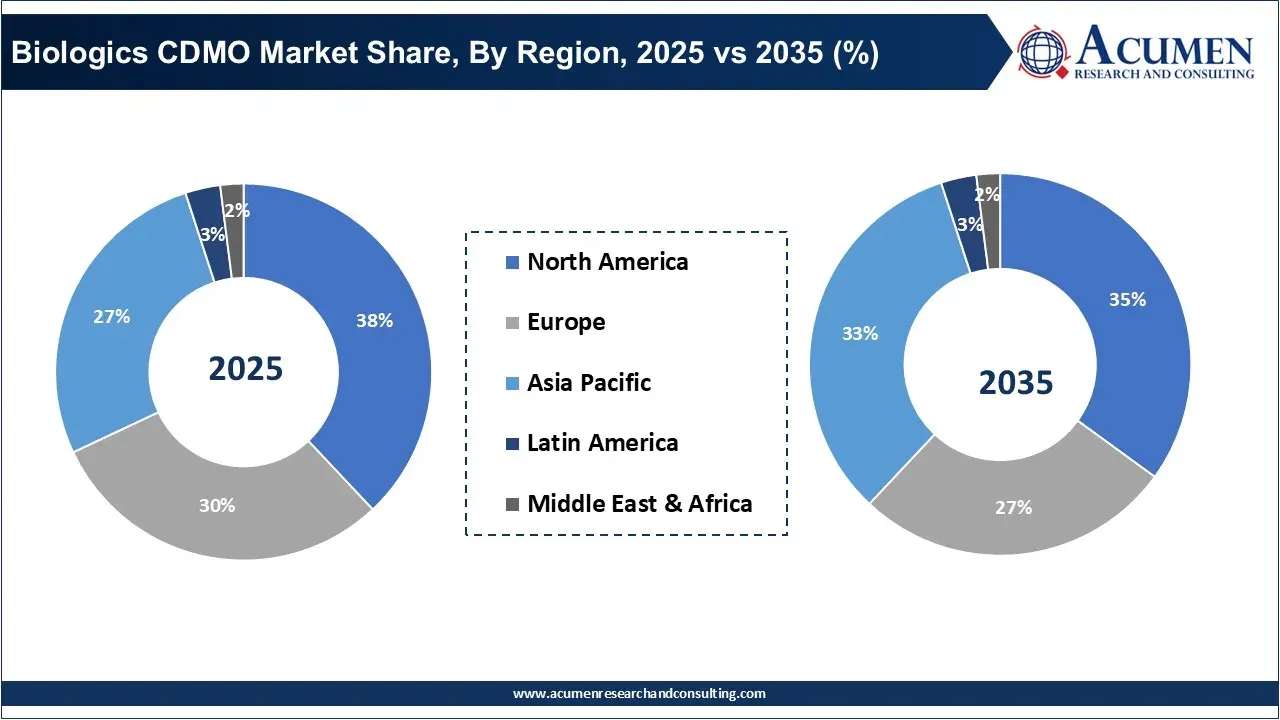
North America held the largest market share of 38% in the biologics CDMO market in 2025 and was valued at $13.02 billion in terms of revenue. North American region is most dominant region in the biologics CDMO market owing to the presence of broad biotechnology industry base, high biopharmaceutical R&D investments, highly developed biomanufacturing infrastructure, large number of CDMOs, and high demand for monoclonal antibodies, recombinant proteins, and other complex biologics for outsourced manufacturing.
- The U.S. is a key contributor with the large pharma base, clinical development network, and commercial-scale manufacturing. Growing investment in manufacturing capacity and dedicated biologics manufacturing plants is further bolstering the region.
Which Region Is the Fastest-Growing in the Biologics CDMO Market?
Asia-Pacific is projected to be the fastest-growing regional market, with a CAGR of 12.9% from 2026 to 2035. The region accounted for 27.0% of the global market in 2025, generating USD 9.25 billion in revenue, and is projected to reach USD 31.96 billion by 2035. Growth is supported by expanding biopharmaceutical manufacturing infrastructure, increasing investment in biotechnology, competitive production capabilities, and rising demand for outsourced biologics development and manufacturing.
China, South Korea, Japan, and India are important contributors to the region's evolving manufacturing landscape. South Korea continues to strengthen its position in large-scale biologics contract manufacturing, while China is expanding its biologics development and production capabilities. Japan contributes through established pharmaceutical expertise and advanced manufacturing infrastructure, while India offers opportunities in biologics production and biosimilar manufacturing.
Top Countries & Their Manufacturing Shifts
- United States: The United States is strengthening its biologics manufacturing capacity through investments in large-scale production facilities, advanced bioprocessing technologies, and domestic supply chains. Pharmaceutical companies are increasingly prioritizing local manufacturing to improve supply chain resilience, reduce reliance on overseas production, and support commercial-scale biologics production.
- South Korea: South Korea is expanding its position in the biologics CDMO industry through high-capacity manufacturing facilities and integrated contract development services. Companies are investing in production infrastructure to support monoclonal antibodies, biosimilars, and other biologic medicines while strengthening their ability to serve pharmaceutical clients across global markets.
- China: China is expanding beyond conventional biologics manufacturing into specialized modalities, including microbial fermentation, plasmid DNA, and viral vector production. Investments in advanced manufacturing infrastructure are helping CDMOs serve biotechnology companies developing complex biologics and next-generation therapies.
- India: India is strengthening its biologics CDMO capabilities through pharmaceutical manufacturing expertise, a skilled workforce, and competitive operating costs. Manufacturers are expanding development, analytical testing, and production services to attract international clients seeking reliable manufacturing partners for biologics and biosimilars.
- United Kingdom: The United Kingdom is investing in flexible biomanufacturing facilities that support antibody production, process development, and clinical-stage biologics. Single-use bioreactor systems are helping manufacturers improve operational flexibility, reduce changeover requirements, and accommodate multiple client programs.
Top Company
- Lonza Group (Switzerland)
- Samsung Biologics (South Korea)
- WuXi Biologics (China)
- Catalent (United States)
- Thermo Fisher Scientific (United States)
- FUJIFILM Biotechnologies (Japan)
- Boehringer Ingelheim (Germany)
- AGC Biologics (Japan)
- Rentschler Biopharma (Germany)
- Charles River Laboratories (United States)
Recent Breakthroughs
- October 2026: Lonza advances aseptic spray-drying technology for biologics. Lonza announced progress in developing a preclinical aseptic spray-drying platform designed to address stability, formulation, and delivery challenges associated with high-dose biologics, monoclonal antibodies, and conjugates. The initiative aims to expand formulation options for complex biologic therapies.
- March 2026: Samsung Biologics completes U.S. manufacturing facility acquisition. Samsung Biologics completed its acquisition of GSK's Rockville, Maryland, facility for approximately US$353 million, adding 60,000 liters of drug-substance manufacturing capacity and increasing its total global capacity to 845,000 liters. The acquisition established the company's first US manufacturing presence and expanded its geographic reach.
Segments Covered
By Service Type
- Contract Manufacturing – Drug Substance
- Contract Manufacturing – Drug Product / Fill-Finish
- Process Development
- Cell Line Development
- Analytical, Quality Control (QC) & Other Services
By Molecule Type
- Monoclonal Antibodies (Including Bispecifics)
- Antibody-Drug Conjugates (ADCs) & Bioconjugates
- Recombinant Proteins & Enzymes
- Vaccines
- Cell & Gene Therapies
- mRNA & Other Biologics
By Expression System
- Mammalian (CHO, HEK293, and Others)
- Microbial (Bacterial & Yeast)
- Others (Insect, Plant, and Cell-Free)
By Manufacturing Technology
- Stainless-Steel Bioreactors
- Single-Use Bioreactors
By Development Stage
- Clinical (Preclinical to Phase III)
- Commercial
By Biologic Type
- Innovator Biologics
- Biosimilars
By Therapeutic Application
- Oncology
- Immunology & Inflammation
- Infectious Diseases
- Metabolic & Endocrine
- Neurology
- Hematology
- Others (Ophthalmology, Rare Diseases, and Cardiovascular)
By End User
- Large Pharmaceutical Companies
- Mid-Size Pharmaceutical Companies
- Small & Emerging Biotech Companies
- Academic, Government & Other Clients
By Region
- North America
- Europe
- Asia-Pacific
- Latin America
- Middle East & Africa
Looking for discounts, bulk pricing, or custom solutions? Contact us today at sales@acumenresearchandconsulting.com
Frequently Asked Questions

Other Healthcare and Pharmaceuticals Reports
July 2021
March 2025
June 2023
December 2020