
Data Center Liquid Cooling: How Heat Quietly Became Computing's Biggest Problem
Author: Acumen Research And Consulting



Data Center Liquid Cooling Market Overview
Data center liquid cooling has emerged as a critical technology to address rising power densities, improve energy efficiency, and support the deployment of increasingly powerful AI-driven systems. The rapid expansion of artificial intelligence, high-performance computing, and next-generation digital infrastructure is fundamentally changing the way data centers are designed and operated. As computing workloads become more intensive, traditional air-based cooling systems are increasingly reaching their efficiency limits, creating a need for advanced thermal management solutions.
Liquid cooling is no longer restricted to special use cases and high-power computer rooms, moving into the general data center landscape as an important technological solution for business, cloud and colocation providers building out modern data centers. Businesses are implementing liquid cooling solutions to handle the heat loads associated with advanced processors, speed up the deployment of AI infrastructure and support more sustainable operations.
According to the expert panel at Acumen Research and Consulting, the growing adoption of AI workloads, hyperscale data center, and energy-efficient cooling technologies is driving significant expansion in the data center liquid cooling market. As organizations continue to invest in next-generation computing infrastructure, liquid cooling is transitioning from an emerging technology into a foundational element of future-ready data center design.
Liquid Cooling Becomes Mainstream for High-Density AI Data Centers
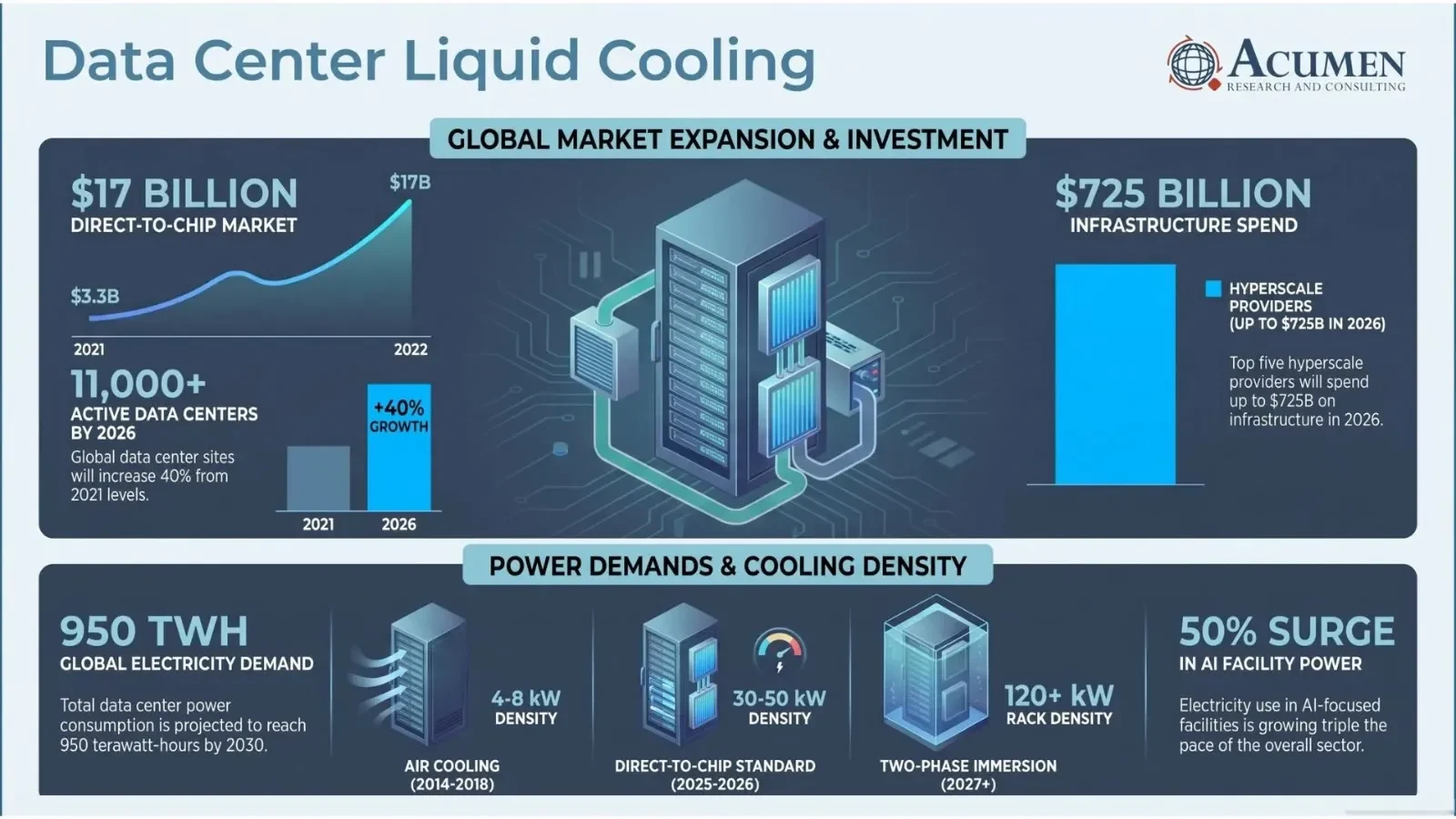
The shift shows up clearly in how fast the hardware side of this business is growing. The direct-to-chip cooling segment alone is expanding from roughly $3.3 billion in 2026 toward $17 billion by 2032, and the coolant distribution units that sit between the building's water supply and the server, often called CDUs, were already a $1.5 billion category in 2025 and are compounding at over 20% a year. In January 2026, one vendor shipped a facility-scale CDU rated at 8 megawatts of heat transfer capacity, supporting 45 degree Celsius warm-water loops specifically so hyperscale AI halls can skip traditional chillers altogether.
CoreWeave has standardized on closed-loop direct-to-chip systems for its Blackwell deployments, and Microsoft is backing neocloud provider Nscale on a rollout of 66,000 Rubin GPUs that requires liquid cooling by design, not as an option. Private capital has noticed too. Blackstone alone has put roughly $863 million behind one cooling technology company, and that's a single transaction in a year full of them.
| Period | Typical Rack Density | Dominant Cooling Approach |
|---|---|---|
| 2014-2018 | 4-8 kW | Air cooling (CRAC/CRAH units) |
| 2019-2022 | 8-15 kW | Air cooling with hot/cold aisle containment |
| 2023-2024 | 15-30 kW | Rear-door heat exchangers, early direct-to-chip |
| 2025-2026 | 30-50 kW | Direct-to-chip standard, immersion in new builds |
| Emerging (2027+) | 80-120+ kW | Two-phase immersion and hybrid liquid systems |
Why Are Data Centers Multiplying So Fast Right Now?
The worldwide number of active data centers will jump by almost 40% in just five years-from approximately 8,000 sites in 2021, to more than 11,000 by mid-2026, representing 170+ countries. Between 4,000 and 4,400 of those will be in the U.S. Alone (who the analyst is varies), which is still nearly half of the world.
It's not just the number of structures, but what occupies them: the five largest hyperscale cloud providers are expected to spend $650-$725 billion on infrastructure in 2026 alone, and about three-fourths of that will go to AI capacity.
Capital spending across all global data centers will for the first time ever surpass $1 trillion this year. This money is no longer being spent on typical air-cooled server rooms, but on facilities designed from the beginning around liquid cooling, since no one will spend hundreds of millions on building not meant to house subsequent generations of chips.
The Silent Crisis Inside Modern Data Centers
Component shortages for insulated-gate bipolar transistors and silicon-carbide semiconductors, both critical for power and cooling electronics, have stretched lead times to around 26 weeks. More than half of global data center construction projects reportedly faced delays in 2025 because of exactly this kind of bottleneck, combined with power infrastructure that couldn't keep pace. There's also a workforce gap that doesn't get talked about enough. Air cooling is a mature trade with decades of trained technicians behind it.
Liquid cooling requires people who understand fluid dynamics, leak detection, coolant chemistry, and how to retrofit a live facility without shutting it down. Hyperscalers are responding by locking in supply chains directly instead of leaving cooling to general contractors, which used to be standard practice. Heat, quite literally, has become the bottleneck that decides how fast a company can deploy new GPU capacity, more so than simply acquiring the chips themselves.
AI's Impact on Grid Planning
The knock-on effect of all this hardware is landing squarely on power grids. Northern Virginia, parts of Texas, and the Phoenix metro area are already facing material grid expansion costs tied directly to data center growth.
- The United States is currently sitting on a structural capacity shortfall estimated near 9.3 gigawatts. Ireland offers a preview of what happens when this goes unmanaged: data centers there already account for more than 20% of the country's total electricity demand.
- In Japan, new grid connections in the Tokyo area can take five to ten years to secure, which is why utilities are now investing more than ¥150 billion just to upgrade substations around Osaka and expand the regional network. Grid planners are having to treat AI campuses less like ordinary commercial tenants and more like small cities, because a single hyperscale AI cluster can draw as much power as tens of thousands of homes.
How Much of the World's Electricity Is Used for Data Centers and Artificial Intelligence?
Global data centers pulled around 415 terawatt-hours of electricity in 2024, about 1.5% of the world's total consumption, after growing at roughly 12% a year for the previous five years. That growth has since accelerated sharply. Consumption jumped to somewhere between 460 and 490 terawatt-hours in 2025, a 17% year-over-year increase, while AI-focused facilities specifically surged around 50% in that same period, nearly triple the pace of the sector overall.
Projections now put total data center electricity demand at roughly 945 to 950 terawatt-hours by 2030, close to 3% of global electricity use, with some scenarios suggesting the figure could pass 1,000 terawatt-hours as soon as 2026, a volume comparable to Japan's entire national electricity consumption. Cooling itself is a meaningful chunk of that draw. In an efficient hyperscale facility, cooling might account for as little as 7% of total electricity use, but in an older, less efficient enterprise data center it can climb past 30%. That gap is exactly why liquid cooling keeps getting framed as an efficiency play as much as a thermal one; shaving cooling overhead by even a few percentage points across a gigawatt-scale campus adds up to real megawatts freed up for actual computing.
Who Is Betting Big on Liquid Cooling?
The explosion of AI data center fuels the liquid cooling hype. It’s still early, the ecosystem has not yet truly commercialized but increasing capital invested and a wave of strategic partnerships indicates it's starting to enter the mainstream on behalf of both traditional players and new ones. It’s no surprise the space’s Venture Capital & Private Equity has aggressively targeted companies that specialize in high-performance liquid cooling for AI and HPC and next-generation data centers.
- Venture capital and private equity investors are increasingly targeting companies developing advanced cooling solutions designed to support AI workloads, high-performance computing, and next-generation data centers.
- Frore Systems has emerged as one of the most well-funded players in the sector, raising $143 million in funding from investors including MVP Ventures, Fidelity, Mayfield, and Qualcomm Ventures.
- The latest funding round has brought the company’s total funding to approximately $340 million, highlighting strong investor confidence in advanced thermal management solutions.
- Additional companies such as Accelsius and Submer have also secured substantial investments, with Accelsius raising approximately $89 million and Submer accumulating around €80 million in funding.
Is Regulation Becoming the Biggest Catalyst for Data Center Liquid Cooling Adoption?
Beyond investor interest, government initiatives and energy efficiency regulations are creating additional momentum for liquid cooling adoption. As data centers consume increasing amounts of electricity, policymakers are introducing stricter sustainability requirements that are encouraging operators to move toward more efficient cooling technologies.
| Country/Region | Regulatory Initiative / Program | Key Requirement or Investment | Impact on Data Center Liquid Cooling Adoption |
|---|---|---|---|
| United States | ARPA-E COOLERCHIPS Program | The U.S. Department of Energy has committed approximately $82 million through funding rounds launched between 2022 and 2023 to support advanced cooling research. The program aims to reduce cooling energy consumption from around 30% to 40% of total data center energy usage toward approximately 5%. | Supports innovation in next-generation cooling technologies and encourages the development of energy-efficient liquid cooling solutions for AI and high-performance computing facilities. |
| European Union | EU Energy Efficiency Directive (2023/1791) | Requires data centers with capacity above 500 kW to report energy performance metrics, including Power Usage Effectiveness (PUE) and Water Usage Effectiveness (WUE). | Increased transparency around energy consumption is encouraging operators to invest in efficient cooling systems, including liquid cooling technologies, to improve sustainability performance. |
| Germany | Energieeffizienzgesetz (Energy Efficiency Act) | Requires newly constructed data centers to achieve a PUE level of 1.2 from July 2026. | Creates a mandatory efficiency benchmark that makes advanced cooling approaches increasingly important for new data center projects. |
| Japan | Green Growth Strategy and Data Center Energy Efficiency Initiatives | Japan is promoting energy-efficient digital infrastructure through sustainability-focused policies and initiatives supporting lower-carbon data centers. | Rising demand for AI infrastructure combined with energy efficiency goals is encouraging Japanese operators to explore liquid cooling for high-density computing environments. |
| Singapore | Green Data Centre Roadmap (GDCR) | The government is supporting sustainable data center expansion through efficiency standards, optimized cooling approaches, and higher performance requirements for new facilities. | Encourages adoption of advanced cooling technologies, including liquid cooling, to manage heat generated by AI workloads while maintaining energy efficiency targets. |
Why Is Japan Becoming an Unlikely Hotspot for AI Data Centers?
The Japanese government has put ¥72.5 billion, close to $480 million, into domestic AI and computing infrastructure, and that's just the public side. Blackstone announced plans in mid-2026 to invest around $30 billion into Japan AI data center over the next three to five years, targeting more than 1 gigawatt of combined capacity. Microsoft separately committed roughly $10 billion between 2026 and 2029 to expand AI infrastructure across the country, while Amazon, Microsoft, and Oracle together have pledged close to $26 billion toward Japanese AI and cloud capacity.
What makes Japan interesting isn't just the money, it's the constraints. Land is limited, grid connections are slow to secure, and the country has a cultural and regulatory push toward energy efficiency that predates the AI boom by decades. That combination is pushing operators there toward liquid cooling faster than in markets where land and power are cheaper to come by, because when you can't simply build wider, you have to build denser, and density is exactly the problem liquid cooling was built to solve.
What Does the Future Hold for Data Center Liquid Cooling?
The data center industry is entering a period where cooling infrastructure will become just as strategically important as computing capacity itself. The rapid expansion of artificial intelligence, machine learning, cloud computing, and high-performance computing is pushing server power densities beyond the capabilities of traditional air-based cooling systems. As a result, liquid cooling is evolving from a specialized technology used in research environments into a fundamental component of next-generation data center architecture.
The next decade of digital infrastructure will be defined by the ability to efficiently manage the heat generated by increasingly powerful computing systems. With AI workloads continuing to accelerate, data center liquid cooling is positioned to become a critical technology enabling the future of sustainable, high-performance computing. Organizations that invest early in advanced cooling infrastructure will be better positioned to support the next generation of digital transformation while meeting evolving energy efficiency expectations.
Get Full Access of Report@ https://www.acumenresearchandconsulting.com/buy-now/0/1124
For any research needs or inquiries, feel free to reach out to us here. +91 8983225533 | sales@acumenresearchandconsulting.com