
Enterprise AI Market Trends 2026: The Rise of Generative AI and Intelligent Automation
Author: Acumen Research And Consulting



Enterprise AI Market Insight
The Enterprise AI market is changing how businesses operate across finance, healthcare, retail, manufacturing, and more. From generative AI and LLMs to intelligent automation and real-time analytics, companies are using AI to improve efficiency, decision-making, and overall business performance. The Enterprise AI Market is expected to surpass USD 600 billion by 2035 as AI becomes a core part of modern enterprise operations.
The Enterprise AI Market is at its peak today. Slightly back the concept was emerging but in today's world it has become the new normal. Globally every sector is dependent on enterprise-grade AI solutions. Traditional software works mainly with rule-based tasks, such as executing predefined workflows or automating basic data processing. On the other hand, Enterprise AI is built to handle the complex, dynamic, and large-scale challenges of real business environments. Large organizations are the key adopters that are implementing Enterprise AI at a considerable rate in order to enhance operational efficiency and decision-making. Enterprise AI is now creating various business approaches, like deploying intelligent automation, embedding AI into core business processes, and incorporating predictive analytics into enterprise workflows to simplify overall operations. In fields such as finance, healthcare, and supply chain management, it supports flexible and scalable operations — companies can quickly adapt, departments can run with greater autonomy, and strategic decisions can be driven by real-time data intelligence. Specifically, the North American and European enterprise sectors are now highly dependent on Enterprise AI solutions. The current market is growing at an exaggerative year on year rate. Acumen Research and Consulting analysis says that the Enterprise AI market will surpass USD 600 Billion by 2035. AI with the help of a skilled human workforce is the key that the future world demands. This growth is happening because large language models, intelligent automation platforms, AI-powered analytics, and agentic AI systems are all coming together. Though AI will redefine traditional job roles, people must upgrade their skills so that AI cannot replace the human touch completely as of now.
Enterprise AI Market Trends in 2026
Rising Enterprise Investments are Accelerating the Enterprise AI Market
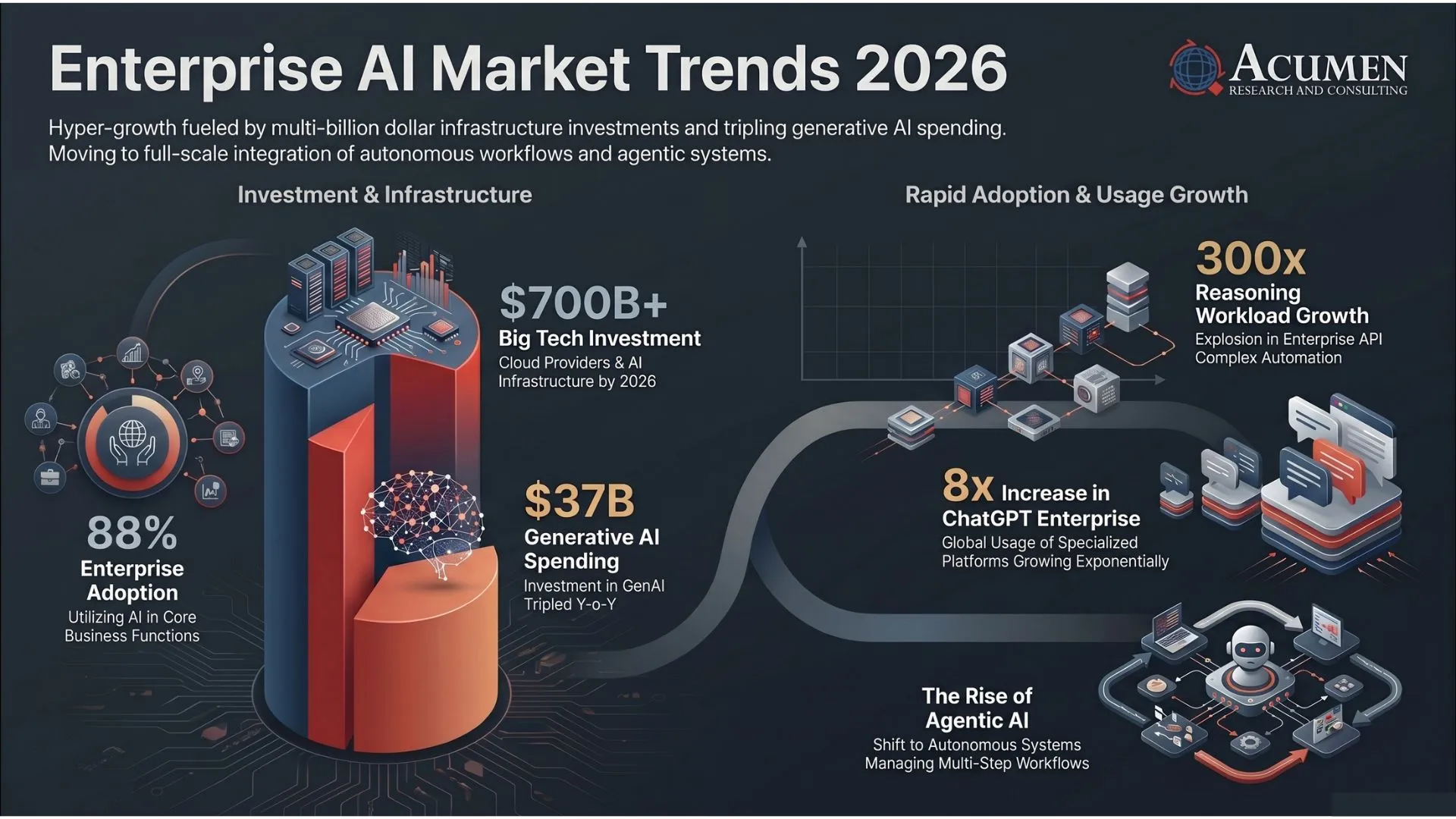
The Enterprise AI market is also witnessing massive investments from global technology companies, cloud providers, and venture capital firms as organizations race to integrate AI into core business operations. The parent AI industry itself is expanding rapidly, with global enterprise AI spending increasing significantly over the last two years. According to recent industry findings, nearly 88% of enterprises are already using AI in at least one business function, while enterprise investment in generative AI alone reached nearly USD 37 billion in 2025, almost tripling year-over-year.
One of the strongest indicators of long-term growth in the Enterprise AI market is the enormous infrastructure spending by major technology companies. Companies such as Microsoft, Google, Amazon, and Meta are expected to collectively invest more than USD 700 billion in AI infrastructure, cloud computing, and data center expansion by 2026. These investments are largely focused on supporting enterprise AI workloads, training large language models, and enabling AI-powered cloud services for businesses worldwide.
Enterprise Adoption of Generative AI is Growing Rapidly
OpenAI has also reported rapid enterprise adoption across industries. According to its latest enterprise AI report, ChatGPT Enterprise usage increased nearly 8x year-over-year, while enterprise API reasoning workloads grew more than 300x during the same period. The company now serves millions of enterprise users globally, highlighting how quickly AI is becoming integrated into everyday business workflows.
Generative AI tools are no longer limited to experimentation. Enterprises are actively deploying AI copilots, intelligent assistants, automated documentation systems, and AI-powered customer engagement tools to improve productivity and simplify business operations. This growing adoption is becoming one of the key drivers behind the rapid expansion of the Enterprise AI market.
Major Technology Companies are Strengthening Enterprise AI Capabilities
Several major developments by key market players are shaping the future direction of enterprise AI. Microsoft continues to integrate AI copilots across its enterprise software ecosystem, including productivity tools, cloud platforms, and cybersecurity systems, with the objective of improving workplace efficiency and automation.
Google is aggressively expanding its enterprise AI cloud capabilities and has strengthened partnerships to scale advanced AI infrastructure and enterprise-grade AI models. Amazon Web Services (AWS) is also heavily investing in enterprise AI infrastructure, enabling organizations to build custom generative AI applications using cloud-based AI platforms and proprietary AI chips.
Meanwhile, companies such as Salesforce, Oracle, SAP, and IBM are embedding AI-powered assistants, predictive analytics, and intelligent automation directly into enterprise business applications to improve operational efficiency, customer engagement, and enterprise-wide decision-making.
| Organization | Technology Type | Application Areas | Key Investments and Metrics | Operational Impact |
|---|---|---|---|---|
| Global Enterprises (Aggregate) | Generative AI, Agentic AI, LLMs, RAG | Finance, Healthcare, Retail, Manufacturing, Logistics, Supply Chain | Gen AI investment reached ~$37 billion in 2025; Market to surpass $600 billion by 2035; 40% productivity gain in skilled employees | Simplifying operations, reducing costs, and enabling autonomous workflows |
| Microsoft | AI Copilots, Generative AI, Cloud Platforms | Productivity tools, Cloud platforms, Cybersecurity systems | Part of >$700 billion collective investment in AI infrastructure by 2026 | Improving workplace efficiency and automation |
| Enterprise AI Cloud, Advanced AI Models | Enterprise AI infrastructure, Cloud computing | Part of >$700 billion collective investment in AI infrastructure by 2026 | Scaling advanced AI infrastructure for businesses | |
| Amazon Web Services (AWS) | Proprietary AI Chips, Cloud-based AI Platforms, Generative AI | Custom generative AI applications | Part of >$700 billion collective investment in AI infrastructure by 2026 | Enabling organizations to build custom generative AI applications |
| OpenAI | Generative AI, LLMs, Enterprise API | Everyday business workflows, Reasoning workloads | ChatGPT Enterprise usage increased ~8x YoY; API reasoning workloads grew >300x | Rapid integration of AI into everyday business workflows |
| Salesforce, Oracle, SAP, IBM | AI-powered assistants, Predictive analytics, Intelligent automation | Enterprise business applications, Customer engagement, Decision-making | NA | Improving operational efficiency and enterprise-wide decision-making |
Agentic AI and Autonomous Workflows are Emerging as Key Trends
Another major trend shaping the Enterprise AI market is the rise of agentic AI systems and autonomous enterprise workflows. Businesses are gradually moving beyond traditional AI chatbots toward intelligent systems capable of managing multi-step tasks, coordinating operations, and assisting in strategic decision-making processes with minimal human intervention.
Industries such as finance, healthcare, retail, manufacturing, and logistics are increasingly adopting these advanced AI capabilities to improve productivity, reduce operational costs, and strengthen competitive advantage. As enterprise environments become more data-intensive and interconnected, autonomous AI systems are expected to play a much larger role in day-to-day operations.
AI Governance and Security are Becoming Critical Priorities
Despite the rapid growth, enterprises are also focusing heavily on AI governance, security, and compliance. As AI becomes deeply integrated into sensitive business operations, companies are investing in responsible AI frameworks, cybersecurity protections, and transparent AI governance models to reduce operational and regulatory risks.
Organizations are recognizing that long-term success in the Enterprise AI market will depend not only on innovation but also on building trust, maintaining data security, and ensuring ethical AI deployment. This balance between rapid AI adoption and responsible implementation is expected to define the next phase of enterprise AI transformation globally.
Important Factors Driving the Growth of Enterprise AI Market
Technical Advancements in Enterprise AI
There are a variety of emerging technologies that are significantly impacting how enterprises process information, draw insights, and implement intelligent decisions in real time scenarios.
Large Language Models (LLMs), Retrieval-Augmented Generation (RAG), AI-powered analytics platforms, intelligent process automation, and agentic AI are a few of the recent advancements reshaping Enterprise AI. Due to modern cloud infrastructure, companies can now deploy sophisticated AI systems with the same consistency and scalability seen in enterprise-grade software platforms. These technologies help in coordinating different business functions across intelligent digital networks by transforming enterprise tools into truly intelligent systems. That reliability now makes enterprise AI solutions suitable for regular, real-world organizational work. Companies across all sectors must strike a different approach between adopting AI quickly in order to remain competitive and exercising caution since the technology is developing more quickly than their present systems. By making large and complex organizational environments—mainly global supply chains, financial systems, and customer-facing operations—more effective and data-driven, enterprise AI is assisting in closing this gap, particularly in settings where crucial decisions, people, and processes are continuously intersected.
Generative AI and LLMs to Elevate the Future of Enterprise AI Industry
Conversational AI assistants, enterprise copilots, AI-powered coding tools, autonomous agents, document intelligence platforms, and AI-driven customer experience solutions are among the few generative AI examples being implemented across various industries to simplify and enhance overall operations. Furthermore, AI-powered analytics engines can navigate complex and large-scale enterprise datasets in order to assist, risk management and strategic planning. Enterprise AI copilots offer considerable efficiency gains of up to 40% in skilled employee productivity.
Industries are Rapidly Adopting Enterprise AI to Simplify Operations
Industries like banking, healthcare, retail, and manufacturing are leading global adoption of advanced Enterprise AI, with the Asia-Pacific region moving faster. Intelligent customer service, financial risk analytics, healthcare administration and diagnostics, smart retail, human resource automation, legal intelligence, supply chain optimization, cybersecurity, and enterprise resource planning are just a few of the verticals where enterprise AI is generating enormous opportunities. Businesses in these industries are quickly incorporating intelligent data pipelines, autonomous decision systems, and AI-powered platforms, establishing the benchmark for the next significant stage of digital transformation. One of the main forces behind AI research and developments in the corporate AI sector is anticipated to be generative AI and huge language models. Multimodal AI, NLP, digital twin technologies, and intelligent security systems are also anticipated to have a major long-term impact on the transformation of several sectors.
Technological innovations and investments in AI-powered corporate platforms are spreading quickly across a number of industries. Cloud infrastructure earners, software integrators, data analytics firms, giant businesses, and even end users who are reorganizing their workflows around intelligent systems are all benefiting from enterprise AI developments and improvements.
Get Full Access of Report@ https://www.acumenresearchandconsulting.com/buy-now/0/3914
For any research needs or inquiries, feel free to reach out to us here. +91 8983225533 | sales@acumenresearchandconsulting.com