
Humanoid Robots in 2027: The Deployment Milestones Manufacturers Should Watch
Author: Acumen Research And Consulting



Key Takeaways
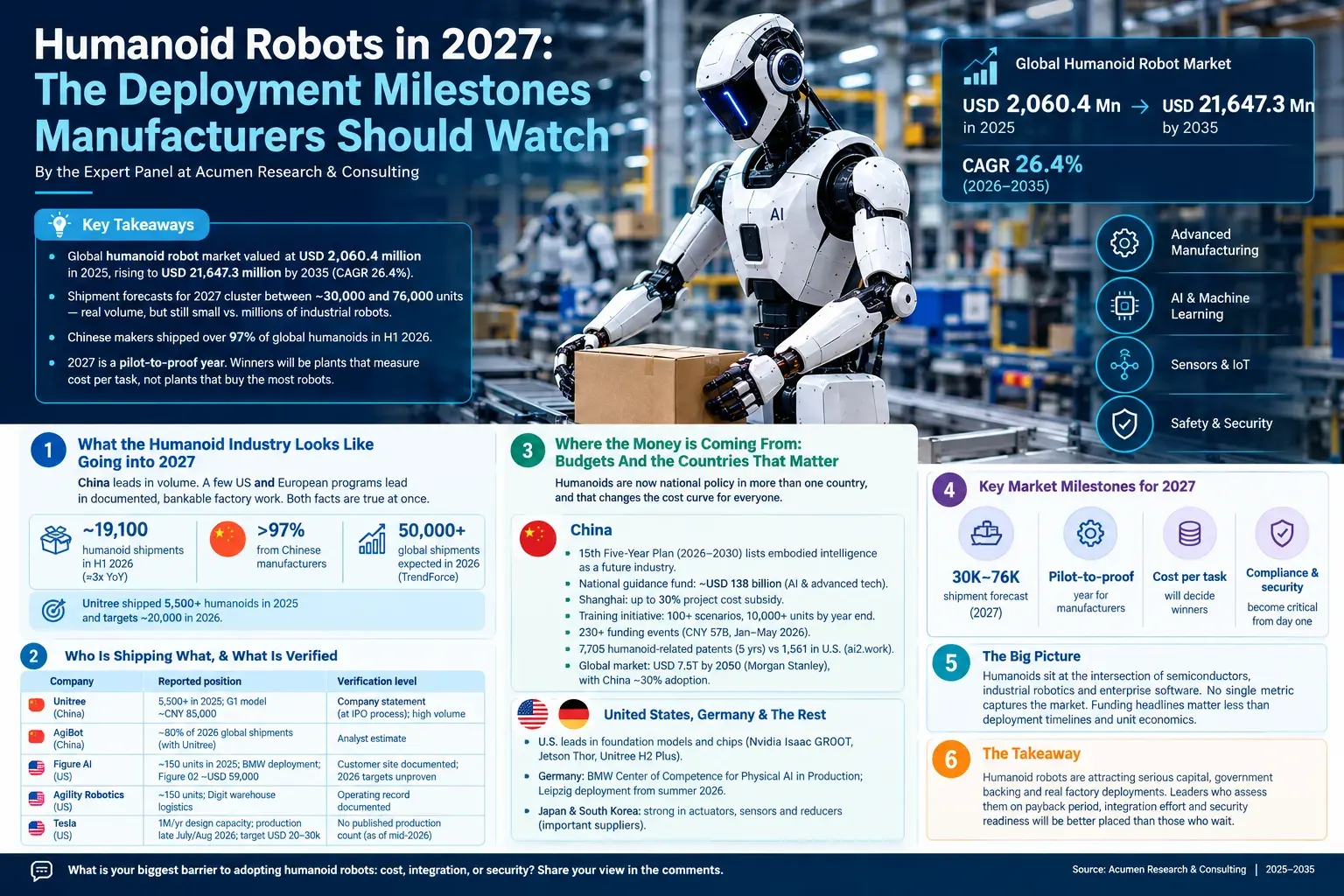
- Acumen Research & Consulting values the global humanoid robot market at USD 2,060.4 million in 2025, rising to USD 21,647.3 million by 2035 (CAGR 26.4%).
- Shipment forecasts for 2027 cluster between roughly 30,000 and 76,000 units, which is real volume but still tiny against millions of industrial robots already installed.
- Chinese makers shipped over 97% of global humanoids in the first half of 2026.
- 2027 is a pilot-to-proof year. The winners will be plants that measure cost per task, not plants that buy the most robots.
What the humanoid industry looks like going into 2027
The headline is a split. On volume, China leads by a wide margin. On documented, bankable factory work, a handful of US and European programs lead. Both facts are true at once, and mixing them up is the most common mistake we see in boardroom discussions.
Reports roughly stated 19,100 humanoid shipments in the first half of 2026, nearly triple the prior year, with Chinese manufacturers above 97% of the total. Unitree says it shipped more than 5,500 pure humanoids in 2025 and reportedly targets around 20,000 in 2026.
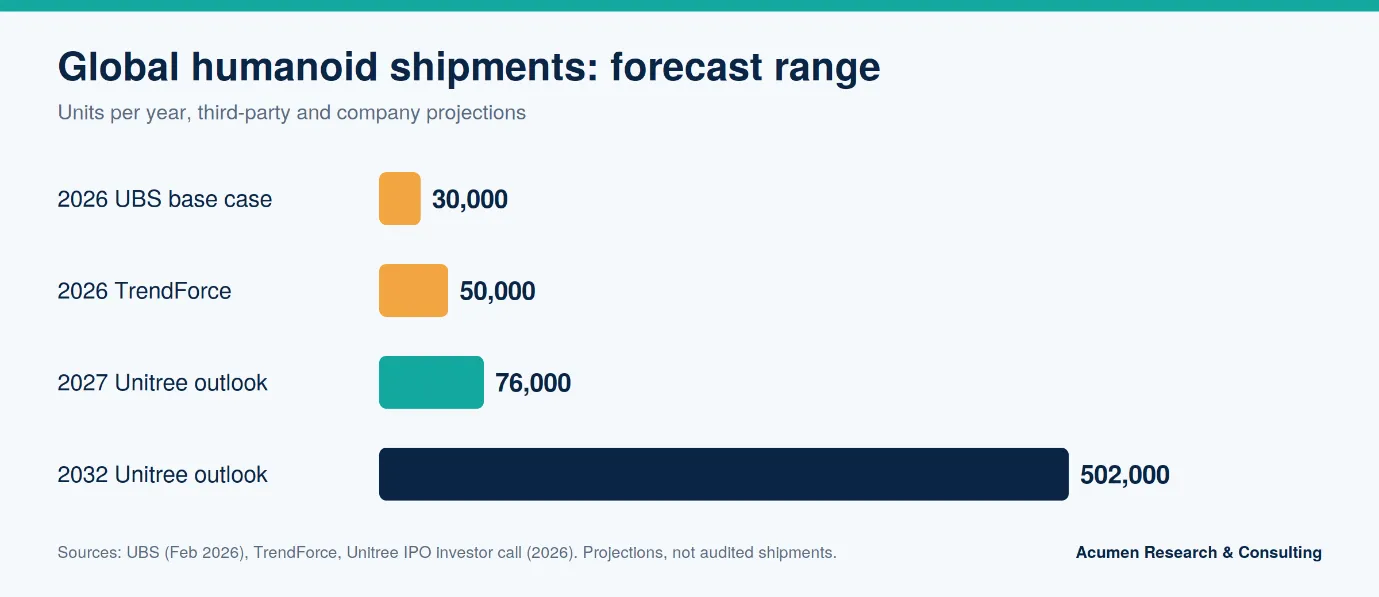
TrendForce expects global shipments to pass 50,000 units in 2026, while UBS holds a 30,000 unit base case and expects the real surge in 2027 and 2028.
The supplier map is crowded. One catalog counts more than 140 humanoid makers worldwide, and Digitimes counts over 150 in China alone, more than half of them startups or cross-sector entrants. Expect consolidation. In our experience, a market with that many entrants and few proven deployments tends to thin out within a few years, and buyers who sign long contracts with weak vendors carry the risk.
Who Is Shipping What, & What Is Verified
| Company | Reported position | Verification level |
|---|---|---|
| Unitree (China) | 5,500+ humanoids in 2025; G1 base model around CNY 85,000 | Company statement at IPO process; high volume |
| AgiBot (China) | With Unitree, projected near 80% of 2026 global shipments | Analyst estimate |
| Figure AI (US) | About 150 units in 2025; BMW Spartanburg deployment; Figure 02 near USD 59,000 | Customer site documented; 2026 targets unproven |
| Agility Robotics (US) | About 150 units; Digit used in warehouse logistics | Operating record documented |
| Tesla (US) | Fremont line designed for 1 million per year; production start guided for late July or August 2026; long-run price target USD 20,000 to 30,000 | No published production count as of mid-2026 |
Tesla deserves a careful read. Elon Musk acknowledged in January 2026 that no Optimus units were doing useful work inside Tesla facilities, against an earlier plan for about 10,000 in 2025. China's rare earth magnet export curbs also disrupted Optimus supply this spring. A design capacity of one million units says little about what the first twelve months of output will look like.
Where the Money is Coming From: Budgets And the Countries That Matter
Humanoids are now national policy in more than one country, and that changes the cost curve for everyone.
China
The 15th Five-Year Plan (2026 to 2030) lists embodied intelligence as one of six future industries, next to quantum technology and fusion energy. APCO reports a national guidance fund of about USD 138 billion for AI and advanced technology. Shanghai subsidizes up to 30% of project costs or humanoid purchases. A 2026 real-world training initiative aims for routine deployment across more than 100 high-value scenarios and 10,000+ units by year end.
Private money follows. Digitimes counts more than 230 embodied AI funding events worth over CNY 57 billion between January and May 2026. Patent filings tell the same story: 7,705 humanoid-related patents in China over five years against 1,561 in the U.S., according to ai2.work. Morgan Stanley's long-range view puts the global humanoid market at USD 7.5 trillion by 2050, with China holding roughly 30% of adoption.
United States, Germany & The Rest
The U.S. leads on foundation models and chips. Nvidia now offers an open reference design built on Isaac GR00T, Jetson Thor and Unitree's H2 Plus body, which shows how entangled the two ecosystems already are. In Germany, BMW set up a Center of Competence for Physical AI in Production and planned a Leipzig deployment from summer 2026. Japan and South Korea remain strong in actuators, sensors and reducers, which makes them important suppliers even where they are not leading in finished robots.
Country Watchlist for 2027
| Country | Strength | Signal to track in 2027 | Risk for buyers |
|---|---|---|---|
| China | Volume, cost, state funding | Whether the 10,000+ unit training initiative reaches real production tasks | Export controls, data governance, vendor churn |
| United States | AI models, chips, enterprise pilots | First audited Optimus output; Figure and Agility fleet counts | Rare earth supply, tariffs, ramp delays |
| Germany / EU | Automotive integration, safety standards | Scale-up beyond BMW pilot sites | Certification pace, high unit cost |
| Japan / South Korea | Precision components | Supplier wins in actuators and batteries | Dependence on foreign assemblers |
The Market Size Picture, & Why Batteries Matter
According to Acumen Research & Consulting, the global humanoid robot market is projected to grow from USD 2,060.4 million in 2025 to USD 21,647.3 million by 2035, a CAGR of 26.4% over 2026 to 2035. Applying that rate gives an implied figure near USD 3,300 million in 2027, though that is our straight-line reading, not a separate forecast.
The faster story sits one layer down. The global humanoid robot battery market was valued at USD 15 million in 2025 and is expected to reach USD 3,288.09 million by 2035, a CAGR of 71.4%. That growth rate is nearly three times the robot market itself, and it points at a real constraint. Runtime per charge, swap logistics and thermal safety decide whether a robot works a full shift or stands at a charger. Manufacturers who treat batteries as an afterthought in a pilot will be surprised by the shift-coverage math.
The Six Deployment Milestones to Watch in 2027
| Milestone | What good looks like |
|---|---|
| Audited production counts | Tesla, Figure and Agility publish units built and units working |
| Price near the USD 20,000 to 30,000 band | Credible quotes, not target prices |
| Safety standards for dynamically stable robots | Clear certification paths for work near people |
| Full-shift autonomy | 8 hours with swap or charge plan and low interventions |
| Rare earth and actuator supply stabilizes | Lead times fall, magnet supply diversifies |
| Second-wave customers | Plants beyond the lighthouse names report repeat orders |
Risks That Rarely Make the Press Release
- Supply chain: Rare earth magnets and precision actuators are concentrated in a few countries.
- Workforce: Unions and works councils will ask about job impact. Present humanoids as task relief for hard-to-fill roles and back that with retraining plans.
- Vendor survival: With 140+ makers, assume some will fail. Insist on escrow or service continuity clauses.
- Cyber and data: A walking robot with cameras is a networked endpoint. Segment it from your core systems.
- Hype gap: Unitree's Q1 2026 profit fell 52% year on year even as the sector rallied, a reminder that volume does not equal margin.
Our Outlook for 2027
We expect 2027 to be the year humanoids move from lighthouse pilots to a small set of repeatable use cases in automotive, electronics and logistics. UBS expects shipment volume to concentrate in 2027 and 2028, and the Unitree outlook of 76,000 units for 2027 supports that direction. Even at that level, humanoids remain a rounding error next to the roughly 2 million industrial robots operating in China alone, according to the IFR. The practical conclusion is to treat humanoids as a complement to proven automation, not a replacement.
Get the full Acumen humanoid robot market report
Segment forecasts, regional models, battery supply chain analysis and competitor profiles. Connect with us at: sales@acumenresearchandconsulting.com
Frequently asked questions
How many humanoid robots will ship in 2027?
- Forecasts range from tens of thousands to the mid tens of thousands. Unitree projects 76,000 units globally, and UBS expects the heaviest volume in 2027 and 2028.
What is the humanoid robot market size?
- Acumen Research & Consulting estimates USD 2,060.4 million in 2025 growing to USD 21,647.3 million by 2035.
Which countries are investing most?
- China leads on state backing, including a roughly USD 138 billion guidance fund and local subsidies. The US leads on AI models and chips, and Germany on automotive integration.
Should a mid-size manufacturer buy humanoids in 2027?
- Pilot first. Run a scoped trial with fixed KPIs and decide on scale only after you have measured cost per task and intervention rate.