
Cold Chain Market Size, Share, Trends, Forecast 2026 To 2035
Cold Chain Market (By Type: Cold Storage, Refrigerated Transportation; By Temperature Range: Chilled (0°C to 8°C), Frozen (-18°C to -25°C), Deep Frozen/Cryogenic (-40°C to -196°C); By Application: Food & Beverages, Pharmaceuticals & Healthcare, Chemicals, Floral & Horticulture, Others) - Global Industry Analysis, Size, Share, Growth, Trends, Regional Analysis And Forecast 2026 To 2035
- Last Updated: 03 Jul 2026
- Report Code: ARC3946
- Category: Consumer Goods and Food and Beverages
Cold Chain Market Size, Forecast 2026 To 2035
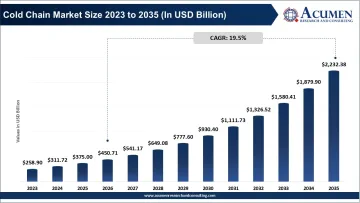
The global cold chain market size was estimated at USD 375 billion in 2025 and is projected to surge around USD 2,232.38 billion by 2035; represents a remarkable CAGR of 19.5% during the forecast period from 2026 to 2035. The overall rising demand for temperature-sensitive biologics, vaccines and specialty drugs according to shift in regulatory compliance has created a strong driving factor for the cold chain market. Additionally, rapid rise in online goods deliveries and expansion of e-commerce lead to robust investments in cold chain infrastructure, while helping the market to boom.
Report Highlights
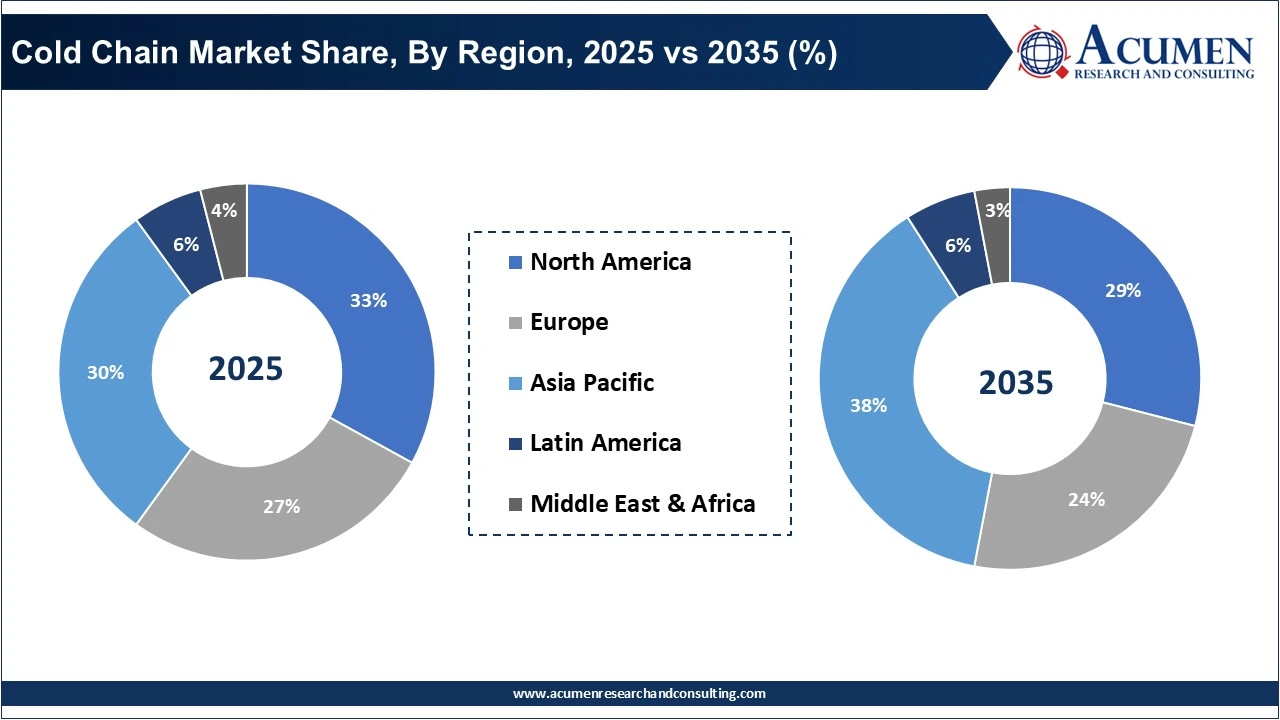
- North America held the largest share in the global cold chain market in 2025 and accounted for 33% of the market. Strong refrigerated warehousing infrastructure, high consumption of frozen food, and increasing demand for pharmaceutical cold chain infrastructure contribute to the growth of this region.
- Asia Pacific had a market share of 30% in 2025 and is expected to grow at the fastest CAGR of 22.6% during the forecast period, attributed to the increasing rate of urbanization, increasing food export from the region and rising demand for pharmaceutical manufacturing.
- By type, the cold storage segment held the largest market share of 58% in 2025, due to its application in long-term storage of perishables such as dairy, fruits & vegetables, seafood and cold storage for vaccines & biologics.
- By temperature range, the chilled (0°C to 8°C) segment captured the highest market share of 48% in 2025 and is expected to maintain its dominance. This segment is expected to be driven by increasing last-mile delivery, international food trade and growing online grocery delivery infrastructure.
- By temperature range, the deep frozen/cryogenic (-40°C to -196°C) segment is projected to grow at the fastest CAGR of 20.7% from 2026 to 2035 owing to rising adoption of gene therapy, cell therapy, biologic & mRNA vaccines across the globe.
- By application, food & beverages segment dominated the global cold chain market with the highest share of 69% in 2025. Increasing global demand for processed food, seafood, dairy & food products, fruits, and vegetables are driving the growth of this segment.
- By application, the pharmaceuticals & healthcare segment accounted for 17% of the market share in 2025, driven by the increasing growth of biological products and biologics, and rising production and demand of vaccine and specialty drugs.
What is Cold Chain Market?
The cold chain market involves facilities, processes, and technology necessary to preserve the integrity of product in low temperature-controlled environment during logistics cycle. The cold chain infrastructure safeguards products from spoilage, food waste, and efficacy of medical product during transportation and storage such as for healthcare, food and beverage and biopharmaceutical sector. Some of the most important cold chain solutions consist of chilling and frozen warehousing, refrigeration containers and trucks, and other temperature monitoring devices (Internet of Thing sensors) used across air and sea.
As the proliferation of online groceries delivery and distribution of medical supplies increase across regions, the role of cold chain in the current day supply chain has expanded and became an inevitable process. The rapid expansion of the pharmaceutical and biologics industries, coupled with increasing demand for temperature-sensitive vaccines and specialty drugs, is significantly driving the growth of the cold chain market.
Emerging Technologies in the Cold Chain Market
1. IoT-Enabled Temperature Monitoring Systems
Internet of Things (IoT) sensors have been revolutionary for cold chain logistics, allowing real-time tracking of temperature, humidity, and location throughout transport and storage. Such systems help decrease spoilage, enhance compliance, and improve visibility of supply chain operations. Leading logistics companies like DHL and Maersk, for example, are implementing IoT enabled reefers for pharmaceutical and food distribution.
2.AI and Predictive Analytics
AI technology helps optimize routing of deliveries, predict demand trends, forecast equipment failure and minimize energy costs. Additionally, it’s employed for predictive analysis that will alert of potential temperature excursions prior to they can actually take place. New York based logistics provider, Lineage Logistics, for example, is utilizing an AI-powered warehouse management system.
3. Automated storage and Retrieval systems (AS/RS)
Robotics for pallet loading and autonomous forklift operation increase delivery speed, decrease need of personnel and boost capacity within refrigerated warehouses. NewCold operates one of the largest automated cold storage warehouses in the world.
4. Blockchain for Supply Chain Visibility
Blockchain has become increasingly well-liked to present end-to-end transparency, particularly for cold supply chains in the pharmaceuticals market in which integrity as well as authenticity are vital. This tech builds an indisputable history of warehousing as well as transit circumstances.
Market Dynamics
What is Driving the Growth of Cold Chain Market?
The demand for pharmaceuticals such as vaccines, biologics, and temperature sensitive medicines is expanding, this is the primary factor for driving market growth in the cold chain industry. This growing need can be primarily seen with an increase in the global vaccination rates, growth of biological drug production, rise in speciality drugs.
Furthermore, with a growing consumption of processed foods and frozen items, rising cross border trading of such goods, and the development of e-commerce online grocery delivery services the industry of smart monitoring devices and services, cold storage warehouse and refrigerated transport is growing extremely rapidly.
What are Major Challenges in the Cold Chain Market?
The cold chain market is struggling from a number of key challenges. One such major challenges faced by the industry is due to the infrastructure costs. Building of temperature controlled warehouses requires significant investment. Along with the maintenance of temperature control, transporting at specific temperatures is not economical as it takes a lot of fuel, for example electricity to power large freezer units in a warehouse.
Apart from this the fluctuations in temperature during transport can be harmful for many sensitive products, not all developing regions can afford advanced cold chain infrastructure and the transportation of goods is getting expensive day by day as per the electricity and fuel cost goes up. Compliance with regulations such as strict temperature control required for pharmaceutical logistics is also one such major challenge.
What is the Largest Opportunity for the Cold Chain Market?
A majority of growth opportunity for the cold chain market can be identified in adoption of advanced technologies which can manage everything at better speed, precision and can offer the complete visibility. The industry of smart monitoring technologies, IoT which tracks temperature of goods in real time, AI which suggests optimized transport routes and smart automated systems are revolutionizing the cold chain management and provide huge opportunities in future.
The increased production of biologic drugs, gene therapies and mRNA vaccines requiring storage at ultra-low temperatures have also opened avenues for new revenue generation by specialized cold chain service providers. Countries like India, Brazil and China also present huge opportunities for expansion due to their rising food exports, strengthening healthcare sector and increase in investments for establishing organized cold chain infrastructure.
Regional Insights
What Made North America Dominate the Cold Chain Market in 2025?
In 2025, the cold chain market was led by the North America region, with a market share of 33.0%. Strong refrigeration infrastructure, the extensive use of frozen foods and a well-developed pharmaceutical cold chain sector contributed significantly to North America’s leadership. North America’s cold chain market size is estimated at nearly $123.75 billion in 2025 and is expected to reach over $647.39 billion by 2035, growing at a CAGR of 17.8%.
North America’s dominance is fueled by a large number of dominant players like Americold Realty Trust, United Parcel Service, and Lineage Logistics, along with demand from biologic transportation, vaccine storage and consumer demand for fresh & frozen food. Furthermore, expanding consumer preference for frozen ready meals, meat products, seafood, and a boom in e-commerce grocery deliveries is fueling investment in the refrigerated transportation and storage sectors.
U.S. Cold Chain Market Overview
The U.S. is the largest cold chain market in the world, characterized by highly developed logistics infrastructure, robust pharmaceutical distribution channels, and a high demand for frozen foods. The U.S. Is also the hub of the largest cold storage operators in the world, including Lineage Logistics, which controls millions of cubic feet of temperature-controlled warehouse capacity. The U.S. contributes to a substantial portion of pharmaceutical cold chain demand because of increased transit of biologics, vaccines, insulin, and specialty pharmaceuticals.
What Makes Asia Pacific the Fastest Growing Region in the Market?
In 2025, the Asia-Pacific held a 30% share of the global market and stood as the second biggest regional market. From 2026 to 2035, Asia Pacific is poised to become the fast-growing sector, demonstrating a CAGR of 22.6%. Increased urbanization, greater food exports, exponential growth in pharmaceuticals production and cold storage government investments are some of the factors boosting growth.
China, India, and Japan are contributing in a huge extent to the market. China has a strong marketplace for cold chain infrastructure, majorly driven by key domestic firms, infrastructure investments an urban grocery delivery networks. On the other hand, areas such as Indonesia, Malaysia and Vietnam are seeing rapid growth while considering the vast meat/seafood consumption.
India Cold Chain Market Overview
India cold chain market has quickly established itself as a growing industry on a worldwide scale because of greater overall food consumption, pharmaceutical manufacturing operations, and government infrastructure investments that are driving a modern supply chain approach. India produces considerable volumes of produce, seafood, and milk, but the food wastage rate of 15%-20% annually emphasizes the necessity for cold chain facilities to store the country’s goods.
Also, India's expansion in vaccine manufacturing, as well as the rise of the biologics industry, has elevated the demand for pharmaceutical cold chain capacity. Additionally, public initiatives, such as Pradhan Mantri Kisan Sampada Yojana, alongside private investment in well-organized cold warehouses, are driving growth, enabling companies such as Snowman Logistics and ColdEX to extend their reach and build temperature-controlled networks.
Top Government Initiatives & Schemes for Promoting Cold Chain Industry
| Country | Government Initiative / Scheme | Key Focus / Significance |
|---|---|---|
| India | Pradhan Mantri Kisan Sampada Yojana (PMKSY) | Aims to strengthen food processing and cold chain infrastructure by providing financial assistance for integrated cold chain and value addition projects. |
| United States | USDA Cold Storage Infrastructure Grants | The United States Department of Agriculture supports cold storage expansion through grants and funding programs focused on reducing supply chain bottlenecks. |
| China | 14th Five-Year Cold Chain Logistics Plan | The Chinese government has prioritized cold chain modernization with heavy investments in refrigerated warehouses, transport fleets, and food logistics infrastructure. |
| Japan | Smart Logistics and Cold Chain Modernization Program | Japan is investing in advanced cold chain technologies such as IoT-based monitoring, automated cold warehouses. |
| Germany | National Hydrogen and Sustainable Logistics Strategy | Germany promotes energy-efficient cold chain logistics through subsidies for electric refrigerated vehicles, low-emission refrigeration systems. |
Segmental Insights
Type Insights
With 58% of total market share in 2025, the cold storage segment will continue to remain dominant. Increased demand for long-term storage of perishable food products, meat & dairy products, seafood products, pharmaceuticals and biologics is driving demand of the segment. Further, increase in organized retail, requirement for inventory buffering and growing vaccine storage have fueled need for temperature controlled warehousing.
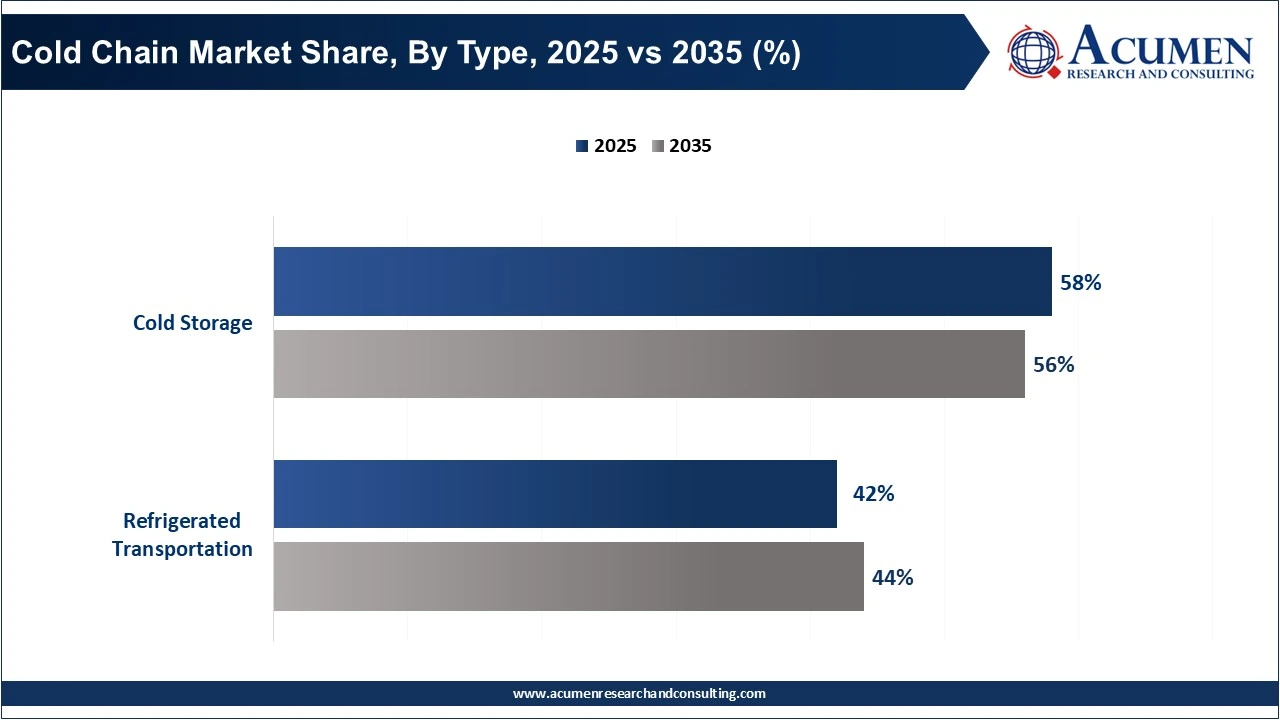
The refrigerated transportation segment held 42% of total market share in 2025 and it is estimated to hold 44% of total market share by 2035 as last-mile and international logistics segment expands. Increase in trade of food products globally, rising pharmaceutical exports and growth in online grocery delivery services contributed to growth of the refrigerated transportation segment.
Temperature Range Insights
The chilled (0C to 8C) segment accounted for the highest share of 48% in 2025 and is expected to continue its dominance. This segment reached about USD 216.34 billion in 2026 and is estimated to reach USD 1,026.89 billion by 2035, exhibiting a CAGR of 18.9%. The increased demand for milk and dairy products, fresh produce, beverages, and several pharmaceutical applications necessitate mild-temperature storage; thus, the growth is robust in this segment, which currently remains a well-established temperature category in the food and healthcare supply chains.
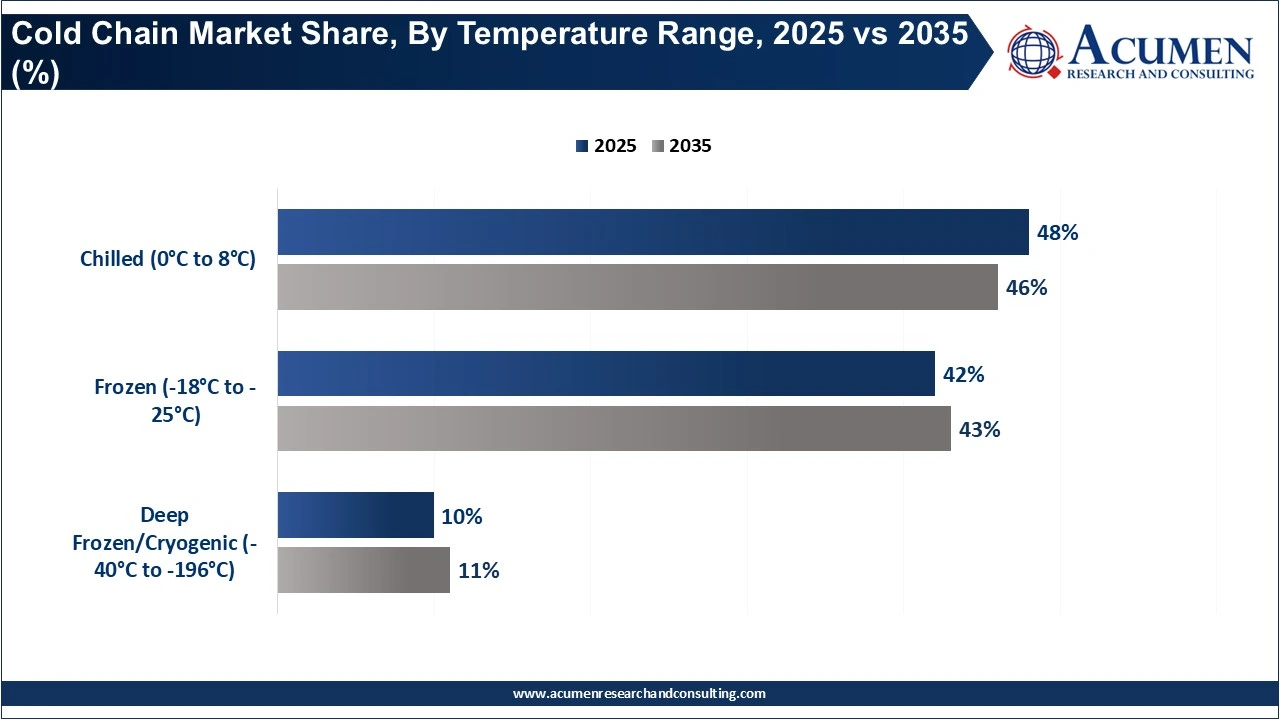
The deep frozen/cryogenic (-40C to -196C) segment is the fastest growing, with an expected CAGR of 20.7% in the forecast period. The segment is estimated to grow from USD 45.07 billion in 2026 to USD 245.56 billion in 2035. This accelerated growth is due to the rising application of complex and innovative medicines like advanced biologics, cell therapies, gene therapies, and mRNA vaccines that require extremely low-temperature storage conditions. Growth in cryogenic bio-banking and precision medicine also aids the expansion of the deep frozen/cryogenic segment.
Application Insights
The food & beverages segment had the largest share in the cold chain market in 2025, holding a dominant 69% of the market. The market size was fueled by rising demand for frozen foods, dairy, seafood, processed meat, and fresh produce across the globe. Increase in the online grocery segment, expanding metropolitan populations, as well as altering consumer lifestyles and dietary preferences are increasing demand for refrigerated transport and storage infrastructure. Food spoilage issues and rising awareness in regards to the importance of food safety are encouraging industries to deploy superior cold chain technologies.
| Application | Revenue Share, 2025 (%) |
|---|---|
| Food & Beverages | 69% |
| Pharmaceuticals & Healthcare | 17% |
| Chemicals | 7% |
| Floral & Horticulture | 3% |
| Others | 4% |
The pharmaceuticals & healthcare sector accounted for a market share of 17% in 2025, making it the second-largest segment. There has been a surge in the distribution of biologics, vaccines, insulin, and blood products, driving the demand for the highly regulated chilled transport infrastructure. In addition to that, rise in the R&D of clinical trials, biologics development, and personalized medication is contributing to growth.
Chemical segment constituted 7% of the market share in 2025. This segment comprises the transport of hazardous and delicate chemical products and fertilizers that require the best temperature regulation to preserve the quality of the product in transit. Despite the comparatively lower share these sectors are of great significance for trade growth globally.
Top Players
Tier 1: Global Market Leaders
These companies dominate the global cold chain market through extensive warehousing capacity, broad geographic reach, and integrated logistics capabilities.
- Lineage Logistics
- Americold Realty Trust
- A.P. Moller - Maersk
- United Parcel Service
- DHL
- Kuehne+Nagel
Tier 2: Regional Expansion Leaders
These players maintain strong regional dominance and are actively expanding their cold storage and transportation footprint.
- NewCold
- Nichirei Corporation
- CEVA Logistics
- DB Schenker
- United States Cold Storage
- Congebec Logistics
Tier 3: Emerging Innovators & Local Specialists
These companies are rapidly growing through niche specialization, regional market penetration, and technology-driven cold chain solutions.
- Snowman Logistics
- Burris Logistics
- Sonoco Products Company
- Wabash National Corporation
- Tippmann Group
- ColdEX
Recent News
- In July 2026, CMA CGM announced the acquisition of FedEx Supply Chain for US$ 1.4 billion, significantly expanding its cold chain and third-party logistics footprint in North America through its subsidiary CEVA Logistics. The deal adds 34 million square feet of warehouse capacity and strengthens temperature-controlled logistics capabilities.
- In October 2024, Cold Chain Technologies completed its acquisition of Tower Cold Chain to expand its reusable temperature-controlled packaging portfolio and enhance global pharmaceutical cold chain logistics. This move strengthens its market position in biologics and vaccine transportation.
Segments Covered
By Type
- Cold Storage
- Refrigerated Transportation
By Temperature Range
- Chilled (0°C to 8°C)
- Frozen (-18°C to -25°C)
- Deep Frozen/Cryogenic (-40°C to -196°C)
By Application
- Food & Beverages
- Pharmaceuticals & Healthcare
- Chemicals
- Floral & Horticulture
- Others
By Region
- North America
- Europe
- Asia-Pacific
- Latin America
- Middle East & Africa
Looking for discounts, bulk pricing, or custom solutions? Contact us today at sales@acumenresearchandconsulting.com
Frequently Asked Questions

Other Consumer Goods and Food and Beverages Reports
October 2018
March 2023
March 2023
March 2025