
Digital Transformation Market Size, Share, Trends, Report 2026 To 2035
Digital Transformation Market (By Offering: Technology / Solutions, Hardware / Infrastructure, Services; By Transformation Area: IT Transformation, Business Process Transformation, Customer Experience Transformation, Workforce Transformation, Product & Business Model Transformation; By Deployment: Cloud, On-Premises, Hybrid; By Enterprise Size: Large Enterprises, SMEs; By Industry: BFSI, IT & Telecom, Healthcare & Life Sciences, Manufacturing, Retail & Consumer Goods, Energy & Utilities, Transportation & Logistics, Government & Public Sector, Others) - Global Industry Analysis, Size, Share, Regional Analysis, Trends and Forecast 2026 - 2035
- Last Updated: 17 Sep 2026
- Report Code: ARC3981
- Category: ICT
Digital Transformation Market Size, Forecast 2026 To 2035
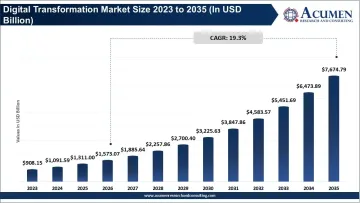
The global digital transformation market size was accounted for USD 1,311 billion in 2025 and is projected to reach around USD 7,674.79 billion by 2035; while growing at a CAGR of 19.3% during the forecast period of 2026-2035. Enterprises are becoming more selective about transformation investments, placing greater emphasis on measurable business outcomes, integration with existing systems, data readiness, cybersecurity, and return on investment. This transition is creating opportunities for technology vendors, cloud providers, system integrators, consulting firms, cybersecurity companies, and specialized AI providers that can demonstrate measurable improvements in productivity, revenue generation, customer engagement, and operational efficiency.
Report Highlights
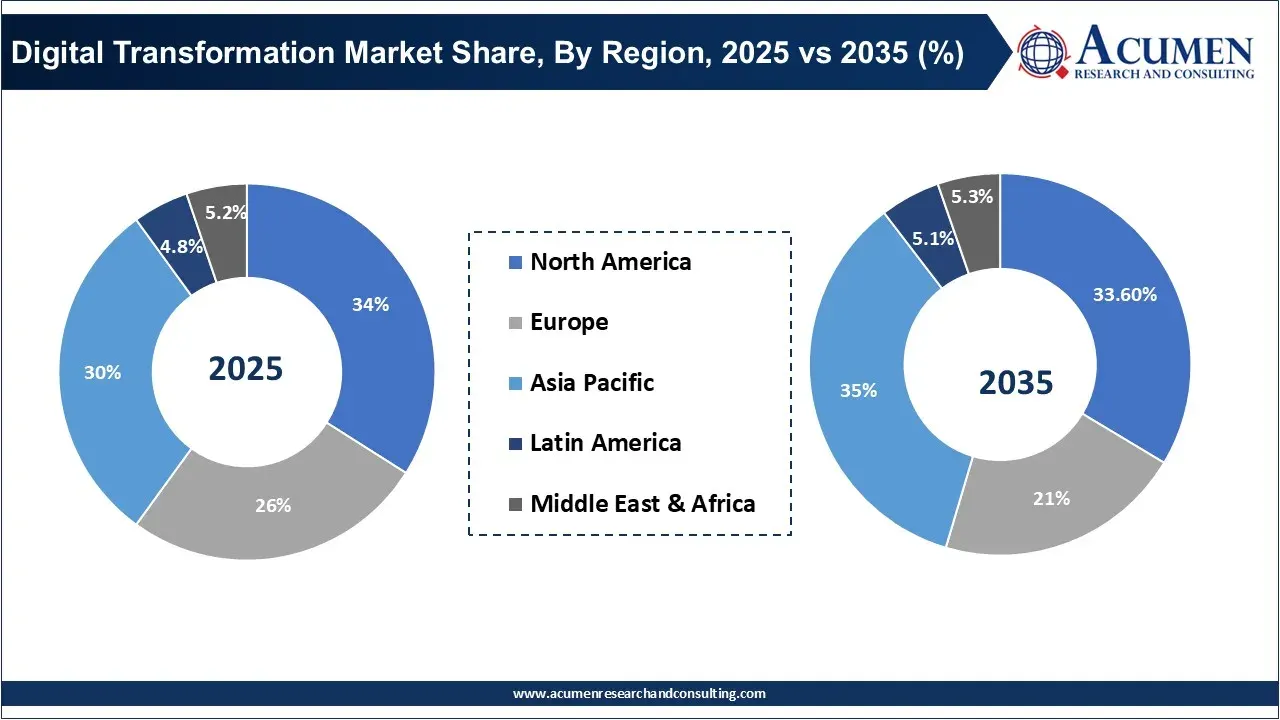
- By region, Asia-Pacific accounted for 30% of the market in 2025 and is expected to become the largest regional market with a 35% share by 2035, supported by rapid AI, cloud, 5G, data-center, and enterprise digitization investments. Current 2026 research also identifies strong regional technology and AI investment momentum, including projected 9.3% technology-spending growth across Asia-Pacific.
- By region, Asia-Pacific is expected to record the fastest regional growth at a 21.3% CAGR from 2026 to 2035, with market value increasing from $471.92 billion in 2026 to $2,686.18 billion by 2035, reflecting accelerating enterprise modernization across major Asian economies.
- By offering, technology/solutions dominated the digital transformation market with a 60.0% share in 2025, supported by enterprise demand for cloud, AI, automation, analytics, cybersecurity, and digital platforms.
- By offering, services represented the second-largest segment with a 25% share in 2025 and are expected to grow at the fastest CAGR of 19.8% through 2035, driven by increasing demand for implementation, integration, consulting, modernization, and managed transformation services.
- By transformation area, business process transformation accounted for the largest share of 30% in 2025, reflecting growing enterprise focus on workflow automation, process optimization, AI, analytics, and digitally enabled operating models.
- By transformation area, product and business model transformation is expected to be the fastest-growing segment at a 21.7% CAGR from 2026 to 2035, supported by the development of digital products, subscription models, platform-based services, and data-driven revenue streams.
- By deployment, cloud accounted for the dominant 62% share of the digital transformation market in 2025, driven by demand for scalable infrastructure, flexible computing, rapid application deployment, and access to advanced digital technologies.
- By deployment, on-premises deployment held the second-largest share of 23% in 2025, supported by enterprises requiring greater control over sensitive data, legacy applications, infrastructure, and regulatory compliance.
- By enterprise size, large enterprises dominated the digital transformation market with a 70.0% share in 2025, supported by larger technology budgets, complex IT environments, extensive legacy infrastructure, and multi-year transformation programs.
- By enterprise size, SMEs accounted for 30% of the market in 2025, with cloud platforms, SaaS, low-code technologies, and managed services helping reduce the cost and complexity of digital transformation.
- By industry, BFSI dominated the digital transformation market with a 23.4% share in 2025, driven by investments in digital banking, mobile platforms, fraud detection, AI analytics, cybersecurity, and modernization of core financial systems.
- By industry, IT and telecom represented the second-largest named industry segment with a 13.0% share in 2025, supported by continued investment in cloud infrastructure, AI, automation, cybersecurity, analytics, and digital service platforms.
Digital Transformation Market Overview
The digital transformation market is no longer about migrating conventional technology to modern-day technology, instead organizations will focus on AI- driven, whole enterprise transformation, relying on generative AI, cloud computing, automation, data analysis, cybersecurity and digital business models.
Businesses are investing heavily in digital technologies as they are moving their operations away from just replacing obsolete infrastructure and lowering operational costs to enhancing customers experience, quicker decisions and bringing in new products, enhancing automated working, and enabling more revenue streams.
The global it spending was forecasted to grow by 7.9% to reach around $5.43 trillion in 2025, with an emphasis on data center systems, software and it services being widely invested as enterprises build more of the AI enabled, and cloud based systems. of all that goes into digital transformation, AI will be taking up a sizable portion of it with global AI spending to be nearly $1.5 trillion in 2025.
Generative AI further changes the composition of investments made toward the digital transformation. With generative AI, the focus will shift from just research and development to the enterprise application of the AI technologies, through automation of workflows, software development, customer interactions, management of knowledge, and aiding in decisions.
Can Digital Transformation Create New Revenue Streams Rather Than Just Reduce Costs? Know I from Our Experts
Our market researchers at Acumen Research and Consulting concur that the motivation of digital transformation is gradually shifting from cost optimization to revenue generation. If early transformation initiatives were characterized by automation of routine functions, lowering IT costs and process efficiencies, companies now leverage AI, cloud, connected devices, digital marketplaces, analytics, and new subscription models to expand their top line, with largest opportunities arising when business model is revamped around digital capabilities.
| Digital Transformation Category | Revenue Opportunity | 2026 Key Highlight |
|---|---|---|
| AI-enabled products | New product and service revenue | 80% of surveyed software companies already offer AI-enabled products or features, while 47% identify increasing customer value as the leading reason for introducing AI capabilities. |
| Subscription models | Recurring revenue | AI-powered subscription apps generate 41% higher first-year revenue per payer than non-AI apps, with median Y1 realized lifetime value of $30.16 versus $21.37. |
| Data monetization | New information-based revenue | 18% of companies using outcome-based AI pricing now link pricing to revenue generated, indicating a shift toward monetizing measurable business value rather than simply selling technology features. |
| Connected products | After-sales revenue | Samsara's connected operations platform generated $2.125 billion in annual recurring revenue in 2026, up 30% year over year, demonstrating the revenue potential of combining connected hardware with recurring digital services. |
| Digital marketplaces | Platform commissions | Digital platforms are increasingly moving toward usage- and outcome-based monetization. In a 2026 survey of enterprise software companies, only 26% expected to remain subscription-only, compared with 37% currently. |
| Personalization | Higher conversion and customer value | 2026 research indicates that personalized experiences can deliver approximately 2x higher conversion rates, while AI-driven recommendations can increase average order value by 44%. |
Revenue generation opportunity is also evident in enterprise investments. According to recent survey findings, 80% of Indian companies invested in AI and technologies for revenue growth objectives, with only 12% adequately measuring the ROI. There is significant difference between investing in digital and monetizing it, the findings suggest.
Where Are Enterprises Spending Their Digital Transformation Budgets? Read How GenAI is Standing Out in the Race
- Global AI spending is estimated at $2.52 trillion in 2026, representing a 44% year-over-year increase.
- A later Gartner update puts 2026 AI spending at $2.59 trillion, reflecting 47% year-over-year growth. More than 45% of AI spending is going toward AI-optimized infrastructure, including AI servers, networking, semiconductors and optimized infrastructure services.
- Enterprise AI investment in India increased 119% in 2026, compared with 110% globally. AI currently accounts for 16.6% of average IT budgets in India, with the share expected to reach 21.3% by 2027.
- The top five global technology companies are expected to invest more than $1 trillion in AI across 2025-2026, illustrating the extraordinary scale of infrastructure and technology investment surrounding AI.
- Gartner research reported in September 2026 indicates that 85% of functional leaders plan to increase AI spending in 2026, while companies had already allocated an average of 12% of their 2025 budgets to AI.
- AI infrastructure spending is also accelerating. Gartner-related research indicates AI-optimized infrastructure spending is growing 96% in 2026, reaching about $42 billion, while inference spending is expected to reach $23.3 billion.
- Stanford's 2026 AI Index reports that generative AI reached 53% population-level adoption within three years, faster than the PC or internet.
- The 2026 AI Index also reports that global corporate AI investment more than doubled in 2025, with generative AI investment growing by more than 200%. This is useful as a recent baseline feeding into 2026 enterprise spending analysis, but I would label it 2025 investment data, not 2026.
Market Dynamics
Driver
AI-Driven Enterprise Modernization Is Accelerating Digital Transformation Investment
The accelerated integration of AI, generative AI, automation, cloud, and big data analytics is a primary force of transformation. Enterprises are increasingly incorporating AI throughout their customer, operations, products, supply chain, finance, marketing, and decision making practices rather than deploying technologies in separate efforts. According to a 2026 survey, nearly 40% of Indian firms claim to be currently using AI to a significant or a full degree compared to about 28% for global firms, while the scale adoption is 62% for product development, 56% for strategy and operations, and 55% for marketing and sales.
Restraint
Legacy Infrastructure and the Enterprise Execution Gap Constrain Transformation Outcomes
Legacy technology environments, fragmented data architectures, cybersecurity requirements, limited digital skills, and difficulties integrating new technologies with existing systems remain significant barriers to digital transformation. The challenge is increasingly shifting from technology acquisition to successful enterprise execution. PwC's 2026 Digital Trends in Operations Survey found that 89% of operations leaders said their technology investments had not fully delivered expected results, while 87% reported that poor data quality affected their ability to achieve value from digital initiatives.
Opportunity
Enterprise-Wide AI Scaling Creates New Opportunities for Digital Transformation Providers
As AI shifts from experimentation in laboratories to adoption within the enterprise, tech vendors, consultants, system integrators, cloud providers and dedicated digital transformation service firms are presented with new and emerging business opportunities. Businesses are no longer just looking for help deploying AI models, they also need support for integrating AI into business applications, updating data infrastructure, rethinking business processes, developing governance and measuring business value.
- KPMG 2026 tech research notes that companies are maturing beyond AI experimentation where competitive advantage relies increasingly on successful scaling and the transfer of technology into business outcomes that can be quantified.
This represents a greater market opportunity for service firms providing comprehensive end-to-end transformation such as agentic AI, data Modernization, Cloud Migrations, Cybersecurity, Intelligently Automated IT operations or industry-specific digital platforms.
Regional Insights
Which Region Held the Largest Share in Digital Transformation Market?
The market in North America represented 34% for digital transformation in 2025, leading regionally among other countries. The market leadership is primarily due to a higher concentration of IT providers, digitally adept companies, cloud infrastructure and enterprises, and organizations that already have enterprise technology budgets established.
Organizations in both the U.S. and Canada are now moving past just digitizing toward entire transformations leveraging AI, cloud computing, data analytics, automation, cybersecurity, digital platforms and modern enterprise architectures, thus creating a sizable addressable market both from technology and services standpoints.
Another predominant theme in the North American market is increasing reliance on integrating digital transformation into enterprise strategy as a business function, instead of treating it solely as IT function. Banks are implementing core banking upgrades and broadening digital financial service offerings, retailers are investing in an omni-channel presence with improved personalization, supply-chain visibility and smart customer engagement.
On the other hand, healthcare entities are leveraging the cloud for data integration, connected health, and improving workflows with analytics, and manufacturers are enhancing production levels with industrial IoT, automation, digital twins and advanced analytics.
Which Countries Offer the Best Opportunities for Digital Transformation Vendors?
| Country | Key Opportunity Areas | Key Highlights |
|---|---|---|
| United States | AI, cloud, cybersecurity, enterprise software, data analytics, automation | The U.S. remains the leading digital economy, with the highest digitalization score and exceptionally high software investment, creating a large addressable market for transformation vendors. |
| China | AI infrastructure, cloud, industrial digitalization, automation, smart manufacturing | China's AI infrastructure spending is expected to exceed $70 billion in 2026, while sovereign cloud IaaS spending is expected to reach about $47.4 billion, creating substantial demand for localized digital solutions. |
| India | Cloud, AI, digital payments, SaaS, cybersecurity, data platforms | India combines rapid enterprise digitization with a large technology-services ecosystem; it also accounted for 6% of global digitally deliverable-services exports in 2024. |
| Singapore | AI, cloud, cybersecurity, fintech, data centers, digital infrastructure | Singapore ranks among the world's leading digital economies and serves as a regional technology hub for enterprises expanding across Asia-Pacific. |
| United Kingdom | AI, fintech, cloud, cybersecurity, enterprise software | The U.K. combines high digital maturity with a strong financial-services and technology ecosystem, while accounting for 10% of global digitally deliverable-services exports in 2024. |
| Germany | Industrial automation, AI, Industry 4.0, cybersecurity, digital manufacturing | Germany's large industrial base and €102.1 billion national Digital Decade roadmap create opportunities for vendors supporting manufacturing modernization, connectivity, public-sector digitization and advanced technologies. |
How is Asia Pacific Growing in the Digital Transformation Market?
Asia-Pacific held 30% share in global digital transformation market in 2025 and occupied second position among various regional markets. Asia-Pacific is expected to occupy largest regional market share of 35% by 2035, and is the largest and fastest growing regional market, is expected to experience a CAGR of 21.3% from 2026 to 2035 and market value is expected to reach USD 2,686.18 billion in 2035 from USD 471.92 billion in 2026.
This rapid growth of Asia-Pacific is being driven by the large technology consuming economies, digitalized infrastructure on rise, rapid adoption of cloud computing among enterprises and government-enabled digitalization campaigns; where technology leaders such as China, India, Japan, South Korea, Singapore and Australia have varying maturity and collectively drive demand for cloud services, enterprise software, automation, analytics, artificial intelligence (AI) and cyber security services.
Crucial element driving the Asia-Pacific digital transformation growth is the simultaneously unfolding transformation among highly developed enterprises and rapidly digitizing companies; where large enterprises are adopting digital transformation to modernize their IT infrastructure and to streamline their operations, while an increased number of SMEs can gain access to cloud applications, which would remove the barriers to investing into capital intensive infrastructure.
Segmental Insights
Offering Insights
Technology / solutions accounted for 60.0% of the global digital transformation market in 2025, establishing it as the dominant offering segment. The leading position reflects the fundamental role of digital technologies in transformation programs, including cloud platforms, artificial intelligence, automation, analytics, cybersecurity, enterprise applications, digital platforms, and data-management technologies.
Enterprises generally require a technology foundation before they can achieve broader operational or customer-facing transformation. As a result, spending on technology platforms remains closely connected to initiatives such as legacy modernization, cloud migration, enterprise application modernization, data integration, workflow automation, AI deployment, and digital experience development.
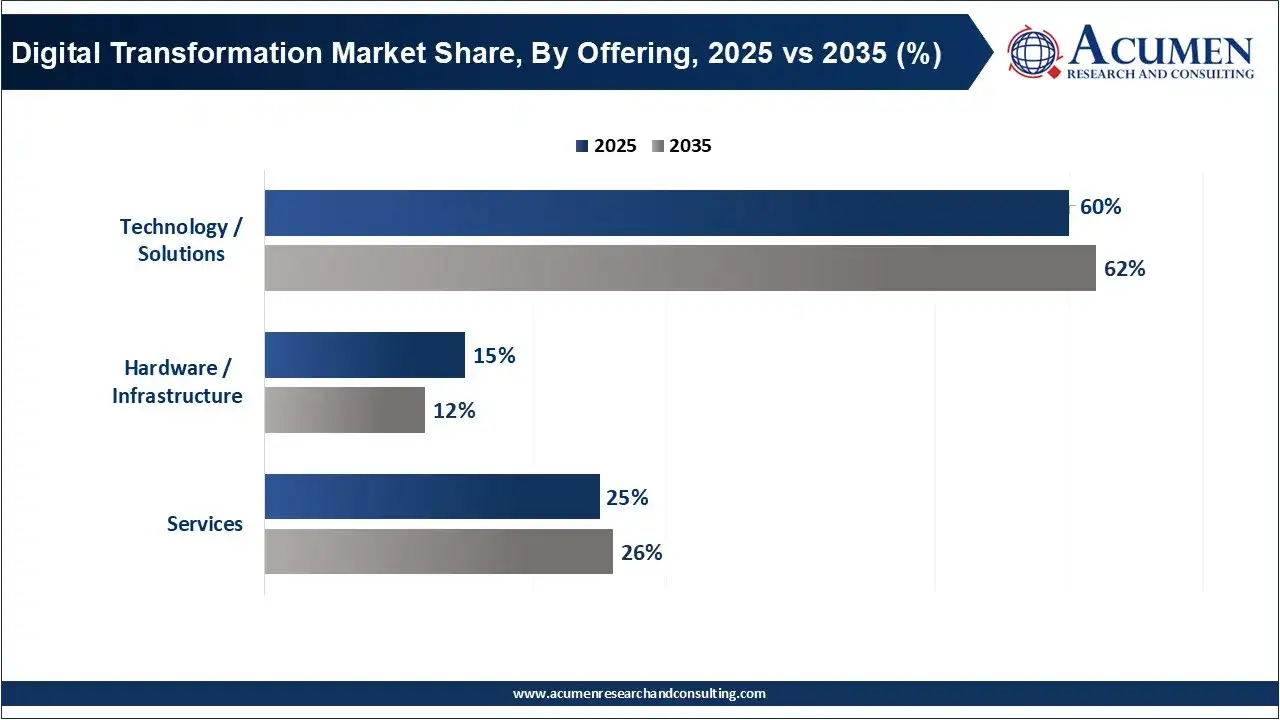
Services represented 25.0% of the market in 2025, making it the second-largest offering segment, and it is expected to increase to 26.0% by 2035. More importantly, services is projected to record the fastest CAGR among offering segments at 19.8% during 2026–2035, with market value increasing from $393.27 billion in 2026 to $1,995.45 billion by 2035.
The strong growth of services reflects the increasing complexity of enterprise transformation. Organizations often possess the capital to purchase digital technologies but lack the internal resources required to assess, integrate, customize, migrate, secure, and continuously manage those technologies. This creates demand for consulting, implementation, integration, managed services, modernization, transformation strategy, and ongoing technical support.
Transformation Area Insights
The leading transformation space in digital transformation was business process transformation, representing 30% of the total market in 2025. This growth segment dominance reflects the increasing adoption by enterprises for a digital transformation drive focused not just on upgrading IT architecture, but also on improving how the core business is done.
Companies are rethinking their business processes in finance, procurement, supply chain, human resource, sales, customers service, manufacturing, and back office operations. Workflow automation, robotic process automation, AI, and analytics, supported by cloud application and process-mining platform technologies, will help businesses identify business inefficiencies, redesign their process around the digital operating model.
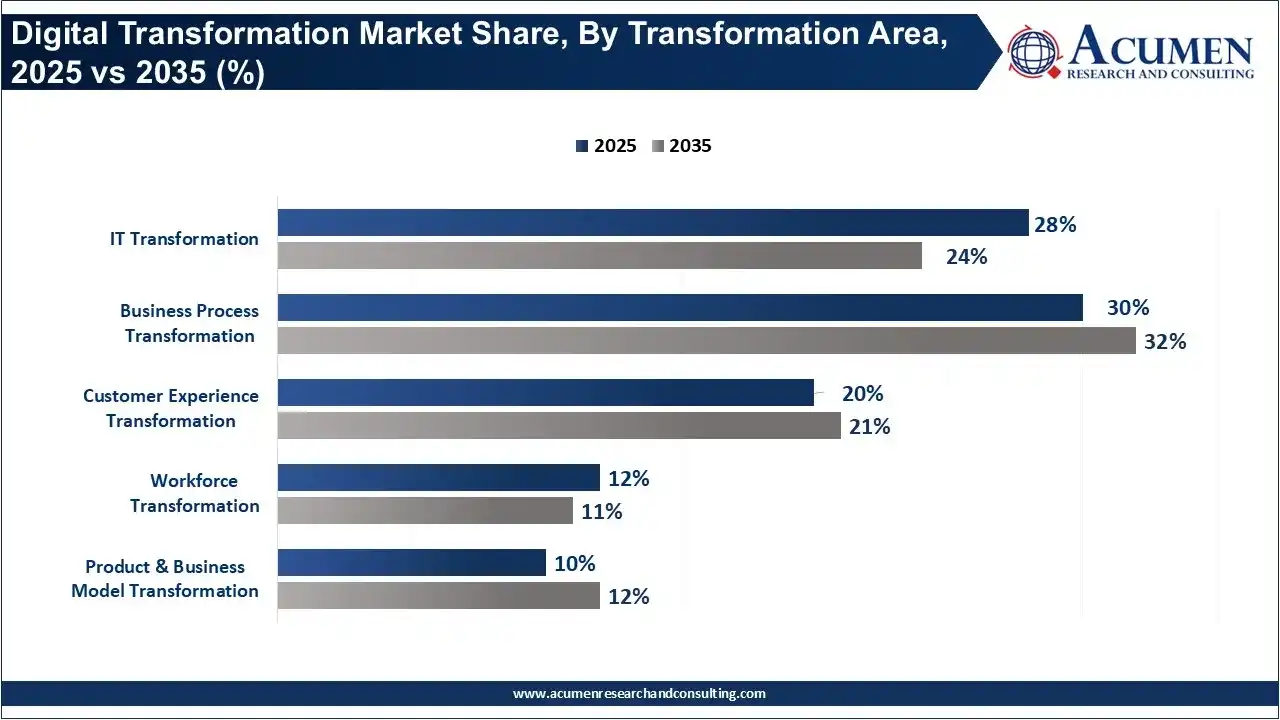
The product & business model transformation held 10.0% of the total market in 2025, but was projected to stand at 12.0% in 2035, being the highest growing area based on the CAGR figures given. This segment is anticipated to show growth at a CAGR of 21.7%, from a market size of $157.31 billion in 2026 to $920.98 billion in 2035.
The higher growth is driven by the rise of enterprises using digital technologies not just for the efficiency they represent for internal operations but for building revenues as well. Companies have been focusing on building digital products, subscription based models, platform offered services, data-centric offerings, or customer propositions powered by digital technology.
Deployment Insights
Cloud deployment accounted for 62% of the digital transformation market in 2025, making it the leading deployment model. Its dominance reflects the need for scalable infrastructure, flexible computing capacity, rapid application deployment, and access to advanced technologies without requiring enterprises to maintain all infrastructure internally.
Cloud environments are particularly important for organizations deploying AI, analytics, enterprise applications, digital customer platforms, and distributed workloads. They allow enterprises to scale computing and storage resources according to demand while providing access to continuously updated software and infrastructure capabilities.
Digital Transformation Market Share, By Deployment, 2025 (%)
| Deployment | Revenue Share, 2025 (%) |
|---|---|
| Cloud | 62% |
| On-Premises | 23% |
| Hybrid | 15% |
The on-premise deployment model constituted 23% share of the digital transformation market during 2025, and stands at the second biggest position within this market, after cloud deployment. This deployment segment continues to remain relevant by virtue of demand for control over the infrastructure, data, applications and system from enterprises engaged with workloads sensitive to these parameters.
Enterprises engaged in handling sensitive workloads, legacy applications and systems mandated by government and legislative needs, along with those required to comply to stricter regulatory requirements of data resdiceny also retain this deployment.
Enterprise Size Insights
In 2025, large enterprises dominated the digital transformation market, holding a market share of 70%. This is attributable to greater IT spending budgets, heterogeneous IT infrastructures, legacy systems, and their need for concurrent transformation of more business units within the enterprise.
Large enterprises typically run multi-year technology initiatives such as; cloud migration, modernized enterprise applications, security solutions, data management platforms, automation solutions, artificial intelligence, anddigital customer engagement as well as work force transformation. Organizations have a high need for consulting, system integrators, managed services and implementation to work in these large heterogeneous environments.
Digital Transformation Market Share, By Enterprise Size, 2025 (%)
| Enterprise Size | Revenue Share, 2025 (%) |
|---|---|
| Large Enterprises | 70% |
| SMEs | 30% |
The small & medium enterprises (SMEs) segment held the second largest share of 30% in 2025. SMEs nevertheless represent an important expansion opportunity as cloud-based software, SaaS platforms, low-code tools, and managed services reduce the technical and financial barriers to digital transformation. However, based on the supplied 2025 data, large enterprises remain the primary source of market spending.
Industry Insights
The BFSI sector represented 23.4% of the 2025 digital transformation market, having the highest share within this sector. This sector presents a huge driving force for transformation of the technological environment since all financial institutions have a strong business incentive to innovate their IT infrastructure due to fierce competition based on superior digital customer experience, instant services, automation, data analytics and advanced IT infrastructure to support and protect data transactions.
Banks, insurers and other financial institutions are investing in mobile banking applications, digital banking platforms, cloud-based infrastructure, fraud detection systems, AI-driven analytical tools, customer service automation, data management platforms and strengthened security of digital applications.
In essence, a digital transformation will also lead to replacing the outdated old generation infrastructure and core banking systems, which hinders the quick rollout of new digital products and integration of innovative technology.
Digital Transformation Market Share, By Industry, 2025 (%)
| Industry | Revenue Share, 2025 (%) |
|---|---|
| BFSI | 23.40% |
| IT & Telecom | 13% |
| Healthcare & Life Sciences | 10% |
| Manufacturing | 11% |
| Retail & Consumer Goods | 9% |
| Energy & Utilities | 5.50% |
| Transportation & Logistics | 4.50% |
| Government & Public Sector | 5.30% |
| Others | 18.30% |
IT & telecom held 13% of the digital transformation market in 2025 and stand out as one of the key industries in this segment after BFSI, driven primarily due to its status as both a consumer and producer of digital technologies. Telecommunications operators, IT service providers, software firms, and technology businesses continue to invest in cloud infrastructure, AI, automation, data analytics, cyber security, and digital platforms for achieving greater operating efficiency and catering to the dynamic need for evolving digital services.
Top Companies
- Accenture (Dublin, Ireland)
- Microsoft (Redmond, Washington, U.S.)
- IBM (Armonk, New York, U.S.)
- Google Cloud (Mountain View, California, U.S.)
- Amazon Web Services (Seattle, Washington, U.S.)
- Salesforce (San Francisco, California, U.S.)
- ServiceNow (Santa Clara, California, U.S.)
- SAP (Walldorf, Germany)
- Oracle (Austin, Texas, U.S.)
- Cisco Systems (San Jose, California, U.S.)
- Capgemini (Paris, France)
What Are the Latest Digital Transformation Acquisitions and Partnerships?
- September 2026: Accenture and Google Cloud launched the Accenture Gemini Enterprise Business Group to accelerate enterprise adoption of AI agents. The initiative will deploy up to 1,000 forward-deployed engineers to help clients integrate and customize AI agents within business workflows. Accenture is also expanding Gemini training to 50,000 employees, strengthening the partnership around enterprise AI implementation.
- August 2026: Tech Mahindra and ServiceNow expanded their partnership to accelerate production-scale enterprise AI adoption. The collaboration combines Tech Mahindra's industry and implementation capabilities with the ServiceNow AI Platform to move organizations from AI pilots toward enterprise-wide automation and measurable business outcomes.
Segments Covered
By Offering
- Technology / Solutions
- Hardware / Infrastructure
- Services
By Transformation Area
- IT Transformation
- Business Process Transformation
- Customer Experience Transformation
- Workforce Transformation
- Product & Business Model Transformation
By Deployment
- Cloud
- On-Premises
- Hybrid
By Enterprise Size
- Large Enterprises
- SMEs
By Industry
- BFSI
- IT & Telecom
- Healthcare & Life Sciences
- Manufacturing
- Retail & Consumer Goods
- Energy & Utilities
- Transportation & Logistics
- Government & Public Sector
- Others
By Region
- North America
- Europe
- Asia-Pacific
- Latin America
- Middle East & Africa
Looking for discounts, bulk pricing, or custom solutions? Contact us today at sales@acumenresearchandconsulting.com
Frequently Asked Questions

Related Market Research Reports
March 2025
September 2026
February 2023
January 2023
June 2026
August 2021
July 2021
May 2020