
Electronic Components Market Size, Share, Report 2026 To 2035
Electronic Components Market (By Component: Active Components, Passive Components, Electromechanical Components; By Industry: Telecommunication, Automotive, Industrial Machinery, Consumer Electronics, Healthcare, Others) - Global Industry Analysis, Size, Share, Regional Analysis, Trends and Forecast 2026 - 2035
- Last Updated: 26 Feb 2026
- Report Code: ARC3907
- Category: Semiconductor and Electronics
Electronic Components Market Size and Forecast 2026 to 2035
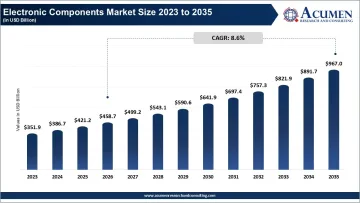
The global electronic components market size was valued at USD 421.23 billion in 2025 and is anticipated to reach around USD 966.96 billion by 2035, growing at a CAGR of 8.6% from 2026 to 2035.
Report Highlights
- Market Set to More Than Double: Growing from USD 421.23 Billion in 2025 to USD 966.96 Billion by 2035, at a strong 8.6% CAGR.
- Asia-Pacific Dominates: The region leads with 43% revenue share, driven by large-scale electronics manufacturing.
- Active Components Lead Revenue: Holding 62% share, with integrated circuits as the primary growth engine.
- Consumer Electronics Tops Demand: Contributes 32% of total revenue, fueled by smart devices and connected technologies.
- Automotive Electrification Boosts Growth: Accounts for 22% share, supported by EVs and advanced vehicle electronics.
- Capacitors & Switches Stand Out: Capacitors lead passive components (49%), while switches dominate electromechanical (40%).
The basic electronic devices in a circuit may act as either regulators of electricity flow or as components that perform an intended function. These include the passive components such as resistors and capacitors, which do not amplify signal strengths. Other essential components include active components such as transistors and diodes which regulate current flow through a device and amplify electrical signals. All these makeup electronic devices like computers, cell phones, and home appliances. Each of them has a different role in making the whole device functional, efficient, and productive in electronic devices. That is why they are highly important in modern technology.
Electronic Components Market Significant Growth Factors
The electronic components market is poised for significant growth, driven by several key factors:
- Increased Demand for Consumer Electronics: Growth in the consumption of consumer electronics is driven by the ever-increasing disposable income and changes in lifestyle around the world. Today, every customer can buy a mobile phone, tablet, laptop, or home appliance. Such consumption pattern calls for more demand for electronic components like semiconductors, display devices, and power management devices, which go into all these products.
- IoT developments: This trend has drastically changed the nature of devices connecting and their manner of interplay. Such needs keep on increasing, therefore demands for electronic components keep on rising. It applies very widely to sensors and microcontrollers with other types of modules used in communication. The sectors are applying IoT to automation and data collecting also; hence, this industry still needs cutting-edge, reliable electronic components.
- Increasing Automotive Electronics: It may be seen how automobile technologies harbor continuous improvement as far as autonomous driving technology and electric vehicles are concerned. For instance, a few of the advanced electronic components that come to mind while illustrating any fair level of sophistication about improvements witnessed in this scenario include sensors, control units, and power electronics. Other needs in this sphere have to face improvement accompanied by new progressions as far as superior safety, as well as the efficiency towards fuel, is concerned.
Report Scope
| Attribute | Details |
|---|---|
| Market Size in 2026 | USD 421.23 Billion |
| Market Size in 2035 | USD 966.96 Billion |
| CAGR 2026 to 2035 | 8.6% |
| Dominant Region | Asia-Pacific |
| Market Segments | Components, Industry, Region |
| Market Players | STMicroelectronics, Murata, Amphenol, Texas Instruments, NXP Semiconductors, Kyocera, Omron, ABB, ON Semiconductor, Infineon Technologies, TDK Corporation, Samsung Electro-Mechanics, Analog Devices, Inc. |
Electronic Components Market Dynamics
Market Drivers
- Technological Advancement: This is the major growth driver for electronic components market, mainly because innovation is continuous in the industry. Miniaturization and new manufacturing techniques facilitate the realization of powerful and efficient components. Therefore, in establishing a dynamic demand cycle, the makers have to continuously modify the product.
- Global Digital Transformation: Expansion into electronic components market has been facilitated by industry trends toward digital solutions. Increasing business investment in digital infrastructure further boosts demand for hardware components involved in processing data, creating connectivity, and introducing automation. All these are well-represented in health, finance, and manufacturing.
- Investment in R&D: Much is invested in research and development. The companies are focusing on new material development, component performance improvement, and advanced technology creation. This investment also forms the growth of manufacturers, and they manage to be competitive in an increasingly saturated market.
Market Restraints
- Supply Chain Vulnerability: The electronic components are dependent on the complex web of supply chains, global by nature. Any natural disaster, political instability, or pandemic in any part of the world could cause grave disruptions to production schedules and stock levels. The effect on manufacturers would also be lost sales and damage to customer relationships as they routinely suffer from delays due to component supplier’s inability to meet deliverables. Such uncertainties compel firms to design supply chains in a way that are sturdier against such uncertainties, which could translate to increased operational costs for them.
- High Raw Material Costs: Fluctuations in the prices of raw materials such as silicon, copper, and some rare earth metals that are used in manufacturing of electronic components is a critical factor limiting the market growth. The substantial demand of these raw materials in the marketplace, challenges in actual mining of these minerals, and geopolitical challenges are frequently responsible for these fluctuating prices, thus having direct impact on market growth. An increased input cost typically flows directly into the profit margin and results in higher prices of end products. It is unlikely for manufacturers to fully pass the costs on to consumers in competitive markets, and so will need careful management of costs and alternative sourcing strategies.
- Shortage of Skilled Workers: Recruiting and retaining skilled labor remains problem for the electronic components industry. Growing technology calls for technical expertise with electronics-from circuit design to materials science to software integration. Progress would stall, productivity would become restrained, and the reach of the enterprise would be limited if properly qualified technical expertise and technicians are not adequately supplied. Such giants would have to invest in training programs in partnership with educational institutions.
Market Challenges
- Higher Pace Technological Progress: The high pace of technological development in IoT, artificial intelligence, and high-grade materials, create technical difficulties for electronics component manufacturers as it becomes difficult to integrate these newer technologies in workflows every time. Lack of technical expertise to manage such improved technology is another key area that poses concerns for component manufacturers. Each new development in technology causes demand patterns to shift due to updated customer expectations while technology demands integration, stretching thin one's resources and managerial functions.
- Global Competition: The electronic components market is highly competitive globally; most of the competition stems from emerging market manufacturers where production costs are lower. In this scenario, incumbents have to either compromise on their prices or differ through innovation and quality. It is only through periodic review of pricing strategy, operational efficiencies and value propositions that businesses may stay ahead while dealing with the challenges faced by entrants from disruptive business models.
- Intellectual Property Issues: In the electronic components market, the development and innovation of products can be easily adapted and reproduced by competition, which is a major intellectual property concern. Thus, one would need a great deal of investment into proper and reliable IP strategies to protect inventions and technologies which often cost considerable sums and are sometimes time-consuming as well. Various patent legislations from different jurisdictions give the appearance of a labyrinth leading to endless disputes and litigations, so this can quite complicate the business climate. This uncertainty may reduce investment in new projects and slow down innovation.
Electronic Components Market Regional Analysis
The electronic components market is segmented into several key regions: North America, Europe, Asia-Pacific, and Latin America, and Middle East and Africa).
Why has the Asia-Pacific region held the largest portion of the electronic components market?
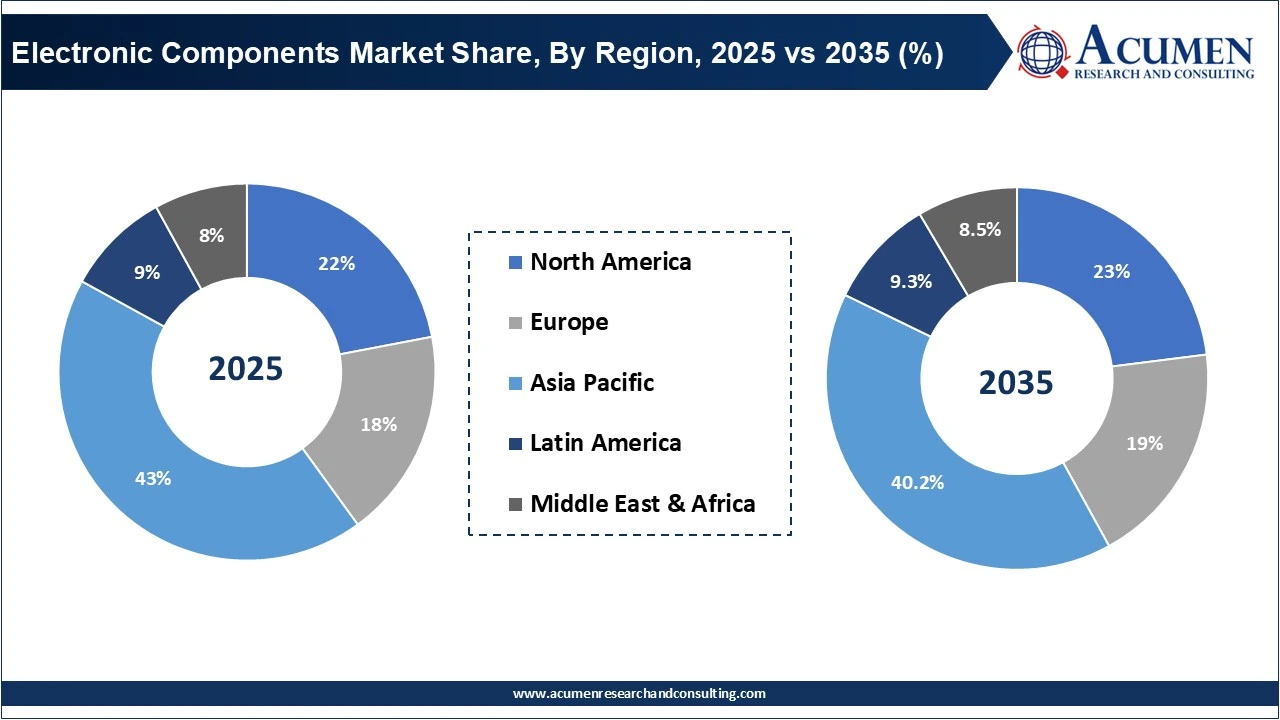
The Asia-Pacific electronic components market size was reached at USD 181.13 billion in 2025 and is forecasted to grow USD 388.72 billion by 2035, growing at a CAGR of 7.8% from 2026 to 2035. The Asia-Pacific region held the largest portion in 2025 accounting for over 43% market share. It is highly influenced by rapid industrialization in this region, as well as the key countries with major electronics manufacturing hubs: China, Japan, South Korea, and Taiwan. China is one of the world's leading electronics manufacturing nation and has developed an enormous variety of components and completed products. Japan is also highly famous for its high-tech components, especially semiconductors and consumer electronics, where Sony and Panasonic are leaders in their respective fields. It is also home for companies such as Samsung and LG that are involved in advanced memory chips manufacturing. More exactly, it is in semiconductors where Taiwan plays a big role but more precisely; TSMC proudly holds its leading position to be a global leader and is in the highest area of chip production.
Why is North America significant markets for electronic components market?
The North America electronic components market size was estimated at USD 92.67 billion in 2025 and is predicted to hit around USD 222.40 billion by 2035, expanding at a CAGR of 9.2% from 2026 to 2035. North America is one of the significant markets, with the driving impetus being technological progress and robust manufacturing. Amongst that, the United States leads the market as many global electronic component manufacturers are headquartered in this region, including several leading semiconductor manufacturers such as Intel, Texas Instruments, Qualcomm, and so on. Canada and Mexico support the market contribution with burgeoning presence in electronics manufacturing and electronics assembly, which is evident in the automotive and the consumer electronics segments. The region benefits from high R&D investments and a highly skilled workforce.
What are the driving factors of Europe electronic components market?
The Europe electronic components market size was reached at USD 75.82 billion in 2025 and is expected to surpass around USD 183.72 billion by 2035 with a CAGR of 9.3% from 2026 to 2035. Europe has an entirely different electronic components market, especially with countries like Germany and France leading the way, in addition to the UK. Germany is renowned for high engineering excellence and an extremely dependent automotive industry on very advanced electronic components. Aerospace and telecommunications are the leading sectors in France, with the UK focusing more on software and electronics integration. The other countries gaining importance in Europe include Eastern European countries like Poland and Hungary, which are turning into manufacturing hubs because of the availability of skilled labor and low production costs that attract investment. Technological innovation initiatives by the European Union further support market growth.
What are the current trends in the LAMEA the electronic components market?
The LAMEA electronic components market was valued at USD 70.61 billion in 2025 and is anticipated to reach around USD 172.12 billion by 2035 at a CAGR of 9.2% from 2026 to 2035. LAMEA has one of the diverse landscapes hosting the electronic components market. The Latin America electronic component market is rapidly growing, especially in countries such as Brazil and Mexico. Mexico has also been a preferred destination for manufacturing of electronic components for North American companies because of its geographic proximity and favorable trade agreements. The United Arab Emirates and Saudi Arabia will diversify their economies in the Middle East. There will be a focus on the areas of technology and electronics as part of a development strategy. In Africa, the electronics market remains developing but, in South Africa and Kenya, mobile technology and telecoms are gaining prominence. LAMEA is growing gradually through a rising demand for electronic products and infrastructure development.
Electronic Components Market Segmental Insights
Type Insights
Active Component: Active components is the largest segment accounted for around 62% market share in 2025. Active components are the parts of a circuit that need electricity from some other source for carrying out the circuitry function. These devices work to amplify and control electrical signals and involves components such as transistors, diodes, and ICs other than operational amplifiers. The said components are considered the main ingredients in the making and processing of signals in numerous electronic appliances. Active components are important in the modern electronic world since they provide appliance functionality in products ranging from the most minute smartphone to heavy machinery in factories.
Passive Component: Passive components accounted for 25% market share in 2025. Passive components do not contain a source of active power that would work, but they may hold energy, dissipate energy, and even filter signals. Examples of such are resistors, capacitors, inductors, and transformers. Active components can control voltage, current, and frequency inside an electronic circuit. Moreover, they are used to increase performance as well as equipment reliability aside from signal amplification.
| Components | Market Share 2025 (%) |
|---|---|
| Active Components | 62% |
| Passive Components | 25% |
| Electromechanical Components | 13% |
Electromechanical Component: These include electromechanical, electrical and mechanical components that change the form of energy between electrical and mechanical motion. Among these are relays, switches, solenoids, and motors. In all these applications where electronic control must be applied to mechanically managed processes, be it an automation system, a robot, or some consumer appliances, their roles are constantly becoming more significant as the systems are becoming more intelligent.
Industry Insights
Telecommunication: The telecommunication industry is very reliant on electronic components for allowing communication over different media. This segment accounted for 18% market share in 2025. The main components in the transmission and reception of signals over a distance are the transceivers, amplifiers, and filters. As 5G technology is advancing and faster internet is in demand, reliable electronic components in telecommunication are in demand.
Automotive: Automotive segment represented 22% of the total electronic components market in 2025. The use of electronic components in modern vehicles is essential. In driver assistance systems, infotainment, and electric vehicles, where sensors, microcontrollers, and power management systems are used, the use of electronic components improves the safety, efficiency, and connectivity of automotive applications. Demand for advanced electronic components is expected to grow highly with advances in the automotive industry in terms of electrification and autonomous driving.
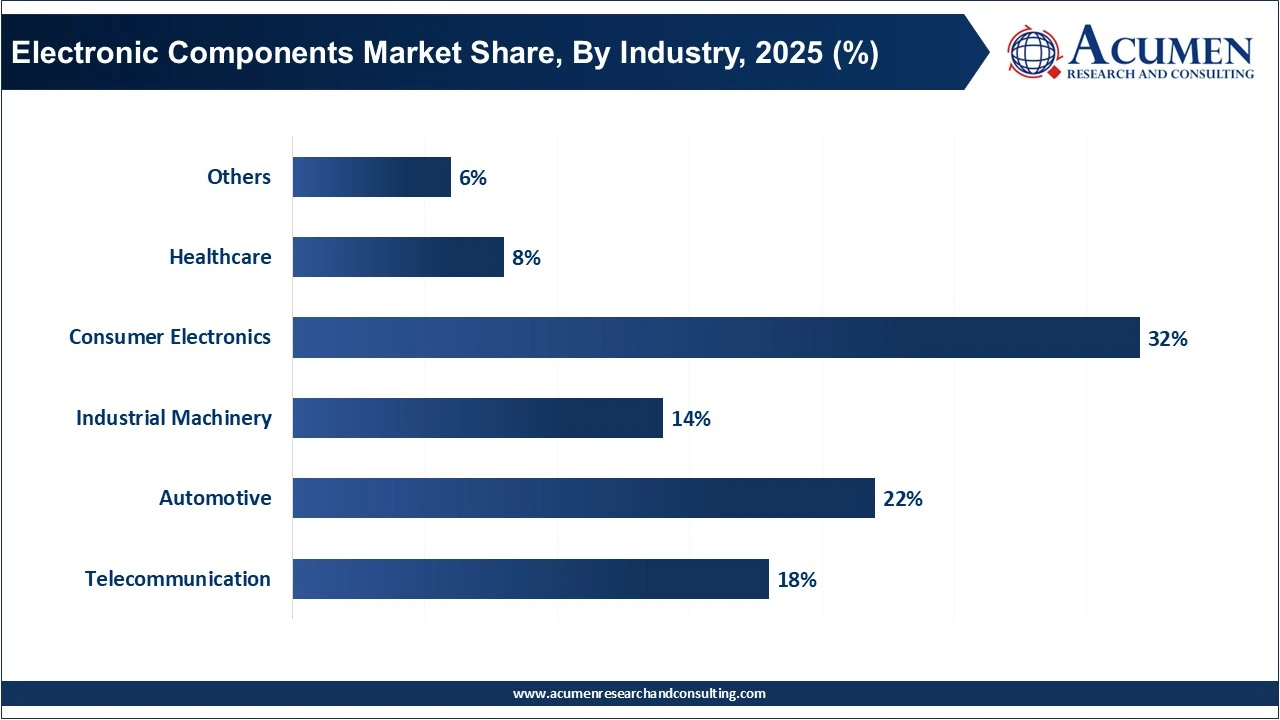
Consumer Electronics: Consumer electronics industry dominated the electronic components market with 32% share in 2025 attributed by the high use of electronic components in Consumer electronics such as smartphones, tablets, television appliances, and wearable devices. Active and passive components play an effective role in the smooth operation of such devices such as high performance and long period battery back-up.
Others (Energy & Utilities, Aerospace & Defense, etc): Other sectors contributing significantly to the electronic components market include energy and utilities, aerospace, and defense, etc. The growing preference for renewable energy systems and smart grids is indirectly supporting the growth of electronic components market as there is an increased need for energy storage systems to store this generated energy, which in turn creates demand for high quality electronic components. Components used in aerospace and defense applications are crucial for navigation, communication, and control systems aboard aircraft and military applications. Hence, the usage of specialized components with high standards of regulation and performance criteria often forces innovation and development within the electronic components market.
Electronic Components Market Top Key Players
- STMicroelectronics
- Murata
- Amphenol
- Texas Instruments
- NXP Semiconductors
- Kyocera
- Omron
- ABB
- ON Semiconductor
- Infineon Technologies
- TDK Corporation
- Samsung Electro-Mechanics
- Analog Devices, Inc.
CEO Statements
Here are some recent CEO statements from key players in the electronic components market:
Jean-Marc Chery, CEO of STMicroelectronics: “At STMicroelectronics, we are dedicated to driving innovation in electronic components, enabling smarter and more sustainable technologies. Our commitment to collaboration and continuous investment in R&D allows us to meet the evolving needs of industries such as automotive, IoT, and industrial applications, ultimately contributing to a greener future.”
Norio Nakajima, CEO of Murata Manufacturing Co., Ltd.: "Our commitment to innovation is unwavering as we strive to develop cutting-edge electronic components that not only meet market demands but also enhance sustainability. By fostering collaboration across industries and investing in sustainable practices, we aim to create solutions that have a positive impact on society and the environment. In this rapidly evolving landscape, adaptability is key, and we are dedicated to leading the way in technological advancements that will shape the future."
R. Adam Norwitt, CEO of Amphenol Corporation: “Our products enable the Electronics Revolution across virtually every end market, including Automotive, Broadband Communications, Commercial Aerospace, Defense, Industrial, Information Technology and Data Communications, Mobile Devices, and Mobile Networks”.
Electronic Components Market Recent Developments
The electronic components market is experiencing fast-paced new product launches and acquisitions, some of which are STMicroelectronics, Murata, Amphenol, Texas Instruments, and NXP Semiconductors. Innovation and strategic partnership are rapidly being actualized by these leading vendors in the quest to further create more advanced functionalities and features within their products, leading to an integrated ecosystem with improved efficiency. Among those aspects, connectivity, automation, and energy management would take center stage. They leverage all the leading-edge technologies with partnerships to give their products more capabilities so that they can meet the continuously changing demands of industries across automotive, consumer electronics, or industrial automation.
- In September 2024, A fourth-generation STPOWER silicon carbide (SiC) MOSFET technology that brings new benchmarks in the field of power efficiency, power density, and robustness has been announced by global semiconductor leader STMicroelectronics serving customers across the spectrum of electronics applications. While developing the new technology, STM paid particular attention to requirements from automotive and industrial markets and designed to optimize specifically in direct response to the needs of the traction inverter, one of the most important building blocks of an electric vehicle powertrain. The company has further innovation commitments on introducing advanced SiC technology up to 2027.
- In May 2024, developed by Murata Manufacturing Co., Ltd., the L Cancel Transformer is an innovative electronic component that cancels the equivalent series inductance of capacitors for noise cancellation. The LCT permits engineers to develop systems in which the system noise can be much reduced at a time when cost and number of components are saved due to Murata's proprietary ceramic multilayer technology. This innovation counteracts the challenges of electromagnetic noise, especially as demand for compact and efficient electronics is increasing. By minimizing ESL through negative mutual inductance, the LCT significantly improves the effectiveness of noise cancellation in the MHz to 1GHz frequency range and reduces the number of parallel capacitors required.
- In July 2024, Amphenol Corporation announced that it had entered into a definitive deal to acquire, for around USD 2.1 billion, net of customary post-closing adjustments, the mobile networks businesses of CommScope in an all-cash transaction. Those OWN and DAS businesses comprise the NICS segment. The acquired entities are forecasted to yield about USD 1.2 billion calendar year 2024 EBITDA. Margin is likely to run in that 25 percent range, which will lead to the acquisition being accretive in the first year after it fully closes to the diluted Amphenol EPS, before the exclusion of acquisition expense under constant macroeconomic conditions.
This market for electronic components is expected to grow rapidly due to the increasing demand for cutting-edge technologies in the consumer electronics, automotive, and industrial automation sectors, with major companies such as STMicroelectronics, Murata, Amphenol, Texas Instruments, and NXP Semiconductors. The Internet of Things, 5G infrastructures, and renewable sources of energy would further fuel the need as enterprises have started looking for components that are more efficient and dependable for increased connection, performance, and sustainability. Innovation and investments in passive components and semiconductor technology will be the backbone of meeting the shifting demand of the market.
Electronic Components Market Segmentation
By Component
- Active Components
- Diodes
- Transistors
- Integrated Circuits
- Others (Emitters and Vaccum Tubes)
- Passive Components
- Resistors
- Capacitors
- Inductors
- Others (Detectors and Antennas)
- Electromechanical Components
- Motors
- Switches
- Relays
- Others (Terminal & Connectors, and Cables)
By Industry
- Telecommunication
- Automotive
- Industrial Machinery
- Consumer Electronics
- Healthcare
- Others (Energy & Utilities, Aerospace & Defense, etc.)
By Region
- North America
- Europe
- Asia Pacific
- Latin America
- Middle East and Africa
Looking for discounts, bulk pricing, or custom solutions? Contact us today at sales@acumenresearchandconsulting.com
Frequently Asked Questions

Other Semiconductor and Electronics Reports
May 2025
September 2022
June 2020
December 2023