
Flex Fuel Market Size, Share, Trends, Report 2026 To 2035
Flex Fuel Market (By Fuel Type: Ethanol-Based Flex Fuel, Methanol-Based Flex Fuel; By Vehicle Type: Passenger Vehicles, Light Commercial Vehicles (LCVs), Heavy Commercial Vehicles (HCVs); By Technology: Factory-Built Flex-Fuel Vehicles, Flex-Fuel Conversion Vehicles) - Global Industry Analysis, Size, Share, Growth, Trends, Regional Analysis And Forecast 2026 To 2035
- Last Updated: 22 Jul 2026
- Report Code: ARC3955
- Category: Chemicals And Materials
Flex Fuel Market Size, Forecast Report 2026 To 2035
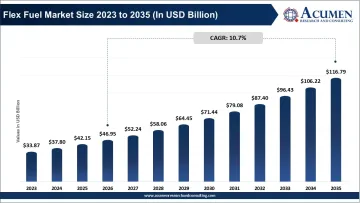
The global flex fuel market size was recorded at USD 42.15 billion in 2025; it is estimated to reach at USD 116.79 billion by 2035. The market is observed to grow at a promising CAGR of 10.7% during the forecast period of 2026-2035. Rising government mandates for ethanol blending and supportive biofuel policies are accelerating the adoption of flex fuel vehicles and expanding investments in ethanol production and fuel infrastructure worldwide.
Report Highlights
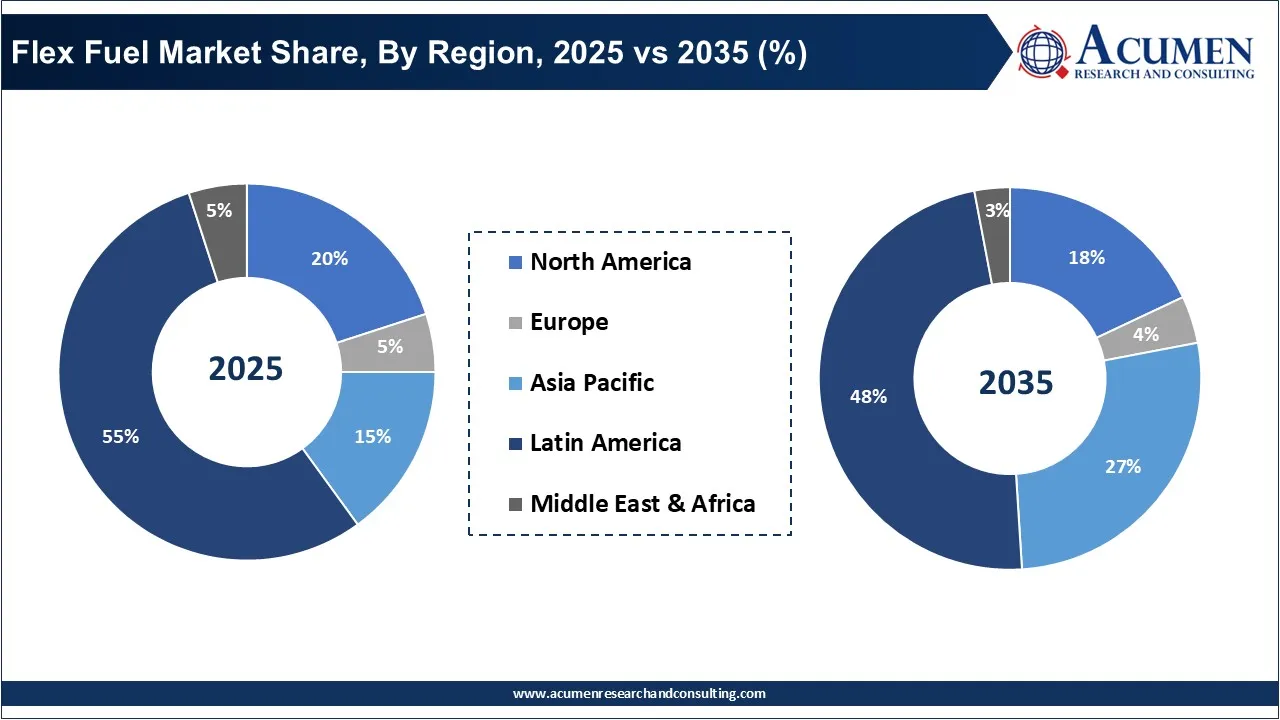
- By region, Latin America dominated the global flex fuel market with a 55% revenue share in 2025, driven by Brazil's mature ethanol ecosystem, extensive flex fuel vehicle adoption, abundant sugarcane-based ethanol production, and strong government support for renewable fuels.
- By region, Asia Pacific is expected to witness the fastest CAGR of 18.1% between 2026 and 2035, fueled by expanding ethanol blending mandates, rapid growth in domestic ethanol production, increasing investments in biofuel infrastructure, and rising adoption of ethanol-compatible vehicles across India, China, and Southeast Asia.
- By fuel type, the ethanol-based flex fuel segment dominated the market with a 95% revenue share in 2025, driven by extensive ethanol production, established fuel distribution infrastructure, and supportive government ethanol blending mandates across Brazil, the United States, and India.
- By fuel type, the methanol-based flex fuel segment is projected to grow steadily through 2035, increasing its market share from 5% in 2025 to 10% by 2035, supported by rising investments in methanol production, green methanol technologies, and government initiatives promoting alternative low-carbon fuels.
- By vehicle type, the passenger vehicles segment dominated the flex fuel market with a 72% revenue share in 2025, owing to high production volumes, widespread adoption of flex fuel passenger cars in Brazil, and expanding ethanol-compatible vehicle portfolios from leading automotive manufacturers.
- By vehicle type, the heavy commercial vehicles segment is expected to register the fastest CAGR of 12.9% during the forecast period (2026–2035), driven by the increasing adoption of renewable fuels in freight transportation, stricter emission regulations, and growing investments in ethanol-powered heavy-duty engines.
- By technology, the factory-built flex-fuel vehicles segment accounted for the largest revenue share of 92% in 2025, attributed to integrated fuel management systems, superior reliability, OEM warranty support, and large-scale manufacturing by major automotive companies.
- By technology, the flex-fuel conversion vehicles segment is anticipated to expand at the fastest CAGR of 15.8% from 2026 to 2035, supported by the growing demand for cost-effective vehicle conversion solutions, advancements in conversion kit technologies, and increasing ethanol blending initiatives in emerging economies.
What Is the Flex Fuel Market and How Is It Transforming the Future of Sustainable Transportation?
The flex fuel market consists of the manufacturing, selling, and deploying of flex fuel vehicles, flex fuel engines, flex fuel fuel systems, flex fuel types of ethanol-based fuels and supporting infrastructure that allow operation on gasoline, ethanol, methanol or some combination of these fuels. Flex fuel vehicles (FFVs) operate much like conventional ICE (Internal Combustion Engine) vehicle technology by using an electronic fuel sensor and computer (ECU) to automatically detect the percentage of ethanol in a given fuel blend.
Flex fuel technology provides an important intermediary step as FFVs utilize existing vehicle platforms and fueling stations. This avoids the huge costs associated with developing entirely new fueling infrastructure. Flex fuel blends like E20, E85 and E100 offer nations the ability to displace petroleum by relying on readily available domestic renewable fuels.
Furthermore, flex fuels are fundamentally shifting agricultural and energy industries, creating demand for agricultural feedstock sources such as corn, sugarcane, cassava, and crop residue, which in turn has spur investment in bio-refineries and the further deployment of second-generation technologies and carbon capture in the flex fuel industry.
Top Government Investments in Biofuel Infrastructure
| Country | Government Investment & Infrastructure Development Focus |
|---|---|
| United States | The U.S. has invested heavily in biofuel infrastructure through the Renewable Fuel Standard (RFS), supporting ethanol blending, renewable fuel production facilities, and distribution networks. The government has expanded support through tax credits, grants, and clean energy programmes to increase advanced biofuel production capacity. The RFS targets more than 84 billion litres of renewable fuel volumes in 2025 across categories. |
| Brazil | Brazil has developed one of the world's most advanced ethanol ecosystems, supported by government programmes such as RenovaBio. Investments focus on sugarcane ethanol plants, ethanol transportation infrastructure, blending facilities, and carbon credit markets. Brazil’s large-scale ethanol infrastructure supports widespread flex fuel vehicle adoption. |
| India | India is accelerating biofuel infrastructure through the Ethanol Blended Petrol (EBP) Programme, supporting ethanol production plants, storage facilities, blending terminals, and supply-chain expansion. |
| China | China has invested in ethanol production facilities, grain-based biofuel projects, and renewable fuel infrastructure to strengthen energy security. Government policies support ethanol blending expansion, particularly in regions with large agricultural output. |
| Thailand | Thailand has developed significant biofuel infrastructure through government-supported ethanol blending programmes, investment in sugarcane and cassava ethanol plants, and expansion of alternative fuel distribution networks. The country promotes E20 and E85 fuel availability to reduce fossil fuel dependence. |
Market Dynamics
Driver
Rising Government Ethanol Blending Mandates and Supportive Biofuel Policies
Ethanol blending policies adopted by the government to spur production and substitute reliance on imported crude oil, such as renewable fuel standards, tax breaks and investment projects have significantly aided growth of flex fuel. Ethanol blending in the country rose to 20% or E20 in 2025, while Brazil maintains world’s highest developed flex fuel market. Indian automakers have received governmental stimulus to build flex fuel compatible vehicles which in turn have expanded the country's ethanol manufacturing capabilities and bolstered fuel distribution networks.
Restraint
Limited Fueling Infrastructure and Feedstock Supply Challenges
Limited availability of ethanol refueling infrastructure in several countries hinder its mainstream adoption even though it is supported by government policies. Major investments are necessary to establish blending terminals, storage and dispensing retail fuel stations for higher blends like E85 and E100. Ethanol uses corn, sugarcane and grains as feedstocks; hence the ethanol market is exposed to volatile climate conditions, harvest and feed prices that can make the cost of production volatile and increase supply uncertainty for the ethanol suppliers.
Opportunity
Advancements in Second-Generation Ethanol and Hybrid Flex Fuel Technologies
Commercialization of second-generation (2G) ethanol that derived from agricultural residues, forestry biomass and non-food sources is leading to a surge in demand for flex fuels, resulting in strong growth prospects for the market. Such advanced biofuels provide an increase in sustainability through reducing dependence on food crop usage while reducing greenhouse gas emissions throughout their lifecycle.
Coupled with the fact that the majority of top auto manufacturers are investing in hybrid flex-fuel vehicles that combine a renewable engine with an electric powertrain, especially in Brazil, combined with growing investment in advanced bio-refineries, renewable fuel infrastructure and carbon capture; this market is only set for accelerated growth and to bolster world-wide decarbonization efforts.
Investment and Funding Landscape
- Global investment in flex fuel technologies has focused on expanding ethanol production capacity, biorefineries, vehicle manufacturing, and alternative fuel infrastructure, as governments and the private sector invest to boost availability of ethanol, improve ethanol blending infrastructure, and hasten adoption of ethanol-compatible vehicle technology.
- POET LLC is a large biofuel manufacturer that has been expanding its ethanol manufacturing facilities across the U.S. POET currently operates more than 35 bioprocessing facilities across nine states, with approximately 3.1 billion gallons in annual ethanol production capacity. Investment has been channeled into expanding bioethanol output and the efficient integration of carbon capture technologies with its bioethanol plants.
- Archer Daniels Midland (ADM) has been investing in integrated biofuel production facilities that utilize its large-scale agricultural processing capabilities across North America, Europe, and South America to maximize the potential of its agricultural feedstocks.
- Valero Energy Corporation has been investing heavily in its renewable fuels business to scale up ethanol production capacity at multiple plants in the U.S. The company is making new investments in renewable fuel production, logistical infrastructure and carbon intensity reductions.
- Razen is an ethanol producer and a Shell-Cosan joint venture, has been making large-scale investments in the future of ethanol production in Brazil. The company is investing around $1.5 billion in second-generation (E2G) ethanol production facilities to utilize sugarcane waste streams to create ethanol without additional land use.
- Private investment is flowing into Brazil’s mature ethanol sector, where flex fuel vehicles are already prevalent, due to significant expansion plans by Razen, So Martinho, BP Bunge Bioenergia and Atvos.
- Auto manufacturers are increasing investments in new flex fuel vehicles to cater to growing demand in key ethanol markets such as Brazil and India. Major OEMs are actively developing vehicles with engines compatible with ethanol including Toyota, Volkswagen, Stellantis, General Motors, Ford, Hyundai and Renault.
- Toyota is expanding investment in ethanol hybrid vehicles in Brazil as a route to achieve emission reductions without sacrificing vehicle performance or relying on charging infrastructure.
- Stellantis has been investing to ramp up the production of flex fuel vehicles at its facilities in Brazil, one of the world's largest ethanol-consuming markets, as part of broader efforts to accelerate the production of more affordable and cleaner-running vehicles using existing fuels.
Regional Analysis
What Made Latin America Dominate the Flex Fuel Market in 2025?
The Latin America flex fuel market size was valued at USD 23.18 billion in 2025 and is estimated to reach USD 56.06 billion by 2035 with a CAGR of 9%. Latin America contributed 55% of the global flex fuel market in 2025 and holds a promising growth throughout the forecast period. This can be largely attributed to the dominant role of Brazil, which has one of the most developed flex fuel ecosystems across the globe owing to decades of ethanol production, supportive government policies, and expansive fuel distribution infrastructure. The nation’s longstanding RenovaBio program, high ethanol blending mandates, and abundant availability of E100 fuel have led to flex fuel vehicles being the dominant choice for consumers.
Top automakers like Toyota, Stellantis, Volkswagen, General Motors, and Hyundai, manufacturing locally-produced, ethanol-compatible cars, have further enhanced market growth.
Furthermore, abundant sugarcane production in Latin America enables cost-effective ethanol manufacturing, thus ensuring a reliable supply of renewable fuel. Ongoing investment in second-generation ethanol technologies and ongoing capacity expansion in bio-refineries is likely to sustain Latin America’s leading position through the forecast period.
How is Asia Pacific Growing Rapidly in Flex Fuel Market?
The Asia-Pacific flex fuel market size was estimated at USD 6.32 billion in 2025 and is forecasted to surpass USD 116.79 billion by 2035. Asia Pacific is anticipated to grow at an estimated CAGR of 18.1% from 2026 to 2035, marking it the fastest-growing regional market. This rapid growth is propelled by strong governmental initiatives toward achieving high ethanol blending levels, robust investment in renewable fuel production capacity, and increased focus on minimizing dependence on imported crude oil.
Following the achievement of a nationwide 20% ethanol blending target (E20) and an expansion in domestic ethanol production capacity, India stands as the prime growth driver.
In other Asian countries such as China, Thailand, Indonesia, and elsewhere in Southeast Asia, governments are also fostering biofuel adoption by introducing blending mandates and providing incentives for their production.
The automotive sector is rapidly responding to these policy shifts by introducing new ethanol-compatible models. Moreover, investments in ethanol storage facilities, blending terminals, and distribution infrastructure are continuously expanding the market within this region.
Segmental Insights
Fuel Type Insights
In the year 2025, ethanol-based flex fuel is contributed for a 95% share of the overall market, becoming the leading segment. Such a leading position would be due to easy availability of ethanol on account of abundant cultivation and use of sugarcane, developed infrastructure for distribution and use of ethanol fuels, and government policies favouring the use of ethanol-blended gasoline in major markets.
With wide acceptance of blends like E10, E20, E27, E85 and E100 by major economies like Brazil, United States and India owing to its environmental advantages, such as lower emissions of Greenhouse gases, and its usage in current IC engine technology, ethanol fuels will remain a dominant alternative fuel source.
Mass production of both sugar cane-based and corn-based ethanol in various parts of the world will enable their wider availability and use, in turn, increasing acceptance of ethanol fuelled automobiles by both the general population and manufacturers.
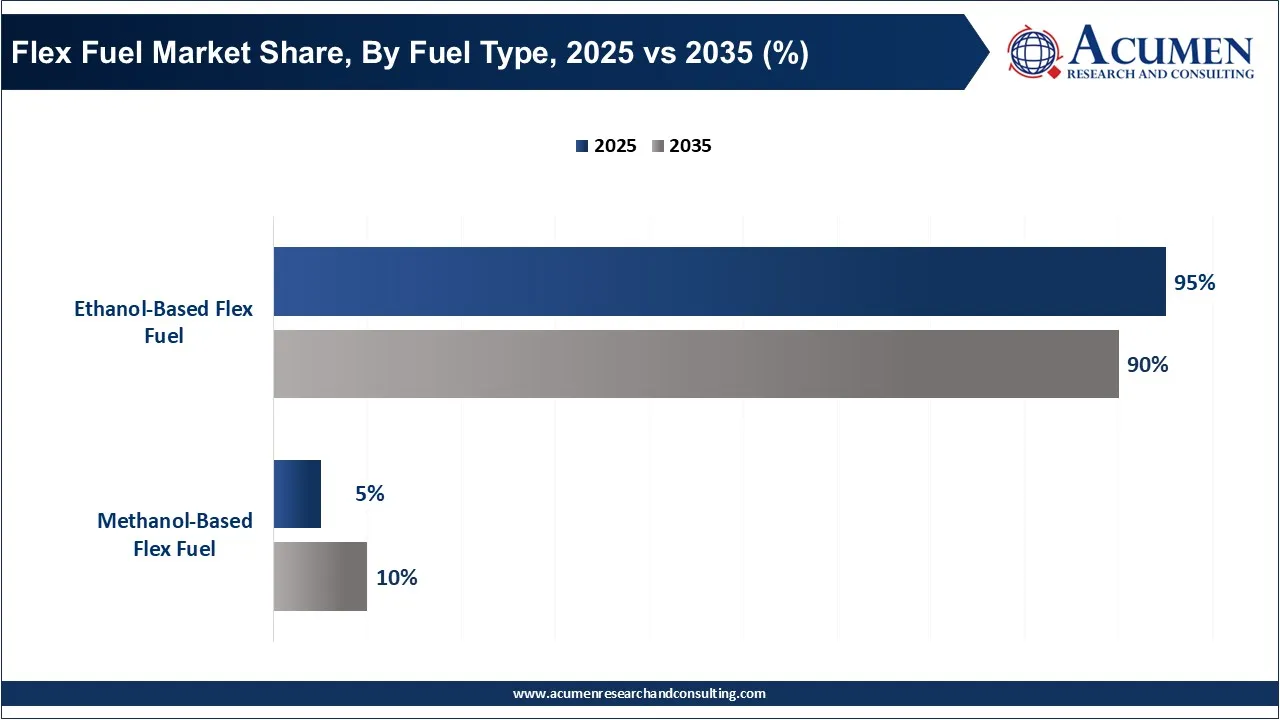
Methanol-based flex fuel will witness increased adoption from 5% of the total market share in 2025 to 10% by 2035 as a result of increased investments in production facilities of methanol and alternative fuel technologies and actively supported adoption of Methanol fueled vehicle technology in several countries including China, as part of diversification of their energy sources.
It is also expected that research into green methanol derived from renewable sources of Hydrogen and captured CO2 could open up further new avenues for the usage of methanol-based flex fuel technology in years to come. As the governments try to maintain several low carbon fuel options in their kitty in addition to the ethanol blend programme, Methanol based blends such as M15, M30 to M85 and M100 will see a phased introduction during next decade.
Vehicle Type Insights
Passenger cars dominated in the year 2025 with 72% of the total flex fuel market. The market share is predominantly due to the increasing penetration of flex fuel passenger cars in Brazil, and a growing range of ethanol compatible vehicles in emerging countries. The major automotive companies like Toyota, Volkswagen, Stellantis, Ford, General Motors and Hyundai have launched various models of flex fuel passenger cars in their portfolio, enabling the drivers to have seamless switching between petrol and ethanol based on the availability and price.
The push toward cleaner vehicles, supported by the incentives offered by governments and expanding ethanol fueling infrastructure are the factors augmenting the segment. Passenger cars are expected to continue its lead over the forecast period owing to high volume production and rising consumer preference towards green mobility.
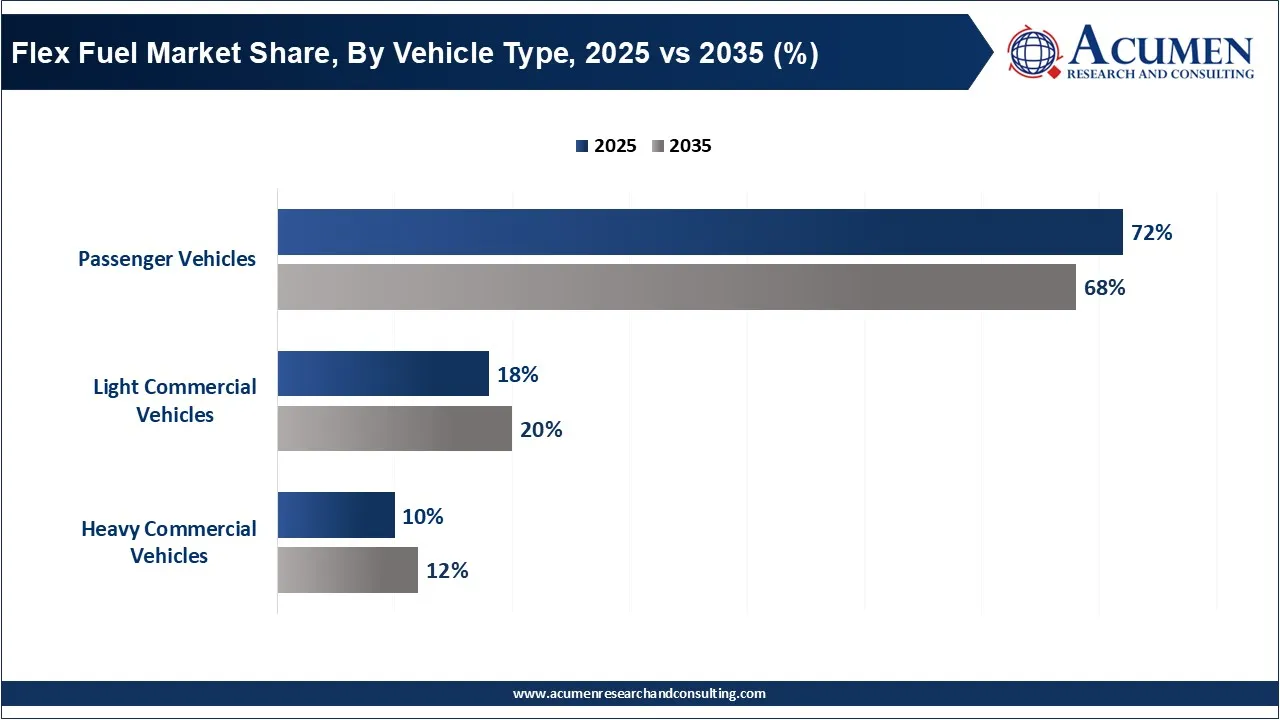
The heavy commercial vehicles segment is estimated to grow at a CAGR of 12.9% between 2026 and 2035 to become the fastest growing vehicle segment. The growing stringency towards carbon emission reduction in the freight transport and cost savings through renewable fuels are the major driving factors for this segment. With the governmental regulations on emission standard for the commercial vehicles becoming stricter, the fleet operators are increasingly assessing the potentiality of ethanol based commercial vehicles and buses.
The escalating investment on the ethanol based heavy duty engine, improved efficiency of the engines and availability of the renewable fuels for the logistics, mining, agriculture, public transportation etc., are anticipated to propel the adoption of the flex fuel technology for commercial vehicles.
Technology Insights
In 2025, factory-built flex fuel vehicles had a dominating share of 92% of the global market by technology. They come built with the fuel management systems, sensors, and engine control units factory programmed for various ethanol blends, eliminating need for after-fit conversions. Factory-built versions offer higher reliability, warranty benefits, easier compliance, and engine efficiency than the converted ones.
Major automakers have integrated this flex fuel technology directly into the production line, with strong presence in Brazil and North America, resulting in large scale manufacturing.
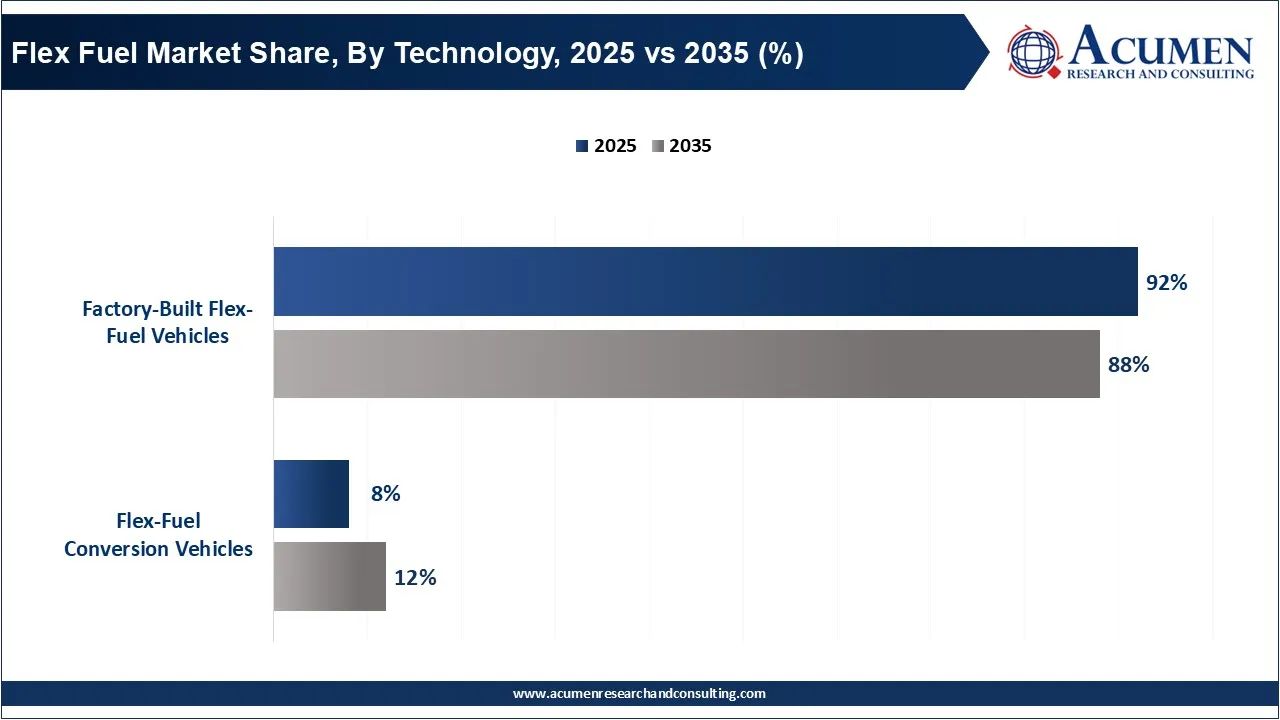
The flex fuel conversion vehicle market is anticipated to be the fastest growing among all technologies with an estimated CAGR of 15.8% from 2026 to 2035. This expansion is attributed to the mounting demand for affordable solutions over investing in brand new flex fuel vehicles, primarily from emerging nations having a large stock of vehicles.
The use of aftermarket conversion kits offers relatively inexpensive access to higher ethanol fuels for conventional gasoline vehicles, thereby presenting a lucrative option for commercial fleets and car owners.
Supportive governmental policies, innovations in conversion kit technology and rising consciousness towards renewable fuels will drive their usage particularly in nations moving towards a higher blending regime without significant replacement of vehicles.
Recent Product Launches and Developments
- July 2026: BMW and Toyota launched a six-month pilot programme in Spain to evaluate 100% renewable gasoline in existing internal combustion engine vehicles. The initiative aims to demonstrate how renewable fuels can complement electrification by reducing lifecycle emissions without requiring new vehicle platforms or fueling infrastructure.
- March 2024: Stellantis announced an investment of R$30 billion (approximately US$6.1 billion) in Brazil through 2030 to launch more than 40 new vehicles, including hybrid flex-fuel models. The investment supports the expansion of ethanol-compatible vehicle production and strengthens Brazil's position as a global hub for flex fuel technologies.
Key Companies & Their Portfolio
| Company | Country | Flex Fuel Market Portfolio |
|---|---|---|
| Toyota Motor Corporation | Japan | Develops flex fuel hybrid vehicles, particularly in Brazil, combining ethanol-compatible engines with hybrid technology to reduce emissions. |
| Volkswagen Group | Germany | Produces ethanol-compatible vehicles in Brazil, offering flex fuel models across passenger vehicle segments through Volkswagen and Audi platforms. |
| Stellantis N.V. | Netherlands | Major flex fuel vehicle manufacturer in Brazil with Fiat and Jeep models equipped with ethanol-capable engines. |
| Ford Motor Company | U.S. | Developed flex fuel vehicles including ethanol-compatible passenger vehicles, SUVs, and commercial models for North American markets. |
| General Motors (GM) | U.S. | Offers ethanol-compatible vehicle technologies and has produced flex fuel models for markets with strong ethanol adoption. |
| Maruti Suzuki India Limited | India | Developing ethanol-compatible vehicles aligned with India's E20 and future flex fuel adoption targets. |
| Raízen S.A. | Brazil | One of the world's largest ethanol producers, operating sugarcane ethanol plants and investing in second-generation ethanol production. |
| Archer Daniels Midland (ADM) | U.S. | Major biofuel producer focused on corn-based ethanol manufacturing, renewable fuel solutions, and low-carbon technologies. |
| POET LLC | U.S. | Leading ethanol producer operating multiple bio-refineries with large-scale ethanol production capacity and advanced biofuel initiatives. |
| Valero Energy Corporation | U.S. | Operates ethanol production facilities and invests in renewable fuel production, logistics, and low-carbon fuel technologies. |
Segments Covered
By Fuel Type
- Ethanol-Based Flex Fuel
- E10–E27 Blends
- E85
- E100
- Methanol-Based Flex Fuel
- M15
- M30–M85
- M100
By Vehicle Type
- Passenger Vehicles
- Light Commercial Vehicles (LCVs)
- Heavy Commercial Vehicles (HCVs)
By Technology
- Factory-Built Flex-Fuel Vehicles
- Flex-Fuel Conversion Vehicles
By Region
- North America
- Europe
- Asia Pacific
- Latin America
- Middle East & Africa
Looking for discounts, bulk pricing, or custom solutions? Contact us today at sales@acumenresearchandconsulting.com
Frequently Asked Questions

Other Chemicals And Materials Reports
December 2022
September 2020
November 2023
September 2022