
Generative Adversarial Networks Market Size, Share, Report 2026 - 2035
Generative Adversarial Networks Market (By Type: Image-Based GANs, Video-Based GANs, Audio-Based GANs, Text-Based GANs; By Deployment: Cloud, On-Premises; By Technology: Conditional GANs, Traditional GANs, Cycle GANs; By Application: Image Generation, Video Generation, Text Generation, 3D Object Generation, Audio and Speech Generation; By End User: Media & Entertainment, Healthcare, Retail & E-commerce, Automotive, Finance & Banking, Others) - Global Industry Analysis, Size, Share, Analysis, Trends and Forecast 2026 - 2035
- Last Updated: 23 Feb 2026
- Report Code: ARC3905
- Category: ICT
Generative Adversarial Networks Market Size and Forecast 2026 - 2035
The global generative adversarial networks market size was estimated at USD 7.06 billion in 2025 and is projected to grow to USD 177.31 billion by 2035, witnessing growth at a CAGR of 38.0% during the forecast period from 2026 to 2035.
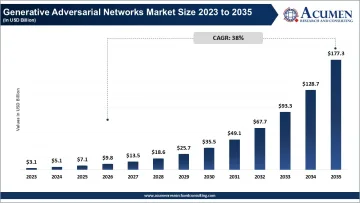
Generative Adversarial Networks (GANs) Market Highlights
- In 2025, North America remained the largest regional market, accounting for around 37% of global revenue in the generative adversarial networks market.
- The Asia Pacific region is expected to experience the fastest growth, registering a CAGR of approximately 39.6% from 2026 to 2035.
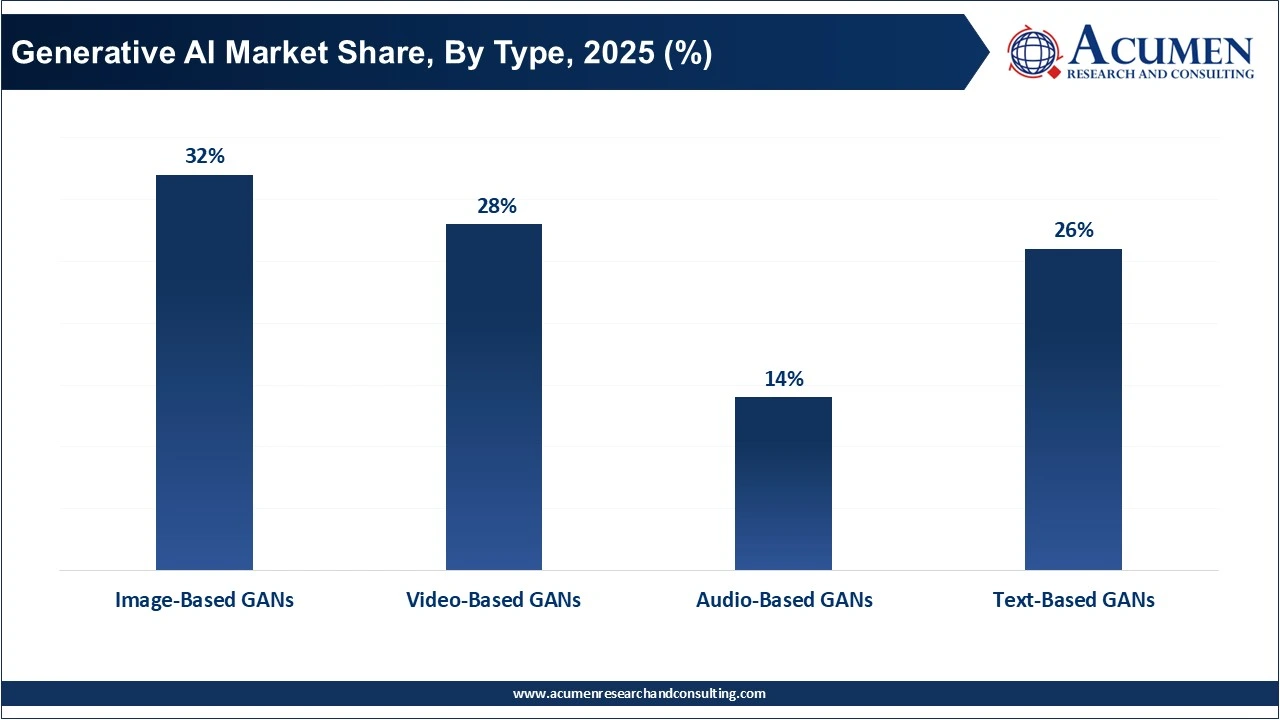
- By Type, the image-based GANs held the dominant market position, representing 32% of the total market share.
- By Deployment, the cloud segment led the market, with a revenue share of 63% in 2025.
- By Technology, the conditional GANs accounted for the largest portion of market adoption, holding around 45% of the total share, while traditional GANs segment is expected to be the fastest growing market segment.
Generative Adversarial Networks Market Overview
The rising demand for high-quality synthetic data and realistic digital content primarily drives the growth of generative adversarial networks market. Organizations across media and entertainment, gaming, advertising, and design increasingly rely on GANs to generate real-world images, videos, visual effects as well as significantly reducing production time and costs. At the same time, sectors such as healthcare, automotive, and finance are adopting GANs for data augmentation, simulation, and model training, especially in scenarios where real-world data is limited, expensive, or restricted due to privacy regulations. The ability of GANs to create accurate, privacy-preserving datasets has made them a critical model for advanced AI and machine learning applications.
Another important factor that increases growth of the market is the rapid development of AI infrastructure and deep learning technologies, supported by expanding cloud computing capabilities and high-performance GPUs. Additionally, the increasing integration of GAN with emerging technologies such as virtual reality (VR), augmented reality (AR), metaverse platforms, and autonomous systems is further strengthening the market growth.
Generative Adversarial Networks Market Dynamics
Market Drivers
Rising Demand for High-Quality Synthetic Data
- The generative adversarial networks (GANs) market is growing continuously because of increasing requirement for high-quality synthetic data to support advanced machine learning and AI model training. Many industries are facing issues about accessing the real-world data due to limited availability of human-generated data, strict privacy regulations, and rising data acquisition costs. Research suggests that high-quality language data may become increasingly constrained by 2030, making synthetic data essential for continued AI development. GANs help overcome this challenge by learning data distribution and generating statistically similar syntenic samples. This approach is especially valuable in sectors where real-world data is scarce, costly, or difficult to obtain safely.
Expansion of GANs in Digital Content Creation
- The media and entertainment industry serve as significant growth driver for the GAN market, as these models are reshaping digital content creation processes. GAN automates labor-intensive tasks such as image editing, texture creation, and video enhancements, while significantly reducing production time and costs. Industries like fashion and gaming are adopting GANs to design digital clothing, enable virtual try-on experiences, and develop immersive environments, which supports the rapid expansion of metaverse economy by enabling the creation of realistic characters, backgrounds, and animation.
Market Restraints
High Computational Cost and Technical Complexity
- A major restraint limiting the growth of generative adversarial networks market is its high computational cost and technical complexity involved in developing, training, and deploying GAN models. Training GANs requires powerful hardware, such as high-end GPUs and large-scale cloud infrastructure, which significantly increases operational expenses. In addition, GAN training is often unstable and requires advanced expertise to balance the generator and discriminator effectively. Many organizations, particularly small and mid-sized enterprises, face challenges due to shortage of skilled talent and limited financial resources to handle these complexities. This often slows widespread adoption, thus limiting the market penetration of GAN technologies.
Ethical Concerns, Data Misuse, and Regulatory Challenges
- The generative adversarial networks market is facing increasing concerns around ethical issues and potential misuse of GAN-generated content such as deepfakes, misinformation, and synthetic images and videos. This risk raises serious questions related to trust, data authenticity, and security. As a result, governments and regulatory authorities are introducing stricter AI governance and compliance requirements, which can delay implementation and increase risks for organizations. These ethical concerns and unclear regulatory frameworks are causing hesitation among enterprises, which in turn is limiting the overall growth of the GAN market.
Market Opportunities
Growing Adoption of Synthetic Data Across Regulated Industries
- A major opportunity of market for the generative adversarial networks lies in the expanding use of synthetic data in highly regulated industries such as healthcare, finance, and insurance. These sectors often face strict data privacy laws and limited access to real-world datasets, which restricts AI model development. GANs provide generating realistic synthetic data that preserves privacy while maintaining the statistical patterns of real information without exposing sensitive details. This capability allows organizations to accelerate AI innovation, improve model accuracy, and maintain compliance with regulations.
Rising Demand for Immersive Digital Experience and Metaverse
- The rapid growth of immersive digital platforms, including virtual reality (VR), augmented reality (AR), gaming, and metaverse environments, presents a significant opportunity for GAN market. GANs enable the creation of highly realistic virtual characters, environments, and assets at scale, reducing content development time and cost. Industries such as media, fashion, retail, and education are increasingly leveraging GANs to deliver personalized and interactive digital experiences.
Generative Adversarial Networks Market Report Scope
| Attribute | Details |
|---|---|
| Generative Adversarial Networks Market Size 2025 | USD 7.06 Billion |
| Generative Adversarial Networks Market Forecast 2035 | USD 177.31 Billion |
| Generative Adversarial Networks Market CAGR During 2026 - 2035 | 38% |
| Analysis Period | 2023 - 2035 |
| Base Year | 2025 |
| Forecast Data | 2026 - 2035 |
| Segments Covered | By Type, By Deployment, By Technology, By Application, By End User, and By Geography |
| Regional Scope | North America, Europe, Asia Pacific, Latin America, and Middle East & Africa |
| Key Companies Profiled | Google, Microsoft, Amazon Web Services (AWS), NVIDIA, IBM, Meta Platforms, OpenAI, Adobe, Intel, Stability AI, Synthesia, and Runway ML |
| Report Coverage | Market Trends, Drivers, Restraints, Competitive Analysis, Player Profiling, Regulation Analysis |
Generative Adversarial Networks Market Regional Analysis
The generative Adversarial Networks (GANs) market is dominated by North America with around 37% market share, supported by its strong artificial intelligence ecosystem, early adoption of deep learning technologies, and presence of leading technology companies and research institutions. The region benefits from heavy investments in AI research and development, widespread availability of high-performance computing infrastructure, and strong collaboration between academia and industry. Major sectors such as media and entertainment, healthcare, automotive, and defense actively deploy GANs for content creation, medical imaging, simulation, and AI model training. In addition, favorable funding environments, mature cloud infrastructure, and rapid commercialization of AI innovations have enabled North America to maintain its leading position in the global GAN market.
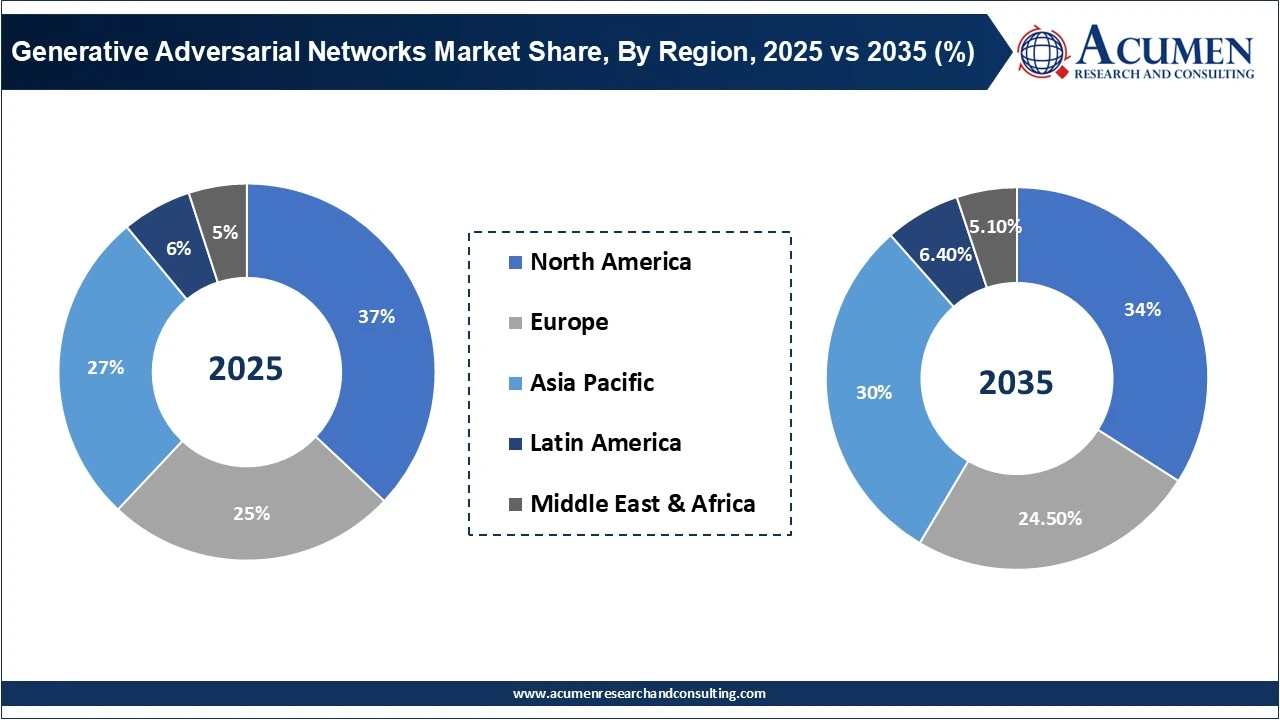
The Asia-Pacific region is the fastest-growing market for generative adversarial networks, driven by rapid digital transformation, expanding AI adoption, and strong government support for AI development. Countries such as China, Japan, South Korea, and India are investing heavily in AI research, smart manufacturing, autonomous systems, and digital media platforms. The regions with large populations and growing digital economies generate massive demand for AI-driven applications, particularly in entertainment, e-commerce, healthcare, and smart cities. Additionally, the increasing number of AI startups, improving cloud infrastructure, and rising demand for immersive technologies such as gaming and metaverse are accelerating GAN adoption, positioning Asia-Pacific as the fastest-expanding regional market.
Generative Adversarial Networks Market Segmentation Insights
The worldwide market for generative adversarial networks is split based on type, deployment, technology, application, end-user and geography.
Type Insights
Image-based GANs dominated the generative adversarial networks market, accounting for around 32% share in 2025, due to early adoption, advanced technology and widespread use across multiple industries. These models are extensively applied in image generation, medical imaging, facial recognition, and creative design, making them highly valuable for both commercial and research purposes. The strong demand from media and entertainment, healthcare diagnostics, retail visualization, and advertising has driven large-scale deployment of image-based GAN solutions. Additionally, the availability of well-established training datasets and proven performance in producing high-quality visual outputs increases the adoption of GANs technology.
| By Type | Market Share, 2025 (%) | Key Highlights |
|---|---|---|
| Image-Based GANs | 32% | Dominates due to strong demand for realistic images in media, advertising, healthcare, and retail. |
| Video-Based GANs | 28% | Growing adoption in video content, streaming, and entertainment for immersive visuals. |
| Audio-Based GANs | 14% | Used in music, speech generation, and audio enhancement applications. |
| Text-Based GANs | 26% | Supports NLP, text synthesis, and AI-driven content creation. |
Video-based GANs represent the fastest-growing segment as demand rises for realistic, dynamic, and immersive visual content. The adoption is being fueled by rapid growth in video streaming platforms, gaming, virtual production, and metaverse applications. Industries are increasingly using video-based GANs for video enhancement, animation, digital human creation, and synthetic video generation, which significantly reduces production time and cost. Advances in computing power and deep learning architectures have significantly improved video generation quality, enabling more realistic outputs and making these solutions more accessible for user and industries.
Deployment Insights
Cloud based deployment segment dominated the generative adversarial networks market, representing 63% market share in 2025, due to its scalability, cost-efficiency, and accessibility to high-performance computing resources. Training GAN models require significant processing power, which cloud platforms provide through on-demand GPUs and AI-optimized infrastructure. Cloud-based solutions also enable faster experimentation, seamless collaboration, and easier integration with existing AI workflows. Enterprises prefer cloud deployment as it reduces upfront hardware investment and supports rapid model development and deployment, further making it the most practical and widely adopted option across industries.
| Deployment | Market Share, 2025 (%) | Key Highlights |
|---|---|---|
| Cloud | 63% | Preferred for scalability, cost efficiency, and high-performance computing access. |
| On-Premises | 37% | Adopted for data privacy, security, and regulatory compliance. |
On-premises deployment is the fastest-growing segment, driven by increasing concerns around data privacy, security, and regulatory compliance. Regulatory sectors such as healthcare, finance, and government prefer on-premise GAN solutions to maintain full control over sensitive data and critical AI workloads. Additionally, organizations with advanced IT infrastructure are investing in in-house AI capabilities to ensure lower latency, customized performance, and long-term cost optimization.
Technology Insights
Conditional GANs segment dominated the generative adversarial networks market, with a revenue share of 45% in 2025, because of the ability to generate controlled and highly targeted outputs based on specific industries such as healthcare for medical image reconstruction, disease diagnosis, and anomaly detection. In media and advertising, they enable personalized content creation, improving audience engagement. The fashion and retail sectors use GANs for virtual design and product visualization, while autonomous vehicle developers apply them to generate realistic driving scenarios for AI training. Strong demand for AI-driven personalization and accuracy continues to support the dominance of this segment.
| Technology | Market Share, 2025 (%) | Key Highlights |
|---|---|---|
| Conditional GANs | 45% | Enables targeted outputs; widely used in healthcare, media, and personalization. |
| Traditional GANs | 30% | Foundational model for R&D, data augmentation, and creative applications. |
| Cycle GANs | 25% | Specialized for style transfer, domain adaptation, and cross-domain applications. |
The traditional GANs segment is expected to grow at the fastest rate during the forecast period, driven by its foundational role in generative AI research and development. Traditional GANs are widely used for data augmentation, allowing organizations to create synthetic datasets where real data is limited or sensitive. As organizations expand their investment in core AI research and experimentation, traditional GANs serve as an accessible entry point before transitioning to more advanced architectures. Continued improvements in training techniques, along with widespread availibility of open-source frameworks are further accelerating their adoption and contributing to rapid growth.
Application Insights
Image generation segment accounted for around 28% market share in 2025 and remained the dominant segment in the GAN market as visual data plays a critical role in decision-making, communication, and user engagement across industries. Industries such as media and advertising, healthcare, retail, and gaming increasingly rely on image-based GANS. For instance, media and advertising companies use image-based GANs to quicky produced high-quality visuals, advertisements, and branded content while reducing production time and costs. In healthcare, GANs are used to generate synthetic medical images such as X-rays, MRIs, and CT scans, helping improve diagnostic model accuracy without compromising patient privacy. The maturity of image datasets, availability of proven GAN architectures, and immediate commercial value have firmly established image generation as the leading application segment.
| Application | Market Share, 2025 (%) | Key Highlights |
|---|---|---|
| Image Generation | 28% | Core use in media, advertising, e-commerce, and medical imaging. |
| Video Generation | 22% | Supports video creation, animation, and immersive experiences. |
| Text Generation | 18% | Powers AI-generated content, summaries, and chatbots. |
| 3D Object Generation | 17% | Growing in gaming, metaverse, virtual prototyping, and simulations. |
| Audio & Speech Generation | 15% | Used in speech synthesis, music, voice assistants, and audio enhancement. |
3D object generation represents the fastest-growing segment of the GAN market, driven by rapid shift towards immersive, interactive, and simulation-driven digital environments across multiple industries. Gaming and metaverse platforms depend on GAN-generated 3D modeling for building realistic virtual worlds, characters models, and environments assests. In automotive and manufacturing, GAN-based 3D modeling supports product prototyping, digital twins, and design simulation, significantly reducing development time and cost. As digital environments become more interactive and complex, demand for GAN-driven 3D content continues to accelerate.
End User Insights
Media and entertainment dominated the GAN market due to their dependence on digital content generation and visual innovation. GANs are widely used to generate realistic image and video synthesis, enhance animation and visual effects, create digital characters, and streamline post-production. The constant demand for fresh, engaging content and rapid expansion of digital media platforms have positioned this industry as the leading adopter of GAN technologies.
| End User | Market Share, 2025 (%) | Key Highlights |
|---|---|---|
| Media & Entertainment | 26% | Leverages GANs for content creation, VFX, and animation pipelines. |
| Healthcare | 18% | Fastest-growing segment used for synthetic medical data, diagnostics, and imaging. |
| Retail & E-commerce | 22% | Enables virtual try-ons, product visualization, and personalized experiences. |
| Automotive | 14% | Supports simulation, autonomous vehicle training, and digital prototyping. |
| Finance & Banking | 11% | Fraud detection, synthetic data for risk modeling, and AI research. |
| Others | 9% | Includes government, education, and industrial applications leveraging GANs. |
Healthcare segment is expected to report the fastest growth over the forecast period, because of the need for data augmentation, diagnostic accuracy, and privacy-preserving AI solutions. GANs are increasingly used to generate synthetic medical images, improve disease detection models, and support clinical research without compromising patient confidentiality. The growing adoption of AI in diagnostics, coupled with strict data privacy regulations, makes GANs an ideal solution for healthcare innovation.
Generative Adversarial Networks Market Players
- Microsoft
- Amazon Web Services (AWS)
- NVIDIA
- IBM
- Meta Platforms
- OpenAI
- Adobe
- Intel
- Stability AI
- Synthesia
- Runway ML
Market Recent Developments
- In January 2026, Adobe launched Firefly Foundry, a platform that enables Hollywood Studios, talent agencies, and production companies to build custom, IP-safe generative AI models, supporting secure and professional-grade content creation.
- In April 2025, Amazon Web Services (AWS) released Amazon Nova Reel 1.1 via Amazon Bedrock, significantly enhancing its generative video capabilities by enabling the creation of multi-shot videos of up to two minutes, a major improvement over the earlier short, single-shot format.
Generative Adversarial Networks Market Segmentation
By Type
- Image-Based GANs
- Video-Based GANs
- Audio-Based GANs
- Text-Based GANs
By Deployment
- Cloud
- On-Premises
By Technology
- Conditional GANs
- Traditional GANs
- Cycle GANs
By Application
- Image Generation
- Video Generation
- Text Generation
- 3D Object Generation
- Audio and Speech Generation
By End User
- Media & Entertainment
- Healthcare
- Retail & E-commerce
- Automotive
- Finance & Banking
- Others (Education, AR/VR, Research, Advertising, Industrial AI)
By Region
- North America
- U.S.
- Canada
- Europe
- U.K.
- Germany
- France
- Spain
- Rest of Europe
- Asia-Pacific
- India
- Japan
- China
- Australia
- South Korea
- Rest of Asia-Pacific
- Latin America
- Brazil
- Mexico
- Rest of LATAM
- Middle East & Africa
- South Africa
- GCC Countries
- Rest of the Middle East & Africa (MEA)
Looking for discounts, bulk pricing, or custom solutions? Contact us today at sales@acumenresearchandconsulting.com
Frequently Asked Questions

Other ICT Reports
April 2025
August 2021
July 2023
September 2026