
On-Grid Battery Energy Storage Systems Market Size, Share, Report 2026 To 2035
On-Grid Battery Energy Storage Systems Market (By Meter Position / Deployment: Front-of-the-Meter (FTM), Behind-the-Meter (BTM); By End User: Utility & Grid-scale Developers, Commercial & Industrial, Residential, Others; By Battery Technology: Lithium Iron Phosphate (LFP), Nickel Manganese Cobalt (NMC), Other Lithium-ion, Flow Batteries, Lead-acid, Sodium-based, Others; By Energy Capacity: <10 MWh, 10–<100 MWh, 100–<500 MWh, 500–<1,000 MWh, ≥1,000 MWh; By Grid Connection Level: Transmission-connected, Sub-transmission-connected, Distribution-connected, Low-voltage / Customer-connected) - Global Industry Analysis, Size, Share, Growth, Regional Analysis, Trends and Forecast 2026 - 2035
- Last Updated: 08 Sep 2026
- Report Code: ARC3976
- Category: ICT
On-Grid Battery Energy Storage Systems Market Size, Forecast Report 2026 To 2035
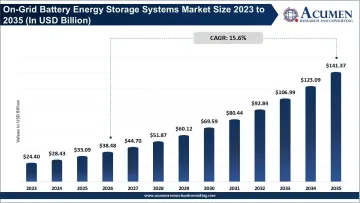
The global on-grid energy storage systems market size was valued at USD 33.09 billion in 2025 and is projected to reach at USD 141.37 billion by 2035, while showing a notable expansion at CAGR of 15.6% during the forecast period of 2026-2035. The increasing penetration of renewable energy, rising electricity demand, grid congestion, and the need for reliable flexibility are accelerating the adoption of on-grid battery energy systems across modern power networks.
Report Highlights
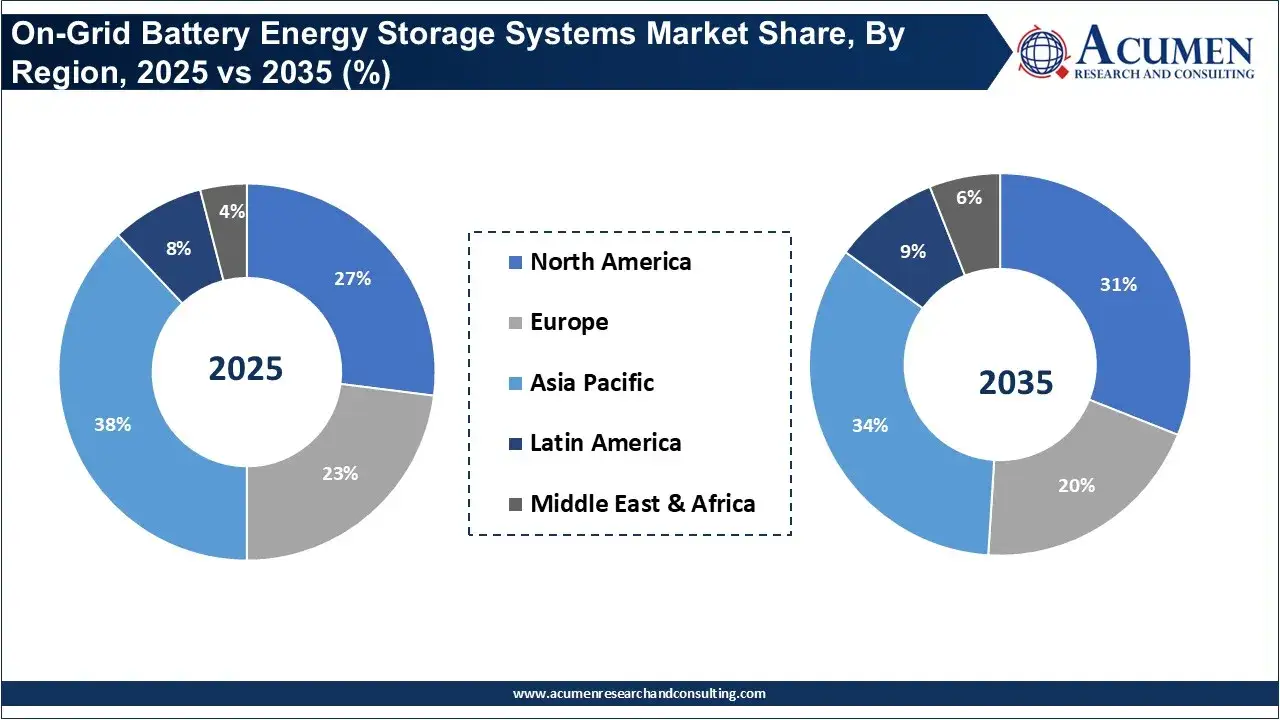
- By region, Asia-Pacific dominated the market with a 38.0% share in 2025, equivalent to approximately $12.57 billion, supported by rising electricity demand, renewable-energy deployment, and investment in grid infrastructure.
- By region, North America held the second-largest share at 27.0% in 2025, valued at approximately $8.93 billion, and is projected to become the largest regional market by 2035 with a 31.0% share.
- By region, Middle East & Africa represents the fastest-growing opportunity, with a projected 20.9% CAGR and market value expected to increase from approximately $1.54 billion in 2026 to $8.48 billion by 2035.
- By meter position/deployment, front-of-the-meter (FTM) systems dominated the market with an 80.0% share in 2025, supported by the increasing deployment of large-scale grid storage systems connected to wider electricity networks.
- By meter position/deployment, behind-the-meter (BTM) systems held the second-largest share at 20.0% in 2025, primarily serving commercial, industrial, and residential customers through peak shaving, demand-charge management, backup power, and self-consumption optimization.
- By end user, utility and grid-scale developers dominated the market with a 68.0% share in 2025, with their share projected to increase to 72.0% by 2035 as large-scale batteries become increasingly integrated into grid infrastructure.
- By end user, commercial and industrial users held the second-largest share at 24.0% in 2025, supported by demand for electricity-cost reduction, peak shaving, and improved operational power reliability.
- By battery technology, lithium iron phosphate (LFP) dominated with a 62.0% share in 2025, driven by its safety, thermal stability, long cycle life, reliability, and cost advantages for stationary storage applications.
- By battery technology, flow batteries held the second-largest share at 14.0% in 2025, supported by their suitability for long-duration storage and applications requiring several hours of renewable-energy shifting.
- By energy capacity, 100–500 MWh systems dominated with a 38.0% share in 2025, reflecting the increasing commercialization of large-scale utility storage projects supporting renewable integration and grid services.
- By energy capacity, 10–<100 MWh systems held the second-largest share at 25.0% in 2025, supported by their applications in distribution-level reinforcement, renewable integration, local peak management, community storage, and smaller utility projects.
- By grid connection level, transmission-connected systems dominated with a 42.0% share in 2025, driven by the expansion of large BESS projects for grid balancing, renewable integration, capacity support, congestion management, and large-scale energy shifting.
- By grid connection level, distribution-connected systems held the second-largest share at 28.0% in 2025, supported by growing requirements for peak-load management, voltage control, renewable integration, and local congestion management.
Why Are On-Grid Battery Energy Storage Systems Becoming Critical to Modern Power Grids?
On-grid battery energy systems on large power grids are playing an increasingly important role as batteries’ ability to rapidly and flexible balance energy and frequency. The deployment of larger wind and solar generation capacity require batteries for managing intermittency, such as storage generation surplus from high output of generation when it’s needed at times of grid overload and declining output of generation, etc.
Grid-scale energy storage can also used for peak demand management, frequency regulation, voltage stability and managing congestion and the integration of renewable resources and maintaining grid stability in the power grid infrastructure.
On-Grid Battery Storage Economics: Statistics, Adoption & Distribution
- The average global battery costs decreased 8% in 2025, whereas LFP batteries costs dropped in excess of 15%. As a consequence LFP battery costs were above 40% cheaper than NMC battery cells/packs.
- More than 90% of the battery energy storage systems deployed globally in 2025 were built using LFP batteries.
- New battery storage capacity added in 2025 totalled 108GW globally, an expansion of over 40% compared to 2024 and the first year that more than 100GW was added.
- In 2025 utility scale BESS had a dominating presence accounting for 87GW or nearly 87% of the global new battery storage additions.
- Cumulative installed battery storage capacity in China reached nearly 136GW by end of 2025; driven by policy support and rapid growth in renewables deployment coupled with rapid buildout of a leading indigenous battery manufacturing industry.
- India’s battery energy storage system (BESS) procurement grew in 2025 by way of a total of 10.4GW of standalone BESS capacity awarded during the year, 57% of which was based on a 2-hour; 2-cycle design.
- According to a Ministry of Power announcement, discovered costs in competitive bidding for BESS systems operated at two cycles per day reached roughly 2.1/kWh in 2025 without the use of viability gap funding, down sharply from roughly 10.18/kWh in 2022-23.
Market Dynamics
Driver
Renewable Energy Expansion Accelerates Demand for Grid Flexibility
The quickly developing universe of environmentally friendly power creation prompts a developing need of adaptable network assets to coordinate variable force supply and request. Decreased costs of the battery, rising proportions of natural energy and need to control summit heap is bringing about utilities and clients establishing network battery storage systems available.
- Global battery capacity addition will come to 108 GW in 2025, 40% more from the earlier year, including close to 87GW for large scale plant, shows an increasing trend in grid storage in the network as a measure for flexibility.
Restraint
High Capital Costs and Grid-Connection Delays Limit Project Deployment
A lack of access to multiple revenue streams to ensure robust economics for battery storage investment and high upfront capital investment needs have so far hampered the pace of battery storage deployment in certain markets, along with permitting and grid-connection delays.
- According to the IEA, even with a significant fall in battery prices, many large-scale battery storage projects are tied up in grid-connection and permitting issues that put them on hold for several years.
Opportunity
Behind-the-Meter Storage Creates New Distributed Grid-Flexibility Revenues
Growing deployment of customer-connected batteries, virtual power plants, and aggregated distributed energy resources present a massive opportunity for on-grid battery energy storage systems market. Behind-the-meter installations are rapidly gaining traction particularly across high retail electricity prices markets that have favorable regulatory environments supporting the use of batteries for demand response, energy arbitrage and grid services.
- In Australia, behind-the-meter battery capacity was around 3.4 GW in 2025 (versus 0.2 GW in 2024), while the US had nearly 3 GW of behind-the-meter capacity installations.
What Role Will Customer-Connected Storage Play in Future Grid Management? Read Our Analyst’s Opinion
According to our industry experts at Acumen Research & Consulting, customer-connected storage is well positioned to transform from a back-up power asset into a monetizable grid flexibility tool as utilities begin to aggregate distributed batteries at scale using demand-response and virtual power-plant (VPP) platforms.
This trend is already observable statistically; the U.S. added almost 3 GW of behind-the-meter battery installations in 2025, while overall behind-the-meter battery installation continues to climb with rising electricity demand and renewable power penetration.
- For instance, U.S. added 19 GW of battery capacity as of 2025, just under 3 GW of which was via behind-the-meter installations. Indian electricity consumers were already demanding storage in 2025 for backup purposes. India battery energy storage capacity to 236.22GWh in 2031-32 from 34.72 GWh in 2026-27 to meet soaring power demand and meet electricity goal to integrate renewable power.
On-Grid Battery Energy Storage Systems Market Regional Insights
Asia-Pacific On-Grid Battery Energy Systems Market Outlook
Asia-Pacific held largest regional market share in the on-grid battery energy systems market in 2025, estimated at 38%, corresponding to nearly $12.57 billion based on market value estimations of other components. The leadership within the region can be ascribed to factors of growing electricity demand, widespread implementation of renewable energy, and investments in grid infrastructure upgrades and maintenance, in addition to its ability to handle the volatile electricity generated by solar and wind farms.
Moreover, multiple nations within this region are investing in on-grid battery storage systems as renewable energy and system assets that are needed to address and shift the renewable electricity generation to peak hour demand, regulate energy frequency, and ease the strain on existing electricity network infrastructure. Asia-Pacific is expected to lead market growth owing to massive deployment of renewable energy across important power regions as well as the significant boost in solar energy utilization in regions, especially during the day time hours, which results in greater supply than demand and followed by growing demand for power during evening hours.
North America On-Grid Battery Energy Systems Market Analysis
North America represented the second-largest regional market in 2025 with a 27.0% share, corresponding to approximately $ 8.93 billion. The region is positioned to become the largest regional market by 2035, with its share increasing to 31.0% and market value reaching approximately $ 43.83 billion.
The regional expansion is being supported by the increasing penetration of renewable generation, electricity-demand growth, grid congestion, aging power infrastructure, and the growing requirement for flexible capacity. Battery systems are increasingly being deployed to perform multiple grid services simultaneously, including energy arbitrage, frequency regulation, capacity support, renewable-energy shifting, and transmission congestion management.
The evolution of the electricity mix is particularly important. As solar and wind capacity increases, the difference between electricity generation and demand becomes more pronounced at different times of the day. Battery systems provide grid operators with a dispatchable flexibility resource that can respond considerably faster than many conventional generation assets.
How Are Government Policies Accelerating Grid-Scale Battery Storage?
| Country | Government Policy / Investment Support | Government Investment / Statistical Data |
|---|---|---|
| United States | Federal incentives, state-level storage programs, utility procurement mandates and grid-market reforms are supporting large-scale BESS deployment. | $3.5 billion allocated under the U.S. Bipartisan Infrastructure Law for grid resilience and reliability programs; federal clean-energy incentives also support standalone energy storage. |
| China | National energy-storage targets, renewable-storage integration policies and provincial deployment programs are accelerating grid-scale storage. | 66 GW / 189 GWh of new-type energy storage was added in 2025, taking cumulative capacity to 145 GW by year-end. |
| India | The government is promoting BESS through viability-gap funding, procurement guidelines, transmission incentives and the National Energy Storage Framework. | Government estimates indicate 41.65 GW of BESS will be required by 2029–30; BESS requirements are projected to reach 47.24 GW / 236 GWh by 2031–32. |
| United Kingdom | The Clean Power 2030 strategy, Clean Flexibility Roadmap and LDES Cap and Floor mechanism are creating long-term investment visibility for storage. | Ofgem's 2026 minded-to decision supports 7.6 GW / 137 GWh of long-duration storage across 16 projects. |
| Australia | Federal and state programs support utility batteries, community batteries and renewable-energy integration through electricity-market reforms and targeted funding. | 95% of battery capacity added after 2024 in Australia's National Electricity Market is designed for 2+ hours of storage duration. |
| Italy | The MACSE mechanism provides a market-based framework for procuring storage capacity needed to integrate renewable generation. | Italy's first MACSE auction contracted 10 GWh of utility-scale BESS for delivery in 2028, with a national target of 50 GWh by 2030. |
Middle East & Africa On-Grid Battery Energy Storage Systems Market Future Outlook
Middle East & Africa is estimated to rise from 4.0% in 2025, 6.0% of global market in 2035, what is significantly most important is the regions’ CAGR during the same timeframe which is 20.9%, increasing market value from around $1.54 billion in 2026, to $8.48 billion in 2035.
The major drivers for the rapid growth can be linked with rapidly growing renewable energy market, electricity access demand, weak grid performance and the strategy for diversified electricity generation portfolio, to replace current dependence of the fossils fuels.
High availability of sun in numerous Middle Eastern and African market means that it's easy to take benefits in the power generation by utilizing renewable, however high solar penetration also required the storage technology which can deliver power generated during day time into the time where it's being used by increasing load, i.e. In the evening.
On-Grid Battery Energy Storage Systems Market Segmentation Insights
Meter Position / Deployment Insights
Front-of-the-meter (FTM) systems dominated the market in 2025 with an 80.0% share, compared with 20.0% for behind-the-meter systems. The FTM segment generated approximately $26.47 billion in 2025 and is projected to reach approximately $117.34 billion by 2035, expanding at a 16.0% CAGR from 2026 to 2035. The leading position held by FTM systems primarily linked to large sized grids storage system which is often situated with existing large scale generation plant or within the grid structure which allows services delivery across wide network rather than that by behind the meter(BTM) system.
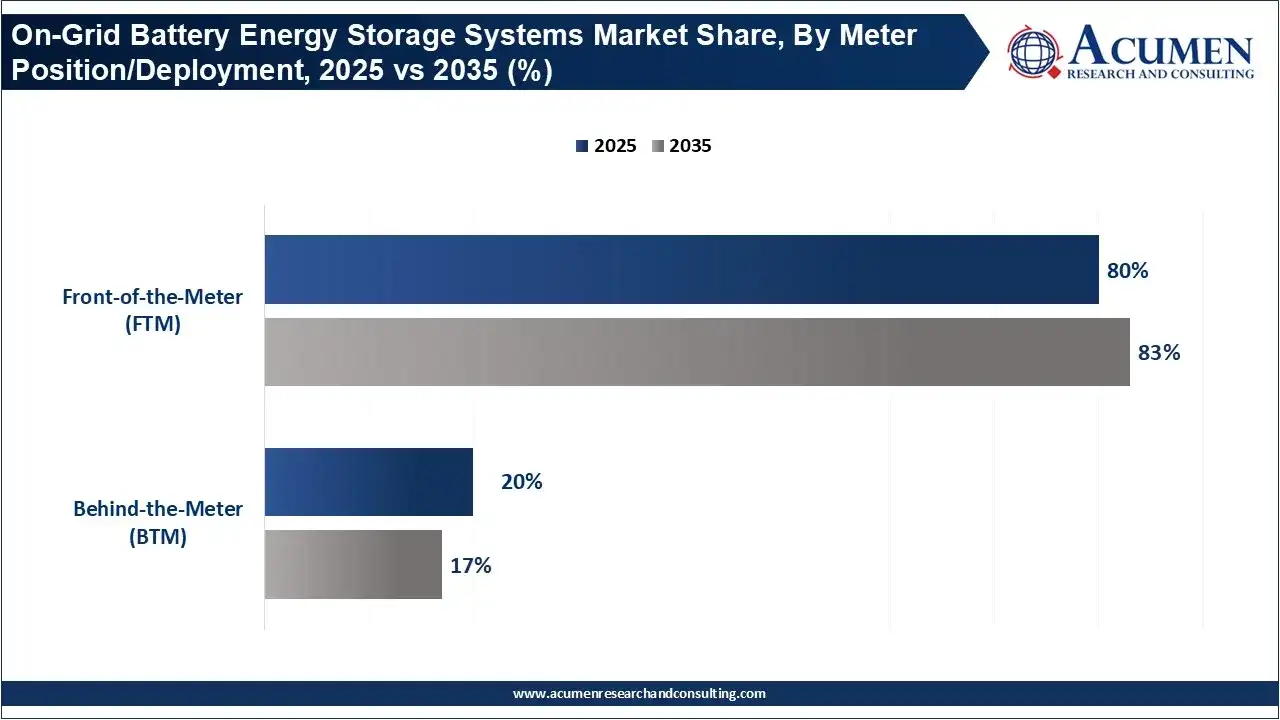
Behind-the-meter systems represented 20.0% of the market in 2025 and are expected to account for 17.0% by 2035. Despite the declining percentage share, the segment is still expected to expand in absolute terms, reaching approximately $24.03 billion by 2035 from approximately $ 7.70 billion in 2026. BTM systems are primarily associated with commercial and industrial facilities and residential electricity consumers. Their applications include demand-charge management, peak shaving, backup power, self-consumption optimization, and reducing exposure to variable electricity prices.
End User Insights
The dominant end-user segment in 2025 was utility and grid-scale developers. These occupied 68.0% of the market and their market share is expected to gain momentum further, standing at 72.0% for the year 2035 at a volume of approx. $101.79 billion with a 16.3% CAGR during the 2026-2035 forecast period. This position of leading end-users is largely attributed to their increased interest towards FTM deployment of batteries. Grid owners, transmission and distribution companies, IPPs and storage developers operating on-grid view batteries as integral, critical grid infrastructure now.
Large scale batteries also owe their position to increased project sizes. As capacity of individual BESS systems increases, utilities and grid-scale segment developers occupy a higher chunk of the overall installed BESS capacity as well as project market value. Hence, the expected growth of the utility and grid-scale segment from 68.0% to 72.0% by 2035 follows the larger centralisation of storage in high capacity systems.
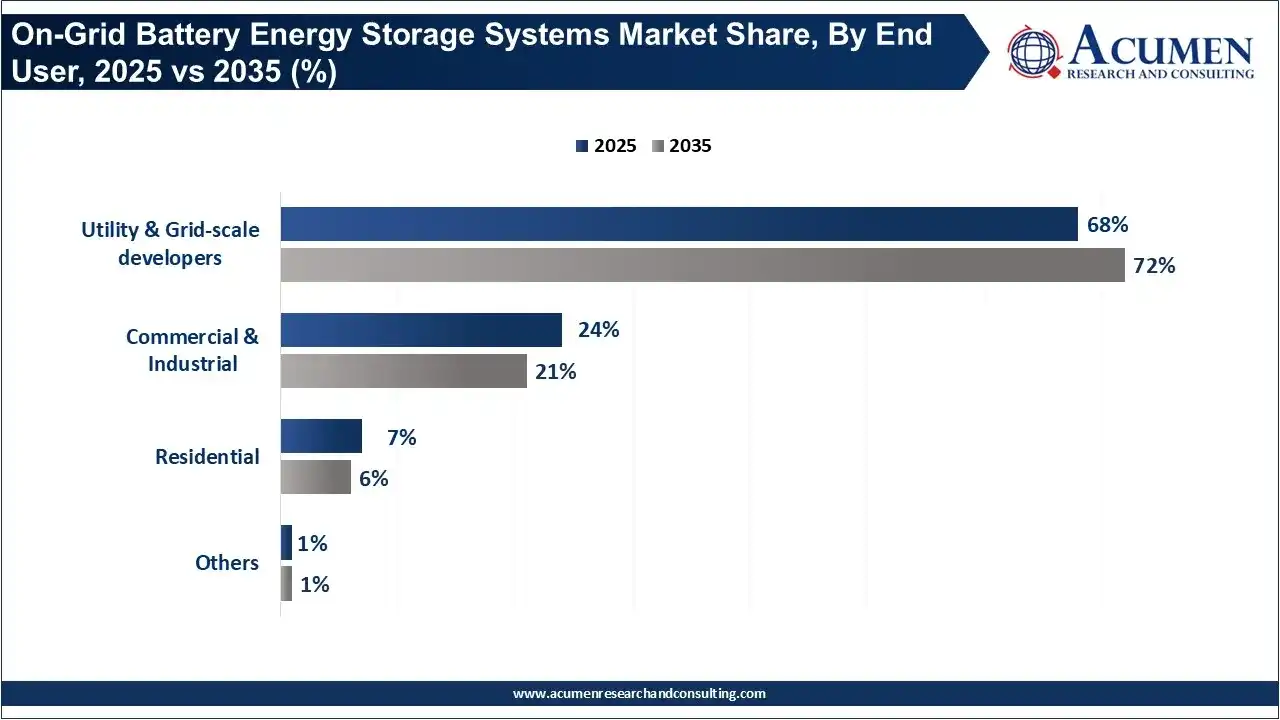
The commercial and industrial segment held the second-largest end-user share at 24.0% in 2025, equating to approximately $9.24 billion on a 2026 market value basis. The segment is anticipated to achieve approximately $29.69 billion by 2035, although with a slightly moderated market share in comparison to previous segment at 21.0%. commercial and industrial loads utilize the on-grid BESS systems to mainly reduce their electricity costs, followed by ensuring power reliability for their operations. Various such loads, including manufacturing industries, warehouses, office buildings, retail facilities, logistics centers, business dependent on significant use of computations, data-intensive fields, etc. can utilize stored energy to peak-shave their energy consumption.
Battery Technology Insights
Lithium Iron Phosphate (LFP) dominated the on-grid battery energy systems market in 2025 with a 62.0% share, making it the clear technology leader. LFP's dominance reflects the particular requirements of stationary energy storage. Unlike many mobile applications, stationary systems are less constrained by volumetric energy density.
Consequently, characteristics such as safety, cycle life, thermal stability, operating reliability, and cost per stored kilowatt-hour become especially important. LFP chemistry has benefited from declining battery costs and increasing manufacturing scale. Its comparatively strong thermal stability and long cycle life make it well suited to grid applications where batteries may undergo frequent charging and discharging over extended operating periods.
On-Grid BESS Market Share, By Battery Technology, 2025 (%)
| Battery Technology | Revenue Share, 2025 (%) |
|---|---|
| Lithium Iron Phosphate (LFP) | 62% |
| Nickel Manganese Cobalt (NMC) | 7% |
| Other lithium-ion | 2% |
| Flow batteries | 14% |
| Lead-acid | 8% |
| Sodium-based | 5% |
| Others | 1% |
In 2025 flow batteries accounted for the second largest market share category of batteries; at 14.0%. Flow batteries can be useful where grids move to significant amounts of non-dispatchable renewable generation due to this ability to store power at a duration suitable for handling several hours of renewable generation deficit to electricity demand.
The value proposition of flow batteries can be particularly well suited for long-duration energy storage applications where deep cycling is often an issue. Its architecture physically disconnects the energy storage medium from the power conversion parts of a system enabling system designers to extend energy storage duration by expanding the reservoir of electrolyte.
Energy Capacity Insights
The 100–500 MWH category was the largest size segment of the market in 2025 with over 38% of the market, showing that hints towards on grid storage projects moving beyond smaller demos/localized storage into truly commercial scale utility projects.
In this energy capacity size range systems can serve a number of grid applications, as they are of suitable scale for many renewable plus storage projects and grid support type applications. These can be developed adjacent to wind and solar assets, at grid node locations or as freestanding storage resources.
On-Grid BESS Market Share, By Energy Capacity, 2025 (%)
| Energy Capacity | Revenue Share, 2025 (%) |
|---|---|
| <10 MWh | 12% |
| 10–<100 MWh | 25% |
| 100–<500 MWh | 38% |
| 500–<1,000 MWh | 17% |
| ≥1,000 MWh | 8% |
The 10–<100 MWh category was the second-largest energy-capacity segment in 2025, accounting for 25.0% of the market. These systems occupy an important middle ground between smaller distributed storage projects and large utility-scale installations. They can serve distribution-level grid reinforcement, renewable integration, local peak management, community energy storage, and smaller utility projects.
Distribution networks are becoming increasingly important as rooftop solar, distributed generation, EV charging, and electrification increase localized electricity demand. Storage in the 10–100 MWh range can help address local network constraints without requiring the deployment of a massive transmission-level installation.
Grid Connection Level Insights
Transmission-connected systems represented the largest grid connection category in 2025 with a 42.0% share. The reasons for transmission-connected systems becoming so dominant are connected to the growth in large BESS projects linked to high-voltage transmission networks.
These projects are mostly becoming attached to standalone grid-scale batteries, renewable-plus-storage projects, capacity and resource adequacy projects, grid balancing, congestion management and large-scale energy shifting.
BESS projects getting larger and more substantial is fueling the increase in transmission level connections, as increasingly such large facilities from hundreds of Megawatt-hours upwards benefit from high-voltage network connections instead of potentially small distribution-support plants.
On-Grid BESS Market Share, By Grid Connection Level, 2025 (%)
| Grid Connection Level | Revenue Share, 2025 (%) |
|---|---|
| Transmission-connected | 42% |
| Sub-transmission-connected | 13% |
| Distribution-connected | 28% |
| Low-voltage / customer-connected | 17% |
Distribution-connected systems represented the second-largest grid connection category with a 28.0% share in 2025. These generally operate on a medium voltage distribution level and offer support to the local grid for peak-load and power management, voltage control, renewable Energy integration, local congestion management, community-energy storage etc.
As electricity grids decentralize distribution connected systems are key to support many of these. From roof-top solar, distributed generations, EV charging infrastructure to heat pumps and electrified commercial and industrial buildings the additional demand to the local grid at specific times can create peaks which will no longer be efficiently handled with traditional infrastructure.
Top Companies, Investors and Leaders
- Sungrow
- Tesla
- CATL
- BYD
- Fluence
- Envision
- Trina Storage
- LG Energy Solution
- Wärtsilä
- Huawei Digital Power
- Samsung SDI
- EVE Energy
- Hithium
- Canadian Solar
On-Grid Battery Energy Storage Systems Value Chain
| Value Chain Stage | Key Highlight | Major Participants / Examples |
|---|---|---|
| Raw Materials & Critical Minerals | Lithium, iron, phosphate, nickel, manganese, graphite and other material extraction and processing | Major Participants / Examples |
| Battery Materials & Components | Cathode, anode, electrolyte, separator and current-collector productionCathode, anode, electrolyte, separator and current-collector production | Battery-material manufacturers |
| Battery Cell Manufacturing | Cell chemistry development, electrode production, cell assembly and testing | CATL, BYD, EVE Energy, LG Energy Solution, Samsung SDI, Hithium |
| Battery Cell Manufacturing | Dispatch optimization, charge/discharge scheduling, energy arbitrage and market participation | CATL, BYD, EVE Energy, LG Energy Solution, Samsung SDI, Hithium |
| BESS System Integration | Dispatch optimization, charge/discharge scheduling, energy arbitrage and market participation | Tesla, Sungrow, Fluence, BYD, CATL, Trina Storage |
| Energy Market Participation | Energy arbitrage, capacity services, ancillary services and grid balancing | Utilities, merchant storage operators, aggregators |
| Repowering & Recycling | Battery replacement, second-life applications, material recovery and recycling | Battery recyclers, OEMs and specialized service providers |
Recent Product Launch, M&A and Investment Activities
- In September 2026, Vertiv announced an agreement to acquire Utility Innovation Group for approximately $1.45 billion in cash, with an additional $1.15 billion tied to performance targets. The transaction expands Vertiv's grid-connected and onsite power capabilities, including microgrid controls and power architecture, strengthening its position in infrastructure supporting data centers, distributed generation and energy storage.
- In August 2026, SK On signed an agreement to supply U.S.-based NeoVolta Power with 9 GWh of LFP battery cells between 2027 and 2032 for energy-storage systems. The cells will be produced at SK On's Georgia facility, highlighting the growing shift of major battery manufacturers toward stationary energy storage as EV demand conditions change.
Segments Covered
By Meter Position / Deployment
- Front-of-the-Meter (FTM)
- Behind-the-Meter (BTM)
By End User
- Utility & Grid-scale Developers
- Commercial & Industrial
- Residential
- Others
By Battery Technology
- Lithium Iron Phosphate (LFP)
- Nickel Manganese Cobalt (NMC)
- Other Lithium-ion
- Flow Batteries
- Lead-acid
- Sodium-based
- Others
By Energy Capacity
- <10 MWh
- 10–<100 MWh
- 100–<500 MWh
- 500–<1,000 MWh
- ≥1,000 MWh
By Grid Connection Level
- Transmission-connected
- Sub-transmission-connected
- Distribution-connected
- Low-voltage / Customer-connected
By Region
- North America
- Europe
- Asia-Pacific
- Latin America
- Middle East & Africa
Looking for discounts, bulk pricing, or custom solutions? Contact us today at sales@acumenresearchandconsulting.com
Frequently Asked Questions

Other ICT Reports
March 2023
April 2025
April 2025
January 2025